Art & Development, Research, Travelogue

notes from the southland

la_traffic

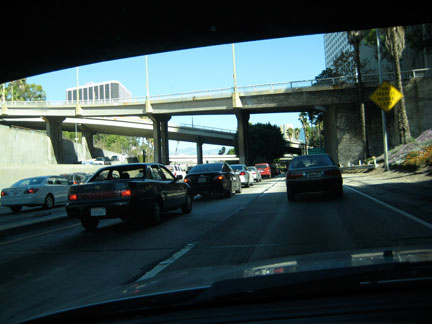
LA. Traffic.

Just got back from Los Angeles, where I de-installed my work at Tarryn Teresa Gallery. A few notes from my mental scrapbook:

mailinvoice

Packing up mailinvoicegetcarsmogged, 2006, plastic and ink on paper, 48 x 66 x 12 inches

Packing tools? I’ll never doubt you again, needle-nose pliers and extension cords! I should expect map pin heads to come clean off by now. I should know better than to rely on the palm sander’s cord. Thankfully, I erred on the side of caution, and it paid off.

NPR and classic rock. Apparently there’s no public radio along the I-5 in Fresno and Merced Counties, or they’re all run by evangelicals. Sans audio books, my substitute of choice was a Bakersfield-based classic rock station. If you could forgive the gratuitous misogyny, you’d discover a playlist spanning Zep, GNR, Def Leppard, Van Halen, Metallica, and Journey. Those bands once inspired repulsion in me, but I think we can all agree now that hair bands made some pretty great pop music. Last week, I heard Thin Lizzy’s “The Boys Are Back in Town” on an early morning grocery run, and it instilled a good mood that lasted hours. So I’m reclaiming this music from the heshers/burnouts/metalheads/bullies who gave it a bad name in high school, and you’re welcome to join me. For those about to rock…

Charles Burchfield, Glory of Spring, 1950, Watercolor on paper. Collection Parrish Art Museum, Southampton, New York. Gift of Mr. and Mrs. Alfred Corning Clark, 1959.6.6. Photo by Gary Mamay. Image source: Hammer Museum


Charles Burchfield at the Hammer Museum. I couldn’t see what Robert Gober, the contemporary hyper-realist sculptor, would see in a mid-century painter of landscapes. The Hammer exhibition, however, is fantastic. It makes clear that Burchfield was vastly under-recognized and portentious. His interest in abstraction, background in Asian-influenced Art Nouveau wallpaper design, experience with social realist pictorialism, and probable mental illness (see Dave Harvey’s great write-up in the LA Weekly) led to an innovative body of paintings that manages to embody countless references (to traditional Chinese scroll painting, Japanese woodcuts, OCD doodling, Cubism, and modern-day fantasy art) while forging a distinct visual language — psychedelic, immersive. I also admire his sheer conviction — after a successful stint as a Regionalist painter, Burchfield wrote in his journal,

“It seems to me, more than ever, imperative that I somehow get these fantasies into finished concrete form even tho there is not sale for them. How we will live, I do not know.”

Burchfield’s final paintings are really tremendous pictures. Some of them are breathtaking. The show is accompanied by extensive notes which provide welcome keys to the artist’s process, thoughts, doubts and motivations.

Nic Hess’ Hammer Project. Pretty great too. Masking tape drawings, a ton of vinyl decals. The placement of imagery in the space was cheeky and unexpected.

Robert Crumb’s Book of Genesis at the Hammer. I always feel the same way after viewing Crumb’s drawings: slightly dirty and tawdry, like I’d stayed at a cheap motel and watched Entertainment Weekly. More of my base self and less of my ideal self. It’s brilliant for Crumb to do a literal interpretation of the first book of the Bible in all its wretched, meaty drama. Of course Crumb can draw like no other, and there’s something vaguely appropriate, like Chick Tracts, to visualize this content in a sensational manner. The curators took pains to point out Crumb’s attempts at historical accuracy in regards to robes and architecture, but his comically zaftig female figures seem excepted from revision.

The historical exhibit at the Japanese American National Museum. I went for the Giant Robot Biennale, but two items from the historical exhibit were like punches to the stomach. First: a small girl’s cape. An internee mother modified a disused Navy peacoat for her daughter. It makes tangible the completely deranged skewing of context (where giving old military coats to forcibly-relocated families is like compassion; where modifying said coat is an act of love and resilience). Second, a massive diorama reified the scope of the internment camp at Manzanar. It was conceived and created by Robert Hasuike, a Mattel Toys model maker. It was effective and, by extrapolation, nightmarish.

Exhibition in Pasadena featuring some high-profile artists from the past 20 years of the institution’s programming. Ambitious show, disappointing reality. Only a few works emerged unscathed from the poor presentation and compromised spaces. I think the less said about this exhibition, the better. So I’ll pose, then, a series of questions:

1. When you’re an artist, and have identified artists you admire who embody rigor, quality, thoughtfulness and professionalism, and you see their work suffer due to poor presentation, how does that make you feel? Do you have similar experiences in your own history so that you can relate to these established artist’s possible regrets? And does this make you hopeful (that you’re not alone) or sad (that even established artists can’t avoid partnerships with presenters who don’t deliver)?

2. Is it the artist’s burden to accept the limitations of a non-commercial presenter? Or is it the artist’s responsibility to push them to expand their capacity and raise the level of exhibition installation and management towards professionalism?

3. When you’re a viewer and your expectations of an exhibition are raised by professionally-produced promotional collateral, who is at fault when the actual show’s installation reads on a lower level of quality, like student-grade?


On Whinging. This post is a bit more critical than usual, but I do grapple with these questions and criticisms wholly. I’m invested—I drove all over LA on a beautiful holiday afternoon and selected a a few shows to focus my attention on. I don’t set out to be critical of these shows—I try to keep an open mind and hope to be surprised for the positive.

Happy Halloween!

halloween

Standard
Research

style points

Random items from the bitstream floating my boat right now:

olafur eliasson skateboard for mekanism
Olafur Eliasson’s deck design for Mekanism Skateboards. So pretty and unusual. A feat of boardmaking technique.
(Image source: Mekanism Skateboards)

design nurd bow-tie necklace
These bow-tie necklaces on DesignNurd.

augusten burroghs, nytimes
Augusten Burrogh’s typographic ornament tattoos.
(From NYTimes.com, photo by Piotr Redlinski for The New York Times)

Standard
Art & Development, Sights

so much easier to love…

I came across some snippets of snipes on NYMag.com, wherein two of NYC macho-garde chefs rain rants across the land. It’s hilarious, and it made me wish that there was an equivalently funny bullshit-calling in the art world.

But, there isn’t that much that I hate in art. Hate is a strong word. Maybe I’m just not grouchy enough. Plus, there are loads of things right now that I love, or at least, expect to really, really like:

Maurice Sendak at the Contemporary Jewish Museum
In my college years, I spent hours studying the illustrator’s line and hand lettering. In The Night Kitchen remains one of my all-time favorite illustrated books. We may take for granted the grief and pathos in children’s fables thanks to Pixar, but I think Sendak, along with Roald Dahl and Shel Silverstein, bridged a tradition of making children’s stories that are more psychologically powerful and ambiguous than the sanitized moralism of fairy tales and Disney.

Charley Harper at Altman Siegal Gallery
Sooner or later, every designer (myself included) borrows from modernist geometry and late 20th century decoration, but the illustrator Charley Harper was the real deal. I’m looking forward to checking out this show of illustrations from Harper’s estate in person, and spying on his paintings on canvas. It naturally follows that for hard-edged, patterned, geometric abstraction would evolve in Adobe Illustrator, but it’s destined to result in hollow imitations without illustrators’ keen eyes.

—-
Black Mirrors

Some of my fellow CCA post-grads share an interest in black mirrors. For example, I learned of the Claude glass from Elizabeth Mooney last year. Recently, Bessma Khalaf created a black mirror for a video. The object and video appear in You’re Not There, Khalaf’s current solo show at Steven Wolf Gallery. The exhibition is sometimes funny and often disturbing. Bessma’s style might be described as no holds barred; You’re Not There trades in creepy, powerful experiences that are hard to shake, the visceral discomfort reminds me of Bruce Nauman’s work.

My project for SoEx’s Bellwether, incidentally, is called mirrorsblack. I’ve been literalizing the idea of putting viewers into my work for some time, but this new sculpture also attempts to literalize the dissolution of self as well. So it’s a pleasure to read about the latest massive installation in the Tate Modern‘s Turbine Hall: what it amounts to be is a black hole of visual perception: Miroslaw Balka’s giant, pitch black chamber. So often I think people go into museums expecting only visual pleasure, I love the idea of turning this expectation on its head, and putting nothingness — or, perhaps more accurately, non-visual experience or the vision of darkness — at the fore.

I would be remiss if I didn’t mention Exercises in Seeing, a show curated by Matthew Post at Queen’s Nails Annex coming up in November. It’s a one-night exhibition in which the gallery will be completely dark. The question of where the art is will be literalized, and again, experience will be emphasized over visuality. I’ll post more details as I hear of them.

Standard
Sights

wanted: machine to clone and transport

First Stop: London

I’d love to skip back over the pond to attend the Frieze Art Fair next week in London. Yes, it is a marriage of art and commerce, but it’s also more than that — newly commissioned art projects, featuring the fabulous Stephanie Syjuco, the delightfully perplexing Ryan Gander, and a fellow named Mike Bouchet, whose project involves hiring a motivational speaker to address an audience at the Frieze Talkslove it! There’s also a programme of killer talks, including a Q&A with John Baldessari, a lecture by James Elkins (the esteemed author from Art Institute of Chicago, who I’ve posted about before) as well as a timely talk on the role of state funding for the arts in a recession.

I’d leave my Clone in San Francisco

Of course, I’d have to clone myself first, so I could also be here in San Francisco for Southern Exposure‘s Grand Opening and the opening of the exhibition, Bellwether. The exhibition is shaping up really nicely, with a huge site-specific balsa wood installation by Reneé Gertler, a DIY survivalist’s shed by Whitney Lynn, an outpost for Lordy Rodriguez’ First Colony, among others. I’m also really looking forward to Liz Glynn‘s Banner Year project, which sweetly reminds me of Jeremy Deller’s Procession in Manchester this summer. Don’t miss the festivities October 16 and 17, at 20th and Alabama Streets.

Next Stop: New York

Then, after that, I’d attend Three Pieces, a one-night multidisciplinary event at PPOW Gallery in Chelsea, where Color&Color, a new publication by Amanda Curreri and Erik Scollon, will be unveiled (along with a work of sound and a work of language/performance. I submitted two images to the inaugural publication — can’t wait to see it.

I’d stick around in NYC for another night to attend The Creative Time Summit at the NY Public Library, which is kind of like a TED Talk for contemporary art. There are so many huge names on the roster, like Alfredo Jaar, Mel Chin, Liam Gillick, Julieta Aranda, the list goes on and on…

A recommended virtual stop: Los Angeles Times art review

200910_latimes_ollman_216x236

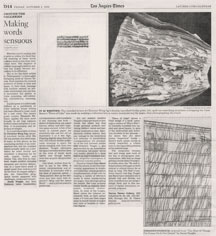
Of course, if I had a transporter, I could save myself a lot of staring at the I-5. Since we haven’t got one — yet! — we could have a look at Leah Ollman’s L.A. Times review of Palimpsests, a three-person exhibition I’m in at Tarryn Teresa Gallery through October 29th.

Standard
Research, Travelogue

L.A. Looks

Between installing recent works at Tarryn Teresa Gallery and being stuck in traffic, I got to have some fun art-life in Los Angeles last weekend…

–Peeked behind the scenes of a down-low James Turrell light installation. Don’t ask where, because I won’t say!

–Experienced Richard Serra’s monumental Band and Sequence steel sculptures at LACMA for the first time, and in near solitude, to boot. I was really grateful to get them both to myself, as the experience was sensory and meditative. I was baffled, though, when I encountered an LED light piece in the corner. It was completely lacking wall text. I knew it was a work because its perimeter was demarcated with vinyl commanding, “Please do not touch,” and when I entered the throw of light, I set off a high-pitched alarm. Yet I’d never known Serra to do light-based work, and I’m sort of keen on these things. A new museum mystery remains unsolved.

–Upstairs at LACMA were a massive Barbara Kruger vinyl installation and a Koons, Warhol and Baldessari group show. The dude show was great, if not especially urgent (in fact, it was scheduled to close a year ago). Still, I hadn’t seen one of Koons’ balloon animals in the flesh in a while, and it was totally and surprisingly effective, accomplishing what I think the provocateur meant to do. That taut, shiny sculpture sort of turned me on. Awkward!

–In the other huge wing was a large survey of Beuys’ multiples. Shows of multiples, esp those tangential to Fluxus, can be wonderfully curio-esque or miserably archival and academic. I’ll admit, my art stamina was no match for the massive scope of this survey. I also had a hard time turning off my preparator brain, noticing the grey-vinyl-on-grey-paint instead of synthesizing the text, and being bothered by the lack of didactic texts in the vitrines. Still, it was cute to see Beuys’ famous sled sculpture, which Stephanie Syjuco is re-creating for 1969, a show at PS1 this fall.

–When you like a gallery, and their shows keep exceeding your expectations, you start to worry about becoming biased. This is what happens to me at Marc Foxx Gallery. I loved the Anne Collier show the last time I was in town, and I loved the group show with Jim Hodges and Frances Stark the preceding visit. This time round, I was slowly but surely impressed with a solo show by Matthew Ronay, who crafts fictionalized juju capes, hoods, staffs and other ritual objects. They’re completely engrossing.

Joel Kyack’s Knife Shop at Francios Ghebaly’s Kunsthalle LA in Chinatown was pretty great too. It’s a theatrical installation in the vein of low-brow, folky, male juvenile art, but it worked for me because it was hokey but believably dangerous. I mean, there’s a table of dozens of hand-made shanks. Anger at the world seems less pathetic (even if the work is in a ‘pathetic aesthetic’) when the artist has ground metal license plate holder and other bits of metal into long blades. These aren’t Nut N Fancy tactical knives; they’re fetishes of obsession and rage.

–The recession seems to hit Chinatown galleries especially hard, with many shops folding or moving, so it’s fantastic to see an example of rigor over sell-ability in this ‘hood. Rachel Khedoori’s installation at The Box is timely and political, and its visual interest is minimalist but nightmarish. It’s a museum-quality show at a small commercial gallery. Not sure how that happened, but it’s cool.

Standard
Research

Drawing, the start of it all

Ooooooooh! The Guardian just launched a series of photos and first-person essays on drawing! It looks fantastic! Highlights include William Kentridge on the mystique of charcoal, David Shrigley on his idiosyncratic ink doodles, graphite master Paul Noble on his rather technical fictive drawings, and Ingrid Calame on her vector-y vellum tracings.

The timing’s great because I just taught the first session of my Sketchbook Drawing class at the Associate Student Union at U.C. Berkeley. It had been a while since I’d been in a figure drawing set-up, and I had a blast and I think my students enjoyed it too. I’m inspired to spend more time with my sketchbook soon.

Sometimes I find the idea of picture-making to be quite conventional, so it’s nice to be reminded of the immediacy and rewards of a fundamental mark-making practice.

Standard
News, Sights

October 22: Color + Color launches at P.P.O.W Gallery

I’ve contributed images to a new artist-initiated publication. It’s launching at an interdisciplinary event at P•P•O•W Gallery, a great space that represents some really awesome artists.

Three Pieces is an ongoing series which showcases three new pieces of sound, image, text or movement from local and visiting artists. Presented by Roddy Schrock and Deric Carner in various locations.

Amanda Curreri and Erik Scollon Presenting Color&Color #0

Color&Color is an artist-curated publication guided by the duality of two thematic colors per issue. The premier issue, Color&Color #0, features Orange & Blue with work by the following artists: Deric Carner, Amanda Curreri, Renee Gertler, Jason Hanasik, Sam Lopes, Celia Manley, Jeremy Chase Sanders, Erik Scollon, Skye Thorstenson, and Christine Wong Yap.

o.blaat (Keiko Uenishi), Sound Event

In Sound Event, the first word, “Sound” swings roughly between two of its many uses in “an experiment through the course of an event”: 1: (as noun,) the sensation produced by stimulation of the organs of hearing by vibrations transmitted through the air or other medium. 2: (as adjective,) following in a systematic pattern without any apparent defect in logic—as in sound reasoning. It is also an attempt to observe the certain swing/shift between a thing “signified” and “signifying” and perhaps the process of accumulation of desire.

Sal Randolph, Language Drawings
The artist will read from a series of new language “drawings” — texts made with a manual typewriter on long rolls of paper. As a kind of spontaneous “drawing practice” the words on these scrolls are free to follow one another according to an evolving set of principles including sound, shape, semantics, syntax, repetition, punning, play and association. These are intended to be texts without result, the residue of a practice that takes place unobserved: daily, meditative, noninstrumental.

P•P•O•W and The Hostess Project presents
Three Pieces: Platform for Art and Sound
Amanda Curreri & Erik Scollon, o.blaat (Keiko Uenishi), Sal Randolph
Thursday, October 22, 2009, 7–9 pm
P•P•O•W Gallery
511 W 25th St, Rm 301
New York City

Standard
Meta-Practice, Research, Values

Enthusiasms Unbounded, Mentality, Reviews

My Art Practice as Enthusiasms Unbounded

“Enthusiams unbounded” is neither grammatically correct nor concise, but it’s the best linguistic capsule for my sentiment: that many aspects of being an artist can be seen as exercises in honoring curiosity.

I love my life in art because I’m constantly learning new things; I made a decision to cultivate areas of knowledge and skill, and they’re accumulating more or less every day. When I look at it this way, art practice is even more satisfying.

I’m starting to think that being an artist means studio work, as well as enacting one’s enthusiasms at will, anytime and anywhere. To borrow examples from my own recent past, this manifests via browsing exhibition catalogs about shopping, learning how to use a nail gun (powered with air: brilliant!), getting over my fear of hand-held circular saws, and savoring donut shop typefaces. My enthusiasms fuel my art practice, so as an artist, it’s my job to follow them.

An Observation on Mentality

My friend Stephanie pointed out that longevity in art can often be attributed to sheer determination. In other words, success in art is partially a war of attrition (especially for women, as my friend Jenifer would add). Stephanie vowed to make art, no matter what. I want art in my life, but I need happiness too. And I think there’s a way to cultivate both:

I suspect that another secret to longevity in the arts is good morale, which requires (at least) two skills:

1. The ability to welcome and accept all forms of validation. I think it’s along the lines of being a connoisseur, not an addict, of the tangible evidence of success. That means blocking out mithering resentments or bitterness in light of any successes, and not letting hang-ups limit the extent of one’s satisfaction.

2. A high tolerance, or the quick ability to recover. May the stings of rejection fade quickly. May the forgettable exhibitions be soon forgotten. May petty resentments pass, along with all the reasons to be jaded about the art world.

The goal, it seems, is to make optimism and happiness “sticky,” and to let all the rest roll off your shoulder. Duckin’ and weavin’. Stick and move.

Enthusiasms, specifically

A cursory look-see of downtown galleries less than stunning, with two major exceptions:

Kim Anno at Patricia Sweetow Gallery

Kim Anno’s paintings on metal are pretty and formal — two things I’m not usually that wowed by. But I felt that feeling of worship that I think overcomes many art lovers when I looked at her paintings — my God, the light! The works are pure abstraction, with large expanses of white paint nestled by wisps of translucent color; they “read” quite simple and gestural and yet there are passages upon passages of textures, patterns, marks and contrasting surfaces. The whites revealed themselves to be rich in color as well. They’re works that continue to reward the act of looking. Expertly executed.

Bruce Connor at Gallery Paule Anglim

I first saw one of Bruce Connor’s miraculous black-and-white inkblot pattern drawings in Lawrence Rinder’s Galaxy at Berkeley Art Museum a few weeks ago, so it’s a treat to see more of them so soon. I absolutely adore them. There are several tiny ones on view, as well as a generous series of leaf-shaped inkblots and a few fuddy-duddy assemblages. The inkblots, though, are sublime. Completely abstract, moments of recognition appear and fade away, with a variety of textures, media and mark-making devices that result in an surprising magnitude of visual experiences — some lent the sensation of solarized photographic prints, others are clearly tactile acrylic, still others suggested small infinities. They strike a balance between meticulous compulsion and the fine art of knowing when to stop.

Standard