Community, Impressions, Travelogue

Points of Reference: West Coast

Some aesthetic impressions from a Portland-San Francisco tour:

Looking east up the Columbia River Gorge, from Crown Point in Oregon, USA. Author: Hux. // Source: Wikimedia Commons.

Looking east up the Columbia River Gorge, from Crown Point in Oregon, USA. Author: Hux. // Source: Wikimedia Commons.

Columbia River Gorge. The more I visit grand vistas, the more I understand Romanticism.

Landscape paintings don’t usually affect me—but imagine living in a crowded, dirty city in the Industrial age, then exploring such vast, stunning locales like the Columbia River Gorge, the Catskills, or the Lake District in the UK. Post-postcard, post-Ansel Adams, I might be desensitized to the images of these places, but I never fail to experience awe—smallness in light of something greater—when I visit these places. It seems natural to want to capture the grandeur and qualities of light, as much as preserve the environment for future generations. [Go Parks!]

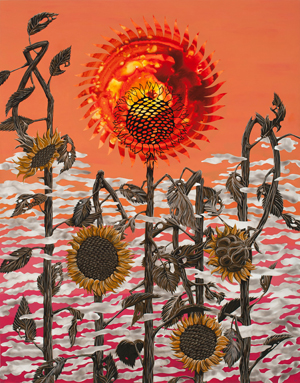
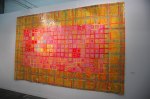
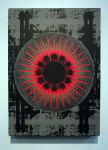
Ryan Pierce. Preview image for New World Atlas of Weeds and Rags. // Source: ElizabethLeach.com.

Ryan Pierce. Preview image for New World Atlas of Weeds and Rags. // Source: ElizabethLeach.com.

Get excited:
Ryan Pierce: New World Atlas of Weeds and Rags
Elizabeth Leach Gallery

Portland, OR
Through June 23

Really happy to catch the solo show of my CCA MFA classmate. Ryan specializes in hard-edged, post-apocalyptic narrative painting over luminous Flashe washes. He constructed this show around weeds, with tight botanical renderings of thistles, milkweeds, etc., as well as giveaways of pesticide-resistant seeds. My favorite paintings were from a sequence featuring the sun and the moon. I sensed some Charles Burchfield-esque visionary heat.

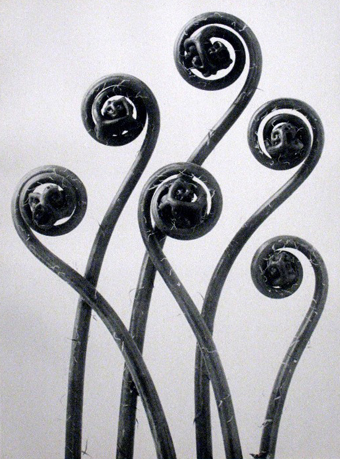
Karl Blossfeldt, Adiantum pedatum, Maidenhair fern, young unfurling fronds, 12x. // Image source: PortlandArtMuseum.org. Caption source: karlblossfeldtphotos.com.

Karl Blossfeldt, Adiantum pedatum, Maidenhair fern, young unfurling fronds, 12x. // Image source: PortlandArtMuseum.org. Caption source: karlblossfeldtphotos.com.

Karl Blossfeldt’s New Objectivity photos of botanical geometry.
70 Years/70 Photographs
Portland Art Museum
Through September 9

My knowledge of photography is a bit anemic, but this means that I get to enjoy many discoveries in the repair process. Blossfeldt’s images were a delight. See more at karlblossfeldtphotos.com.

Portland Sewing

The short: Private lessons with Sharon Blair. Highly recommended.

The long: My sewing knowledge comprised making clothes for Puffy, my stuffed Crocker Spaniel, under the guidance of my mother. (Mom’s an excellent seamstress who made some of my favorite childhood dresses. She still uses a Montgomery Ward Singer dating from the late 1970s/early 1980s; to change stitches, she manually changes a baffling array of stamped metal gears.)

Remarkably, this experience, along with much experimentation, has girded me through sewn sculptures and ribbon projects over the past few years. In the same time though, I’d accumulated a battery of questions about fabrics and techniques. Sharon, the instructor, patiently answered them all. She has tons of industry experience, and started the lesson with a quick history of sewing machine manufacturers. <Tool nerd swoon>

I got a crash course in cutting and sewing, and practiced three of the six kinds of fell seams, which will be critical for an upcoming flag project.

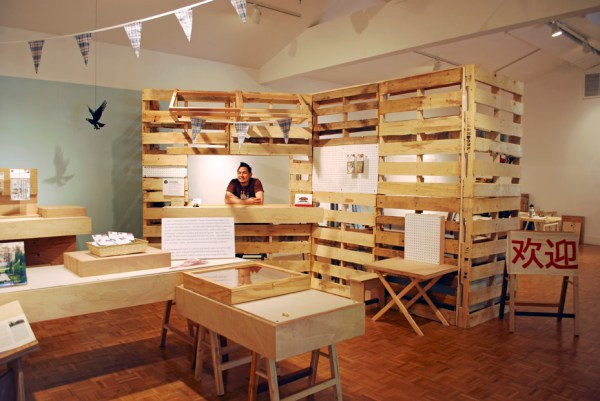
The Marianas (Michael Arcega and Stephanie Syjuco), Montalvo Historical Fabrications and Souvenirs (A Pop-up Shop), 2012. // Source: StephanieSyjuco.com.

The Marianas (Michael Arcega and Stephanie Syjuco), Montalvo Historical Fabrications and Souvenirs (A Pop-up Shop), 2012. // Source: StephanieSyjuco.com.

The Marianas (Michael Arcega and Stephanie Syjuco)
Montalvo Historical Fabrications and Souvenirs (A Pop-up Shop)
Montalvo Project Space
Woodside, CA
Through July 20

Friends’ first collaboration. It’s good. Go see it, and bring cash!

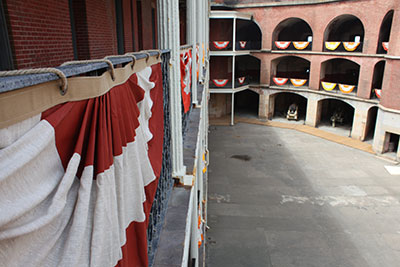
Allison Smith, Fort Point Bunting, 2012. // Source: international-orange.org. Photo: Jan Stürmann.

Allison Smith, Fort Point Bunting, 2012. // Source: international-orange.org. Photo: Jan Stürmann.

International Orange
FOR-SITE Foundation
Fort Point
San Francisco
Through October 28

Really good show in an amazing site. Go! I went on a foggy, chilly Monday (no crowds) and it was lovely.

My favorite was Allison Smith‘s Fort Point Bunting. Each of the 75 swags is accompanied by quotes from servicewomen printed on linen and framed in waxed canvas cording. The narratives were empowering. While military intervention is fraught, this insight in the battle for equal access to combat is pretty thrilling.

Stephanie Syjuco‘s International Orange Commemorative Store (A Proposition) establishes a standard of finish and level of production that is sublime, and should have most artists quaking in our boots. Anadamavi Arnold‘s crepe paper gowns were magnificent. I read Kate PocrassAverage Magazine off-site, but found it to be the most entertaining and insightful look at the Golden Gate Bridge. I also loved Andy Freeberg‘s portraits of workers on the bridge, for the diverse, recognizable subjects, rarely-seen perspectives, and cool tools.

Fort Point’s history and vistas were great to explore. I enjoyed how the show engaged the site, so that viewers browsed historical/permanent displays in the course of visiting the exhibition. I expected a strong show due to the roster of international artists; I was pleased to find that the projects that resonated with me most form a collection of articulate, accomplished female artists.

Robert Kinmont: 8 Natural Handstands (detail), 1969/2009; nine black-and-white photographs; 8 1/2 x 8 1/2 in. each; courtesy of Alexander and Bonin, New York. Photo: Bill Orcutt. // Source: bampfa.berkeley.edu.

Robert Kinmont: 8 Natural Handstands (detail), 1969/2009; nine black-and-white photographs; 8 1/2 x 8 1/2 in. each; courtesy of Alexander and Bonin, New York. Photo: Bill Orcutt. // Source: bampfa.berkeley.edu.

State of Mind: New California Art Circa 1970
Berkeley Art Museum
Through June 17

I’d heard rumors that this is the best show  many locals had seen in a long time. Unfortunately, I had only one hour, so I didn’t have the quiet mind required for uncovering the historical significance of the performance documentation and historical ephemera that ran through the show.

I loved that the show brought the major West Coast art initiative Pacific Standard Time up to Bay Area. Also, it’s not often you get to see an major survey exhibition about California art that doesn’t have a Los Angeles bias. I enjoyed learning more about seminal artists like Gary Beydler, William Leavitt, Bas Jan Ader, and Guy de Cointet (these de Cointet text drawings are fantastic, backgrounding Tauba Auerbach’s text paintings). It’s always nice to see Bruce Nauman‘s video pieces installed—here, Come Piece, two closed-circuit televisions with different halves of their lenses taped off.

The only thing that struck me negatively was the way that political art (works by artists of color and feminist artists) was the last thematic section. The architecture of the last room especially made the agit-prop David Hammons seem like an afterthought. I can’t pinpoint it, but I suspect that the early earth and performance work relates to a spiritual quest in merging art and life, and I intuit a bit of a woo-woo factor there, reinforced by the fact that my contemporaries who are especially fond of these artists tend to make transcendental works themselves.

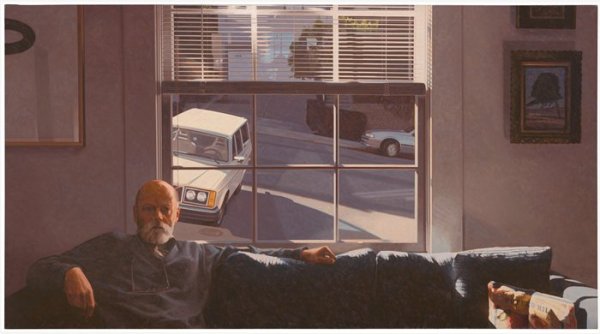
Robert Bechtle, Potrero Hill, 1996; painting; oil on canvas, 36 in. x 66 in. (91.44 cm x 167.64 cm); Collection SFMOMA, Ruth Nash Fund purchase; © Robert Bechtle  Source: http://www.sfmoma.org/explore/collection/artwork/104616##ixzz1xQHskP3n  San Francisco Museum of Modern Art. // Source: SFMOMA.org.

Robert Bechtle, Potrero Hill, 1996; painting; oil on canvas, 36 in. x 66 in. (91.44 cm x 167.64 cm); Collection SFMOMA, Ruth Nash Fund purchase; © Robert Bechtle Source: http://www.sfmoma.org/explore/collection/artwork/104616##ixzz1xQHskP3. San Francisco Museum of Modern Art.

Robert Bechtle, Potrero Hill (1996)
SFMOMA 

Bechtle is a perennial favorite of the SFMOMA’s, and mine too. This late, great painting—on view in the second floor galleries—is like five paintings in one. The JPG doesn’t do it justice. Bechtle’s understanding of reflected light and surfaces is phenomenal. This work was the highlight of my SFMOMA visit, along with Anthony Discenza’s The Effect in  the contemporary language art show, Descriptive Acts.

I expected that The Utopian Impulse: Buckminster Fuller and the Bay Area and Parra: Weirded Out shows would be more extensive. In fact, the Fuller show has two huge wall graphics that leads to a room of fantastic, large screenprint posters and transparencies. That’s followed by a group show by local, contemporary designers that is so un-related visually that my companion and I assumed that we’d drifted into the permanent design exhibit. The Parra exhibit is a massive mural, that is lovely and loads of fun, but I would have loved to see some works on paper, to get a little more intimate with the person behind these famous graphics.

I also would have loved to see more of Mark Bradford‘s video and performance works, especially documentation of his intervention at the San Diego-Tijuana border, though those could have been in the Bradford show I just missed at YBCA. The extensive selection of Bradford’s collages helped me understand the depth of his innovation with the materials (posters and curling papers) and tools (rope and power sander).
Standard
Impressions

Ecstatic Alphabet/Heap of Langauge and Tom Sachs

I am really blessed to live in NYC, as well as have days like today, when I can sample from some of its bounty.

Just as I was finishing up work early, a friend emailed to remind me about Ecstatic Alphabets/Heaps of Langauge at MoMA, a survey of text-based art. A very well-edited selection of 20th c. works on paper and printed works are on view, followed by a larger gallery with bigger projects by contemporary artists.

Among the first half-dozen works viewers will encounter are:

I was hooked. My favorite discoveries in the modern section were:

Marcel Broodthaers. Un Coup de dés jamais n'abolira le hasard. 1969. // Source: moma.org.

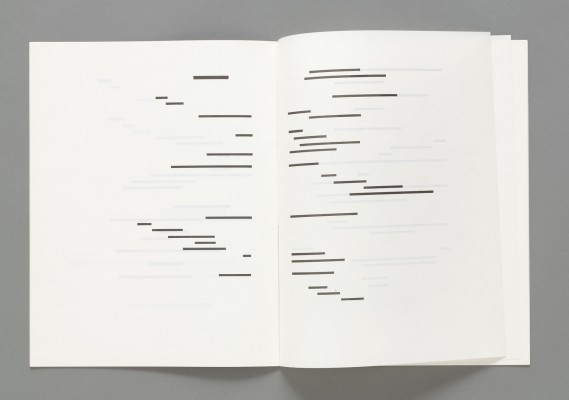
Marcel Broodthaers. Un Coup de dés jamais n’abolira le hasard. 1969. // Source: moma.org.

Marcel Broodthaers‘ version of Stéphane Mallarmé’s “Un Coupe de Dés…” Simple redaction rectangles on translucent vellum. Hints of what will come, and what has past, is visible. The book is time, and the open spread the present moment. It’s such a simple idea, but so well executed, that its elegance is quite profound. Being moved by simple gestures is always welcome.

Carl Andre‘s now now (1967). I have mixed feelings about Andre, but the textual/typographic gesture was so simple, yet so evocative of objects in space, that I really had a durational experience, to my surprise. (See it on page 2 of this exhibition PDF.)
There were many more works I enjoyed by Henri Chopin and Christopher Knowles. Of course, it’s really amazing and cool that Robert Smithson‘s Heap of Language is on view.

The contemporary gallery provided a nice opportunity to see Shannon Ebner‘s large photos of landscape interventions, as well as Tauba Auerbach‘s paintings.

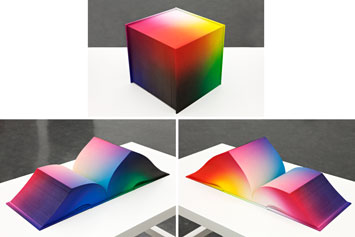
Tauba Auerbach, RGB Colorspace Atlas (Volume 1), 2011, Digital offset printing on mohawk superfine paper, 3200 pages, linen, binder's board, acrylic paint Measurements for closed book Binding: Daniel E. Kelm and Leah H. Purcell at the Wide Awake Garage in Easthampton, USA Edition of 3 / SOTA/S 2011-036/1. // Source: StandardOslo.no.

Tauba Auerbach, RGB Colorspace Atlas (Volume 1), 2011, Digital offset printing on mohawk superfine paper, 3200 pages, linen, binder’s board, acrylic paint Measurements for closed book Binding: Daniel E. Kelm and Leah H. Purcell at the Wide Awake Garage in Easthampton, USA Edition of 3 / SOTA/S 2011-036/1. // Source: StandardOslo.no.

Tauba Auerbach, RGB Colorspace Atlas. (2011). // Source: Rhizome.org.

Tauba Auerbach, RGB Colorspace Atlas. (2011). // Source: Rhizome.org.

Most of all, Auerbach’s recent RGB Colorspace Atlas series was ingenious and visually lush. They’re books—blank, hardbound, filled with pages so that it forms a perfect cube. Then, it’s airbrushed to create an RGB colorspace. Six examples are on view—three closed, three open—and they’re breathtakingly beautiful.

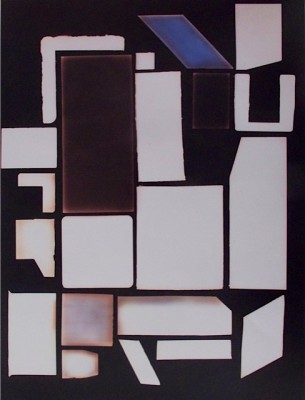
Paul Elliman. My Typographies (2). 1994 Paul Elliman (British, b. 1961). My Typographies (2). 1994. Photogram, 11 x 14" (27.9 x 35.6 cm) Courtesy the artist. © Paul Elliman. // Source: moma.org.

Paul Elliman. My Typographies (2). 1994 Paul Elliman (British, b. 1961). My Typographies (2). 1994. Photogram, 11 x 14″ (27.9 x 35.6 cm) Courtesy the artist. © Paul Elliman. // Source: moma.org.

I also appreciated getting to know the work of Paul Elliman (British, b. 1961), whose Found Fount series is a series of typologies of odds and ends. (Fount/Foundry/Font, get it?) The objects are on view, but the photograms are also very enjoyable.

A few weeks ago, I decided to switch directions in the studio and give text-based art a rest to see what would happen to my work. I was afraid that working with text might be too easy or formulaic, and result in art that is too quick a read. Ecstatic Alphabets/Heap of Language reminded me of the joy of elegant solutions—textual or not—and my love of the printed page.

The crowds were in full force for Free Fridays at MoMA, rewarding persistence and patience. About a mile uptown, I visited Tom Sachs’ Space Program: Mars, organized by Park Avenue Armory and Creative Time.

Tom Sachs. Creative Time/Park Avenue Armory. Source: CreativeTime.org.

Tom Sachs. Creative Time/Park Avenue Armory. Source: CreativeTime.org.

Tom Sach's Space Program: Mars. Source: Park Avenue Armory newsletter.

Tom Sach’s Space Program: Mars. Source: Park Avenue Armory newsletter.

It was my first visit to the Armory. I knew that art and antique fairs are held there, so I understood that it is a huge space. Still, nothing quite prepared me for turning the corner of the sole freestanding wall in the Armory, and seeing the expanse of space populated by precisely-lit installations/stage sets as well as various artist-made (or artist’s studio-made) space vehicles.

The show was unlike anything I’ve ever seen, and I found myself at a loss for words. I don’t want to ruin the experience for anyone, so I’ll leave you with the fragment M shared with me: “It’s so earnest.” The exhibition continues through June 17. I recommend attending a public program, such as the Demonstrations. And allow lots of time.

Standard
Impressions

Chelsea jaunt

Made lemons out of lemonade today: Sidelined from running, I took up biking, and I rode down to Chelsea and up to Columbia for some art shows. Perfect weather for it.

Standouts:

Three of the four shows I loved have to do with mirrors. So sue me.

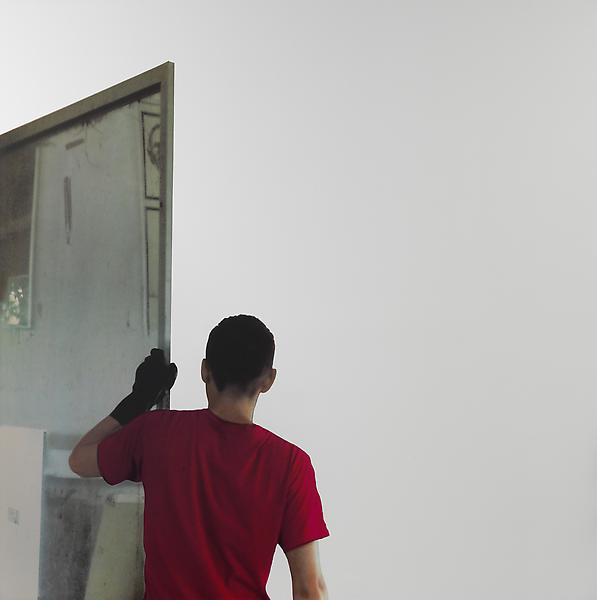
Michelangelo Pistoletto, Lavoro - Atelier, 2008-2011, Silkscreen on polished super mirror stainless steel 59 X 59 inches (150 X 150 cm). // Source: luhringaugustine.com

Michelangelo Pistoletto, Lavoro - Atelier, 2008-2011, Silkscreen on polished super mirror stainless steel 59 X 59 inches (150 X 150 cm). // Source: luhringaugustine.com

Michelangelo Pistoletto at Luhring Augustine
Lavoro
Thru April 28

The Arte Povera mirror-maker depicts construction workers, bringing the past of each building these are shown in into the present. I liked these a lot. Baffled why the statement said that the images are “adhered” when the image captions, and the works themselves, suggest screenprinting as the medium. These are not my favorite Pistolettos; I liked some of the older ones at the Walker and Brooklyn Museum better, but it’s still great to see so many of them in one place. A treat.

Greg Smith at Susan Inglett Gallery
ners Banners Banners Ban
Thru May 26

GO SEE IT. ESPECIALLY THE VIDEO.

If you can’t make it, read on…. (Spoiler alert.)

I made a point of going into galleries that aren’t on my usual route, and this one paid off. There are drawings and mixed media assemblages with a harness, all very cruddy and rough. The best thing, though, is a video that documents a performance in which the artist produced and installed the works under and on the Brooklyn-Queens Expressway. There’s a belt of canvas that goes completely around the car, and shots of the artist operating a sewing machine while driving (not recommended!). He used copious amounts of sweetly colorful dots, and also made some fabric-and-cotton-batting pennant flags. It’s a bizarre experiment with lots of physical and legal risk for crafty, yet un-crafted, artworks. Super thought-provoking for thinking about what is at stake in a work or practice, and what is success or failure.

Grey Peak of the Wave, Installation view, 2012 Alicja Kwade, Alexandra Leykauf and Florian & Michael Quistrebert. Source: HarrisLieberman.com.

Grey Peak of the Wave, Installation view, 2012 Alicja Kwade, Alexandra Leykauf and Florian & Michael Quistrebert. Source: HarrisLieberman.com.

Grey Peak of the Wave at Harris Leiberman
Group show of European artistst
Through April 28

I love this kind of work. Subtle, open-ended, perceptual, quiet. My favorites were:

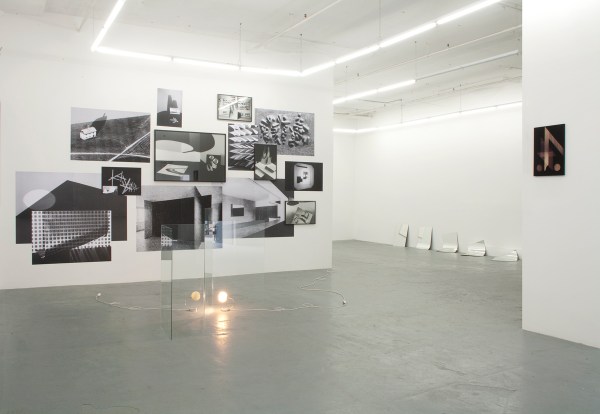
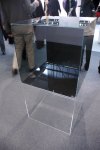
Alicja Kwade’s taped glass sheets with two lamps, one on, one off (above, on ground). In the glass’ reflection, the unlit lamp appears convincingly illuminated.

Alicja Kwade’s bent mirrors, as if drooping down off the wall like a sheet of paper (also seen above, in the rear space). Surreal. Materially simple, disguising what I’m sure was laborious or expensive fabrication. Manipulating common materials in uncommon ways never gets old to me.

Alexandra Leykauf’s wall vinyls and framed photos (also above, back wall). Who doesn’t love a b/w photo of geometric abstraction made with real objects? And then complicating commodification with both framed works and site-specific, one-use vinyl? So simple, so good.

IRAN do ESPÍRITO SANTO, Installation view of SWITCH at Sean Kelly Gallery, New York March 21 - April 28, 2012 Photo: Jason Wyche, New York. Source: skny.com.

IRAN do ESPÍRITO SANTO, Installation view of SWITCH at Sean Kelly Gallery, New York March 21 - April 28, 2012 Photo: Jason Wyche, New York. Source: skny.com.

Iran do Espírito Santo at Sean Kelly
Switch
Thru April 28

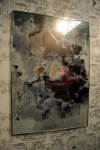
I loved this Brazilian artists’ subtle, perceptual, materially sophisticated works ever since I saw a few at Altman Siegal in San Francisco. This show is a brave selection of 3 major works: a large wall painting, a series of marble replicas of glass bulb covers, and this series of “mirrors.” In fact, these are all made with two sheets of plate glass sandwiching a reflective tint. They look like mirrors until you spend a little more time with them, and realize that they are slightly transparent. They don’t, as the press release states, look like they’re folding, the way Kwade’s bent mirrors do at Harris Lieberman. But they do achieve something else, which as to do with how the leaning piece and the floor piece allow slightly different amounts of light and reflectivity. It’s sort of like the difference between a 100% printed CMYK black, and a “rick black,” which is a mixture using more colors, and hence, more saturation. The mirror on the floor looks as if you could fall into it.

Standard
Bucket List, Impressions

Josephine Meckseper, Josiah McElheny

Josephine Meckseper, a German artist based in NYC, has been making photographs, sculptures, installations and videos critical of American military power and consumer culture. I had seen her famous Pyromaniac 2 photo before, but am finally spending more time with her vitrines of readymade objects and store-inspired displays.

I’m late in getting familiar with Meckseper’s work (it might have been useful for thinking through a 2010 show about 99¢ stores). But it’s just as well now, as I’m  currently thinking about new projects that are off the wall, and Meckseper uses some inventive display strategies.

Josephine Meckseper Pyromaniac 2  2003  C-Print  101 x 76 cm // Source: Saatchi-Gallery.co.uk.

Josephine Meckseper, Pyromaniac 2, 2003 C-Print 101 x 76 cm // Source: Saatchi-Gallery.co.uk.

Josephine Meckseper, Jaguar, 2010, Mixed media on reflective slatwall, 94 1/2 x 94 1/2 x 12 1/2 in. / 240 x 240 x 31.8 cm // Source: timothytaylorgallery.com.

Josephine Meckseper, Jaguar, 2010, Mixed media on reflective slatwall, 94 1/2 x 94 1/2 x 12 1/2 in. / 240 x 240 x 31.8 cm // Source: timothytaylorgallery.com.

Josephine Meckseper, Afrikan Spir 2011 Mixed media in steel and glass vitrine 80 x 80 x 20 in. / 203.2 x 203.2 x 50.8 cm // timothytaylorgallery.com.

Josephine Meckseper, Afrikan Spir, 2011, Mixed media in steel and glass vitrine, 80 x 80 x 20 in. / 203.2 x 203.2 x 50.8 cm // Source: timothytaylorgallery.com.

Josephine Meckseper, The Concept of Irony, 2010 Toilet brush, costume jewelry, sandals, newspaper, decorative wall hangings, hosiery, book, framed collage with newsprint and colored acetate on paper, acrylic painting on canvas, cloth, metal and acrylic display fixtures on metal rack 74.5 x 24.75 x 24 inches (189.2 x 62.9 x 61 cm) // Source: ElizabethDee.com

Josephine Meckseper, The Concept of Irony, 2010 Toilet brush, costume jewelry, sandals, newspaper, decorative wall hangings, hosiery, book, framed collage with newsprint and colored acetate on paper, acrylic painting on canvas, cloth, metal and acrylic display fixtures on metal rack 74.5 x 24.75 x 24 inches (189.2 x 62.9 x 61 cm) // Source: ElizabethDee.com

Josephine Meckseper, Der Wille zur Macht, 2011, Mixed media on steel pole 52.25 x 9 x 9 inches (132.7 x 22.86 x 22.86 cm) // Source: ElizabethDee.com.

Josephine Meckseper, Der Wille zur Macht, 2011, Mixed media on steel pole 52.25 x 9 x 9 inches (132.7 x 22.86 x 22.86 cm) // Source: ElizabethDee.com.

Art Production Fund and Meckseper recently teamed up for the Manhattan Oil Project, a monumental kinetic sculpture/intervention in Times Square, currently on view through May 6th at 46th Street and 8th Ave.

Josephine Meckseper, Manhattan Oil Project, 2012 // Source: Art Production Fund

Josephine Meckseper, Manhattan Oil Project, 2012 // Source: Art Production Fund

Meckseper is an anti-capitalist activist. At her recent talk at Sculpture Center, she cited the forms of sculpture that have inspired her, including the fall of monuments to great men, and the Berlin Wall. I liked something she said about working in social contexts, which I paraphrased in my notes as:

What are the oppositional voices in the neighborhood?

I was very inspired by Josiah McElheny‘s talk in the Public Art Fund’s lecture series at the New School.

I liked McElheny’s works, and appreciated learning about these stunning projects:

Josiah McElheny, "Island Universe" (detail view), 2008, installed at the Museo Nacional Centro de Arte Reina Sofía, Madrid. Courtesy of artist, photograph by Ivån Caso Lafuente.

Josiah McElheny, "Island Universe" (detail view), 2008, installed at the Museo Nacional Centro de Arte Reina Sofía, Madrid. Courtesy of artist, photograph by Ivån Caso Lafuente. // Source: http://www.veralistcenter.org/

A beautiful installation at the Crystal Palace in Retiro Park in Madrid. Project with Museo Nacional Centro de Arte Reina Sofía. Visiting the Crystal Palace is going on my bucket list.

JOSIAH MCELHENY, The Past Was A Mirage I'd Left Far Behind, 2011-2012, Wood, Mirror, Screen material and Projection. Seven multiple reflective screens made of mirrored glass, wood, and projection cloth. Experimental abstract films programmed to change throughout the period of one year. dimensions variable upon installation. The Bloomberg Commission: Josiah McElheny Whitechapel Gallery, London September 7, 2011 – July 20, 2012. // Source: andrearosengallery.com.

JOSIAH MCELHENY, The Past Was A Mirage I'd Left Far Behind, 2011-2012, Wood, Mirror, Screen material and Projection. Seven multiple reflective screens made of mirrored glass, wood, and projection cloth. Experimental abstract films programmed to change throughout the period of one year. dimensions variable upon installation. The Bloomberg Commission: Josiah McElheny Whitechapel Gallery, London September 7, 2011 – July 20, 2012. // Source: andrearosengallery.com.

This is a really cool video installation using kaideoscopic imagery made with substrates of mirrors and wood. I’d love to see this and I’m looking forward to this show coming to Boston ICA this summer!

McElheny is pound-for-pound one of the most brilliant contemporary artists of our time. First, the craftsmanship of his handblown glass is impeccable. Second, he’s an artist’s artist, constantly experimenting and advancing art historical dialogues, such as with his remake of The Metal Party and the Light Club of Italia. Third, he’s a formidable intellect, whose contributions to Artforum are not an insignificant part of his practice. He said one of the things he enjoys as an artist is to generate new research, and one of his forthcoming multiples is a translation of Blanque’s “Eternity through the Stars: An Astronomical Hypothesis.” While this text has inspired Borges and other writers, it’s never been translated into English before, and McElheny is searching for a publisher.

He talked about

display as a sequence of events,

thinking through

how ideas are expressed in objects.

On readymades, he expressed that

artists must transform an object because industrial production resists transformation. Readymades propose that consuming is art. It’s a dangerous idea that competing with the capacities of industrial production is difficult, and that artists can only react.

His opposition to Adolf Loos’ “Ornament and Crime” theory of modernism is based on his principle that

the desire to make a mark on the world and show you exist is universal.

I especially loved the way he phrased that urge:

To make a material mirror.

These are fundamental quandries for artists. For artists who are interested in the concepts embedded within the materials we use, and who want to make work that embodies, rather than illustrates, our ideas, it is an essential one.

During the Q&A, someone asked if McElheny saw his practice as a moral one. He equivocated away from making a personal statement, but did say:

The ethics of art are to create more permissive thinking—to generate more, and not less, thought.

I did see the interlocutor’s point, as McElheny stated his ambivalence about beauty. He said something about seeing how quickly beautiful things can turn ugly. It reminded me of Yi-Fu Tuan’s point in Passing Strange and Wonderful: Nature, Aesthetics and Culture (Island Press, 1993)—that for most of human history, beauty and goodness were synonymous, so the aesthetic carries a moral tint.

McElheny’s practice seems to be experiments in enacting or expressing moral principles through strategies of aesthetic production and display.

Standard
Impressions

An Art Fair, Positively Materialistic

Last week I researched a lot of art materials, so when I attended the Armory Art Fair it seemed like the thing that attracted me the most were materials.

Spared from crowds and achey feet, you’ll have to excuse the poor-quality snapshots.

First, some novel materials or presentation styles I found attractive, interesting, or fun. Followed by some examples of exuberance/knickknackery, good ideas, nice techniques, and one lone example of an interest in psychology.

I did attend VOLTA, but my battery promptly quit. On my camera, that is. View a catalog. I loved Patrick Jacob‘s miniature vistas as seen through a miniature domestic set (The Pool, NYC). Also nice to see Ed Pien‘s work at Pierre-François Ouelette Art Contemporain, Montreal. Neat retroreflective paper cut.

Standard
Impressions

Tom Friedman @ Luhring Augustine, Jeffrey Gibson @ Participant, more

Given my underwhelming art show attendance record in NYC, I took a quick jaunt through galleries in Chelsea today, followed by a pilgrimage to the East side for an LES space. I’ve linked to gallery photos when available, to spare you and the artists from my low-res snapshots.

Doug Wheeler at David Zwirner 

This light-and-space artists’ major installation is this month’s must-see show, but I couldn’t see it.

Last weekend, I tried to get in line one hour before closing time, but was told to come back another day.

Today, the wait time was estimated to be about 90 minutes, with a growing line outside, and a longer line inside. Unlike Disneyland, there weren’t signs estimating the wait time; I came by this information covertly, and I promptly gave up.

The gallery ought consider extending the show as well as opening hours.

Photos on DavidZwirner.com.
Read Randy Kennedy’s review on NYTimes.

Terry Winters (borrowing from Mihaly Csikszentmihalyi) at Matthew Marks

Big abstract paintings in the big space, small transparency-and-Xerox collages in the smaller storefront. The collages were fun and psychedelic with rainbow-colored data visualizations.

What made me stop was recognizing a chart borrowed from  psychologist Mihaly Csikszentmihalyi, whose research on flow and creativity has inspired many of my Positive Signs drawings. Winters appropriated a X-Y graph on how challenges and skill can lead to apathy or flow. He overlaid it on a paint chip page. Worked for me.

Photo at matthewmarks.com.

Klaus Weber at Andrew Kreps

Sun Press looked cool, and would have been really cool if the sculptural contraption was working. Sunlight streamed in the windows and hit a mirror attached to hydraulic pistons on a wooden base. Several yards down a hall, another mirror (actually silver mylar pulled taut on a frame) was meant to catch the reflected light and re-direct it onto glass-plate-mounted transparencies, which would have acted as masks for incredibly slow, one-at-a-time, sun-bleached reproductions. Architecture and astronomy conspired against Weber, however, throwing the solar rays inertly on a wall.

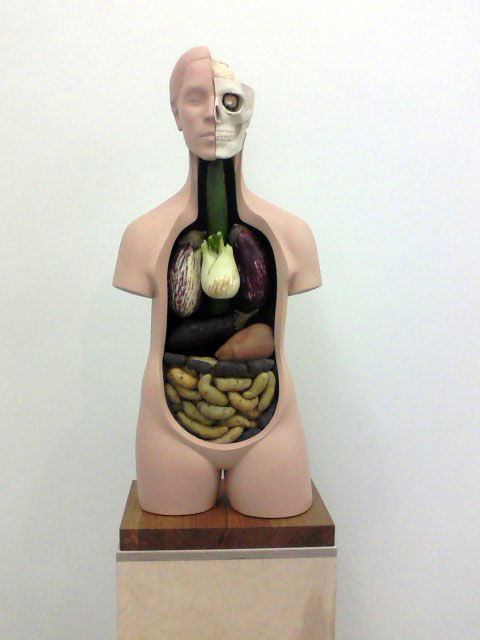
The rest of the show was very good, however. A wall of death masks had two subtle surprises—humorously, a cartoonish character, and unnervingly, an empty spot with lone, expectant nail. I also liked some large, black-on-black screenprints made with honey, more for the food materials, á la Ed Ruscha. In an anatomical model, real produce filled in for organs, updating Giuseppe Arcimboldo’s veggie portraits, plus real-time decay. The brain, so inscrutable, is a cauliflower. As in my fridge, the cucumber, which stands in for the esophagus, mutinies first, shrinking as if in anaphylactic shock.

The gallery site hasn’t got any photos yet, so enjoy my grainy mobile phone photo.

A sculpture from Klaus Weber's show, "if you leave me I'm not following" at Andrew Kreps Gallery.

A sculpture from Klaus Weber's show, "if you leave me I'm not following" at Andrew Kreps Gallery.

John Miller at Metro Pictures

Puzzling theatrical sets made with b/w vinyl murals, fake trees and rocks, and sparkly automotive-painted file cabinets.

Photos at MetroPicturesGallery.com.

The carpet that spells “NO” reminded my of Amanda Curreri’s Leveller. Similar materials, very different intentions and effects.

Tom Friedman at Luhring Augustine

Really superb show by the master conceptualist-craftsman. Friedman’s sculptures and wall-works seem epitomize idiosyncrasy. There is hyper-realism, psychedelia, minimal text works, and miniatures; all result from a persistent attraction to labor. Friedman is a artistic daredevil, unafraid of the impossible.

Thankfully, full photo documentation is at LuhringAugustine.com.

Over and over, I thought of other artists who might appreciate this show, whose works resonates with specific projects. For example, I thought Steven Barich, who has made tiny pixel graphite drawings, might appreciate this pixellated acrylic painting. Anthony Ryan, who was painstakingly inlaying and weaving paper the last time I visited his studio, might enjoy this interpolated paper collage. This wrinkled photo of itself was not unlike Zachary Royer Schultz’ Crumple projects. And for yours truly, who has been dreaming about a kite project, there was this tiny figure, and his far, faraway kite (not pictured, and actually, it’s so tiny it’s barely visible in person).

AIGA’s 50 Books/50 Covers 2010 Competition 

[Full disclosure: my husband contributed to the interactive components of this exhibition.]

Graphic design aficionados who find themselves ogling covers rather than shopping for books in bookstores, this is the exhibition for you. Come and ogle away.

Graphic designers, beware: visiting this exhibition will only whet your appetite for expensive and unusual printing and bindery—gloss varnishes, rich textiles, and extraordinary boxes. Come anyway; this is the best way to see them, better than the mind-numbing sameness of printed catalogs.

Too many covers were stunners, but I especially loved the covers for Frank Rose’s The Art of Immersion and the book series, Themes of Psychoanalysis, elegantly illustrated with only one or two letters, symbols, or ornaments. The affect and emotion book, for example, bears a mirrored ampersand, which looks like two figures in intimate exchange.

Also: good spurs for home town pride: Rebecca Solnit’s The Infinite City, Mark Dion’s OMCA monograph, McSweeney’s, Tartine, etc.

Info and installation photos at AIGA.org.

Selected book covers can be seen at AIGA.org’s design archives.

Jeffrey Gibson at Participant, Inc.

[At one time, Jeffrey was a studio neighbor in Oakland, CA.]

Jeffrey, who is Native American, populates Participant’s not-insubstantial space with sculptures using rugs, beadwork, masks, leatherwork, and drums. As soon as I saw these tchotchkes, painted to look like art, I thought of another LES installation/performance wherein white artists appropriated Native American culture to articulate nature-inspired mysticism. Americans in general are guilty of participating in this ongoing cultural imperialism; it’s just that the conscious acts seem so overt, privileged, and repellant. I wondered what Jeffrey would have made of them.

A series of circular drums are painted with hard-edged geometric shapes and stripes, with some whisks of aerosol. These seem to most clearly convey the show’s inspiration, a 1940s exhibit of Native American art situated in modern art history. Other works, like the pink fluorescent tube shooting out of a hide satchel adorned with two beaded balls, queer up the theme. A b/w video displays time-lapse photos of the drum-paintings in progress. Moving blankets, heavy with paint and Native ornamentation, ground floor works and, as a flag, worry a hardwood dowel.

More info at ParticipantInc.org.

Standard
Impressions, Meta-Practice

See: Bill Cunningham New York and The Artist

Want inspiration? Watch these feature-length films.

Bill Cunningham New York

Bill Cunningham New York
Directed by Richard Press (2010)
[Visit the official site or watch the trailer.]

Portrait of the bike-riding, Carnegie-Hall-residing, NY Times street fashion photographer. A real photographer and  egalitarian. Made me want to go out and shoot hundreds of photos, and aspire to be unflappable of character and constantly amazed at life.

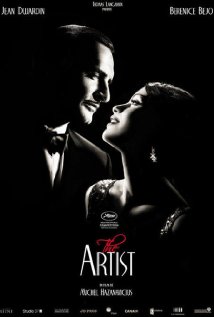
The Artist

The Artist
Directed by Michel Hazanavicius (2011)
[Visit the official site or watch the trailer.]

Heartbreakingly beautiful, symbolic, mostly-silent black-and-white movie about the rise and fall of stardom. A really potent, modern narrative about creative life and pride, brought to life with incredible cinematography, direction and acting (as well as great typography). I saw it yesterday and can’t wait to see it again.


Standard
Impressions, Travelogue

New Haven: Art, architecture, clouds, and nativity scenes

New Haven, I learned, is very sleepy during Yale’s winter break. The special exhibitions at Yale University Art Gallery and the Yale Center for British Art are in changeover. Artspace was not open during their normal scheduled hours of the current show. Though the timing of my visit was not ideal, I enjoyed looking for and finding art in New Haven today.

Yale University Art Gallery
First—Louis Kahn’s building knocked my socks off. The exterior was cold and blocky, but the interior featured a beautiful lobby, interesting textures, and warm touches, like the uneven edges on the window scrims, and a cool-while-totally-sensible triangular stairwell. Big points for the handsome building signage in projected light.

Collections worthy of a prestigious Ivy League, like an Assyrian stone wall from the 5th c. BC. C’mon! (It’s the first image in this Flash-based “gallery tour.”)

Lots of gems in European and American art. I studied debossed gold-leaf patterns at length in some stunning pre-Renaissance icons. Duchamp’s Tu M’. A good Nam June Paik closed circuit television installation showing a live video of artificial flowers mounted to the top of the tube. Lucas Samaras’ Chicken Wire Box #4 (1972) and Untitled (1963), a panel covered in concentric circles of different colored yarn, then pinned with hundreds of straight pins (kind of like this). Happy and perception-stretching.

I also very much enjoyed mentions of local industry. The decorative art and design—early modernist nickel-silver tea set, pressed lead glass bowls—manufactured in little Massachusetts towns like Dedham and North Attleboro. They assert a history about designers and craftsmen that contrasts, in my mind, the must-have (in 19th c. wealthy homes and 21st c. general art museums) portraits of wealthy patrons.

joseph smith, tea caddy, 1767, source yale university art gallery

Joseph Smith, Tea caddy, 1767. Source: Yale University Art Gallery website

Joseph Smith’s Tea Caddy (1767) kills me. It looked totally out of place in the vitrine with mirror-polished silver vases. It manages to be endearing and craptastic. The construction of the clay seems unconcerned with formal considerations, but the calligraphic curliques suggest a desire to make it beautiful and refined. It’s surprisingly complex.

I also found the Asian and African art floor inspiring—Chinese watercolors and ceramics spurred me to think about patterns and line and the tropes of genre paintings; a ceremonial mask surrounded by oversized photographs of similar masks in use in Africa seemed like a sensitive approach to exhibiting these objects in contexts so different than their originally intended ones.

Yale Center for British Art
The architecture here is opposite what you’d think—instead of heavy, dark wood paneling with ornate wainscoting is warm, orange-toned wood interrupted with concrete. The galleries were lined with unbleached canvas-covered walls and filled with light. Except for an atrium (pictured on the museum home page), which I found suffocatingly prison-yard-esque, the museum was open and welcoming. This fresh approach seemed reflected in the collections curation. There were what seemed like hundreds of British paintings on view, and I never thought I’d hold up to make it all the way through, but surprising choices in the selections kept my morale up.

John Constable’s Cloud studies are a special treat that alone would make a visit worthwhile. Even for non-painters. (Otherwise you can get the book.)

I also liked the house portraits—they are more like oil-painted illustrated 3-D maps (remember these cheesy illustrated maps?) of English estates. The perspective is often forced and awkward. They’re interesting as cultural documents. (When you have a mansion and gardens upon gardens, do you really need a painting of it too? Do the servants carrying loaded baskets upon their heads evoke the same sense of satisfaction as the parasol-wielding leisure-seekers?) They are, essentially, heavily narrated architectural and informational graphics, and their quirks appeal.

Knights of Columbus Museum

The Knights of Columbus are a Catholic service organization, and they have a huge “museum” (though it seemed more like an office building with some gallery spaces) on the edge of downtown New Haven. I visited and found their exhibition on a recent mosaic project in DC to be informative. Photographs and texts guide viewers step-by-step through the old-world tradition completed with modern industrial tools. From drawing, making the mosaic in sections, scaffolding, to installation, it was great for nerding out on technical side of art making.

There’s also the State Room, full of memorabilia of different honorary gifts that were given to various Knights. The KoC-logo has been emblazoned on cowboy boots, judge’s gavels, and even a Filipino barong. It reminded me of promotional item showrooms, which are fun to visit as an artist.

The real reason I went to the KoC Museum, though, was for the Christmas in Asia exhibition of crèches, or nativity scenes. They were so brilliant that I am still disappointed that photography was not permitted; after all, I didn’t see any individual artists credited. While a few works were attributed to specific woodcarving workshops in China, the overwhelming majority was to “Unknown Artist”—presumably, some street vendor who sold the item in a brief transaction where Western currencies were advantageous and an exhibition loan form was absent. But whatever.

The crèches generally fell into two groups. In the first category, it seemed as if Asian craftsmen did a competent job of simulating Western realism, as well as tropes about the nativity scene and the participant’s appearances. This is interesting as an outcome of globalization. The objects were made for Western audiences, or for a local audience that prefers their nativity scenes traditional. The second category, however, spoke to my taste for the awkward and funny cross-cultural translations. In these cases, artists interpreted the nativity scene with local materials (bamboo, Korean paper mâche, Indonesian woodcarving, Filipino shells) and traditional forms. Sometimes the manger was substituted with a raised bamboo platform-hut with a thatched roof. The camels gave way to elephants (Pakistan) and a cat (Korea). This kind of willful naiveté was captured in an elaborately traditional Thai scene, featuring wrapped skirts on the women, farmer’s shirts on the men and a gilt fruit basket loaded with tropical fruit. The kicker was that the three wise men included a saffron-robed monk.

The crèches might indicate a darker truth—local craftsmen turning to non-native narratives to appeal to tourists’ tastes, not to mention colonialism. However, there are other possible explanations, and here’s one: For my mom, a Buddhist, Christ presents neither conflict nor contradiction. (In fact, I think the reason Christianity is not my cup of tea is because it’s incapable of this kind of religious tolerance.) It’s possible that some of these folk crafts emerge from the same feeling of nonchalant appropriation. Or maybe the craftspeople just love Christmas.

Standard