Community

Bay Area art: workin’ it.

Really, really excited that even if I have to leave one awesome art community (in Manchester) I’m coming straight home to another (in the San Francisco Bay Area). So good to be home, so thankful for really bright CCA folks doin’ it.

Just came from Speculative Fictions, a talk at Patricia Sweetow Gallery, featuring Weston Teruya, Jina Valentine, Arnold Kemp, Gail Wight and Jerome Reyes. A great mix of really bright practicing artist-thinkers. I think anytime a commercial gallery pursues an intellectual discussion is really good — this time, the talk ranged from sci-fi, Battlestar Galactica, to conspiracy theories… Weston’s a friend; nevertheless, I think that his new works, incorporating a giant pineapple water tower and too-perfect gazebos are really good. I love seeing the work expand…

The shows at SF Camerawork are really good — all having to do with manipulation and desire. It got me thinking a lot about the manufacture of images, advertising, graphic design, and the crafting of paintings… The photographs are really well crafted. I’m not always easily impressed by photography — my appreciation for technical feats is pretty limited — but I was really impressed with the quality of the works and curation. Thoughtful, good stuff.

Coming up soon:

MFA exhibition opens at CCA Thursday night

Live and Direct opens at Ping Pong Gallery Friday night. Curated by cohort Amanda Curreri, and including a number of really thoughtful CCA MFA artists like Nyeema Morgan and Erik Scollon.

Standard
Art & Development, Community, Travelogue

The Art Community in Manchester: All Right! Part 2

I’ve said it before, but I’ll say it again — I really appreciate the artist’s community here in Manchester. In the past week, I’ve put the finishing touches on my open studio, relied on the support of staff, acquaintances and new friends, and felt extremely humbled that my work is being engaged by so many smart and curious artists and art enthusiasts here. Despite my generalizations about the Manc temperament, so many artists have demonstrated generosity, enthusiasm, interest, as well as a commitment to excellence… It’s really something!

Reception at Chinese Arts Centre

Visitors look at my work in the residency studio/gallery.

Visitors look at my work in the residency studio/gallery.

Last Thursday’s Open Studio reception at the Chinese Arts Centre went great! It was terrifically organized and very well-attended. I appreciated the format: Before the galleries were opened, attendees gathered round in the shop, where Sally Lai (CAC CEO) and Yink Kwok (CAC curator) introduced myself and Ed Pien, the fantastic installation artist whose solo show is now on in CAC’s gallery. We both had a chance to speak and invite guests to ask us questions, which I think really helped people engage me, my work, and the organization. It’s a smart format.

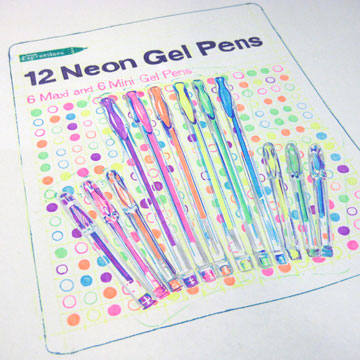
Detail from a series of drawings on display at the Open Studio. Christine Wong Yap, 2009, glitter pen on gridded A4 paper. Text: Happiness, pleasure, absence of displeasure, satisfaction. Inspired by Paul Martin's "Sex, Death and Chocolate: The Science of Pleasure," London: Fourth Estate (2008)

Detail from a series of drawings on display at the Open Studio. Christine Wong Yap, 2009, glitter pen on gridded A4 paper. Text: Happiness, pleasure, absence of displeasure, satisfaction. Inspired by Paul Martin, Sex, Death and Chocolate: The Science of Pleasure, 2008.

CAC did a bang-on job, making the galleries look fantastic, and hosting a wonderful party. There was a post-reception gathering at Apotheca, the gorgeous lounge/bar across the street. Apotheca has demonstrated generous support for CAC and other local art events; it’s really great to see a private business so involved in the local community.

My "Sorted" badges for sale at the CAC front desk, with a special reception offer; Regular price: £10/$15.

My Sorted badges for sale at the CAC front desk, with a special reception offer.

I had heard that Chinese Arts Centre’s known for putting on strong previews, and this one did not disappoint. The turnout was amazing (interestingly, many people were not fashionably late — maybe 50 people arrived within the first half hour? But the flow of people throughout the evening seemed continuous). It was also really nice that some of the local MA students stopped by, even though the closing of their show at the Triangle was concurrent. I felt really happy to hear Stephen Ashdown’s comment about my commemorative badge:

SORTED is a first-rate emblem of Manchester pride!

Ed Pien Lecture at Whitworth Gallery

Ed Pien presents a slide lecture at the Whitworth Art Gallery, Manchester.

Ed Pien presents a slide lecture at the Whitworth Art Gallery, Manchester.

Ed’s show at CAC is a finely tuned installation of netting, video, sound and mirrors. It’s dark, kinetic, immersive, and deeply affective. Ed talked about his work in a Tuesday Talk at the Whitworth and I really enjoyed hearing about his arc — his past drawings, paper cuts and installations seem to truly lead to his current installation.

I especially enjoyed hearing about an installation comprised of dozens of two-layer drawings of ghosts: the top layer was on a lightweight, semi-transparent paper, which floated upward revealing the lower layer when viewers triggered a motion sensor. Brilliant!

Dinner at Islington Mill

Islington Mill is super cool. I knew it as a building converted to artists’ studios, rehearsal space for bands like The Ting Tings, the site of an experimental art academy, free library, gallery and performance venue. If that’s not enough the proprietors, Bill and Maury, are starting a B&B. And, if that too is not enough, they’re also starting a series of artists’ dinners, in which artists or curators create an art and dining experience for about 25 people.

Ed and Johannes' dinner at Islington Mill

Ed and Johannes' dinner at Islington Mill

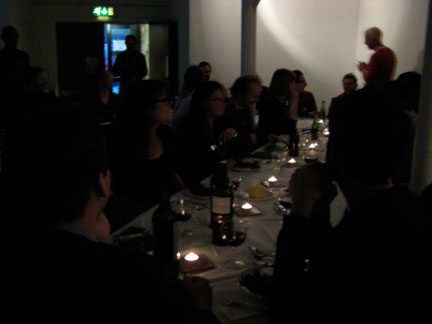
Ed Pien and Johannes Zits served an artists’ meal last night. I helped out because cooking is rad: teamwork, collaboration, being in the zone, etc. Ed and Johannes presented a carefully crafted menu that was in dialogue with a series of videos of their past performance work. For example, the salad’s baked goat cheese mirrored the moon in Ed’s animation of dancing silhouettes. The Greek goat stew went along with Johannes’ performance with a goat. The food was very high quality, and the artists, arts presenters and arts supporters in attendance made a beautiful cross-section of the Manchester arts scene. It was all sort of made possible with the hard work and vision of Bill and Maury (Maury’s out of town so Bill had to do everything from setting up tables to mounting the projector to serving the beer and making coffee.). These guys are the indefatigable cornerstones of the community here — I really admire that they can achieve so much, and still seem like friendly, relaxed people to boot.

I felt really privileged to be part of it — to squeeze in this happy experience before I left, and to feel like there’s so much more potential collaboration and goodness here that I have to come back.

Standard
Art & Development, Community, Research, Travelogue

Bits and Bobs

Detail from a drawing/sculpture in progress.

Detail from a drawing/sculpture in progress.

Cheap and cheerful

Here in Manchester, there’s a saying, cheap and cheerful. It means what it sounds like. For example, This and That is a tasty curry house that offers three items for £4.20; it’s praised as epitomizing cheap and cheerful.

I like the phrase because:

  • It’s thoroughly appreciative, even though Mancs can seem totally unsentimental.
  • It’s characteristic of something local: As Stuart Maconie put it in Pies and Prejudice,

    …many of the north’s market and mill towns … have become shrine[s] devoted to binge drinking and discount shopping.*

    Within a half-mile radius, there are three pound stores–Poundland, Pound World and Pound Empire, whose business name, confusingly, is Pound Kingdom–and one Quality Save.

  • It reminds me of a Chinese expression, which is nearly identical (literally, “has attractiveness, has cheapness”). For my ultra-frugal immigrant parents, no higher compliment could be paid.

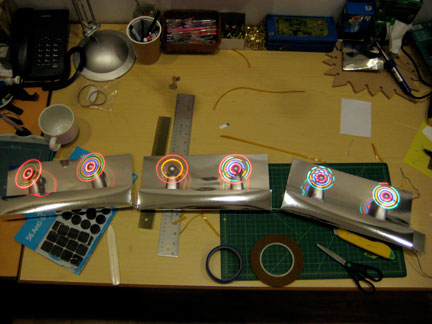
I’m about four days away from the Open Studio reception (Thursday, April 23, 5:30-7:30 pm, Chinese Arts Centre), so I’ve been working hard to finish several projects. Some are inspired by cheap and cheerful, so I’m making use of knickknacks from pound shops, like fans with multi-colored LEDs. Here’s a studio shot of the fans wired together to run on grid power instead of batteries, something I learned from this Instructables page.

Studio view

Studio view

Dan Graham, Tate Podcasts

Though I missed Dan Graham’s speaking engagements in the SF Bay Area this spring, I got his podcast lecture from the Tate. I enjoyed his talk, even without the pictures; he’s whip-smart, brisk, and completely free of affectation. For someone to have shown in as many Biennales and Documentas as he has, it’s very refreshing to hear him say in the same even, ego-less tone, that the Queen of Norway commissioned him to make a pavilion, so he made one on a fjord, it’s quite popular, and it’s referred to as a shower stall. Asides like this, from most other artists, would come across as false modesty.

Projections!

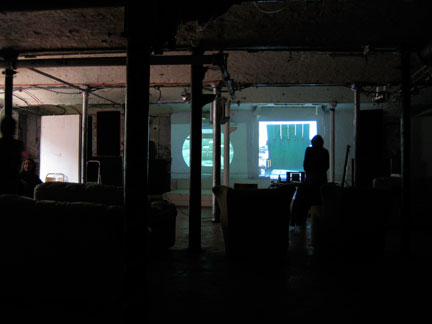
Preparing for T.S. Beall's artist's talk at Islington Mill

Preparing for T.S. Beall's artist's talk at Islington Mill

I enjoyed meeting Tara Beall, the artist in residence at Islington Mill, whose work is a fascinating combination of Arte Povera, webcam-sourced-video, boundaries, interstitial spaces, architecture, and installations that are a hybrid of kinetic art and video projections.

Her work seems in dialogue with the work of Ed Pien, whose new show at the Chinese Arts Centre is being installed right now. I’ve been getting sneak peeks of it — mirrors, projectors, cut paper, and macramé on the scale of architecture — and I think it’s going to be phenomenal!


*To be fair, Maconie also wrote, “Like [Manchester] at its best, [The Smiths] had glamor and gloom, winsomeness and wit; they were magical and proletariat all at once.”

Standard
Art & Development, Community

the art community in manchester: all right!

I’ve had the good fortune of sharing my work and investigations with loads of local artists and curators in and around Manchester. For example, yesterday, artist and curator Paul Harfleet was nice enough to open Apartment for one last visit before it closes permanently. The Plaited Fog artist’s collective generously had me up to Preston for a chat and a curry. (Warm thanks to artist and curator Elaine Speight and Rebecca Chesney.)

People usually want to know what I think of Manchester. Invariably, I start by talking about what I’ve learned about Mancunian temperments. I try to contextualize my thoughts as observations. Still, it’s quite surreal — and perhaps a bit presumptuous — to tell people what I think of their attitudes.

While I notice the tendency to down-play enthusiasm, in all fairness I’d like to add that I’ve experienced tremendous hospitality, curiosity, and engagement here. One of the obvious best things about Manchester is its investment in culture; a less obvious (for tourists of only the briefest stays) best thing about Manchester is the local artists’ and curators’ investment in art, culture and community. The art community members I’ve met have been very generous with their time, energy, resources and knowledge, for which I’m very grateful.

Here’s a completely subjective, incomplete list of some of the amazing arts partners in Manchester:

Manchester Art Gallery
City art gallery/museum; like all civic museums in England, admission is free. And people go. Brilliant.

Chinese Arts Centre

Chinese Arts Centre

Chinese Arts Centre
Not-for-profit gallery, residency, tea shop

Urbis
Art/design/arch centre with exhibitions about the urban environment

Cornerhouse
Not-for-profit gallery/indie film house

Castlefield Gallery
Not-for-profit artist led gallery, run by the indubitable Kwong Lee. Castlefield also does TheArtGuide.co.uk, a terrific email newsletter about art events in and around Manchester.

International 3 Gallery
(Semi-)not-for-profit artist-led gallery. Feels like The Mission District.

Whitworth Art Gallery
University gallery; large exhibition space, great contemporary programming. Home of the terrific, but under-publicized, Tuesday Talks, organized by Mr Pavel Bucher.

Cube
Art/arch/design gallery

Detail from Johannes Zits' installation at 20+3 Projects

Detail from Johannes Zits' installation at 20+3 Projects

Post-opening imperial pints at Jam Street Cafe

Post-opening imperial pints at Jam Street Cafe

20+3 Projects
An artist-run gallery based in a Heidi Schaefer‘s house.

Islington Mill
Artist-led art studio compound with an experimental art school and library, and occasional exhibitions and short residencies. Also functions as a music venue. (Tomorrow, Thursday 4/16, AIR Tara Beall, will talk about her work at 6pm.)

Rogue Studios
Art studio compound with occasional exhibitions

jeremy deller procession 2009
Love love love this banner, esp given the socialist history of Manchester.

Manchester International Festival
OK, Kanye, Kraftwerk, Lou Reed, Laurie Anderson, De La Soul and the Happy Mondays might get the big headlines, but Marina Abramovic at the Whitworth, a video installation scored by Damon Albarn, and Jeremy Deller’s procession sound amazing…

Standard
Art & Development, Community, Travelogue

Great Northern Art

AKA, “My Art Highlights from Birmingham, Liverpool, Stoke-on-Trent, Manchester and Leeds.”
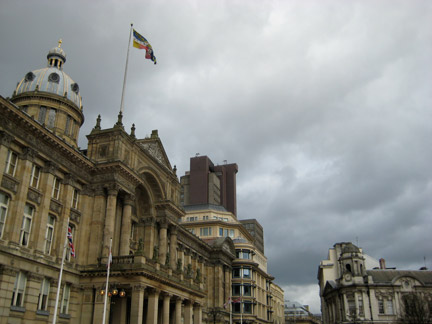
Grey clouds in Birmingham, UK

Grey clouds in Birmingham, UK

The Chinese Arts Centre offers a travel stipend for Breathe artists-in-residence to conduct research within the U.K. Earlier, I attended the Fly Eric symposium in Barrow, and the Global Modernities symposium in London. This past weekend, I, along with the good-humored traveler N.M., sought out contemporary art in Birmingham, Liverpool and Leeds. The skies were grey and misting, and clocks would not cooperate with us, but we pushed onwards and we were rewarded with some gems among these Northern industrial cities.

Birmingham & Stoke-on-Trent

I’ve heard that just as cars represent freedom to Americans, the rails are a symbol of escape for the British. I can see why: On the train to Birmingham, I found a quiet car, opened a good book, and felt that my modest expectations—passing scenery and a period of uninterrupted time to think—were all fulfilled. I was flooded with a sense of contentment.

Since I visited Annette Messenger’s exhibition at the Hayward Gallery in London, I’ve been thinking about her premise that one cannot talk about happiness without clichés. It’s a maxim I find both truthful and discouraging, so unexpected contentment, in its minor way, is somewhat miraculous.
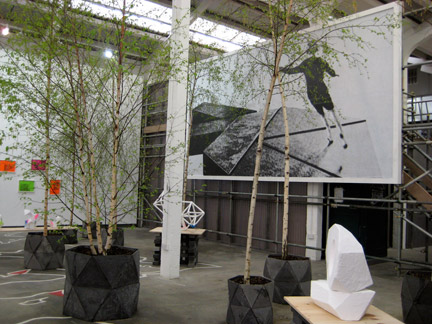
Simon and Tom Bloor's exhibition at Eastside Projects

Simon and Tom Bloor's exhibition at Eastside Projects

Contemporary art can require a sense of adventure—sometimes quite literally. On the quest for it, you will find yourself on the ‘wrong’ side of the tracks in strange cities, seeking out alternative art spaces with little to no signage, and having faith that the artwork will be cutting edge and worth the effort. Such was the case with Eastside Projects. Nestled between junkyards and auto shops, this artist-led gallery is a spacious, high-ceilinged warehouse showing top-notch contemporary projects. It’s keen on conceptualism and new media (it features a semi-permanent Lawrence Weiner text work and a large video screening room, and the office is housed in an absurdly impractical structure made by artists). The current exhibit, Simon and Tom Bloor’s “As Long As It Takes,” is visually attractive, conceptually rigorous, and cunningly specific to Birmingham. The twins present new sculptures, watercolors, drawings, a billboard and a limited edition print around the history of local modernist public sculptures. The shapes of the geometric models are strangely familiar—one recalls the structure in San Francisco’s Justin Herman Plaza. Like Aaron Curry, the Bloors use spray paint to defile Modernist purity. But a series of hand-painted watercolors, reproducing satirical newspaper cartoons complete with halftone dots, makes clear that the process of appropriation transforms the originals. Here’s what I mean: “high” modernist sculptures were parodied in a “low” editorial art from, which the Bloors re-made as “high” conceptual art. Brilliant! I really enjoyed the show, as well as Eastside Projects’ founder’s eclectic publications, including a series responding to R. Buckminster Fuller’s 40 Strategic Questions.

Armando Andrade Tudela. Untitled (Rattan 4), 2009, Rattan, metal, wood, Installation view, Ikon Gallery, 2009, Photo: Stuart Whipps
Armando Andrade Tudela. Untitled (Rattan 4), 2009, Rattan, metal, wood, Installation view, Ikon Gallery, 2009, Photo: Stuart Whipps.
Source: IKON Gallery.

In the sunny side of town, IKON Gallery is an ICA in a converted cathedral, and it had the rare distinction (for this part of the U.K., anyway) of showing projects by three international artists. I was most impressed with the work of Armando Andrade Tudela, a Peruvian video/sculpture/installation artist. I really liked his installation involving only a sheet of survival-blanket mylar pinned to the wall by an industrial sheet of glass. It created two overlaid reflections: the glass offered a barely perceptible, but undistorted, reflection; the mylar, a picture of a fractured self. It made me think of Dan Graham’s use of sheet glass as a metonym for corporate power. This wasn’t Tudela’s expressed intention, but I noticed that other works, including walls skinned with pegboard, and woven works that were equal parts baskets and paintings, played with moiré patterns and perceptions too.

Also at the IKON, Manthia Diawara presented “Maison Tropicale,” a documentary video airing the perspectives of the former owners of Modernist prototype homes, which were later purchased by Ângela Ferreira for an exhibition at the Venice Biennale and re-sold at much higher prices. I found the story captivating, though the art and post-colonial politics were a mess, underscoring that there are no easy solutions, but an excess of guilt to go around.

Stoke-on-Trent

Richard T. Walker's   it’s hard to find you because i can’t quite see what you mean to me.  2009

Richard T. Walker's it’s hard to find you because i can’t quite see what you mean to me. 2009

Just before my residency, I was so busy I missed “Trying to Cope with Things that Aren’t Human (Part One)” at David Cunningham Projects in San Francisco. Luckily, the curator, Ian Brown, is based in this part of England, and brought the exhibition to Stoke-on-Trent’s airspace gallery. Richard T. Walker’s slide show of waving “hi” and “bye” to the sun is endearing. In the back room, two identical glass spheres are topped with polar caps that are revealed inside as icebergs.

Liverpool

Markus Hansen's Other People's Feelings, Courtesy of VirgilGallery.com
Markus Hansen’s Other People’s Feelings. Source: VirgilGallery.com

“Until it Hurts”, a four-person exhibition at Open Eye Gallery, is organized around the mutability of identity, a theme in photography that can seem exhausted or obvious. Thankfully, two particular works in the show are precise and effective. Josh Weinstein’s video, “Cross Examination” (2005), is a quirky, feel-good documentary of strangers on the streets of New York hazarding guesses about the artist based on his, how do you say, humble appearance. The responses are weird, wonderful, presumptive and sometimes rude, but the artist maintains a disarming smile throughout. The effect is that viewers learn very little about the artist (except, maybe, that he’s enormously self-composed, and his art is rather generous), and a lot about the assumptions of others. Markus Hansen‘s “Other People’s Feelings” (2000-5) sequences pairs self-portraits with headshots of others as a video. In each self-portrait, the artist mimics the other people. It’s enchanting to compare and contrast Hansen’s feat of emoting, acting and photographing.

David Osbaldeston's Your Answer is Mine, 2006. Source: MattsGallery.org
David Osbaldeston’s Your Answer is Mine, 2006. Source: MattsGallery.org

In 4×4 at the Bluecoat, David Osbaldeston presents a text-based billboard in mixed media, combining intaglio with digital reproduction, 19th century letterpress style with 21st century hand-done graphic design, and critical theory with vaguely subjective pie charts. The billboard’s lack of color, but richness of grey, is startling. Its paradoxes engage.

N.M. and I also stopped at the Tate Liverpool (Melanie Smith’s painting/video/installation in the DLA Piper show is still fantastic, as are William Blake’s bookplates) and the International Slavery Museum, which takes a frank look at how English slave traders and industrialists participated in and profited from slavery in the American South like cotton and sugar. (A U.S. National Slavery Museum, long overdue, is being constructed in Fredricksberg, VA, by the way.)

Manchester

“Small world.”

I am always surprised—though I shouldn’t be —when I come across references to the San Francisco Bay Area here in Manchester. For example, by chance, I read a book in Birmingham in which the narrator attends a lecture at CCA. And the traveling exhibition on Emory Douglas, Minister of Culture for the Black Panther Party, is now at URBIS, just a few blocks from the Chinese Arts Centre. I met Emory in Oakland years ago. I never would have put “Emory Douglas” and “Manchester” together. Luckily, someone at URBIS did. The quality of the exhibition is phenomenal, and Mancs should take note.

The whole exhibition—art, graphics, displays, historical context, and multiple voices and personalities—makes for a vibrant, thorough, interactive experience. I was happy to see lots of visitors taking their time absorbing the show, which in turns inspires shock, rage, pride, admiration, outrage, grief, and gratitude.

At Cornerhouse, I watched 24 Hour Party People, a movie about the early nineties Madchester music scene. I loved every minute of it. It’s the story of Tony Wilson—impresario, BBC personality and music promoter. He is portrayed with searing wit, a touch of madness, egomania, and an unflappably stiff upper lip. When he breaks the “fourth wall” of the film, it doesn’t make you feel like he’s over-explaining the narrative, but somehow helps to speed it up; aware, as brilliance is, of the fleeting nature of good times.

Leeds

Perhaps my art tolerance was starting to flag, but Leeds bore the brunt of a more intensely critical eye. Asta Gröting’s exhibition at Henry Moore Institute was pretty good, even if I felt mostly pushed away by the hermetic sculptures, which varied wildly from spooky kinetic hemispheres around office chairs, to brass “potatoes” in chiseled angles, to an oversized clod of earth with no discernible referent, to a silicon cast of intercourse, to a Mona Hatoum-like beaded cage. I couldn’t sew it all together; the works seemed completely discrete in form, content, concerns. The only thing I could make sense of is the fact that Gröting was a student of Joseph Beuys; this may be stereotypical, but I find some meaning in the fact of her German-ness, as I’ve felt similarly—locked out of deadly-serious Art with a sense of mirthless laughter—about Martin Kippenberger’s work too.

Keith Arnatt, from Self-Burial in 9 photographs, courtesy MediaArtNet.org
Keith Arnatt, from Self-Burial in 9 photographs. Source: MediaArtNet.org

Upstairs, the work of Keith Arnatt, an early adopter of American Minimalism, Conceptualism and Performance Art in Britain, is represented with a modest selection of black-and-white photographs, a text work, and a series of color sketches of geometric sculptures. I liked the photograph documenting a cubic hole in the earth lined with mirrors. Very simple stuff that any art student today might come up with, but at the time it was on the pulse of a movement, or two. I also liked “Self-Burial in 9 Stages,” a series of photographs documenting, well, the artist burying himself standing up, until only a patch of wavy hair is visible in the newly-turned earth. It really resonated with my recent thoughts about the dissolution of self in installations like Gregor Schneider’s Kinderzimmer (see Claire Bishop’s Installation Art, Tate, 2005), or the dissolution of the artist as in Josh Weinstein’s video at Open Eye Gallery, or the implicit denial in Chu Yun’s work (see Philip Tinari’s profile in the March Artforum, or this year’s Venice Biennale, whichever is handier). Incidentally, the trooper N.M. had a complimentary experience, engaging the drawings and passing more quickly over the photographs. Admittedly, given the chronological distance, the photos lack urgency, and while I’m usually not bothered by a gallery’s white-cube-ness, the presence of earthworks by way of only photos made the gallery seem especially sterile.

At the Leeds Art Gallery, I was intrigued by Shahin Afrassiabi’s installation, “Jalousie Gelocht, Als Blend Schultz” (2003), which is comprised of mundane objects like a television with nothing in particular onscreen, a roll of wallpaper, a table, a lamp, a funny blue geometric painting, etc. It was memorable because the TV emitted a brief, cheerful instrumental song. The pleasure was surprising, because I find that many installation artists create theatrical tableaux that rely too heavily on a “reading” of pathos to be meaningful.

I also enjoyed Angela Bulloch’s cubic sculpture, “Extra Time 8:5,” which was reminiscent of both Minimalism and sort of also a TV set. Furthering this mimesis is the fact that the single-pixel screen changed colors according to a BBC program.
Standard
Art & Development, Community, Travelogue

new manc art highlights

Islington Mill Studios; hallway.

Islington Mill Studios; hallway.

The Dilemma of Archive
New library
Islington Mill

Islington Mill is a really cool artist-initiated studio compound with a gallery, performance venue, experimental school, and now, a new library focusing on art books. I find the whole idea of the place very grassroots, appealing and innovative.

detail of installation by Maurice Carlin

detail of installation by Maurice Carlin


detail of installation by Maurice Carlin

detail of installation by Maurice Carlin

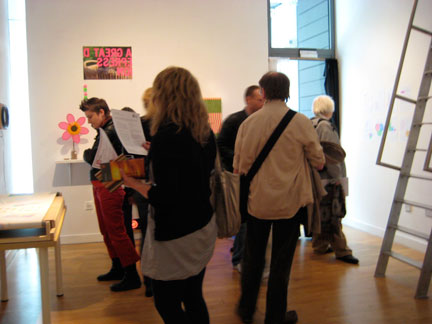
Last night, I attended the opening of The Dilemma of Archive, a show featuring the work of Maurice Carlin and G. Leddington. The exhibition space is a disused studio — about the size of a bedroom, maybe 15×12 feet. But the modest space held a really tight grouping of four works, which were peculiar and quiet and rewarded sustained attention.

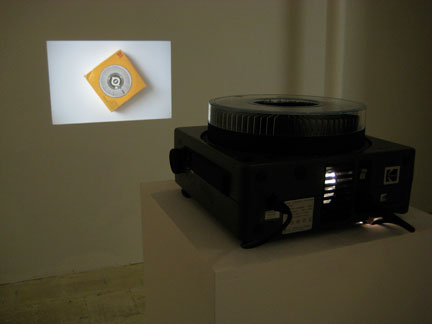
Slide show/installation by G. Leddington at Islington Mill

Slide show/installation by G. Leddington at Islington Mill

I really liked G. Leddington’s slide show of a turning carosel box, which reminded me of the work of Anne Collier and Tacita Dean. But Leddington’s accompanying works — photo prints of obscure articles, book plates and photos relating to Henri Michaux, art collector/smuggler swung the content away from the project of photography and back towards the archive.

My contribution to the new library.

My contribution to the new library.

The curatorial statement is quite smart, pointing out the paradoxes inherent in any archive — exhibitions, art collections or libraries. I really liked the high conceptual quality and grassroots venue partnered with the new library initiative. I keep telling people that Manchester is a cool city, and if they can look past the binge drinking and American-style malls, they’d see the local points of vibrance like Islington Mills.

Gregor Schneider‘s Kinderzimmer
Subversive Spaces
Whitworth Art Museum

I couldn’t be bothered to see this pitch-black, one-viewer-at-a-time installation — the wait times were always long, but today, by happenstance, I was able to get in after a brief 10-minute wait.

I won’t spoil what’s inside for those who yet to see it, but I will say this:

I found it extremely effective. It was emotional — the darkness was so complete it was terrifying, and upon exiting, my sense of relief gave way to a curious ecstasy. It was provocative and I experienced a sense of convergence between:

  • Dan Graham’s interest in the just-past
  • In Claire Bishop’s Installation Art: A Critical History (Tate 2005) darkness and the dissolution of self…
  • …and how Kinderzimmer manages to include pure phenomenology, mimesis and representation
  • how Schneider exploited the flaws in human hardware
  • how the installation achieved high aspirations in spite of the humble materials
  • grief and existential subjectivity
Standard
Art & Development, Community, Travelogue

thameside art highlights

Shadows and lights on the Queen's Walk, Thameside, London. Sorry, none of the exhibitions allowed photography. What you see is what you get.

Shadows and lights on the Queen's Walk, Thameside, London. Sorry, none of the exhibitions allowed photography. What you see is what you get.

Some highlights from my recent trip to visit museums in London. It seems like there’s never enough time in London, but I hope to make it back for galleries and more fun.

Annette Messenger
Mark Wallinger Curates The Russian Linesman
Hayward Gallery

Messenger is amazing. The exhibition makes evident how she was influential in the development of installation art. The work highly symbolic and theatrical — “a dreamscene tableaux,” as Claire Bishop might describe it — so it’s not exactly my favorite type of installation art, but I was profoundly moved nonetheless. In particular, I really liked “Articulated/Disarticulated,” (see a photo on Urban Landfill blog) a recent, room-sized installation where stuffed human and animal forms were mechanically tortured. It really captured the essence of her dichotomies — both comical and horrifying, humorous and tragic, magical and corporeal. “Casino” is a giant installation — the most phenomenological of the works on view, I think — and it’s stunning.

Wallinger curated a show that probed perception and thresholds. Artifacts are mixed in with contemporary and historical works. It’s a really perceptive show. Fred Sandback’s space delimitations looked fantastic. I knew that the rectangular outline was comprised purely of black string, not glass or some other solid surface, but I tried to bring myself to interrupt the immaterial plane and I couldn’t. Good stuff.

Wallinger’s also got some of his own work, mixed in with a series of 3-D viewfinders of historical photos. They set a high expectation for excellence for the show, and it doesn’t disappoint.

Roni Horn
Rodchenko & Popova
Tate Modern

Horn’s work is highly idiosyncratic. I’m still mulling it over — especially the strange groupings of photographs, including the signature weather/model image — but two things immediately stuck. First, of course, I enjoyed “The Opposite of White” dyad — giant, solid cast glass sculptures in transparent glass and opaque black. Two irreconcilable, but true facts: white reflects light, hence its opposite is transparency; or is its opposite that which absorbs light (black)? Second, you have to see Horn’s hermetic, strange drawings. Reproduction doesn’t do them justice. They’re extreme — a pattern is loose and gestural, pencil marks diagrammatic, and cuts and inlays mechanically precise. They’re astounding, quiet feats, really.

Rodchenko & Popova is a major survey of the dynamic output of two pre-Stalinist artists. Paintings, graphic works (pleasingly tight in pen, weirdly wonky in color crayon, of all things), letterpress publications, films, textile design, furniture, posters, 3-D constructions, photographs and did I mention motion graphics?—means that there is loads to look at and appreciate. I really ‘get’ the Constructions in Constructivism now, and formally appreciate the simple compositions of repeated lines and circles. Most of all, I came away with the sense of avant garde fearlessness, as the couple was unafraid to make clean breaks from previous art styles, even their own. They formulated many new platforms and embraced integration and service to the public.

Altermodern
Tate Britain

Nicolas Bourriaud curated this triennial of mostly British artists. Bourriaud has coined “Altermodern” to describe an in-progress theory about the globalized, interconnected epoch to follow Postmodernism. He casts the artist as “homo viator, a traveller whose passage through signs and formats reflect a contemporary experience of mobility.” When I turned my gaze from the Tate Britain’s impressive pediment towards the Thames (where it’s easy to recognize the seat of imperial power), I wondered how fully a British art institution could embrace a new, multi-polar, Zakarian world. My skepticism was corroborated, when, in Global Modernities, the coinciding symposium, Walter Mignolo labelled the theory “a Eurocentric critique of Eurocentrism.”

I think altermodern an interesting term, and it may be useful for categorizing some existing themes in art — transitional sites (e.g., Walead Beshty’s FedEx boxes, “transit-specific works” as Galleon Trade colleague Eric Estuar Reyes would put it, see video at the Whitney 2008 Biennial site) and liminal states (Spartacus Chetwynd’s beanbag installation with psychedelic performative video, or Gustav Metzger’s crystal light show — I shit you not). The triennial is sort of, well, triennial-y: giant, well-executed spectacular installations, some big names, and limited thematic connections. Here’s what stood out:

Franz Ackermann posits what seems to be a critique of immigration and national identity. (Pics on ArtNet.)

Darren Almond delivers surprising, stunning photographs as usual.

Peter Coffin‘s staged projection- and installation-based museum exhibition, where photos and videos are projected on works from museum collections, e.g., bees on a painting by Joseph Albers. A virulent strain of MJT uncanny.

Navin Rawanchaikul‘s hand-painted Indian-style movie billboard is a riot; the accompanying documentary video of interviews of Indians who’ve relocated to Thailand seems pedestrian and conventional by comparison.

Bob and Roberta Smith create a “junk space” (as identified by Irit Rogoff, the consequences of global modernity) littered with disused stuff and the characteristically ironically upbeat-but-sad-sack enamel signs. One, “I wish I could have voted for Barack Obama,” (pic on ArtNet) is paired with a colorful plastic tricycle, highlighting the wishful thoughts of Britons. Smith pointed out that the exhibition is meant to be interrogative, but I think it’s pretty cool to have an explicitly didactic space within it via his signs. Extra points to Mr. Smith for avoiding the common UK mispronunciation of Barack (“BER-rick,” as opposed to “Buh-RAWK).

Simon Starling illustrates his brilliant reduction of forms with a series of desks commissioned by emailing low-resolution photographs to furniture makers. There’s more to it, of course, having to do with Francis Bacon and others, but the gesture is pure poetry.

Tate-to-Tate ferry
Brilliant, easy, scenic, affordable. You know, art institutions usually have short hours, so minimized travel during open hours is appreciated. Also, “Tate-to-Tate” is a nice sounding phrase, like a mirror, and also reminds me of the 1980s TV show, “Hart to Hart.”

Reconnecting with Mediha

This quote.
As an existentialist, I tend to agonize about my art/legacy/life becoming fodder for “the dustbin of history,” so it was surprising to hear the ever-optimistic M.D. say: “The great thing about history is that things disappear” in regards to the dominating influence of Conceptualism and Minimalism in contemporary art today.

Standard
Art & Development, Community

Points of reference: 15 Feb 2009, 1306 GMT

This video of artist Ryan Gander talking about his exhibition, “Heralded as the New Black” at IKON Gallery, Birmingham’s top-notch ICA.

Drawings by Donald Urquhart, an Edinburgh-based 2-D artist. His older works (online at Maureen Paley Gallery, London’s Bethnel Green) remind me of Candyass’ jokey text works (see them at Alexander Gray Associates, NYC) and Tony Garifalakis‘ heavy metal-influenced work. Drawings like “An Alphabet of Bad Luck, Doom and Horror” (2004) are charming, if a bit juvenile and 1990s. So it’s interesting to see Urquhart’s successive turn. Newer works look like Vija Celmins’ photorealist drawings conceptually paired with monochromes (see a photo and review on The List) Interesting!

Maria Fusco’s “Report: Contemporary Art Writing and it’s environs” on Map Magazine, based in Scotland.

Why didn’t [the] Brooks [Memorial Art Gallery] — and other museums that practiced racial segregation de jure — create two collections: one for whites and one for blacks? After all, segregation laws had doubled other public facilities: water fountains, schools, hospitals. This answer is more obvious. If there had been two collections — or two museums — the ‘white’ one could no longer make a claim to be universal. Art for ‘whites only’ would be particular, representing only white taste. Letting ‘negroes’ into the public museum one day a week was an unavoidable way to guarantee the universality of what was, in effect, purely white culture. It was not enough to marginalize African Americans; they were required as silent witnesses to their own exclusion by a supremacist culture masquerading as a universal one.

Jenifer Allen’s “Colour Theory: The history of racial segregation in American art galleries and contemporary identity politics.” Frieze Magazine. Issue 120. January-February 2009.

Allen does a great job of articulating the privilege of white racelessness. In art, white (often male) figures are sometimes used to convey universal emotions, truths or experiences. You see this a lot in combinatoric mass culture kitsch (as Johanna Drucker puts it). I’ve been guilty of this before. Which maybe explains why I no longer relate to art that employs stylized raceless (read white) figures to get at vague, larger truths or somehow hint at the subconscious.

Standard