Art & Development

Reasons to Get Excited

The art fairs are coming to NYC this week: Armory, Pulse*, Independent, VOLTA, Red Dot, Scope, ADAA, Fountain, and Verge [see Artcard.cc’s Art Fair Google map] not to mention the slew of concurrent activity. But in the San Francisco Bay Area, I’m missing out on the solo shows of some dear friends. These are people who work super hard and are finally getting their due. See what they’ve been toiling at.

March 12-April 9
Pablo Guardiola
Jet Travel

Reception: Saturday, March 12, 6-9pm.
Romer Young Gallery
1240 22nd Street, San Francisco
Gallery hours: Tuesday & Thursday, 6-9; Friday & Saturday, 11-5, and by appt7

March 4-April 1
Charlene Tan
400%

Reception: Friday, March 4, 6:00-8:30pm
Ampersand International Arts
1001 Tennessee Street (at 20th. st.)
San Francisco, California 94107
Gallery hours: Thursdays and Fridays, noon-5pm, and by appointment

Details TBA: ~ April 1
Anthony Daniel Ryan

Lake Gallery, San Francisco

Plus, Weston Teruya has curated a show with some great artists…

March 11-April 23
On The Ground
Taha Belal, Gaye Chan, Sofia Cordova, Sergio De La Torre, Malak Helmy, Juan Luna-Avin, Jerome Reyes, Rene Yung

Reception: Friday, March 11, 2011, 7-9pm
Southern Exposure
3030 20th Street (@ Alabama)
San Francisco, CA 94110
Gallery Hours: Tuesday-Saturday, 12-6pm

I designed the poster… We were inspired by maps and blue lines.

On the Ground, Southern Exposure poster. Design: Christine Wong Yap.

Poster for Southern Exposure's exhibition, On the Ground. Design: Christine Wong Yap.

*Art in General‘s booth at Pulse to preview a new multiple by William Pope.L!

Standard
Art & Development

The Odds

While creating graphic representations of the odds of art competitions is not the most optimistic thing to do, I like how these graphics look, and with so many deadlines falling around March 1st, it seemed like a good time to post a few more.

Art Omi’s International Artists’ Residency received over 700 applications this year for 30 residency openings.

///////////////////////////////////////////////////////////////////////////
///////////////////////////////////////////////////////////////////////////
///////////////////////////////////////////////////////////////////////////
///////////////////////////////////////////////////////////////////////////
///////////////////////////////////////////////////////////////////////////
///////////////////////////////////////////////////////////////////////////
///////////////////////////////////////////////////////////////////////////
///////////////////////////////////////////////////////////////////////////
///////////////////////////////////////////////////////////////////////////
///////////////////////////////////////////////////////////////////////////

or 1:23, or 4.2%

The webpage of Creative Capital’s 2011 Visual Arts Grant states, “we will support approximately … 23 projects” and “We anticipate up to 1500 Letters or Inquiry will be submitted.”
///////////////////////////////////////////////////////////////////////////
///////////////////////////////////////////////////////////////////////////
///////////////////////////////////////////////////////////////////////////
///////////////////////////////////////////////////////////////////////////
///////////////////////////////////////////////////////////////////////////
///////////////////////////////////////////////////////////////////////////
///////////////////////////////////////////////////////////////////////////
///////////////////////////////////////////////////////////////////////////
///////////////////////////////////////////////////////////////////////////
///////////////////////////////////////////////////////////////////////////
///////////////////////////////////////////////////////////////////////////
///////////////////////////////////////////////////////////////////////////
///////////////////////////////////////////////////////////////////////////
///////////////////////////////////////////////////////////////////////////
///////////////////////////////////////////////////////////////////////////
///////////////////////////////////////////////////////////////////////////
///////////////////////////////////////////////////////////////////////////
///////////////////////////////////////////////////////////////////////////
///////////////////////////////////////////////////////////////////////////
///////////////////////////////////////////////////////////////////////////

or 1:65, or 1.5%

See more art competition odds.

Standard
Community

America Now and Here

M is involved in this new contemporary art initiative, and it’s super exciting! After 9/11, Eric Fischl started this project involving loads of contemporary artists to start dialogues throughout the country. They are gearing up to tour soon and bringing killer artists to Kansas City first, with more cities to be announced…

I love that it’s sort of civic but in a grassroots way, and totally artist-initiated. Despite the divisive political climate, there is still much that connects us, and art can play a role. Getting to see some of the country firsthand when I drove cross-country last summer really made me excited about the range of regional identities and cultures that are all uniquely American. The prospect that contemporary art can help to generate a dialogue about America and our hopes is too good to pass up.

I think on-the-ground cultural exchange like this can have so much potential (just ask Antonio Carlos Joabim and Dizzy Gillespie). I promise you’ll be excited about these artists as I am…

America: Now and Here

“The idea is simple. Let’s find a theme that everybody shares and build a dialogue around it. Our theme is America. We’ll start by sharing our ideas and experiences through the art that we make. Now, it’s your turn. Let’s use art to have a dialogue about America.”
—Eric Fischl

Standard
Research

Happiness Infographics

Via ET and FlowingData.com:

'life is simple' by Moritz Resl

Moritz Resl, Life is simple, digital art print, 16x16 inches / 42x42 cm, Open edition.

Source: MoritzResl.net

I like these infographics, even if they are a bit simplistic, they’re upbeat.

Are you happy?

By H34DUP and David Meiklejohn. Source: blog.h34dup.com

A quibble: humans adapt to positive emotions quite readily, as Phillip Zimbardo and John Boyd wrote in The Time Paradox. So the advice “Keep doing what you’re doing” would probably maintain happiness, but only for so long. Humans also need novelty, variation, and new challenges.

Cheap and Cheerful #5

Christine Wong Yap, Cheap and Cheerful #5, 2009, neon and glitter pen, 11.625 x 7.75 inches / 29.5 x 45 cm. Produced in the Breathe Residency at Chinese Arts Centre.

Plus, for you-know-whats and giggles (unless you’re an information graphics designer for which chartjunk is a curse upon the earth of Biblical proportions):

The usually illustrious Christoph Nieman’s illustration for Portfolio.com:

Illustration by Christoph Niemann

Illustration by Christoph Niemann for article about personal wealth and happiness on Portfolio.com

Standard
Research

Art info round-up

M recently asked me about good sources for art news. It’s a great question because I wouldn’t think to answer it. But actually, more art news sources have sprouted up the past few years, so it might be well worth an overview now.

Email lists

First off, to hear about artists you’re interested in, sign up for museum and gallery email lists. Many artists also have websites and mailing lists of their own. College and university art programs will inform you of visiting artists’ lectures.

If you’re already struggling to slay the email dragon, set up a separate email address for newsletters. This is especially useful for heavy, but informative, mailers such as the largely international e-flux, Art Agenda and Art & Education.

I am most excited about…

Art Practical
A bi-weekly online critical journal with features, critical reviews, and 250-word Shotgun reviews based in San Francisco, CA, with contributors in far-flung cities. Their news section, updated a few times a week, is nicely well-curated. Art Practical cultivates emerging critics while maintaining high editorial standards. [Disclosure: I am a contributor.]

Open Space
The blog of the San Francisco Museum of Modern Art, with invited contributors selected from distinguished curators, poets, writers, and artists. The writings can be very speculative and interdisciplinary. I think it’s one of SFMOMA’s most promising ventures. [Disclosure: I will be a contributor March through June this year.]

Frieze Magazine
UK monthly magazine. Rigorous, critical, yet not too obscure, and beautifully designed to boot. A nice view into UK and European art scenes.

Artcards.cc
A great way to get weekly round-ups of openings.

For criticism, I also try to check out…

NY Times
I find Holland Cotter’s critical writing astute.

LA Times’ Culture Monster
Reviews of exhibitions around LA, with the occasional amazing essay or op-ed.

Art Papers
An Atlanta-based print magazine with sound writing and design.

Artforum
The phone book-sized monthly glossy behemoth everyone loves to hate. Not sure why the gossip column, Scene & Herd, always leads the website, while the print issue is anchored by weighty essays and critical reviews from around the world. Yet, it’s one of the main sources for a reason.

New York Magazine
The populist critic Jerry Saltz is straightforward and often enthusiastic. Some people have a problem with that, but I don’t.

From the source…

Frieze Foundation podcast talks
Listen to well-produced lectures and panels from artists, writers and curators. I appreciate the high level of dialogue at the Frieze talks.

Bad at Sports
A deliberately informal, low-tech, interview-based podcast. The interviews are most compelling when guests bring a lot of energy and focus to the mic.

Most recently, my curiosity has been piqued by:

Fillip
A newish magazine/website/podcast out of Vancouver, BC.

Art 21 Blog
The blog of the fantastic PBS contemporary art TV series. In the coming months, VG will be a contributor; (I designed her column mark), and I’m looking forward to her thought-provoking posts.

When visiting different cities, I usually try to find…

Art Info’s Gallery Guide maps.

There’s lots more:

Art in America, the typographically-challenged Art News, Brooklyn Rail, the art internet “channel” Art Babble, Happenstand, Art Rabbit, Art Review, Bomb, the super-brains’ journal October, Cabinet, and SB’s Artopic.

Apologies for the many others that I’ve missed. It’s not for want of interest, merely, for want of time and energy after the end of a long week making, installing, photographing, re-touching, writing about, looking at, planning, and collaborating on art. And anyway, I think this answer’s Ms question.

Standard
Art & Development, Community, Research

Works in Progress

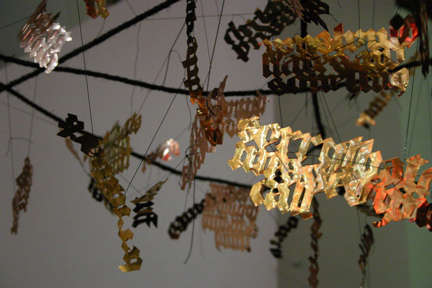
Christine Wong Yap Work-in-progress view of Cloud II (Aura / Good Thoughts) 2011 mixed media installation: Glitter foil on board, 3-D illusion plastic, fun fur yarn, thread, elastic, hula hoops, beads dimensions vary

Christine Wong Yap, Work-in-progress view of Cloud II (Aura / Good Thoughts), 2011, mixed media installation.

I’ve been working on a new cutout text installation for a forthcoming group exhibition. It will be an optimistic, exhuberant update to my copper and elastic installation, Cloud.

Cloud (installation view), 2006, copper, rope, elastic, monofilament, 7 x 6 feet / 2.1 x 1.8 m

Cloud (installation view), 2006, copper, rope, elastic, monofilament, 7 x 6 feet / 2.1 x 1.8 m

The original installation was comprised of mundane, mindless texts, such as “hey, it’s me, are you busy now?” The new iteration uses spoken, written and emailed texts from my life that express happiness, gratitude, or empathy. It will be made of colorful materials like 3D illusion plastic and glitter foil.

Your wish has come true

Work-in-progress view of hand-cut glitter foil on board. Text: “Your wish has come true.”

February 28 – April 1, 2011
Portraiture: Inside Out
Opening Reception: Thursday, March 3, 5—9pm
An exhibition of contemporary portraiture. Curated by Ruth Ballester, Whitney Fehl and Lauren Thompson, Graduate Students in the Museum Professions Program.

Artists: Sarah Bliss, Dominic Guarnaschelli, Gwen Hardie, Jenny Hyde, Pat Lay, Greg Leshé, So Yoon Lym, Ryan Roa, Steve Rossi, Jesse Eric Schmidt, Travis LeRoy Southworth, Tanja Targersen, Peter Whittenberger, Christine Wong Yap, Raphael Zollinger

Opening Reception: Thursday, March 3, 5–9pm
Walsh Gallery at Seton Hall University, South Orange, NJ
Gallery hours: Monday–Friday, 10:30am–4:30pm

Also in the exhibition, by chance, are two members of the collective, Brolab, who I met through volunteering for the Art in Odd Places festival, and whose work I enthused about, last fall.

Random & Rad:

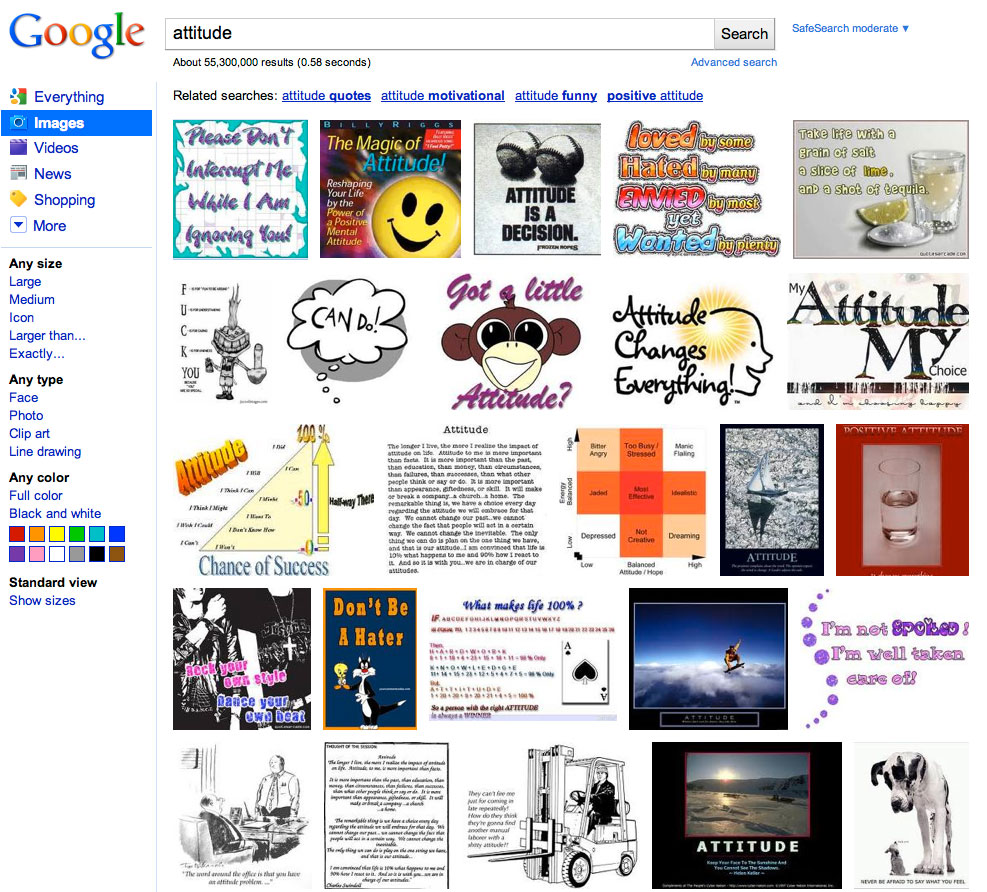
I did a Google image search for “attitude” and this is what came up:

Google image search results for Attitude

I love the mix of results! Trashy, jokey mottos alongside sincere (if simplistic) mantras for optimism. Just the first row is brilliant: unapologetic crudeness underscored by a sassy type treatment, self-help clichés (positive thinking, magic, happy face), motivational sports maxims, more unapologetic crudeness plus sexual egomania, and a party-goer’s mantra. It sort of exemplifies American ignominy as well as the desire for inspiration and the futility of oversimplified positive thinking. It presents lowbrow poles of irony and sincerity.

Standard
Artists, Community, Research

College Art Association: artists, ideas, inspiration

[Apologies for the duration since the last post. I’ve been busy working towards an exhibition—Portraiture: Inside Out, opening at the Walsh Gallery at Seton Hall University in New Jersey on March 3rd. I’ve also been preparing for a stint as a contributor to SFMOMA’s Open Space blog from March through June.]

———

The College Art Association (CAA) 2011 Annual Conference is in New York this week, so I took some time out to attend. I first heard of the conference from classmates seeking academic jobs, but it turns out that the conference has a lot to offer non-job-seekers as well.

My personal highlights are:

During the “Data As Medium” panel, Brian Evans (University of Alabama) talked about cognitive linguistics (someone’s been reading Lakoff/Johnson!) and found similarities between Kandinsky’s point-line-plane schema with databases’ variable-array-table. He also drew parallels between the hierarchy of information (noise-data-info-knowledge) and the experiential spectrum (reality-sensation-perception-cognition). I was fascinated.

Penelope Umbrico, Img Collection #6: Universal Remotes, (for sale on the Internet)

Penelope Umbrico, Img Collection #6: Universal Remotes, (for sale on the Internet). Source: PenelopeUmbrico.net

Penelope Umbrico, For Sale/TVs From Craigslist

Penelope Umbrico, For Sale/TVs From Craigslist. Source: PenelopeUmbrico.net

I adored the artist’s lecture by Penelope Umbrico (Bard College and School of Visual Art). She uses mundane sources like Flickr and Craig’s List to find images of mundane things, like sunsets and armoires. What made her talk especially engaging and funny is the way she structured her narrative to follow her thought process. First came the sunsets, then armoires followed, then televisions. Then photos of people in front of her installations of photos of sunsets at museums, such as the nice installation at SFMOMA’s 75th Anniversary collection show. The worm eats itself.

Curiously, Umbrico cited numerous authors already on my list of to-reads:
Walker Percy, a 20th century fiction and non-fiction writer interested in cognitive science; Vilém Flusser, a Czech philosopher whose writings are oft cited by artists; and Milan Kundera, Czech author of books like The Unbearable Lightness of Being.

The discussion was especially provocative after reading “The Postmedia Perspective,” a recent article by Domenico Quaranta on Rhizome.org (brought to my attention by the astute and curious ET). Quaranta, summing up Peter Weibel, says:

postmedia art is the art that comes after the affirmation of the media; and given that the impact of the media is universal and computers can now simulate all other media, all contemporary art is postmedia.

Or in Weibel’s words:

This media experience has become the norm for all aesthetic experience. Hence in art there is no longer anything beyond the media. No-one can escape from the media. There is no longer any painting outside and beyond the media experience. There is no longer any sculpture outside and beyond the media experience. There is no longer any photography outside and beyond the media experience.

I also attended “Making a Living With or Without a Gallery,” in which the panelists could offer little beyond common sense career advice (dealers aren’t parents {or peyh-rints, in the New York idiom}; getting a gallery is not an end; artists should make their own scene). Thus my highlight was running into art critic Jerry Saltz. I think his writing is accessible, smart and unpretentious. Indeed, I’ve heard people say that the New York Magazine and Work of Art critic is–aided by social media–populist to a fault, but I think in the art world, where playing nice-nice for self-advancement seems like the rule, I find his willingness to say what he really thinks, to engage mass audiences, and to be uninhibitedly enthusiastic at times to be refreshing.

A panel on residencies hosted by the Alliance of Artists Communities exposed me to the Fine Arts Work Center in Provincetown, MA. It sounds like a great residency if you can commit to seven (winter) months in New England.

I did not manage to formulate my comment into a question during the Q&A session, but I wanted to say that after all the hours (and fees) I’ve spent applying to residencies (14 applications to residencies, fellowships and studio programs in the past 12 months), I have come to appreciate specificity. I am grateful to those organizations that state what kind of artists should apply, and frustrated by organizations who cast very wide nets, even if the artists they have awarded in the past fit a specific profile—perhaps they are international or established, or comfortably 2-D or 3-D work.

Even if application fees merely offset the costs of the program, and organizations want to attract the largest pool of entries in order to secure the best applications since you never know what the jurors will go for, it seems like being specific about which artists should apply would behoove the jurors and applicants. While I wouldn’t want any artist to lose out on opportunities, let’s be realistic about the odds of success and the wasted efforts of hundreds of applicants.

For example:

The A.I.R. Gallery’s 2011 Fellowship program received 250+ applications for six fellows.
//////////////////////////////////////////////////
//////////////////////////////////////////////////
//////////////////////////////////////////////////     or 1:41
//////////////////////////////////////////////////
//////////////////////////////////////////////////

Smack Mellon’s 2011 Artist Studio Program received 600+ applications for six studios.
//////////////////////////////////////////////////
//////////////////////////////////////////////////
//////////////////////////////////////////////////
//////////////////////////////////////////////////
//////////////////////////////////////////////////
//////////////////////////////////////////////////     or 1:100, or 1%
//////////////////////////////////////////////////
//////////////////////////////////////////////////
//////////////////////////////////////////////////
//////////////////////////////////////////////////
//////////////////////////////////////////////////
//////////////////////////////////////////////////

The Public Art Fund’s In the Public Realm new work commission program received 400+ applications for a 10-person shortlist, for up to three commissions.
//////////////////////////////////////////////////
//////////////////////////////////////////////////
//////////////////////////////////////////////////
//////////////////////////////////////////////////     or 1:133, or 0.7%
//////////////////////////////////////////////////
//////////////////////////////////////////////////
//////////////////////////////////////////////////
//////////////////////////////////////////////////

The Lower East Side Printshop Special Editions Residency Program received a whopping 600+ applications for four awardees.
//////////////////////////////////////////////////
//////////////////////////////////////////////////
//////////////////////////////////////////////////
//////////////////////////////////////////////////
//////////////////////////////////////////////////
//////////////////////////////////////////////////     or 1:150, or 0.6%
//////////////////////////////////////////////////
//////////////////////////////////////////////////
//////////////////////////////////////////////////
//////////////////////////////////////////////////
//////////////////////////////////////////////////
//////////////////////////////////////////////////

[See more art competition odds.]

I don’t intend to discourage artists from applying (quitters never win!), and I do not mean to imply that these programs don’t warrant their desirability and high level of competition. What I’m trying to say is: Don’t say your program supports emerging artists if rarely awards them in actuality. Save us the time, effort, and dashed hopes. There are certainly easier ways of generating income and finding great artists. The Jerome Foundation is very clear about who and what it funds, and I think it’s a great model.

Unsurprisingly, my favorite panel featured major artists talking about life as artists. Parallel Practices featured Petah Coyne, Philip Taafe, Vija Celmins, Robert Gober, and Janine Antoni. That’s a mind-blowing group of artists. Initially, they responded to the question of what they do when they’re not making art: gardening (Celmins), travelling or walking to observe (Coyne & Taafe), nothing (Taafe), purposively driving cross-country to stop in post-Katrina New Orleans and Laramie, WY (Gober), and seeking to release the unconscious through dance (Antoni; she demonstrated an amazing five-part sequence of movements inspired by Jungian unconscious. To boot, she also mentioned flow, the concept by Mihaly Csikzentmihalyi, one of my favorite authors at the moment. Of flow, Antoni said, “I live my life for it,” and I think many artists would agree.)

But the Q&A session made me realize that this discussion was not just good because these were great artists, but because the talk focused on two fundamentals of being an artist:
1. Creativity—where it comes from, and how to find it when it’s gone; and
2. Resolving life of an artist, which can feel like an anomaly in conflict with the status quo.

I think hearing these artists speak about such fundamental and personal matters provided a sense of wholeness; implied was the vision of the integrated self, in which being an artist did not conflict with being a committed partner, parent, worker, or invested citizen. While these artists are arguably among the most important living artists of our times (I’m in agreement with Gober, who said such of Celmins), and their realities are much different from the mass at CAA (few know the pain of a bad Venice Biennale show, but most can relate to bad reviews), there was a sense that common conditions to being an artist, like finding balance in art and love, can be resolved. It was hope-inspiring.

At the International Association of Art Critic’s panel, “Artist-Critic: The Critic-Artist,” my negative emotions narrowed in on one critic—I didn’t catch his name because I couldn’t see who was who—but he caught my attention with glib, disparaging statements like,

“I don’t find contemporary art that engrossing.”

“Forty years ago, poets and painters all went to the same events,” (as if there were ever only one scene, or one scene that mattered) “and that’s not so today, so I think that’s why there are no poet-critics.” (What about Kevin Killian and a lively, arty lit scene in San Francisco?)

With the rise of blogs, “there’s rampant amateurism” that the panelists stood against, and deservedly so, because “If you were going to get your car fixed, you wouldn’t take it to a repair shop that’s just been open six months. Likewise, we’ve been looking at art for thirty or forty years, and that experience sets us apart.” (What a bad analogy. I would totally trust a newly certified mechanic with basic repairs. The inexperienced would never become experienced otherwise. Plus, while excellence may be aided by experience, it is not exclusive to the experienced.)

Ironically, someone else on the panel told a joke about critic’s kingmaker complex, for which this self-important critic seemed to be a case study.

Mel Chin, Safehouse

A safe house in New Orleans that will store the hand-drawn “Fundred” dollar bills before they are brought by armored truck to Congress. Source: Fundred.org.

Mel Chin is my new favorite artist. His interview by Miranda Lash of the New Orleans Museum of Art revealed a thoughtful, intelligent, politically-engaged, humble and personable artist. Besides the utter charm of a Southern-accented Chinese American contemporary artist (seriously!), he talked with sensitivity and generosity about his projects, which could be considered social practice or political art, yet seems to come from such a place of intellectual clarity and moral certainty, it seems free of the politically-correct baggage. It is not aesthetic theory that lends these projects value. They are compelling because they act in the world with efficacy.

In Chin’s view, “Art is a catalytic structure that forms the possibility of options.”

Watch a PBS Art 21 video of Mel Chin discussing Revival Field, a scientific experiment to show how plants can remove toxins from soil. Chin’s animation explains the project in greater detail.

I am also a huge fan of the Fundred project, a participatory movement to lobby Congress to clean up the lead-contaminated soil in a New Orleans neighborhood. Get involved and draw a Fundred!

Fundred is an art project envisioned by Chin and executed by children, adults, teachers, and all of us.

Between sessions I attended the California College of the Arts alumni reception. It was really great to see former instructors, catch up with alumni, and connect with other artists new to New York. Being surrounded by bright, thoughtful artists and art workers is still one of my favorite activities.

Standard
Art & Development, Citizenship

Kempinas, Happiness, Democracy

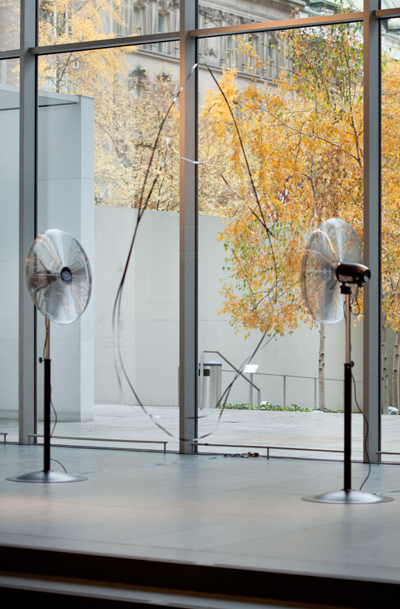
Zilvinas Kempinas’ Double O (2008) at the MoMA

Zilvinas Kempinas. Double O. 2008. Installation view at MoMA as part of On Line: Drawing Through the Twentieth Century. Photo by Jason Mandella

Zilvinas Kempinas. Double O. 2008. Installation view at MoMA as part of On Line: Drawing Through the Twentieth Century. Photo by Jason Mandella. Source: MoMA.org

Zilvinas Kempinas’ Double O (2008) at the MoMA is a mesmerizing, extraordinarily simple installation in which fans suspend two loops of VHS tape in their intersecting currents. Have a look at the video on the MoMA site. The examples of Kempinas’ work that I first encountered seem like larger-than-life explorations of form and optics. Double O is a miraculous combination of simple materials, which prove to be just as effective as labor-intensive, perfect installations.

And the Pursuit of Happiness
A panel in the Live from NYPL! series and the Walls and Bridges Festival

This Franco-American panel of theorists and artists was a mishmash of languages, somewhat esoteric areas of academic research (via French Revolution specialist Sophie Wahnich and Ancient Greece expert Barbara Cassin), American common sense (no-nonsense artist/illustrator Maira Kalman), and likable, self-effacing irreverence (the author Daniel Handler, AKA Lemony Snicket). The Americans seemed like they couldn’t hang with the intellectual rigor of the French academics, while the French seemed oblivious to the idiomatic phrases and physical cues that made the Americans seem warm and entertaining to the audience of New Yorkers.

Unintended absurdity, evident investment in the topic, and the chance to see and hear examples of Kalman’s and Handler’s work and process kept me in my seat. However, at the end, I could hardly contain myself. The concluding question was “What makes you happy?” and nearly all of the respondents talked about losing oneself in skilled activity–yet no one mentioned Mihaly Csikszentmihalyi’s concept of flow.

Further, Handler divulged that happy conditions don’t inspire him to write. Italo Calvino’s short story, “The Adventure of a Poet”—which I wrote a post about a few days ago—is exactly about how much easier it is to represent the mundane, while the transcendent often begets cliché.

I was also interested to hear Wahnich discuss the centrality of the political self in the search for happiness. If I understand her—or her interpreter—correctly, she explained that the freedom to act politically—not necessarily in the civic sense as an activist or voter, rather the basic liberty of movement, speech, thought, and action—is fundamental to the pursuit of happiness. Handler said that the Declaration of Independence is a statement about how democracy must be homegrown; it cannot be installed by foreign powers, and it must be fought for by the people. Still, no one on the panel connected this talk about self-determination and the struggle for democracy with the grassroots democracy movement in Egypt today.

While the Declaration of Independence sought liberty for some men, and the struggle for civil rights in this country is far from over—gay marriage being the most obvious liberty, to me, that the state ought not deny its citizens—its passage on happiness and building democracy seems worth remembering at this time.

We hold these truths to be self-evident, that all men are created equal, that they are endowed by their Creator with certain unalienable Rights, that among these are Life, Liberty and the pursuit of Happiness.–That to secure these rights, Governments are instituted among Men, deriving their just powers from the consent of the governed, –That whenever any Form of Government becomes destructive of these ends, it is the Right of the People to alter or to abolish it, and to institute new Government, laying its foundation on such principles and organizing its powers in such form, as to them shall seem most likely to effect their Safety and Happiness.

Standard