Sights

wanted: machine to clone and transport

First Stop: London

I’d love to skip back over the pond to attend the Frieze Art Fair next week in London. Yes, it is a marriage of art and commerce, but it’s also more than that — newly commissioned art projects, featuring the fabulous Stephanie Syjuco, the delightfully perplexing Ryan Gander, and a fellow named Mike Bouchet, whose project involves hiring a motivational speaker to address an audience at the Frieze Talkslove it! There’s also a programme of killer talks, including a Q&A with John Baldessari, a lecture by James Elkins (the esteemed author from Art Institute of Chicago, who I’ve posted about before) as well as a timely talk on the role of state funding for the arts in a recession.

I’d leave my Clone in San Francisco

Of course, I’d have to clone myself first, so I could also be here in San Francisco for Southern Exposure‘s Grand Opening and the opening of the exhibition, Bellwether. The exhibition is shaping up really nicely, with a huge site-specific balsa wood installation by Reneé Gertler, a DIY survivalist’s shed by Whitney Lynn, an outpost for Lordy Rodriguez’ First Colony, among others. I’m also really looking forward to Liz Glynn‘s Banner Year project, which sweetly reminds me of Jeremy Deller’s Procession in Manchester this summer. Don’t miss the festivities October 16 and 17, at 20th and Alabama Streets.

Next Stop: New York

Then, after that, I’d attend Three Pieces, a one-night multidisciplinary event at PPOW Gallery in Chelsea, where Color&Color, a new publication by Amanda Curreri and Erik Scollon, will be unveiled (along with a work of sound and a work of language/performance. I submitted two images to the inaugural publication — can’t wait to see it.

I’d stick around in NYC for another night to attend The Creative Time Summit at the NY Public Library, which is kind of like a TED Talk for contemporary art. There are so many huge names on the roster, like Alfredo Jaar, Mel Chin, Liam Gillick, Julieta Aranda, the list goes on and on…

A recommended virtual stop: Los Angeles Times art review

200910_latimes_ollman_216x236

Of course, if I had a transporter, I could save myself a lot of staring at the I-5. Since we haven’t got one — yet! — we could have a look at Leah Ollman’s L.A. Times review of Palimpsests, a three-person exhibition I’m in at Tarryn Teresa Gallery through October 29th.

Standard
Art & Development

odds and ends

1.
I think the conceptual artist Glenn Ligon is fantastic. And I, for one, think Americans should be proud to have the Obamas in the White House. So it totally floats my boat that the Obama family has selected a work by Ligon for display in their home.

2.
I was right! Fred Tomaselli’s lecture was great — brisk, jocular and razor-sharp. Again, there’s nothing like hearing a thoughtful, well-spoken artist share his narrative of artistic development. Plus, his work is so stunning! My colleagues and I were unanimously impressed and inspired.

This coming Monday, October 12, Xu Tan, who’s currently showing his Keywords project at YBCA, is speaking at SFAI.

3.
Pae White’s exhibition at the Mills College Art Museum closes in 10 days. I saw the show’s iteration at New Langton Arts, where it blew my mind.

4.
It seems to be a good time to read.
Research is critical for my studio momentum. Here are texts I hope to synthesize into my art practice soon:

Calvin Tomkins’ profile of Bruce Nauman, “Western Disturbances,” The New Yorker, June 1, 2009, p. 68
(Reassuringly, Nauman’s studio practice also involves a lot of sitting, reading and thinking. I also love how the author characterizes Nauman’s work as “uningratiating.” I am driven to make work that’s also rather unspectacular, though I’ve yet to shake the urge to apologize for its visual paucity. It seems pointless and maybe a bit classist, but it’s true, people still like big, colorful, spectacular art.)

In “Thinking literally: The surprising ways that metaphors shape your world” (Boston Globe, September 27, 2009), Drake Bennett describes psychologists who are uncovering how metaphors are crucial tools in human thought. I find the writing style a bit too commercial, but I’m enjoying the idea that scientific research can validate the intuitive decisions involved in making phenomenological installations. Perhaps there is a sensory, non-literal, common ground through which an installation artist can communicate with her audience, without an intellectual interpretation….

I think this idea might work well in parallel with “Against Interpretation” by Susan Sontag.

Benedict Carey’s “How Nonsense Sharpens the Intellect” (NYTimes.com, October 5, 2009) seems like another great, timely reference, because it touches on the ideas of aberrations (which I’ve been thinking about since the Galaxy show at BAM), and seems to related to the slightly-off effects my viewer-oriented installations aspire to create.

Standard
Art & Development

moments in Bay Area art-time

PAST:

I really liked Kenneth Baker’s review of Kim Anno’s show at Patricia Sweetow Gallery (SF Gate, Sept. 26, 2009) — very concise writing about the work and the context of contemporary painting. How’s this for a tight lede:

New abstract painting arrives today in an interpretive hall of mirrors where quotation, pastiche and the cannibalizing of motifs by designers can instantly embarrass any claim to originality.

The review also mentions a show by stellar artists Walead Beshty, Patrick Hill and Karl Haendel at NOMA Gallery. I’ve been a fan of Haendel’s insanely detailed graphite realism since Glen Helfand’s Particulate Matter at Mills College Art Museum, and of Beshty’s since I saw his Fed-Ex’d glass cubes at the Whitney Biennial, so I regret missing the chance to see their work as well as Hill’s.

Another show I wish I saw was Ian McDonald and Conrad Meyers II at Queens Nails Annex. I totally loved Ian McDonald’s mixed media sculptures at Rena Bransten and YBCA’s Bay Area Now 5; in both exhibits he showed ceramics works that were functional yet their identities were somehow unhinged, with a lot of great material juxtapositions. His latest work about everyday objects and usability really resonates with my Pounds of Happiness project, but I just haven’t been able to make it over there…

Besides opening a show in LA last weekend, I’ve been logging hours at the studio…

PRESENT / JUST PAST:

…where I’ve been nerding out on behind-the-scenes art stuff, like:
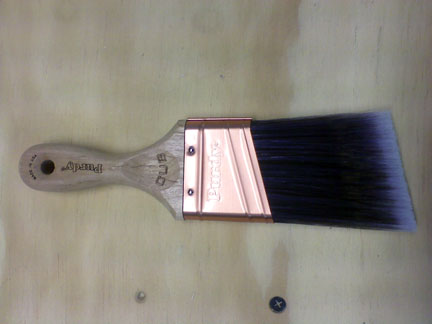
1. Taking joy in the small things in life.

1. Taking joy in the small things in life.

I haven’t painted in ages, but that doesn’t mean that I no longer enjoy that brand-new brush buzz… This is my first-ever Purdy. It’s sharp as a razor, and it buoys my hope that craftsmanship can still exist within mass manufacturing.

Some things, though, don’t change: Wood stain, it turns out, smells exactly like the last time I used it, in junior high wood shop class. I’ve lost my printmaker’s tolerance for oil and solvent smells, but gosh, it’s satisfying to wipe down fresh stain and see the wood grain magically re-appear.

Lately, I keep thinking back to Mr. James’ shop class, and my dad’s garage, because those are the places where I learned most of my woodworking skills. I picked up a few things in college and grad school, and I’m picking up new skills quickly as a preparator. But the foundation is the same, and certain traits seem to show through. For example, in junior high I found the jigsaw and bandsaw least intimidating, and to this day I still use circular saws with extreme respect and caution. I also still appreciate my dad’s improvisational handyman approach — try to use what’s around, instead of running to the store for every little bit of hardware or new tool — and his good humor inherent in tinkering.
2. Building a big crate.

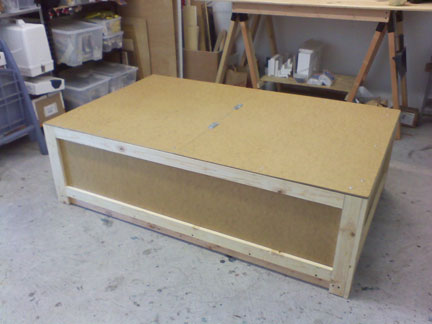
2. Building a big crate.

This crate, which has a detachable compartment, took about:
— 2 hours to design,
— 2.5 hours procure and unload the materials, and
— a solid day and a half to construct.
To move the crate, though, is gonna take three people and a truck.

(A recurring puzzle: Why do people think that artists just make art all day? When in fact, there’s so many other things that need to be done, like making crates, storing stuff properly, framing, writing, reading, research, procurement, bookkeeping, seeing art, talking to people, emails, etc. That’s why CARFAC Canadian Artists’ Representation / Le Front des artistes canadiens is so exceptional: it reflects an understanding that an artist’s work extends beyond studio work and exhibition installs. See their PDF guidelines for Professional Fees, which include admin and preparatory work, as distinct from baseline Exhibition Fees.)

This crate is for mirrorsblack, my newest sculpture, which will be unveiled at…

FUTURE / Art events I won’t miss:

Friday, October 16, 8–10 pm (Member’s Opening)
Saturday, October 17, 4–10 pm (Public Opening)
October 17–December 12, 2009 (exhibition)
Bellwether
Southern Exposure, 3030 20th Street, San Francisco
I stopped by SoEx’s new digs the other day and it’s all abuzz with activity. Their purpose-built gallery/office/classroom is brand spanking new. I can’t wait for the inaugural exhibition to launch. There’ll also be loads of activities and artist’s projects at the Public Grand Opening / Block Party, so hope to see you there.

Monday, October 5, 7:30 pm
Fred Tomaselli lecture
SF Art Institute
Tomaselli’s resin-cast mixed-media paintings are mind-bending. His works in MOCA’s Ecstacy show were trippy and hallucenagenic enough, but his more recent work at White Cube were completely stunning. He also seems like a down-to-earth kind of guy. I think his lecture will be great.

Thru December 12
Moby-Dick
Wattis Institute for Contemporary Art
Though I helped to install this show, I didn’t get to spend much time looking at the work, especially the media works. I’d love to spend more time with the lovely paintings by Marcel Dzama, prints by Rockwell Kent, and the installation by Ellen Gallagher and Edger Cleijne. Also, I’ve heard high praise of the film by Peter Hutton.
Standard
Art & Development

a follow-up to “the original”

I recently got a note from the artist Mircea Cantor, whose work I mentioned in a blog post written about a year ago.

Cantor and I share an interest in creating empty present forms (see his and mine).

As Cantor pointed out, my post could misconstrued as a snarky lob at a fellow artist, or a claim to precedence. I’d like to clarify that while I wrote that

what matters is not who comes up with an idea first, but who does it best (a cousin to the cynical saying, If you can’t do it better, make it bigger)

I didn’t intend to claim that my work was better, or that Cantor’s work was bigger b/c he couldn’t make it better. I am not that cynical. That’s why I distinguished our works, and discussed how the scale differentiates his work. Examining our conceptual intentions might help a larger audience understand how similarities and contradictions can co-exist in contemporary art. As I ended that previous post with this thought, I’ll do so again:

A lot of artists fear being unoriginal, so they usually wince when they encounter similar work by other artists. Whatever. Here’s a new saying: Similarities happen. It’s not the worst thing in the world. In fact, it can work out for everyone.

No hard feelings.

Standard
Research, Travelogue

L.A. Looks

Between installing recent works at Tarryn Teresa Gallery and being stuck in traffic, I got to have some fun art-life in Los Angeles last weekend…

–Peeked behind the scenes of a down-low James Turrell light installation. Don’t ask where, because I won’t say!

–Experienced Richard Serra’s monumental Band and Sequence steel sculptures at LACMA for the first time, and in near solitude, to boot. I was really grateful to get them both to myself, as the experience was sensory and meditative. I was baffled, though, when I encountered an LED light piece in the corner. It was completely lacking wall text. I knew it was a work because its perimeter was demarcated with vinyl commanding, “Please do not touch,” and when I entered the throw of light, I set off a high-pitched alarm. Yet I’d never known Serra to do light-based work, and I’m sort of keen on these things. A new museum mystery remains unsolved.

–Upstairs at LACMA were a massive Barbara Kruger vinyl installation and a Koons, Warhol and Baldessari group show. The dude show was great, if not especially urgent (in fact, it was scheduled to close a year ago). Still, I hadn’t seen one of Koons’ balloon animals in the flesh in a while, and it was totally and surprisingly effective, accomplishing what I think the provocateur meant to do. That taut, shiny sculpture sort of turned me on. Awkward!

–In the other huge wing was a large survey of Beuys’ multiples. Shows of multiples, esp those tangential to Fluxus, can be wonderfully curio-esque or miserably archival and academic. I’ll admit, my art stamina was no match for the massive scope of this survey. I also had a hard time turning off my preparator brain, noticing the grey-vinyl-on-grey-paint instead of synthesizing the text, and being bothered by the lack of didactic texts in the vitrines. Still, it was cute to see Beuys’ famous sled sculpture, which Stephanie Syjuco is re-creating for 1969, a show at PS1 this fall.

–When you like a gallery, and their shows keep exceeding your expectations, you start to worry about becoming biased. This is what happens to me at Marc Foxx Gallery. I loved the Anne Collier show the last time I was in town, and I loved the group show with Jim Hodges and Frances Stark the preceding visit. This time round, I was slowly but surely impressed with a solo show by Matthew Ronay, who crafts fictionalized juju capes, hoods, staffs and other ritual objects. They’re completely engrossing.

Joel Kyack’s Knife Shop at Francios Ghebaly’s Kunsthalle LA in Chinatown was pretty great too. It’s a theatrical installation in the vein of low-brow, folky, male juvenile art, but it worked for me because it was hokey but believably dangerous. I mean, there’s a table of dozens of hand-made shanks. Anger at the world seems less pathetic (even if the work is in a ‘pathetic aesthetic’) when the artist has ground metal license plate holder and other bits of metal into long blades. These aren’t Nut N Fancy tactical knives; they’re fetishes of obsession and rage.

–The recession seems to hit Chinatown galleries especially hard, with many shops folding or moving, so it’s fantastic to see an example of rigor over sell-ability in this ‘hood. Rachel Khedoori’s installation at The Box is timely and political, and its visual interest is minimalist but nightmarish. It’s a museum-quality show at a small commercial gallery. Not sure how that happened, but it’s cool.

Standard
Citizenship

Flooded Manila: How to help

Three days ago, Manila was besieged by Typhoon Ketsana. Sixteen inches of rain fell in 12 hours. 80% of Manila was flooded, with some areas under 20 feet of water. The flood extends to 25 nearby provinces. 140 people have been killed, and over 100,000 have taken refuge in shelters. (Source: BBC)

When I visited Manila in 2007, I saw many, many people of very modest means living there. But I saw just a fraction of an unbelievably dense, sprawling metropolitan area. It’s almost incomprehensible to imagine the 450,000 people who have been displaced by the storm.

It’s hard for most Americans to understand how far a U.S. dollar can go in the Philippines normally, much less during a state of emergency. If you can, please support the relief effort, so that the displaced can access clean water, food and aid.

If you can do bank transfers or fax your credit card info to an international line, you can donate to Philippines Red Cross.

To support the relief effort for children via credit card, visit UNICEF.

Standard
News

Palimpsests at Tarryn Teresa Gallery (LA)

Artist's Reception for Palimpsests, Tarryn Teresa Gallery, LA

Artist's Reception for Palimpsests, Tarryn Teresa Gallery, LA

Just got back from Los Angeles, where I installed recent text-based works, including the kinetic light sculpture Binary Pair, in Palimpsests, a show featuring the work of three artists using text. Curated by Elizabeth Williams, Palimpsests runs at Tarryn Teresa Gallery through October 29.

The other artists in the show are Cara Barer and recent Mills MFA grad, Annie Vought. Houston-based Barer contributed dramatic photos of books, pages sculpturally splayed. Vought is exhibiting her meticulous papercuts of found letters. I think the show hangs together really well, and I’m very pleased to be part of a strong showing completely authored and presented by women (artists, curator, gallery owner and preparator too!). I’m also very appreciative of the opportunity to share my work, and especially my kinetic sculpture, with the Los Angeles art audience.

If you’re in LA in the next few weeks, try to check it out. The gallery is located in a rather industrial part of downtown, but I think you’ll find the space to be worth the visit. Don’t forget to nip in the project space/installation gallery, where you’ll find Binary Pair.

Tarryn Teresa Gallery is pleased to present Palimpsests, an exhibit from guest curator Elizabeth Williams featuring work by Cara Barer, Annie Vought and Christine Wong Yap. Whether done playfully or poignantly, the artists in Palimpsests pay tribute to the associations and meanings we bring to the written word. Collections of words can differ extraordinarily, as can the reader’s response to them. Letters, books, newspapers, magazines or small one-page notes all offer the ability to inspire feelings of attachment or even aversion. An audience’s perception is mainly influenced by the meaning of the words themselves, but the manner of delivery can create an air of legitimacy, sentimentality or stronger emotions. With these visual works, the artists address the continuum of the written word.

Palimpsests
September 26–October 29, 2009
Artist’s Reception: September 26, 6–8 pm
Tarryn Teresa Gallery
1820 Industrial St. #230
Los Angeles, CA
hours: Mon.–Fri., 11 am–5 pm, Sat. 11 am–4 pm

Standard
Research

Drawing, the start of it all

Ooooooooh! The Guardian just launched a series of photos and first-person essays on drawing! It looks fantastic! Highlights include William Kentridge on the mystique of charcoal, David Shrigley on his idiosyncratic ink doodles, graphite master Paul Noble on his rather technical fictive drawings, and Ingrid Calame on her vector-y vellum tracings.

The timing’s great because I just taught the first session of my Sketchbook Drawing class at the Associate Student Union at U.C. Berkeley. It had been a while since I’d been in a figure drawing set-up, and I had a blast and I think my students enjoyed it too. I’m inspired to spend more time with my sketchbook soon.

Sometimes I find the idea of picture-making to be quite conventional, so it’s nice to be reminded of the immediacy and rewards of a fundamental mark-making practice.

Standard