Research

Happiness Infographics

Via ET and FlowingData.com:

'life is simple' by Moritz Resl

Moritz Resl, Life is simple, digital art print, 16x16 inches / 42x42 cm, Open edition.

Source: MoritzResl.net

I like these infographics, even if they are a bit simplistic, they’re upbeat.

Are you happy?

By H34DUP and David Meiklejohn. Source: blog.h34dup.com

A quibble: humans adapt to positive emotions quite readily, as Phillip Zimbardo and John Boyd wrote in The Time Paradox. So the advice “Keep doing what you’re doing” would probably maintain happiness, but only for so long. Humans also need novelty, variation, and new challenges.

Cheap and Cheerful #5

Christine Wong Yap, Cheap and Cheerful #5, 2009, neon and glitter pen, 11.625 x 7.75 inches / 29.5 x 45 cm. Produced in the Breathe Residency at Chinese Arts Centre.

Plus, for you-know-whats and giggles (unless you’re an information graphics designer for which chartjunk is a curse upon the earth of Biblical proportions):

The usually illustrious Christoph Nieman’s illustration for Portfolio.com:

Illustration by Christoph Niemann

Illustration by Christoph Niemann for article about personal wealth and happiness on Portfolio.com

Standard
Art & Development, Community, Research

Works in Progress

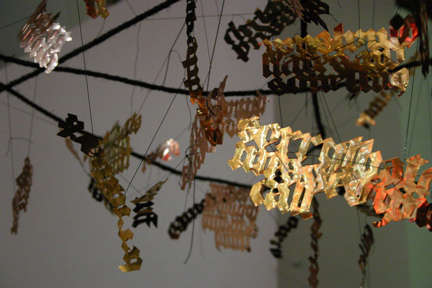
Christine Wong Yap Work-in-progress view of Cloud II (Aura / Good Thoughts) 2011 mixed media installation: Glitter foil on board, 3-D illusion plastic, fun fur yarn, thread, elastic, hula hoops, beads dimensions vary

Christine Wong Yap, Work-in-progress view of Cloud II (Aura / Good Thoughts), 2011, mixed media installation.

I’ve been working on a new cutout text installation for a forthcoming group exhibition. It will be an optimistic, exhuberant update to my copper and elastic installation, Cloud.

Cloud (installation view), 2006, copper, rope, elastic, monofilament, 7 x 6 feet / 2.1 x 1.8 m

Cloud (installation view), 2006, copper, rope, elastic, monofilament, 7 x 6 feet / 2.1 x 1.8 m

The original installation was comprised of mundane, mindless texts, such as “hey, it’s me, are you busy now?” The new iteration uses spoken, written and emailed texts from my life that express happiness, gratitude, or empathy. It will be made of colorful materials like 3D illusion plastic and glitter foil.

Your wish has come true

Work-in-progress view of hand-cut glitter foil on board. Text: “Your wish has come true.”

February 28 – April 1, 2011
Portraiture: Inside Out
Opening Reception: Thursday, March 3, 5—9pm
An exhibition of contemporary portraiture. Curated by Ruth Ballester, Whitney Fehl and Lauren Thompson, Graduate Students in the Museum Professions Program.

Artists: Sarah Bliss, Dominic Guarnaschelli, Gwen Hardie, Jenny Hyde, Pat Lay, Greg Leshé, So Yoon Lym, Ryan Roa, Steve Rossi, Jesse Eric Schmidt, Travis LeRoy Southworth, Tanja Targersen, Peter Whittenberger, Christine Wong Yap, Raphael Zollinger

Opening Reception: Thursday, March 3, 5–9pm
Walsh Gallery at Seton Hall University, South Orange, NJ
Gallery hours: Monday–Friday, 10:30am–4:30pm

Also in the exhibition, by chance, are two members of the collective, Brolab, who I met through volunteering for the Art in Odd Places festival, and whose work I enthused about, last fall.

Random & Rad:

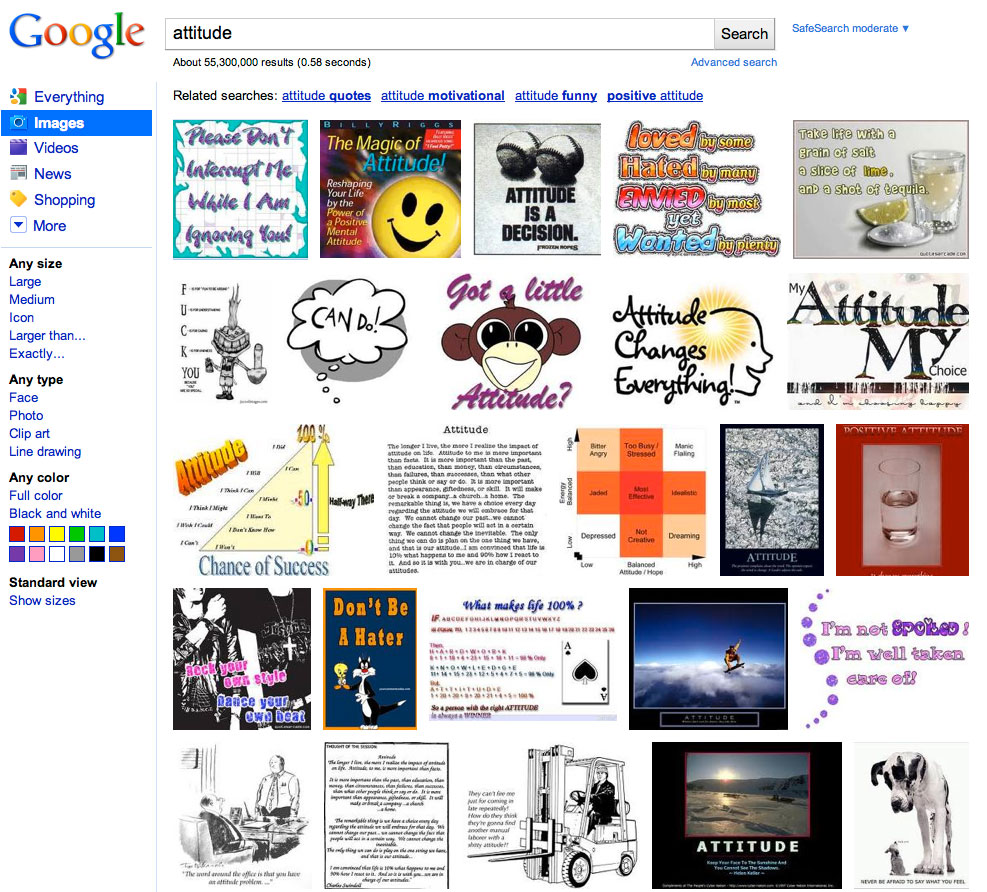
I did a Google image search for “attitude” and this is what came up:

Google image search results for Attitude

I love the mix of results! Trashy, jokey mottos alongside sincere (if simplistic) mantras for optimism. Just the first row is brilliant: unapologetic crudeness underscored by a sassy type treatment, self-help clichés (positive thinking, magic, happy face), motivational sports maxims, more unapologetic crudeness plus sexual egomania, and a party-goer’s mantra. It sort of exemplifies American ignominy as well as the desire for inspiration and the futility of oversimplified positive thinking. It presents lowbrow poles of irony and sincerity.

Standard
Community, Research

Points of reference

For artists and/or fans of Borges and Calvino:
Cynthia Ozick reading “In the Reign of Harad IV,” a wonderful short story by Steven Millhauser, about making, visibility, and recognition. On the New Yorker‘s fiction podcast.

For fellow cognitive science and psychology dabblers:
“Social Animal: How the new sciences of human nature can help make sense of a life,” by David Brooks (yup, that David Brooks, the NYT columnist), a summation of loads of psychological and cognitive science research, including thoughts about flow and happiness.

For those who need an optimism booster shot:
Born to Be Good: The Science of a Meaningful Life, by Dasher Keltner (New York: W.W. Norton & Co., 2009).
The UC Berkeley psychology professor’s theories on how to live a balanced life of “completing the good in others.” Interesting discussion of the intellectual lineage from Darwin to Ekman (a facial expression researcher profiled by Malcolm Gladwell in the New Yorker). The author’s long hair + references to Eastern philosophy = high hippie dippy quotient, but Keltner is an informed and lively writer. Those seeking cynical, burdensome academic texts ought look elsewhere.

For those seeking art that touches on psychoanalysis:
Jonathan Solo: Shadow
Catherine Clark Gallery
January 8 – February 19, 2011
see also: Carl Jung, Shadow

For those obsessed with happiness and/or mapping:
Mappiness, an iPhone app that asks users to rate their level of happiness at random moments throughout the day. Developed by London School of Economics PhD candidates, it’s a fully realized, popular version of what I had hoped to do with Hedonimeter.net, a project I started in grad school and hadn’t yet returned to. My enthusiasm for visual and symbolic systems has not evolved into the motivation to learn more about statistics and programming… yet.

For art-seekers in San Francisco:
Works by friends and supporters:
Three solo exhibitions: Jaime Cortez, Kenneth Lo, and Ginger Wolfe-Suarez
Southern Exposure, 3030 20th St., San Francisco, CA
January 7, 2011 – February 19, 2011

For art-seekers in LA:
Collective Show
January 21-23 and January 27-30, 2011
995, 997 North Hill Street, Los Angeles, CA

For art-seekers in Liverpool:
Nam June Paik
Tate Liverpool
17 December 2010 – 13 March 2011

For typography nerds:
The flyer for the symposium at the Nam June Paik Art Center. Nothing wrong with type-based solutions, no.

For design-seekers in San Francisco:
A show curated by the super-talented, super-humble Jon Sueda
The Way Beyond Art: Wide White Space
January 20–February 5
CCA Wattis Institute for Contemporary Art

Standard
Art & Development

Musings on artifice, optimism, and synthetic happiness

Cute ___ Calendar, 2010, collage of found calendars, 12 x 12 x 0.5 inches / 30 x 30 x 1.2 cm

Cute ___ Calendar, 2010, collage of found calendars, 12 x 12 x 0.5 inches / 30 x 30 x 1.2 cm


In my most recent work about happiness, such as Irrational Exuberance (Asst. Colors), I thought about being unafraid of artifice. Since optimism, in my view, is a choice, deliberately choosing to find and take the optimistic perspective in any given situation is a bit artificial. Rather than making optimism seem less genuine, it made me think that optimism is more accessible. I may not have been born an optimist, but that doesn’t mean I can’t become one.

In a similar vein, the objects I constructed were blatantly about pleasure. People seem to have a hard time with that; their skepticism colored the work with futility. But I do really see these objects, for all their cheap materials and modest ambitions—maybe something as innocuous as to brighten one’s day—to also express my sincere interest in optimism and the benefit of small pleasures, no matter how naked their (modest) ambitions.

We synthesize happiness, but we think happiness is something to be found.

We believe that synthetic happiness is not the same as what we might call “natural” happiness. What are these terms? Natural happiness is what we get when we get what we wanted. Synthetic happiness is what we make when we don’t get what we wanted. In our society, we have a strong belief that synthetic happiness is of an inferior kind. Why do we have that belief? Well, it’s very simple. What kind of economic engine would keep churning, if we believed that not getting what we want would make us just as happy as getting it?…

I want to suggest to you that synthetic happiness is just as real and enduring as the kind of happiness that you stumble upon when you get exactly what you were aiming for… (Dan Gilbert, “Why are we happy?” delivered at a TED conference, 2004)

I recently just finished a new series of works on paper using more discount store goods. This time, I made 18 works using only stick-on flags arranged on “neon” paper. (As dollar-store goods are wont to do, the packaging’s promise fulfilled expectations from its own alternate universe—in other conditions, the blue and green papers would be considered pastel. I’m not complaining: “Neon” paper isn’t really neon anyway; inert gasses wouldn’t make good collage substrates.)

Working with the materials, I discovered their small potentials: while the number of available colors was very limited, the flags’ translucence and adhesive—which enhances saturation—creates the illusion of a wider color spectrum. The flags’ matte surfaces also draw attention to the paper’s reflectivity. It’s amazing how even cheap, everyday materials can convey exuberance and pleasure.
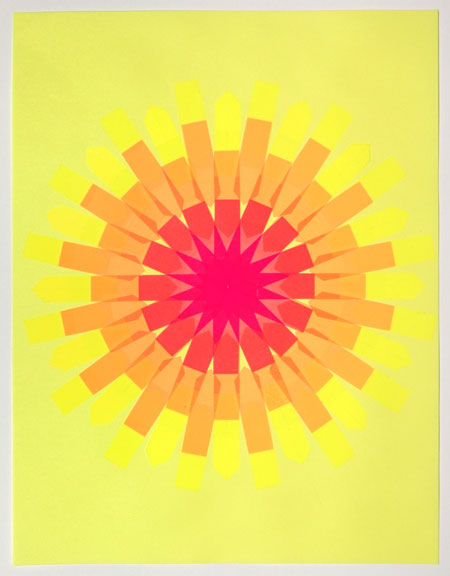
Flag Snowflake No. 2, 2010, stick-on flags on neon paper, 8.5 x 11 inches / 21.5 x 30 cm
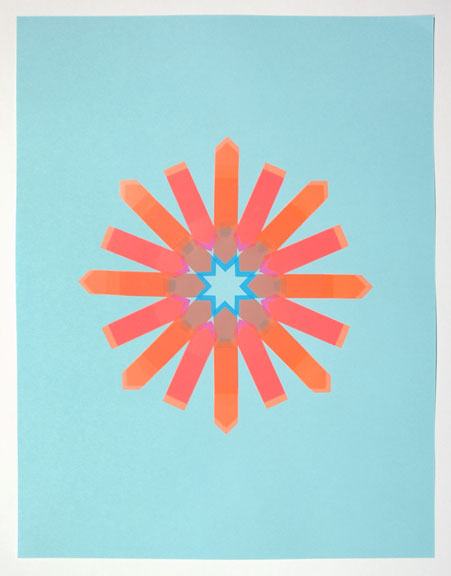
Flag Snowflake #2, 2010, stick-on flags on neon paper, 8.5 x 11 inches / 21.5 x 30 cm

Flag Snowflake No. 12, 2010, stick-on flags on neon paper, 8.5 x 11 inches / 21.5 x 30 cm

Flag Snowflake #2, #12, & #17, 2010, stick-on flags on neon paper, 8.5 x 11 inches / 21.5 x 30 cm

Flag Snowflake No. 17, 2010, stick-on flags on neon paper, 8.5 x 11 inches / 21.5 x 30 cm

Flag Snowflake #2, #12, & #17, 2010, stick-on flags on neon paper, 8.5 x 11 inches / 21.5 x 30 cm

To support Kearny Street Workshop, I’m donating the above three selections from the Flag Snowflake series to One Size Fits All, an online sale. Bid on works by 48 artists who created 8.5×11 works on paper—all for the stunningly affordable price of $100 each. Artists include Jenifer K Wofford, Mike Arcega, Stephanie Syjuco, Weston Teruya, and many, many more.

Kearny Street Workshop is the nation’s oldest Asian Pacific American multidisciplinary arts organization. They have supported me in the past by exhibiting my work in their emerging arts festival, inviting me to present my work, and in 2008, supporting the development of all new work for a three-person exhibition. They have been continuing their work with the dynamic leadership of Ellen Oh—recent projects include partnerships with the de Young Museum. I’m very honored to support KSW, and hope you do too if you can.

Especially for artists: Some thoughts about setting goals and heeding cautions—

Yes, some things are better than others. We should have preferences that lead us into one future over another. But when those preferences drive us too hard and too fast, because we have overrated the differences between these two futures, we are at risk. When our ambition is bounded, it leads us to work joyfully. When our ambition is unbounded, it leads us to lie, to cheat, to steal, to hurt others, to sacrifice things of real value. When our fears are bounded, we’re prudent, we’re cautious, we’re thoughtful. When our fears are unbounded and overblown, we’re reckless, and we’re cowardly. The lesson I want to leave you with, with these data, is that our longings and our fears are both overblown to some degree, because we have within us the capacity to manufacture the very commodity we are constantly chasing when we choose experience. (Dan Gilbert, “Why are we happy?” delivered at a TED conference, 2004)

Standard
Research

Schjeldahl on Rist

In “Feeling Good” (New Yorker, September 27, 2010; abstract here ), Peter Schjeldahl reviews Pipolotti Rist’s show at Luhring Augustine in NYC, and in the process, extols the singular artist and her commitment to pleasure.

I savored the subject and the conveyance. I admire Rist’s work for it fearless optimism and exuberance. She manages to make massive installations that are friendly and participatory. Schjeldahl’s words brim with enthusiasm, and he also contextualizes Rist’s work with a preternaturally long view.

A few of my favorite passages are:

The first two lines:

The Swiss video- and installation-maker Pipilotti Rist is an evangelist for happiness like no other first-rate artist that I can think of, except, perhaps, Alexander Calder. Like Calder, she is immune to solemnity, and her work appeals to more or less everybody.

This gem:

Color is more than the keynote of Rist’s art—it’s practially the theology.

Her pop cultural affinities don’t unite high and low so much as make them seem like interchangeable engines of pleasure. Rist resolves no critical problems of contemporary art. She just makes you forget there are any.

(I wondered about this same dialectic—this addiction to criticality as radical opposition—in my show Irrational Exuberance, and it was discussed in the closing dialogue, As Is: Pop and Complicity.)

…not that thought is allowed much traction. There’s a steady state of wonderment at having a body right here, right now…. Imagine, as Rist makes easy in the show’s main room, being a sheep in a lush meadow entirely surrounded, as far as you can see, by what you like to eat. Life surely vitiates such sublime contentment most of the time, but numbness to it seems an optional tragedy.

Just as positive psychologists want you to know: Optimism is a choice.

Schjeldahl takes a strong position in the course of explaining Rist’s significance:

Pleasure is a serious matter in and for art, which must justify itself continually in a global culture of mass entertainments. Glumness is an understandable but self-defeating reaction of people determined to somehow make a difference. Rist is remarkable for having insisted on bliss in an era, which peaked in the nineteen-nineties, when a parade of artists ambitiously expanded art’s physical scale and social address only to burden it, self-importantly, with theoretical arcana and political sanctimony.

As a critical writer, I aspire to this level of expertise and confidence.

Proof that writing about art need not be burdened by art-speak, pretension, or obfuscation:

Responsible as well as responsive to contemporary art’s enlarged public sphere, she maintains standards of craft and sincerity—outward discipline, inward necessity—that speak for themselves, without critical gloss or winking irony.

Standard
Research

Positive Psychology and Positive Thinking

In developing my exhibition, “Irrational Exuberance (Asst. Colors),” last spring, I studied positive psychology. During the closing dialogue, “As Is: Pop and Complicity” (read the transcript), I realized that the term positive psychology is easily confused with popular psychology—understandably, since the distinction is not entirely clear, when my readings of positive psychology take form in trade paperbacks—and positive thinking. Certainly, positive psychology is optimistic; through research-based cognitive behavior modification, it aims to increase happiness, and to engage in that kind of self-awareness and change is to embrace to possibility that one can positively change one’s attitudes. However, to mistake positive psychology for mere positive thinking is a mistake.

In “Power Lines: What’s behind Rhonda Byrne’s spiritual empire?” (New Yorker, September 13, 2010), Kelefa Sanneh reviews two recent books on positive thinking. He takes a critical look at Rhonda Byrne, the positive thinking guru and author of “The Secret” (2007) and “The Power” (2010), starting off with Byrne’s appearance on Oprah. Maybe I’m an elitist, sheltered in a ‘Bay Area Bubble’ unconcerned with such mass culture, but the phenomenon of “The Secret” remained a secret to me until now. Is this what people think I mean when I say positive psychology?

Sanneh contrasts Byrne’s quasi-but-un-religious, ultra-simplistic mysticism with Barbara Ehrenreich’s “Bright-Sided: How Positive Thinking is Undermining America” (2009; also released with the more specific, less ‘sticky’ subtitle, “How the Relentless Promotion of Positive Thinking is Undermining America”). When the leftist activist fired this shot, it alarmed me, but as Sanneh points out,

For Ehrenreich, the alternative to the pursuit of happiness is the pursuit of justice—except you don’t have to choose…. She promises that we can find a deeper, richer form of happiness by ‘shaking off self-absorption and taking action in the world.’

This, of course, brings to mind the three components, according to Paul Martin, author of “Sex, Drugs and Chocolate” (2008) of happiness: pleasure, the absence of displeasure, and satisfaction—becoming an agent, enacting one’s will in the world. Striving and accomplishing goals through acting in the world—not mere positive thinking—leads to deeper happiness? Yes, I’d agree with that. I am now more inclined to believe that Ehrenreich—whose undercover reports on working class struggle instantiated institutional privilege in America in “Nickel and Dimed” (2001) I enjoyed—is explicit in her aim at unthinking positive thinking, rather than all psychology concerned with happiness.

So while the terminology may overlap, along with the general optimistic outlook and “woo woo” self-improvement vibe, positive psychology and positive thinking are very different. For the latter, read Byrne and watch Oprah. For the former, read psychologists and researchers like Martin Seligman and Mihaly Csikszentmihalvi.

Standard
Research

Biology, Trust and Skepticism

Both trust and distrust, it now seems, are influenced by hormones that can induce people to ratchet their feeling of trust up or down.
The trust side of the equation is mediated by a brain hormone known as oxytocin. A soft touch or caress will send a pulse of oxytocin into a person’s bloodstream….
There needs to be an antidote to oxytocin that makes a person keep those warm, fuzzy feelings suppressed in the appropriate circumstances….
Researchers at Utrecht University in Holland now report that they have identified this antidote: it is testosterone….
“Testosterone decreases interpersonal trust and in an apparently adaptive manner,” the researchers conclude. (Nicolas Wade, “She Doesn’t Trust You? Blame the Testosterone,” NYTimes.com, June 7, 2010)

Standard
Research

Yes No Language

In “No,” Ben Zimmer’s latest contribution to his On Language column (NYTimes.com, March 15, 2010), yes and no are examined through the lens of Congressional discourse and pop culture. Zimmer lists some associations:

yes no, agreement opposition, positivity negativity, acceptance denial, getting to yes, party of no

From my personal collection, here are a few greatest hits of yes and no memorabilia:

A (lost) sticker bearing the phrase, “The Land of Yes.” It was produced by Trillium Press, which is now SF Electric Works. The motto conveyed a commitment to helping artists realize their projects.

Ugo Rodinone’s “Hell Yes!” architectural signage for the New Museum. Rounded text + rainbow stripes + in an arc = unabashed enthusiasm.

My first word was “no”—a troubling fact for an aspiring optimist—but it turns out, I’m not alone. Zimmer informs:

…the power of no is even more primal, perhaps because it is so often among the first words that English speakers learn as children.

Zimmer also discusses yes and no in terms of the “up/down” vote, an orientational metaphor with its own set of associations, as examined by linguists George Lakoff and Mark Johnson in Metaphors We Live By (U. of Chicago Press, 1980):

happy sad and other dyads

Some of these orientational metaphors cohere. For example, a person with high status might expect being in positions of control more often. Good, virtue and life/health are obviously linked. But it would be a mistake to assume that all of the concepts associated with up or down are necessarily coherent. Lakoff and Johnson describe a discrepancy between two metaphors associated with up and down, unknown (up) and known (down) does not cohere with finished (up, as in “the crate’s buttoned up” or “the shoot’s wrapped up”) and unfinished (down).

To this I might add:

transcendent mundane, concept material, ephemeral quotidian

Visual Thesaurus

I love this thesaurus for the visually inclined. The concept map is a brilliant way to group similar meanings and identify specific words.

Standard