NYT does it again with killer infographics:
“Mapping the Nation’s Well-Being”
Three years X 100 American adults X Quality of life indicators ÷ Congressional districts.
NYT does it again with killer infographics:
“Mapping the Nation’s Well-Being”
Three years X 100 American adults X Quality of life indicators ÷ Congressional districts.
Via ET and FlowingData.com:

Moritz Resl, Life is simple, digital art print, 16x16 inches / 42x42 cm, Open edition.
I like these infographics, even if they are a bit simplistic, they’re upbeat.

A quibble: humans adapt to positive emotions quite readily, as Phillip Zimbardo and John Boyd wrote in The Time Paradox. So the advice “Keep doing what you’re doing” would probably maintain happiness, but only for so long. Humans also need novelty, variation, and new challenges.

Christine Wong Yap, Cheap and Cheerful #5, 2009, neon and glitter pen, 11.625 x 7.75 inches / 29.5 x 45 cm. Produced in the Breathe Residency at Chinese Arts Centre.
—
Plus, for you-know-whats and giggles (unless you’re an information graphics designer for which chartjunk is a curse upon the earth of Biblical proportions):
The usually illustrious Christoph Nieman’s illustration for Portfolio.com:

Illustration by Christoph Niemann for article about personal wealth and happiness on Portfolio.com
To be concerned with happiness is to risk the perception of frivolity. Happiness is not perceived as a subject worthy of serious attention, particularly in contemporary art, in my experience. But as positive psychologists argue, the search for happiness is neither common sense nor thoroughly understood; additional inquiry is warranted from this point of view.
For those who cherish their notion that art about pain is more weighty or more serious, have a look at Italo Calvino’s short story, “The Adventures of a Poet.” The author describes the struggle to write about pleasure, and the familiar ease of writing about ugliness. In this way, perhaps it could be said that making art about happiness is more challenging.
Emory University features an archive of Calvino’s writings on their website. Have a look around.
Alexandre Singh’s The School for Objects Criticized
New Museum
Thru January 23

Alexandre Singh, _The School for Objects Criticized_, 2010, Multimedia installation, installation view: New Museum of Contemporary Art. Source: New Museum of Contemporary Art
Caught Free at the New Museum before it closes on January 23rd. By chance, I saved the best for last: Alexandre Singh’s multimedia installation, an installation as theatrical “play,” with inanimate objects as actors. Found objects were lent WASPy perspectives and political positions in surround sound audio tracks and theatrical lighting. It was entertaining, which made the fact of sitting in a room looking at common objects even more strangely compelling.Thankfully, Free is accompanied by an online catalog, with more info on the installation.
Haegue Yang’s Voice and Wind
New Museum
Thru January 23
This installation of colorful, rainbow-palette Venetian blinds and scents occupies the New Museum’s ground floor glass-walled installation space. It’s a fun installation that invites people to walk thru, dipping under portals and encountering semi-enclosed spaces to sniff different scents. I was most interested in the parallels I found with my own work; in the statement, Yang professes an interest in happiness, and colors “on the edge of taste.”
Walls & Bridges: Happiness
New York Public Library
Saturday, January 29, 2011
I’m looking forward to this dialogue about happiness and art, featuring Barbara Cassin, Daniel Handler, Maira Kalman, and Sophie Wahnich.
America considers the pursuit of happiness an inalienable right. But where is this pursuit taking us? How valuable is positive thinking? In arts, melancholia has long been a source of inspiration. Specialist of Ancient Greece Barbara Cassin will give a philosophical point of view on the topic, and historian of the French Revolution Sophie Wahnich will bring some insight on the conditions of happiness. They will be discussing with co-authors of 13 Words Lemony Snicket (Daniel Handler) and Maira Kalman, also New Yorker cover artist and author of the acclaimed And the Pursuit of Happiness.
My art has concerned happiness for the past two years, so I was fascinated to learn about a man who is forced to avoid joy and pleasure.
Neurologist Matt Frerking suffers from narcolepsy with catoplexy, a disease that results in momentarily losing the ability to move one’s muscles. In his case, the attacks are triggered by strong positive emotions. As Chris Higgins, the storyteller, narrated on This American Life (Episode #409, “Held Hostage”, originally aired June 4, 2010):
When Matt gets really happy—when he feels the warm fuzzy stuff—he becomes paralyzed by his emotions. Literally. Paralyzed.
Since I’m also interested in knickknacks and decorations, and how important and valuable they are, it was fascinating to hear this:
Frerking:
It can be a triggering condition just to discuss [looking at a wedding photo.]
Higgins:
At this moment, Matt is having an attack… Think about this: Matt had this attack while he was talking about a photo he has never seen. If just talking about a picture can cause this, imagine the other things Matt has to avoid.
It’s this kind of deep personal meaning invested in personal effects that fascinates me. How can an object can be invested with such strong memory, emotion and meaning, and yet be distinguished from art?
Higgins goes on to describe further negative impacts of the disease on Frerking’s life:
After living with this disease for four years, with being punished every time he experiences happiness, Matt’s adapted, though the way he has adapted is sad: He tries to enjoy things less. He told me he tries to think of himself as a robot, and not engage too emotionally. He’s told me he even has to be careful how he speaks, not to get too enthusiastic or worked up.
I find this tremendously tragic—and ironic, considering how much some of my past work advocated for modest pleasure. Certainly I was not talking about moderation in lieu of irrational exuberance, nor for the hostages of such diseases. If you are in good health, be grateful. It allows you the ability to feel as much happiness and express as much exuberance as you like.
Higgins ends on an optimistic note:
But it’s important to point out, even though Matt is being trained by his brain everyday not to feel these emotions, he still has them…. Although Matt tries to avoid happiness, it’s still part of his life. He’s proof that you can’t avoid happiness, it’ll still find you no matter what.

Cute ___ Calendar, 2010, collage of found calendars, 12 x 12 x 0.5 inches / 30 x 30 x 1.2 cm
In a similar vein, the objects I constructed were blatantly about pleasure. People seem to have a hard time with that; their skepticism colored the work with futility. But I do really see these objects, for all their cheap materials and modest ambitions—maybe something as innocuous as to brighten one’s day—to also express my sincere interest in optimism and the benefit of small pleasures, no matter how naked their (modest) ambitions.
—
We synthesize happiness, but we think happiness is something to be found.
We believe that synthetic happiness is not the same as what we might call “natural” happiness. What are these terms? Natural happiness is what we get when we get what we wanted. Synthetic happiness is what we make when we don’t get what we wanted. In our society, we have a strong belief that synthetic happiness is of an inferior kind. Why do we have that belief? Well, it’s very simple. What kind of economic engine would keep churning, if we believed that not getting what we want would make us just as happy as getting it?…
I want to suggest to you that synthetic happiness is just as real and enduring as the kind of happiness that you stumble upon when you get exactly what you were aiming for… (Dan Gilbert, “Why are we happy?” delivered at a TED conference, 2004)
—
I recently just finished a new series of works on paper using more discount store goods. This time, I made 18 works using only stick-on flags arranged on “neon” paper. (As dollar-store goods are wont to do, the packaging’s promise fulfilled expectations from its own alternate universe—in other conditions, the blue and green papers would be considered pastel. I’m not complaining: “Neon” paper isn’t really neon anyway; inert gasses wouldn’t make good collage substrates.)
Working with the materials, I discovered their small potentials: while the number of available colors was very limited, the flags’ translucence and adhesive—which enhances saturation—creates the illusion of a wider color spectrum. The flags’ matte surfaces also draw attention to the paper’s reflectivity. It’s amazing how even cheap, everyday materials can convey exuberance and pleasure.
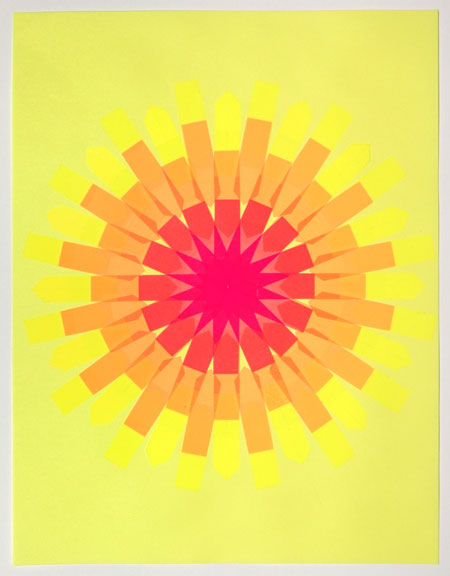
Flag Snowflake #2, 2010, stick-on flags on neon paper, 8.5 x 11 inches / 21.5 x 30 cm
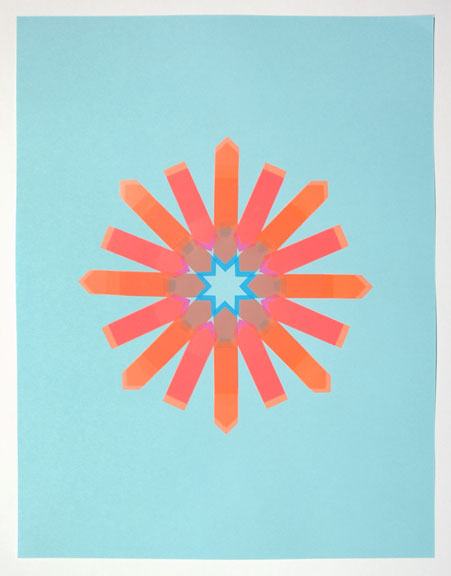
Flag Snowflake #2, #12, & #17, 2010, stick-on flags on neon paper, 8.5 x 11 inches / 21.5 x 30 cm

Flag Snowflake #2, #12, & #17, 2010, stick-on flags on neon paper, 8.5 x 11 inches / 21.5 x 30 cm
To support Kearny Street Workshop, I’m donating the above three selections from the Flag Snowflake series to One Size Fits All, an online sale. Bid on works by 48 artists who created 8.5×11 works on paper—all for the stunningly affordable price of $100 each. Artists include Jenifer K Wofford, Mike Arcega, Stephanie Syjuco, Weston Teruya, and many, many more.
Kearny Street Workshop is the nation’s oldest Asian Pacific American multidisciplinary arts organization. They have supported me in the past by exhibiting my work in their emerging arts festival, inviting me to present my work, and in 2008, supporting the development of all new work for a three-person exhibition. They have been continuing their work with the dynamic leadership of Ellen Oh—recent projects include partnerships with the de Young Museum. I’m very honored to support KSW, and hope you do too if you can.
—
Especially for artists: Some thoughts about setting goals and heeding cautions—
Yes, some things are better than others. We should have preferences that lead us into one future over another. But when those preferences drive us too hard and too fast, because we have overrated the differences between these two futures, we are at risk. When our ambition is bounded, it leads us to work joyfully. When our ambition is unbounded, it leads us to lie, to cheat, to steal, to hurt others, to sacrifice things of real value. When our fears are bounded, we’re prudent, we’re cautious, we’re thoughtful. When our fears are unbounded and overblown, we’re reckless, and we’re cowardly. The lesson I want to leave you with, with these data, is that our longings and our fears are both overblown to some degree, because we have within us the capacity to manufacture the very commodity we are constantly chasing when we choose experience. (Dan Gilbert, “Why are we happy?” delivered at a TED conference, 2004)
Cultivate: setting goals, taking risks, being organized, self-actualizing
De-emphasize: worrying about regrets and how you are perceived
Takeaway: Build self-regard and internal measures of achievement
[Psychologist Robert W. Hill of Appalachian State University] argues that perfectionistic traits can be either adaptive or maladaptive. It depends upon whether they are forward- or backward-looking, emotionally positive or negative, and motivated from an inner urge or an outside push.
In a paper just published in the journal Personality and Individual Differences, Hill and two colleagues describe an experiment that illustrates the importance of distinguishing between types of perfectionism. They surveyed 216 psychology students to assess their perfectionistic tendencies, as well as their psychological well-being and satisfaction with life.
Adaptive perfectionism was determined by combining the students’ self-reported scores in four areas: striving for excellence, organizational skills, tendency to plan ahead and holding others to high standards. Maladaptive perfectionism was measured by the sum of four other scores: concern over mistakes, need for approval, tendency to ruminate over past performances and perceived parental pressure.
“We found that adaptive perfectionism was associated with indicators of positive psychological outcomes,” Hill reports. “The more an individual was prone to striving for excellence, planning ahead, being organized, they typically had a high level of psychological well-being, life satisfaction and positive mood. The inverse was true for maladaptive perfectionism.”
Hill found a “wide distribution” of these traits in the test subjects, suggesting that most people have some combination of adaptive and maladaptive perfectionism….
“Adaptive perfectionism is an internal standard for achievement,” he notes. “Maladaptive perfectionism is an external concern – wondering what other people are going to think. It’s kind of a thinking habit: ‘I made a mistake there.’ ‘Someone will notice I didn’t do that right.’ We know from a number of studies that cognitive behavioral therapy can change or reduce those kinds of thoughts.”
—Tom Jacobs, “The Two Faces of Perfectionism,” Miller-McCune, January 28, 2010
Marketers have been selling “experiences”* for several years now, so it’s cute to read about American consumers turning to free or low-cost experiences. It’s clearly due to the recession, though perhaps popular psychology has made some inroads into mainstream culture as well:
Quietly but noticeably over the past year, Americans have rejiggered their lives to elevate experiences over things. … Psychologists have been saying for years that shared experiences like vacations lead to more long-term happiness than the latest bauble.
—Damian Cave, “Americans Doing More, Buying Less, a Poll Finds,” NYTimes.com, January 2, 2010
[*Here’s an example of “experience” marketing gone bad: my head nearly exploded a few days ago, when I sat down at a P.F. Chang’s and our server demonstrated mixing a special sauce out of three condiments, including Chinese mustard. Yuck. That’s like making Thousand Island dressing out of ketchup, mayo and relish, only worse because the diners get a whiff of ethnic experience, and it’s being repeated thousands of times over in franchises around the country. It offended me, and probably would have offended my family.]
 R+D
R+D 