Research

Csikszentmihalyi, diagrammed for artists

Michael Yap, my husband and a current MFA candidate in the School of Visual Arts’ Interaction Design program, posted a very interesting diagram on his blog yesterday. It charts ideas from psychologist Mihaly Csikszentmihaly’s book, “Creativity: Flow and the Psychology of Discovery and Invention” (New York: Harper Collins, 1996), on findings from direct research on exceptionally creative artists, musicians, scientists, and businesspeople.

“Creativity” speaks to me as an artist–not just because it validates my experiences on living the life of an artist, but also because its subject matter corresponds to my interest in optimism, pessimism and positive psychology. I’ll post thorough notes when I’m done. In the meantime, have a look at what Michael has done with his reading:

Michael Yap, A conversation to learn, artist and the field, goal level, Id like to share an idea with you; We would like to understand your idea

Michael Yap's Conversation Systems Diagram

It’s an interesting way to look at the interaction between artist, Field, and Domain.

Have a look at the assignment and see the whole diagram on the project PDF!

Standard
Research

enthusiasms: art books and sporting sentiments

I’m feeling very grateful to be in New York right now. Today was 48º and brisk; my hands were numb but the sun was shining, and among the spirited events I attended today were the NYC marathon and the NY Art Book Fair at PS1. This morning, I took a commemorative run (my own personal best, yet far less than 26 miles) and headed out to Long Island City to see how the pros do it.

The ING New York City Marathon

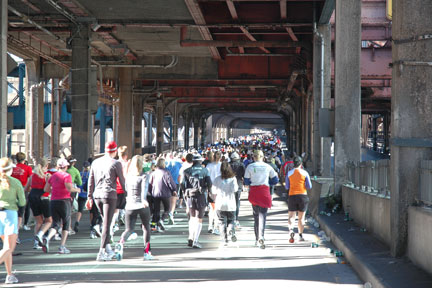
NYC Marathon, November 7, 2010

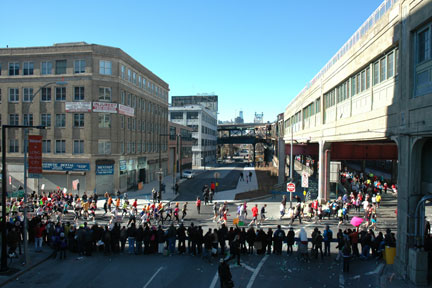
NYC Marathon, November 7, 2010, from Queensboro Station


NYC Marathon, November 7, 2010

NYC Marathon, November 7, 2010. Runners heading up Queensboro Bridge.

Stepping out of the Queensboro Station, I heard cheering and turned to see a huge mass of humanity running up the incline of the lower deck of the Queensboro Bridge. The marathon. I felt like I could see thousands of runners, and something about the cheering, for strangers, fellow New Yorkers, and marathon guests—”Good work, runners!” “Go Alli!”—got me all teary eyed. There were no losing teams, no dirty tricks. Just running through all five boroughs of NYC. It was exhilarating to see runners of all ages pounding the pavement. They were on mile 15 or so, and their faces transparently conveyed their exhaustion, determination, pain, and heart. I found it wonderfully compelling. You really wanted each and every one of them to make it, to push through, and finish.

Printed Matter’s NY Art Book Fair at PS1 in Long Island City, Queens

Heading towards the Chase tower—the lighthouse of Queens—I made my way to PS1, where the marathon crowds’ ear muffs and signs gave way to creative make-up and pegged pants. Printed Matter’s NY Art Book Fair was housed in all of PS1’s galleries; there were too many vendors to count, and plenty of visitors. It was a madhouse, and it looked like many vendors were doing brisk business.

I failed to browse wares of all of the vendors; there were just too many. From what I did see, here are some of my favorites sights.

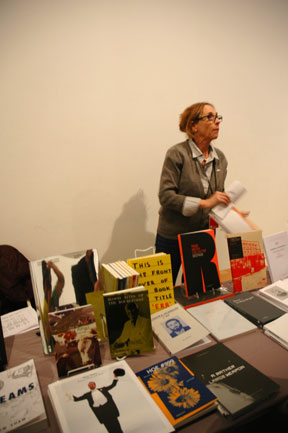
I also started to lose track of what vendors’ booths I was at. Too overstimulated to browse many books, I just let things catch my eye.

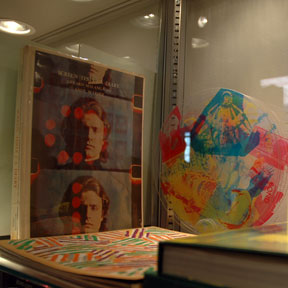
artist unknown

Artist & vendor unknown.

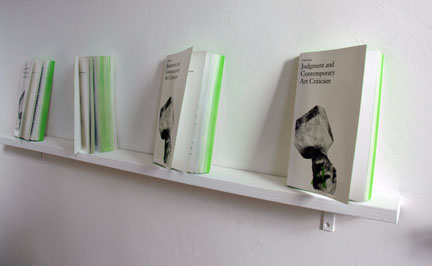
Some designer had a stroke of genius with these green edges.

Paper Placemats

Here’s a neat idea for a printed book-like thing with art that’s not an art book, from J&L Books.

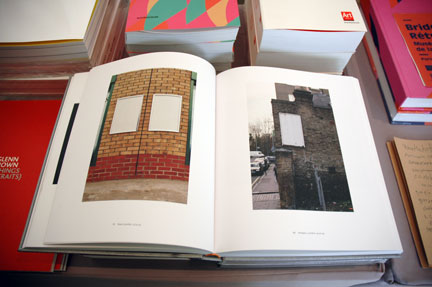
David Batchelor, Found Monochromes

A neat book of “found monochromes” around London by David Batchelor at the RAM Publications booth.

E-flux

The display and vast scholarship at E-flux, like their email list and magazine, were great all around. I missed editor Boris Groy’s talk, so I picked up “Going Public,” a book of his essays on the same subject.

Werkplaats Typografie (Arnhem) will set up an alternative economic system in which services will be exchanged instead of bought.

Werkplaats Typografie offered funny multiples in exchange for must-read art and design books. In the distance are the books that visitors contributed. In the foreground, on this side of the monstrous Ping Pong table, are the goods to trade for, sort of like the goodie counter at an arcade. The red-shirted negotiators were busy wheeling and dealing.

werkplaatstypografie box of bread

Werkplaats Typografie left a lot of room for interpretation, encouraging interaction. This pyramid of boxes of bread is positively curious.

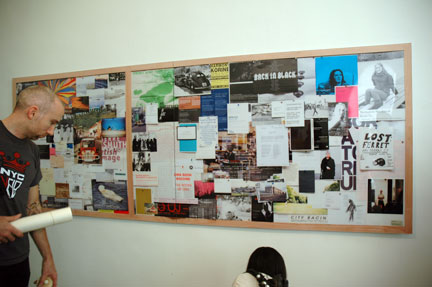
Joseph Grigely, Information Economy photo

Here’s an interesting project: artist Joseph Grigely is interested in ‘exhibition prosthetics,’ the collateral involved in making and marketing exhibitions. Here, he presented a photograph of a bulletin board. (Teaser: It’s not unlike a sight you might see in Shadowshop, Stephanie Syjuco’s emporium of artists’ wares at SFMOMA, to which I’ve contributed multiples.)

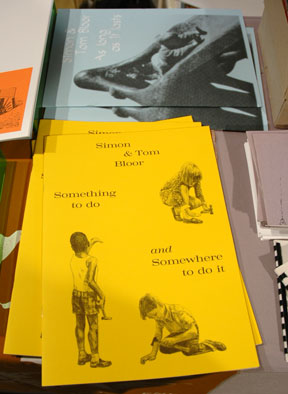
Simon and Tom Bloor

I was so excited to see Eastside Projects at PS1. I loved Simon and Tom Bloorsexhibition at the gallery in Birmhingham, UK. There were great drawings and sculptures about the intersection of modernism and children’s play structures.

What is sculpture, book by Simon and Tom Bloor

I couldn’t resist Simon and Tom Bloor’s activity book for children, which posed complex art questions as fun, accomplishable drawing assignments.

There were some spectacular names of projects too:

Lines and Shapes

Lines and Shapes wins the award for best name of a publication. The magazine also scores high in the feminine and beautiful metric. It’s the kind of art book you could get for your mom.

The Most Beautiful Swiss Books

Running in a very close second in the name contest is The Most Beautiful Swiss Books. If you think it sounds self-aggrandizing, look at the wares!

Motto goods

Naming your distribution company “Motto” makes for killer tote bags.

I also appreciated novel display strategies. (Again, maybe it’s because the next show my work is in is Shadowshop.)

DAP browser window display

DAP‘s cheeky meatspace browser window. The text is all painted by hand.

Cream and black display

Check out the cream and black palette, extending to the shopgirl, and the circle of books on the wall echoed by the hair clip.

Display frame box

This vendor’s room-in-a-picture/box idea reminded me of a work of art I saw at the Walker Art Center (I can’t look up the name because I managed to lose that notebook somewhere in the gallery). Still, must the shop girl be on display like merchandise too? (Although the visitor with the party jacket probably wouldn’t have minded?)

Also, you gotta love fun graphic design:

Idea Books poster

Poster for Amsterdam-based Idea Books.

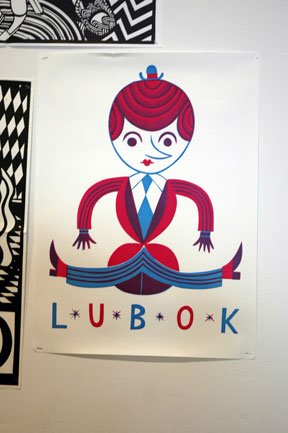
Lubok poster

Lubok‘s woodcuts, books and posters were adorable!

giant posters

Gigantic posters (5′ tall?) in the Dutch Pavilion.

And how about fashion?

fashionable lady

I liked this lady’s outfit: a menswear dress shirt under a grey cardigan made of sweatshirt material, with a string of “pearls” in glossy silver. Plus bold glasses. New York is good for learning how ladies mature with aplomb.

fruit jacket

This blasted photo was meant to share with you an awesome puffer jacket, printed with photos of fruit (on chair)!

art metropole mr cool

What’s more exciting: Toronto’s awesome Art Metropole in NYC, or this guy’s Le Tigre shirt’s tiger’s friends?

Lubek fashion

Lubok‘s sellers of woodcut prints and books wearing graphic stripes and red-black-and-white patterns? Coincidence? Methinks not.

After browsing several rooms full of rare books—too expensive for me to buy, and too fragile for me to browse as I juggled coat and camera—I realized that I love reading books, but I don’t have to collect them. Maybe it’s because my recent cross-country-move has instilled a phobia of accumulation, or maybe I’d rather make use of the city’s libraries. More likely, I’m a cheapskate, and I’m plagued with guilt about the stack of unread books sitting on the shelf above my desk.

Whatever the reason, I found myself most attracted to prints and multiples. (Am I so transparent, to only like the things I like to make?)

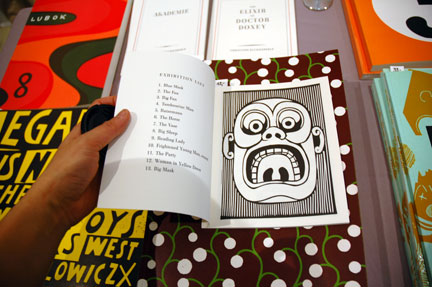
Lubok wares
Lubok book inside

Wares from the German company, Lubok Books.

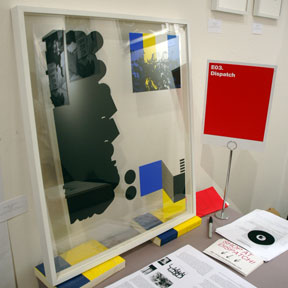
NYArtBookFair exhibition of prints on photocopies

DISPATCH, “a New York-based curatorial partnership between Howie Chen and Gabrielle Giattino,” had some really fantastic screenprints. I love how they exhibited them: framed, over a crazy photocopy-like montage.

NYArtBookFair_02

Among my favorites was this screen print on acetate (2008) by Jose Leon Cerrillo.

Screenprint by Matthew Brannon

“Where were we” (2008), a screenprint by Matthew Brannon. These prints by Brannon are so cool, I try to resist liking them, but it’s not easy.

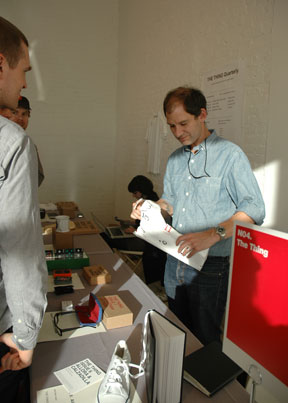
So when I rounded a corner and saw Jonn Herschend at his booth of The Thing Quarterly, subscription-based multiples, I knew I would fail to control my impulse buys.

Jonn Herschend

Artist Jonn Herschend at The Thing Quarterly’s booth.

I realized, a few years ago, that I need to put my money where my mouth is. If I think more people should buy, own, and enjoy art, I need to do the same. Bartering with other artists is great, but it’s also nice to show that you really support and believe in an artist with your wallet too. My budget is small, which means that my taste for multiples (which are generally more affordable) is perfect, and so I finally accepted that there were plenty of rationales for subscribing:
1. The Thing is an awesome idea.
2. The artists involved in The Thing are uniformly interesting and exciting.
3. I’m lucky to know one-half of the duo behind The Thing.
4. I’m proud of the fact that The Thing is from San Francisco, CA.

If that weren’t enough:
5. The Thing is super affordable: $200 for 4 limited edition multiples; that’s only $50/multiple. You could spend that on pints (!) in Manhattan.
6. The upcoming artists blow my mind!

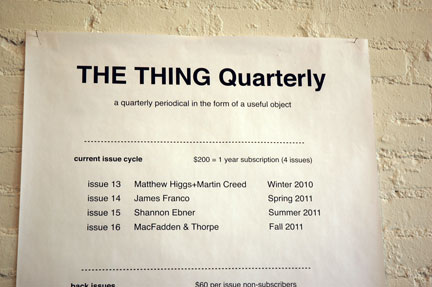
The Thing Quarterly subscription information

Matthew Higgs + Martin Creed (LOVE Martin Creed’s work!); James Franco (Sometimes his stony delivery makes me think that he’s new Keanu, but then I read about his fine art hijinx and suspect that he’s a performance art polymath. Also, M approves of his next movie.); Shannon Ebner (whose text-based work is great); and MacFadden & Thorpe (SF graphic designers who are so good, seeing their projects makes me raise my fists in mock-envy to the sky).
Standard
Research

Surprises at the MoMA

I visited the MoMA yesterday, on the last day of The Original Copy: The Photography of Sculpture, 1839 to Today. Working with studio-based compositions of sculptures and sculptural arrangements, Brancusi’s suite of beautiful b/w photos featured glints of light, while Jan de Cock [see his innovative website]‘s Studio Repromotion series were unaffected, curious color 4x6s. Cyprien Gaillard‘s Analogous Geographies (a series of groups of sixteen random Polaroids, all shot at 45 degree angles, and arranged to create composite landscapes) had a neat presentation (the photos were lain on a concave matboard-like surface in deep frames set at a low angle). Robin Rhode‘s Stone Flags (in which the illusion of flag-waving is carried out in a kind of live-action stop-motion hybrid, using real stones and a real figure) captured the heavy burden of statehood on personal identity. I was also happy to be introduced to Brassaï‘s Involuntary Sculptures, large b/w macro shots of materials like balls of dust or smeared toothpaste. The questioning of the nature of sculpture, and the embrace of chance, seems very contemporary. The cherry on the cake, though, was one of Duchamp’s valises of miniatures of his sculptures and paintings.

Still, while I toured other shows around the museum, I was most affected and impressed by three videos. This is a rarity for me. I haven’t got anything against video, it’s just that I don’t often have the patience it takes to watch enough videos to see the great ones. In this case, all three were very powerful, shared some similarities, yet are completely different.

Glenn Ligon‘s The Death of Tom (2008) is elegiac. It’s impressive because it seems to convey no content, yet ample clues point the observant viewer towards a very specific historical and cultural moment. [It’s so good I don’t want to spoil it for you, so I’ll add a SPOILER ALERT here. Skip to the next graph if you don’t want to know.] The short film consists of unintelligible streaks of white light; a hazy, nebulous, shifting blur creates sort of a monochromatic, animated Rothko. It’s unclear what you’re looking at, and when, if ever, the video will start. Yet a beautifully-recorded piano accompanies the light; its riffs and rhythms allude to vaudevillian tunes. The composition is nostalgic and playful and yet, interpretive, heavy, burdened and woeful. Being familiar with Ligon’s work, and his interest in race and the representation of Black Americans, I surmised a connection to blackface and the co-mingled feelings of liberation and weight. It’s a very powerful piece that connects strongly to Ligon’s paintings about illegibility and misreadings. Jason Moran, the pianist and composer, provides clues, context and grace in equal measure. It’s on view through May 9, 2011.

In a prime example of the multi-polarity of artists of color and ways of working, unflinching Vietnamese documentarian Dinh Q. Lê and his collaborators present a completely different video that concerns racial and national politics as well. Their giant, three-channel video is at times emotionally heart-wrenching, bombastic, borderline propagandistic, and completely unnerving. The Farmers and The Helicopters (2006) features interviews with a handful of survivors of the Vietnam War and their experiences with helicopters: elderly ladies who were terrorized as children, a militia man who fired on them, and a perplexing, passionate, self-taught mechanic, who, enthralled with helicopters and their utilitarian and humanitarian potentials, built a helicopter from scrap metals with a farmer. Le Van Danh’s and Tran Quoc Hai’s handiwork is on view in the gallery adjacent to the video. It’s massive, white like an angel, and mind-blowing. The Farmers and The Helicopters is on view through January 24, 2011.

The third video I liked was features only color fields, similar to Ligon’s black-and-white-blur, yet is aggressively gripping like Lê’s. Paul Sharit‘s Ray Gun Virus (1966) is a film consisting of rapidly interspersed fields of color, accompanied by a loud, brain-invading mechanical drone. Finding the screening room empty, I proceeded to break all normal viewing protocol: standing in the projection throw, observing the awesome retinal after-images (or colors) that occurred, and generally zoning out. I thought about looking straight into the projection when more visitors came in, and I resumed my normative viewing role. A structuralist filmmaker, Ray Gun Virus was Sharit’s first “flicker” films which aimed to alter consciousness. He succeeded. See a visitor-created YouTube video. Also on view through May 9, 2011.

Standard
Research

Missing Colors at Annet Gelink Gallery

I like the curious images for David Maljkovic’s solo show at Annet Gelink Gallery in Amsterdam.

David Maljkovic

David Maljkovic, Missing Colours, 2010, Installation with 5 framed b/w photographs, 1 framed photo collage, 1 collage on canvas, 1 tl light, coloured cellophane, slideshow of 80 slides. Image Source: Annet Gelink Gallery

I think the above use of slides that are removed from the viewer’s natural sightline is brilliant.

The other works use photographs, colored gels, historical bits of typography, site interventions, a little bit of painting and an oppressive grey collage material, it appeals to me visually with its open-endedness, while emotionally conveys longing for pleasure.

Standard
Sights

The Laundromat Project Fall Auction is on Wednesday

SOAPBOX II – 2nd Annual Art Auction
Wednesday, October 27, 2010, 6-9 PM
Collette Blanchard Gallery, 26 Clinton Street, NYC

I’m helping out with this auction to benefit an awesome community art initiative that brings contemporary artists into laudromats to lead free workshops in diverse neighborhoods across NYC. The cause is good, and so is the selection of art. Have a look!

Join the Laundromat Project and its many friends on Wednesday, October 27th for a silent auction and celebration to support its programs in New York City’s most vibrant communities. Tickets begin at $25 online($30 at the doors) and include drinks, nibbles, and music by DJ Khary! This year, artist and LP Create Change alumni Shinique Smith and artist Jayson Keeling are donating special edition prints to $1000 and $250 ticket buyers, respectively.

Donating Artists:
Derrick Adams • Golnar Adili • Joell Baxter • Petrushka Bazin • Aisha Bell • Karlos Carcamo • Brendan Carroll • Talia Chetrit • Sandra Chi • Samantha Contis • Pradeep Dalal • Hope Dector • Matthew Deleget • Stephanie Diamond • Erin Diebboll • Sarah Eichner • Rico Gatson • Deborah Grant • Christopher K. Ho • Wayne Hodge • Sheree Hovsepian • Kathleena Howie-Garcia aka LadyKFever • Joseph Laurro • Shaun El C. Leonardo • Yeni Mao • Dean Monogenis • Erika Neola • Glexis Novoa • Kambui Olujimi • Dawit Petros • Rob Pruitt • Ronny Quevedo • Kenya (Robinson) • Bayeté Ross SmithDread Scott • Paul Mpagi Sepuya • Rudy Shepherd • Shinique Smith • Yasmin Spiro • Anna Stein • Hank Willis Thomas • Mickalene Thomas • Zefrey Throwell • Cody Trepte • Jiny Ung • Mary Valverde • Kim Venable • Saya Woolfalk • and more!

Standard
Community, Research

Elizabeth Foundation for the Arts Open Studios

Open Studios is a chance to talk to artists, peek at studios and works in progress, and think about methods and materials. I enjoyed this very much in my visit to the Elizabeth Foundation for the Arts Open Studios last night. The EFA Open Studios continues today and Saturday.

The EFA has a building in midtown Manhattan with six floors of studios rented by established and emerging artists. There’s also a project space, as well as a print shop. The whole building was a hive of activity for Open Studios; it reminded me of being an Affiliate Artist at the Headlands Center for the Arts in Sausalito, CA, where I opened my studio to the public many times (Visit the Headlands’ Fall Open House this Sunday, October 17). EFA had a similar cross-section: a few big names; many interesting, under-recognized artists; and a cadre of East Asian artists with crafty or pop/anime sensibilities. There were lots of painters and few video artists; meticulous, feminine papercuts (by Amina Amed and Jaq Belcher); and a few very commercial enterprises balanced by a few wacky conceptualists and performance artists. I was surprised to see that some artists had large etching presses or Vandercook letterpresses in their studios. (You see how important elevators become when your studio is 5 or 6 or 9 floors up.) I was most excited about these artists:

Saya Woolfalk, Cartography of No Place, Gouache on paper, 30" x 40", 2008

Saya Woolfalk, 2008, Cartography of No Place, Gouache on paper, 30" x 40". Image source: Artist’s website.

Saya Wookfalk makes paintings, installations, performances and videos in Hello Kitty hues. She works with cognitive scientists and dancers, and teaches herself theater lighting. Need I say more?

Kristian Kozul makes kinda bad-ass sculpture. In his studio, he’s working on fantastic militaristic busts dripping in rosettes and covered in a glossly black resin.

David Greg Harth[/caption]

David Greg Harth, World News Tonight, 2010. Image source: davidgregharth.com.

David Greg Harth’s immensity can’t be captured here, but I’ll try: weird, painful, simple, public interventions, like collecting autographs in a Bible, tumbling down public steps, and opening a kiosk that only sells newspapers with horrible, 300-pt. headlines. Provocative, hilarious and wince-worthy. I liked that the artist was complicit in his projects about human folly: his willingness to humiliate and hurt himself was in plentiful evidence.

Dane Patterson, The Wedding, Graphite on Paper, 22 x 30 in, 2009

Dane Patterson, 2009, The Wedding, Graphite on Paper, 22 x 30". Image source: danepatterson.com

Dane Patterson can draw like crazy; but many steps—performance, sculpture, and photography—lead up to it.

Of the painters, I was attracted to Patty Catuera’s and Gary Petersen‘s work. Both make hard-edge, brightly colored, super flat abstractions. If you said that these paintings appeal to my design sensibilities, you’d probably be right, and I see nothing wrong with that. Patty’s work seems especially vibrant and sweet in its simplicity. The imagery originates in landscapes, and with the large expanses of flat, abstract space, there is room to push and pull the volumes and imagine a narrative unfolding.

I also liked David Storey’s mildly figurative mid-mod abstractions. They’re cheeky. They make me think of Mad Men interiors and knowing smiles.

Hong Seon Jang, Forest, tape on black chalkboard, 2010, 25x19 inches

Hong Seon Jang, 2010, Forest, tape on black chalkboard, 25×19 inches. Image source: hongseonjang.com.

Hong Seon Jang, Geographic wave (in process) National Geographic magazines, binder clips, push pins, 2009, 140x80 inches (variable)

Hong Seon Jang, 2009, Geographic wave (in process) National Geographic magazines, binder clips, push pins, 140×80 inches (variable). Image source: hongseonjang.com.

Hong Seon Jang had some terrific lichens cut from National Geographics, and forest scenes made out of cellophane tape. Nice!

Noah Kersfield

Still from a video by Noah Kersfield. Image source: http://www.noahklersfeld.com.

Noah Klersfeld’s videos were weirdly mesmerizing, partly from the sheer technical prowess, like stained glass come to life from pedestrian, single-camera shots.

Jihyun Park‘s large punched-paper and burned-paper works are really beautiful. I’m not especially compelled by the imagery, but the craftsmanship and perceptual experience are fantastic.

I admired Yuken Teruya’s paper sculptures in graduate school. I also love the graphic quality of batik, so it was a special treat to visit Teruya’s studio and see his most recent dye-resist paintings.

Hank Willis Thomas’ work is clean and super provocative; if, like me, you were most familiar with his advertisement-based work, he’s been busy with lots of text-based signs and lenticulars as well. I’ll leave it at that, since I’ve been helping out my fellow CCA alum.

Brian Whitney set up four mirrors to successfully merge two images into a 3D image; he’s also figured out a way to print photographic images on mylar. Jealous!

I also really enjoyed talking to Jimbo Blachy and his guest, who I assume to be his collaborator, Lytle Shaw. They had the skeleton of a boat set up in their studio, a whole lot of boating and Brit-ish ephemera, and they were wearing matching striped sailor shirts. That is, until you looked closer and realized that one of the shirts was actually a white t-shirt with stripes painted on it. That kind of geniality and jokiness immediately appealed to me. Later, I passed by their studio again, and saw the two of them alone, busy cracking each other up.

Standard
Research

Brian May, guitarist, astrophysicist, stereography enthusiast

We were barreling down a long corridor of ivy-covered trees in Tennessee when we finally listened to Terry Gross’ interview with Brian May (Fresh Air, WHYY, August 3, 2010), guitarist of Queen, co-writer of classic songs, astrophysicist and author of a new book on stereography.

It was one of those episodes of Fresh Air that you don’t soon forget.

It was a funny thing to hear May, with his humble and polite demeanor, describe touring with Queen, writing arena anthems, the non-issue of Freddy Mercury’s sexuality, and the pain of Queen’s limited success in America largely due to our homophobia. It was vital. I also relished paying attention to the strange structure of “We Will Rock You,” and May’s nerdy explanation of how he achieved the arena-like acoustics in the studio.

Of course the interview was spurred by May’s recent book of stereography, which is related to his PhD in astrophysics.

To be have a life in the arts, and to achieve the kind of success where your artwork becomes part of the culture, is really nothing short of extraordinary. To change courses and pursue specialized academics, and then share your love of science with a general audience, speaks to an admirable ambition and confidence. What an inspiration!

Standard