Research

“…the real force of wisdom lies in its timely deployment: not just what you say but when you say it, at the precise time the person you’re talking to needs to hear it.”

–Barry Schwabsky,  “Permission to Fail,” The Nation, January 21, 2014

[Isn’t that true of aesthetic experiences too? Mine included; especially as they relate to positive psychology or optimism.]

Timing is everything

Quote
Research

“All my work is based on the potentiality of trust. Though we rarely speak of trust in relation to art, a work of art may well be the ultimate expression of trust. It is as if we trust, for instance, that some inked piece of paper or painted canvas will receive us and speak truly about our world and its own. It is this space of trust that enables dialogue to unfold. Dialogue is a group of people freely reaching a place and verbally exchanging thoughts in a present and immediate way whilst listening, not only to others but also to themselves with others, then coming together and exchanging again, and after having left, coming together yet again. Such gathering is never spontaneous; still, it must be proposed.”

Esther Shalev-Gerz, The Contemporary Art of Trusting Uncertainties and Unfolding Dialogues, Art & Theory Publishing.

–Esther Shalev-Gerz, The Trust Gap (2013)

Quote
Sights
Mathilde Ter Heijne,  Woman to Go

Mathilde Ter Heijne, Woman to Go

This is an interesting premise for a show: postcard reproductions of early Daguerreotypes of unidentified women, with texts about recognized women, given away for free. Increasing the visibility of women through this act of generosity/ distribution. More info at the artist’s site.

It’s on view at Jack Hanley Gallery in NYC. Nice to see non-commercial projects at a commercial gallery.

Mathilde Ter Heijne: Woman to Go @ Jack Hanley Gallery

Aside
Sights

get excited: cool things everywhere

Being an artist involves so many activities, I’ve fallen behind on seeing art. But there’s lots out there to be excited about!

 Amanda Curreri, Under the Socialist Sun with Interference, Monoprint with screenprint, 15 x 11 inches, 2013; Llewelynn Fletcher, Standing Sound Costume: Lion, 2010, basswood, mahogany, low frequency sound, bass-shaker speakers, 3.5'W X 3.5'L X 7'H. // Source: c3initiative.org.

Amanda Curreri, Under the Socialist Sun with Interference, Monoprint with screenprint, 15 x 11 inches, 2013; Llewelynn Fletcher, Standing Sound Costume: Lion, 2010, basswood, mahogany, low frequency sound, bass-shaker speakers, 3.5’W X 3.5’L X 7’H. // Source: c3initiative.org.

Cool artists getting a cool residency in Portland, OR

ERNEST Introductions (Amanda Curreri & Llewellyn Fletcher)
c3 initiative, Portland, OR
Dec 7, 2013 – Feb 15, 2014
Opening: Sat, Dec 7, 6-9pm
Launching ERNEST’s collaborative two-year public project and partnership with Portland’s c3 initiative.

Installation view of The Shadows Took Shape. // Source: StudioMuseum.org // Photo: Adam Reich

Installation view of The Shadows Took Shape. // Source: StudioMuseum.org // Photo: Adam Reich

Afrofuturist aesthetics @ the Studio Museum
Including a collaborative project by Nyeema Morgan
Plus a great portrait of the artists in the New Yorker Magazine

The Shadows Took Shape
November 14–March 9, 2014
Studio Museum
NYC

Artists of The Shadows Took Shape in the New Yorker Magazine. Photograph by Christaan Felber.

Artists of The Shadows Took Shape in the New Yorker Magazine. Photograph by Christaan Felber.

I don’t think female artists of color have enough visibility; this is a lovely move in a good direction.

Leonid Tishkov, Private Moon. // Source: ArtsCatalyst.org.

Leonid Tishkov, Private Moon. // Source: ArtsCatalyst.org.

A wonderfully speculative, lunar-themed exhibition in London

The preview images look so cool.

January 10-February 2, 2014
The Art Catalyst’s Republic of the Moon
Bargehouse, Oxo Tower Wharf, South Bank, London

Vacuum/plenum (the Cotard delusion, invisibility, and other gravities), 2009, mirror, two-way plexiglass mirror, aluminum, steel, casters, Dimensions variable, mirrored box is 4x4x7 ft. // Source: SeldonYuan.com

Vacuum/plenum (the Cotard delusion, invisibility, and other gravities), 2009, mirror, two-way plexiglass mirror, aluminum, steel, casters, Dimensions variable, mirrored box is 4x4x7 ft. // Source: SeldonYuan.com

Vacuum/plenum (the Cotard delusion, invisibility, and other gravities), by Seldon Yuan

I came across this NYC artist when I received a rejection letter and he was listed as one of the winners. But when I viewed his site, and this project in particular, the selection committee’s wisdom became apparent to me. The sting of rejection is a mitigated by intrigue of this work. I wish this project was my own. It’s brilliant.

Personal Goal Setting Advice for Artists

Love this Personal Goal Setting advice from  Creative Capital’s Internet for Artists Handbook. I came across this a while ago but keep recommending it to folks. Really useful!

(I just noticed it’s written by Blithe Riley, an artist involved in interesting, radical visual art programming at Interference Archive in Gowanus in Brooklyn. Coming up this week: neat programming around Asian American struggle.)

Your turn: These Calls for Entry

Signal Fire’s spring exhibition in the New Mexico wilderness
Spring applications due December 31

Interface Gallery’s call for participatory projects
Oakland, CA
Stipends available. Applications due January 1, 2014.


Standard
Research

sometimes it takes work to be happy

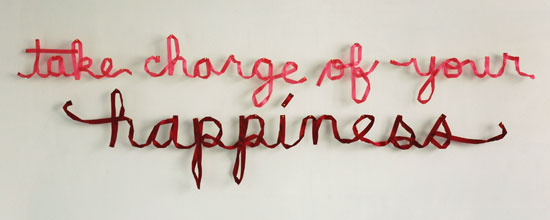
Christine Wong Yap, take charge of your happiness, 2011, ~83 × 24 × 1 in / 211 × 61 × 2.5 cm.

Christine Wong Yap, take charge of your happiness, 2011, ~83 × 24 × 1 in / 211 × 61 × 2.5 cm.

Happiness is a vague term that belies the complexity of psychological wellbeing.

I was reminded of this fact by a few things this week. These things may help to explain what I wanted to express with the work, take charge of your happiness: it takes continual attention, intention, action, and time to cultivate the myriad elements that contribute to wellbeing.

1.

Make it concrete.

This week, someone asked me what I thought about the brief article, “A Fine-Arts Degree May Be a Better Choice Than You Think,” by Daniel Grant in the Wall Street Journal (November 10, 2013). The author summed up three studies or sources that reported that artists are “happy” or “happier” than the general population.

I think the points are interesting but felt that the research warranted further elaboration. I thought: What is meant by happiness? Though the term is often used diffusely, it can be understood with more precision, and indeed, such clarity is helpful for increasing one’s own wellbeing.

What I mean by happiness is outlined a bit in the next item.

2.

Recognizing my own unhappiness.

This week, I skipped the gym and did desk work for four days in a row—personally, this amounts to a recipe for psychological disaster. I even walked five miles to work one day, but it wasn’t enough to release the endorphins that bring emotional balance. Add a few triggers and the result was pointless irritability and misanthropic anger.

I hit the gym until all my muscles were fatigued and my mind was clear. It showed me, once again, how I’m more relaxed, generous, optimistic, and compassionate after a good workout. My sense of well-being is increased. These are major components of happiness. But obviously, it takes intention to get to the gym in the first place.

So, reminder to self (it bears repeating): Working out is as much for psychological as physical wellbeing.

Add to that the fact that I’m starting to miss working out outdoors, and it’s not even winter yet. So an immediate action step is to look into bicycle clubs!

Less of this. (Charlie Brown by the inimitable Charles Schultz.)

Less of this. (Charlie Brown by the inimitable Charles Schultz.)

More of this. (by Charles Schultz)

More of this. (by Charles Schultz)

3.

Be physically involved in doing what you love.

I’ve been writing applications to grants and residencies as part of my strategic goals. It became a habit too successfully, to where I had to remind myself that I’m on track to my goals and can focus my efforts on the studio for a few weeks.

Once in the studio, I popped on a podcast of Grayson Perry’s Reith lecture, and he validated the importance of play and of losing yourself in the activity. (All the lectures are great, I highly recommend them!) He didn’t use the word flow, but I think he meant it.

4.

Make a plan.

I feel like I’ve been working on my VIA Semaphore flag project forever. I’ve sewed 13 flags in three months (it’s an edition of three, so I could say I’ve sewed 36 flags, but whatever).

Christine Wong Yap, flag for gratitude from the VIA semaphore project (tentatively titled), 2013, linen, 12.5x12" each, edition of three from a set of 24.

Christine Wong Yap, flag for gratitude from the VIA semaphore project (tentatively titled), 2013, linen, 12.5×12″ each, edition of three from a set of 24. See more on my Facebook Page album.

<NERD ALERT> Since I’m a huge adopter of Creative Capital‘s strategic planning advice for artists, I do weekly check-ins. I also moved my to do list onto a calendar; fewer tasks fall through the cracks, and I’m more aware about procrastination.

In this week’s check-in, I put the production of the remaining 11 flags into a calendar. It’ll take six weeks if I add nothing else to my schedule. This is familiar—I’ve done six-week plans in gearing up for road races. Instead of focusing on my slow progress or the seeming interminableness, I’m excited about enjoying the momentum and how much I’ll accomplish.

5.

It’s OK.

I really like this spark chart from pro runner Lauren Fleshman’s website. It documents her life’s highs and lows. It’s awesome because it shows how even major athletes have setbacks and personal detours, too. But the ultimate message is to bounce back, and be resilient.

Lauren's Life: Highs and Lows, from AskLaurenFleshman.com.

Lauren’s Life: Highs and Lows, from AskLaurenFleshman.com.

Having been sidelined from running by a knee injury, it’s also reassuring to know that Fleshman has overcome her own.

This chart also reminds me of Phil Zimbardo & John Boyd’s book, The Time Paradox, which urges readers to have a healthy time perspective: to ensure the past also houses happy memories and achievements, to utilize and savor the present, and to look forward to the future. Sometimes the past seems like a large closet overstuffed with regrets and humiliations, but as Fleshman, Zimbardo and Boyd point out, there’s lots to remember fondly too.

6.

Remember gratitude.

Keeping a gratitude journal is a proven way to increase your subjective wellbeing. There are apps for gratitude journaling now.

The University of Melbourne is seeking participants for a new gratitude survey.

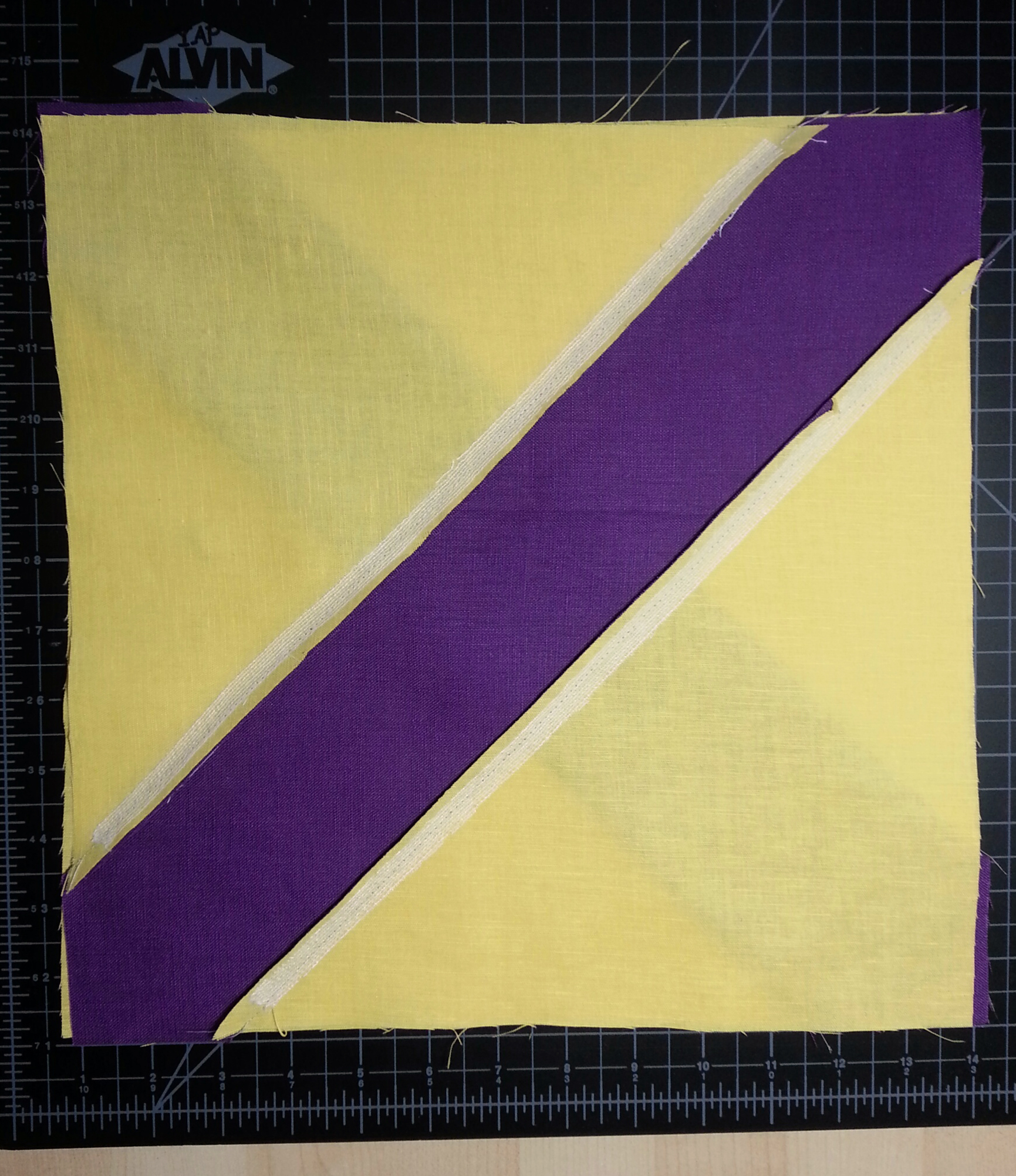
Sewing on the bias (the stretchy direction) is hard! Fusible interfacing makes it easier.

Sewing on the bias (the stretchy direction) is hard! Fusible interfacing makes it easier.

What I’m grateful for this week:

7.

Give.

It feels good and it’s the right thing to do.

UNICEF, the Humanitarian Coalition, and Doctors without Borders are good. The Asia Society’s post on how to help is especially thorough.

Standard
Sights

Get excited: This week in NYC

Loads of thought-provoking art events in NYC are coming up! These all appeal to things I’m excited about lately—horizontal networks, feminism, activism and more:

Tonight! Tuesday, November 12
PANEL: Who Cares About Collaboration?

Eyebeam
540 W 21st St, NYC
7-9pm, Free

Speakers include Joe McKay (UCB/Headlands!), Sarah Perks (the awesome Cornerhouse of Manchester), and folks from The White Building (a cool London art space).

Friday, November 15
EXHIBITION OPENING: A Necessary Shift
Elizabeth Foundation for the Arts Projects Space 

323 W 39th Street, 2nd floor, NYC
6–8pm

Reception for the exhibition and event series for EFA’s Arts-Workers-as-Artists program, including Hatuey Ramos-Fermín and Elizabeth Hamby, whose excellent Boogie Down Rides event brightened up my weekend.

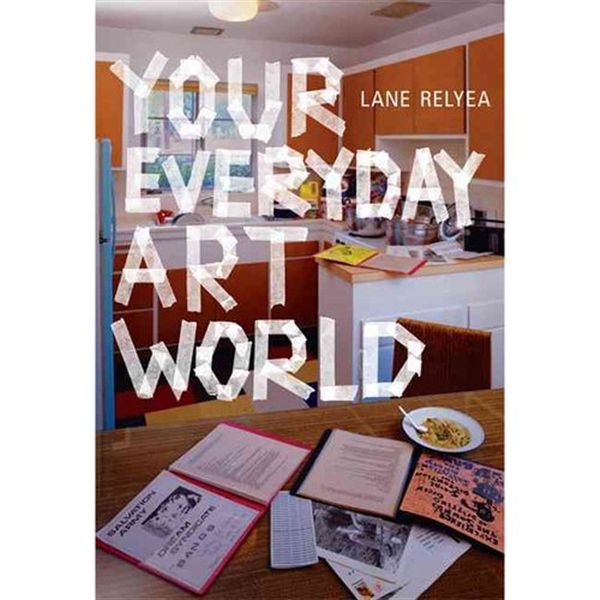
Lane Relyea, Your Everyday Art World

Lane Relyea, Your Everyday Art World

Saturday, November 16
CONVERSATION: Katy Siegel with Lane Relyea, author of Your Everyday Art World
Regina Rex
1717 Troutman Ave #329, Queens
6pm
About the

new networked, participatory art world

Get there early to check out:

EXHIBITION: Ornament and Crime
Ortega y Gasset Projects
1717 Troutman Ave #327, Queens
Gallery hours are 1-6 Saturdays and Sunadays. Exhibition on through Dec 8.

Group show curated by undercover super hero Lauren F. Adams, featuring projects by Stephanie SyjucoDavid MabbSusanne Slavick, and Stacy Lynn Waddell.

Monday, November 18
PRESENTATION: Guerilla Girls Broadband
Interference Archive
131 8th Street #4, Brooklyn
7:30pm
Talking about their latest project, MapAbortion, on access to reproductive health.

(I’m also really excited about Interference Archive’s forthcoming exhibition, Serve the People: The Asian American Movement in New York, opening December 5. IA’s core collective includes the indefatigable Josh MacPhee, and book- club-mate Blithe Riley!)

Standard
Impressions

A Surprisingly Visual and Aesthetic Science Festival

Despite only mild curiosity about medical history and an easily grossed-out constitution, I was consistently enthralled at yesterday’s Festival of Medical History at the New York Academy of Medicine (NYAM).

The festival’s organizers—which included art writer Lawrence Weschler—suffused the conference with programming that could have easily been presented at visual criticism symposia. Though it’s ostensibly a science-oriented festival, I loved the integration of aesthetics. Here are my highlights:

Competitive Slide Slam: Images of the Cosmos vs. Images of the Brain

Filmmaker/editor Michael Benson jocularly presented photos of the universe (see some here, click on ‘Prints’), which neuroscientist Carl Schoonover tried to match or top with images of the brain (see some here, click on ‘Portraits of the Mind’). Both speakers offered insightful factoids emphasizing immensity—either the space’s grandness or the brain’s complexity. It was entertaining, playful, visually stunning, and expansive.

The compositions where surprisingly similar, yet aesthetically divergent. The images of the cosmos exuded high resolution and definition, while the images of the brain were either painterly or graphic, with subjective use of color. It raised questions about the selectivity of image-processing. What drives the desire to bring distant galaxies into crystal clear focus? What does it mean when color is cleaved from visual reality, making some gases visible to the human eye, or differentiating microscopic parts of the brain in fantastical neon colors?

Both speakers limned the question of what constitutes consciousness. Benson’s images could be tools in the search for extra-terrestrial life, while Schoonover showed a video of active brain cells in a Petri dish, reaching out to build connections.

(Bonus: Check out the transcendent Cat’s Eye Nebula on the Hubble site.)

Spaces to Read, Research and Work

NYAM’s building on Fifth Ave is grand, with lots of beautiful, symbolic architectural features. We visited its rare books library (open to the public by appointment), which housed a display of Renaissance-era books with fantastic wood engravings and etchings, and 19th- and 20th-century ephemera—always a typographic treat.

Conservation lab at the New York Academy of Medicine.

Conservation lab at the New York Academy of Medicine.

The conservation lab, however, was exactly my kind of dreamy: a spacious, light-filled, dust-free, and organized workspace. Everything had its place, from fabric yardage in a gridded shelving system, to boards in flat racks, to a few real-bone folders on display. The workbenches—laminate tops, ergonomic heights, on casters—made me miss the clean room in the old CCA Printshop, and fantasize about a dream studio with an enclosed clean/storage room.

A drill press was fitted into a corner next both a hand vacuum and a dust-collection machine: a Virgo’s paradise.

(Side note: The three conservators were female; one mentioned how traditionally, women sewed bindings. In my experience, contemporary book binding and book arts seem practiced by women more often than men. Why is that? The fact that sewing is involved can’t be determinate, even today, can it? Or is there something about temperament, and the quietude of books? Or both?)

Modes of Display

Amy Herzog‘s talk about dioramas was fantastic. I hope she publishes an essay, it was one of the most well-crafted visual criticism presentations I’ve heard, connecting the reflection of the self in daguerreotypes, Daguerre’s coining of the term diorama, and the recognition of self through encounters with the other and a confrontation with death. Here’s the synopsis:

Momento Mori: Reflections on Death and the Art of the Tableau

This talk surveys a spectrum of artistic and museological dioramas, waxworks, and post-mortem photographic practices, and the hermetic, frozen worlds each offer to the viewer. There is something profoundly fetishistic, and mildly necrophilic, at the heart of the diorama, an apparent desire to encapsulate and reanimate those items on display. This paradoxical tension between preservation and regeneration seems germane to the 19th-century imaginary in general, the moment at which many of the visual practices I will discuss came into being. And while the diorama in particular is driven by a certain pedagogical directive, my talk will suggest that their lessons are more ambiguous than their creators likely imagined, and offer uncanny insights into our contemporary condition.

(Weird bonus! Learn about a book of Walter Potter’s bizarre anthropomorphized kitten taxidermy or see pics on The Daily Mail.)

Early 20th-c. Obsession with Rays via Fritz Kahn’s Fantastical Illustrations

As employee of the US National Library of Medicine, and therefore, the federal government, Michael Sappol‘s talk was at risk of cancelation. In a brilliant sidestep of the government shutdown, someone else read Sappol’s written remarks.

Sappol wrote that rays, beams, and waves became an obsession and a base metaphor of modernity in the 1920s-1940s. Kahn was a physician who lived from 1888-1968 (what a spectacular period in which to live!). Using commercial illustrators, he used pipes and rooms to create body-as-factory illustrations, and then adopted lines to signal electricity within and outside of the body, like flow charts a with spare diagrammatic language for engineers.

Fritz Kahn (author), Der Mensch als Industriepalast (Man as Industrial Palace)  Stuttgart, 1926. Chromolithograph. // Source: National Library of Medicine.

Fritz Kahn (author), Der Mensch als Industriepalast (Man as Industrial Palace) Stuttgart, 1926. Chromolithograph. // Source: National Library of Medicine.

I love Sappol’s ideas of developing an iconography of “occult forces” invisible to the human eye; of “electricity, magnetism, mesmerism;” connecting light and radios and radiology for images of “radiant modernity;” and the merging of German mechanist tradition with Kahn’s Romantic leanings. Indeed, some of the radiant images reminded me of Charles Burchfield’s visionary paintings, like Radiant Spring.

 Fritz Kahn (author), Das Leben des Menschen... (The Life of Man). Vol. 5  Stuttgart, 1931. Relief halftone. // Source: National Library of Medicine.

Fritz Kahn (author), Das Leben des Menschen… (The Life of Man). Vol. 5 Stuttgart, 1931. Relief halftone. // Source: National Library of Medicine.

Kahn’s pictures are immediately appealing, and Sappol explains why: they harmonize the discordant in modern life via the flow of life and energy.

Learn more about Kahn and his work at Fritz-Kahn.com.

Or set yourself a Google alert for Sappol’s book (currently in production), How to Get Modern with Scientific Illustration: Fritz Kahn, Pictured Knowledge and the Visual Rhetoric of Modernity.

Get excited: NYAM plans to make the festival an inaugural event. I hope they keep it free, open to the public, and strongly integrated with art and aesthetics!

Thanks for bringing the festival to my attention, M and New York Today, NYT’s fantastic picks list (also a great reference for ultra-concise yet warm writing, to which I will aspire, however wordily I fail).

Standard
Impressions, Research

Points of Reference: Haim Steinbach, The Meaning of Things, and Irrational Exuberance Anew

Christine Wong Yap, Irrational Exuberance (Asst. Colors), installation view at Sight School, Oakland, CA. 2010.

Christine Wong Yap, Irrational Exuberance (Asst. Colors), installation view at Sight School, Oakland, CA. 2010.

It’s been three years since I created Irrational Exuberance (Asst. Colors), a body of work inspired by discount store culture, pleasure and decoration. Recently, I’ve encountered salient art and writings related to those ideas. These references are not too late—in fact, they are perfectly on time, as I’m currently revisiting Irrational Exuberance to envision a new body of work and self-initiated project.

The references are like three planets with shared orbits:

A Two-Hour Drive. A Three-Year Journey.

Featured guests (L-R): artist, writer and theorist Ginger Wolfe-Suarez, curator and critic Glen Helfand, and writer and curator Patricia Maloney.

Featured guests at As Is, the dialogue at Irrational Exuberance at Sigh School (L-R): artist, writer and theorist Ginger Wolfe-Suarez, curator and critic Glen Helfand, and writer and curator Patricia Maloney.

In the dialogue that accompanied Irrational Exuberance in 2010, artist and theorist Ginger Wolfe-Suarez cited Steinbach’s work (download her interview with Steinbach from his site):

I’m interested in looking at Christine’s work, and work like Christine’s, that transcends consumption as a closed system of signs and symbols. That conversation can be transformative. … I was really interested in how [Haim Steinbach and Allan McCollum’ talked about their objects. …. There are political ramifications for words like consumption—like nihilation—so I think the ability to tackle, and transcend, those conversations is really exciting for me.

I had looked at reproductions of Steinbach’s most iconic works: found objects displayed on shelves. I was inspired by how modest they were, but also found the objects un-transformed, recognizable identities difficult to overcome. Like the drawing instruction, “Draw what you see, not what you know,” when I as faced with Steinbach’s artworks, it was hard to see what was in front of me when it kept on insisting to be what I knew it to be. I couldn’t find the space for visual or conceptual discovery at the time.
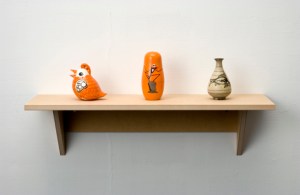
Haim Steinbach, Untitled (bird, nesting dolls, vase), 2006  MDF shelf; ceramic bird; wooden nesting dolls; Korean ceramic vase 11-3/4 x 33 x 10-1/2 in. (30 x 84 x 27 cm). // Source: HaimSteinbach.net.

Haim Steinbach, Untitled (bird, nesting dolls, vase), 2006 MDF shelf; ceramic bird; wooden nesting dolls; Korean ceramic vase 11-3/4 x 33 x 10-1/2 in. (30 x 84 x 27 cm). // Source: HaimSteinbach.net.

I was still curious to learn more, so I visited once again the world is flat. Bard is a two-hour drive from NYC, but it was worth the trek. I gained a profound appreciation for Steinbach’s work by seeing it in person, in abundance, and with exceptionally keen curatorial direction by Tom Eccles and Johanna Burton united with spot-on exhibition design for maximum effect. I didn’t love all the work, or completely understand it, but I fully respected it. I had to wrestle with what Steinbach was doing, what the viewers are meant to do or experience, and what I felt, which was at times pleasure, bafflement, and also despair—the world is flat, leaving my preconceptions about value in limbo. While Steinbach’s work is still potently mysterious to me, I found the accompanying catalog to set interesting parameters about what, exactly, Steinbach’s ideas and works are.

Brute Material Facts

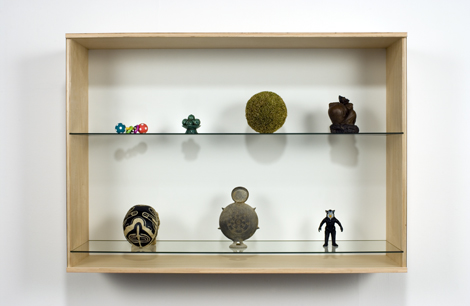
Haim Steinbach, Untitled (skull, vessel, figurine, toy, fruit bowl, sphere, peasant), 2006  Birch plywood, plastic laminate and glass box; synthetic polymer skull; Korean ceramic vessel; plastic figurine; plastic baby toy; Chinese fruit bowl; straw ball; Chinese ceramic statuette 37-3/4 x 53-3/4 x 14-3/4 in. (95.8 x 136.6 x 37.5 cm) // Source: HaimSteinbach.net.

Haim Steinbach, Untitled (skull, vessel, figurine, toy, fruit bowl, sphere, peasant), 2006 Birch plywood, plastic laminate and glass box; synthetic polymer skull; Korean ceramic vessel; plastic figurine; plastic baby toy; Chinese fruit bowl; straw ball; Chinese ceramic statuette 37-3/4 x 53-3/4 x 14-3/4 in. (95.8 x 136.6 x 37.5 cm) // Source: HaimSteinbach.net.

The aesthetic experience of contemporary art is often like an act of unraveling a riddle. Familiarity with the tropes usually leads towards plausible hypotheses: commenting on this, re-contextualizing that, hybridizing this plus that—you get the idea. Steinbach’s work is more abstruse. It offers no Tootsie Roll center like the center of a Tootsie Pop. In her essay, “Some Collectables,” from the exhibition catalogue for once again the world is flat., curator Johanna Burton points out:

These are not … representations of things, but rather presentations of them.

Steinbach’s objects are not metaphors or symbols to be deciphered. They are all surfaces and cultural associations. They are the point. Whereas, discussions of the readymade, appropriation, and mass production, Burton states,

are only tangential to the brute material fact of what’s actually there.

That “brute material fact” is exactly what I couldn’t overcome initially. And this may also be another point of Steinbach’s—for me, as a viewer, to look at what’s there and to forget habits of looking. As Burton says, the very title

asks us to reconsider what we think we know, and to survey the terrain around us, as if we were seeing it for the first time again.

In other words, Steinbach is asking viewers to move beyond recognition to perception. In The Meaning of Things, Csikszentmihalyi and Rochberg-Halton explain John Dewey’s ideas of perception versus recognition. Recognition is

when we experience a thing and interpret it only as something we already know

Hence, there is no new organization of feeling, attention or intentions within the viewer. Just as I could only see the objects’ identities when I first encountered Steinbach’s work, I could not garner a meaningful aesthetic experience from them. On the other hand, perception is

when we experience a thing and realize its own inherent character … [the] object imposes certain qualities on the viewer that create new insights.

Certainly art objects are intended to create aesthetic experiences that “create new insights” on the viewer; Steinbach challenges viewers to perceive quotidian objects anew.

The Quotidian

In Irrational Exuberance, I sought to question class and value distinctions inherent in decorative objects. Many of the works in Irrational Exuberance are multiples, reinforcing discount stores’ feelings of immediacy and abundance. The subtext is that idea serialized objects can also be personally meaningful. Burton explains that this holds true for Steinbach too:

Steinbach’s interest … in collecting as a mode of production would seem to court the individualistic, affective drive toward objects, while also acknowledging the serial nature of every such ‘special’ object.

For the Things authors, everyday objects bring together the self and the world:

household objects become sights of a wider network of meanings that embrace the whole world.

echoing the very title of the Steinbach show: once again the world is flat. This leveling works two ways: bringing art objects ‘down’ to the same level as quotidian objects and elevating everyday things ‘up’ to the rarified realm of artworks.

In “Not a Readymade” (reprinted in the exhibition catalog and also downloadable from Steinbach’s site) Anthony Huberman interviews Steinbach, who reveals that his work

embraces the idea that art is always with us, a function of the everyday.

Vinyl Ficus #3 & 4, 2010, vinyl, mylar, thread, lacing, wire, ~18 x 12 x 12 inches / 45 x 30 x30 cm each

Christine Wong Yap, Vinyl Ficus #3 & 4, 2010, vinyl, mylar, thread, lacing, wire, ~18 x 12 x 12 inches / 45 x 30 x30 cm each

The Things authors even wrote about the role of objects in visual art thusly:

Creative artists are those who can find a convincing visual solution to a problem that was never previously formulated. In the solution, and even in the formulation of creative problems, objects stimulate and help develop the artist’s thought.

In 1980, they could not known to what extent Steinbach would use objects expressly to advance thought.

Sentiment

Cute ___ Calendar, 2010, collage of found calendars, 12 x 12 x 0.5 inches / 30 x 30 x 1.2 cm

Christine Wong Yap, Cute ___ Calendar, 2010, collage of found calendars, 12 x 12 x 0.5 inches / 30 x 30 x 1.2 cm

In 2010, I wrote that Irrational Exuberance was an immersion in sentiment:

… an exercise in pleasure, modest expectations and accessibility.

With its unabashed enthusiasm, … Irrational Exuberance (Asst. Colors) marks a shift … I became enamored with the aesthetic, symbolic and conceptual potential of discount store culture, the decorative impulse, and the search for happiness.

…sentiment and immediacy are embraced. The exhibition’s title highlights the paradox of thinking rationally about emotional and internal experiences.

My previous work had been “cool”—often black-and-white, reserved, and materially minimal. I found kinship in a quote attributed to G. K. Chesterton:

The meanest habit of humankind is to be skeptical of sentiment.

In the public dialogue, sentimentality appeared divisive; perhaps in the age of irony, audiences automatically assume that elation and enthusiasm cannot be sincere. It’s a comfort to me that Steinbach does not shy from sentiment either. In Giorgio Verzotti’s “Object, Sign, Community: On the Art of Haim Steinbach” (reprinted in the exhibition catalog and also downloadable from Steinbach’s site), he states:

What Steinbach highlights …. is the object as a focus of emotion.

The Reciprocal Relationship Between Objects and Selfhood
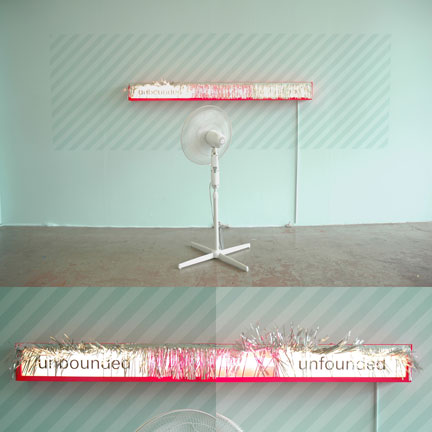
Christine Wong Yap, Unbounded/Unfounded, 2010, fan, metallic fringe and light box: pegboard, wood, acrylic, vinyl, lights, paint, 73 x 60 x 48 inches / 1.8 x 1.5 x 1.2 m.

Christine Wong Yap, Unbounded/Unfounded, 2010, fan, metallic fringe and light box: pegboard, wood, acrylic, vinyl, lights, paint, 73 x 60 x 48 inches / 1.8 x 1.5 x 1.2 m.

I’m interested in how objects accrue meaning or sentiment. Are objects merely containers for human associations? Or do they “act” as well? This transaction may be more reciprocal than I think, as objects can also shape humans.

Verzotti describes the link between objects shape the self:

An object, inasmuch as it forms part of our daily lives … to satisfy certain needs, becomes, Steinbach says, vital to the construction of our identity.

This is essentially what the authors of Things set out to study:

how the most complex pattern of emotion and thought can become embedded in and symbolized by concrete things, that is how things themselves are part of the interpretive sign process that constitutes meaning.

They elaborate:

Things actively change the content of what we think is our self and thus perform a creative as well as reflexive function….

Objects affect what a person can do, either by expanding or restricting the scope of that person’s actions and thoughts…. Objects have a determining effect on the development of the self.

According to Burton, Steinbach’s work conjures very similar ideas:

Objects are less about their owners, … and more about the circulations they make…. Objects reflect much of their owners’ beliefs, systems of faith, and measures of value… [and] also produce [them].

The overlap in the ideas between the Things authors, Burton, and Irrational Exuberance are abundant. One of Burton’s paragraphs in particular is especially sociological and psychological:

Our drive to acquire and organize things is, in part, how we understand ourselves. Less a comment on capitalism than an investigation of the production of self, Steinbach’s work acknowledges the fragility of subjecthood—that our funny, fragile egos are bound up in the unexpectedly rich terrain of the knickknacks and bric-a-brac, to say nothing of priceless mementos, we collect and covet.

This is a sequence of ideas that are relevant even line by line. First, she writes,

Our drive to acquire and organize things is, in part, how we understand ourselves. …[Steinbach’s work is] an investigation of the production of self…

This echoes the Things authors:

the potential significance of things is realized in a process of actively cultivating a world of meanings, which both reflect and help create the ultimate goals of one’s existence.

Next, Burton specifies that Steinbach’s work is

Less a comment on capitalism

This, too, came up at the dialogue at Irrational Exuberance (Asst. Colors). Some viewers assumed a negative, oppositional critique on my part where there was none. I embraced the bright colors and cheap materiality as sincere expressions of enthusiasm and pleasure, so this perspective was confounding. Where was it coming from? I had theorized that works of art can operate like barometers for optimism and pessimism, and this seemed further evidence that viewer’s projections are just as integral to the reading of the work as the work itself.

Last, Burton writes

our funny, fragile egos are bound up in the unexpectedly rich terrain of the knickknacks and bric-a-brac

This could very well be a statement for Irrational Exuberance.

The Social Life of Objects

Christine Wong Yap, Irrational Exuberance (Asst. Colors) buttons #1–3, 2010, badges, 1–1.75 inches / 2.5 x 4.5 cm dia. each.

Christine Wong Yap, Irrational Exuberance (Asst. Colors) buttons #1–3, 2010, badges, 1–1.75 inches / 2.5 x 4.5 cm dia. each.

In the study of positive psychology, improving one’s subjective wellbeing seems to always begin with the self and expand towards the social. There seems to be a parallel here: beginning with the habits of mind such as recognition and perception, acknowledging the everyday, and considering the organization of the self, and moving on to relationships.

In Steinbach’s interview with Huberman, he states

my practice is directly committed to the social.

How is it that inanimate objects can be social? Steinbach suggests how can they not:

There’s always more than one object at hand. Being here means you and here.

Verzotti’s points out the relational aspect of things between people:

Each object is both an object and a sign associated with a specific social dynamic, a token of exchange with we weave our interpersonal relations…

I’d thought about art objects as props that mediate relationships. Now it appears that objects might function similarly.

Christine Wong Yap, a diagram of how artists and viewers inform works of art and thereby mediate relationships between artists and viewers.

Christine Wong Yap, a diagram of how artists and viewers inform works of art and thereby mediate relationships between artists and viewers.

Csikszentmihalyi and Rochberg-Halton elaborate on the many levels of this social potential:

Objects … serve to express dynamic processes within people, among people, and between people and the total environment. These processes might lead to a more and more specific differentiation or increasing integration…

by which they mean, the individuation of the self or alignment with others. They add:

Differentiation is the result of control, whereas integration is based on participation.

This calls to mind my idea that art experiences are opportunities for enacting trust or skepticism. Perhaps another way to think of art experiences is as opportunities for expressing differentiation/control or integration/participation.

Integration and Differentiation

When I read the once again the world is flat. exhibition catalog, so many points seemed to overlap with my own interests in Irrational Exuberance that I became nervous—which I self-diagnosed as the anxiety of influence.

An obvious similarity between once again the world is flat. and Irrational Exuberance is the use of common objects displayed on shelves. Though I used found objects in non-shelf displays, I collaged, sewed, and constructed most of the objects in Irrational Exuberance. My work conveys “craft” more than “brute materiality.” Further, Steinbach invests much of his constructive energy in the shelves, not the objects on display; in my work, the attention is reversed.

I like to think that I’m forging a different path on shared terrain. Or to use a different metaphor (same idea, different things), since orbits have different trajectories, coincidental moments of proximity are the result of traveling great distances.

Standard