Art & Development

o! the joy of teaching

I had a great day of sharing knowledge. I presented my work in Sydney Cohen‘s 2-D class at CCA, and taught my Sketchbook Drawing class at the ASUC at UC Berkeley.

The 2-D class is for first-year undergrads in all departments. Though my work is fairly conceptual and 3-D, the students seemed responsive to my non-art materials such as the night lights in Dark into Light. They also asked great questions, like Do you come up with a concept first to execute? (While I often start with an idea, the project takes form as I’m working), and this gem: You mentioned your frustration with the limit of available materials — would you rather have any imaginable media to work with? (Yes, but no, the material’s manufacture and limitations often inform the work). Another student asked How do you choose what books to read? (The Road is perhaps bleakest of novels, and Dreams of my Father is most optimistic of memoirs. Psychology books are is easy to find, because psychologists always reference other researchers.)

My talk is littered with quotes and references, but the unglamorous reality is that I don’t actually retain much of what I read. I’m too much of a spazzy multi-tasker to absorb and recall information. I have to synthesize it. And the only way I’ve found to synthesize and retain information — my personal method of aperception — is to write extensive notes by longhand in my sketchbook. In fact, I looked up Holly Schorno‘s name in sketchbook #15 today, so I could present her work in my Sketchbook Drawing class.

I proposed Sketchbook Drawing, a six-week class, to the ASUC at UC Berkeley. They run art classes open to Cal students and the general public.

My goal was to make the class fun, safe for experimentation, and keep the students — who had a variety of previous art experiences — engaged. I skimmed fundamentals like figure drawing, gesture drawing, cartoon skeletons, contour drawing and color theory. My interest lies more in creative self-expression and mixed media fluidity than realism or mastery. In my own experience, drawing everyday is the only surefire way to improve one’s observational skills, and a sketchbook practice is a great place to start.

I had taken a few years off of teaching, and I had reservations about returning to it. But students that are responsible, self-motivated, and eager to learn has made teaching a dream. It’s been fun to present the work of artists and illustrators filtered through my tastes (Eric Drooker, Henri Matisse, Jess, Weston Teruya, Charley Harper, Maurice Sendak, Raymond Pettibon, Michelle Blade, John Audobon, Dan Eldon). Of course it’s really great that many of my students responded appreciatively to the class and are enthused about the next 6-week section, Intermediate Sketchbook Drawing, starting Wednesday, November 4.

I value transparency, so I was happy to talk about professional practices with the students at CCA. When I was younger, I thought of the “art world” as monolithic, and I regarded it with suspicion. It was nice to explain my new position that the art world is in fact comprised of a network of people, most of whom are bright, hardworking and benign. I encouraged them to consider their role in the network, and how their behavior shapes others’ opinions of art and artists. I put it rather bluntly, but I think I got my message across.

Standard
Art & Development

Fine Messes

I had a great time celebrating SoEx’s Grand Opening and the opening of Bellwether this weekend. Great people, great space and a great reason to celebrate. Both nights ended with dancing in the street. I can’t think of a better way to celebrate a new home.

I was too busy taking in all the happy faces to bother with photos, but here are two… I’m quite fond of many of the works in the show, and especially of Jonn Herschend‘s work. I know a lot of people came to the opening but didn’t have a chance to see the video, and I strongly recommend going back for it. I’d offer some sort of bribe — cookies perhaps? — but the video in itself is reward enough. Yeah, I know, big words. So?

Jonn Herschend's Another Fine Mess, Part 1

Jonn Herschend's Another Fine Mess, Part 1

detail of Jonn Herschend's Another Fine Mess, Part 1

detail of Jonn Herschend's Another Fine Mess, Part 1

And a studio moment:

Dad's old saw.

Firing up dad's old circular saw for the first time.

Fired up a new hand-me-down saw. This one also dates from the pre-dustbag years.

Standard
Art & Development

a moment for gratitude

I am feeling humbled and profoundly grateful to be one of the lucky artists to participate in the SoEx network.

SoEx’s Grand Opening Member’s Preview tonight saw the street closed off, strung up in festive lights, and peopled with smiling faces. It was a celebration of a shared hunger for art and ideas, with the tacit common ground that alternative art space is vital.

It seems like nothing short of a coup for a scrappy arts non-profit to secure a permanent home in San Francisco in this economy, and inaugurate it with new artist commissions and public projects.

It took a lot of people to make everything possible tonight. I’ve only glimpsed a small extent of the vision, courage, leadership, labor and generosity needed for this contemporary art barn-raising. Thank you.

Please stop by tomorrow between 4-10pm at 20th and Alabama Streets for continued revelry, of our fair city, and of our good fortune that it is home to a brilliant, generous, like-minded network.

Standard
Art & Development

mirrorsblack

mirrorsblack (2009, wood, mirrors, spraypaint, lights, casters, 36x66x36 inches / 1×1.6×1 m) is a new sculpture I’ve made for Bellwether, the inaugural exhibition at Southern Exposure’s new headquarters.

In line with my previous work exploring optimism and pessimism using metaphors like light and dark and how art objects mediate relationships between artists and viewers, mirrorsblack literalizes the attempt to create phenomenological installations wherein viewers experience “mimetic engulfment” and the “dissolution of the self” (Claire Bishop, Installation Art: A Critical History, Routledge, 2005).

Literalizing concepts has been a way for me to point out my skepticism about the expectation that art should be transcendent or ineffable. By putting the viewer (or at least, his or her partial reflections) into the work, I’m also exploring whose expectations and meanings are projected onto the art object.

My engagement with this work was further stimulated by a recent article in the Boston Globe (Drake Bennet, “Thinking Literally,” Sept. 29, 2009) on psychologists’ research on how metaphors are not just a way humans communicate, but are in fact keys to the way we think. An implication of this experiment-based research seems to be that — as phenomenological artists have intuited for some time — while philosophers have valued abstract thought, and and conventionally-minded art patrons might prefer visual stimuli, bodily experience is no less a realm of cognition and the conveyance of meaning.

mirrorsblack suggests my ambiguity about the future, and the sense that one can never get a complete picture from any singular perspective.

Bellwether opens this Friday and Saturday with grand opening parties, including a block party with artist-led events. The exhibition continues through December 12, 2009. For more information, visit soex.org.

Standard
Art & Development

Hello Manchester

Yarright mates,

Should you find yourself at home on 20 October, fancying a bit of contemporary art, perhaps you might like to direct the telly to Channel M at 15:00 for Zeitgeist, in which I try to convince the general public that coloring with pound shop glitter pens is in fact legitimate contemporary art. The projects that resulted from my residency at Chinese Arts CentrePounds of Happiness, Unlimited Promise, the Cheap and Cheerful drawings and Sorted — may appear in the programme as well.

Cheers,
Christine

PS. The student-producers from a university in Salford were quite taken with my Californian accent, and clearly, the fascination was mutual.

Standard
Art & Development, Sights

so much easier to love…

I came across some snippets of snipes on NYMag.com, wherein two of NYC macho-garde chefs rain rants across the land. It’s hilarious, and it made me wish that there was an equivalently funny bullshit-calling in the art world.

But, there isn’t that much that I hate in art. Hate is a strong word. Maybe I’m just not grouchy enough. Plus, there are loads of things right now that I love, or at least, expect to really, really like:

Maurice Sendak at the Contemporary Jewish Museum
In my college years, I spent hours studying the illustrator’s line and hand lettering. In The Night Kitchen remains one of my all-time favorite illustrated books. We may take for granted the grief and pathos in children’s fables thanks to Pixar, but I think Sendak, along with Roald Dahl and Shel Silverstein, bridged a tradition of making children’s stories that are more psychologically powerful and ambiguous than the sanitized moralism of fairy tales and Disney.

Charley Harper at Altman Siegal Gallery
Sooner or later, every designer (myself included) borrows from modernist geometry and late 20th century decoration, but the illustrator Charley Harper was the real deal. I’m looking forward to checking out this show of illustrations from Harper’s estate in person, and spying on his paintings on canvas. It naturally follows that for hard-edged, patterned, geometric abstraction would evolve in Adobe Illustrator, but it’s destined to result in hollow imitations without illustrators’ keen eyes.

—-
Black Mirrors

Some of my fellow CCA post-grads share an interest in black mirrors. For example, I learned of the Claude glass from Elizabeth Mooney last year. Recently, Bessma Khalaf created a black mirror for a video. The object and video appear in You’re Not There, Khalaf’s current solo show at Steven Wolf Gallery. The exhibition is sometimes funny and often disturbing. Bessma’s style might be described as no holds barred; You’re Not There trades in creepy, powerful experiences that are hard to shake, the visceral discomfort reminds me of Bruce Nauman’s work.

My project for SoEx’s Bellwether, incidentally, is called mirrorsblack. I’ve been literalizing the idea of putting viewers into my work for some time, but this new sculpture also attempts to literalize the dissolution of self as well. So it’s a pleasure to read about the latest massive installation in the Tate Modern‘s Turbine Hall: what it amounts to be is a black hole of visual perception: Miroslaw Balka’s giant, pitch black chamber. So often I think people go into museums expecting only visual pleasure, I love the idea of turning this expectation on its head, and putting nothingness — or, perhaps more accurately, non-visual experience or the vision of darkness — at the fore.

I would be remiss if I didn’t mention Exercises in Seeing, a show curated by Matthew Post at Queen’s Nails Annex coming up in November. It’s a one-night exhibition in which the gallery will be completely dark. The question of where the art is will be literalized, and again, experience will be emphasized over visuality. I’ll post more details as I hear of them.

Standard
Art & Development

odds and ends

1.
I think the conceptual artist Glenn Ligon is fantastic. And I, for one, think Americans should be proud to have the Obamas in the White House. So it totally floats my boat that the Obama family has selected a work by Ligon for display in their home.

2.
I was right! Fred Tomaselli’s lecture was great — brisk, jocular and razor-sharp. Again, there’s nothing like hearing a thoughtful, well-spoken artist share his narrative of artistic development. Plus, his work is so stunning! My colleagues and I were unanimously impressed and inspired.

This coming Monday, October 12, Xu Tan, who’s currently showing his Keywords project at YBCA, is speaking at SFAI.

3.
Pae White’s exhibition at the Mills College Art Museum closes in 10 days. I saw the show’s iteration at New Langton Arts, where it blew my mind.

4.
It seems to be a good time to read.
Research is critical for my studio momentum. Here are texts I hope to synthesize into my art practice soon:

Calvin Tomkins’ profile of Bruce Nauman, “Western Disturbances,” The New Yorker, June 1, 2009, p. 68
(Reassuringly, Nauman’s studio practice also involves a lot of sitting, reading and thinking. I also love how the author characterizes Nauman’s work as “uningratiating.” I am driven to make work that’s also rather unspectacular, though I’ve yet to shake the urge to apologize for its visual paucity. It seems pointless and maybe a bit classist, but it’s true, people still like big, colorful, spectacular art.)

In “Thinking literally: The surprising ways that metaphors shape your world” (Boston Globe, September 27, 2009), Drake Bennett describes psychologists who are uncovering how metaphors are crucial tools in human thought. I find the writing style a bit too commercial, but I’m enjoying the idea that scientific research can validate the intuitive decisions involved in making phenomenological installations. Perhaps there is a sensory, non-literal, common ground through which an installation artist can communicate with her audience, without an intellectual interpretation….

I think this idea might work well in parallel with “Against Interpretation” by Susan Sontag.

Benedict Carey’s “How Nonsense Sharpens the Intellect” (NYTimes.com, October 5, 2009) seems like another great, timely reference, because it touches on the ideas of aberrations (which I’ve been thinking about since the Galaxy show at BAM), and seems to related to the slightly-off effects my viewer-oriented installations aspire to create.

Standard
Art & Development

moments in Bay Area art-time

PAST:

I really liked Kenneth Baker’s review of Kim Anno’s show at Patricia Sweetow Gallery (SF Gate, Sept. 26, 2009) — very concise writing about the work and the context of contemporary painting. How’s this for a tight lede:

New abstract painting arrives today in an interpretive hall of mirrors where quotation, pastiche and the cannibalizing of motifs by designers can instantly embarrass any claim to originality.

The review also mentions a show by stellar artists Walead Beshty, Patrick Hill and Karl Haendel at NOMA Gallery. I’ve been a fan of Haendel’s insanely detailed graphite realism since Glen Helfand’s Particulate Matter at Mills College Art Museum, and of Beshty’s since I saw his Fed-Ex’d glass cubes at the Whitney Biennial, so I regret missing the chance to see their work as well as Hill’s.

Another show I wish I saw was Ian McDonald and Conrad Meyers II at Queens Nails Annex. I totally loved Ian McDonald’s mixed media sculptures at Rena Bransten and YBCA’s Bay Area Now 5; in both exhibits he showed ceramics works that were functional yet their identities were somehow unhinged, with a lot of great material juxtapositions. His latest work about everyday objects and usability really resonates with my Pounds of Happiness project, but I just haven’t been able to make it over there…

Besides opening a show in LA last weekend, I’ve been logging hours at the studio…

PRESENT / JUST PAST:

…where I’ve been nerding out on behind-the-scenes art stuff, like:

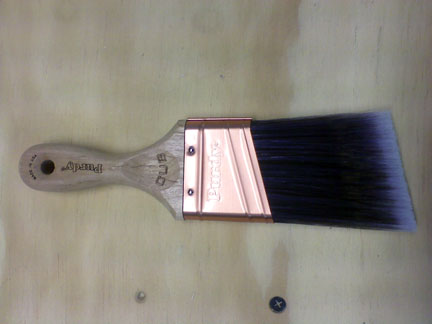
1. Taking joy in the small things in life.

1. Taking joy in the small things in life.

I haven’t painted in ages, but that doesn’t mean that I no longer enjoy that brand-new brush buzz… This is my first-ever Purdy. It’s sharp as a razor, and it buoys my hope that craftsmanship can still exist within mass manufacturing.

Some things, though, don’t change: Wood stain, it turns out, smells exactly like the last time I used it, in junior high wood shop class. I’ve lost my printmaker’s tolerance for oil and solvent smells, but gosh, it’s satisfying to wipe down fresh stain and see the wood grain magically re-appear.

Lately, I keep thinking back to Mr. James’ shop class, and my dad’s garage, because those are the places where I learned most of my woodworking skills. I picked up a few things in college and grad school, and I’m picking up new skills quickly as a preparator. But the foundation is the same, and certain traits seem to show through. For example, in junior high I found the jigsaw and bandsaw least intimidating, and to this day I still use circular saws with extreme respect and caution. I also still appreciate my dad’s improvisational handyman approach — try to use what’s around, instead of running to the store for every little bit of hardware or new tool — and his good humor inherent in tinkering.

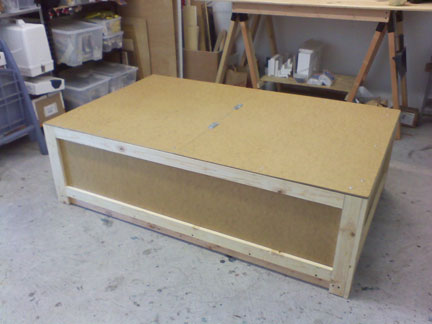
2. Building a big crate.

2. Building a big crate.

This crate, which has a detachable compartment, took about:
— 2 hours to design,
— 2.5 hours procure and unload the materials, and
— a solid day and a half to construct.
To move the crate, though, is gonna take three people and a truck.

(A recurring puzzle: Why do people think that artists just make art all day? When in fact, there’s so many other things that need to be done, like making crates, storing stuff properly, framing, writing, reading, research, procurement, bookkeeping, seeing art, talking to people, emails, etc. That’s why CARFAC Canadian Artists’ Representation / Le Front des artistes canadiens is so exceptional: it reflects an understanding that an artist’s work extends beyond studio work and exhibition installs. See their PDF guidelines for Professional Fees, which include admin and preparatory work, as distinct from baseline Exhibition Fees.)

This crate is for mirrorsblack, my newest sculpture, which will be unveiled at…

FUTURE / Art events I won’t miss:

Friday, October 16, 8–10 pm (Member’s Opening)
Saturday, October 17, 4–10 pm (Public Opening)
October 17–December 12, 2009 (exhibition)
Bellwether
Southern Exposure, 3030 20th Street, San Francisco
I stopped by SoEx’s new digs the other day and it’s all abuzz with activity. Their purpose-built gallery/office/classroom is brand spanking new. I can’t wait for the inaugural exhibition to launch. There’ll also be loads of activities and artist’s projects at the Public Grand Opening / Block Party, so hope to see you there.

Monday, October 5, 7:30 pm
Fred Tomaselli lecture
SF Art Institute
Tomaselli’s resin-cast mixed-media paintings are mind-bending. His works in MOCA’s Ecstacy show were trippy and hallucenagenic enough, but his more recent work at White Cube were completely stunning. He also seems like a down-to-earth kind of guy. I think his lecture will be great.

Thru December 12
Moby-Dick
Wattis Institute for Contemporary Art
Though I helped to install this show, I didn’t get to spend much time looking at the work, especially the media works. I’d love to spend more time with the lovely paintings by Marcel Dzama, prints by Rockwell Kent, and the installation by Ellen Gallagher and Edger Cleijne. Also, I’ve heard high praise of the film by Peter Hutton.

Standard