Art & Development

Why I do art technician work

On occasion, I work as an art technician. The job involves handling, installing, and sometimes fabricating artwork, and all the physical aspects of transitioning galleries between exhibitions.

The work is not for the faint-hearted (think: carrying lumber and sheet goods up stairs) or status-minded (the art world can be very classist), but I find it rewarding and educational. Technician work requires multiple abilities: skills of facture, art materials knowledge, problem-solving, and communicating with artists. Art schools don’t teach how to build crates, pack artwork, make pedestals, light galleries and so on. You also need to be able to switch gears: to throw it into high gear when it’s time to jam, and slow down for details and delicate work. It is wonderful work when you can manage this as well as maintain a good attitude and a sense of camaraderie with your team.

I’ve been helping out with exhibitions at Art in General, a non-profit alternative art space dedicated to producing and presenting new work. Their mission reflects the ethos of the art world I’d like to participate in.

I’m proud of the work I’ve done there—this week involved framing things on odd angles, sheetrock, 15 pedestals, 72 linear feet of guttered shelves. Ticking off what seemed to be an impossible checklist is very satisfying. As are the moments when a tool becomes an extension of your consciousness. While I love doing graphic design work, it can mean sitting at a screen all day, increasing my appreciation of the physicality and immediacy of technician work (which, in turn, can increase my appreciation for design work).

Best of all is doing this work alongside good-natured, problem-solving co-workers. I need enthusiasm no less than skills; the “let’s do it” attitude whether the job is re-doing a detail that’s 1/8″ off, or rip-cutting a lot of plywood first thing in the morning.

There are pitfalls to the work—for artists, disillusionment; and in an oft-male-dominated field, confidence becoming arrogance. But I’ve been very lucky to get my on-the-job training from experienced individuals who share knowledge generously and patiently, and who are communicative and team-oriented. And in inviting new members of a team now, I know that I owe my comfort with tools and confidence in my skills to those mentors. In gratitude, I look forward to sharing my modest abilities, and hopefully, my enthusiasm, with those who are hungry to learn.

Standard
Art & Development

More Art Competition Odds

The Space Program of The Marie Walsh Sharpe Art Foundation received over 1,100 applications this year for 17 finalists.

///////////////////////////////////////////////////////////////////////////
///////////////////////////////////////////////////////////////////////////
///////////////////////////////////////////////////////////////////////////
///////////////////////////////////////////////////////////////////////////
///////////////////////////////////////////////////////////////////////////
///////////////////////////////////////////////////////////////////////////
///////////////////////////////////////////////////////////////////////////
///////////////////////////////////////////////////////////////////////////
///////////////////////////////////////////////////////////////////////////
///////////////////////////////////////////////////////////////////////////
///////////////////////////////////////////////////////////////////////////
///////////////////////////////////////////////////////////////////////////
///////////////////////////////////////////////////////////////////////////
///////////////////////////////////////////////////////////////////////////
//////////////////////////////////////////////////


or 1:64, or 1.5%

The Keyholder Residency Program of The Lower East Side Printshop received over 200 applications this year for 4 resident spots.

///////////////////////////////////////////////////////////////////////////
///////////////////////////////////////////////////////////////////////////
//////////////////////////////////////////////////


or 1:50, or 2%

See more art competition odds.

Standard
Art & Development

The International Award for Participatory Art

Forgive my stroppiness of late. It’s not all doom and gloom in the world of art competitions. There is some good news, such as the announcement of a new prize with exciting criteria.

Pablo Helguera has won the first edition of the International Award for Participatory Art. The Award, a biennial project promoted by the Legislative Assembly of the Region Emilia-Romagna, is dedicated to artists with an outstanding experience in participatory art projects. The three finalists of the award, chosen from a list of 18 artists nominated by curators, critics and artists from all over the world, had to develop a project idea to be realised in the city of Bologna, Italy in 2011. Helguera’s project was chosen from a short list of three proposals submitted by the winner and the other two finalists Mel Chin and Jeanne van Heeswijk. The award consists in the prize of 15,000 EUR and a budget of 30,000 EUR to create the project. 

Pablo Helguera (Mexico City, 1971) is a New York based artist whose work focuses on history, pedagogy, sociolinguistics and anthropology in formats such as lectures, museum displays, performance and written fiction. His project The School of Panamerican Unrest, a nomadic think-tank, physically crossed the continent by car from Anchorage to Tierra del Fuego. He has exhibited widely and has been recipient of the Guggenheim Fellowship and the Creative Capital grant. He is the author of several books including The Pablo Helguera Manual of Contemporary Art Style, Theatrum Anatomicum (and other performance lectures), and What in the World.

Helguera’s project for Bologna, called Ælia Media, consists in creating a nomadic cultural journalism institute and broadcast center, as an alternative arts multimedia channel. The project will function in two capacities: one, as a training ground for currently active and aspiring cultural producers, and second, as a temporary broadcast program in a variety of media (video, radio, print and web) with a primary emphasis on user-generated content (consumer-generated media) using live participation methods as well as online social networks.

The project will derive its strategies from processes of learning, self-organization, and media production that have local roots but with a contemporary emphasis and outlook. The “Ælia Media Corporation” will try to be a cabinet of curiosities of cultural journalism, searching for the extraordinary in the ordinary, rediscovering the wealth of cultural production in Bologna, and juxtaposing opinions on specific issues, tying them with larger issues internationally.

“The idea of the kiosk”, explains Helguera “is firstly to provide visibility of the project in the city and secondly to create a location in the form of a ‘third place’. Occasionally the kiosk will “travel” to other parts of the city to reach other communities and to draw attention to particular issues in the city”.

The award was announced by an international jury comprising Julia Draganovic, award curator, Rudolf Frieling, curator at the Media Arts Department at the San Francisco Museum of Modern Art, Alfredo Jaar, one of the most influential artists on the international contemporary art scene, Bert Theis, artist, curator and co-founder of out-Office for Urban Transformation and Isola Art Center, Milan and Luigi Benedetti, Director General of the Legislative Assembly of the Region of Emilia-Romagna. The jury announced the winner at Arte Fiera – Bologna Art Fair and gave a preview of the winner’s participatory project, the first of its kind, to be created at Bologna in the course of 2011.

The International Award for Participatory Art is launched by the Legislative Assembly of the Emilia-Romagna Regional Government in collaboration with
LaRete Art Projects and goodwill.

The Award is curated by Julia Draganovic assisted by co-curator Claudia Löffelholz.
For further information and to be constantly updated about the project see: www.artepartecipativa.it

Standard
Art & Development, Research

Art Fairs: Armory, Independent, Pulse, VOLTA: What caught my eye

Among so many gallery booths, the artwork at art fairs suffers from little context, quietude, and time for reflection–but I still managed to enjoy myself at Armory, VOLTA, Independent, and Pulse (I missed Scope and the others; sorry). I assessed galleries rather than artwork, and looked at art to learn about artists and techniques. In short, I went as an artist, not a critic.

What caught my eye?

Recent Works by Artists I Like:

Kerry James Marshall, Jack Shainman Gallery, Armory

A painting by Kerry James Marshall at Jack Shainman Gallery, New York (Armory).

Kerry James Marshall (detail), Jack Shainman Gallery, Armory

I love this stylish signature for this narrative “period” painting.

A lightbox by Kota Ezawa at Murray Guy, Armory

A lightbox by Kota Ezawa at Murray Guy, New York (Armory). He’s got a solo show at the gallery through April 9th.

Brion Nuda Rosch, DCKT Contemporary, Armory

Brion Nuda Rosch‘s collages, which I have seen around San Francisco, looked nice at DCKT Contemporary (Armory). They remind me of Ed Ruscha‘s work, while remaining their own discrete investigation.

Anne Collier, Marc Foxx Gallery, Los Angeles, Armory

Photo by Anne Collier from Marc Foxx Gallery, Los Angeles (Armory). I saw another photo from this series of handouts at another booth at Independent. The list of questions are fitting for art fairs—the second question here is, “Where have I seen this before?”

Mel Bochner, Two Palms, New York, Armory.

High-relief, impasto monoprints by Mel Bochner from Two Palms, New York (Armory).

Artists who piqued my curiosity:

Claudia Weiser, Seis and Höke, Armory

Mirrored installation and colored pencil drawings on black paper by Claudia Weiser from Sies and Höke, Düsseldorf (Armory). I think a lot of my neo-hippie/Romanticist/mystic artist friends in California would love this work.
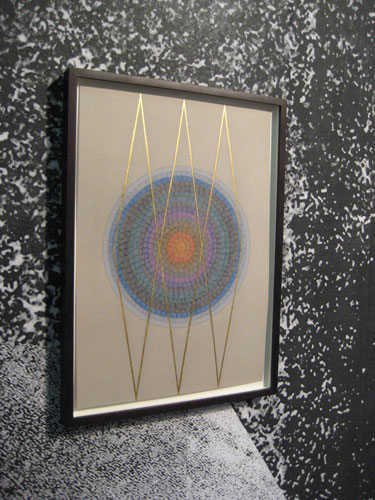
Gel pen drawing, Claudia Weiser

A nice colored pencil drawing by Claudia Weiser.

David Kramer, Galerie Laurent Godin, Armory

Cheeky illustration-inspired watercolor by David Kramer from Galerie Laurent Godin, Paris (Armory). The text reads, “I always like it better… when things are shiny and new.”

David Kramer, Galerie Laurent Godin, Armory

More Kramer.

A second look: Lots of pictures, including some glorious Mad Men meets Flintstones installations. Colorful, ironic, likable pathetic-aesthetic. I can see why this work would be popular, in a Judd Apatow sort of way. Tongue-in-cheek tropes of male identity means you can have your bar cart and wink-wink humor too.

Fabio Viale, The Pool, NYC, Volta

A milk crate carved of black marble by Fabio Viale from The Pool, NYC (VOLTA).

A second look: Rendering everyday objects in luxe materials is not very original, but the inanity still struck me. Craft suggests time and labor—human energy—thus imbuing objects with meaning (or the idea of meaning). Yet does meaning always equate to significance…?
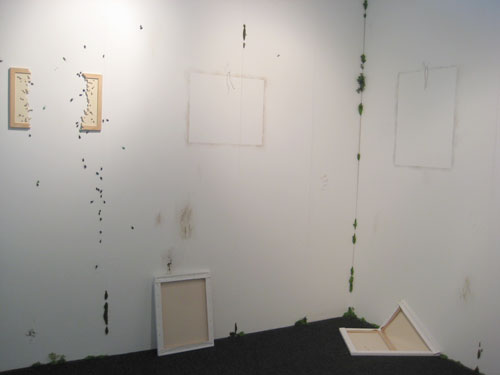
Jorge Perianes, Galeria Adhoc, Vigo, Volta

You would think that only a few days after seeing the biggest cockroach in my life that I wouldn’t enjoy these pest-infested paintings by Jorge Perianes from Galeria Adhoc, Vigo (Volta). But fake bugs that don’t move are much more fun and funny than real NYC bugs. [The gallery’s site uses frames, so links to the artist’s page are not available.]
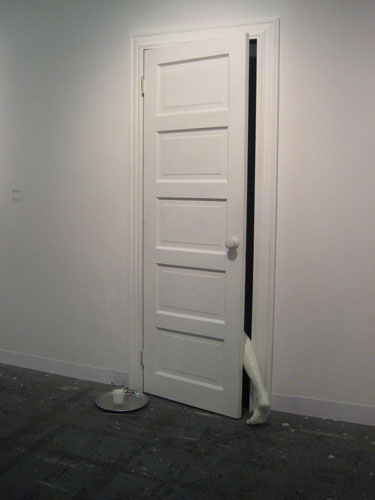
Juliao Sarmento, Pilar Corrias Gallery, London, Armory

Installation by Julião Sarmento from Pilar Corrias Gallery, London (Armory).

A second look: A quick glance at the gallery site suggests that this type of surrealist installation is atypical for the artist. Perhaps more is forthcoming.

Willem Andersson, Gallery Niklas Belenius, Volta

Paintings of bandaged and decorated military officers by Willem Andersson from Gallery Niklas Belenius, Stockholm (VOLTA). Of course these are of grave implications, but there’s something comical about the proliferation of the medals. The complete bandaging is also reminiscent of Georgio de Chirico‘s canvas-covered manequins, and The Invisible Man TV series.

Peter Liversidge, Ingleby Gallery, Edinburgh, Armory

A project by Peter Liversidge from Ingleby Gallery, Edinburgh (Armory). Yes, that is a neon ampersand and a two-way mirror. And 10 proposals for projects.
Peter Liversidge, Ingleby Gallery, Edinburgh, Armory

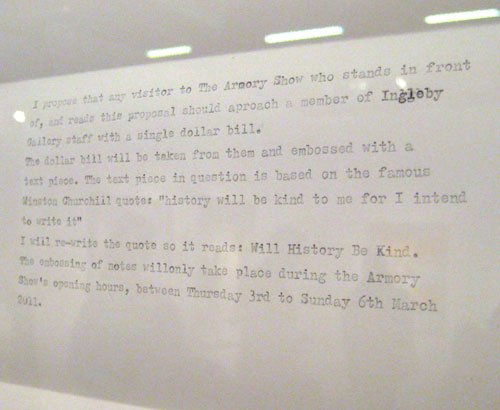
Not more than three days had passed since I told RR how no one actually types out their conceptual projects on a typewriter anymore. Above, Liversidge proves me wrong. To boot, the gallery’s site states that Liversidge types these at his kitchen table.
Peter Liversidge, Ingleby Gallery, Edinburgh, Armory

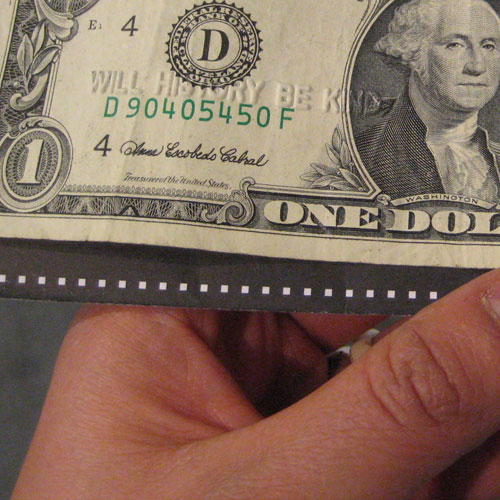
Per the typewritten instructions above, I stood before and read the proposal, presented a dollar bill to the gallery staff, who embossed my bill with the text. I love the site-specific, limited-duration aspect of the project. And I’m eager to learn more about Liversidge, to gain insight on the possible explanations for the text.

Will history be kind to me? Will I write history? And since the project is limited to the Armory Fair, and only US dollar bills were proscribed, What are the consequences of how I spend my money on writing history?

A second look: As it turns out, Liversidge makes text installations that completely appeal to my tastes. We’ve even used similar, ambivalent/psychological texts; the same maxim inspired his project, The Darkest Hour is Just Before the Dawn and my installation, Binary Pair. He also uses flowers to spell out advice that positive psychologists would agree with. Fantastic!

[Also, Ingleby Gallery also represents Ian Hamilton Finlay’s estate and Iran do Espírito Santo (check out this lovely photogram).]

Valeska Soares, Eleven Rivington, NYC, Armory

A flame-worked tube glass conversation chair by Valeska Soares from Eleven Rivington, NYC (Armory).

Valeska Soares, Eleven Rivington, NYC, Armory

A collage of book dedications also by Valeska Soares from Eleven Rivington, NYC (Armory).

Valeska Soares, Eleven Rivington, NYC, Armory

Soares detail: “For KATHERINA v. F. who taught me / that love is more / than the longing / to be together.” A brilliant project that compiles uses a few words to convey unknowable authors’ love and gratitude.

Artworks relating to themes in my current work—happiness, exuberance, decoration, cheap plastic, mythologized interiors:

Alex McLeod, Angell Gallery, Toronto, Armory

Photo by Alex McLeod from Angell Gallery, Toronto (Pulse: Impulse). This is like a still-life equivalent of Owl City—super cute verging on twee, appealing to many and possibly grotesque to cynics. I think it’s adorable, and also interesting in how it balances extraordinary cuteness and good taste.
Birgit Verwer, Livingstone Gallery, The Hague, Pulse

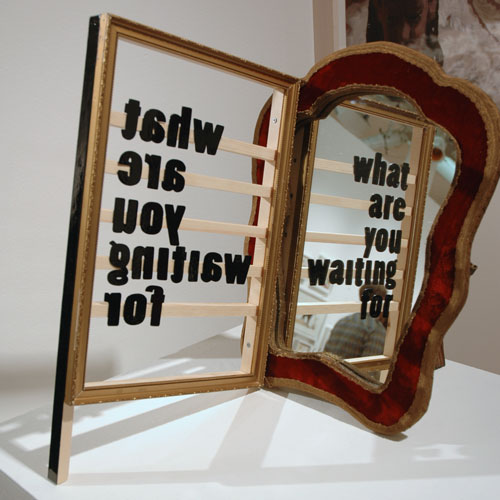
A mirror and text by Birgit Verwer from Livingstone Gallery, The Hague (Pulse).
Cassandra C. Jones, Baer/Ridgeway, San Francisco, Pulse

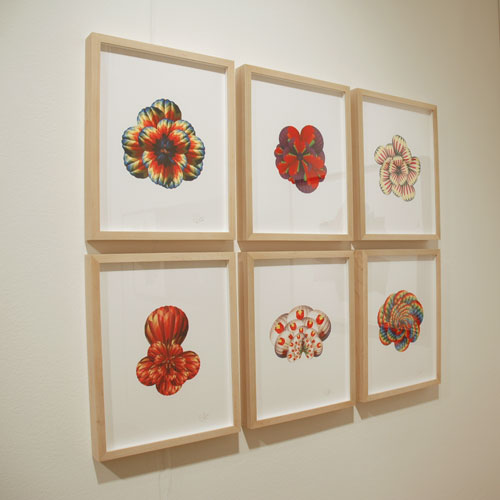
Rainbow balloon prints by Cassandra C. Jones from Baer/Ridgeway, San Francisco (Pulse).

Eric Beltz

Image Source: Artist’s section at MorganLehmanGallery.com

Drawing of an embroidery by Eric Beltz from Morgan Lehman, NYC (Pulse).

Joseph Burwell, Miyako Yoshinaga, Tokyo, Pulse/Impulse

Garage-inspired installation by Joseph Burwell from Miyako Yoshinaga Art Prospects, Tokyo (Pulse: Impulse). Though there is a high proportion of 2-D art in the installation, it appeals to my interest in the domestic and decoration—what is art and not art, why, and how each functions to provide pleasure or happiness.
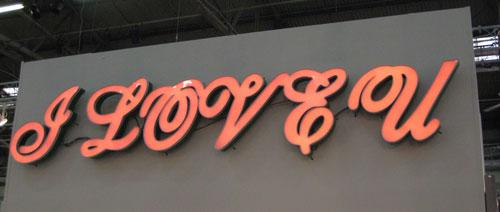
Kara Kim, Kukje Gallery/Tina Kim Gallery, Seoul/NYC, Armory

Color-shifting LED signage by Kira Kim from Kukje Gallery/Tina Kim Gallery, Seoul/NYC (Armory). Cursive scripts were never meant to be set in all capitals like this. The typographic awkwardness is part of the ridiculousness of such a sign.

A second look: Oddly, Kim’s work is completely different on the site. No textual works or signs and no discernable ties to love.
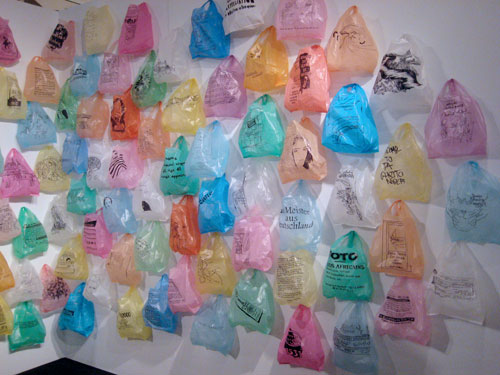
Katrin Strobel, Galerie Heike Strelow, Frankfurt, Volta

Hand-drawn plastic bag installation reflecting Paris’ diversity, by Katrin Ströbel from Galerie Heike Strelow, Frankfurt (VOLTA).

Nelson Lierner, Galerie Gabrielle Maubre, Paris, Armory

A map made with stickers by Nelson Lierner from Galerie Gabrielle Maubre, Paris (Armory). [I’d link to the artist’s page, but there isn’t one.] That’s Micky and Minnie Mouse on North America, kangaroos on Australia, and—yes—gorillas on Africa.

A second look: I’m all for experimentation, but when the results go horribly wrong, as it did with the gallery’s ugly Google-based website, conventional HTML seems not so bad.

nelson lierner gabrielle maubre armory

Detail.

Kelty Ferris, DCKT Contemporary, NYC, Armory

Keltie Ferris seems like primarily a painter, but I liked these framed hot pink spaces from Horton Gallery, NYC (Armory).

Sarah Pucci, Air de Paris, Paris, Armory

Beads, sequins and styrofoam by Sarah Pucci from Air de Paris, Paris (Armory). [Frame-based site—no link to artist’s page available. From the home page, click on news to access main navigation.]
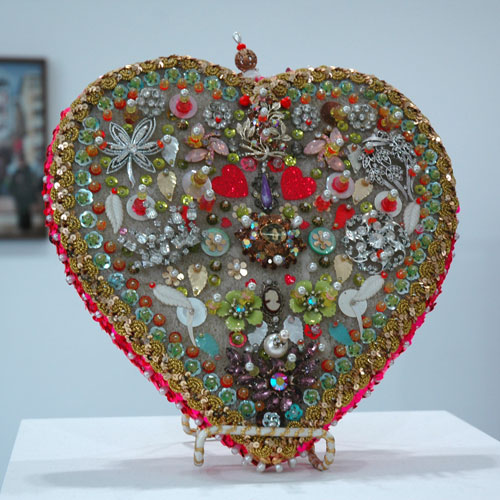
Sarah Pucci

Another Pucci. I like how it looks so ornate and rich with such common materials. In viewing her other work, she seems to reference the Baroque, but there’s something crafty that speak to heavily beaded garments from many cultures too.

Fiona Rae, Buchmann Gallery, Berlin, Armory

I like these funny “gift” collages by Fiona Rae from the Buchmann Gallery, Berlin (Armory). They both feature bows of ribbon.
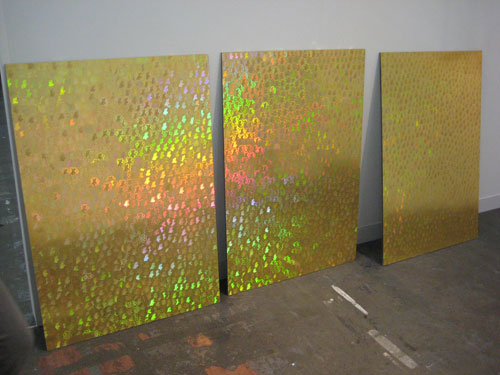
Unknown, Seventeen Gallery, London, Armory

No labels identified these holographic sticker sheets from Seventeen Gallery, London (Armory). It was adjacent to Abigail Reynold’s collages, however.

Conceptual and textual works:

antonimuntadas_gabriellemaubrie_armory

Antoni Muntadas’ Project involved framed texts with the 5W’s and other basic questions. Gabrielle Maubrie, Paris (Armory).

Fia Backstrom, Murray Guy, NYC, Armory

Text panels by Fia Backström, Murray Guy, NYC (Armory).

Gustavo Artigas, Caja Blanca, Mexico City, Armory

Paintings (not vinyl) describing toxic properties of the pigments by Gustavo Artigasi from Caja Blanca, Mexico City (Armory).

gustavoartigas-inst_cajablanca_armory

Assorted toxins. Gustavo Artigasi.

Ulrik Weck, Galleri Christina Wilson, Armory

Textual by association: bookcase of wood planks by Ulrik Weck from Galleri Christina Wilson, Copenhagen (Armory). [This idea of planks standing in for books will be echoed in Re-Covering, a group exhibition curated by Mike Chavez-Dawson at Untitled Gallery in Manchester this summer.]

Unknown artist, Sutton Lane, London/Paris/Brussels, Independent

Thick felt letters by an unidentified artist, Sutton Lane, London/Paris/Brussels (Independent).

Artist unidentified, Untitled Gallery, NY, Armory

Oversized prints/posters on a tiled penny floor. Artist(s) unidentified, Untitled Gallery, NY (Armory).

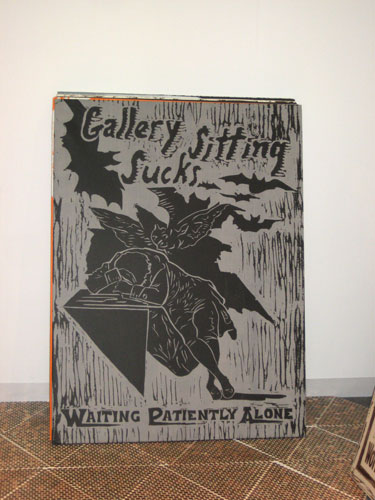
unk-det_untitledgallery_armory

unk-det2_untitledgallery_armory

Nice materials:
unk_spruthmagers_armory.jpg

Projector with a loop that shows only light, on a silver metallic canvas. Artist unknown, from Sprueth Magers,  Berlin/London (Independent).

albertoborea_isabelhurley_volta

Screenprint on brushed metal by Alberto Borea from Isabel Hurley, Málaga (VOLTA).

damienhirst_othercriteria_armory

In commercial printing, foil printing has been around a long time, but only recently has it been developed for fine art printmaking workshops. If you’re Damien Hirst or Other Criteria, however, you can employ commercial printing techniques for fine art editions.
andrewlewicki_charlesjamesgallery_armory

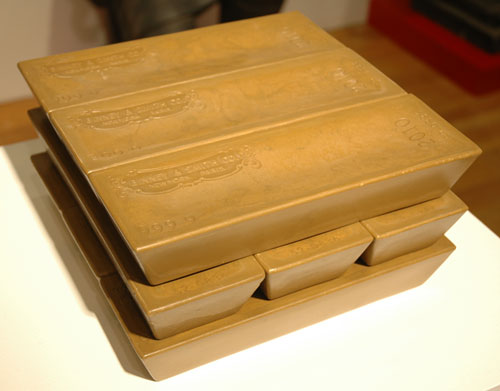
Gold brick crayons by Andrew Lewicki from Charles James Gallery, Los Angeles (Pulse).
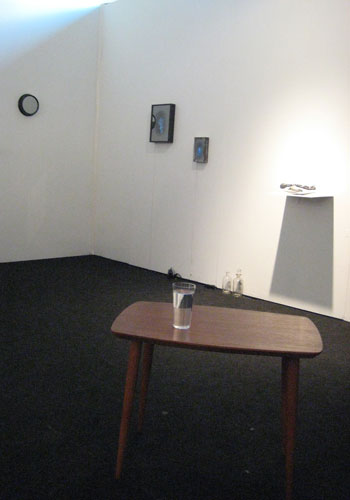
Ken Matsubara, MA2 Gallery, Tokyo, Volta

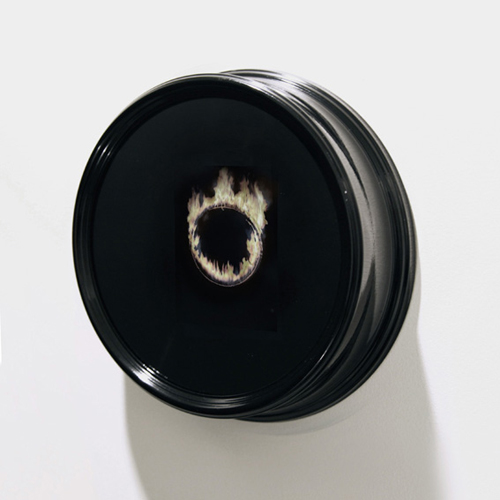
Installation view of assorted works by Ken Matsubara from MA2 Gallery, Tokyo (VOLTA).

kenmatsubara2_ma2gallery_volta

Detail of a Matsubara sculpture. Video displayed beneath a cup of water.

Source: MA2 Gallery website.

Black and white video of a ring of fire. What you can’t see from the photo is that the video is behind a piece of two-way mirror. In a white gallery, it’s only when dark reflections—such as the viewer’s face—appear in the mirror that the video becomes visible. Matsubara’s work is impressively slick—few pieces had visible electrical leads, and it’s evident that many of his pieces use the latest, thinnest and smallest screen technologies. There was a Gothic/cabinet of curiosity/black mirror feel to the works that would appeal to many people.

michaelwilkinson_themoderninst-tobywebsterltd_armory

By Michael Wilkinson from The Modern Institute/Toby Webster Limited, Glasgow (Armory).

I’m thoroughly perplexed by this piece. The wall label ascribes the material as “etched mirror,” but etching is done with acid, which would leave a frosted surface, which the glass does not have on either side. The pattern suggests that the hot, liquid silvering was dripped or thrown at the glass. Typically, glass is not meant to withstand sudden changes in temperature, so that it might survive partial silvering is really interesting…

[A look at the gallery site brought me to this installation…

Source: Jim Lambie’s secion on themoderninstitute.com.

…by Jim Lambie. Those papery things are aluminum sheets with fluorescent paint. Love it!]

charlesavery_pilarcorriasgallery_armory

Hand-drawn posters by Charles Avery from Pilar Corrias Gallery, London (Armory).

patrickaarnivaara_gallericharlottelund_armory

A sculpture with Plexiglas Radiant, whose colors change upon reflection and transparency, sort of like Golden Paint’s Interference Colors. By Patrick Aarnivaara from Galleri Charlotte Lund, Stockholm (Armory).

unk3_casatriangulo_armory

More Plexiglas Radiant. Artist unidentified, Casa Triângulo, Saõ Paulo (Armory).

unk_casatriangulo_armory

Another unidentified artist, I believe, from Casa Triângulo, Saõ Paulo (Armory).
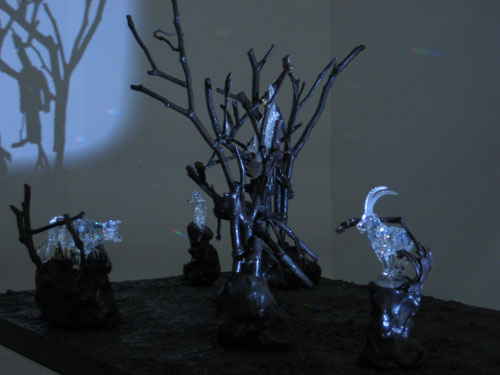
Unknown Artist, Casa Triangulo, Sao Paulo, Armory

The installation featured a flash of projected light onto kinetic crystal sculptures.
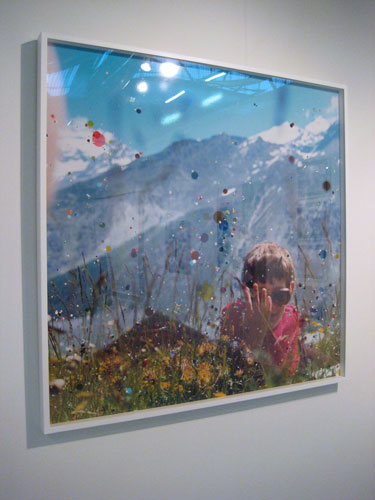
Sebastiaan Bremmer, Hales Gallery, London, Pulse

This made me want to paint on photos. I’ve done it in the past, but adding only a layer of colorful dots is really sweet and playful. Photo with paint and ink by Sebastiaan Bremmer from Hales Gallery, London (Pulse). Hales’ site features other photos with dots by Bremmer.
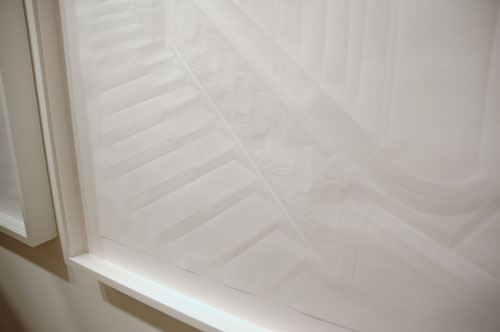
Simon Schubert, Patrick Heide Contemporary Art, London, Armory

Realist interiors rendered only in subtly-folded paper by Simon Schubert from Patrick Heide Contemporary Art, London (Pulse). Looks like Heide doesn’t represent Schubert. For more pics, visit the artist’s site.
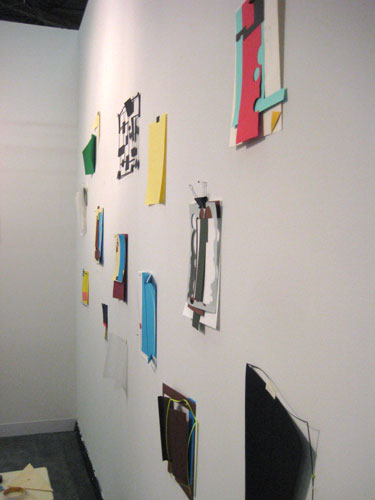
Artist unknown, Galeria Casas Riegner, Bogota, Armory

Paper sculptures of paper crafts. Artist unknown, Galeria Casas Riegner, Bogotá (Armory).

unk_det3_galeriacasasriegner_armory

The binder clip is made of paper. Artist unknown, Galeria Casas Riegner, Bogotá (Armory).

unk_det2_galeriacasasriegner_armory

The triangle and stool is made of wood. But the tapes, razor and eraser are made of paper. Artist unknown, Galeria Casas Riegner, Bogotá (Armory).

Interesting display strategies:

peterliversidge_inglebygallery_armory

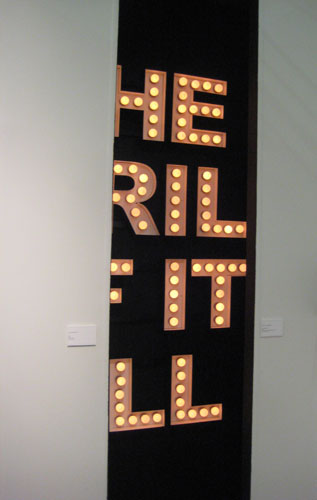
Illuminated signage, “The Thrill of it All,” tucked behind two partial walls. By Peter Liversidge from Ingleby Gallery, Edinburgh (Armory).

Etienne Chambaud, Bugada Cargnel, Armory

Etienne Chambaud, Bugada Cargnel, Armory

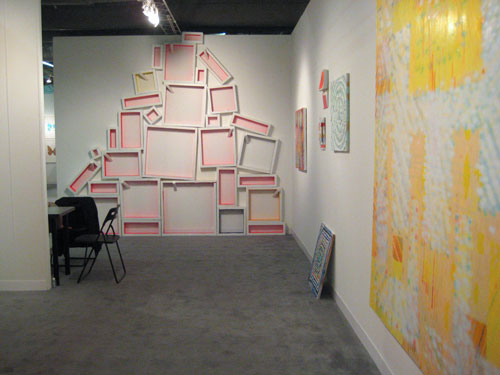
Using frames-as-unordered-vitrines is super smart. By Étienne Chambaud from Bugada & Cargnel, Paris (Armory).
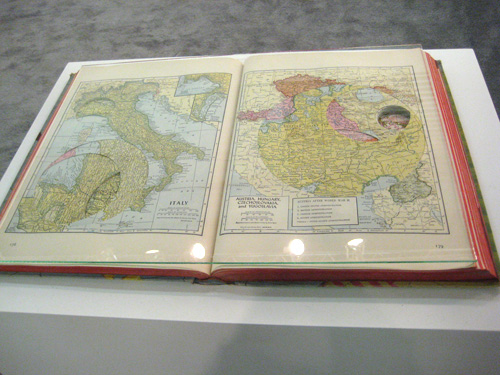
Etienne Chambaud, Bugada Cargnel, Armory

Glass: slimmer and cheaper than a vitrine; the object is not encased, but its surface is protected. There’s something nice, too, about how it’s flattened into an image. Étienne Chambaud from Bugada & Cargnel, Paris (Armory).

Apologies to artists and their galleries for the quality of my snapshots. I know many artists dislike poor documentation of their work (myself included), but bear in mind that the purpose of my posts is to share my enthusiasm. Linking to galleries’ websites is a time-consuming task I could do without, but I do it so that readers can learn more about the artists, and hopefully, see more photos of the works, or perhaps even see the work in person one day.

I collected information from wall labels, which were not always available. Booth signage was sometimes confusing. Sorry for any incomplete or incorrect information. Corrections welcome.

Standard
Art & Development

Reasons to Get Excited

The art fairs are coming to NYC this week: Armory, Pulse*, Independent, VOLTA, Red Dot, Scope, ADAA, Fountain, and Verge [see Artcard.cc’s Art Fair Google map] not to mention the slew of concurrent activity. But in the San Francisco Bay Area, I’m missing out on the solo shows of some dear friends. These are people who work super hard and are finally getting their due. See what they’ve been toiling at.

March 12-April 9
Pablo Guardiola
Jet Travel

Reception: Saturday, March 12, 6-9pm.
Romer Young Gallery
1240 22nd Street, San Francisco
Gallery hours: Tuesday & Thursday, 6-9; Friday & Saturday, 11-5, and by appt7

March 4-April 1
Charlene Tan
400%

Reception: Friday, March 4, 6:00-8:30pm
Ampersand International Arts
1001 Tennessee Street (at 20th. st.)
San Francisco, California 94107
Gallery hours: Thursdays and Fridays, noon-5pm, and by appointment

Details TBA: ~ April 1
Anthony Daniel Ryan

Lake Gallery, San Francisco

Plus, Weston Teruya has curated a show with some great artists…

March 11-April 23
On The Ground
Taha Belal, Gaye Chan, Sofia Cordova, Sergio De La Torre, Malak Helmy, Juan Luna-Avin, Jerome Reyes, Rene Yung

Reception: Friday, March 11, 2011, 7-9pm
Southern Exposure
3030 20th Street (@ Alabama)
San Francisco, CA 94110
Gallery Hours: Tuesday-Saturday, 12-6pm

I designed the poster… We were inspired by maps and blue lines.

On the Ground, Southern Exposure poster. Design: Christine Wong Yap.

Poster for Southern Exposure's exhibition, On the Ground. Design: Christine Wong Yap.

*Art in General‘s booth at Pulse to preview a new multiple by William Pope.L!

Standard
Art & Development

The Odds

While creating graphic representations of the odds of art competitions is not the most optimistic thing to do, I like how these graphics look, and with so many deadlines falling around March 1st, it seemed like a good time to post a few more.

Art Omi’s International Artists’ Residency received over 700 applications this year for 30 residency openings.

///////////////////////////////////////////////////////////////////////////
///////////////////////////////////////////////////////////////////////////
///////////////////////////////////////////////////////////////////////////
///////////////////////////////////////////////////////////////////////////
///////////////////////////////////////////////////////////////////////////
///////////////////////////////////////////////////////////////////////////
///////////////////////////////////////////////////////////////////////////
///////////////////////////////////////////////////////////////////////////
///////////////////////////////////////////////////////////////////////////
///////////////////////////////////////////////////////////////////////////

or 1:23, or 4.2%

The webpage of Creative Capital’s 2011 Visual Arts Grant states, “we will support approximately … 23 projects” and “We anticipate up to 1500 Letters or Inquiry will be submitted.”
///////////////////////////////////////////////////////////////////////////
///////////////////////////////////////////////////////////////////////////
///////////////////////////////////////////////////////////////////////////
///////////////////////////////////////////////////////////////////////////
///////////////////////////////////////////////////////////////////////////
///////////////////////////////////////////////////////////////////////////
///////////////////////////////////////////////////////////////////////////
///////////////////////////////////////////////////////////////////////////
///////////////////////////////////////////////////////////////////////////
///////////////////////////////////////////////////////////////////////////
///////////////////////////////////////////////////////////////////////////
///////////////////////////////////////////////////////////////////////////
///////////////////////////////////////////////////////////////////////////
///////////////////////////////////////////////////////////////////////////
///////////////////////////////////////////////////////////////////////////
///////////////////////////////////////////////////////////////////////////
///////////////////////////////////////////////////////////////////////////
///////////////////////////////////////////////////////////////////////////
///////////////////////////////////////////////////////////////////////////
///////////////////////////////////////////////////////////////////////////

or 1:65, or 1.5%

See more art competition odds.

Standard
Art & Development, Community, Research

Works in Progress

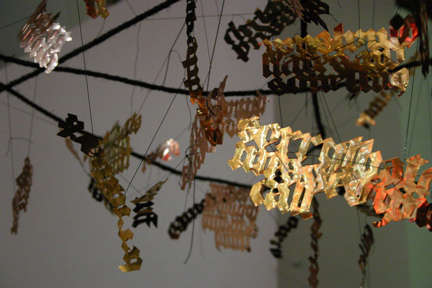
Christine Wong Yap Work-in-progress view of Cloud II (Aura / Good Thoughts) 2011 mixed media installation: Glitter foil on board, 3-D illusion plastic, fun fur yarn, thread, elastic, hula hoops, beads dimensions vary

Christine Wong Yap, Work-in-progress view of Cloud II (Aura / Good Thoughts), 2011, mixed media installation.

I’ve been working on a new cutout text installation for a forthcoming group exhibition. It will be an optimistic, exhuberant update to my copper and elastic installation, Cloud.

Cloud (installation view), 2006, copper, rope, elastic, monofilament, 7 x 6 feet / 2.1 x 1.8 m

Cloud (installation view), 2006, copper, rope, elastic, monofilament, 7 x 6 feet / 2.1 x 1.8 m

The original installation was comprised of mundane, mindless texts, such as “hey, it’s me, are you busy now?” The new iteration uses spoken, written and emailed texts from my life that express happiness, gratitude, or empathy. It will be made of colorful materials like 3D illusion plastic and glitter foil.

Your wish has come true

Work-in-progress view of hand-cut glitter foil on board. Text: “Your wish has come true.”

February 28 – April 1, 2011
Portraiture: Inside Out
Opening Reception: Thursday, March 3, 5—9pm
An exhibition of contemporary portraiture. Curated by Ruth Ballester, Whitney Fehl and Lauren Thompson, Graduate Students in the Museum Professions Program.

Artists: Sarah Bliss, Dominic Guarnaschelli, Gwen Hardie, Jenny Hyde, Pat Lay, Greg Leshé, So Yoon Lym, Ryan Roa, Steve Rossi, Jesse Eric Schmidt, Travis LeRoy Southworth, Tanja Targersen, Peter Whittenberger, Christine Wong Yap, Raphael Zollinger

Opening Reception: Thursday, March 3, 5–9pm
Walsh Gallery at Seton Hall University, South Orange, NJ
Gallery hours: Monday–Friday, 10:30am–4:30pm

Also in the exhibition, by chance, are two members of the collective, Brolab, who I met through volunteering for the Art in Odd Places festival, and whose work I enthused about, last fall.

Random & Rad:

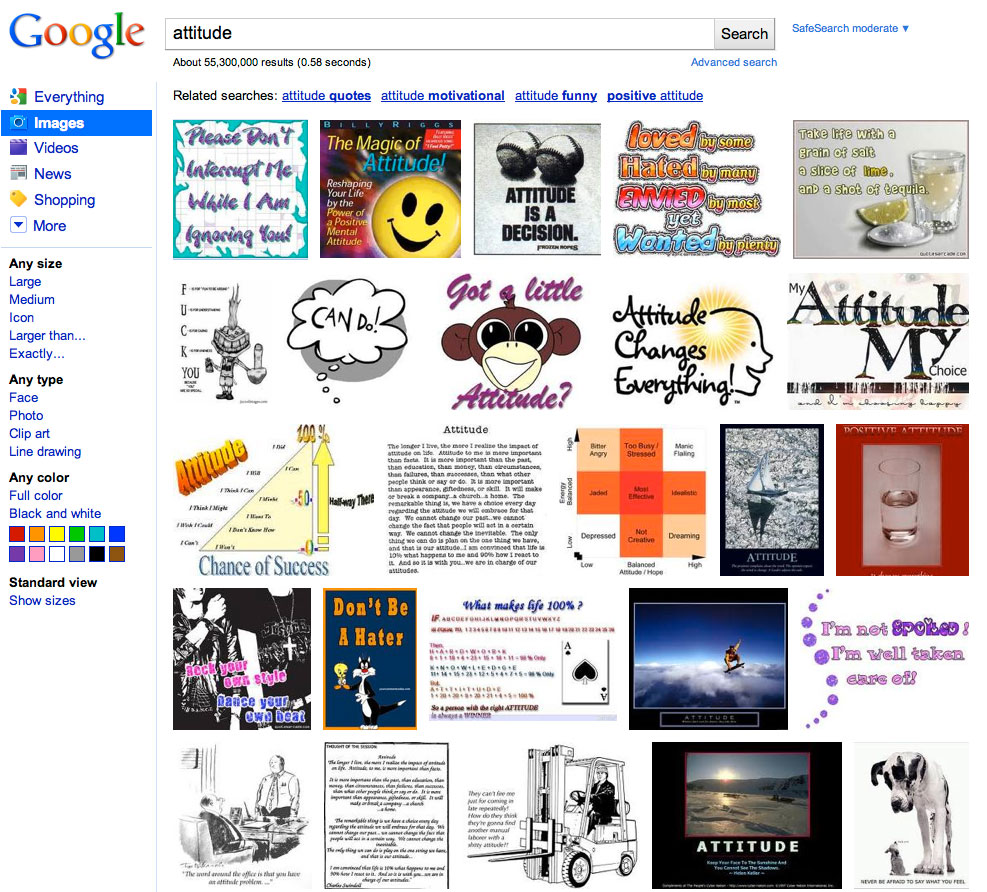
I did a Google image search for “attitude” and this is what came up:

Google image search results for Attitude

I love the mix of results! Trashy, jokey mottos alongside sincere (if simplistic) mantras for optimism. Just the first row is brilliant: unapologetic crudeness underscored by a sassy type treatment, self-help clichés (positive thinking, magic, happy face), motivational sports maxims, more unapologetic crudeness plus sexual egomania, and a party-goer’s mantra. It sort of exemplifies American ignominy as well as the desire for inspiration and the futility of oversimplified positive thinking. It presents lowbrow poles of irony and sincerity.

Standard
Artists, Community, Research

College Art Association: artists, ideas, inspiration

[Apologies for the duration since the last post. I’ve been busy working towards an exhibition—Portraiture: Inside Out, opening at the Walsh Gallery at Seton Hall University in New Jersey on March 3rd. I’ve also been preparing for a stint as a contributor to SFMOMA’s Open Space blog from March through June.]

———

The College Art Association (CAA) 2011 Annual Conference is in New York this week, so I took some time out to attend. I first heard of the conference from classmates seeking academic jobs, but it turns out that the conference has a lot to offer non-job-seekers as well.

My personal highlights are:

During the “Data As Medium” panel, Brian Evans (University of Alabama) talked about cognitive linguistics (someone’s been reading Lakoff/Johnson!) and found similarities between Kandinsky’s point-line-plane schema with databases’ variable-array-table. He also drew parallels between the hierarchy of information (noise-data-info-knowledge) and the experiential spectrum (reality-sensation-perception-cognition). I was fascinated.

Penelope Umbrico, Img Collection #6: Universal Remotes, (for sale on the Internet)

Penelope Umbrico, Img Collection #6: Universal Remotes, (for sale on the Internet). Source: PenelopeUmbrico.net

Penelope Umbrico, For Sale/TVs From Craigslist

Penelope Umbrico, For Sale/TVs From Craigslist. Source: PenelopeUmbrico.net

I adored the artist’s lecture by Penelope Umbrico (Bard College and School of Visual Art). She uses mundane sources like Flickr and Craig’s List to find images of mundane things, like sunsets and armoires. What made her talk especially engaging and funny is the way she structured her narrative to follow her thought process. First came the sunsets, then armoires followed, then televisions. Then photos of people in front of her installations of photos of sunsets at museums, such as the nice installation at SFMOMA’s 75th Anniversary collection show. The worm eats itself.

Curiously, Umbrico cited numerous authors already on my list of to-reads:
Walker Percy, a 20th century fiction and non-fiction writer interested in cognitive science; Vilém Flusser, a Czech philosopher whose writings are oft cited by artists; and Milan Kundera, Czech author of books like The Unbearable Lightness of Being.

The discussion was especially provocative after reading “The Postmedia Perspective,” a recent article by Domenico Quaranta on Rhizome.org (brought to my attention by the astute and curious ET). Quaranta, summing up Peter Weibel, says:

postmedia art is the art that comes after the affirmation of the media; and given that the impact of the media is universal and computers can now simulate all other media, all contemporary art is postmedia.

Or in Weibel’s words:

This media experience has become the norm for all aesthetic experience. Hence in art there is no longer anything beyond the media. No-one can escape from the media. There is no longer any painting outside and beyond the media experience. There is no longer any sculpture outside and beyond the media experience. There is no longer any photography outside and beyond the media experience.

I also attended “Making a Living With or Without a Gallery,” in which the panelists could offer little beyond common sense career advice (dealers aren’t parents {or peyh-rints, in the New York idiom}; getting a gallery is not an end; artists should make their own scene). Thus my highlight was running into art critic Jerry Saltz. I think his writing is accessible, smart and unpretentious. Indeed, I’ve heard people say that the New York Magazine and Work of Art critic is–aided by social media–populist to a fault, but I think in the art world, where playing nice-nice for self-advancement seems like the rule, I find his willingness to say what he really thinks, to engage mass audiences, and to be uninhibitedly enthusiastic at times to be refreshing.

A panel on residencies hosted by the Alliance of Artists Communities exposed me to the Fine Arts Work Center in Provincetown, MA. It sounds like a great residency if you can commit to seven (winter) months in New England.

I did not manage to formulate my comment into a question during the Q&A session, but I wanted to say that after all the hours (and fees) I’ve spent applying to residencies (14 applications to residencies, fellowships and studio programs in the past 12 months), I have come to appreciate specificity. I am grateful to those organizations that state what kind of artists should apply, and frustrated by organizations who cast very wide nets, even if the artists they have awarded in the past fit a specific profile—perhaps they are international or established, or comfortably 2-D or 3-D work.

Even if application fees merely offset the costs of the program, and organizations want to attract the largest pool of entries in order to secure the best applications since you never know what the jurors will go for, it seems like being specific about which artists should apply would behoove the jurors and applicants. While I wouldn’t want any artist to lose out on opportunities, let’s be realistic about the odds of success and the wasted efforts of hundreds of applicants.

For example:

The A.I.R. Gallery’s 2011 Fellowship program received 250+ applications for six fellows.
//////////////////////////////////////////////////
//////////////////////////////////////////////////
//////////////////////////////////////////////////     or 1:41
//////////////////////////////////////////////////
//////////////////////////////////////////////////

Smack Mellon’s 2011 Artist Studio Program received 600+ applications for six studios.
//////////////////////////////////////////////////
//////////////////////////////////////////////////
//////////////////////////////////////////////////
//////////////////////////////////////////////////
//////////////////////////////////////////////////
//////////////////////////////////////////////////     or 1:100, or 1%
//////////////////////////////////////////////////
//////////////////////////////////////////////////
//////////////////////////////////////////////////
//////////////////////////////////////////////////
//////////////////////////////////////////////////
//////////////////////////////////////////////////

The Public Art Fund’s In the Public Realm new work commission program received 400+ applications for a 10-person shortlist, for up to three commissions.
//////////////////////////////////////////////////
//////////////////////////////////////////////////
//////////////////////////////////////////////////
//////////////////////////////////////////////////     or 1:133, or 0.7%
//////////////////////////////////////////////////
//////////////////////////////////////////////////
//////////////////////////////////////////////////
//////////////////////////////////////////////////

The Lower East Side Printshop Special Editions Residency Program received a whopping 600+ applications for four awardees.
//////////////////////////////////////////////////
//////////////////////////////////////////////////
//////////////////////////////////////////////////
//////////////////////////////////////////////////
//////////////////////////////////////////////////
//////////////////////////////////////////////////     or 1:150, or 0.6%
//////////////////////////////////////////////////
//////////////////////////////////////////////////
//////////////////////////////////////////////////
//////////////////////////////////////////////////
//////////////////////////////////////////////////
//////////////////////////////////////////////////

[See more art competition odds.]

I don’t intend to discourage artists from applying (quitters never win!), and I do not mean to imply that these programs don’t warrant their desirability and high level of competition. What I’m trying to say is: Don’t say your program supports emerging artists if rarely awards them in actuality. Save us the time, effort, and dashed hopes. There are certainly easier ways of generating income and finding great artists. The Jerome Foundation is very clear about who and what it funds, and I think it’s a great model.

Unsurprisingly, my favorite panel featured major artists talking about life as artists. Parallel Practices featured Petah Coyne, Philip Taafe, Vija Celmins, Robert Gober, and Janine Antoni. That’s a mind-blowing group of artists. Initially, they responded to the question of what they do when they’re not making art: gardening (Celmins), travelling or walking to observe (Coyne & Taafe), nothing (Taafe), purposively driving cross-country to stop in post-Katrina New Orleans and Laramie, WY (Gober), and seeking to release the unconscious through dance (Antoni; she demonstrated an amazing five-part sequence of movements inspired by Jungian unconscious. To boot, she also mentioned flow, the concept by Mihaly Csikzentmihalyi, one of my favorite authors at the moment. Of flow, Antoni said, “I live my life for it,” and I think many artists would agree.)

But the Q&A session made me realize that this discussion was not just good because these were great artists, but because the talk focused on two fundamentals of being an artist:
1. Creativity—where it comes from, and how to find it when it’s gone; and
2. Resolving life of an artist, which can feel like an anomaly in conflict with the status quo.

I think hearing these artists speak about such fundamental and personal matters provided a sense of wholeness; implied was the vision of the integrated self, in which being an artist did not conflict with being a committed partner, parent, worker, or invested citizen. While these artists are arguably among the most important living artists of our times (I’m in agreement with Gober, who said such of Celmins), and their realities are much different from the mass at CAA (few know the pain of a bad Venice Biennale show, but most can relate to bad reviews), there was a sense that common conditions to being an artist, like finding balance in art and love, can be resolved. It was hope-inspiring.

At the International Association of Art Critic’s panel, “Artist-Critic: The Critic-Artist,” my negative emotions narrowed in on one critic—I didn’t catch his name because I couldn’t see who was who—but he caught my attention with glib, disparaging statements like,

“I don’t find contemporary art that engrossing.”

“Forty years ago, poets and painters all went to the same events,” (as if there were ever only one scene, or one scene that mattered) “and that’s not so today, so I think that’s why there are no poet-critics.” (What about Kevin Killian and a lively, arty lit scene in San Francisco?)

With the rise of blogs, “there’s rampant amateurism” that the panelists stood against, and deservedly so, because “If you were going to get your car fixed, you wouldn’t take it to a repair shop that’s just been open six months. Likewise, we’ve been looking at art for thirty or forty years, and that experience sets us apart.” (What a bad analogy. I would totally trust a newly certified mechanic with basic repairs. The inexperienced would never become experienced otherwise. Plus, while excellence may be aided by experience, it is not exclusive to the experienced.)

Ironically, someone else on the panel told a joke about critic’s kingmaker complex, for which this self-important critic seemed to be a case study.

Mel Chin, Safehouse

A safe house in New Orleans that will store the hand-drawn “Fundred” dollar bills before they are brought by armored truck to Congress. Source: Fundred.org.

Mel Chin is my new favorite artist. His interview by Miranda Lash of the New Orleans Museum of Art revealed a thoughtful, intelligent, politically-engaged, humble and personable artist. Besides the utter charm of a Southern-accented Chinese American contemporary artist (seriously!), he talked with sensitivity and generosity about his projects, which could be considered social practice or political art, yet seems to come from such a place of intellectual clarity and moral certainty, it seems free of the politically-correct baggage. It is not aesthetic theory that lends these projects value. They are compelling because they act in the world with efficacy.

In Chin’s view, “Art is a catalytic structure that forms the possibility of options.”

Watch a PBS Art 21 video of Mel Chin discussing Revival Field, a scientific experiment to show how plants can remove toxins from soil. Chin’s animation explains the project in greater detail.

I am also a huge fan of the Fundred project, a participatory movement to lobby Congress to clean up the lead-contaminated soil in a New Orleans neighborhood. Get involved and draw a Fundred!

Fundred is an art project envisioned by Chin and executed by children, adults, teachers, and all of us.

Between sessions I attended the California College of the Arts alumni reception. It was really great to see former instructors, catch up with alumni, and connect with other artists new to New York. Being surrounded by bright, thoughtful artists and art workers is still one of my favorite activities.

Standard