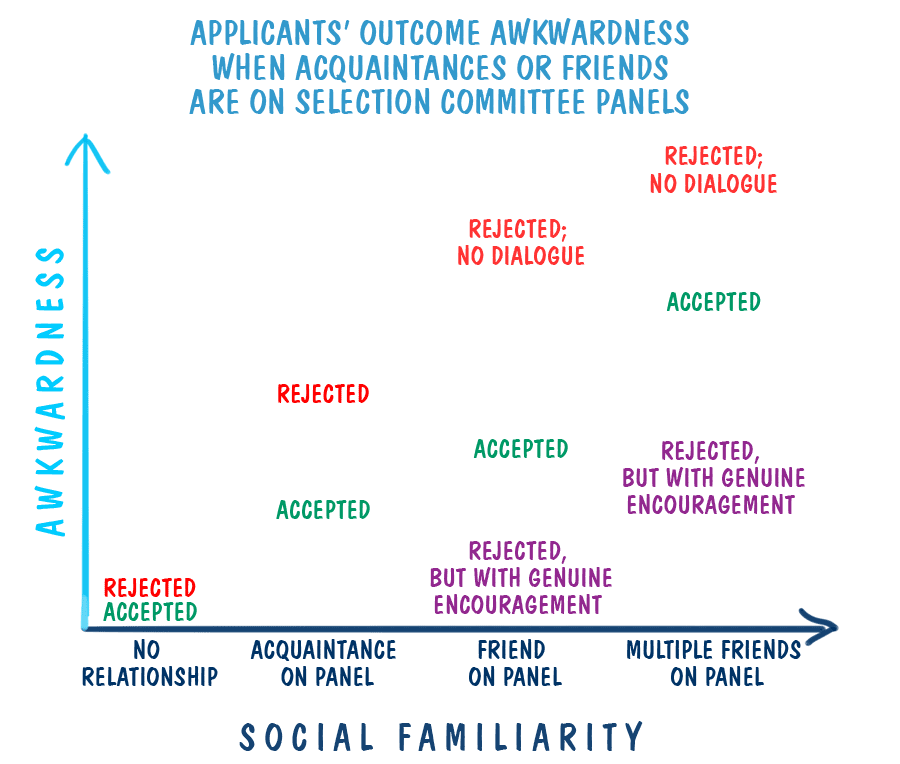
Applicants’ Outcome Awkwardness When Acquaintances or Friends are on Selection Committee Panels
Applicants’ Outcome Awkwardness When Acquaintances or Friends are on Selection Committee Panels
Franconia Sculpture Park received over 100 applications for 10 Jerome or Open Studio Fellowships in 2014.
///////////////////////////////////////////////////////////////////////////
/////////////////////////+
or about 1:10, or 10%
That’s roughly 40 more applications, for two more spots, in 2013.
See all Art Competition Odds.
Smack Mellon’s 2014 Artist Studio Program received over 700 applications for 6 available studios.
///////////////////////////////////////////////////////////////////////////
///////////////////////////////////////////////////////////////////////////
///////////////////////////////////////////////////////////////////////////
///////////////////////////////////////////////////////////////////////////
///////////////////////////////////////////////////////////////////////////
///////////////////////////////////////////////////////////////////////////
///////////////////////////////////////////////////////////////////////////
///////////////////////////////////////////////////////////////////////////
///////////////////////////////////////////////////////////////////////////
/////////////////////////+
or about 1:116, or 0.8%.
That’s roughly 100 more applications from 2012.
See all Art Competition Odds.
“The fact that in only three of the 58 large-scale biennials examined here do women artists reach a 50 percent representation with men must invite further reflection on the current conditions under which women artists can express themselves in international forums and are able to realize their full potential as professionals.”
—Chin-tao Wu (from the 2012 conference, New Geographies of Feminist Art: China, Asia, and the World)
Some generative, collective thoughts for transparency and against competition.
Thinking about all the things that are supposed to go unspoken in the art world, and artists’ self-preservation, and how even a teeny bit of transparency can seem risky or radical in the obfuscating art world. Our battles seem so hard won, why share any insight with others? Exactly because none of this is easy. Info and access are the easy bits, relative to good work, persistence, and longevity.
“Every interaction involves a choice between collaboration and competition, and to what degree. Eventually you have to choose the world you want to live in.”
—TC
“So much of the way that the art world is structured favors competition. Grants are competitive. … Artists compete with artists–stealing ideas instead of sharing them, or using copyright laws to guard against thoughtful re-use. Artists compete for shows in a limited number of exhibition spaces instead of finding their own ways to exhibit outside of these competitive venues. Artists conceal opportunities from their friends as a way of getting an edge up on the capital-driven competition. … This is a treadmill made from decomposing shit that is so devoid of nutrients that even its compost won’t allow anything fresh to grow. We need something better to run on. … Working toward a global network where one creates opportunities and, in turn, can respond to limitless opportunities without the pressure to compete, allows for a more generous, diverse and open art practice.”
—Marc Fisher (Temporary Services), “Against Competition,” Blunt Art Text #2, April 2006 via Stephanie Syjuco/Free Texts
Five reservations about calls for art, starting with a competition judged by collectors.
#1: This call from Sylvia White Gallery in Ventura, CA.
This call set off all sorts of red flags for me. On a small scale, it instantiates what’s wrong with a market-driven art world.
For this exhibition, Sylvia White has invited 15 of the gallery’s best collectors to review the artist submissions and select their favorite work.
The gallery will exhibit works selected by the gallery’s collectors (read: customers). There’s no guiding curatorial vision beyond that.
With works selected by 15 people with different tastes, the resulting group show will probably be haphazard.
Also:
Collectors names will be kept anonymous until the opening reception.
Why? I don’t believe it’s to dissuade undue influence, because jurors are named in open calls regularly. I think it’s because collectors love a discrete gallery, because their interactions are about money, dibs, and discounts.
It’s certainly not for artists’ benefits—art competitions create unfavorable odds for applicants; the chance to introduce our work to jurors is a secondary consolation. But with anonymous jurors, we can only surmise. Experienced artists will steer clear of this mystification (and a gallery whose website features exhibition images sans artist credits). Less experienced artists hungry for a chance to show or sell their work, however, may not know better.
Let’s break it down. These costs are certain:
There is only one guaranteed benefit:
…and this possible benefit (with a certain cost):
In the past, I may have participated in juried calls with terms like these. The exposure seemed worth it to me then, but strikes me as a raw deal now.
I encourage young artists to apply widely to calls, especially when your work is developing. But as your work matures, it’s OK to be more discriminating, and to seek out more advantageous opportunities, and especially ones that cohere to your values and goals of why you’re showing and to whom. (Proceed with caution.)
—
CAFÉ is a call for entry service loaded with regional, fee-based calls for exhibitions. When I realized that their shows and venues generally weren’t interesting or advantageous for me, I stopped reading it—a decision the above call further validates. (Proceed with caution.)
—
#3: SlowArt Productions/Limner Gallery, Hudson, NY.
In checking NYFA, I come across calls from SlowArt regularly…. Almost too regularly.
Years ago, back when the gallery was on Sixth Ave in NYC, my work was accepted into one of their calls. I spent what seemed like a small fortune on framing and shipping, and I was disappointed that the show didn’t lead to more opportunities.
In retrospect, given how many open calls SlowArt posts per year, I realize the over-reach of my expectations. By nature, open call shows are mixed bags, and galleries won’t have well-respected programs if they’re always showing mixed bags. Though I am grateful for the exhibition opportunity, it would be nice to spare young artists misconceptions about what these calls can do for them. A huge reach, much less critical attention, is highly unlikely, especially in Hudson (population 6,713). (Proceed with caution.)
—
#4: Entry fees based on quantity of images.
The calls from Sylvia White Gallery and Slow Art use a variable entry fee: $35 for 3-4 images, and $5 per additional image.
<Huge generalization> I think this fee structure can be an indicator for low- or middle-brow exhibition calls. It seems suited for finding iconic images or salable works, rather than understanding artist’s overall practices. It also rewards convention—it’s easier to convey your practice in three images if you work in one media (as opposed to say, post-media or post-studio artists).
In the past two years, I’ve applied to 29 residencies, exhibitions, grants and other opportunities. I don’t think any of them used this fee structure. (For most, I submitted 8 to 10 images—sometimes as few as 6 and as many as 20—for a flat fee or no fee at all. The flat fees always work out to a better deal per each image.) More importantly, these calls are often for better opportunities, offering visibility as well as resources or stipends.
(Proceed with caution.)
—
#5: Calls requiring “framed, ready-to-hang” art.
Similar to Reservation #4—this is also not a great sign of a killer exhibition—but more persnickety.
[A caveat: This requirement makes sense for annual juried shows with dozens of artists, or one-night installs at benefit auctions. I’m less sympathetic when it’s for a call for exhibition that’s part of the gallery’s regular programming.]
A gallery exists to exhibit art. Asking for ready-to-hang art implies that the gallery has only the bare-minimum capacity to install artworks. Instead of finding the budget and hiring the necessary labor, they ask artists to facilitate installation and/or compromise what they exhibit (as not every work calls for framing). Limiting a show to framed art minimizes labor while also restricting risk, creativity and innovative exhibition-making.
(Depending on the situation, proceed with caution.)
“the market artists whose potential social worth is quite directly to serve the interests of the international clientele inhabiting the most rarefied of income heights, a highly paid service role to which several generations of artists have been trained to aspire.
But this is not the picture of ourselves that most of us artists, curators, critics wish to recognize…. The artistic imagination continues to dream of historical agency.”
—Martha Rosler, Culture Class, 2013, p 211
The support and help of friends can turn rejection into to fruitful art exhibitions, pay/money, and new works.
See my animated GIF on Emily Speed’s Work Makes Works Tumblr of artist-drawn diagrams.
 R+D
R+D 