Meta-Practice

For Your Information, updated

Some more theoretically useful links.

I’m preparing a presentation about my work and practices; accompanying links are here for simplicity’s sake. [If you’re not in the class, this may seem out of context. Surprise!]

Kearny Street Workshop

make things (happen) @ Nathan Cummings Foundation

Residency @ Centre for Contemporary Chinese Art

Irrational Exuberance (Asst. Colors)

As Is Transcript

Art Practical

Franconia Sculpture Park

Montalvo Arts Center exhibitionsresidency programs

Happiness Is… exhibition

Susan O’Malley, artist

Leah Rosenberg, artist

Creative Capital Goal Setting Tips

“Art Competitions: A Selective Comparison of Applicant Pools, Awards, and Odds” on Temporary Art Review

Art Competition Odds on this blog

Positive Signs drawings #21 & 22

Seligman, Martin E. P. Learned Optimism. New York: Free Press, 1990. [WorldCat.org listing]


Misc:

Artist’s Resources page

Residency tips on Daily Serving/Help Desk

Portrait of an Artist, Wily and Engaged” on Art Practical 

Standard
I am an artist.  This does not mean I will work for free.  I have bills just like you do.  Thank you for understanding.  And please think twice before asking me to  donate art for your charity.  * Unless it is to help another artist.  Because it doesn't help me one bit with exposure.  Instead, Host an old fashion Cake Walk,  Who doesn't want to win a cake?

Michele Bock. // Source: https://michelebock.wordpress.com. // Share freely.

Meta-Practice

Take a (cake) walk

Image
Meta-Practice

“The writer either has a meaning and cannot express it, or he inadvertently says something else, or he is almost indifferent as to whether his words mean anything or not. This mixture of vagueness and sheer incompetence is the most marked characteristic of modern English prose.

…modern writing at its worst … consists in gumming together long strips of words which have already been set in order by someone else, and making the results presentable by sheer humbug….

1. Never use a metaphor, simile, or other figure of speech which you are used to seeing in print.

2. Never use a long word where a short one will do.

3. If it is possible to cut a word out, always cut it out.

4. Never use the passive where you can use the active.

5. Never use a foreign phrase, a scientific word, or a jargon word if you can think of an everyday English equivalent.

6. Break any of these rules sooner than say anything outright barbarous.”

George Orwell, “Politics and the English Language” (1946)

George Orwell on vagueness in writing

Quote
Meta-Practice

Unrealized Project: Write a better article for this headline and lede

Headline:

“Dealing direct: do artists really need galleries?”

Lede:

“Successful artists, as well as some smart youngsters, are in no rush to secure big-league representation”

This article (Cristina Ruiz, The Art Newspaper, April 9, 2014) starts off with the example of one mega-artist (who employs 45 staff) on the ‘pro’ side, and ends with quotes from an art adviser, curator, and collector on the ‘con’ side.

This headline-lede-article grouping frustrates for raising an interesting question but answering with the status quo ‘no.’ It reinforces the tired assumptions that artists are powerless without galleries, and that commercial galleries are the primary means whereby artists advance. It reassures dealers—not to worry, dealers’ jobs are safe—while telling artists (again) that the market system works fine, and it can only be bypassed by the most exceptional.

I should have known better (I think it’s safe to say that The Art Newspaper  views “the art world” as the same thing as “the art market”), but I wanted to read how artists proceed without commercial gallery representation (unrealized project idea!). Most of us artists do so already; I’d wager 90% of us work this way. Yet too often professional development advice to artists focuses on garnering gallery representation, as if artists’ agency is solely a matter of glomming on to more powerful people.

*Unrealized Project #2: I was also hoping for frank talk about why artists might not want representation.* Recently I heard a veteran artist tell emerging artists about a blue chip gallery’s dodgy financial practices, and how we should keep our expectations for transparency extremely low. Why? I’d love to read a gallerist’s explanation in print (Unrealized Project #3). Why should galleries hide even very basic bookkeeping from their suppliers? What exempts these businesses from standard business practices? Why can’t the commercial art industry adhere to norms like cutting checks promptly or issuing statements?

**Unrealized Project #4: Write an article to go with the headline, “Do galleries need artists?”

Standard
Art & Development, Meta-Practice

Points of Reference: Finding the right partners means not working with the wrong ones

1.
Being an artist and applying to competitions means dealing with rejection.
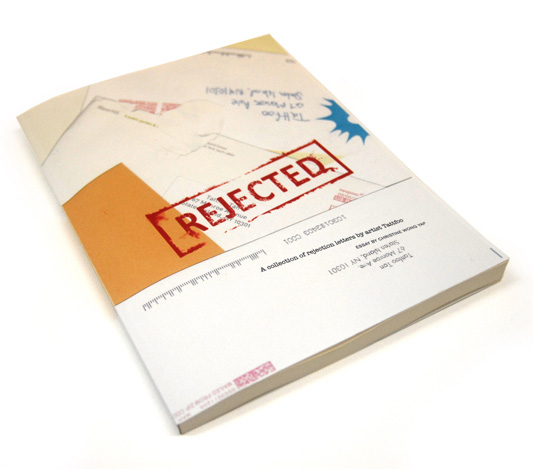
Rejected, a compilation of rejection letters, by Tattfoo Tan. // Source: Tattfoo.com.

Rejected, a compilation of rejection letters, by Tattfoo Tan. // Source: Tattfoo.com.

See also: Tattfoo Tan’s iheartrejectionletters.com.

2.
But dealing often with rejection doesn’t mean accepting everything that comes your way. Artists aren’t powerless. We have agency. When an “opportunity” presents itself, an appropriate reaction is to evaluate benefits and costs.

From “Standard Questions for Artists” from Standard Deviation by Helena Keefe (via ArtPractical.com):

Given an opportunity…
Do I believe in what this institution does/stands for? Is it the ideal venue for this project/my work? Does my work feel alive in this context?…
Does this opportunity help me meet or get to know people I may want to work with in the future? Will it enable conversation with people I want to be in conversation with? Is this opportunity helping me reach the audience I want to reach?…
Is there enough freedom in this opportunity? Would saying no to this opportunity be saying yes to something else I care more about? Is this the best artworld for my work? Is it the most effective use of my time/money/energy?

[I’d even ponder, “Is this what I want to do with my life?”]

…Am I being instrumentalized? Am I okay with that?
Am I happier making my living separate from making my art?

3.
Artists, too, can be selective, and reject things that aren’t good fits for us. Indeed, taking a pass on an opportunity can be a generative, productive action.

From Non-Participation: Call for Submissions by Lauren van Haaften-Schick:

The project, Non-Participation, will be a collection of letters by artists, curators, and other cultural producers, written to decline their participation in events, or with organizations and institutions which they either find suspect or whose actions run counter to their stated missions. These statements are in effect protests against common hypocrisies among cultural organizations, and pose a positive alternative to an equally ubiquitous pressure to perform. At the heart of the project is the notion that what we say “no” to is perhaps more important than what we agree to.

Historic instances and examples include: Adrian Piper’s letter announcing her withdrawal from the show Reconsidering the Object of Art: 1965-1975 at LA MoCA, stating her opposition to Phillip Morris’ funding of the museum and requesting that her criticizing statement be publicly shown; A letter from Jo Baer to a Whitney Museum curator canceling an upcoming exhibition on the grounds that her work was not being taken seriously because she is a woman artist; Marcel Broodthaers open letter to Joseph Beuys questioning the relationship between artists and exhibiting institutions; and, just recently, critic Dave Hickey‘s public announcement of his “quitting” the art world.

This tactic is oppositional to always saying yes; to the (non-)strategy of waiting for more powerful or influential dealers/curators/critics to “save” artists from obscurity and precarity; and to making art only for external validation. You will risk upsetting people and possibly being seen as “difficult.” But to do otherwise is to run the risk of adopting values—self-interest, opportunism, careerism—not your own, which are harmful to your practice and your fellow artists.

See also: Art Practical’s current issue, Value/Labor.

Addendum, added 4/10/2014:

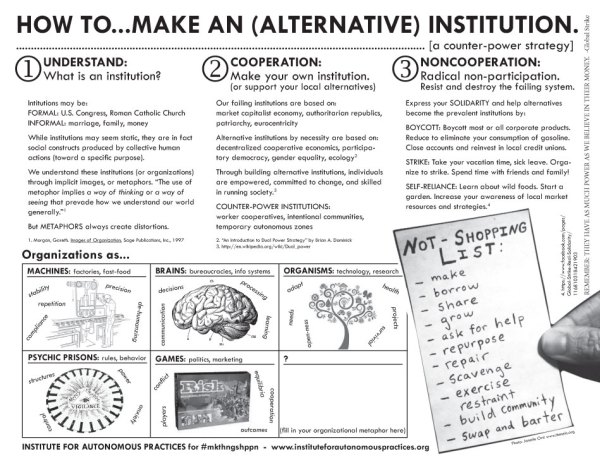
Sarrita Hunn, “How to…Make an (Alternative) Institution” // Source: makethings-happen.christinewongyap.com.

Sarrita Hunn, “How to…Make an (Alternative) Institution” // Source: makethings-happen.christinewongyap.com.

See also: Sarrita Hunn’s “How to… Make an (Alternative) Institution,” a freely downloadable PDF ‘activity sheet’/visual essay for Make Things (Happen). In the third of three steps, Hunn describes “Noncooperation/Radical Non-Participation.” Also online at Temporary Art Review.

Standard
Meta-Practice

“…the history of market success and the history of interesting ideas in art diverge more often than they connect. I grew up seeing an art world where that success immediately made your ideas suspect. You grew up seeing one where market failure meant a failure of idea as well. Each situation was fleeting and in the larger sense meaningless.”

Nayland Blake on defining your own success

Quote
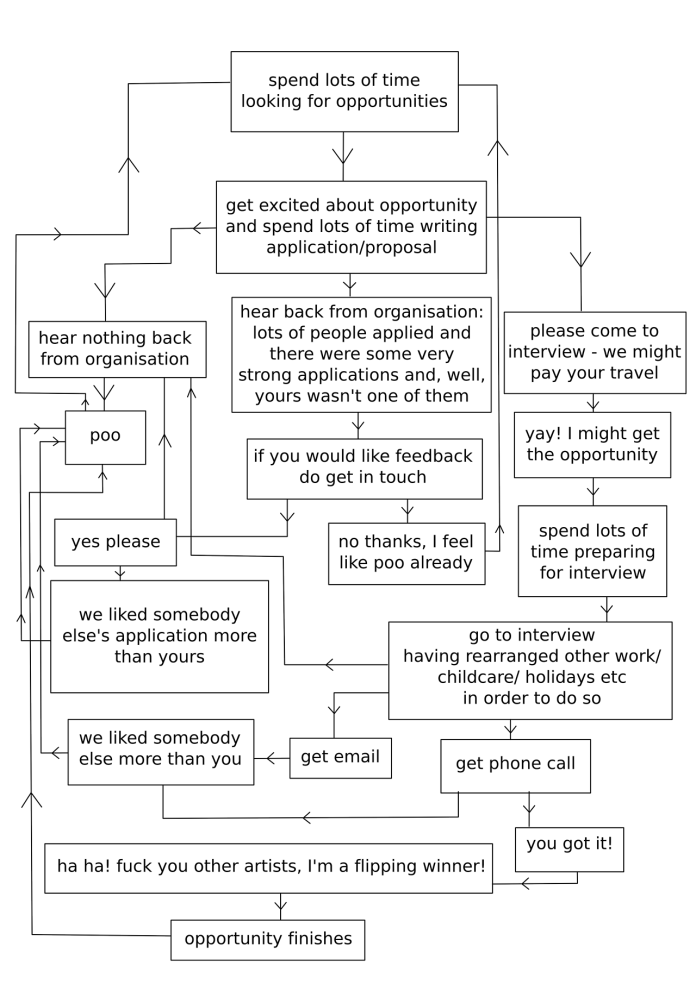
Ben Sadler's flow chart, on Emily Speed's Work Makes Work Tumblr, which ostensibly encourages young artists to keep working. However, Sadler jump-cuts from receipt of an opportunity to the end of it, and shows how applying to opportunities seems circularly Sisyphean...

Ben Sadler‘s funny flow chart, on Emily Speed’s Work Makes Work Tumblr. Ostensibly, the charts encourage young artists to keep working. But Sadler jump-cuts from receipt to the end of an opportunity, showing how the application process can seem circularly Sisyphean…. // Source: workmakesworks.tumblr.com

I received four rejection letters in as many weeks. Applying to opportunities means fielding rejections, but it can feel pretty harsh—as illustrated above—when they come in quick succession.

Meta-Practice

work makes (more) work: Ben Sadler on applying to opportunities

Image