Research

Happiness Is… Research Note #6

Spending time with family on this holiday, and also, generally as an artist who craves validation, I’ll try to bear in mind this bit of wisdom:

Relationships thrive when they shift from the desire to be validated, to the desire to be known.

—Paraphrased from Nathaniel Branden paraphrased by Tal Ben-Shahar in Happier.
Standard
Research

Happiness Is… Research Note #5

Studying positive psychology doesn’t make me a happy person.

It doesn’t make me a grateful person. Like Thanksgiving Day, it can only remind me to practice gratitude.

It doesn’t make me immune to negative emotions. I’ve learned strategies for coping with adversity, but I still have to enact them.

Following 36 anxious hours, the relief of a repaired sewing machine.

Following 36 anxious hours, the relief of a repaired sewing machine.

When my sewing machine stopped working two nights ago, the uncertainty of how I’d remain productive during this residency got the better of me. I was under-slept and anxious, and when the machine came back from the repair shop with the presser foot unable to stay in the upright position, I’d had it, and lost my cool.

Thankfully, Montalvo just happens to have a sewing machine to lend me. It didn’t occur to me to even ask. (There it is, fellow artists: Have courage! It doesn’t hurt to ask!)

And when I went back to the shop, the repairman fixed the problem on the spot.

Now I’ve got two working sewing machines and am able to get back to work! For that—really, for art, which provides so many opportunities for flow and purpose—I’m grateful.

Standard
Research

Happiness Is… Research Note #4

I habitually plan ahead, but there are lots of things I only learn by doing (and failing). Likewise, experiences drive home the principles I  intend to remember but somehow forget.

Such was the case today, as I got to work on a new project sewing twill tape and transparent vinyl. I had a slow start, as I learned to reconcile the surprisingly stretchy twill tape with the not stretchy-at-all vinyl. It took a few hours for me to find a rhythm and start to make real progress.

So at dinner, I sang my sewing machine’s praises. It felt trusty, reliable, like a lithium ion drill driver—I finally felt like my burgeoning skills are appropriately utilizing some of the machine’s capacities, while the promise of more advanced projects lay ahead for the two of us.

It was ironic, then, when my sewing machine’s feed dogs stopped advancing. Then, the reverse lever offered none of its usual resistance. Something snapped, inside the machine first, and then inside me second. I panicked. I have a lot of production ahead of me during this residency, and most of it requires sewing. I don’t have time for the machine to sit in a repair shop!

But this is the reality, and I must conform to it. As Martin Seligman explains in Flourish, there are realities you can shape, and those you can’t. I can’t change the fact that my sewing machine needs repair. But I can work so that this setback doesn’t derail my residency.

Standard
Research

Happiness Is… Research Note #3

For being where you are, and knowing when you are:

Attitudes toward the past are key to the development of gratitude … which allow you to appreciate the present.

Philip Zimbardo and John Boyd, The Time Paradox

When we link ourselves to the future, we behave better today.

Shane Lopez, IPPA World Congress, 2010
Standard
Research

Happiness Is… Research Note #2

For my fellow artists:

For [lifelong flow] it is necessary to invest energy in goals that are so persuasive that they justify effort even when our resources are exhausted and when fate is merciless in refusing us a chance at having a comfortable life.

Mihaly Csikszentmihalyi, Flow: The Psychology of Optimal Experience (1990)
Standard
Research

Happiness Is… Research Note #1

To wake up and know that the day is dedicated solely to art making is one of the greatest luxuries that residencies afford. In residence at Montalvo Arts Center.

To wake up and know that the day is dedicated solely to art making is one of the greatest luxuries that residencies afford.

I’m currently in residence at the lovely and pastoral Montalvo Arts Center, preparing for an exhibition called Happiness Is…, which opens in January at the Montalvo Project Space Gallery.

It’s a great opportunity for me because I’ve explored optimism and positive psychology in my work for many years. Yet the idea of making art that defines or instills happiness sets off red flags (and not of the exuberant variety) in my mind. It’s because happiness is a vague term, which has popular and common meanings.

I hope to acknowledge and grapple with happiness’ personal specificity, elusiveness, and complexity. 

I am working on four projects for the exhibition. They are related to happiness, but more specifically, are attempts to concern themselves with:

  • The numerous aspects or components of happiness, or happiness’ complexity;
  • Subjective well-being, positive psychology’s theoretical and research-based knowledge about happiness;
  • Purpose, perhaps a lifelong challenge and key component of happiness;
  • And finally, also, exuberance and sentiment, or in other words, pleasure.

While I’ll focus on production, I will also be reviewing my past research and conducting new research. As I go, I will post notes that seem worthy of sharing. Here’s the first one. It speaks to me because residencies are tremendous opportunities for artists, and Montalvo is especially lovely, and I’m feeling terribly grateful, humbled, and somewhat embarrassed by the riches afforded me.

We must appreciate our core self, who we really are, independent of our accomplishments; we must believe that we deserve to be happy; we must feel that we are worthy by virtue of our existence.

—Tal Ben-Shahar, Happier (2007)
Standard
Research

Off Cuts, Part 2

Some more odds and ends to mull…

In my London art trip, I was intrigued by about two collection-based venues; both in Camden and both new to me. The current shows were interesting enough, but I am more intrigued by the spaces and the ambitious, cutting-edge contemporary art they will show.

David Roberts Art Foundation is “an independent, non-profit foundation” founded in 2007 and seems to aggressively collect and exhibit contemporary art, including the work of younger artists. I really loved the experimental, questioning nature outlined in the exhibition pamphlet:

a museum is a production site, a site that not only presents and describes an existing context, but generates new contexts, a site where artists, curators, critics and other stakeholders can produce, share, discuss, act and interact, where visitors are co-producers, and where the machinery of exhibitions produces prototypes, experiences, catalysts for thought….

I liked this too:

An artwork is a system that cannot be reduced only to an object or an index (certificat, instructions, etc.). It also includes the histories (material and conceptual), the trajectories (physical or virtual) and the narratives (past or to come) generated by the artwork: this is what this programme will research.

And:

Study is not an attempt to capture or seize but a methodology of encounter and the insistence on the provisional as both form and content within the process of research.

Read more here (click on A House of Leaves. First Movement).

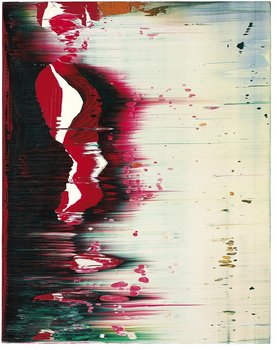
Gerhard Richter Fuji, 1996 Oil on alucobond. David Roberts Collection // Source: davidrobertsartfoundation.com.

Gerhard Richter, Fuji, 1996 Oil on alucobond. David Roberts Collection // Source: davidrobertsartfoundation.com.

Small but stunning Richter on view in A House of Leaves as of two weeks ago; it’s an ever-unfolding exhibition so who knows what’s on now?

While DRAF is housed in an industrial brick warehouse in an alley off of the high street, the Zabludowich Collection is sited in an imposing church in a residential street.

Founded in 1994, the Zabludowich Collection “exhibits in venues in the UK, USA and Finland” and “actively creates new opportunities for audiences to engage with emerging art.”

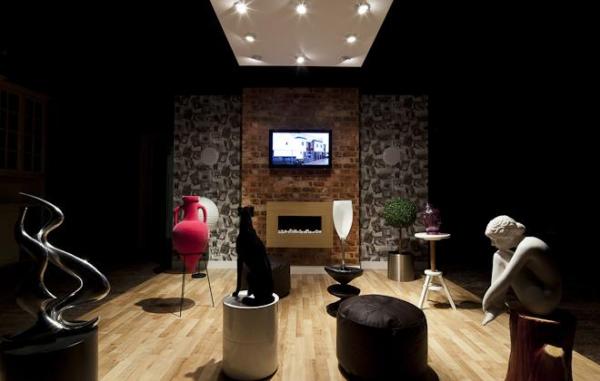
Matthew Darbyshire, Showhome, 2012 // Source: zabludowiczcollection.com.

Matthew Darbyshire, Showhome, 2012 // Source: zabludowiczcollection.com.

The current exhibition by Matthew Darbyshire featured sets made of printed vinyl CG streetscapes. I was most interested in the Showhome installation, involving mass manufactured chairs and high-end interior design decorations. It was familiar yet preposterous and sad. There’s something interesting in packaging showrooms’ theatricality in art exhibit’s pretentions of perfect, timeless viewing experiences. The exhibition as a whole expressed some of the suffocation of consumer culture, and I couldn’t help but feel some of that coldness and repression as I left the show.

This detail of The Tempest (~1862) by Peder Balke. It’s a seascape, maybe one of the most unlikely genres of painting I’d be attracted to. But the elegance, brushstrokes,  simplicity and evocativeness is what gets me.

Stephen Chambers’ gold leafed potato print, on view now at the Royal Academy of Arts in the Artist’s Laboratory.

Two faces, carved with simple marks. Maybe a man and a woman. Despite the elemental form, I still read the faces as deeply empathetic with each other, united in the way that lifelong couples are.

Potato prints are a basic form of printmaking, one that could be the first type of printmaking children experience. The idea of gold-leafing a potato print is so absurd it’s brilliant.

The show features a 70-part screenprint mural, nice stuff, interesting timeless narrative vignettes.

Richard Artschwager’s Tower II (1979)

A theoretical device for communication. Nice pairing with Demand and Opie. Plus a daringly bright aqua wall. Go Tate!

Richard Artschwager, Tower II, 1979 (center), with a photo by Thomas Demand (left) and Julian Opie's You See An Office Building 4 (1996). Tate Liverpool.

Richard Artschwager, Tower II, 1979 (center), with a photo by Thomas Demand (left) and Julian Opie’s You See An Office Building 4 (1996). Tate Liverpool.

San Francisco or London?

Notting Hill.

Notting Hill.

Love this message.

Shoreditch.

Text: ESPO in Shoreditch.

Jason Evans‘ photo/installations.

By chance, I stumbled into The Grange Prize exhibition at Canada House.

It was a group exhibition featuring the work of four finalists for a major international, contemporary photo prize. I was most attracted to Jason Evans’ work; it was the most playful and mixed-media, using wall graphics, texts, objects, and loud colors. The combination unfolds in a way that I think asks the viewer to engage the experience in a more multi-sensory way.

Here are some of his casual, snapshot-like photos. I think they work better en masse.

Jason Evans. // Source: jasonevans.info.

Jason Evans. // Source: jasonevans.info.

Jason Evans. // Source: jasonevans.info.

Jason Evans. // Source: jasonevans.info.

Jason Evans. Installation view. // Source: jasonevans.info.

Jason Evans. Installation view. // Source: jasonevans.info.

Curiously, I couldn’t bring myself to cast a vote. The show seemed too small; there’s not enough work on view to get a sense of each artist’s scope and capacities. (The winner was announced; her work seems to demonstrate photographic skill the most apparently, but with the least compelling subject matter and use of materials for me personally.)

Standard
Research, Values

Off-Cuts, Part 1

In no particular order, I submit some exhibitions, passages, and ideas worth savoring. Get the stockpot ready;  offcuts are best after a low and slow simmer.

Richard Wilson’s 20:50 (1987/2012)

I’d only read about this installation involving tons of used sump oil in installation art books and on Matt’s Gallery’s website. It was a delight to stumble upon it in the Saatchi Gallery. It doesn’t look like much; but you have to be there to understand its depths (literally and figuratively).

Richard Wilson, 2050, 1987/2012. Saatchi Gallery, London.

Richard Wilson, 20:50, 1987/2012. Saatchi Gallery, London.

Sarah Bridgland’s papercut assemblages.
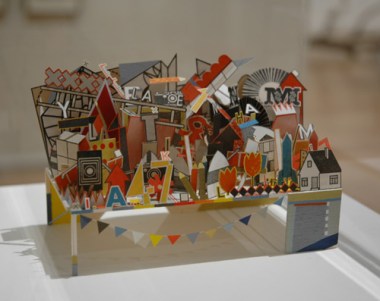
Sarah Bridgland, The Pier, 2012, paper, card, balsa wood, glue, thread, pencil, paint. On view in The First Cut, Manchester Art Gallery, Manchester, UK.

I loved this for the typographic exuberance, plus who can resist the miniature pennant flags? But have a look at Brigland’s site—the less figurative work is quieter yet lovely as well.

Seen at Manchester Art Gallery’s The First Cuts exhibition. A neat survey of works on paper by international artists. A lot of nature/tree/leaf and bird artworks—maybe too many.

Rob Ryan‘s paper cuts.

He works in a sweet, illustrative vein, making children’s books and gift cards. Not unlike Nikki McClure.
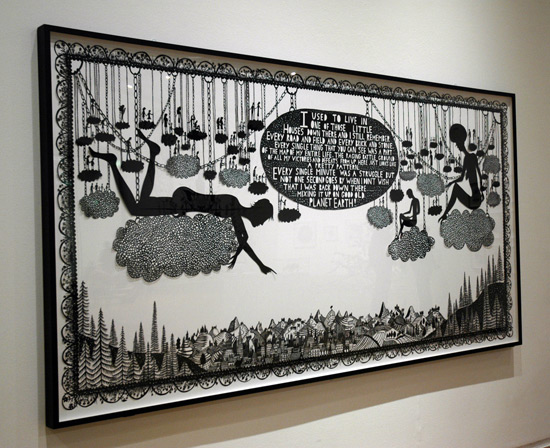
Rob Ryan, papercut, The First Cut, Manchester Art Gallery.

Rob Ryan, The Map of My Entire Life, framed papercut, 2012. The First Cut, Manchester Art Gallery, Manchester, UK.

VIEWER FAIL.

I had the sad experience of watching museum goers fail to engage meaningful artworks. I was able to find a silver lining—which could mean I’m an optimist, finding the positive, or maybe I’m a cynic, so low are my standards.

When a group of museum goers encountered  silhouettes by a well-regarded artist, they didn’t register the horrifying narratives of slavery, rape, mutilation and vengeance. Instead, they took photos of themselves mimicking the pose of one pair—a gentleman taking the hand of a Victorian lady. Ugh!

Though I was morally outraged, I was able to find a comforting logic: If even this artist’s work can be regarded so flippantly by “viewers” (the label seems to be an overstatement in this case), then it can happen to any artist’s work. So, if it happens to my artwork, I don’t have to take it personally. It’s not my problem.

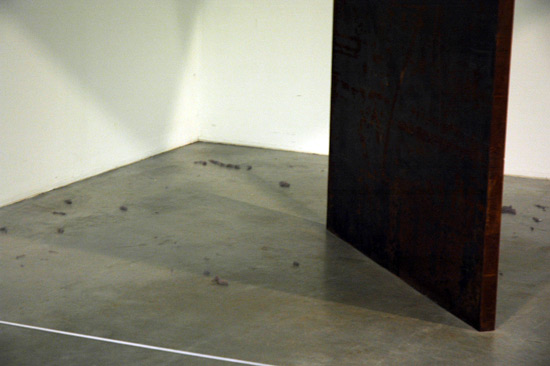
Dust bunnies under a Richard Serra sculpture at the Tate Modern. Good decision to leave it as is. Would you want to sweep under a massive sheet of steel that is not fastened to anything?

Dust bunnies under a Richard Serra sculpture at the Tate Modern. I’m glad I don’t have to sweep under gigantic, unfastened sheets of steel, and it looks like no one at TM does either.

Alfredo Jaar‘s kinetic lightbox sculpture

Brilliant. Two identical lightboxes; one hangs upside down from a motor on the ceiling. As it lowers, the room is washed with greater intensities of light, until the tables meet and seal the light inside, and the room goes dark, like a supernova, except for a fine horizon line encircling the room. A perfect Minimalist gesture, loaded with content if you consider Jaar’s interests in history, who tells it, etc.

Alfredo Jaar, Lament of the Images, 2002, motorized lightboxes. Tate Modern.

Alfredo Jaar, Lament of the Images, 2002, motorized lightboxes. Tate Modern.

Alfredo Jaar, Lament of the Images, 2002, motorized lightboxes. Tate Modern.

Alfredo Jaar, Lament of the Images, 2002, motorized lightboxes. Tate Modern.

Ewa Partum

When I think of early language and conceptual art, I think of b/w photos and videos, often of white, Western men. So learning about Partum, a female Polish artist pioneering conceptual art and feminist performance in the 1960s, is exciting. More info at tate.org.uk.
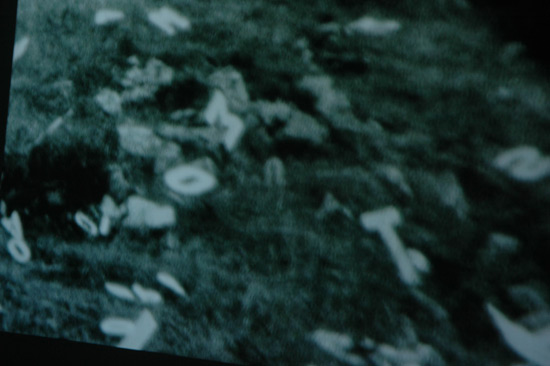
Still from Poem video documentation by Ewa Partum. Tate Modern.

Still from Poem video documentation by Ewa Partum. Tate Modern.

University of the Arts London's MA Textile Arts students' massive textile baobob.

University of the Arts London’s MA Textile Arts students’ massive textile baobob.

Yinka Shonabare had some amazing public installations (love the Fourth Plinth project!) in London, and when I saw this baobob tree covered in world textiles at the Southbank Centre, I assumed it was a work of his as well. But it’s not! It’s but MA Textile Arts students. I love it, I think it’s brilliant especially in connection with this summer’s Olympics, signaling a place for the whole world to gather.

Art Update

Really became a fan of Art Update’s booklet-format gallery guide. Each neighborhood in London had its own spread: maps right next to listings.

A spread from my well-travleed copy of Art Update: London.

A spread from my well-traveled copy of Art Update: London.

I hope I never have to open any more large maps standing in the middle of the sidewalk again. I also hope I never have to sort through gallery listings not separated by neighborhood. And I hope more gallery guides indicate locations with gallery names instead of numbers.

The Liverpool Biennial had a lovely identity, but way finding was not its best asset. Why separate the map from the listings in the brochure? Why put an arrow when a location was off the map, but omit the address? There were sandwich boards announcing that you’ve found a location, but not many signs helping you get there, or find the entrance (as much needed on the Cunard Building). I walked around Flag Exchange looking for flags or an exchange, only to see that the design-conference-y tents were the artworks… <disappointment> …I think?  <Uncertainty.> It was too cold (upper 30s, and I had only a light jacket on) for me to care <indifference>.

Cheryl Strayed

From “Tiny Beautiful Things: Advice on Life and Love from Dear Sugar” (2012):

Let whatever mysterious starlight that guided you this far guide you onward into whatever crazy beauty awaits….

Something to aspire to:

What do you do when you don’t know what to do about something?

…I attempt to analyze the situation from the perspective of my “best self”—the one that’s generous, reasonable, forgiving, loving, bighearted, and grateful. I think really hard about what I’ll wish I did a year from now…. I move towards the light, even if it’s a hard direction in which to move.

And, for artists (myself included) who think of themselves upon hearing of other artists’ successes:

You know what I do when I feel jealous? I tell myself not to feel jealous. I shut down the why not me? voice and replace it with one that says don’t be silly instead. It really is that easy. You actually do stop being an awful jealous person by stopping being an awful jealous person. When you feel terrible because someone has gotten something you want, you force yourself to remember how much you have been given. You remember that there is plenty for all of us. You remember that someone else’s success has absolutely no bearing on your own. You remember that a wonderful thing has happened to one of your … peers and maybe, if you keep working and if you get lucky, something wonderful may also someday happen to you.

And if you can’t muster that, you just stop. … There isn’t a thing to eat down in that rabbit hole of bitterness except your own desperate heart. If you let it, your jealously will devour you….

I know it’s not easy being an artist. I know the gulf between creation and commerce is so tremendously wide that it’s sometimes impossible not to feel annihilated by it. … the people who don’t give up are the people who find a way to believe in abundance rather than scarcity. They’ve taken into their hearts the idea that there is enough for all of us, that success will manifest itself in different ways for different sorts of artists, that keeping the faith is more important than cashing the check, that being genuinely happy for someone else who got something you hope to get makes you genuinely happier too.

Standard