Meta-Practice

Keep walking toward the mountain: staying true to your goals

Author Neil Gaiman offered practical, heartening advice in commencement speech at the University of the Arts in Philadelphia last year. The speech, and his delivery of it, is warm and generous—listening to him deliver it is highly recommended.

Short of that, I love his perspectives on persistence, quoted below. If it seems that I’m obsessed with optimism and motivational inspirations, it’s because I am. Day-to-day life is filled with the mundane: hours spent commuting, generating income, sending off applications for things that may or may not come into fruition, and so on. In the muddle of quotidian distractions, the clarity of advice from a fellow traveler is helpful.

I love Gaiman’s suggestion of how to navigate over the long haul—by envisioning a longterm goal as a distant mountain:

And I knew that as long as I kept walking towards the mountain I would be all right. And when I truly was not sure what to do, I could stop, and think about whether it was taking me towards or away from the mountain. I said no to editorial jobs on magazines, proper jobs that would have paid proper money because I knew that, attractive though they were, for me they would have been walking away from the mountain. And if those job offers had come along earlier I might have taken them, because they still would have been closer to the mountain than I was at the time.

Another way of having faith in a slow process with unforeseeable results:

A freelance life, a life in the arts, is sometimes like putting messages in bottles, on a desert island, and hoping that someone will find one of your bottles and open it and read it, and put something in a bottle that will wash its way back to you: appreciation, or a commission, or money, or love. And you have to accept that you may put out a hundred things for every bottle that winds up coming back.

The problems of failure are problems of discouragement, of hopelessness, of hunger. You want everything to happen and you want it now, and things go wrong.

… nothing I did where the only reason for doing it was the money was ever worth it, except as bitter experience…. The things I did because I was excited, and wanted to see them exist in reality have never let me down, and I’ve never regretted the time I spent on any of them.

I’ve also been observing more successful peers with a mix of envy and dread, wondering how I would cope with the constraints they perceive as imposed on them. How is it that one can avoid an upwardly-mobile treadmill, in which opportunities increase while autonomy and creative freedom decrease? Gaiman perceives what some would call a trade-off for the tragedy it is:

…The problems of success. They’re real, and with luck you’ll experience them. The point where you stop saying yes to everything, because now the bottles you threw in the ocean are all coming back, and have to learn to say no.

I watched my peers, and my friends, and the ones who were older than me and watch how miserable some of them were: I’d listen to them telling me that they couldn’t envisage a world where they did what they had always wanted to do any more, because now they had to earn a certain amount every month just to keep where they were. They couldn’t go and do the things that mattered, and that they had really wanted to do; and that seemed as a big a tragedy as any problem of failure.

And after that, the biggest problem of success is that the world conspires to stop you doing the thing that you do, because you are successful. There was a day when I looked up and realised that I had become someone who professionally replied to email, and who wrote as a hobby. I started answering fewer emails, and was relieved to find I was writing much more.

That tragic entrapment of success is not an inevitability. Keep re-assessing; be led not by fears of losing what you’ve gained, but by your commitment to your practice.

Standard
Values

What not to do at a phenomenological art installation

[CURMUDGEON WARNING: This is going to be an angry, misanthropic post. I try to be optimistic and share the positive, but all my efforts yesterday could not save my experience at James Turrell’s exhibition at the Guggenheim from being marred by other viewers.

Turrell is one of my favorite artists. He creates spaces for one-of-a-kind perceptual experiences and transcendence. I went to his exhibition to restore my faith in why I make art, to be freed from mundane constraints; so I cleared my schedule on a weekday morning to avoid crowds, and I cleared my head to be receptive. When I got there, I tried to block out other viewers’ inane conversations (first mentally and then physically by plugging my ears) and ignore their persistent, distracting photo-taking and mobile device addictions. I even conducted positive self-talk about personal boundaries and controlling my psychic energy(1). But it was all for nought. Having enough physical and psychic space to appreciate Turrell’s subtle installations was impossible.

As an artist, I need viewers. But as a viewer, especially for phenomenological installations like Turrell’s, I could do without 90% of them. I know most viewers have good intentions and, by dint of being at the museum, want to appreciate art, however, I could not help but feel how selfish and self-sabotaging many viewers were at the Guggenheim yesterday. What follows is ranting and conservative—for the positive, come back another time.]


What not to do at a phenomenological art installation:

  • Take pictures when photography is explicitly forbidden. It’s disrespectful to the artist and the institution. If those entities seem too abstract to you, at least use your self-control to not disregard and thereby disrespect the guards as fellow human beings. They didn’t make the rules but they bear the brunt of enforcing them, thousands of times a day, week after week, when the rules are clearly stated.(2) While many institutions allow picture taking, it’s a privilege, not a right. Furthermore, picture-taking forces guards to verbally enforce the rules, which further distracts other viewers from the art.
  • Take pictures when photography is explicitly forbidden and the host institution has posted plentiful pictures on their website. It’s especially selfish and pointless.
  • Take pictures or use a mobile device when viewing a finely-calibrated light installation that utilizes the entire space. You are inside the artwork. Just as you wouldn’t add paint to a painting, do not add your screen’s light to a light installation.
  • Take pictures of a phenomenological, durational exhibition, whose very intention is for viewers to be present, slow down, quiet the mind, and free oneself from contemporary distractions.(3)
  • Make shadow puppets, or let your children make shadow puppets, in the light installations. There are endless places to play with shadows in the world, but only a handful in which to view a Turrell installation. Behave yourself for the same reasons that you wouldn’t climb on a marble statue at the Met.
  • Take one of the highly coveted seats inside the installation to read a newspaper or use your mobile device. If it’s an emergency and you must use your device, excuse yourself to a lobby or hallway. If it’s not, stop sabotaging your own experiences and be present! Further, to pass your time not engaging the artwork is especially inconsiderate when there are over a hundred people waiting in line outside due to the installation’s limited capacity.
  • Start up a conversation about how too many people are talking to fully experience the installation, and carry it on, contributing to the problem.

1. From Mihaly Csikszentmihalyi’s Flow:

A memo on my desk with Mihaly Csikszentmihalyi's advice for creating flow experiences: The quality of consciousness determines the quality of life. Purposeful action leads to enjoyment. Erect barriers against distractions. Dig channels so energy can flow. Do not let chance or external routine dictate what we do. Source: Mihaly Csikszentmihalyi, Flow (2008).

A memo on my desk with Mihaly Csikszentmihalyi’s advice for creating flow experiences: The quality of consciousness determines the quality of life. Purposeful action leads to enjoyment. Erect barriers against distractions. Dig channels so energy can flow. Do not let chance or external routine dictate what we do. Source: Mihaly Csikszentmihalyi, Flow (2008).

2. I probably saw over a hundred people taking pictures in the hour or so I was in Aten Reign, Turrell’s once-in-a-lifetime, site-specific installation in the Guggenheim’s iconic rotunda. Visitors blatantly felt that they did not have to follow the no-pictures rule—that their need to take a photo surpassed any of the artist or institution’s logic or any basic respect of the guard as a human being just doing his job.

This is how bias works: People understand that bias exists—but we believe that only other people are biased, whereas we think that we see things as they really are. The flaw, of course, is that if everyone else is biased, no one, including ourselves, is unbiased. In fact, we are all biased. (See Jonathan Haidt, The Happiness Hypothesis (2006).)

No photography means no photography. It doesn’t mean that other people can’t take photos.

3. Louis CK takes down mobile phone addictions beautifully on Conan: put down the device, be present, experience art, and let yourself experience real emotions.

Addictions erode self-control and the incredibly important characteristic of being able to delay gratification. The very definition of addiction is when people continue an automatic behavior out of desire, even as pleasure diminishes (see Paul Martin, Sex, Drugs and Chocolate: The Science of Pleasure). If feeding the addiction leads to selfish and self-sabotaging behaviors, self-regulation is in order. There’s a profound difference, anyway, between fleeting pleasures and lasting enjoyment.

Christine Wong Yap, Positive Sign #49 (Pleasure and enjoyment), 2011; glitter and neon pen on gridded vellum; 8.5 × 11 in./21.5 × 28 cm.

Christine Wong Yap, Positive Sign #49 (Pleasure and enjoyment), 2011; glitter and neon pen on gridded vellum; 8.5 × 11 in./21.5 × 28 cm.

Standard
Art Competition Odds

art competition odds: 2014 Djerassi Artist Resident Program

The Djerassi Resident Artist Program received 823 applications for 80 residency spots in 2014.

///////////////////////////////////////////////////////////////////////////
/////
//////////////////////////////////////////////////////////////////////
///////////////////////////////////////////////////////////////////////////
///////////////////////////////////////////////////////////////////////////
///////////////////////////////////////////////////////////////////////////
///////////////////////////////////////////////////////////////////////////
///////////////////////////////////////////////////////////////////////////
///////////////////////////////////////////////////////////////////////////
///////////////////////////////////////////////////////////////////////////
///////////////////////////////////////////////////////////////////////////
/////////////////////////////////////////////////////////////////////////

Recipients comprise about 1:10, or 9.7% of applicants.

See all Art Competition Odds.

Standard
Meta-Practice

Home Studio 360

In a recent post, I urged working artists to value ourselves and our practices independent of commercial validation.

It’s easier to say than do. Here’s a case in point:

Because I have a hang-up that I might be perceived as a less serious artist since I work from home, I’ve never posted pics of my current studio.

Until now. 

Studio panorama. Pretty nice to have light and fresh air. The windows face out to a covered porch, where I've done a little bit of woodworking.

Studio panorama. Pretty nice to have light and fresh air. The windows face out to a covered porch, where I’ve done a little bit of woodworking.

I'm sewing the VIA signal flag project these days. I put up some ribbons on the walls so I can pin things up without constantly making new holes in the walls. Leftover insulation foam from a packing project has been turned into another pinboard for swatches (at left).

I’m sewing the VIA signal flag project these days. I put up some ribbons on the walls so I can pin things up without constantly making new holes in the walls. Leftover insulation foam from a packing project has been turned into another pinboard for swatches (at left).

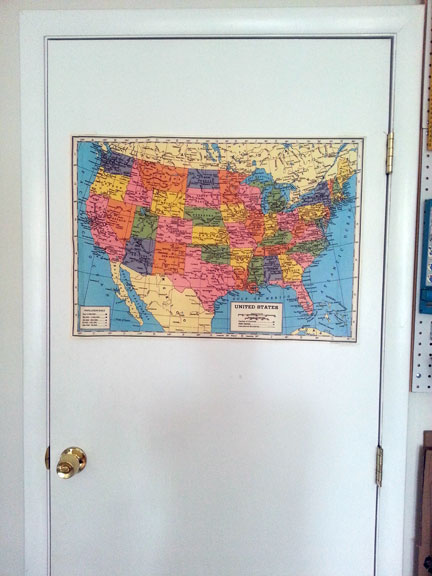
I'm guessing this map is from the 1970s. It's fun to think about all the places I've yet to visit in this huge, amazing country.

I’m guessing this map is from the 1970s. It’s fun to think about all the places I’ve yet to visit in this huge, amazing country.

As far as I'm concerned, books, artist's tape, and colorful pens are non-negotiable.

Pegboard’s irresistible promise of organization.

As far as I'm concerned, books, artist's tape, and colorful pens are non-negotiable.

As far as I’m concerned, books, artist’s tape, and colorful pens are non-negotiable.

Though I would rather have a studio outside the home, I have to admit—the convenience of a home studio is a big plus. Working from home, I’ll never have to eat a Trader Joe’s MRI or bodega junk food. I’ll never have to commute just to get the dimensions of a work of art or pick up a ruler. Other artists’ dusts, fumes, music and garbage are non-issues. Late at night, I don’t have to get creeped out in an empty building or desolate neighborhood. I get to use a full kitchen and clean bathroom! I never suffer the consequences of leaving materials or references at “home,” and bringing a fan or air conditioner, or scarf or jacket, takes all of 30 seconds.

According to the W.A.G.E. survey, 45.8% of artist-respondents reported that they don’t rent studios outside of their own residences, either. So I’m far from alone in managing my resources this way. My fears were based on assumptions of what a serious artist should be doing. But as Creative Capital mentors have said,

Artists! Don’t should all over yourself.

I’d love a bigger, more flexible studio one day, but for now, my little home studio is not too bad—and now that I think about it, it’s pretty great. I’ll try to take my own advice and Be Here Now.

WF made me this awesome trophy.

W made me this awesome trophy. Be here now!

Standard
Meta-Practice

notes on meta-practice from Bryan Cranston

Actor Bryan Cranston, who worked for years doing guest appearances and commercials, felt “stuck in junior varsity,” but persisted in his self-promotion efforts nonetheless:

The whole idea is to put yourself in a position to be recognized for your work so opportunities increase. False humility or even laziness could prevent that.

(Tad Friend, “The One Who Knocks,” New Yorker, September 16, 2013)

Author Tad Friend ascribes that even

…luck is the residue of design and devotion.

Standard
Meta-Practice

To exhibit or not to exhibit? Try a Decision Table

Along the lines of This is the Level of Nerdiness You Should Aspire To, actor and director Bryan Cranston shared a system of determining what projects to take on. Presumably it also helps him arrive at decisions faster:

he’d constructed a grid in blue ballpoint: the Cranston Project Assessment Scale. On the left were rankings from Very Good to Poor, and across the top, in decreasing order of importance, were Story, Script, Role, Director, and Cast. A very good story was worth ten points, a very good cast only two. Story and script count the most, he said, because “an actor can only raise the level of bad writing by a grade. C writing, and I don’t care if you’re Meryl Streep—you can only raise it to a B.” After factoring in bonus points (high salary = +1; significant time away from family = –3), he’d pass on a project that scored less than 16 points, consider one from 16 to 20, accept one from 21 to 25, and accept with alacrity one from 26 to 32.

(Tad Friend, “The One Who Knocks,” New Yorker, September 16, 2013)

What might such a ranking system look like for a visual artist? Artists often want to say “yes” to every opportunity that comes their way, so when they should say “no,” they deliberate about it for a while. Perhaps something like this could help artists?

Proposal for an exhibition opportunity ranking system. As each artist values each category differently, you'll have to fill in the values. Getting the math to square across different opportunities was tricky; I'm sure scientists and mathematicians who are more knowledgeable than I in designing experiments could advise on how much to weigh each cell.

Proposal for an exhibition opportunity ranking system. Since artists’ priorities are different, you’ll have to fill in the points. It also helps if you have some math/science sense to properly weigh each cell.

For me, how much I’m personally invested in a project matters. The curation should be minimally, appropriate, and ideally, compelling. Funding is always a consideration, though how significant it is depends on the project costs and the precariousness of my financial situation. The venue‘s physical spaces and upkeep, exhibition design, and organizational capacity are important to me too. Audience appropriateness, relevance, and foot traffic are factors too.

Standard
Community, Meta-Practice

Shaping the art criticism that we would like to participate in

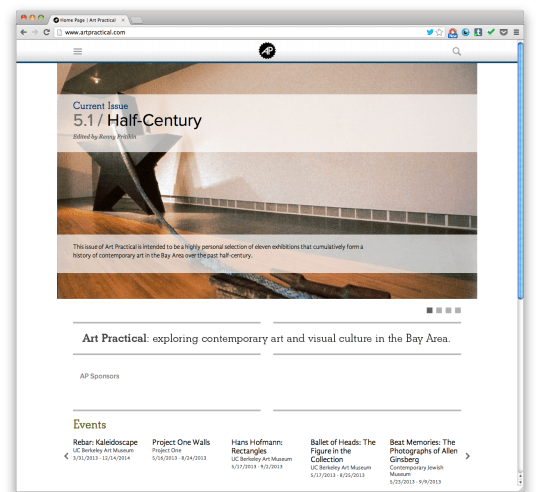
Art Practical's first issue on its redesigned site.

Art Practical’s first issue on its redesigned site.

Have a look at the re-design of Art Practical, an online art criticism platform with reviews and features focusing on San Francisco Bay Area art.

Five years ago, there was a dearth of art criticism in the Bay Area. The chances of having a review written about your work seemed maddeningly infinitesimal. I think all that has changed because of Art Practical, with its diverse base of contributors and regular bi-weekly publishing schedule. It’s better edited than most metro dailies and stays focused on substance..

Art Practical can’t single-handedly cover all the shows in the Bay Area, but does more than any other publication or platform. It also centralizes an archive of Bay Area art activity, and cultivates a new generation of critics.

Art Practical is a perfect example of what happens when dedicated people actualize an aspect of the art world they want to participate in.

If Bay Area artists still feel like there isn’t enough art criticism there, I’d challenge them to submit a Shotgun Review. Complaining about the lack of criticism won’t result in better or more criticism, as legions of Bay Area artists and art students have shown. Taking a position and crafting a review requires risk and responsibility, just like building a new platform to enhance a local art ecology.   

The latest issue features a history of Bay Area art in eleven shows.

Standard
Citizenship

Color, happiness, and symbols of resistance

People paint rainbow-colored stairs on August 31, 2013 in Istanbul. Stairs in the Cihangir and Findikli neighborhoods, which attracted attention after being painted in rainbow colors by a local man on August 27, were all painted grey on the night of August 29, and following comments on social media, the municipality of Beyoglu immediately painted them again in rainbow colors. // Source: Ozan Kose / AFP / Getty Images. From Huffington Post.

People paint rainbow-colored stairs on August 31, 2013 in Istanbul. Stairs in the Cihangir and Findikli neighborhoods, which attracted attention after being painted in rainbow colors by a local man on August 27, were all painted grey on the night of August 29, and following comments on social media, the municipality of Beyoglu immediately painted them again in rainbow colors. // Source: Ozan Kose / AFP / Getty Images. From Huffington Post.

A set of public stairs in Turkey has arguably been the site of:

  • guerilla art (when a local resident painted them in rainbow stripes),
  • a populist happiness gesture (he wanted “to make people smile”),
  • censorship (Turkish officials covertly re-painted the stairs grey), and
  • resistance (locals were outraged, and the city re-painted the stairs in bright colors).

It goes to show how using vibrant colors and promoting happiness may seem like simple gestures, but they can be powerful and meaningful actions for people and cities too.


Standard