“By greatly upsizing found objects into bronze, steel, porcelain or wood — thereby establishing, by means of scale, a readily identifiable distinction between the work of art and the thing it’s mimicking — Koons is returning thought to sense experience, but a form of sense experience that is both highly materialistic and deeply conservative, relying on orthodox, costly mediums to affirm the elevation of his lowborn subject matter into art. His lack of adventurousness and invention in this regard is in sharp contrast to the silkscreening (then considered solely a commercial process) adopted by Warhol for his paintings, or the soft vinyl sculptures of everyday objects concocted by Claes Oldenburg (who can be seen, in many respects, as the anti-Koons, outclassing him on every count of wit, irony, and imagination). Koons’s bravura handling of granite and bronze, the materials of the ancient Egyptians and Greeks, reflects the reactionary attitude toward materials that cost Marcia Tucker, the founder of the New Museum, her job at the Whitney in 1977 after she exhibited Richard Tuttle’s sculptures made out of wire and rags.”
—Thomas Michelli, “Have a Nice Day: Jeff Koons and the End of Art,” Hyperallergic.com, June 28, 2014
Impressions: Lygia Clark, Other Primary Structures, Mel Bochner, and more
Some notes on exhibitions at the MoMA and the Jewish Museum.
Driven by cabin fever (I’ve been cooped up in the home studio rendering video for three hot days) and hungry for inspiration, I met up with NM and visited the MoMA and the Jewish Museum of New York. The shows we attended were excellent. I couldn’t be happier with our selections.
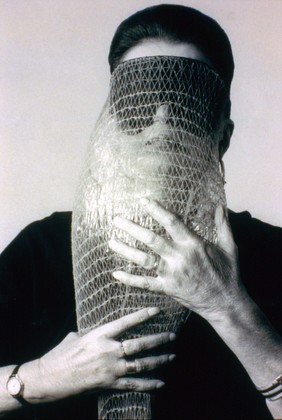
Lygia Clark wearing Máscara abismo com tapa-olhos (Abyssal mask with eye-patch, 1968), a work made of fabric, elastic bands, a nylon bag, and a stone, in use. Courtesy Associação Cultural “O Mundo de Lygia Clark,” Rio de Janeiro. Photograph: Sergio Gerardo Zalis, 1986 // Source: moma.org.
Lygia Clark: The Abandonment of Art, 1948-1988
Museum of Modern Art
Through August 24, 2014
- The curatorial premise of the show is that the Brazilian artist started off as a Modernist painter of geometric abstraction, transitioned into making interactive sensorial objects, and finally left art to practice psychotherapy. (This seems unusual, as the default curatorial impulse is to historicize and affirm the importance of an artist within art history.)
- The size, texture, and visuals of the early paintings reminded me of Constructivism. However, Clark expanded beyond the rectangle and engaged in a reflexive investigation. (NM and I wished to shape our own practices around questions more, as open-ended inquiries.)
- A room of black and white, 2-D, Neo-Concretist compositions had a lot of energy—lots of visual tension and concision. I especially loved the wall text explaining how Neo-concretism differed from the Concretist aim to rid all external referents, acknowledging that (We are always embodied!):
“the work of art is a projection of the body”
- The final room invites interaction with replicas of her iconic mirror goggles, and instructions for actions, including a surprisingly delightful Möbius strip activity. This is a rare participatory space in a museum that is completely authentic and appropriate.
- Clark met resistance in art and psychotherapy—as a wall text explained, “her work was an abyss, an absence pointing to open, unresolved questions in both disciplines.” (Art is presumed to take all kinds, but then why is it so uncomfortable when projects become too akin to other realms? I think Clark is totally underrated, and I hope the exhibition and substantial monograph act to remedy this.)
- Installation notes: [Sometimes I wish I could turn this habit off, as it detracts from my experience of the art; on the other hand, I hope it hones my exhibition-making craft.] Most of the work is installed very high on the wall—I’m guessing on a 66″ centerline. I felt like I was craning my neck to look at the pictures. The last room, however, featured projections flush to the floor, so maybe the height was designed to emphasize Clark’s evolution to participation.
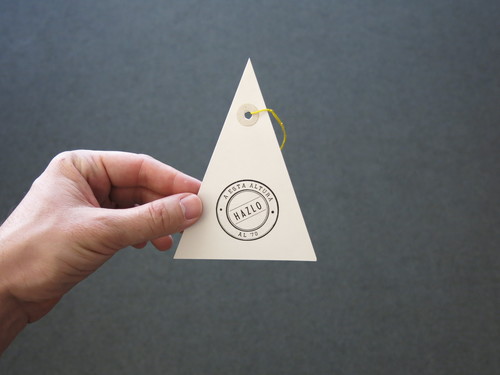
Edgardo Antonio Vigo. Hazlo (Do it). 1970. Photo: David Horvitz // Source: moma.org.
The Unmaker of Objects: Edgardo Antonio Vigo’s Marginal Media
Museum of Modern Art
Through June 30, 2014
View the exhibition site.
“This exhibition celebrates the mail art, visual poetry, performative works, and publications of the Argentine artist Edgardo Antonio Vigo (1928–1997).” —MoMA site
- Gorgeous typography. Much of the ephemera was beautifully produced letterpress or woodcut prints with custom cutout shapes. Hailing from the late 1960s, it was stylish, exuberant and not overly complicated. It wasn’t on fancy paper with a pronounced de-boss, or dream-of-the-1890s-hipster-baroque. It was tasteful and original. In my thinking about simple gestures and conceptual works, I tend to recall Stanley Brouwn’s scribbled scraps or Fluxus’ typewritten instructions. However, elemental/conceptual gestures can be accompanied by killer graphic design, too.
- One piece of paper, one cutout, two words = more than most art achieves.
- Many of the works bore prompts or procedures. I’ve wanted to improve my atrophied Spanish skills, and this became one more reason.
- Installation notes: Four vitrines in a mixed-use atrium. Not the most ideal venue, but the display inside was great. The ephemera was laid out on wool or some other non-woven fabric, and the grey texture contrasted the paper nicely, grounding it in everyday usage.
An unfortunately small thumbnail of an installation view of Other Primary Structures at The Jewish Museum, New York. Photo: David Heald/The Jewish Museum. // Source: thejewishmuseum.org.
Other Primary Structures
The Jewish Museum
Through August 3, 2014
- Jens Hoffman, formerly of the Wattis Institute, restaged the seminal Minimalist exhibition with non-Western artists.
- The physical space was challenging—ornate architecture, small rooms. But Hoffman bent the space to his will with his stylized, almost aggressive exhibition-making. Reproductions of the original exhibition loomed on billboard-sized temporary walls. They crowded the small spaces, and positioned the actual physical works in a more literal relationship to the original show.
- There was a surprisingly great amount of tension in the show. The works were present, palpably.
- The minature model of the original show, fabricated by Bay Area artist Andy Vogt, is a treat.
- Museum notes: The Museum’s identity is being re-designed by Sagmeister…. Jon Sueda and Jens Hoffman were an unstoppable duo, IMHO. Also, the way the Upper East Side building had been selectively renovated as a contemporary museum reminded me of places like the Ikon Gallery in Birmingham, UK. Being reminded of such history in physical spaces makes totally-white cubes seem boring.)
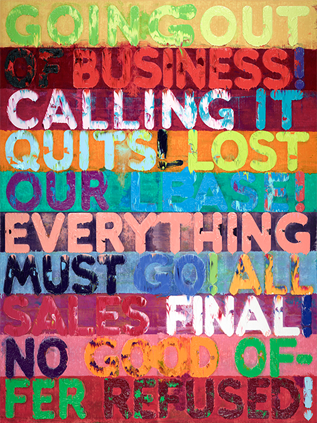
Mel Bochner, Going Out of Business, 2012, oil on velvet, 93 ½ × 70 ¼ in. (237. 5 x 178.4 cm). Private collection, New York. Artwork © Mel Bochner. // Site: thejewishmuseum.org.
Mel Bochner: Strong Language
The Jewish Museum
Through September 21, 2014
- I’ve been a huge Bochner fan since seeing his retrospective at Whitechapel.
- This is another great exhibition. See it! Reproductions of Bochner’s text paintings do not do them justice!
- Bochner’s exhibition reviews—including Primary Structures—dating back to the 1960s are also on view. It’s not often that artists’ critical writing practices are acknowledged alongside their gallery work.
- Bochner has talked about his love of graph paper—numerous drawings attest to his usage of printed grids of all sorts as a medium for sketching and expanding the conceptual bounds of portraiture.
- Installation note: In the final room, three subtle text paintings use interference paints (reflecting light in different colors), but it’s nearly impossible to tell they way they are installed.
Excellent venues, exhibitions, and curatorial vision are bountiful, if you know where to look, or find them with good luck and/or persistence.
art competition odds: Artist Alliance Inc. 2014 LES Studio Program
Artists Alliance Inc. received 200 applications for its 2014 LES Studio Program, and awarded three residency sessions.
//////////////////////////////////////////////////
//////////////////////////////////////////////////
//////////////////////////////////////////////////
//////////////////////////////////////////////////
Fellows comprise about 1:66, or 1.5% of applicants.
See all Art Competition Odds.
“The art world is and always has been a complex system, a field of constellations and interrelations—some friendly to each other, some antagonistic… each of us acteurs decides where we position ourselves and in what direction we move…
Exhibitions are opportunities to test situations and combinations, and to explore thoughts. For me, they… carry the potential to construct architectures of discourse. From my perspective, exhibitions are equal to seminars; both produce a space for communication through artistic and intellectual means…
An exhibition is a zone of activity, a space for communication that one must produce; it is not a given. An exhibition has to clarify what questions are being raised and share this process with the audience…”
—Ute Meta Bauer, “Zones of Activity: From the Gallery to the Classroom,” from Learning Mind: Experience into Art, Mary Jane Jacobs and Jacquelynn Baas, eds. (2009)
Ute Meta Bauer on Exhibitions
Notes on the Bronx Museum Artists in the Marketplace Program
Some reflections on the 13-week professional development AIM program.
—
I gained tangible advice and tools.
For example, in the writing workshop led by Martha Schulman, we workshopped our artists’ statements. Martha shared great, mechanical advice for writing (focus on verbs and nouns, use an inverse pyramid model) and strategies for editing (print it out and cut it up, or highlight different things in different colors). My statement was due for an overhaul; have a look at the result.
Sergio Muñoz Sarmiento’s legal and contract workshops were informative, interesting, and immediately useful—they helped me summon the courage to negotiate better terms in a contract. He’s a super engaging speaker and I recommend artists attend his workshops or art law performances anytime you have the chance.
In her funding workshops, Melissa Rachleff gave me great advice for in-kind donations for a project whose budget is only partially funded. She also organized group mock review panels using a criteria-based rating worksheet. It was terrifying yet effective to see proposals from this perspective.
There were other sessions that validated my existing or past practices, and others that my peers found beneficial.
—
A cohort. Having relocated to NYC in 2010, I wanted to be a part of AIM to gain a sense of community. In this regard, AIM has been a great gift.
This year’s cohort of 36 artists is pretty awesome, for two reasons. It’s diverse: in age, educational background, media, conceptual interests, and geography (recent international transplants, born-and-bred-New Yorkers, artists from across four boroughs, plus Jersey). (It’s also 2/3 women!)
At the same time, everyone is smart and interesting, and their studio practices are advanced.
This combination offers huge potential for rigorous dialogues and cross-pollination.
Though the cohort was split into a Winter and Spring session, we were encouraged to organize visits each other’s studios to get to know each other. This was an opportunity that I didn’t want to let pass, so I started organizing with the help of Maria and Margaret. Everyone was interested and flexible. The dialogues were thoughtful and engaging, and I really hope they continue into the future.
—
One of the first art world things I did when I moved here was to volunteer at Art in Odd Places. I met and “helped” BROLAB, a collaborative of AIM alumni. Their level of activity is inspiring. I’m eager to see what productive, alternative things can happen among our little group of like-minded, enthusiastic colleagues.
—
Thanks to Lia Zaloff and Sergio Bessa for their hard work and vision in realizing AIM, and to the Bronx Museum and its funders for making this opportunity possible. And thanks in advance to Hatuey Ramos Fermín and Laura Napier, curators of the Bronx Biennial, for the exhibition to come!
—
The application for AIM 2015 is now open. The deadline is September 5, 2014. The open call is competitive—good luck!
art competition odds: Kala Art Institute 2014 Fellowship
The Kala Art Institute’s 2014 Fellowship Award received 330 applications for nine Fellowships and six Honorary AIR awards.
//////////////////////////////////////////////////
//////////////////////////////////////////////////
//////////////////////////////////////////////////
//////////////////////////////////////////////////
//////////////////////////////////////////////////
//////////////////////////////////////////////////
//////////////////////////////
Fellows comprise about 1:36, or 2.7% of applicants.
Fellows and Honorable Mentions comprise 1:22 or 4.5% of applicants.
See last year’s odds, or all Art Competition Odds.
Get Excited: Artists Make Things (Happen)
Check out these shows featuring make things (happen) artists!
Through 6/22
Surveillapocalypse
Five Myles, Brooklyn
(Maria Hupfield, David Gregory Wallace)
Through 6/30
SIP 2013 Fellowship Show Part 1
Blackburn 20|20, NYC
(Dionis Ortiz)
Through June
Lexa Walsh: Mapping the Archive
de Young Museum, San Francisco
Through 7/6
Piero Passacantando : I Paint You, You Paint Me
Ed Varie, NYC
6/21–8/17
Sondheim Finalists Exhibition
The Walters Art Museum, Baltimore
(Lauren F. Adams)
—
And help make things (happen) artists support great alternative art spaces!
Take Genevieve Quick’s personalized tour of OMCA for Royal Nonesuch Gallery’s fundraiser.
Help Islington Mill* purchase a bus to provide access and mobility for its numerous artists/musicians/visitors (*co-founded by Maurice Carlin).
 R+D
R+D 