Art & Development

water towers, sunset strip and donuts

Prepping for tonight’s Sketchbook Mixed Media Class at ASUC Berkeley, I pulled together sample taxonomies:

The Bescher’s water towers
(though I would have loved to get a picture of SFMOMA’s print of superimposed water towers)

Ed Ruscha’s Every Building on Sunset Strip

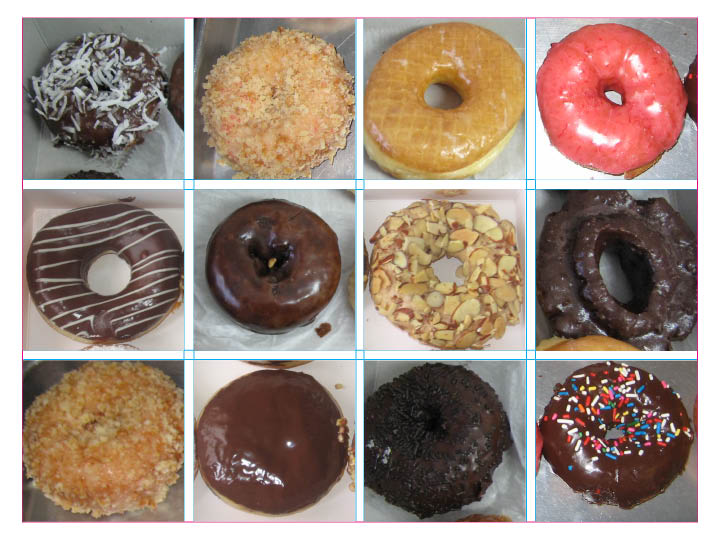
And made a mock of a sample grid, with lifted pics of donuts.

Donuts on a grid! Hi-larious.

This grid allowed me to talk about margins, columns and gutters, as well as introduce real-life uses of algebra :

How does one determine column widths?
Say our page is 12 inches, our margins 0.5 inches, that leaves us an 11-inch wide art area.
column widths = A
gutter widths = B
4a x 3b = 11 inches
Assigning B a width of 0.25 inches, A = 5.125 or 5–1/8 inches

Most 7th graders don’t take trips from Zurich to Paris. Then again, most don’t make grids to draw taxonomies, either, but for a nerdy art kid like me this would have been great!

[ADDENDUM: A week later, Linda Yablonsky blogged about a grid of donuts by ___ as part of the Miami art fairs festivities (“Art Basel Miami Beach: The Pre-Game Show,” New York Times Magazine, Dec. 2, 2009). Something’s in the air, and I think it smells like donuts.]

Standard
Art & Development

Nathaniel Rackowe’s Black Shed (Expanded)

This project by Nathaniel Rackowe looks amazing. It’ll be at Bischoff/Weiss Gallery‘s booth at Art Basel Miami, so I’ll just have to live with experiencing only the beautiful isometric rendering and my power of visualization. I had a chance to see a previous installation by Rackowe at B/W, just half a block from INIVA in London, and it was fantastic. This new work will be covered in bitumen, which, as it turns out, might be asphalt. I imagine the heat, light, and smell will be moving.

Standard
Art & Development, Research

Optimism the public art project, metaphors, gratitude, the identity of art

Reed Seifer, “a graphic artist and designer,” partnered up with Creative Time to put optimism—at least, the printed word—into the public’s pockets. See a photo and write-up: Michael M. Grynbaum’s article, “The Days May Be Grim, but Here’s a Good Word to Put in Your Pocket” (NYTimes, Nov. 19, 2009).

I’m all for optimism and public art in mundane settings. To be a bit critical, though, I think the ambiguity of a single word—any single word—seems very apparent in this project, maybe too much for my liking. That’s because the work appears in reproduction in an advertising space, and uses the tools of advertising (copywriting, concision, graphic design, mass production). It seems to be simultaneously a bit of marketing for optimism as well as marketing for itself as a single author’s project. If it is a work of conceptual art, I think it’s about as sticky as a chance procedure, as temporal as an incidental “piece.” While I’m interested in conceptual art, and I make idea-driven art, I’m pretty attached to how an art object embodies its idea.

While at times I’m acutely aware of the distance I feel from material reality / meatspace, I’m also accepting that our embodied selves inform how we understand the world. George Lakoff and Mark Johnson’s Metaphors We Live By (University of Chicago Press, 1978) is proving to be a useful text for me. It outlines the orientational and ontological means of cognition that are rooted in our physical and phenomenological experiences.

I have been thinking about gratitude and generosity a lot lately. Some of this has to do with art practice; some of it concerns life.

I’ve maintained a gratitude journal—to record that which I am grateful for—for half a year now. I first learned of the practice during my residency in Manchester this Spring, when I researched positive psychology. I started it as much to satisfy my therapeutic curiosity (to see if gratitude journals would work and make me a happier person) and as part of my commitment, as an artist, to exploring optimism.

One thing I have learned, so far, is that gratitude begets generosity. I’m reminded that I’m a lucky person; that makes me feel happy, and I’m motivated to share that lightness of spirit. These small gestures—among friends, loved ones, co-workers—are nothing; merely the stuff of everyday life; utterly forgettable and yet, for the brief times they last, thoroughly pleasurable. These are truly modest pleasures.

These gestures aren’t art. Yes, they originated in, and feed, my art practice. There’s certainly art theory and practice about generosity. And I’m still interested in Lewis Hyde‘s notions of the gift as a tool for forming or reifying social bonds. So it had occurred to me that I could make art out of these gestures—shoot some photos, name them as pieces—but that needlessly complicates them. Without a name the gesture is not a Work. But as a not-Work the gesture remains as a gesture—temporal, simple, modest. I’m appreciative of these qualities. I had come to appreciate works that are nervily barely works; in this case I like gestures that are so slight they aren’t even works. So it seems like I’m—for the moment—interested in the practice of art practice, or maybe as Barthes might put it, the Text over the Work. Indeed, Barthes’ joissance—pleasure without separation, or the pleasurable loss of awareness of self—seems to correlate with Zimbardo’s keen interest on the loss of self in instances of “finding the flow” of activities (a modest pleasure itself).

One surefire way you could have made my eyes roll in art school is to pose the question, “Is this art?” This is a worthy discussion for young artists, but it’s can also be a tedious riddle, with no definitive answers and an overabundance of circular logic. Curiously, I’ve found myself uttering this same question in my work as a preparator. There are times you unpack a crate of art, and where the Art Object begins and ends is not always apparent. It’s funny to handle stray materials with white gloves, focus and care, until their identities are determined, and it becomes “safe” to handle them with bare hands, reintegrated as parts of the mundane material reality of everyday life.

Standard
Research

recommended: Eric Gill, Iconographer, at USF

Eric Gill is the man behind the sublimely timeless Gill Sans. He’s also one of the 20th century’s notable wood-engraving artists, handling line and form in geometrically-stylized, gorgeous English Arts and Crafts way. He was a bit of a fanatic and nutter (what the gracious might call an eccentric, or what the unpretentious might call a freak).

The University of San Francisco (where I’ve had the pleasure of sitting in for E., a faculty member) holds a broad collection of Gill’s prints, books, bookplates, blocks and even a little sculpture. They’re on display in the Thatcher Gallery in the USF library through December 20. If you can make it through the imposing swipe-card turnstiles (hope the desk aides look your way, so you can inform them that you’d like to see the exhibition), you’ll find dozens of fine, detailed prints to peruse.

It’s a pleasure. I’m not one to warm to religious art easily — like Howard Belsey in Zadie Smith’s On Beauty, my tastes in art are secular — but Gill’s prints are winsome. He employs the Arts and Craft’s simplicity and elegance of line with a rudimentary, stylized geometry echoing Byzantine icons, yet Gill’s resolutely-embodied figures are lithe, muscular, and slightly Medieval in appearance. The result is a mythological aura, suiting fables, moralism, the life of someone seeking transcendence.

The artwork veers between deeply religious to sensual to erotic. I found the bookplates and illuminated letterpress blocks to be the most delicate, whimsical and endearing. These, according to a didactic banner, were considered by the artist to be mere decorations, “flowers of the graphic designer” or some such utterance of regret. Yes, they are illustrative, but one in particular, with a large, well-balanced drop-cap “O,” featured a captivating illustration of a subterranean skeleton pulling at roots while a man tugged at leaves of the same plant. Free of its movable body text, the image perplexes, and its message, however unspoken, is still communicated confidently and clearly.

I also enjoyed two prints, with the texts, “THEN” and “JESUS,” in which figures populate a landscape formed by the handsome roman capitals (his Perpetua typeface, perhaps). After leading a typography crash-course in my Sketchbook class at ASUC last night, it was a treat to see top-notch text and image compositions.

On view are also a number of intaglio prints, as well as Gill’s carved blocks. These are finely detailed, and bring, even in their reversed, inky pitch-blackness, Gill’s precision and craftsmanship to life.

The exhibition was produced with the help of a number of USF departments. Upon exit, do browse the interactive design on a computer near the entrance — it’s thorough and nicely designed (and unfortunately, it’s not online). In contrast, I found the installation — even accounting for the architectural limitations — to be wanting; I’m just tall enough to study the tiny prints hanging on what seemed to be 59″ or 60″ centers. Still, it’s too high for such modestly scaled works. Yet Iconographer creates a great dialogue with the papercuts of Nikki McClure, and, across town at the Wattis Institute, the wood-engravings by Gill’s coeval, the American Rockwell Kent.

Standard
Travelogue

The $1,300 test

Whilst in the UK during the Breathe Residency, I’d heard rumblings that the UK’s Home Office (domestic government) planned to tighten the borders with hugely detrimental effects on art galleries and residency programmes. The new procedures require:

“All non-EU visitors now must apply for a visa in person, and supply biometric data, electronic fingerprint scans and a digital photograph. The Home Office’s 158-page guideline document also outlines new controls over visitors’ day-to-day activity: visitors must show that they have at least £800 pounds of personal savings, which have been held for at least three months prior to the date of their application.”

What?! £800 amounts to over $1,300 USD. It would be nice if all artists could maintain a little nest egg, just for their own financial security—however, to maintain it for the sole purpose of entering the UK for a residency program or art exhibition seems ridiculous. The rate of exchange is not really favorable for Americans — imagine the challenge for artists from developing countries. There must be away to keep the country safe, without making England seem so Orwellian to its own highly-surveilled citizens and unwelcoming to potential visitors.

Some art organizations are getting organized and have posted a petition aimed at Parliament here.

Standard
Art & Development

another joy of teaching

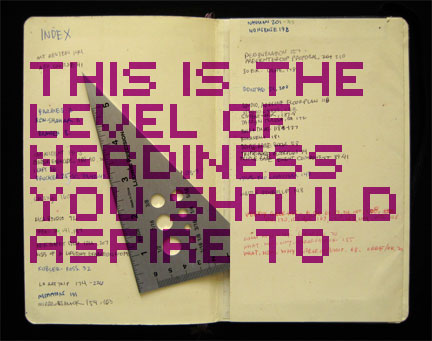
M and I were talking about sharing knowledge; he teaches design and I teach drawing/mixed media at the ASUC Art Studio. We both love to encourage our students to be extreme in their embrace of tools and techniques. He articulated one of my new favorite pedagogical mottoes:

This is the level of nerdiness you should aspire to

The pocket in the back of my Moleskin sketchbook has finally found its true calling: home to an ultra-precise metal triangle.

Standard
Art & Development

optimism and pessimism

I am opposed to false dichotomies (who isn’t), and there are times when I think artists’ embrace of ambiguity is a bit wishy-washy (obsessions man v. nature, nature v. technology, interstitial spaces, etc), but I do think optimism and pessimism is a rich terrain, and much more than a mere duality.

The test of a first-rate intelligence is the ability to hold two opposing ideas in mind at the same time and still retain the ability to function. One should, for example, be able to see that things are hopeless yet be determined to make them otherwise.
— F. Scott Fitzgerald

Standard
Art & Development, Research, Travelogue

notes from the southland

la_traffic

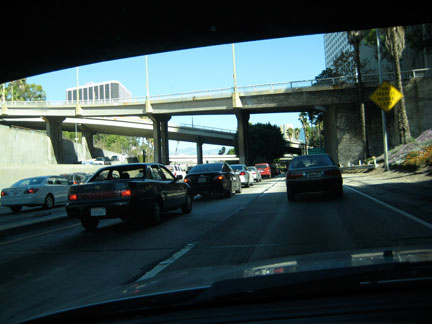
LA. Traffic.

Just got back from Los Angeles, where I de-installed my work at Tarryn Teresa Gallery. A few notes from my mental scrapbook:

mailinvoice

Packing up mailinvoicegetcarsmogged, 2006, plastic and ink on paper, 48 x 66 x 12 inches

Packing tools? I’ll never doubt you again, needle-nose pliers and extension cords! I should expect map pin heads to come clean off by now. I should know better than to rely on the palm sander’s cord. Thankfully, I erred on the side of caution, and it paid off.

NPR and classic rock. Apparently there’s no public radio along the I-5 in Fresno and Merced Counties, or they’re all run by evangelicals. Sans audio books, my substitute of choice was a Bakersfield-based classic rock station. If you could forgive the gratuitous misogyny, you’d discover a playlist spanning Zep, GNR, Def Leppard, Van Halen, Metallica, and Journey. Those bands once inspired repulsion in me, but I think we can all agree now that hair bands made some pretty great pop music. Last week, I heard Thin Lizzy’s “The Boys Are Back in Town” on an early morning grocery run, and it instilled a good mood that lasted hours. So I’m reclaiming this music from the heshers/burnouts/metalheads/bullies who gave it a bad name in high school, and you’re welcome to join me. For those about to rock…

Charles Burchfield, Glory of Spring, 1950, Watercolor on paper. Collection Parrish Art Museum, Southampton, New York. Gift of Mr. and Mrs. Alfred Corning Clark, 1959.6.6. Photo by Gary Mamay. Image source: Hammer Museum


Charles Burchfield at the Hammer Museum. I couldn’t see what Robert Gober, the contemporary hyper-realist sculptor, would see in a mid-century painter of landscapes. The Hammer exhibition, however, is fantastic. It makes clear that Burchfield was vastly under-recognized and portentious. His interest in abstraction, background in Asian-influenced Art Nouveau wallpaper design, experience with social realist pictorialism, and probable mental illness (see Dave Harvey’s great write-up in the LA Weekly) led to an innovative body of paintings that manages to embody countless references (to traditional Chinese scroll painting, Japanese woodcuts, OCD doodling, Cubism, and modern-day fantasy art) while forging a distinct visual language — psychedelic, immersive. I also admire his sheer conviction — after a successful stint as a Regionalist painter, Burchfield wrote in his journal,

“It seems to me, more than ever, imperative that I somehow get these fantasies into finished concrete form even tho there is not sale for them. How we will live, I do not know.”

Burchfield’s final paintings are really tremendous pictures. Some of them are breathtaking. The show is accompanied by extensive notes which provide welcome keys to the artist’s process, thoughts, doubts and motivations.

Nic Hess’ Hammer Project. Pretty great too. Masking tape drawings, a ton of vinyl decals. The placement of imagery in the space was cheeky and unexpected.

Robert Crumb’s Book of Genesis at the Hammer. I always feel the same way after viewing Crumb’s drawings: slightly dirty and tawdry, like I’d stayed at a cheap motel and watched Entertainment Weekly. More of my base self and less of my ideal self. It’s brilliant for Crumb to do a literal interpretation of the first book of the Bible in all its wretched, meaty drama. Of course Crumb can draw like no other, and there’s something vaguely appropriate, like Chick Tracts, to visualize this content in a sensational manner. The curators took pains to point out Crumb’s attempts at historical accuracy in regards to robes and architecture, but his comically zaftig female figures seem excepted from revision.

The historical exhibit at the Japanese American National Museum. I went for the Giant Robot Biennale, but two items from the historical exhibit were like punches to the stomach. First: a small girl’s cape. An internee mother modified a disused Navy peacoat for her daughter. It makes tangible the completely deranged skewing of context (where giving old military coats to forcibly-relocated families is like compassion; where modifying said coat is an act of love and resilience). Second, a massive diorama reified the scope of the internment camp at Manzanar. It was conceived and created by Robert Hasuike, a Mattel Toys model maker. It was effective and, by extrapolation, nightmarish.

Exhibition in Pasadena featuring some high-profile artists from the past 20 years of the institution’s programming. Ambitious show, disappointing reality. Only a few works emerged unscathed from the poor presentation and compromised spaces. I think the less said about this exhibition, the better. So I’ll pose, then, a series of questions:

1. When you’re an artist, and have identified artists you admire who embody rigor, quality, thoughtfulness and professionalism, and you see their work suffer due to poor presentation, how does that make you feel? Do you have similar experiences in your own history so that you can relate to these established artist’s possible regrets? And does this make you hopeful (that you’re not alone) or sad (that even established artists can’t avoid partnerships with presenters who don’t deliver)?

2. Is it the artist’s burden to accept the limitations of a non-commercial presenter? Or is it the artist’s responsibility to push them to expand their capacity and raise the level of exhibition installation and management towards professionalism?

3. When you’re a viewer and your expectations of an exhibition are raised by professionally-produced promotional collateral, who is at fault when the actual show’s installation reads on a lower level of quality, like student-grade?


On Whinging. This post is a bit more critical than usual, but I do grapple with these questions and criticisms wholly. I’m invested—I drove all over LA on a beautiful holiday afternoon and selected a a few shows to focus my attention on. I don’t set out to be critical of these shows—I try to keep an open mind and hope to be surprised for the positive.

Happy Halloween!

halloween

Standard