Art & Development, Community

first set of referents for 2010

Lacey Jane Roberts, Building it Up to Tear it Down, Southern Exposure

Now through February 20, see three solo shows by Genevive Quick, Lacey Jane Roberts and Andy Vogt at Southern Exposure. Quick‘s optical devices constructed from paper and foamcore are phenomenal, pretty, and pretty phenomenal. I’m also looking forward to Mike Lai‘s one-night only performance on February 26. I honestly can’t remember being this excited for Chinese New Year because of art. Lion Dancers, a dance battle, giant fists! If there’s a new year’s cake (buttery mochi baked to a golden brown), I’m gonna freak out.

There’s a Mystery There: Sendak on Sendak is on at the Contemporary Jewish Museum closes January 19. Unfortunately, I went on a weekend and could hardly see a thing. Sendak’s empathy towards children’s emotions and vulnerability, and his fantastic line, color and typography have always been dear to me. It’s a treat to see original drawings on tracing paper, quick dummy mock-ups of books, and photo-ready art — acetate line work over watercolor on paper. Overall, though, Sendak is a hugely prolific artist, and I would have liked to see much more space allotted to the exhibition, some attention to his lettering, and proper screening rooms for the videos. Three videos are online, but many more interviews with Sendak are only viewable on monitors in the gallery with single headsets.

A lot of arts presenters are creating quality interactive content, but very little of it seems to escape the gallery walls. The Tate Channel and partners working with ArtBabble.org are wonderful exceptions. Quality videos featuring artist’s projects and interviews are great resources for art students, and they help the public appreciate contemporary art.

The 75th anniversary exhibition at SFMOMA had a lot of “greatest hits.” Having visited the collection galleries before, I was familiar with many of the works on display. There were some nice surprises: a selection of very elegant modern typewriters and their wonderfully designed poster advertisements, a television show produced by the SFMOMA to help their early audiences appreciate modern art, photographs by Will Rogan documenting “public sculptures” such as a Sainsbury’s bag stuck in a fence, and the gallery on Bay Area Figuration — one of the few places you can see several of David Park’s drippy, barely figurative paintings.

Another pleasant surprise was Jennifer Sonderby’s gorgeous exhibition signage: neat columns of matte black vinyl text, set off from the gallery walls with subtle fields of Tuftesque flat cream. I often wonder why proven conventions in print design (such as columns no wider than 60 characters) are disregarded in exhibition signage. I’m starting to believe that anything less than great visual design in modern or contemporary museums is inexcusable. There’s just too much design talent and typographic sensitivity among mass audiences for graphic design to be compromised.

A less pleasant surprise was the decision to organize a few rooms to honor specific early donors. I get that many museums were founded by philanthropists whose embrace of modern art should be acknowledged, still, when I consider the 20th century, I can’t ignore that wealth and power was often consolidated with the aid of discriminatory gestalts. Art exhibitions are ideological. It may not always be explicit, but curating rooms to honor donors sure makes it apparent.

To date, only the second floor galleries were open. An exhibition of photographs is forthcoming. I’m looking forward to visiting prints by Larry Sultan.

I also had the chance to visit the ICA Boston recently. The building was stunning, so much so that the art inside sometimes paled in comparison.

Damián Ortega: Do It Yourself is a great overview of conceptual strategies: improvisational sculptures made of everyday materials, serializing and re-ordering mural-painted bricks to create chance compositions, photographic taxonomies of building materials, formal examinations of cubes. His installation of an exploded view of a VW Beetle did not disappoint. I was surprised by the striking experience of perception in three dimensions. I also adored an installation of nine looped 16-mm film projections of domino-effect bricks in various wild and semi-inhabited landscapes. But the show also illustrated the risk of making work that doesn’t seek to please: sometimes the sum is underwhelming.

ICA Collection: In the Making confounded me: I thought ICAs are ICAs because they are not museums/collecting institutions. It was also hit-or-miss: I thought a small-sized gallery neutered works by Cornelia Parker and Roni Horn, but the show redeemed itself with transcendent, ethereal installations by Tara Donovan.

I wanted to like Krzysztof Wodiczko’s …Out of Here: The Veteran’s Project, because it’s so rare for contemporary artists to address current political issues. But the installation, which simulated the experience of being in an Iraqi neighborhood that falls into a chaotic combat zone, was loud, cinematic, and manipulative. If its goal was to make me feel vulnerable, it succeeded. But the fact is, I wasn’t actually there; I was in a gallery on the Boston waterfront getting shaken up by digital animations, voice actors reading a script, and sound effect artists having a field day. It was heavy handed, and yet, no more meaningful or revelatory than a video game.

But R.H. Quaytman‘s thoughtful, cheeky exhibition of paintings blurred the lines between painting, printmaking, sculpture and installation. They called into question the narrative inherent in exhibition-making, modernist tropes, museum storage and display, optical effects, and surface treatments and materials. It might have been neurotic painting-about-painting, yet it resulted in a curious, thought-provoking experience that I didn’t wholly understand, but enjoyed nonetheless. Ironically (or perhaps predictably?) Quaytman’s exhibition is part of a series featuring emerging artists. The show gave me hope that there’s still more to explore in contemporary art.

Curious:
The Survival Annex, shop within shoppe
At the Curiosity Shoppe, 855 Valencia Street, San Francisco
Grand opening just past, not sure how long exhibition/shop is on.

Front + Center: Weather Streams
Headlands Center for the Arts, Marin Headlands
Opening Sunday, January 17, 2-5pm
Thru Feb. 28

Ellen Harvey: The Room of Sublime Wallpaper (II)
Art Production Fund LAB
Wooster Street, NYC
Jan. 16 – Feb 20, 2010
Reception: Jan. 16, 5-7pm

Super Diversity – Who Participates Now?
Discussion on the phemomenon of ‘super diversity’ in the visual arts
INIVA, Rivington Place, London
Feb. 2, 2010, 6:30pm

Standard
Research

More art, less story

Louis Menand’s in-depth look at the work of Andy Warhol in the current New Yorker Magazine (January 11, 2010) is stellar.

Warhol is easily one of the 20th century’s most popular artists; it’s too easy to underestimate the influence of his work, and as Menand argues, the philosophy and rigor behind it.

Menand calls conventional understandings of modernism into question, pitting Clement Greenberg against Arthur Danto. He includes some surprises: Pop pre-existed Warhol, our quintessentially American Pop artist had European influences, and the fundamental conceptual differences between the works of Duchamp and Warhol.

Especially when, as V puts it, periodicals are more interested in the story rather than the art, cheers to the New Yorker for their faith in the reader’s intelligence and interest in art history and criticism.

Standard
Research

Criticisms

I think what’s incredible and incredibly maddening about the art world is its openness, its idiosyncrasy, its nebulous criteria. The lines between art, non-art, craft, kitsch, high art and low art, are all blurred—yet, people like what they like and defend their tastes. So be it.

I read art reviews to learn about exhibitions, but I’m always aware of critics’ subjectivity. In fact, my favorite critics, like Holland Cotter of the New York Times and Jerry Saltz of New York Magazine, balance descriptive exposition with opinions and a discussion of praxis—helping viewers see how artists put theory into practice. The feeling I get is that they aren’t writing because they have a deadline to meet, but because they have something they want readers to know.

Some critics, though, are primarily descriptive, revealing their own position only implicitly. I thought this was the modus operandi of East Bay Express staff writer, DeWitt Cheng, so I was surprised to read a recent review:

The comedian/actor Will Rogers once dismissed communism as “one-third practice and two-thirds explanation.” One might similarly criticize a fair amount of contemporary art that is conceptual rather than visual in its orientation, thus requiring some explanation on behalf of viewers. The idea that priorities are askew is especially problematic when the verbiage seems unsupported by the artwork, or inflated.

DeWitt Cheng, “Tangible Modern Art,” East Bay Express, December 23, 2009

I think when critics articulate their positions, it’s fantastic. I’m for transparency in the art world. Having a position explains why critics review some exhibitions or venues and not others. It also suggests to readers and young artists who may not know any better (poor things!), that critics are not objective, do not speak for the art world as a whole, nor are they authorities whose opinions are exempt from questioning.

These institutional structures that we kneel and bow and defer to are not inviolate institutional structures…. They’re not entitled to exist without challenge…. So you have to put yourself in a position where you are capable of knocking them off the position they occupy, because we are not bound to defer to anything that exists. Everything is available for critique—and also displacement….

—From Kerry James Marshall lecture at SFAI (via podcast)

Furthermore, readers would be well advised to seek out multiple critics, including ones of different critical positions. In this case, critics whose interests in visual art extend beyond art with “visual orientations” could make the East Bay contemporary art print journalism more balanced. (Some places to start: Artopic, ArtPractical).

My position is well documented on this blog (the world’s most rambling critical statement?). Another way to sum up my boosterism of art that is not primarily visual in orientation might be articulated in Lee Johnson’s recent interview with Ryan Gander:

LJ: Has your artistic practice i.e. the aesthetic of your work, been effected in any way by the turbulent economy?

RG: Not really, in the beginning I worried about it, but it had no effect. I don’t think the type of collections that buy my work stop collecting, people don’t buy my work for investments, they buy it because they want to own it, share it with others, or take care of it. They are collecting and preserving art history in the making in some way. I guess it would have more effect on artists that make things that sit pretty in people’s homes. The things I make are a bit beyond that, very little of what I make looks good, the things I make are by-products of the idea, so the Collector has to fall in love with the idea, not the thing.

LJ: Your practice draws on multiple layers of fact and fiction, and you work in a variety of different media including photography, printed word, film, performance, intervention and sculpture. Is it vital for your life-force and inspiration that you mix things up in the way you do, and keep surprising people?

RG: Its the nature of art making, it is in fact the only way of making art. I don’t trust anyone who starts everyday knowing they will make ‘a photo’, or only ‘a painting’ to be an artist. Art has to precede craft otherwise it isn’t ‘art’, its ‘the arts’. I love painting, it makes me sincerely happy, but I can’t do it everyday! I am an artist and I have a job to do, and the process of painting doesn’t fit every idea and starting point (in fact very, very few – only really ones that talk about the history of painting itself). I see being a painter, or a photographer in contemporary art like masturbating a bit, just pleasing yourself, really selfishly, but sharing nothing.

“Lee Johnson talks to Ryan Gander at Frieze Art Fair 2009,” White Hot Magazine, November 2009.

Gander makes his position undeniably clear. It seems grounded in a belief shared by many conceptualists: that the art medium has to be appropriate to the idea; that to work in a visual medium because the artist is most interested in its visual orientation, without considering its appropriateness to the idea or content, is conventional and inexcusable, perhaps even willfully ignorant. I don’t include Gander’s comments to knock our dear, much-maligned painter friends and uni-disciplinarian artists, but to help explain that art of a visual orientation, too, is subject to criticism, and can fall short when you consider different criteria.

Finally, two other ideas to explore—to know one’s position as a critic might be to also recognize the limits of one’s subjectivity. I am a young writer, and writing intelligently about work I don’t like or understand is challenging. Further, to take a position as a critic is to identify the work you’d gravitate to, as well as that which would leave you unaffected. But the third kind of art—arguably, the reason we keep looking and writing—is that which surprises you, and challenges your assumptions.

Standard
Art & Development

Getting Excited and Making Things, Part 2

Marketers have been selling “experiences”* for several years now, so it’s cute to read about American consumers turning to free or low-cost experiences. It’s clearly due to the recession, though perhaps popular psychology has made some inroads into mainstream culture as well:

Quietly but noticeably over the past year, Americans have rejiggered their lives to elevate experiences over things. … Psychologists have been saying for years that shared experiences like vacations lead to more long-term happiness than the latest bauble.

Damian Cave, “Americans Doing More, Buying Less, a Poll Finds,” NYTimes.com, January 2, 2010

[*Here’s an example of “experience” marketing gone bad: my head nearly exploded a few days ago, when I sat down at a P.F. Chang’s and our server demonstrated mixing a special sauce out of three condiments, including Chinese mustard. Yuck. That’s like making Thousand Island dressing out of ketchup, mayo and relish, only worse because the diners get a whiff of ethnic experience, and it’s being repeated thousands of times over in franchises around the country. It offended me, and probably would have offended my family.]

Standard
Art & Development

‘Tis the season to get excited and make things

christmas wreath

Ken, my printmaking teacher, used to stock up on canned goods in early December, so he could lay low until the holiday frenzy blew over. I thought it was brilliant. Exposure to Adbusters, anti-consumerist punk ethos and St. Nicholas’ makeover at formative ages made sitting out of Christmas feel cool (and at least a little morally superior).

This year, though, I went for it—and I ended up engaging in the kind of crafty, modest home projects that I think accounts for part of Christmas’ appeal: to get excited and make things, to be creative, to express generosity and gratitude. Projects included stockings (two people can be a family, too!) and preparators’ mini tool aprons for some of the outstanding colleagues I’ve had the pleasure of learning from this year.

stockings

preparators mini work apron

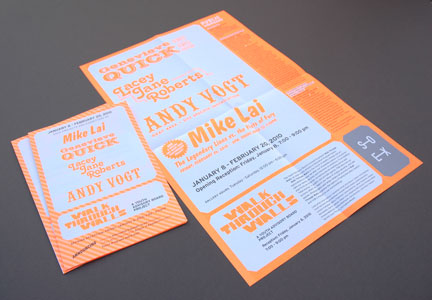
I also finished the poster for Southern Exposure‘s upcoming exhibition, a series of four solo projects by Mike Lai, Genevive Quick, Lacey Jane Roberts and Andy Vogt. I had a great time exploring typography and printing with fluorescent inks in collaboration with SoEx, and am quite pleased with the result. Most importantly, SoEx liked it, and two of the artists have told me they were happy with it as well.

soex poster

Standard
Community, Research

two interviews

I wouldn’t presume to tell the truth. I’m telling my version of the truth, but it’s not the objective version. There is no objective version….

Photography does stop time. It’s an exterior form of memory: This existed. That’s its greatest truth: to leave a trace of what has been.

–Larry Sultan

California photographer and longtime California College for the Arts professor, Larry Sultan passed away last Sunday at age 63. His good humor, probing art practice and generosity is missed by colleagues, students and fans.

Listen to an interview with Larry with on Fresh Air with Terry Gross. It was recorded in 1989.

Why do you want to avoid saying anything concrete?

I’m just not interested in using the position as an artist to dictate anything. I consider myself as one my viewers, and it would be paradoxical to speak simultaneously to myself and others. I like to think that being an artist is neither an entertainer nor a doctor.

What emotion do you most want to inspire most in your viewers?

That’s not a concern, really. I think emotions are too subjective and it’s wasteful to control the viewer. I think it’s more about creating a frequency of tension in the work that connects in different ways to different people.

Über-brain artist Jordan Wolfson as interviewed in “Art, Theory” by Ana Finel Honigman (New Yor Times’ T Magazine, December 9, 2009).

Standard
Community, Research

Art Practical

My review of Primero la Caja, Pablo Guardiola’s solo show at Galería de la Raza, has been published on ArtPractical.com. The current issue, Work(er), includes an interview with David Ireland, a review of the triennial exhibition at the Int’l Center for Photography, and reviews of local shows.

Art Practical is a much-needed site for Bay Area art criticism. It is forged from three grassroots, artist-led initiatives — Shotgun Review, Happenstand, and Talking Cure quarterly — that emerged as direct responses to the Bay Area’s narrow art reportage. Especially after the folding of Artweek magazine, I think Art Practical’s energy, vision and commitment to excellence will be a meaningful presence in the Bay Area art community.

Art Practical welcomes sponsorships and individual donations.

Standard
Art & Development

Two Brothers named Design and Art

To be considered a “serious” artist, there’s pressure to downplay one’s non-art practices — even visual ones like graphic design. Art professionals need to distinguish between dabblers and lifers, but that shouldn’t be hard. It’s perplexing that this dissociation persists.

Consider art since 1960, and the typographic sensitivity of many Conceptualists.

on kawara, lawrence weiner, yoko ono, barbara kruger

So you think you are a typophile? Faces named below.

Consider how aspiring artists and designers learn. My early creative interests were unbounded — drawing horses and floorplans as a kid, making zine collages as a teenager, studying printmaking (AKA graphic arts) in college.

Further, my making skills — whether tinkering, bookmaking, or print and web design — enhance my art capacity, especially now that I’m making text-based installations and producing multiples. It seems obvious that design is a useful skill set for artists; fellow artists and art institutions need graphic design, too.

Good design conveys risk-taking and visual sophistication. For example, Stripe‘s print and signage design for the Wattis and Cinthia Wen’s/Design at Noon’s identity design for YBCA* are innovative, flat-out gorgeous assets.

So I’m excited to have the chance to bring my design skills to a contemporary art context. After a terrific experience creating new work for Southern Exposure‘s Bellwether exhibition, I was invited to design the poster for SoEx’s next show. The alternative arts organization has a history of working with award-winning designers like McFadden & Thorpe and Post Tool, so I earnestly accepted. The poster will be arriving in mailboxes and shop windows in the coming weeks. You can’t miss it.

In the meantime, worlds (art and killer typography) collide: Emigré is having a show at Gallery 16.

EMIGRE at Gallery 16
December 18 – January 29, 2010
Opening reception on Friday December 18 from 6 – 9pm

Emigre, Inc. is a digital type foundry in Berkeley, whose magazines were an inspiration since year zero B.M. (Before Macintosh). You can bet that there will be gorgeous posters, publications and, quite possibly, some hand-thrown pots. Because designers can be artists too.

An outro in the rock ballad of this blog post:

I’m not so idealistic as to pretend that there aren’t differences between being a graphic designer and being an artist. Last week when M, a workaholic early-bird designer, started staying up late to obsessively photograph his design portfolio, I told him that he’s becoming an artist. His response:

“Noooooooooooooooooo!”


(*Disclosure: Occasionally I work at the Wattis and YBCA doing design/vinyl/preparator work.)

Avant Garde Medium, DIN Cond Bold, American Typewriter, Futura Bold Oblique

Standard