Art & Development, Travelogue

Breathe Residency: Reflections

Flowers bloom in a distant field. On the rail from MCR to LDN, journal resting open, collecting my thoughts after three months of living in England.

Flowers bloom in a distant field. On the rail from MCR to LDN, journal resting open, collecting my thoughts after three months of living in England.

Last week, the Breathe Residency concluded. I de-installed the works from the Open Studio, packed my bags, boarded a train for a weekend in London, and cried when I saw the farm fields covered in yellow flowers. It was May; I had been in Manchester for three months. My time was filled with travel, meeting people and so much generosity.

I’ve documented my development as an artist on my website. Read Everyday Ambition, Forays into Optimism and Pessimism.

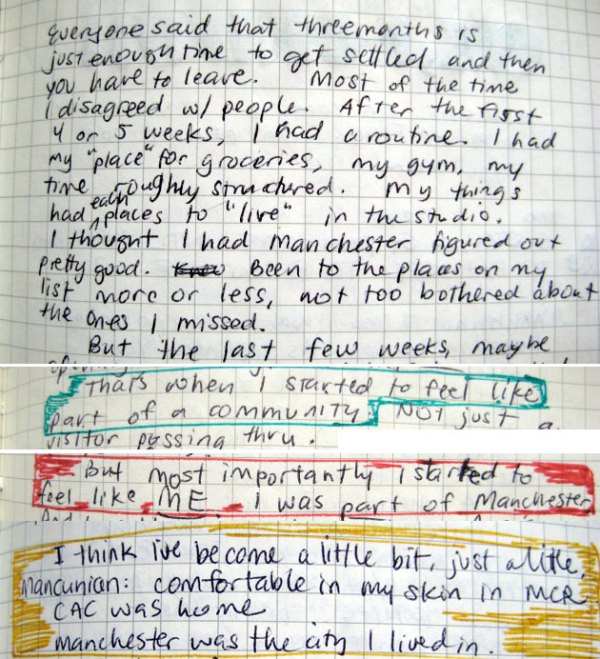
But the experience was intensely personal and emotional too. I think the most honest way of sharing my post-residency thoughts would be to post a few passages from my journal, below.

feeling in between past and future, manchester and london. where am i? macclesfield? midlands? too much in my head. i have to do some writing so i don't take breathe for granted, so i don't forget this feeling of love and generosity and goodness and integrity that i've been fortunate enough to enjoy in manchester. remain grateful. preserve the memory of this feeling as a source of happiness.

everyone said that three monthis is just enough time to get settled and then you have to leave. most of the time i disagreed with people. after the first 4 or 5 weeks, i had a routine. i had a place for my groceries, my gym, my time roughly structured. my things had each places to live in the studio. i thought i had manchester figured out pretty good. been to the places on my list more or less, nont too bothered about the onces i missed. but the last fee weeks, maybe... that's when i started to feel like part of a community, not just a visitor passing through... but most importantly i started to feel like me. i was aprt of manchester. i think i've become a ilttle bit, just a little, mancunian: comfortable in my skin in MCR. CAC was my home. Manchester was the city i lived in.

profoundly grateful. i'm a different person. three months older. maybe a modest step in becoming a better artist. but i hope i am a better person after all the benificence i've received. gratitude for kindness, hospitality, generosity. for new friends.

Standard
Art & Development, Community, Travelogue

The Art Community in Manchester: All Right! Part 2

I’ve said it before, but I’ll say it again — I really appreciate the artist’s community here in Manchester. In the past week, I’ve put the finishing touches on my open studio, relied on the support of staff, acquaintances and new friends, and felt extremely humbled that my work is being engaged by so many smart and curious artists and art enthusiasts here. Despite my generalizations about the Manc temperament, so many artists have demonstrated generosity, enthusiasm, interest, as well as a commitment to excellence… It’s really something!

Reception at Chinese Arts Centre

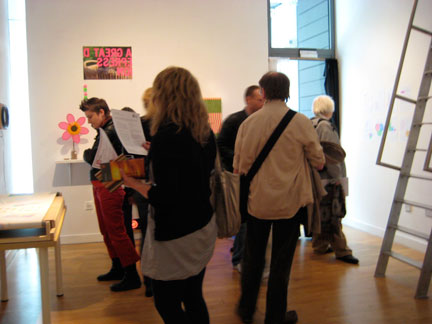
Visitors look at my work in the residency studio/gallery.

Visitors look at my work in the residency studio/gallery.

Last Thursday’s Open Studio reception at the Chinese Arts Centre went great! It was terrifically organized and very well-attended. I appreciated the format: Before the galleries were opened, attendees gathered round in the shop, where Sally Lai (CAC CEO) and Yink Kwok (CAC curator) introduced myself and Ed Pien, the fantastic installation artist whose solo show is now on in CAC’s gallery. We both had a chance to speak and invite guests to ask us questions, which I think really helped people engage me, my work, and the organization. It’s a smart format.

Detail from a series of drawings on display at the Open Studio. Christine Wong Yap, 2009, glitter pen on gridded A4 paper. Text: Happiness, pleasure, absence of displeasure, satisfaction. Inspired by Paul Martin's "Sex, Death and Chocolate: The Science of Pleasure," London: Fourth Estate (2008)

Detail from a series of drawings on display at the Open Studio. Christine Wong Yap, 2009, glitter pen on gridded A4 paper. Text: Happiness, pleasure, absence of displeasure, satisfaction. Inspired by Paul Martin, Sex, Death and Chocolate: The Science of Pleasure, 2008.

CAC did a bang-on job, making the galleries look fantastic, and hosting a wonderful party. There was a post-reception gathering at Apotheca, the gorgeous lounge/bar across the street. Apotheca has demonstrated generous support for CAC and other local art events; it’s really great to see a private business so involved in the local community.

My "Sorted" badges for sale at the CAC front desk, with a special reception offer; Regular price: £10/$15.

My Sorted badges for sale at the CAC front desk, with a special reception offer.

I had heard that Chinese Arts Centre’s known for putting on strong previews, and this one did not disappoint. The turnout was amazing (interestingly, many people were not fashionably late — maybe 50 people arrived within the first half hour? But the flow of people throughout the evening seemed continuous). It was also really nice that some of the local MA students stopped by, even though the closing of their show at the Triangle was concurrent. I felt really happy to hear Stephen Ashdown’s comment about my commemorative badge:

SORTED is a first-rate emblem of Manchester pride!

Ed Pien Lecture at Whitworth Gallery

Ed Pien presents a slide lecture at the Whitworth Art Gallery, Manchester.

Ed Pien presents a slide lecture at the Whitworth Art Gallery, Manchester.

Ed’s show at CAC is a finely tuned installation of netting, video, sound and mirrors. It’s dark, kinetic, immersive, and deeply affective. Ed talked about his work in a Tuesday Talk at the Whitworth and I really enjoyed hearing about his arc — his past drawings, paper cuts and installations seem to truly lead to his current installation.

I especially enjoyed hearing about an installation comprised of dozens of two-layer drawings of ghosts: the top layer was on a lightweight, semi-transparent paper, which floated upward revealing the lower layer when viewers triggered a motion sensor. Brilliant!

Dinner at Islington Mill

Islington Mill is super cool. I knew it as a building converted to artists’ studios, rehearsal space for bands like The Ting Tings, the site of an experimental art academy, free library, gallery and performance venue. If that’s not enough the proprietors, Bill and Maury, are starting a B&B. And, if that too is not enough, they’re also starting a series of artists’ dinners, in which artists or curators create an art and dining experience for about 25 people.

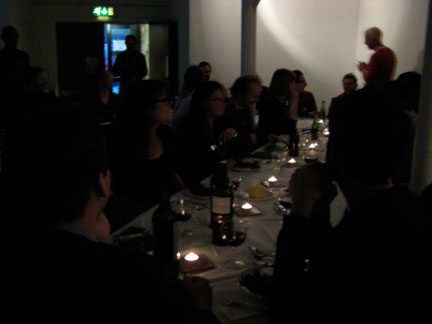
Ed and Johannes' dinner at Islington Mill

Ed and Johannes' dinner at Islington Mill

Ed Pien and Johannes Zits served an artists’ meal last night. I helped out because cooking is rad: teamwork, collaboration, being in the zone, etc. Ed and Johannes presented a carefully crafted menu that was in dialogue with a series of videos of their past performance work. For example, the salad’s baked goat cheese mirrored the moon in Ed’s animation of dancing silhouettes. The Greek goat stew went along with Johannes’ performance with a goat. The food was very high quality, and the artists, arts presenters and arts supporters in attendance made a beautiful cross-section of the Manchester arts scene. It was all sort of made possible with the hard work and vision of Bill and Maury (Maury’s out of town so Bill had to do everything from setting up tables to mounting the projector to serving the beer and making coffee.). These guys are the indefatigable cornerstones of the community here — I really admire that they can achieve so much, and still seem like friendly, relaxed people to boot.

I felt really privileged to be part of it — to squeeze in this happy experience before I left, and to feel like there’s so much more potential collaboration and goodness here that I have to come back.

Standard
Art & Development, News, Travelogue

sorted: a new artist’s multiple

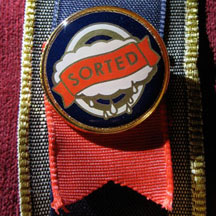
Christine Wong Yap, Sorted, 2009, limited edition of 50 enamel and gilt badges, 1 inch diameter.

Christine Wong Yap, Sorted, 2009, limited edition of 50 enamel and gilt badges, 1 inch diameter.

SORTED
A Limited Edition of 50 Gilt and Enamel Pin Badges

breathe_33b

Inspired by British commemoratives, the badge depicts a banner over a rain cloud, which is obscuring a drab rainbow. These symbols suggest the coexistence of gloomy outlooks and vibrant attitudes.

The limited-edition badge is the result of a study of Mancunian slang, temperament and weather. The artist noticed Mancunian inventiveness in the expressions of displeasure, as well as the tendency to downplay enthusiasm.

The artist also observed that the weather is valued as a source of comiseration. Perhaps Mancs employ defensive pessimism, wherein low expectations are more likely to be pleasantly surpassed.

£10 / $15.

Come to the Chinese Arts Centre reception on 23 April to receive a special discounted price of only £7.

Residents of the USA can email me at cwy (at) christinewongyap.com to reserve your badge.

Standard
Art & Development, Community, Research, Travelogue

Bits and Bobs

Detail from a drawing/sculpture in progress.

Detail from a drawing/sculpture in progress.

Cheap and cheerful

Here in Manchester, there’s a saying, cheap and cheerful. It means what it sounds like. For example, This and That is a tasty curry house that offers three items for £4.20; it’s praised as epitomizing cheap and cheerful.

I like the phrase because:

  • It’s thoroughly appreciative, even though Mancs can seem totally unsentimental.
  • It’s characteristic of something local: As Stuart Maconie put it in Pies and Prejudice,

    …many of the north’s market and mill towns … have become shrine[s] devoted to binge drinking and discount shopping.*

    Within a half-mile radius, there are three pound stores–Poundland, Pound World and Pound Empire, whose business name, confusingly, is Pound Kingdom–and one Quality Save.

  • It reminds me of a Chinese expression, which is nearly identical (literally, “has attractiveness, has cheapness”). For my ultra-frugal immigrant parents, no higher compliment could be paid.

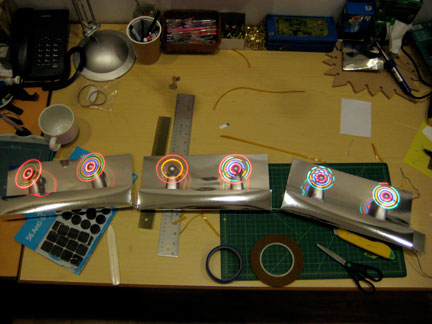
I’m about four days away from the Open Studio reception (Thursday, April 23, 5:30-7:30 pm, Chinese Arts Centre), so I’ve been working hard to finish several projects. Some are inspired by cheap and cheerful, so I’m making use of knickknacks from pound shops, like fans with multi-colored LEDs. Here’s a studio shot of the fans wired together to run on grid power instead of batteries, something I learned from this Instructables page.

Studio view

Studio view

Dan Graham, Tate Podcasts

Though I missed Dan Graham’s speaking engagements in the SF Bay Area this spring, I got his podcast lecture from the Tate. I enjoyed his talk, even without the pictures; he’s whip-smart, brisk, and completely free of affectation. For someone to have shown in as many Biennales and Documentas as he has, it’s very refreshing to hear him say in the same even, ego-less tone, that the Queen of Norway commissioned him to make a pavilion, so he made one on a fjord, it’s quite popular, and it’s referred to as a shower stall. Asides like this, from most other artists, would come across as false modesty.

Projections!

Preparing for T.S. Beall's artist's talk at Islington Mill

Preparing for T.S. Beall's artist's talk at Islington Mill

I enjoyed meeting Tara Beall, the artist in residence at Islington Mill, whose work is a fascinating combination of Arte Povera, webcam-sourced-video, boundaries, interstitial spaces, architecture, and installations that are a hybrid of kinetic art and video projections.

Her work seems in dialogue with the work of Ed Pien, whose new show at the Chinese Arts Centre is being installed right now. I’ve been getting sneak peeks of it — mirrors, projectors, cut paper, and macramé on the scale of architecture — and I think it’s going to be phenomenal!


*To be fair, Maconie also wrote, “Like [Manchester] at its best, [The Smiths] had glamor and gloom, winsomeness and wit; they were magical and proletariat all at once.”

Standard
Art & Development, Research, Travelogue

Mancunian slang and temperments

Mancunian Slang Adjective Flash Drawings: Stroppy, Naff, Scally, Grotty, Mardy Ink on six ready-made fluorescent yellow die-cut papers 12 x 7.5 inches each; 37 x 50 inches assembled. Produced during the Breathe Residency at Chinese Arts Centre

Mancunian Slang Adjective Flash Drawings: Stroppy, Naff, Scally, Grotty, Mardy Ink on six ready-made fluorescent yellow die-cut papers 12 x 7.5 inches each; 37 x 50 inches assembled

One of the things I’ve been researching during the Breathe Residency is Mancunian slang and temperaments. (Mancunian means of Manchester, for you Yanks). Manchester is known as a rainy post-industrial city, but I’ve found its emphasis on cultural life and development to be very forward-looking. It’s sort of like an English Detriot or Oakland–perpetually stuck between an unrecoverable past and a difficult-to-realize future, but with glimpses of hope all around.

The first thing I noticed about Manchester is the accent–broad, flat vowels, and the way words like “early” (“arr-lah”) feel flipped around to me. The next thing I noticed is the colorful slang.

I did some drawings that attempted to quantify the Mancunian temperment by taxonomizing the slang words that I heard by chance. In other words, I noticed that there were more slang words to describe displeasure, than there were to describe pleasure.

Above, an initial early version of the project. For the benefit of my fellow Americans, here’s a run-down:

Stroppy and mardy are both unpleasant characteristics, sort of irritable, uncommunicative, whiny. Many Brits are surprised that Americans don’t use the word stroppy. Maybe in an Anne of Green Gables book, but not in Oakland.

Naff means not good. Janky might be a good American corollary.

Scally means chav, a young Briton who’s adopted American hip-hop style, generally regarded as tacky, trashy, low-life. They are usually described as wearing trackie bottoms (track suit pants), flat caps (baseball hats), trainers (sneakers) and Burberry hats, though I haven’t seen any Burberry hats in Manchester. There are connotations of class, Northerner-ness (city mouse v. country mouse?), and probably racial ones, too, but I don’t know enough about it.

Grotty means dingy. It’s also used like the American slang adjective, ghetto.

Another word I heard was wanky, which is just a short way of saying like a wanker.

I only heard a few slang words that were positive:

Chuffed means enthusiastic, e.g., “I’m not too chuffed about it myself.”

As in America, Wicked means cool, e.g., “Hey, I’ve got an open studio coming up.” [Hands over a postcard.] “Wicked.” I’ve only heard it once or twice, which I attribute to a reluctance to express unbridled enthusiasm.

Sorted means sorted out, e.g., “Have you got it sorted?” or “Did you eat?” “Yeah, we went to Pizza Hut. Sorted.”

One more phrase is necessary to round out this list.

All right is the typically lukewarm, understated Mancunian way of expressing approval or appreciation. It can mean anything from OK to great. E.g., a Mancunian could enjoy an event, and describe it as “all right.”

This is in contrast with the American usage, which expresses neutrality or can even be a euphemism for bring underwhelmed, e.g., “How was ‘Marley and Me’?” “It was all right.” “Hm, didn’t really do it for you, huh?”

—–

The Manc temperment is partly explained by the Northern identity. In England, a North-South divide signifies cultural differences as well as disparate levels of prosperity and health indicators.

For those interested in learning more about the north of England, I’d recommend these starting points:

Stuart Maconie’s Pies and Prejudice: In Search of the Great North, which I blogged about before.

Time Shift – Series 8 – The North-South Divide, an interesting hour-long BBC documentary.

HearManchester.com, which I also mentioned in a previous blog

Zeitgeist, a Salford University-produced arts and entertainment TV program. Watch past episodes online.

Standard
Art & Development, Travelogue

State of the Art: New York at Urbis

Tonight, Urbis unveiled State of the Art: New York, an exhibition featuring 16 “emerging”* contemporary artists or artists groups from New York City. The contributions are very high quality, conceptually tight and eminently desirable. With bright lights and flashing colors, the space pulsates with energy. There are videos to watch, installations to circumambulate, and opportunities for interactivity. The show inspired optimistic feelings within minutes…

Bruce

Bruce High Quality Foundation, The Rite of Spring

I noticed two themes. First, there seemed to be an attraction to work demonstrating “New York-ness.” Among the site-specific works were The Bruce High Quality Foundation’s The Rite of Spring, a series of photos and a video re-enacting the “Beaux-Arts Ball in 1931, where the giants of Modernist architecture dressed as the landmarks they created.” Think cardboard costumes and tights, like on Broadway or Conan O’Brien. Lovable, but as N.M. might say, “I get it. You’re quirky.” Another only-in-New-York project is a proposal for a thermodynamic stove powered by steam vents in the streets, by Forays (Geraldine Juarez & Adam Bobette). Of course, they cooked a hot dog. Resourceful, yes; palatable, not so much. Plus, I’m not sure that heating up a hot dog counts as “cooking.” Two other projects employ New York cultural phenomena—neighborhood gossips and hip-hop bling—but more on those later.

Gavan

Installation by Gandalf Gavan

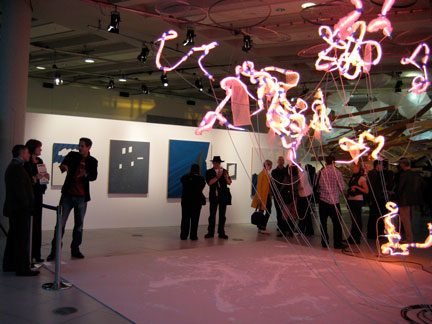
Second, a lot of the work was explicitly post-modernist—directly referencing art and culture of the 20th century. This trend seems like it’s gone from interesting to nearly ubiquitous (and might soon verge on passé). Gandalf Gavan re-interprets Pollack’s drips in neon. He makes gestural concepts like “movement” and “energy” material, in squiggles of light and plaster splashes on the floor. It’s sort of garish and tacky, and flirts a little with corporate lobby light pieces and 1980s new wave decorating motifs. What differentiates Gavan’s work is its precariousness, matter-of-fact presentation of hardware and materials (such as the blue painter’s tape and bubble wrap), and, of course, references to aesthetic discourse.

Winter

Joe Winter’s Printershake/Earthquake, detail

Another work that seemed acutely aware of art history is Joe Winter’s Printershake/Earthquake project. It’s a new spin on action art and chance procedures in image making. He presented five prints (cyan, magenta, yellow, black, full color) and a b/w action photo of someone shaking a consumer-grade printer as it was printing. The display was straightforward, and the prints were surprising. There was also a performance by Matthew Lutz-Kinoy, whose musical, fashion and facial hair styles channeled Freddy Mercury. Why is it that when I see inscrutable performance art, I always feel like people want to re-create Soho in the 1980s?

Salas

Carolyn Salas and Adam Parker Smith, Holy Ghost

But the show wasn’t limited to these themes. When you first enter the space, your vantage is filled with a massive, spectacular fabric installation. Carolyn Salas & Adam Parker Smith’s Holy Ghost depicts a giant head of Jesus, in all its all guts and glory, in the midst of a tornado of lumber and human bones. It’s all made from fabric—even the firring strips and 2×4”s are covered in wood-grain-printed fabric—making the menacing supernatural weather event seem, conflictingly, cuddly.

LoVid's Network

LoVid, Network

Behind Holy Ghost, a digital projection of colorful static draws in viewers with its flashes and sizzles. It’s the contribution by LoVid (Tali Hinkis & Kyle Lapidus). NetWork is an interactive installation combining weaving and digital technology. By handling some fingerless-glove-like wire apparatus attached to a bird’s nest of electrical leads, participants can influence the colors and patterns of the projections. Visitors can also help weave a screen of electrical wires, to fill the space inhabited by the projection. NetWork makes high-tech low. It’s colorful and friendly, and sweetly reminds me of experimentation in the 1970s, and places like the Exploratorium. On the other hand, I found the interface to be haphazard. The instructions were singed into wood cut-outs that seemed visually, materially and conceptually incongruous. From a design standpoint, a call to action should be as clear as possible. Still, LoVid’s take on the intersection of old and new technologies is smart and pleasing.

eTeam's Second Life Dumpster

eTeam's Second Life Dumpster

A lot of people think contemporary art looks likes piles of junk, so for that reason alone, I like the pile of junk contributed by eTeam (Hajoe Moderegger & Franziska Lamprecht) in Second Life Dumpster. It’s the contents of a Dumpster in Second Life materialized with “First Life” counterparts. I had hoped the garbage from Second Life would look crappier—maybe covered in poorly rendered texture patterns, perhaps. I think there’s supposed to be a commentary about waste and obsolescence somewhere, but there’s also the irony that the objects were not disposed, but were re-purposed / recycled, at least for the duration of the exhibition. It’s sort of like tinkering with the past, and re-writing the future…

Tamy Ben-Tor does Engrish

Tamy Ben-Tor does Engrish

In her videos, Tamy Ben-Tor presents monologues as different archetypal characters (artist, art critic, etc.). My experience with them was one of uncomfortable self-consciousness, especially when she took the role of an artist with a thick Japanese accent and ridiculous glasses. The racial politics are so complicated—it’s a progressive thing, I suppose, that her range of exaggerated characters includes non-whites.

In Bonchinches / The Gossips, vignette videos by Michael Paul Britto, a series of New York women of color talk to, shout at, and mumble about off-screen passersby from a window. The framing (sorry about the pun) device is familiar and comedic, sort of Sesame Street, 227 and countless plays all at once. The actors nail the New Yorker characters spot-on, with fearsome nails, unrepentant bossiness and unveiled verbal aggression. Their loquaciousness is an art form. But I wonder about the reception of this work, and who its audience is. For New Yorkers, they may respond simply with recognition: “Yo, that’s my Tia!” But I wonder if Mancs can understand the accents and slang, and how they interpret the no-holds-barred mannerisms. Do they know that New Yorkers’ bad reputations belie some of the friendliest, nicest people in the world? That there’s more to these women than tough exteriors?

Leon Reid IV's True Yank

Leon Reid IV's True Yank

In the intervention True Yank, Leon Reid IV “blings” a statue of Lincoln in Manchester. The little-known history of the statue (having to do with the loss of tens of thousands of mill workers’ jobs due to an embargo on Southern cotton during the American Civil War) is really interesting. In comparison, the art project seems like little more than a prank, an irreverent gesture. In a video statement, the artist cited three motivations behind the work: to bring attention to the sculpture, to spark curiosity about Lincoln, and to “have a laugh.” I had expected more critical thinking—maybe around issues of appropriation, like the appropriation of hip-hop (read: black) style by white chavs? Or “bling” and materialism? Or the human costs of gold mining? Nope, just a non-committal stance behind satire…

Also in the exhibition: Kenneth Tin-Kin Hung’s completely bonkers, bombastic kitsch animations; Shelter Serra’s reduced-scale Styrofoam Hummer (see Andrew Junge’s actual-sized Styrofoam Hummer!); Graham Anderson’s formal yet cheeky paintings; Jennie C. Jones’s cassette tape obsolescence art; and Michael Schall’s meticulous drawings and prints.

*Urbis is pretty loose with this. Some of the artists are in their 40s and have quite extensive, international exhibition histories.

Standard
Art & Development, Community, Travelogue

Great Northern Art

AKA, “My Art Highlights from Birmingham, Liverpool, Stoke-on-Trent, Manchester and Leeds.”
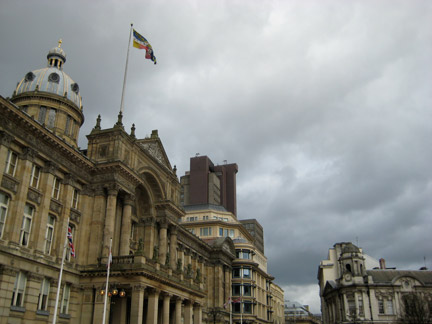
Grey clouds in Birmingham, UK

Grey clouds in Birmingham, UK

The Chinese Arts Centre offers a travel stipend for Breathe artists-in-residence to conduct research within the U.K. Earlier, I attended the Fly Eric symposium in Barrow, and the Global Modernities symposium in London. This past weekend, I, along with the good-humored traveler N.M., sought out contemporary art in Birmingham, Liverpool and Leeds. The skies were grey and misting, and clocks would not cooperate with us, but we pushed onwards and we were rewarded with some gems among these Northern industrial cities.

Birmingham & Stoke-on-Trent

I’ve heard that just as cars represent freedom to Americans, the rails are a symbol of escape for the British. I can see why: On the train to Birmingham, I found a quiet car, opened a good book, and felt that my modest expectations—passing scenery and a period of uninterrupted time to think—were all fulfilled. I was flooded with a sense of contentment.

Since I visited Annette Messenger’s exhibition at the Hayward Gallery in London, I’ve been thinking about her premise that one cannot talk about happiness without clichés. It’s a maxim I find both truthful and discouraging, so unexpected contentment, in its minor way, is somewhat miraculous.
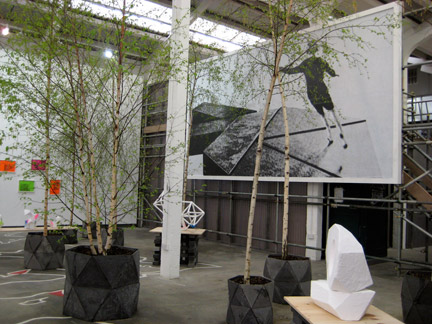
Simon and Tom Bloor's exhibition at Eastside Projects

Simon and Tom Bloor's exhibition at Eastside Projects

Contemporary art can require a sense of adventure—sometimes quite literally. On the quest for it, you will find yourself on the ‘wrong’ side of the tracks in strange cities, seeking out alternative art spaces with little to no signage, and having faith that the artwork will be cutting edge and worth the effort. Such was the case with Eastside Projects. Nestled between junkyards and auto shops, this artist-led gallery is a spacious, high-ceilinged warehouse showing top-notch contemporary projects. It’s keen on conceptualism and new media (it features a semi-permanent Lawrence Weiner text work and a large video screening room, and the office is housed in an absurdly impractical structure made by artists). The current exhibit, Simon and Tom Bloor’s “As Long As It Takes,” is visually attractive, conceptually rigorous, and cunningly specific to Birmingham. The twins present new sculptures, watercolors, drawings, a billboard and a limited edition print around the history of local modernist public sculptures. The shapes of the geometric models are strangely familiar—one recalls the structure in San Francisco’s Justin Herman Plaza. Like Aaron Curry, the Bloors use spray paint to defile Modernist purity. But a series of hand-painted watercolors, reproducing satirical newspaper cartoons complete with halftone dots, makes clear that the process of appropriation transforms the originals. Here’s what I mean: “high” modernist sculptures were parodied in a “low” editorial art from, which the Bloors re-made as “high” conceptual art. Brilliant! I really enjoyed the show, as well as Eastside Projects’ founder’s eclectic publications, including a series responding to R. Buckminster Fuller’s 40 Strategic Questions.

Armando Andrade Tudela. Untitled (Rattan 4), 2009, Rattan, metal, wood, Installation view, Ikon Gallery, 2009, Photo: Stuart Whipps
Armando Andrade Tudela. Untitled (Rattan 4), 2009, Rattan, metal, wood, Installation view, Ikon Gallery, 2009, Photo: Stuart Whipps.
Source: IKON Gallery.

In the sunny side of town, IKON Gallery is an ICA in a converted cathedral, and it had the rare distinction (for this part of the U.K., anyway) of showing projects by three international artists. I was most impressed with the work of Armando Andrade Tudela, a Peruvian video/sculpture/installation artist. I really liked his installation involving only a sheet of survival-blanket mylar pinned to the wall by an industrial sheet of glass. It created two overlaid reflections: the glass offered a barely perceptible, but undistorted, reflection; the mylar, a picture of a fractured self. It made me think of Dan Graham’s use of sheet glass as a metonym for corporate power. This wasn’t Tudela’s expressed intention, but I noticed that other works, including walls skinned with pegboard, and woven works that were equal parts baskets and paintings, played with moiré patterns and perceptions too.

Also at the IKON, Manthia Diawara presented “Maison Tropicale,” a documentary video airing the perspectives of the former owners of Modernist prototype homes, which were later purchased by Ângela Ferreira for an exhibition at the Venice Biennale and re-sold at much higher prices. I found the story captivating, though the art and post-colonial politics were a mess, underscoring that there are no easy solutions, but an excess of guilt to go around.

Stoke-on-Trent

Richard T. Walker's   it’s hard to find you because i can’t quite see what you mean to me.  2009

Richard T. Walker's it’s hard to find you because i can’t quite see what you mean to me. 2009

Just before my residency, I was so busy I missed “Trying to Cope with Things that Aren’t Human (Part One)” at David Cunningham Projects in San Francisco. Luckily, the curator, Ian Brown, is based in this part of England, and brought the exhibition to Stoke-on-Trent’s airspace gallery. Richard T. Walker’s slide show of waving “hi” and “bye” to the sun is endearing. In the back room, two identical glass spheres are topped with polar caps that are revealed inside as icebergs.

Liverpool

Markus Hansen's Other People's Feelings, Courtesy of VirgilGallery.com
Markus Hansen’s Other People’s Feelings. Source: VirgilGallery.com

“Until it Hurts”, a four-person exhibition at Open Eye Gallery, is organized around the mutability of identity, a theme in photography that can seem exhausted or obvious. Thankfully, two particular works in the show are precise and effective. Josh Weinstein’s video, “Cross Examination” (2005), is a quirky, feel-good documentary of strangers on the streets of New York hazarding guesses about the artist based on his, how do you say, humble appearance. The responses are weird, wonderful, presumptive and sometimes rude, but the artist maintains a disarming smile throughout. The effect is that viewers learn very little about the artist (except, maybe, that he’s enormously self-composed, and his art is rather generous), and a lot about the assumptions of others. Markus Hansen‘s “Other People’s Feelings” (2000-5) sequences pairs self-portraits with headshots of others as a video. In each self-portrait, the artist mimics the other people. It’s enchanting to compare and contrast Hansen’s feat of emoting, acting and photographing.

David Osbaldeston's Your Answer is Mine, 2006. Source: MattsGallery.org
David Osbaldeston’s Your Answer is Mine, 2006. Source: MattsGallery.org

In 4×4 at the Bluecoat, David Osbaldeston presents a text-based billboard in mixed media, combining intaglio with digital reproduction, 19th century letterpress style with 21st century hand-done graphic design, and critical theory with vaguely subjective pie charts. The billboard’s lack of color, but richness of grey, is startling. Its paradoxes engage.

N.M. and I also stopped at the Tate Liverpool (Melanie Smith’s painting/video/installation in the DLA Piper show is still fantastic, as are William Blake’s bookplates) and the International Slavery Museum, which takes a frank look at how English slave traders and industrialists participated in and profited from slavery in the American South like cotton and sugar. (A U.S. National Slavery Museum, long overdue, is being constructed in Fredricksberg, VA, by the way.)

Manchester

“Small world.”

I am always surprised—though I shouldn’t be —when I come across references to the San Francisco Bay Area here in Manchester. For example, by chance, I read a book in Birmingham in which the narrator attends a lecture at CCA. And the traveling exhibition on Emory Douglas, Minister of Culture for the Black Panther Party, is now at URBIS, just a few blocks from the Chinese Arts Centre. I met Emory in Oakland years ago. I never would have put “Emory Douglas” and “Manchester” together. Luckily, someone at URBIS did. The quality of the exhibition is phenomenal, and Mancs should take note.

The whole exhibition—art, graphics, displays, historical context, and multiple voices and personalities—makes for a vibrant, thorough, interactive experience. I was happy to see lots of visitors taking their time absorbing the show, which in turns inspires shock, rage, pride, admiration, outrage, grief, and gratitude.

At Cornerhouse, I watched 24 Hour Party People, a movie about the early nineties Madchester music scene. I loved every minute of it. It’s the story of Tony Wilson—impresario, BBC personality and music promoter. He is portrayed with searing wit, a touch of madness, egomania, and an unflappably stiff upper lip. When he breaks the “fourth wall” of the film, it doesn’t make you feel like he’s over-explaining the narrative, but somehow helps to speed it up; aware, as brilliance is, of the fleeting nature of good times.

Leeds

Perhaps my art tolerance was starting to flag, but Leeds bore the brunt of a more intensely critical eye. Asta Gröting’s exhibition at Henry Moore Institute was pretty good, even if I felt mostly pushed away by the hermetic sculptures, which varied wildly from spooky kinetic hemispheres around office chairs, to brass “potatoes” in chiseled angles, to an oversized clod of earth with no discernible referent, to a silicon cast of intercourse, to a Mona Hatoum-like beaded cage. I couldn’t sew it all together; the works seemed completely discrete in form, content, concerns. The only thing I could make sense of is the fact that Gröting was a student of Joseph Beuys; this may be stereotypical, but I find some meaning in the fact of her German-ness, as I’ve felt similarly—locked out of deadly-serious Art with a sense of mirthless laughter—about Martin Kippenberger’s work too.

Keith Arnatt, from Self-Burial in 9 photographs, courtesy MediaArtNet.org
Keith Arnatt, from Self-Burial in 9 photographs. Source: MediaArtNet.org

Upstairs, the work of Keith Arnatt, an early adopter of American Minimalism, Conceptualism and Performance Art in Britain, is represented with a modest selection of black-and-white photographs, a text work, and a series of color sketches of geometric sculptures. I liked the photograph documenting a cubic hole in the earth lined with mirrors. Very simple stuff that any art student today might come up with, but at the time it was on the pulse of a movement, or two. I also liked “Self-Burial in 9 Stages,” a series of photographs documenting, well, the artist burying himself standing up, until only a patch of wavy hair is visible in the newly-turned earth. It really resonated with my recent thoughts about the dissolution of self in installations like Gregor Schneider’s Kinderzimmer (see Claire Bishop’s Installation Art, Tate, 2005), or the dissolution of the artist as in Josh Weinstein’s video at Open Eye Gallery, or the implicit denial in Chu Yun’s work (see Philip Tinari’s profile in the March Artforum, or this year’s Venice Biennale, whichever is handier). Incidentally, the trooper N.M. had a complimentary experience, engaging the drawings and passing more quickly over the photographs. Admittedly, given the chronological distance, the photos lack urgency, and while I’m usually not bothered by a gallery’s white-cube-ness, the presence of earthworks by way of only photos made the gallery seem especially sterile.

At the Leeds Art Gallery, I was intrigued by Shahin Afrassiabi’s installation, “Jalousie Gelocht, Als Blend Schultz” (2003), which is comprised of mundane objects like a television with nothing in particular onscreen, a roll of wallpaper, a table, a lamp, a funny blue geometric painting, etc. It was memorable because the TV emitted a brief, cheerful instrumental song. The pleasure was surprising, because I find that many installation artists create theatrical tableaux that rely too heavily on a “reading” of pathos to be meaningful.

I also enjoyed Angela Bulloch’s cubic sculpture, “Extra Time 8:5,” which was reminiscent of both Minimalism and sort of also a TV set. Furthering this mimesis is the fact that the single-pixel screen changed colors according to a BBC program.

Standard
Art & Development, Travelogue

hello staunch supporters of classical beauty

In a previous post, I mentioned the idea that “the great thing about history is that things disappear.” I used it in the context of looking forward to a future in which my art is no longer confined to a post-Minimal or post-Conceptual understanding.

But the idea is also a useful for discussing very basic questions of taste in art. I’ve noticed that there is a particularly argumentative population that finds contemporary, and even modern, art abominable. You can find them leaving comments on contemporary arts coverage in mainstream newspapers. Often, the comments have nothing to do with the artist, art or angle of the story. Rather, the authors seem intent on complaining about how the 20th century or Duchamp (single-handedly) ruined art. These authors often valorize classical art (often made by white men for elites). In their opinion, nothing can or ever will surpass classical realism, or even provide a worthwhile artistic experience.

As an artist who would like to help more people appreciate contemporary art, it’s saddening and exhausting to hear audiences espouse such rigid, exclusionary definitions of art. So I’d like to take this opportunity to remind such audiences that historical art isn’t representative of all art from the past. Just some. So here’s a revised quote:

The great thing about history is that things Western dreck, or works deemed dangerous or worthless by those in power* disappeared.

The fact that the historical art that has survived to the present is only the sanctioned good stuff doesn’t seem to factor into many classicists’ considerations. As Stephen Bayley put it:

The motion [that ‘Britain has become indifferent to beauty’] wobbled as the audience saw the prejudice inherent in it: greater interest in beauty existed in the past. Yet people have a selective view of the past and its benefits…. And [David Starkey, who argued against Bayley] is corrupted by “survival bias”, the fact that only the best of the past survives and influences us disproportionately.

Stephen Bayley, “‘Britain has become indifferent to beauty'”, The Observer, March 22, 2009.

*Or things used by cultures who didn’t collect things for posterity; after all libraries, archives, cabinet of curiosities were all outgrowths from the Age of Discovery and Age of Reason.

Standard