Impressions

Tom Friedman @ Luhring Augustine, Jeffrey Gibson @ Participant, more

Given my underwhelming art show attendance record in NYC, I took a quick jaunt through galleries in Chelsea today, followed by a pilgrimage to the East side for an LES space. I’ve linked to gallery photos when available, to spare you and the artists from my low-res snapshots.

Doug Wheeler at David Zwirner 

This light-and-space artists’ major installation is this month’s must-see show, but I couldn’t see it.

Last weekend, I tried to get in line one hour before closing time, but was told to come back another day.

Today, the wait time was estimated to be about 90 minutes, with a growing line outside, and a longer line inside. Unlike Disneyland, there weren’t signs estimating the wait time; I came by this information covertly, and I promptly gave up.

The gallery ought consider extending the show as well as opening hours.

Photos on DavidZwirner.com.
Read Randy Kennedy’s review on NYTimes.

Terry Winters (borrowing from Mihaly Csikszentmihalyi) at Matthew Marks

Big abstract paintings in the big space, small transparency-and-Xerox collages in the smaller storefront. The collages were fun and psychedelic with rainbow-colored data visualizations.

What made me stop was recognizing a chart borrowed from  psychologist Mihaly Csikszentmihalyi, whose research on flow and creativity has inspired many of my Positive Signs drawings. Winters appropriated a X-Y graph on how challenges and skill can lead to apathy or flow. He overlaid it on a paint chip page. Worked for me.

Photo at matthewmarks.com.

Klaus Weber at Andrew Kreps

Sun Press looked cool, and would have been really cool if the sculptural contraption was working. Sunlight streamed in the windows and hit a mirror attached to hydraulic pistons on a wooden base. Several yards down a hall, another mirror (actually silver mylar pulled taut on a frame) was meant to catch the reflected light and re-direct it onto glass-plate-mounted transparencies, which would have acted as masks for incredibly slow, one-at-a-time, sun-bleached reproductions. Architecture and astronomy conspired against Weber, however, throwing the solar rays inertly on a wall.

The rest of the show was very good, however. A wall of death masks had two subtle surprises—humorously, a cartoonish character, and unnervingly, an empty spot with lone, expectant nail. I also liked some large, black-on-black screenprints made with honey, more for the food materials, á la Ed Ruscha. In an anatomical model, real produce filled in for organs, updating Giuseppe Arcimboldo’s veggie portraits, plus real-time decay. The brain, so inscrutable, is a cauliflower. As in my fridge, the cucumber, which stands in for the esophagus, mutinies first, shrinking as if in anaphylactic shock.

The gallery site hasn’t got any photos yet, so enjoy my grainy mobile phone photo.
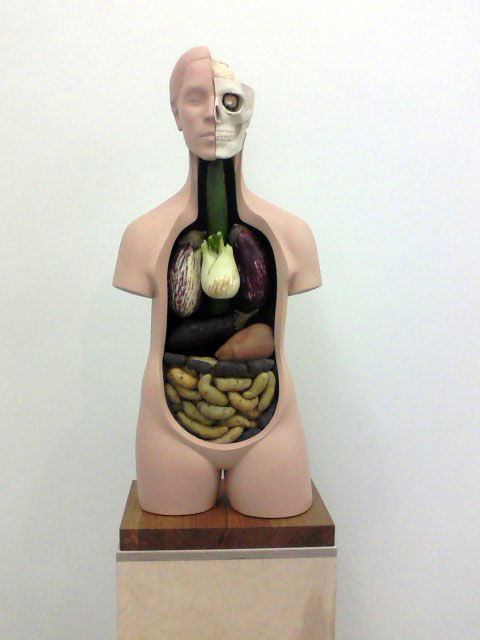
A sculpture from Klaus Weber's show, "if you leave me I'm not following" at Andrew Kreps Gallery.

A sculpture from Klaus Weber's show, "if you leave me I'm not following" at Andrew Kreps Gallery.

John Miller at Metro Pictures

Puzzling theatrical sets made with b/w vinyl murals, fake trees and rocks, and sparkly automotive-painted file cabinets.

Photos at MetroPicturesGallery.com.

The carpet that spells “NO” reminded my of Amanda Curreri’s Leveller. Similar materials, very different intentions and effects.

Tom Friedman at Luhring Augustine

Really superb show by the master conceptualist-craftsman. Friedman’s sculptures and wall-works seem epitomize idiosyncrasy. There is hyper-realism, psychedelia, minimal text works, and miniatures; all result from a persistent attraction to labor. Friedman is a artistic daredevil, unafraid of the impossible.

Thankfully, full photo documentation is at LuhringAugustine.com.

Over and over, I thought of other artists who might appreciate this show, whose works resonates with specific projects. For example, I thought Steven Barich, who has made tiny pixel graphite drawings, might appreciate this pixellated acrylic painting. Anthony Ryan, who was painstakingly inlaying and weaving paper the last time I visited his studio, might enjoy this interpolated paper collage. This wrinkled photo of itself was not unlike Zachary Royer Schultz’ Crumple projects. And for yours truly, who has been dreaming about a kite project, there was this tiny figure, and his far, faraway kite (not pictured, and actually, it’s so tiny it’s barely visible in person).

AIGA’s 50 Books/50 Covers 2010 Competition 

[Full disclosure: my husband contributed to the interactive components of this exhibition.]

Graphic design aficionados who find themselves ogling covers rather than shopping for books in bookstores, this is the exhibition for you. Come and ogle away.

Graphic designers, beware: visiting this exhibition will only whet your appetite for expensive and unusual printing and bindery—gloss varnishes, rich textiles, and extraordinary boxes. Come anyway; this is the best way to see them, better than the mind-numbing sameness of printed catalogs.

Too many covers were stunners, but I especially loved the covers for Frank Rose’s The Art of Immersion and the book series, Themes of Psychoanalysis, elegantly illustrated with only one or two letters, symbols, or ornaments. The affect and emotion book, for example, bears a mirrored ampersand, which looks like two figures in intimate exchange.

Also: good spurs for home town pride: Rebecca Solnit’s The Infinite City, Mark Dion’s OMCA monograph, McSweeney’s, Tartine, etc.

Info and installation photos at AIGA.org.

Selected book covers can be seen at AIGA.org’s design archives.

Jeffrey Gibson at Participant, Inc.

[At one time, Jeffrey was a studio neighbor in Oakland, CA.]

Jeffrey, who is Native American, populates Participant’s not-insubstantial space with sculptures using rugs, beadwork, masks, leatherwork, and drums. As soon as I saw these tchotchkes, painted to look like art, I thought of another LES installation/performance wherein white artists appropriated Native American culture to articulate nature-inspired mysticism. Americans in general are guilty of participating in this ongoing cultural imperialism; it’s just that the conscious acts seem so overt, privileged, and repellant. I wondered what Jeffrey would have made of them.

A series of circular drums are painted with hard-edged geometric shapes and stripes, with some whisks of aerosol. These seem to most clearly convey the show’s inspiration, a 1940s exhibit of Native American art situated in modern art history. Other works, like the pink fluorescent tube shooting out of a hide satchel adorned with two beaded balls, queer up the theme. A b/w video displays time-lapse photos of the drum-paintings in progress. Moving blankets, heavy with paint and Native ornamentation, ground floor works and, as a flag, worry a hardwood dowel.

More info at ParticipantInc.org.
Standard
Sights

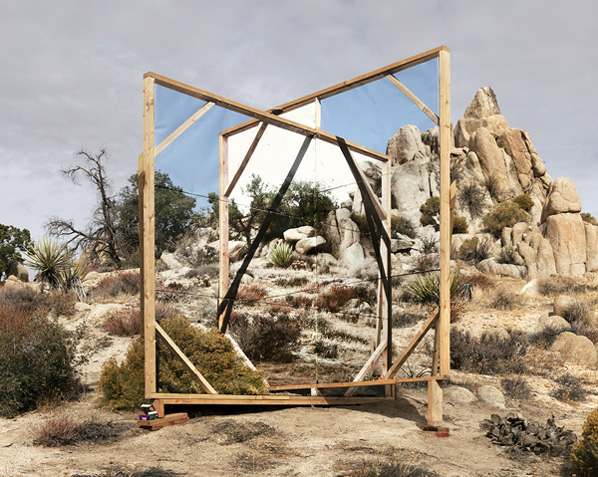
See: Chris Engman’s mirror/tint/landscape photos

Filter + filter + mirror + mirror = blue-r skies, cooler landscape. Ingenious!

Chris Engman, Permeation, 2012, archival inkjet print, 38 x 48 in, edition of 6, Courtesy of Luis De Jesus Los Angeles. Source: re-title.com.

Chris Engman, Permeation, 2012, archival inkjet print, 38 x 48 in, edition of 6, Courtesy of Luis De Jesus Los Angeles. Source: re-title.com.

March 3 – April 7, 2012
Dualities, Omissions, Loops, and Ruptures: Chris Engman, Cody Trepte, Samantha Roth, and John Houck
LUIS DE JESUS Los Angeles
2685 S. La Cienega Boulevard, Los Angeles, CA 90034
Hours: Tuesday-Saturday, 10am-6pm
Artists’ Reception: Saturday, March 3rd, 6-9 PM

Standard
Research

Fun Facts

Last weekend, I enjoyed the rare honor of speaking publicly about my work twice in the same day.

First, I delivered a guest artist’s talk to a graduate seminar in San Francisco via Skype (a first for me). Emphasizing the vicissitudes of my life in the arts, I shared a factoid I learned from Creative Capital’s Professional Development workshop. I hope I remembered it correctly:

One positive response for every 13 to 15 applications for grants, residencies and awards is a pretty good average.

(Artists: It’s Spring deadline season. How are your applications coming along? Listings here.)

Being an artist can be variously trivial, serendipitous, laborious, or intentional. So I might have over-explained my art for these students, but it seems a worthy risk if it counter-balances, at least a bit, the obfuscation and unspoken rules about engaging the art world as an emerging artist.

While I wanted to convey the principle, nothing free—paying dues and investing sweat equity—I came away marveling at my good fortune to have benefitted from so many supportive organizations, foundations, and individuals… such as people who dream big, put in work, show up, share, and ask good questions—like the seminar students. The end of the Q&A came too soon.

Then, I participated in a group artists’ talk alongside other artists in Voices of Home at Jenkins Johnson Gallery. Independent curator Kalia Brooks did a great job moderating the panel, which included wave-splashing painting teachers and self-effacing younger artists. The artists have varied practices, terrain enough for an engaging discussion.

The audience, which exceeded the gallery’s seating capacity, was really great; thanks to everyone who attended.

The talk was organized in recognition of Black History Month, so with a panel of all (but one) Black artists, the subject of race and representation in the art field came up for discussion.

For emerging artists in San Francisco, New York City might still be seen as an art world center, with the center-of-the-center being Chelsea. For a panel of largely Black artists, speaking to a largely African American audience in a commercial gallery in Chelsea, geography was a non-issue, but access, via the lens of identity, was still a concern.

Some of the artists rejected the idea that they ought contend with identity in the studio, but no one disavowed as much when it came to engaging the professional field and the public realm.

Have you fantasized about de-activating your Facebook account? Me, too. Paul Martin’s definition of addiction—desire without pleasure—has characterized my recent experiences.

The headline,

“The Anti-Social Network: By helping other people look happy, Facebook is making us sad,”

of Libby Copeland’s article on Slate last year provides a clue to the problem.

Here is some irony about positive sentiments: I tried to keep my status updates positive, but willfully-upbeat presentations may actually be annoying, and en masse, distressing. I don’t think this undermines the value of optimism and positive enthusiasm in general, but speaks to Facebook’s perniciousness as a substitute for interaction and companionship.

So I’m taking a Facebook hiatus. It’s been four days, though it seems longer than that. Congratulations to me, I know. <Hallelujah hands.> [Sarcastic, I know. But I ought to share my un-Photoshopped sentiments, too, apparently. You have to start somewhere, buddies.]

One more fun fact, by way of Ritter Sport chocolates:

What Germans call “Halbbitter” (literally, “Half bitter”) is the same as what Americans call “semi-sweet.”

The half-full, half-empty optimism/pessimism riddle just got a chocolate-y analogue.

Standard
Sights

see: simone leigh @ the kitchen

Affective installation of theatrically-lit ceramic and glass chandeliers (one, bomb-like breasts; another, womb-like cowry shells), sculptures, and two videos. One of the two figurative works is composed from vessels and suggests forced labor; the show is beautifully crafted and wholly discomfiting.

Simone Leigh. "You Don't Know Where Her Mouth Has Been," 2012. Stoneware, porcelain, and wire, dimensions variable. Courtesy the artist, Tilton Gallery, and The Kitchen. Photo: Jenny Blumenfield.

Simone Leigh. "You Don't Know Where Her Mouth Has Been," 2012. Stoneware, porcelain, and wire, dimensions variable. Courtesy the artist, Tilton Gallery, and The Kitchen. Photo: Jenny Blumenfield. Source: blog.art21.org

January 18–March 11, 2012
Simone Leigh: You Don’t Know Where Her Mouth Has Been
Curated by Rashida Bumbray
The Kitchen
512 West 19th Street, New York, NY 10011
Exhibition Hours: Tues–Fri, 12-6pm; Sat 11–6pm FREE

Standard
Impressions, Meta-Practice

See: Bill Cunningham New York and The Artist

Want inspiration? Watch these feature-length films.

Bill Cunningham New York

Bill Cunningham New York
Directed by Richard Press (2010)
[Visit the official site or watch the trailer.]

Portrait of the bike-riding, Carnegie-Hall-residing, NY Times street fashion photographer. A real photographer and  egalitarian. Made me want to go out and shoot hundreds of photos, and aspire to be unflappable of character and constantly amazed at life.

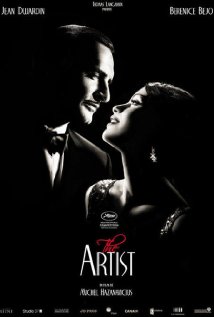
The Artist

The Artist
Directed by Michel Hazanavicius (2011)
[Visit the official site or watch the trailer.]

Heartbreakingly beautiful, symbolic, mostly-silent black-and-white movie about the rise and fall of stardom. A really potent, modern narrative about creative life and pride, brought to life with incredible cinematography, direction and acting (as well as great typography). I saw it yesterday and can’t wait to see it again.


Standard
Research, Sights

Feelgood art and Jeremy Deller retrospective

Wow! Isn’t this grand? Vanessa Thorpe’s article, “Feelgood art: the pick-me-up to get us through an age of anxiety,” appeared on Guardian.co.uk yesterday.

She cites artists encouraging positive emotions: Michael Landy’s kindness-on-the-Underground project, Tracey Emin’s “trust me” neon, the title of Jeremy Deller’s upcoming retrospective at the Hayward.*

But wait, I think all of these artists aren’t so one-dimensional that their work could be considered “feelgood.”

I’m thrilled to bits to hear about artists considering psychology from non-negative attitudes, as well as the influence of positive psychology expanding into the arts and humanities, but Thorpe’s article is not that. I think Thorpe set up an annoying happy face in the headline and lede only to slap it down in the article. It’s simple-minded to call artwork concerning positive affect “feelgood” and “pick-me-up.” It’s a misinterpretation of Deller, whose work has been consistently class-aware and courageous. Thorpe acknowledges as much, after rankling readers into mild outrage in their aversion to unabashed sentiment. Desparate, newsworthi-fying journalese.

*Actually, this is grand:

February 22 – May 13, 2012
Jeremy Deller: Joy in People
Hayward Gallery, London

Deller’s a brilliant artist, I love his work and thoughtful approach to developing projects and working with people. Plus, the Hayward is an amazing space. I really wish I could pop over to the Southbank Centre this spring for this!

Standard
Meta-Practice, Research

words on social practice and creativity

Christoph Büchel’s Piccadilly Community Centre: an exciting example of social practice.

J.J. Charlesworth’s “Hidden Intentions,” (Art Review, December 2011) introduced me to this brilliant intervention transforming the tony Central London Hauser & Wirth location (formerly a bank) into a working social centre, and not just for in-the-know art students, but for the public—senior citizens, yoga practitioners and so on. Piccadilly Circus is a popular tourist’s nexus like Times Square, where simply winding through crowds, dodging street salesmen, and finding a restroom can be exhausting. So Büchel’s gesture of turning an exclusive, expensive, private space into a rambunctious, free, public one is quite satisfying. I was also intrigued to read that

much was made of whether Büchel’s project was a comment on David Cameron’s ‘Big Society’

I find Büchel’s responsiveness commendable.

On irony, and bridging the divide between art and life

“Hidden Intentions” is not an exhibition review, but a speculative essay. Charlesworth also examines Matthew Darbyshire’s faux loft ads at Herald Street, writing that it

is interesting because, like Büchel’s community centre, it points backwards to interrogate the capacity of the viewer to recognise the gesture as ironic. Because irony always implies a ‘double’ audience—those who accept the gesture at face value and those who realise the gesture is simulated intentionally—it also implies a form of superiority, which is often couched in terms of criticism of another….

This is art that writes itself into the fabric of everyday life with only the fading trace of the artist as proof of its reality as a sort of ironic gesture, and in which the work’s audience is made complicity with the artist’s manipulation of the world of others…. Of course, it still needs the institutional frame of the artworld to allow it to happen, but in doing so, it takes to an extreme the postmedium scope of current artistic possibility, where in the end, the only thing that is distinguishable is the discursive setup of the artworld itself.

Conflict aids creativity?

So argues Jonah Lehrer in “Group Think: The Brainstorming Myth” (The New Yorker, January 20, 2o12). He presents evidence contrary to the widely-accepted prohibition against criticism in brainstorming:

According to [psychology professor Charlan] Nemeth, … “…debate… will always be more productive. True creativity requires some trade-offs.”

To Lehrer and Nemeth, I’d respond with a constructively critical, “Yes, but…”

Positive Sign #1, 2011, glitter and fluorescent pen with holographic foil print on gridded vellum, 8.5 × 11 in / 21.5 × 28 cm

Consider Mihaly Csikszentmihalyi‘s five stages of the creative process: preparation, incubation, insight, evaluation, and elaboration. I would think that debate is productive in some stages (such as evaluation and elaboration) and not others (such as preparation, incubation, and insight).

Perhaps more even-handed: sociologist Brian Uzzi analyzed musicals to find correspondences between social intimacy among creators and box office and critical success.

“The best Broadway teams, by far, were those with a mix of relationships,” Uzzi says. “These teams had some old friends, but they also had newbies. This mixture meant that artists could interact efficiently—they had a familiar structure to fall back on—but they also managed to incorporate some new ideas. They were comfortable, but not too comfortable.”

For artists considering creative and professional collaborators, choose carefully.

Lehrer also makes an exemplar of the MIT “rad lab”—where a disused building became home to divergent departments, creating spillover, and presumably, lending interdisciplinary gusto to the work of Chompsky, Bose, and other paradigm shifters. Lehrer concludes

The lesson of Building 20 is that when the composition is right—enough people with different perspectives running into on another in unpredictable ways—the group dynamic will take care of itself…. The most creative spaces are those which hurl us together.

I cringed when I read that last sentence, after my experiences in open-plan studios in graduate school. Unwanted intrusions can make focusing attention seem like a Herculean task. Being hurled together say, when you’re reading or trying to resolve an artwork, with someone taking a phone call or playing music, is not creative, but torturous. Psychologist Jonathan Haidt points out that humans can adapt to many things, but we never adapt to intermittent noise:

Research shows that people who must adapt to new and chronic sources of noise … never fully adapt, and even studies find some adaptation still find evidence of impairment on cognitive tasks. Noise, especially noise that is variable or intermittent, interferes with concentration and increases stress. It’s worth striving to remove sources of noise in your life.

Jonathan Haidt, The Happiness Hypothesis, New York: Basic Books (2006) 92.
Standard
Research

trinkets from the bitstream

O, Internet! Some glimmers of humor and poetry:

No cover

In search of a book, I found this little gif. It’s a cover design that’s meant to stand in for a missing file, but it’s handsome, balanced, mysterious and beautiful on its own. Book-face with a swash-nose. I’d read it.

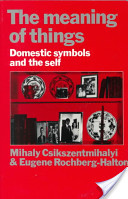
Mihaly Csikszentmihalyi & Eugene Halton, The Meaning of Things, 1981

Mihaly Csikszentmihalyi & Eugene Halton, The Meaning of Things, 1981

I’m slowly working my way through psychologist Mihaly Csikszentmihalyi’s books. This one, co-authored with Eugene Halton, is on how objects become associated with sentiment. It sounds very enriching for me as an artist. I love this graphic cover too: plates and photos on display, with the title in sentence casing in a gothic typeface.

Aziz Ansari’s Treat yo’ self! clip from Parks and Rec. Ridiculous, self-indulgent, yet quite possibly a brilliant idea. What if everyone had one big Treat Yo’ Self Day every year? Rewards following accomplishments are nice, but too much performance-orientation can be unsustainable. I imagine that participants might demonstrate more restraint in the weeks prior and after the big day. You don’t need “fine leather goods” to indulge; you can share time, company, grace, learning experiences, etc.

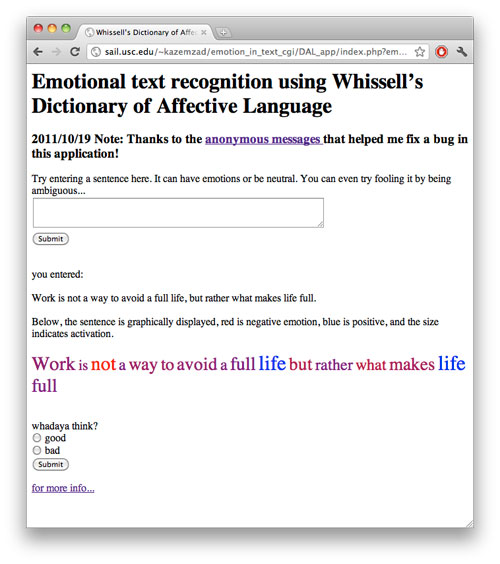
Ebrahim "Abe" Kazemzadeh, Emotional text recognition using Whissell’s Dictionary of Affective Language

Ebrahim "Abe" Kazemzadeh, Emotional text recognition using Whissell’s Dictionary of Affective Language. Source: http://sail.usc.edu/~kazemzad/emotion_in_text_cgi/DAL_app/

Ebrahim “Abe” Kazemzadeh’s program, Emotional text recognition using Whissell’s Dictionary of Affective Language. Kazemzadeh is a PhD student at the University of Southern California (USC) studying computer science, with a graduate degree in computational linguistics. The program assigns colors and sizes to emotional words. Red indicates negative emotions; blue, positive. Representing subjective states with programming is such a wonderfully strange idea. The inherent failure is what makes it compelling.

Pollyanna, I re-learned, lives by the principle of The Glad Game, the objective of which is to find something to be glad about in every situation. It turns out that Littleton, NH, hometown of the Pollyanna author, has an annual Official Pollyanna Glad Day, with a parade. Why not be glad? Why not tie balloons and daisies to and parade in a yellow pick-up?

Official Pollyanna Glad Day 2005, Litteton, NH (hometown of Pollyanna author Eleanor H. Porter)

Official Pollyanna Glad Day 2005, Litteton, NH (hometown of Pollyanna author Eleanor H. Porter). Source: GoLittleton.com

Standard