Citizenship, Community, Sights

get excited: open studios, mfa shows, more

Besides Frieze, NADA, and Pulse art fairs in NYC this week, there’s a slew of auxilliary events, open studios, and MFA shows to check out. In support of friends and community, here’s my list:

Go Stephanie!

May 4–6
Stephanie Syjuco: RAIDERS (Redux)
Catharine Clark Gallery’s New York Pop-Up Gallery
313 W 14th Street, 2F, NYC

May 4–6
LMCC’s Open Studio Weekend
125 Maiden Lane, 14th Floor, NYC

Go Michael!

Saturday, May 12
IN/VISION
2012 MFA Interaction Design Festival at the School of Visual Arts
Thesis Presentations: 11am – 4pm @ SVA Theatre
Thesis Exhibition: 5–7pm @ SVA Interaction Design Department
Go Nyeema!
May 12–13
NARS Foundation Open Studios
88 35th Street, 3rd Floor, Brooklyn
May 18–19
Kambui Olujimi: A Life in Pictures
Apex Art, 291 Church Street, NYC
Saturday, May 19
Question Bridge: Black Males Blueprint Roundtable
Brooklyn Museum 
Finally, if that’s not enough, learn about Emergency USA‘s amazing projects building medical infrastructure in areas of conflict:
Thursday, May 3, 7pm, E-USA office @ 21 Exchange Place. Presentation. RSVP to nyc@emergencyusa.org.
Sunday, May 6, 5–8pm, Randolph Beer, Nolita. 15% benefit happy hour.
Standard
Impressions

Chelsea jaunt

Made lemons out of lemonade today: Sidelined from running, I took up biking, and I rode down to Chelsea and up to Columbia for some art shows. Perfect weather for it.

Standouts:

Three of the four shows I loved have to do with mirrors. So sue me.

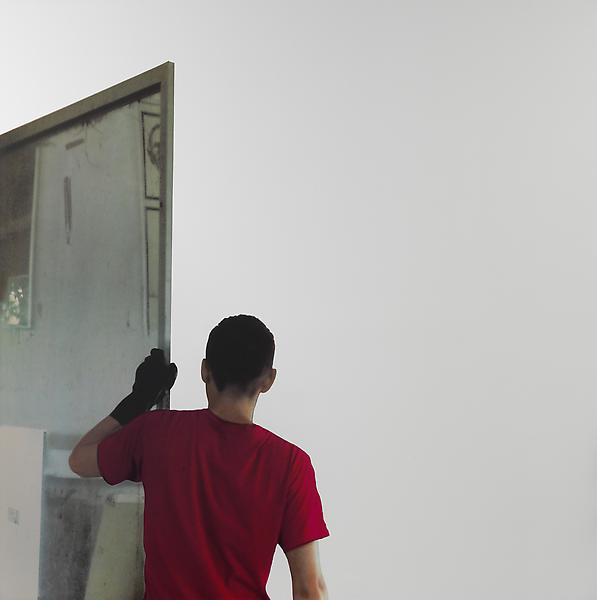
Michelangelo Pistoletto, Lavoro - Atelier, 2008-2011, Silkscreen on polished super mirror stainless steel 59 X 59 inches (150 X 150 cm). // Source: luhringaugustine.com

Michelangelo Pistoletto, Lavoro - Atelier, 2008-2011, Silkscreen on polished super mirror stainless steel 59 X 59 inches (150 X 150 cm). // Source: luhringaugustine.com

Michelangelo Pistoletto at Luhring Augustine
Lavoro
Thru April 28

The Arte Povera mirror-maker depicts construction workers, bringing the past of each building these are shown in into the present. I liked these a lot. Baffled why the statement said that the images are “adhered” when the image captions, and the works themselves, suggest screenprinting as the medium. These are not my favorite Pistolettos; I liked some of the older ones at the Walker and Brooklyn Museum better, but it’s still great to see so many of them in one place. A treat.

Greg Smith at Susan Inglett Gallery
ners Banners Banners Ban
Thru May 26

GO SEE IT. ESPECIALLY THE VIDEO.

If you can’t make it, read on…. (Spoiler alert.)

I made a point of going into galleries that aren’t on my usual route, and this one paid off. There are drawings and mixed media assemblages with a harness, all very cruddy and rough. The best thing, though, is a video that documents a performance in which the artist produced and installed the works under and on the Brooklyn-Queens Expressway. There’s a belt of canvas that goes completely around the car, and shots of the artist operating a sewing machine while driving (not recommended!). He used copious amounts of sweetly colorful dots, and also made some fabric-and-cotton-batting pennant flags. It’s a bizarre experiment with lots of physical and legal risk for crafty, yet un-crafted, artworks. Super thought-provoking for thinking about what is at stake in a work or practice, and what is success or failure.

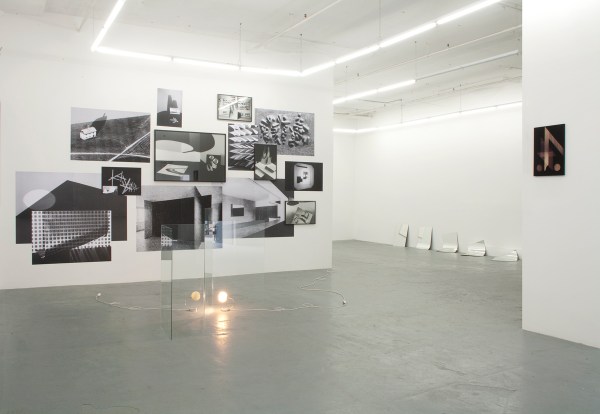
Grey Peak of the Wave, Installation view, 2012 Alicja Kwade, Alexandra Leykauf and Florian & Michael Quistrebert. Source: HarrisLieberman.com.

Grey Peak of the Wave, Installation view, 2012 Alicja Kwade, Alexandra Leykauf and Florian & Michael Quistrebert. Source: HarrisLieberman.com.

Grey Peak of the Wave at Harris Leiberman
Group show of European artistst
Through April 28

I love this kind of work. Subtle, open-ended, perceptual, quiet. My favorites were:

Alicja Kwade’s taped glass sheets with two lamps, one on, one off (above, on ground). In the glass’ reflection, the unlit lamp appears convincingly illuminated.

Alicja Kwade’s bent mirrors, as if drooping down off the wall like a sheet of paper (also seen above, in the rear space). Surreal. Materially simple, disguising what I’m sure was laborious or expensive fabrication. Manipulating common materials in uncommon ways never gets old to me.

Alexandra Leykauf’s wall vinyls and framed photos (also above, back wall). Who doesn’t love a b/w photo of geometric abstraction made with real objects? And then complicating commodification with both framed works and site-specific, one-use vinyl? So simple, so good.

IRAN do ESPÍRITO SANTO, Installation view of SWITCH at Sean Kelly Gallery, New York March 21 - April 28, 2012 Photo: Jason Wyche, New York. Source: skny.com.

IRAN do ESPÍRITO SANTO, Installation view of SWITCH at Sean Kelly Gallery, New York March 21 - April 28, 2012 Photo: Jason Wyche, New York. Source: skny.com.

Iran do Espírito Santo at Sean Kelly
Switch
Thru April 28

I loved this Brazilian artists’ subtle, perceptual, materially sophisticated works ever since I saw a few at Altman Siegal in San Francisco. This show is a brave selection of 3 major works: a large wall painting, a series of marble replicas of glass bulb covers, and this series of “mirrors.” In fact, these are all made with two sheets of plate glass sandwiching a reflective tint. They look like mirrors until you spend a little more time with them, and realize that they are slightly transparent. They don’t, as the press release states, look like they’re folding, the way Kwade’s bent mirrors do at Harris Lieberman. But they do achieve something else, which as to do with how the leaning piece and the floor piece allow slightly different amounts of light and reflectivity. It’s sort of like the difference between a 100% printed CMYK black, and a “rick black,” which is a mixture using more colors, and hence, more saturation. The mirror on the floor looks as if you could fall into it.

Standard
Bucket List, Impressions

Josephine Meckseper, Josiah McElheny

Josephine Meckseper, a German artist based in NYC, has been making photographs, sculptures, installations and videos critical of American military power and consumer culture. I had seen her famous Pyromaniac 2 photo before, but am finally spending more time with her vitrines of readymade objects and store-inspired displays.

I’m late in getting familiar with Meckseper’s work (it might have been useful for thinking through a 2010 show about 99¢ stores). But it’s just as well now, as I’m  currently thinking about new projects that are off the wall, and Meckseper uses some inventive display strategies.

Josephine Meckseper Pyromaniac 2  2003  C-Print  101 x 76 cm // Source: Saatchi-Gallery.co.uk.

Josephine Meckseper, Pyromaniac 2, 2003 C-Print 101 x 76 cm // Source: Saatchi-Gallery.co.uk.

Josephine Meckseper, Jaguar, 2010, Mixed media on reflective slatwall, 94 1/2 x 94 1/2 x 12 1/2 in. / 240 x 240 x 31.8 cm // Source: timothytaylorgallery.com.

Josephine Meckseper, Jaguar, 2010, Mixed media on reflective slatwall, 94 1/2 x 94 1/2 x 12 1/2 in. / 240 x 240 x 31.8 cm // Source: timothytaylorgallery.com.

Josephine Meckseper, Afrikan Spir 2011 Mixed media in steel and glass vitrine 80 x 80 x 20 in. / 203.2 x 203.2 x 50.8 cm // timothytaylorgallery.com.

Josephine Meckseper, Afrikan Spir, 2011, Mixed media in steel and glass vitrine, 80 x 80 x 20 in. / 203.2 x 203.2 x 50.8 cm // Source: timothytaylorgallery.com.

Josephine Meckseper, The Concept of Irony, 2010 Toilet brush, costume jewelry, sandals, newspaper, decorative wall hangings, hosiery, book, framed collage with newsprint and colored acetate on paper, acrylic painting on canvas, cloth, metal and acrylic display fixtures on metal rack 74.5 x 24.75 x 24 inches (189.2 x 62.9 x 61 cm) // Source: ElizabethDee.com

Josephine Meckseper, The Concept of Irony, 2010 Toilet brush, costume jewelry, sandals, newspaper, decorative wall hangings, hosiery, book, framed collage with newsprint and colored acetate on paper, acrylic painting on canvas, cloth, metal and acrylic display fixtures on metal rack 74.5 x 24.75 x 24 inches (189.2 x 62.9 x 61 cm) // Source: ElizabethDee.com

Josephine Meckseper, Der Wille zur Macht, 2011, Mixed media on steel pole 52.25 x 9 x 9 inches (132.7 x 22.86 x 22.86 cm) // Source: ElizabethDee.com.

Josephine Meckseper, Der Wille zur Macht, 2011, Mixed media on steel pole 52.25 x 9 x 9 inches (132.7 x 22.86 x 22.86 cm) // Source: ElizabethDee.com.

Art Production Fund and Meckseper recently teamed up for the Manhattan Oil Project, a monumental kinetic sculpture/intervention in Times Square, currently on view through May 6th at 46th Street and 8th Ave.

Josephine Meckseper, Manhattan Oil Project, 2012 // Source: Art Production Fund

Josephine Meckseper, Manhattan Oil Project, 2012 // Source: Art Production Fund

Meckseper is an anti-capitalist activist. At her recent talk at Sculpture Center, she cited the forms of sculpture that have inspired her, including the fall of monuments to great men, and the Berlin Wall. I liked something she said about working in social contexts, which I paraphrased in my notes as:

What are the oppositional voices in the neighborhood?

I was very inspired by Josiah McElheny‘s talk in the Public Art Fund’s lecture series at the New School.

I liked McElheny’s works, and appreciated learning about these stunning projects:

Josiah McElheny, "Island Universe" (detail view), 2008, installed at the Museo Nacional Centro de Arte Reina Sofía, Madrid. Courtesy of artist, photograph by Ivån Caso Lafuente.

Josiah McElheny, "Island Universe" (detail view), 2008, installed at the Museo Nacional Centro de Arte Reina Sofía, Madrid. Courtesy of artist, photograph by Ivån Caso Lafuente. // Source: http://www.veralistcenter.org/

A beautiful installation at the Crystal Palace in Retiro Park in Madrid. Project with Museo Nacional Centro de Arte Reina Sofía. Visiting the Crystal Palace is going on my bucket list.

JOSIAH MCELHENY, The Past Was A Mirage I'd Left Far Behind, 2011-2012, Wood, Mirror, Screen material and Projection. Seven multiple reflective screens made of mirrored glass, wood, and projection cloth. Experimental abstract films programmed to change throughout the period of one year. dimensions variable upon installation. The Bloomberg Commission: Josiah McElheny Whitechapel Gallery, London September 7, 2011 – July 20, 2012. // Source: andrearosengallery.com.

JOSIAH MCELHENY, The Past Was A Mirage I'd Left Far Behind, 2011-2012, Wood, Mirror, Screen material and Projection. Seven multiple reflective screens made of mirrored glass, wood, and projection cloth. Experimental abstract films programmed to change throughout the period of one year. dimensions variable upon installation. The Bloomberg Commission: Josiah McElheny Whitechapel Gallery, London September 7, 2011 – July 20, 2012. // Source: andrearosengallery.com.

This is a really cool video installation using kaideoscopic imagery made with substrates of mirrors and wood. I’d love to see this and I’m looking forward to this show coming to Boston ICA this summer!

McElheny is pound-for-pound one of the most brilliant contemporary artists of our time. First, the craftsmanship of his handblown glass is impeccable. Second, he’s an artist’s artist, constantly experimenting and advancing art historical dialogues, such as with his remake of The Metal Party and the Light Club of Italia. Third, he’s a formidable intellect, whose contributions to Artforum are not an insignificant part of his practice. He said one of the things he enjoys as an artist is to generate new research, and one of his forthcoming multiples is a translation of Blanque’s “Eternity through the Stars: An Astronomical Hypothesis.” While this text has inspired Borges and other writers, it’s never been translated into English before, and McElheny is searching for a publisher.

He talked about

display as a sequence of events,

thinking through

how ideas are expressed in objects.

On readymades, he expressed that

artists must transform an object because industrial production resists transformation. Readymades propose that consuming is art. It’s a dangerous idea that competing with the capacities of industrial production is difficult, and that artists can only react.

His opposition to Adolf Loos’ “Ornament and Crime” theory of modernism is based on his principle that

the desire to make a mark on the world and show you exist is universal.

I especially loved the way he phrased that urge:

To make a material mirror.

These are fundamental quandries for artists. For artists who are interested in the concepts embedded within the materials we use, and who want to make work that embodies, rather than illustrates, our ideas, it is an essential one.

During the Q&A, someone asked if McElheny saw his practice as a moral one. He equivocated away from making a personal statement, but did say:

The ethics of art are to create more permissive thinking—to generate more, and not less, thought.

I did see the interlocutor’s point, as McElheny stated his ambivalence about beauty. He said something about seeing how quickly beautiful things can turn ugly. It reminded me of Yi-Fu Tuan’s point in Passing Strange and Wonderful: Nature, Aesthetics and Culture (Island Press, 1993)—that for most of human history, beauty and goodness were synonymous, so the aesthetic carries a moral tint.

McElheny’s practice seems to be experiments in enacting or expressing moral principles through strategies of aesthetic production and display.

Standard
Sights

get excited: Josephine Meckseper, Josiah McElheny, Rob Carter

This week I’m looking forward to:

Josephine Meckseper The Complete History of Postcontemporary Art, 2005. Courtesy the Artist, New York, and VG Bild-Kunst.

Josephine Meckseper The Complete History of Postcontemporary Art, 2005. Courtesy the Artist, New York, and VG Bild-Kunst. Source: Sculpture-Center.org.

Monday, April 9, 7PM
Subjective Histories of Sculpture: Josephine Meckseper
SculptureCenter
44-19 Purves St, Long Island City, Queens

Citing specific works, bodies of work, texts, or even personal anecdotes taken from inside and outside cultural production, and inside and outside art, these subjective, incomplete, partial, or otherwise eclectic histories question assumptions and propose alternative methods for understanding sculpture’s evolving strategies.

Josiah McElheny, Island Universe (installation view), 2009. Courtesy the artist, Donald Young Gallery, Chicago, and Andrea Rosen Gallery,  New York. Photo: Museo Nacional Centro de Arte Reina Sofia, Madrid © Josiah McElheny. Source: publicartfund.org.

Josiah McElheny, Island Universe (installation view), 2009. Courtesy the artist, Donald Young Gallery, Chicago, and Andrea Rosen Gallery, New York. Photo: Museo Nacional Centro de Arte Reina Sofia, Madrid © Josiah McElheny. Source: publicartfund.org.

Wednesday, April 11, 6:30pm
Public Art Fund Talks at The New School: Josiah McElheny
The New School, John Tishman Auditorium
66 West 12th Street, between 5th & 6th Avenues, NYC

McElheny is whip-smart and I expect nothing less than to be blown away.

Public Art Fund is pleased to present a talk by Josiah McElheny, an American artist whose multifaceted artistic practice has incorporated decorative and functional traditions of glass, as well as research, writing, and curating to explore materiality and its relationship to the ways in which we see and experience objects. Often using narratives inspired by the histories of art, design, and glass as points of departure, McElheny has created massive sculptures of shining chrome and transparent glass that layer myriad references as diverse as twentieth-century fashion, modernist design, sixteenth-century Italian painting, and even the Big Bang theory.

Rob Carter. Faith in a Seed, 2012. Image courtesy the artist. Source: ArtinGeneral.org.

Rob Carter. Faith in a Seed, 2012. Image courtesy the artist. Source: ArtinGeneral.org.

Opening: Friday, April 13, 6-8pm
Exhibition: April 13–June 23, 2012
Rob Carter: Faith in a Seed
Art in General

79 Walker Street (just off Canal and Broadway), NYC

I helped to build out this show, and I’m very excited to see how the installation and videos have come, quite literally, to life.

Faith in A Seed intertwines the languages of science and history into a living sculptural form. Rob Carter’s installation centers on the houses and gardens of three men of the 19th century. Miniature replicas of Charles Darwin’s Down House, Henry David Thoreau’s cabin at Walden, and Sir John Bennet Lawes’ Rothamsted Manor are the centerpieces of a large-scale triangular garden.

Viewers are invited to witness Carter’s controlled but fragile ecosystem in three distinct ways: time-based video projections, peepholes cut into the sides of the garden, as well as from an elevated viewing platform.

Standard
Research

everyday objects / significant objects

Significant Objects, Joshua Glenn, Ed. Source: Amazon.com.

Significant Objects, Joshua Glenn, Ed. Source: Amazon.com.

A few weeks ago, I mused about a zeitgeist of everyday objects as containers for sentiment. Since then, WNYC’s Studio 360 program aired a segment and a short story contest, “In Search of Significant Objects.” It was inspired by a new book, Significant Objects, due out July 2, 2012. What is this about? The authentic, mundane, intimate, analog, in reaction to increasingly digital/virtual/distant/homogenized experiences? Is it this: remix culture –> we-are-all-curators / personal brand managers –> narcissists of small differences = We are all becoming Miranda Julys?

Standard
Community, Sights

See: Bessma Khalaf @ Steven Wolf Fine Arts

This looks like it’s going to be an amazing show. Go Bessma & Steven!

April 20 – May 19, 2012
Bessma Khalaf: Re-Enchanter
Opening Reception: Friday, April 20, 6-8pm
Steven Wolf Fine Arts

2747 19th Street, A, San Francisco, CA 94110
Gallery Hours: Wed–Fri 10:30-5:30, Saturday 11-5

In Re-enchanter, Bessma Khalaf’s new exhibition at Steven Wolf Fine Arts, the Iraqi born artist draws upon the Chaldean tradition of witchcraft, sorcery and truth telling to play the role of artist as re-enchanter of a dead, modernist world. Chaldeans are a small Christian sect of Iraqis. Historically, they were perceived by neighboring empires as experts in sorcery, astrology and the magical arts, and were consulted to deal with the unknown. But with the rise of religious fundamentalism they are now hunted like witches in their region.

With little more than an oversized hoodie and some everyday objects, Khalaf uses vaudevillian magic to transform herself from Gandalf the wizard, to a lady in a burka, to a Jedi Knight, and then back to an Oakland home girl. Her broomstick is a Segway and her backdrop is night, and the promise land of California. While this new body of work is visually darker than Khalaf’s previous films and photographs, it continues to rely on humor and ironic juxtapositions to illuminate the dark, tragic geography that divides the old world and the new.

Standard
Research

Jim Hodges

Jim Hodges (b. 1957) is an American contemporary artist based in New York, NY. I loved his work at Barbara Gladstone (both locations) a few months ago, as well as at SFMOMA and Marc Foxx Galleryin LA in the past. His materials (including mirrors and lightbulbs), and themes (happiness) overlap with those in my work. I am finally getting around to doing more research about him.

The more I learn, the more it seems that I’ve been following in Hodge’s footsteps.

What I admire most about Hodges’ work is this: simple gestures generating expansive imports. In other words, 1 + 1 = 3. When two recognizable things or ideas combine for an unexpected outcome, it’s startling.

Hodge’s work can be luminous or colorful, and suggestive of pleasure or happiness, but it is also characterized by themes of death and fragility. The feeling of loss made sense when I learned that Hodges was a contemporary and friend of Felix Gonzales-Torres. I was also reminded of how Tom Friedman experiments with common materials too.

Below are some photos found online, and some scanned in from an exhibition catalog. I think the dates of the works are quite telling about the artist’s development.

Past Installations

I suspect that Hodge’s fake flower projects started with simple material investigations: taking apart ready-made flowers, arranging and re-arranging them, which culminates in monumentally-scaled curtains that drape on the floor.

Jim Hodges, Untitled (Threshold), 1993–4, silk, plastic, thread, steel wire, 92x58 inches. The Ann and Mel Schaffer Family Collection. Source: Hodges, Jim, Ian Berry, Ron Platt, and Allan Schwartzman. 2003. Jim Hodges. Saratoga Springs, N.Y.: Frances Young Tang Teaching Museum and Art Gallery at Skidmore College.

Jim Hodges, Untitled (Threshold), 1993–4, silk, plastic, thread, steel wire, 92x58 inches. The Ann and Mel Schaffer Family Collection. Source: Hodges, Jim, Ian Berry, Ron Platt, and Allan Schwartzman. 2003. Jim Hodges. Saratoga Springs, N.Y.: Frances Young Tang Teaching Museum and Art Gallery at Skidmore College.

Jim Hodges, Changing things (detail), 1997, Silk, plastic, wire and pins (342 parts), 193 x 376 cm, Dallas Museum of Art, Mary Margaret Munson Wilcox Fund and gift of Catherine and Will Rose, Howard Rachofsky, Christopher Drew and Alexandra May, and Martin Posner and Robyn Menter-Posner, © martabuso / Fondazione Bevilacqua La Masa, From the exhibition Love, eccetera, Fondazione Bevilacqua La Masa, 5 February-5 April 2010, Piazza San Marco Gallery, Venezia. Source: ArtTattler.com.

Jim Hodges, Changing things (detail), 1997, Silk, plastic, wire and pins (342 parts), 193 x 376 cm, Dallas Museum of Art, Mary Margaret Munson Wilcox Fund and gift of Catherine and Will Rose, Howard Rachofsky, Christopher Drew and Alexandra May, and Martin Posner and Robyn Menter-Posner, © martabuso / Fondazione Bevilacqua La Masa, From the exhibition Love, eccetera, Fondazione Bevilacqua La Masa, 5 February-5 April 2010, Piazza San Marco Gallery, Venezia. Source: ArtTattler.com.

A massive curtain composed completely of fake flowers. It’s super colorful and translucent in person. It’s also very difficult to resist touching. Sometimes I think contemporary art is afraid of sentiment, but this work wholly embraces joy. Very pop.

Jim Hodges, No Betweens, 1996; sculpture; silk, cotton, polyester, and thread, 360 in. x 324 in. (914.4 cm x 822.96 cm); Collection SFMOMA, Purchase through a gift of Kimberly S. Light; © Jim Hodges  Source: San Francisco Museum of Modern Art

Jim Hodges, No Betweens, 1996; sculpture; silk, cotton, polyester, and thread, 360 in. x 324 in. (914.4 cm x 822.96 cm); Collection SFMOMA, Purchase through a gift of Kimberly S. Light; © Jim Hodges Source: San Francisco Museum of Modern Art

Jim Hodges, Where are we now? (detail), 1999, silk, cotton, polyester, and thread, 24x18 feet, installation view at Miami Art Museum, Carlos and Rosa de la Cruz Collection. Source: Hodges, Jim, Ian Berry, Ron Platt, and Allan Schwartzman. 2003. Jim Hodges. Saratoga Springs, N.Y.: Frances Young Tang Teaching Museum and Art Gallery at Skidmore College.

Jim Hodges, Where are we now? (detail), 1999, silk, cotton, polyester, and thread, 24x18 feet, installation view at Miami Art Museum, Carlos and Rosa de la Cruz Collection. Source: Hodges, Jim, Ian Berry, Ron Platt, and Allan Schwartzman. 2003. Jim Hodges. Saratoga Springs, N.Y.: Frances Young Tang Teaching Museum and Art Gallery at Skidmore College.

Here’s a curious black version.

Jim Hodges, The end from where you are, 1998, Silk, cotton, polyester, and thread, 16 x 16'. Source: ArtTattler.com.

Jim Hodges, The end from where you are, 1998, Silk, cotton, polyester, and thread, 16 x 16'. Source: ArtTattler.com.

Jim Hodges, Into Life, 2001  Silk, cotton, polyester and thread; dimensions variable. Source: GladstoneGallery.com.

Jim Hodges, Into Life, 2001 Silk, cotton, polyester and thread; dimensions variable. Source: GladstoneGallery.com.


I’ve been sewing and thinking about flags a lot, so here’s one more instance of serendipity.

Jim Hodges, Here's Where We Will Stay  printed nylon, painted chiffon and silk head scarves with thread, embroidery and sequins 230 x 225 in. (584.2 x 571.5 cm.) 1995. Source: Christies.com.

Jim Hodges, Here's Where We Will Stay printed nylon, painted chiffon and silk head scarves with thread, embroidery and sequins 230 x 225 in. (584.2 x 571.5 cm.) 1995. Source: Christies.com.

Immersive gold leaf.

Jim Hodges and still this 2005-2008 23.5K and 24K gold with Beva on gessoed linen in 10 parts 200" x 185" x 89". Source: JamesWagner.com.

Jim Hodges and still this 2005-2008 23.5K and 24K gold with Beva on gessoed linen in 10 parts 200" x 185" x 89". Source: JamesWagner.com.

2.5-D
(Works that are not quite 2-D or 3-D)

Jim Hodges, Folding (into a Greater World), 1998 Mirror on canvas in two parts 72 x 96 inches Collection of Eileen and Peter Norton, Santa Monica. Source: ArtLies.org.

Jim Hodges, Folding (into a Greater World), 1998 Mirror on canvas in two parts 72 x 96 inches Collection of Eileen and Peter Norton, Santa Monica. Source: ArtLies.org.

Jim Hodges, Movements (stage II), 2006  Mirror on canvas; 84 x 96 inches. Source: GladstoneGallery.com.

Jim Hodges, Movements (stage II), 2006 Mirror on canvas; 84 x 96 inches. Source: GladstoneGallery.com.

Having spent so much time obsessed with light bulbs for previous projects, it’s strange that I’m only just now coming across this work.

Jim Hodges, Coming Through, 1999 Light bulbs, ceramic sockets, wood and metal panels 31 x 63 x 5 inches Collection of Rebecca and Alexander Stewart, Seattle. Source: ArtLies.org.

Jim Hodges, Coming Through, 1999 Light bulbs, ceramic sockets, wood and metal panels 31 x 63 x 5 inches Collection of Rebecca and Alexander Stewart, Seattle. Source: ArtLies.org.

Jim Hodges, With the Wind, 1997, scarves, thread, 90x99x5 inches. Collection of Penny Cooper and Rena Rosenwasser. Source: Hodges, Jim, Ian Berry, Ron Platt, and Allan Schwartzman. 2003. Jim Hodges. Saratoga Springs, N.Y.: Frances Young Tang Teaching Museum and Art Gallery at Skidmore College.

Jim Hodges, With the Wind, 1997, scarves, thread, 90x99x5 inches. Collection of Penny Cooper and Rena Rosenwasser. Source: Hodges, Jim, Ian Berry, Ron Platt, and Allan Schwartzman. 2003. Jim Hodges. Saratoga Springs, N.Y.: Frances Young Tang Teaching Museum and Art Gallery at Skidmore College.

I love how simple yet effective this is. It’s presented in an unfussy way, yet is beautiful and works beautifully.

Jim Hodges, Arranged, 1996, Folded book with metal paper clips, 33 x 16.5 x 26 cm, photo: Heidi L. Steiger. Source: ArtTattler.com.

Jim Hodges, Arranged, 1996, Folded book with metal paper clips, 33 x 16.5 x 26 cm, photo: Heidi L. Steiger. Source: ArtTattler.com.

Jim Hodges, Untitled, 2001, Prismacolor on wall, dims. var. Installation views, CRG Gallery, NY. Source: Hodges, Jim, Ian Berry, Ron Platt, and Allan Schwartzman. 2003. Jim Hodges. Saratoga Springs, N.Y.: Frances Young Tang Teaching Museum and Art Gallery at Skidmore College.

Jim Hodges, Untitled, 2001, Prismacolor on wall, dims. var. Installation views, CRG Gallery, NY. Source: Hodges, Jim, Ian Berry, Ron Platt, and Allan Schwartzman. 2003. Jim Hodges. Saratoga Springs, N.Y.: Frances Young Tang Teaching Museum and Art Gallery at Skidmore College.

Works on Paper

Jim Hodges, Overlaps under there, 1999, tissue paper with cut paper, 30 x 22.5 inches. Private Collection, NY. Source: Hodges, Jim, Ian Berry, Ron Platt, and Allan Schwartzman. 2003. Jim Hodges. Saratoga Springs, N.Y.: Frances Young Tang Teaching Museum and Art Gallery at Skidmore College.

Jim Hodges, Overlaps under there, 1999, tissue paper with cut paper, 30 x 22.5 inches. Private Collection, NY. Source: Hodges, Jim, Ian Berry, Ron Platt, and Allan Schwartzman. 2003. Jim Hodges. Saratoga Springs, N.Y.: Frances Young Tang Teaching Museum and Art Gallery at Skidmore College.

Happy III Jim Hodges (American, born 1957)  2001. Colored pencil on two pieces of paper, Installation: 60 x 44 1/2" (152.4 x 113 cm). The Judith Rothschild Foundation Contemporary Drawings Collection Gift. © 2012 Jim Hodges. Source: MoMA.org.

Happy III Jim Hodges (American, born 1957) 2001. Colored pencil on two pieces of paper, Installation: 60 x 44 1/2" (152.4 x 113 cm). The Judith Rothschild Foundation Contemporary Drawings Collection Gift. © 2012 Jim Hodges. Source: MoMA.org.

Jim Hodges  COMPLEX CHORD - GREEN CENTERED GOLD 2011 collage 15 1/8 x 11 1/2 x 2 1/2 inches. Source: 2by2catalogue.org.

Jim Hodges COMPLEX CHORD - GREEN CENTERED GOLD 2011 collage 15 1/8 x 11 1/2 x 2 1/2 inches. Source: 2by2catalogue.org.

Jim Hodges. Source: art-documents.tumblr.com

Jim Hodges. Source: art-documents.tumblr.com

Found this today. Oddly, I’ve also been playing with photo transparencies of kitch imagery in the studio lately.

Jim Hodges, I've pictured us..., 2008, Folded archival pigment print on transparent Mylar, 36 7/8 x 27 x 2 3/4 inches. Source: ArtNet.com.

Jim Hodges, I've pictured us..., 2008, Folded archival pigment print on transparent Mylar, 36 7/8 x 27 x 2 3/4 inches. Source: ArtNet.com.

Text Work

Lift ticket for Aspen Art Museum’s partnership project. If this is not positive psychology, I don’t know what is.

Jim Hodges, Give More Than You Take, 2008. Image courtesy of the artist and CRG Gallery, New York. Source: aspenartmuseum.org.

Jim Hodges, Give More Than You Take, 2008. Image courtesy of the artist and CRG Gallery, New York. Source: aspenartmuseum.org.

For this billboard, according to the Hirshhorn:

Hodges invited international delegates to the United Nations to translate in their own language and handwriting the phrase “don’t be afraid.”

Originally used “to remind the artist to have courage in making his own work,” the phrase also takes on various political connotations.

Jim Hodges, Don’t Be Afraid billboard at the Hirschhorn, 2005-2006. Source: hirshhorn.si.edu.

Jim Hodges, Don’t Be Afraid billboard at the Hirshhorn, 2005-2006. Source: hirshhorn.si.edu.

Jim Hodges, Don't Be Afraid, 2004  Injet on vinyl; dimensions variable. Source: GladstoneGallery.com

Jim Hodges, Don't Be Afraid, 2004 Injet on vinyl; dimensions variable. Source: GladstoneGallery.com

Recent Exhibitions

Selections from the knock-out exhibitions at Barbara Gladstone this past winter. Rejoice, Minnesotans: these are going to be in the Walker’s 2014 survey exhibition, Jim Hodges: sometimes beauty.

Jim Hodges Untitled (2011) installed at Barbara Gladstone Gallery, New York Photo: Gladstone Gallery. Source: WalkerArt.org.

Jim Hodges, Untitled (2011) installed at Barbara Gladstone Gallery, New York Photo: Gladstone Gallery. Source: WalkerArt.org.

Get the backstory on the monoliths at Walker Art Magazine.

Jim Hodges oversees the deinstallation of Untitled at Gladstone Gallery. Source: WalkerArt.org.

Jim Hodges oversees the deinstallation of Untitled at Gladstone Gallery. Source: WalkerArt.org.

Installation using light, mirrors, motors, blackened water, the entire gallery space, and then some. It’s really riveting. Have a look at the video of a performance at jimhodges.com.

Jim Hodges, Untitled, 2011  Mirror ball, mechanics and water; dimensions variable. Source: BarbaraGladstone.com.

Jim Hodges, Untitled, 2011 Mirror ball, mechanics and water; dimensions variable. Source: GladstoneGallery.com.

Jim Hodges, Untitled, 2011  Mirror ball, mechanics and water; dimensions variable. Source: BarbaraGladstone.com.

Jim Hodges, Untitled, 2011 Mirror ball, mechanics and water; dimensions variable. Source: GladstoneGallery.com.

Untitled, 2011  Wood, canvas, tempera and mechanics; Inside: 120 x 180 x 180 inches (304.8 x 457.2 x 457.2 cm) / Outside: 163 x 185 1/4 x 189 1/4 inches (414 x 470.5 x 480.7 cm). Source: BarbaraGladstone.com.

Jim Hodges, Untitled, 2011 Wood, canvas, tempera and mechanics; Inside: 120 x 180 x 180 inches (304.8 x 457.2 x 457.2 cm) / Outside: 163 x 185 1/4 x 189 1/4 inches (414 x 470.5 x 480.7 cm). Source: GladstoneGallery.com.

It’s interesting to think about how an artist develops—starting with modest projects made alone, in a studio, using materials at hand, and then orchestrating multi-venue, logistics-laden, monumental fabrication projects. This is a particularly contemporary way for an artist’s work to mature, as the latter is only possible with market success and the support of blue-chip institutions.

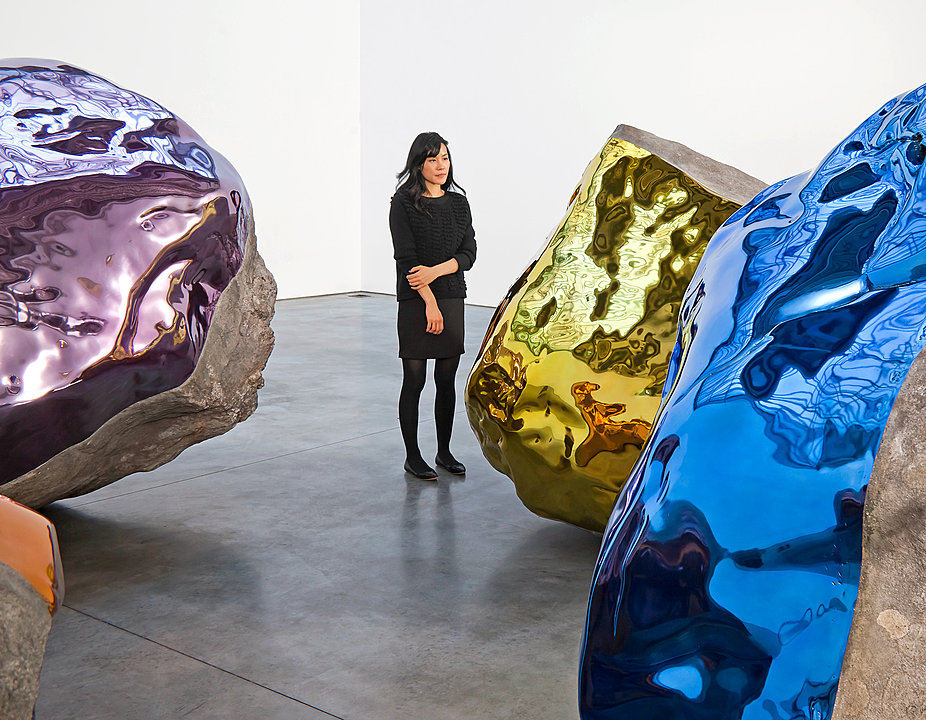
Perhaps if emerging artists bushwhack their way through creative territories, established artists have to remain true to course despite siren songs of numerous pathways (sorry for mixing maritime and terrestrial metaphors). Even in his recent massive metallized boulders, I think Hodges’ work retains its elemental, experimental and experiential aspects.

This seems to be true for viewers and for artists, including Hodges. Quoted by Heidi Zuckerman Jacobson of the Aspen Art Museum (HuffPo), Hodges said:

There are no guarantees [in art]. [Art] challenges and rewards. We get what we choose from it.

Surveying an artist’s life’s work is a great way to gain perspective. When I did a lot of research on contemporary artists in graduate school, I realized that of the artists whose work I love, the work they’re making their fifties is outstanding. Hodges is in his mid-fifties. (So is Cindy Sherman.) The message is to keep pushing, be patient, and never stop evolving.

I think it’s fantastic that the Walker is going to host a survey of Hodges’ work next year. Combined with the Walker’s amazing design team, I’m sure the catalog is going to be fantastic. Maybe a Phaidon monograph will be in order soon?
Standard