Sights

The Third Paradise presented by Cittadellarte – Fondazione Pistoletto

I love Italian Arte Povera artist Michelangelo Pistoletto’s screenprints on mirror-polish steel.

I also really enjoyed theorist Claire Bishop’s book, Installation Art: A Critical Survey (Routledge, 2005).

While Pistoletto is well-known for his mirror pieces, he has also been creating Cittadelarte, a non-profit with numerous working groups re-imagining art, life, work and more. I’m not quite sure I understand what it is, as much as glean a sense of revolutionary possibility from it. I thought I’d visit if I ever make my way to Italy, but it turns out I don’t have to go there to participate. See below for a worldwide Cittadelarte participatory program coming this December.

Bishop, on the other hand, is no fan of participatory art, and is in fact launching her latest book, Artificial Hells, at CUNY’s Martin E. Segal Theater tomorrow night.

Hold these opposing thoughts in your mind, if you can:

June 26, 2012, 6:30–7:30pm
Artificial Hells Book Launch
Martin E. Segal Theatre, 365 Fifth Avenue, New York, NY 10016

A searing critique of participatory art by an iconoclastic historian

Join art historian Claire Bishop and Carrie Lambert-Beatty in conversation at the Martin E. Segal Theatre to celebrate the launch of Bishop’s new book, Artificial Hells: Participatory Art and the Politics of Spectatorship.

Since the 1990s, critics and curators have broadly accepted the notion that participatory art is the ultimate political art: that by encouraging an audience to take part an artist can promote new emancipatory social relations. Around the world, the champions of this form of expression are numerous, ranging from art historians such as Grant Kester, curators such as Nicolas Bourriaud and Nato Thompson, to performance theorists such as Shannon Jackson.

Artificial Hells is the first historical and theoretical overview of socially engaged participatory art, known in the US as “social practice.” Claire Bishop follows the trajectory of twentieth-century art and examines key moments in the development of a participatory aesthetic. This itinerary takes in Futurism and Dada; the Situationist International; Happenings in Eastern Europe, Argentina and Paris; the 1970s Community Arts Movement; and the Artists Placement Group. It concludes with a discussion of long-term educational projects by contemporary artists such as Thomas Hirschhorn, Tania Bruguera, Paweł Althamer and Paul Chan.

Since her controversial essay in Artforum in 2006, Claire Bishop has been one of the few to challenge the political and aesthetic ambitions of participatory art. In Artificial Hells, she not only scrutinizes the emancipatory claims made for these projects, but also provides an alternative to the ethical (rather than artistic) criteria invited by such artworks. Artificial Hells calls for a less prescriptive approach to art and politics, and for more compelling, troubling and bolder forms of participatory art and criticism.

Via Art Agenda:

21 December 2012
Michelangelo Pistoletto

The Third Paradise
cittadellarte.it
rebirth-day.org

Rebirth-Day: the first worldwide day of rebirth
A great celebration throughout the world—a vital, living, breathing symbol of a new beginning.

December 21st, the winter solstice in the northern hemisphere and the summer soltice in the Southern, is a day celebrated by mankind since time immemorial.

A fateful “end of the world” connotation, as widespread as it is unfounded, has been attributed to this day in 2012, proposing a theme that is recurrent in mythologies and religions as well as in the literature of fantasy and science fiction.

All imaginative factors aside, this date can take on a symbolic meaning, as it effectively corresponds to a climactic phase of human history. We are progressing steadily toward an inevitable collapse—the science is there to prove it.

The whole of human society is now in the reckoning and so must face a historic transition, a complete change.

Humanity has gone through two paradises. The first, in which it integrated fully with nature; the second, in which it expanded into an artificial world of its own, which grew until it came into conflict with the natural world. It is time to begin the third stage, in which humanity will reconcile and unite nature and artifice, creating a new balance at every level and in every area of society: “an evolutionary step in which the human intelligence finds ways to live in harmony with the intelligence of nature” (Michelangelo Pistoletto).

A new perspective opens up that involves everyone, without exception, in the daily effort to implement the process of rebirth—each according to his or her abilities and possibilities.

On 21 December 2012, let us meet in streets and squares all over the world, and on the Web, to take part in the great inaugural celebration of the Third Paradise.

Participation in the Rebirth-day represents a personal commitment to the process of change….

Standard
Research

Frippery

Who knows, we may look back on [Wes] Anderson’s works as we do on the boxes of Joseph Cornell—formal troves of frippery, studded with nostalgic private jokes, that lodge inexplicably in the heart.

Anthony Lane, “Stormy Weather,” New Yorker, June 4 & 11, 2012

Considering objects and how they accrue significance, I’ve put these thoughts together:


Christine Wong Yap, Place Space Thing Object, 2011. Meaning is comprise of purpose or sentiment. Space plus meaning equals Place. Object plus meaning equals Thing.

Christine Wong Yap, Place Space Thing Object, 2011.

Standard
Impressions

Lesley Dill at George Adams Gallery, NYC

Via a great Chelsea photo-laden post on Words in Space:

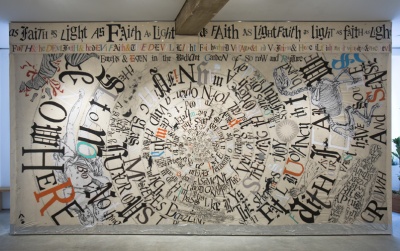
Lesley Dill, Faith & the Devil, Installation View, 2011-2012, acrylic paint, oil pastel, silver leaf, gold leaf, mixed media on cotton panel. // Source: georgeadamsgallery.com

Lesley Dill, Faith & the Devil, Installation View, 2011-2012, acrylic paint, oil pastel, silver leaf, gold leaf, mixed media on cotton panel. // Source: georgeadamsgallery.com

Closed Jun 2, 2012
Lesley Dill: Faith & The Devil
George Adams Gallery
525 West 26th Street, First Floor, New York, New York 10001

Kicking myself for missing this calligraphy-installation show! See smallish photos on the gallery’s exhibition page, and a stunning detail on Words in Space.

Standard
Community, Impressions, Travelogue

Points of Reference: West Coast

Some aesthetic impressions from a Portland-San Francisco tour:

Looking east up the Columbia River Gorge, from Crown Point in Oregon, USA. Author: Hux. // Source: Wikimedia Commons.

Looking east up the Columbia River Gorge, from Crown Point in Oregon, USA. Author: Hux. // Source: Wikimedia Commons.

Columbia River Gorge. The more I visit grand vistas, the more I understand Romanticism.

Landscape paintings don’t usually affect me—but imagine living in a crowded, dirty city in the Industrial age, then exploring such vast, stunning locales like the Columbia River Gorge, the Catskills, or the Lake District in the UK. Post-postcard, post-Ansel Adams, I might be desensitized to the images of these places, but I never fail to experience awe—smallness in light of something greater—when I visit these places. It seems natural to want to capture the grandeur and qualities of light, as much as preserve the environment for future generations. [Go Parks!]

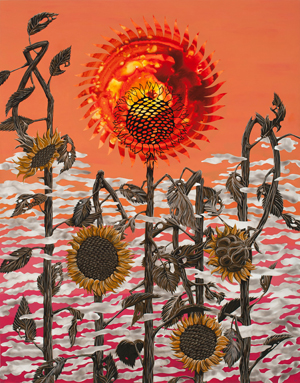
Ryan Pierce. Preview image for New World Atlas of Weeds and Rags. // Source: ElizabethLeach.com.

Ryan Pierce. Preview image for New World Atlas of Weeds and Rags. // Source: ElizabethLeach.com.

Get excited:
Ryan Pierce: New World Atlas of Weeds and Rags
Elizabeth Leach Gallery

Portland, OR
Through June 23

Really happy to catch the solo show of my CCA MFA classmate. Ryan specializes in hard-edged, post-apocalyptic narrative painting over luminous Flashe washes. He constructed this show around weeds, with tight botanical renderings of thistles, milkweeds, etc., as well as giveaways of pesticide-resistant seeds. My favorite paintings were from a sequence featuring the sun and the moon. I sensed some Charles Burchfield-esque visionary heat.

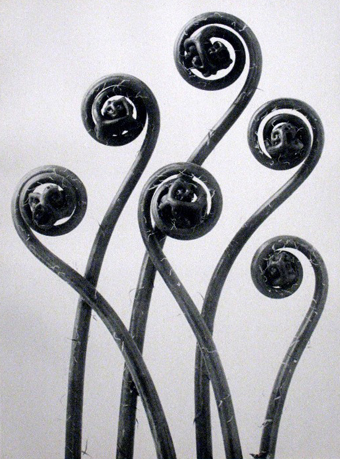
Karl Blossfeldt, Adiantum pedatum, Maidenhair fern, young unfurling fronds, 12x. // Image source: PortlandArtMuseum.org. Caption source: karlblossfeldtphotos.com.

Karl Blossfeldt, Adiantum pedatum, Maidenhair fern, young unfurling fronds, 12x. // Image source: PortlandArtMuseum.org. Caption source: karlblossfeldtphotos.com.

Karl Blossfeldt’s New Objectivity photos of botanical geometry.
70 Years/70 Photographs
Portland Art Museum
Through September 9

My knowledge of photography is a bit anemic, but this means that I get to enjoy many discoveries in the repair process. Blossfeldt’s images were a delight. See more at karlblossfeldtphotos.com.

Portland Sewing

The short: Private lessons with Sharon Blair. Highly recommended.

The long: My sewing knowledge comprised making clothes for Puffy, my stuffed Crocker Spaniel, under the guidance of my mother. (Mom’s an excellent seamstress who made some of my favorite childhood dresses. She still uses a Montgomery Ward Singer dating from the late 1970s/early 1980s; to change stitches, she manually changes a baffling array of stamped metal gears.)

Remarkably, this experience, along with much experimentation, has girded me through sewn sculptures and ribbon projects over the past few years. In the same time though, I’d accumulated a battery of questions about fabrics and techniques. Sharon, the instructor, patiently answered them all. She has tons of industry experience, and started the lesson with a quick history of sewing machine manufacturers. <Tool nerd swoon>

I got a crash course in cutting and sewing, and practiced three of the six kinds of fell seams, which will be critical for an upcoming flag project.

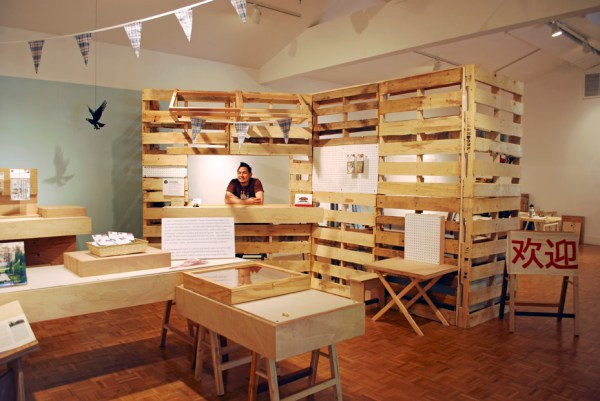
The Marianas (Michael Arcega and Stephanie Syjuco), Montalvo Historical Fabrications and Souvenirs (A Pop-up Shop), 2012. // Source: StephanieSyjuco.com.

The Marianas (Michael Arcega and Stephanie Syjuco), Montalvo Historical Fabrications and Souvenirs (A Pop-up Shop), 2012. // Source: StephanieSyjuco.com.

The Marianas (Michael Arcega and Stephanie Syjuco)
Montalvo Historical Fabrications and Souvenirs (A Pop-up Shop)
Montalvo Project Space
Woodside, CA
Through July 20

Friends’ first collaboration. It’s good. Go see it, and bring cash!

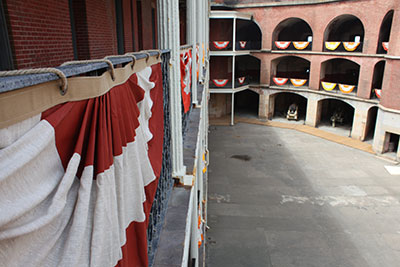
Allison Smith, Fort Point Bunting, 2012. // Source: international-orange.org. Photo: Jan Stürmann.

Allison Smith, Fort Point Bunting, 2012. // Source: international-orange.org. Photo: Jan Stürmann.

International Orange
FOR-SITE Foundation
Fort Point
San Francisco
Through October 28

Really good show in an amazing site. Go! I went on a foggy, chilly Monday (no crowds) and it was lovely.

My favorite was Allison Smith‘s Fort Point Bunting. Each of the 75 swags is accompanied by quotes from servicewomen printed on linen and framed in waxed canvas cording. The narratives were empowering. While military intervention is fraught, this insight in the battle for equal access to combat is pretty thrilling.

Stephanie Syjuco‘s International Orange Commemorative Store (A Proposition) establishes a standard of finish and level of production that is sublime, and should have most artists quaking in our boots. Anadamavi Arnold‘s crepe paper gowns were magnificent. I read Kate PocrassAverage Magazine off-site, but found it to be the most entertaining and insightful look at the Golden Gate Bridge. I also loved Andy Freeberg‘s portraits of workers on the bridge, for the diverse, recognizable subjects, rarely-seen perspectives, and cool tools.

Fort Point’s history and vistas were great to explore. I enjoyed how the show engaged the site, so that viewers browsed historical/permanent displays in the course of visiting the exhibition. I expected a strong show due to the roster of international artists; I was pleased to find that the projects that resonated with me most form a collection of articulate, accomplished female artists.

Robert Kinmont: 8 Natural Handstands (detail), 1969/2009; nine black-and-white photographs; 8 1/2 x 8 1/2 in. each; courtesy of Alexander and Bonin, New York. Photo: Bill Orcutt. // Source: bampfa.berkeley.edu.

Robert Kinmont: 8 Natural Handstands (detail), 1969/2009; nine black-and-white photographs; 8 1/2 x 8 1/2 in. each; courtesy of Alexander and Bonin, New York. Photo: Bill Orcutt. // Source: bampfa.berkeley.edu.

State of Mind: New California Art Circa 1970
Berkeley Art Museum
Through June 17

I’d heard rumors that this is the best show  many locals had seen in a long time. Unfortunately, I had only one hour, so I didn’t have the quiet mind required for uncovering the historical significance of the performance documentation and historical ephemera that ran through the show.

I loved that the show brought the major West Coast art initiative Pacific Standard Time up to Bay Area. Also, it’s not often you get to see an major survey exhibition about California art that doesn’t have a Los Angeles bias. I enjoyed learning more about seminal artists like Gary Beydler, William Leavitt, Bas Jan Ader, and Guy de Cointet (these de Cointet text drawings are fantastic, backgrounding Tauba Auerbach’s text paintings). It’s always nice to see Bruce Nauman‘s video pieces installed—here, Come Piece, two closed-circuit televisions with different halves of their lenses taped off.

The only thing that struck me negatively was the way that political art (works by artists of color and feminist artists) was the last thematic section. The architecture of the last room especially made the agit-prop David Hammons seem like an afterthought. I can’t pinpoint it, but I suspect that the early earth and performance work relates to a spiritual quest in merging art and life, and I intuit a bit of a woo-woo factor there, reinforced by the fact that my contemporaries who are especially fond of these artists tend to make transcendental works themselves.

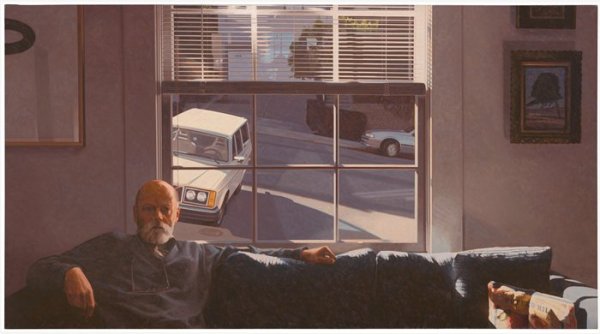
Robert Bechtle, Potrero Hill, 1996; painting; oil on canvas, 36 in. x 66 in. (91.44 cm x 167.64 cm); Collection SFMOMA, Ruth Nash Fund purchase; © Robert Bechtle  Source: http://www.sfmoma.org/explore/collection/artwork/104616##ixzz1xQHskP3n  San Francisco Museum of Modern Art. // Source: SFMOMA.org.

Robert Bechtle, Potrero Hill, 1996; painting; oil on canvas, 36 in. x 66 in. (91.44 cm x 167.64 cm); Collection SFMOMA, Ruth Nash Fund purchase; © Robert Bechtle Source: http://www.sfmoma.org/explore/collection/artwork/104616##ixzz1xQHskP3. San Francisco Museum of Modern Art.

Robert Bechtle, Potrero Hill (1996)
SFMOMA 

Bechtle is a perennial favorite of the SFMOMA’s, and mine too. This late, great painting—on view in the second floor galleries—is like five paintings in one. The JPG doesn’t do it justice. Bechtle’s understanding of reflected light and surfaces is phenomenal. This work was the highlight of my SFMOMA visit, along with Anthony Discenza’s The Effect in  the contemporary language art show, Descriptive Acts.

I expected that The Utopian Impulse: Buckminster Fuller and the Bay Area and Parra: Weirded Out shows would be more extensive. In fact, the Fuller show has two huge wall graphics that leads to a room of fantastic, large screenprint posters and transparencies. That’s followed by a group show by local, contemporary designers that is so un-related visually that my companion and I assumed that we’d drifted into the permanent design exhibit. The Parra exhibit is a massive mural, that is lovely and loads of fun, but I would have loved to see some works on paper, to get a little more intimate with the person behind these famous graphics.

I also would have loved to see more of Mark Bradford‘s video and performance works, especially documentation of his intervention at the San Diego-Tijuana border, though those could have been in the Bradford show I just missed at YBCA. The extensive selection of Bradford’s collages helped me understand the depth of his innovation with the materials (posters and curling papers) and tools (rope and power sander).

Standard
Impressions

Ecstatic Alphabet/Heap of Langauge and Tom Sachs

I am really blessed to live in NYC, as well as have days like today, when I can sample from some of its bounty.

Just as I was finishing up work early, a friend emailed to remind me about Ecstatic Alphabets/Heaps of Langauge at MoMA, a survey of text-based art. A very well-edited selection of 20th c. works on paper and printed works are on view, followed by a larger gallery with bigger projects by contemporary artists.

Among the first half-dozen works viewers will encounter are:

I was hooked. My favorite discoveries in the modern section were:

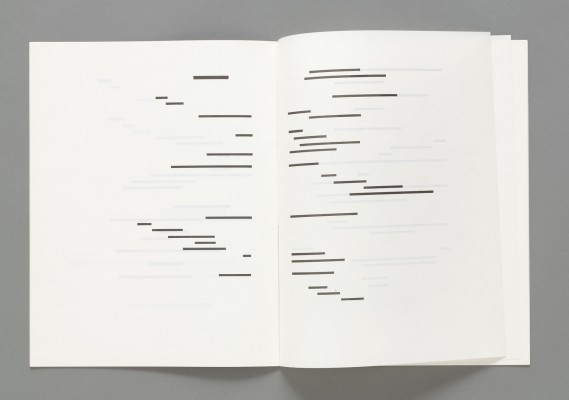
Marcel Broodthaers. Un Coup de dés jamais n'abolira le hasard. 1969. // Source: moma.org.

Marcel Broodthaers. Un Coup de dés jamais n’abolira le hasard. 1969. // Source: moma.org.

Marcel Broodthaers‘ version of Stéphane Mallarmé’s “Un Coupe de Dés…” Simple redaction rectangles on translucent vellum. Hints of what will come, and what has past, is visible. The book is time, and the open spread the present moment. It’s such a simple idea, but so well executed, that its elegance is quite profound. Being moved by simple gestures is always welcome.

Carl Andre‘s now now (1967). I have mixed feelings about Andre, but the textual/typographic gesture was so simple, yet so evocative of objects in space, that I really had a durational experience, to my surprise. (See it on page 2 of this exhibition PDF.)

There were many more works I enjoyed by Henri Chopin and Christopher Knowles. Of course, it’s really amazing and cool that Robert Smithson‘s Heap of Language is on view.

The contemporary gallery provided a nice opportunity to see Shannon Ebner‘s large photos of landscape interventions, as well as Tauba Auerbach‘s paintings.

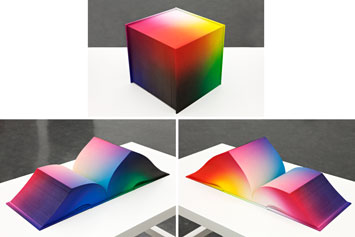
Tauba Auerbach, RGB Colorspace Atlas (Volume 1), 2011, Digital offset printing on mohawk superfine paper, 3200 pages, linen, binder's board, acrylic paint Measurements for closed book Binding: Daniel E. Kelm and Leah H. Purcell at the Wide Awake Garage in Easthampton, USA Edition of 3 / SOTA/S 2011-036/1. // Source: StandardOslo.no.

Tauba Auerbach, RGB Colorspace Atlas (Volume 1), 2011, Digital offset printing on mohawk superfine paper, 3200 pages, linen, binder’s board, acrylic paint Measurements for closed book Binding: Daniel E. Kelm and Leah H. Purcell at the Wide Awake Garage in Easthampton, USA Edition of 3 / SOTA/S 2011-036/1. // Source: StandardOslo.no.

Tauba Auerbach, RGB Colorspace Atlas. (2011). // Source: Rhizome.org.

Tauba Auerbach, RGB Colorspace Atlas. (2011). // Source: Rhizome.org.

Most of all, Auerbach’s recent RGB Colorspace Atlas series was ingenious and visually lush. They’re books—blank, hardbound, filled with pages so that it forms a perfect cube. Then, it’s airbrushed to create an RGB colorspace. Six examples are on view—three closed, three open—and they’re breathtakingly beautiful.

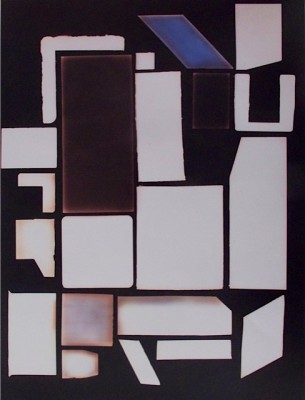
Paul Elliman. My Typographies (2). 1994 Paul Elliman (British, b. 1961). My Typographies (2). 1994. Photogram, 11 x 14" (27.9 x 35.6 cm) Courtesy the artist. © Paul Elliman. // Source: moma.org.

Paul Elliman. My Typographies (2). 1994 Paul Elliman (British, b. 1961). My Typographies (2). 1994. Photogram, 11 x 14″ (27.9 x 35.6 cm) Courtesy the artist. © Paul Elliman. // Source: moma.org.

I also appreciated getting to know the work of Paul Elliman (British, b. 1961), whose Found Fount series is a series of typologies of odds and ends. (Fount/Foundry/Font, get it?) The objects are on view, but the photograms are also very enjoyable.

A few weeks ago, I decided to switch directions in the studio and give text-based art a rest to see what would happen to my work. I was afraid that working with text might be too easy or formulaic, and result in art that is too quick a read. Ecstatic Alphabets/Heap of Language reminded me of the joy of elegant solutions—textual or not—and my love of the printed page.

The crowds were in full force for Free Fridays at MoMA, rewarding persistence and patience. About a mile uptown, I visited Tom Sachs’ Space Program: Mars, organized by Park Avenue Armory and Creative Time.

Tom Sachs. Creative Time/Park Avenue Armory. Source: CreativeTime.org.

Tom Sachs. Creative Time/Park Avenue Armory. Source: CreativeTime.org.

Tom Sach's Space Program: Mars. Source: Park Avenue Armory newsletter.

Tom Sach’s Space Program: Mars. Source: Park Avenue Armory newsletter.

It was my first visit to the Armory. I knew that art and antique fairs are held there, so I understood that it is a huge space. Still, nothing quite prepared me for turning the corner of the sole freestanding wall in the Armory, and seeing the expanse of space populated by precisely-lit installations/stage sets as well as various artist-made (or artist’s studio-made) space vehicles.

The show was unlike anything I’ve ever seen, and I found myself at a loss for words. I don’t want to ruin the experience for anyone, so I’ll leave you with the fragment M shared with me: “It’s so earnest.” The exhibition continues through June 17. I recommend attending a public program, such as the Demonstrations. And allow lots of time.

Standard
Sights

See: Common Ground @ City Hall Park, Lower Manhattan

I just spent the past few days assisting an artist producing a massive concrete sculpture for Public Art Fund’s upcoming exhibition. If the other projects in the show are as ambitious the one I worked on, it’s going to be very inspiring.

May 24–Nov. 30, 2012
Common Ground
Public Art Fund
Elmgreen & Dragset, Ian Hamilton Finlay, Roger Hiorns, Jenny Holzer, Matthew Day Jackson, Christian Jankowski, Justin Matherly, Paul McCarthy, Amalia Pica, Thomas Schutte
City Hall Park
, Bordered by Broadway, Chambers Street, Centre Street, and Park Row, NYC
Opening: Wednesday, May 23, 2012, 5:30 – 6:30pm
Performance at 5:45pm // Remarks at 6:00pm

Throughout history, art in the public realm has been a means to represent common beliefs, values, and ideals. However, in our own diverse and pluralistic society, we value art most highly as the expression of a unique personal vision. Common Ground brings together the work of an international group of contemporary artists, each with a strikingly original artistic language and a strong engagement with the civic role and context of public art.

Standard
Sights

see: Michael Jones McKean’s The Rainbow

Last year I started running a loop that spanned the East River, and I got the crazy notion of creating a massive rainbow connecting Queens and Manhattan, without the slightest notion of how to manifest such an art project. Luckily, I don’t have to; another artist has figured out how to, in Omaha.

Michael Jones McKean, The Rainbow, 2011 (test).

Michael Jones McKean, The Rainbow, 2011 (test). Source: Art-Agenda.com.

June 1–September 15, 2012
Michael Jones McKean
The Rainbow: Certain Principles
of Light and Shapes Between Forms

Bemis Center for Contemporary Arts
724 S 12th Street, Omaha, Nebraska 68102
Opening weekend: June 21–23

Michael Jones McKean’s The Rainbow: Certain Principles of Light and Shapes Between Forms creates a simple but phenomenal visual event—a rainbow in the sky. The public artwork will produce temporary rainbows above the Bemis Center using the most elemental materials: sunlight and rainwater. Twice per day with clear sun, for 20 minutes each, a rainbow will appear above Bemis Center’s downtown building.

A rainbow operates as an egalitarian visual experience. It is by nature temporary, undetermined, and wonderful. The Rainbow exists somewhere between real and representation, actual and artifice. McKean is deeply interested in the rainbow as a complex form—ephemeral and steeped in mythology—that possesses an out-of-time existence as pure optical phenomena. The image of a rainbow extends through time, surpassing our known and archived histories, and operates as a constant unchanged form. Although the symbol of a rainbow has been co-opted, politicized, branded, and commodified, an actual prismatic rainbow still has an ability to jolt us from the everyday. It feels hopeful, yearning, optimistic, ghost-like, and meaningful.


Standard
Sights

See: Light and Landscape and Tom Sachs

These look like they’ll be great show, well worth the hike upstate and uptown.

May 12–November 11, 2012
Light and Landscape
Storm King Art Center
Old Pleasant Hill Road‬, Mountainville, NY 12553‬

Storm king presents contemporary art that explores creative and conceptual possibilities of natural light.

Storm King Art Center presents a special exhibition devoted to contemporary art in which natural light is both a primary medium and a conceptual focus. Light and Landscape, organized by Associate Curator Nora Lawrence, encompasses 25 works by 14 artists who use a variety of strategies to engage with light as a central component of their art. Encompassing sculpture, installation, works on paper, and video, the works encourage viewers to contemplate not only their natural surroundings and the effects of sunlight, but also the vast impact of light on our daily lives and ecosystem.

Artists represented in the exhibition are Matthew Buckingham, Peter Coffin, Olafur Eliasson, Spencer Finch, Katie Holten, Roni Horn, Donald Judd, Anish Kapoor, William Lamson, Anthony McCall, Katie Paterson, Tobias Putrih, Alyson Shotz, and Diana Thater. Their work will be installed across Storm King’s 500 acres of hills, fields, and woodlands—interspersed with the Art Center’s permanent collection—and in the Museum Building.

May 16–June 17, 2012
Tom Sachs: SPACE PROGRAM: MARS
Park Avenue Armory
643 Park Avenue, between 66th and 67th Streets, New York, NY 10065

From May 16 through June 17, Park Avenue Armory and Creative Time join forces with artist Tom Sachs to launch SPACE PROGRAM: MARS, a four-week mission to the Red Planet that explores the universe as a path to discovering ourselves. This interactive installation recasts Park Avenue Armory’s 55,000-square-foot drill hall as an immersive space odyssey featuring dynamic and meticulously crafted sculptures, including elaborate spacecraft, Mission Control, a launch platform, a Mars landscape, and much more. SPACE PROGRAM: MARS will be manned by Sachs and his studio team of thirteen, who will perform the myriad procedures, rituals, and tasks of their mission at the Armory.

Standard