Citizenship, Meta-Practice, Values

Points of reference: Income inequality, empathy, artists, and capital

There’s something in the air…. Articles have been popping up about the intersection of the tech sector and extreme wealth, and status and the empathy gap, just as my artist friends in the Bay Area are reeling about news of galleries closing and venerable artists being evicted. To consider income inequality, class, and how artists got into the position we’re in in relation to the high-powered wealth-corrupted “art world,” I’ve been thinking specifically about capitalism.

Here are some points of reference, of which I’m still trying to make sense:

INCOME INEQUALITY:

In New York, Bill de Blasio‘s NYC mayoral campaign.

This past weekend’s Creative Time Summit. I didn’t go, but will watch some of the videos, esp Rebecca Solnit’s keynote on gentrification in SF, and My Brooklyn’s mapping- and data-driven anti-gentrification efforts.

“Will Work for Inspiration,” David Byrne’s op-ed for Creative Time Reports, includes this bit on preserving NYC for all:

I don’t believe that crime, danger and poverty make for good art. That’s bullshit. But I also don’t believe that the drop in crime means the city has to be more exclusively for those who have money. Increases in the quality of life should be for all, not just a few.

THE EMPATHY GAP:

The title says it all: “Rich People Just Care Less” is an op-ed by psychologist Daniel Goleman posted in NY Times (October 6, 2013):

A growing body of recent research shows that people with the most social power pay scant attention to those with little such power. …

Income inequality is at its highest level in a century. This widening gulf between the haves and have-less troubles me, but not for the obvious reasons. Apart from the financial inequities, I fear the expansion of an entirely different gap, caused by the inability to see oneself in a less advantaged person’s shoes. Reducing the economic gap may be impossible without also addressing the gap in empathy.

Over at the Greater Good Science Center, Jason Marsh posted “Why Inequality Is Bad for the One Percent” last year (September 25, 2012), and though it opens with then-presidential candidate Mitt Romney, it’s furnishes more background to Goleman’s op-ed…

…in a 2010 study published in Psychological Science, researchers found that people of higher socioeconomic status (SES) were worse at reading other people’s emotions—a skill known as “empathic accuracy,” a basic part of empathy.

… inequality may be self-perpetuating: The lack of compassion the rich feel might make them less likely to out look for the less fortunate, thereby increasing the gap between rich and poor—and the worse this gap gets, the research suggests, the less inclined the rich may be to do anything about it.

… insularity is an enemy of empathy.

CREATIVITY:

In trying to get a foothold in NYC as an artist, it’s nice to hear David Byrne acknowledge the difficulty:

As one gets a little older, those hardships [of surviving in NY in the 1970s] aren’t so romantic – they’re just hard. The trade-off begins to look like a real pain in the ass if one has been here for years and years and is barely eking out a living. The idea of making an ongoing creative life – whether as a writer, an artist, a filmmaker or a musician – is difficult unless one gets a foothold on the ladder, as I was lucky enough to do. I say “lucky” because I have no illusions that talent is enough; there are plenty of talented folks out there who never get the break they deserve.

ART META-PRACTICE:

Maria Popova recently posted “Happy Birthday, Brain Pickings: 7 Things I Learned in 7 Years of Reading, Writing, and Living” on Brain Pickings:

Do nothing for prestige or status or money or approval alone. As Paul Graham observed, “prestige is like a powerful magnet that warps even your beliefs about what you enjoy. It causes you to work not on what you like, but what you’d like to like.” Those extrinsic motivators are fine and can feel life-affirming in the moment, but they ultimately don’t make it thrilling to get up in the morning and gratifying to go to sleep at night — and, in fact, they can often distract and detract from the things that do offer those deeper rewards.

Jerry Saltz, who seems perpetually in a pickle about being an art world insider while trying to critique the art world’s narrow halls of power, did have this worthwhile critique to share, in “Saltz on the Trouble With Mega-Galleries” in NY Mag:

The artist is a brand, and the brand supersedes the art. The scale and pace of these places often turn artists into happy little factories with herds of busy assistants turning out reams of weak work. It’s the new Capitalist Realism.

Andrea Fraser’s “1% Art” came out last year in Adbusters, but only recently crossed my path. It’s really good, so I’ve quoted it at length:

A broad-based shift in art discourse may help precipitate a long overdue splitting off of the market-dominated subfield of galleries, auction houses, and art fairs. If a turn away from the art market means that public museums contract and ultra-wealthy collectors create their own privately controlled institutions, so be it. … It is time we began evaluating whether artworks fulfill, or fail to fulfill, political or critical claims at the level of their social and economic conditions. We must insist that what art works are economically determines what they mean socially and also artistically.

If we, as curators, critics, art historians and artists, withdraw our cultural capital from these markets, we have the potential to create a new art field where radical forms of autonomy can develop: not as secessionist “alternatives’ that exist only in the grandiose enactments and magical thinking of artists and theorists, but as fully institutionalized structures, which, with the “properly social magic of institutions,’ will be able to produce, reproduce and reward noncommercial values.”

Fraser’s post made me ask myself, “What am I doing?” If I resent how much Saltz bags on others for writing too much about the 1% art world and mega-galleries, when they and he should write about the 99%, shouldn’t I focus my efforts in the 99% as well? What does that mean for me as an artist, in relation to other artists and institutions? What does that mean for me as an art worker—an installer and assistant?
Ben Davis, 9.5 Theses on Art and Class (Haymarket Books).

Ben Davis, 9.5 Theses on Art and Class (Haymarket Books).

Finally, I read Ben Davis’ 9.5 Theses on Art and Class (Haymarket Books) in an informal book club. The book was provocative, but I’ve really enjoyed exchanging ideas with bright artists, curators and art historians in our little self-organized book club. (You can participate in a virtual book club hosted on Temporary Art Review, thus far here and here.)

Our final meeting yesterday, ended with a fascinating discussion about how our future selves might look back on this contemporary moment in art history from a post-capitalist perspective. How will we historicize this Capitalist art? What will it be like to be distanced from such narrow conditions of production?

What if artists are at the center, not the power players that Davis spends so many chapters discussing? What if I went on a 1% Art World diet, ignoring the art stars, yacht parties, the market, celebrity gossip, and auction records, how much time would I have for thinking about materials and processes?

What might a post-capitalist art world look like? What kinds of structures and institutions will artists work within? How do I turn my attention towards those alternative futures now?

Standard
Meta-Practice

Keep walking toward the mountain: staying true to your goals

Author Neil Gaiman offered practical, heartening advice in commencement speech at the University of the Arts in Philadelphia last year. The speech, and his delivery of it, is warm and generous—listening to him deliver it is highly recommended.

Short of that, I love his perspectives on persistence, quoted below. If it seems that I’m obsessed with optimism and motivational inspirations, it’s because I am. Day-to-day life is filled with the mundane: hours spent commuting, generating income, sending off applications for things that may or may not come into fruition, and so on. In the muddle of quotidian distractions, the clarity of advice from a fellow traveler is helpful.

I love Gaiman’s suggestion of how to navigate over the long haul—by envisioning a longterm goal as a distant mountain:

And I knew that as long as I kept walking towards the mountain I would be all right. And when I truly was not sure what to do, I could stop, and think about whether it was taking me towards or away from the mountain. I said no to editorial jobs on magazines, proper jobs that would have paid proper money because I knew that, attractive though they were, for me they would have been walking away from the mountain. And if those job offers had come along earlier I might have taken them, because they still would have been closer to the mountain than I was at the time.

Another way of having faith in a slow process with unforeseeable results:

A freelance life, a life in the arts, is sometimes like putting messages in bottles, on a desert island, and hoping that someone will find one of your bottles and open it and read it, and put something in a bottle that will wash its way back to you: appreciation, or a commission, or money, or love. And you have to accept that you may put out a hundred things for every bottle that winds up coming back.

The problems of failure are problems of discouragement, of hopelessness, of hunger. You want everything to happen and you want it now, and things go wrong.

… nothing I did where the only reason for doing it was the money was ever worth it, except as bitter experience…. The things I did because I was excited, and wanted to see them exist in reality have never let me down, and I’ve never regretted the time I spent on any of them.

I’ve also been observing more successful peers with a mix of envy and dread, wondering how I would cope with the constraints they perceive as imposed on them. How is it that one can avoid an upwardly-mobile treadmill, in which opportunities increase while autonomy and creative freedom decrease? Gaiman perceives what some would call a trade-off for the tragedy it is:

…The problems of success. They’re real, and with luck you’ll experience them. The point where you stop saying yes to everything, because now the bottles you threw in the ocean are all coming back, and have to learn to say no.

I watched my peers, and my friends, and the ones who were older than me and watch how miserable some of them were: I’d listen to them telling me that they couldn’t envisage a world where they did what they had always wanted to do any more, because now they had to earn a certain amount every month just to keep where they were. They couldn’t go and do the things that mattered, and that they had really wanted to do; and that seemed as a big a tragedy as any problem of failure.

And after that, the biggest problem of success is that the world conspires to stop you doing the thing that you do, because you are successful. There was a day when I looked up and realised that I had become someone who professionally replied to email, and who wrote as a hobby. I started answering fewer emails, and was relieved to find I was writing much more.

That tragic entrapment of success is not an inevitability. Keep re-assessing; be led not by fears of losing what you’ve gained, but by your commitment to your practice.

Standard
Art Competition Odds

art competition odds: 2014 Djerassi Artist Resident Program

The Djerassi Resident Artist Program received 823 applications for 80 residency spots in 2014.

///////////////////////////////////////////////////////////////////////////
/////
//////////////////////////////////////////////////////////////////////
///////////////////////////////////////////////////////////////////////////
///////////////////////////////////////////////////////////////////////////
///////////////////////////////////////////////////////////////////////////
///////////////////////////////////////////////////////////////////////////
///////////////////////////////////////////////////////////////////////////
///////////////////////////////////////////////////////////////////////////
///////////////////////////////////////////////////////////////////////////
///////////////////////////////////////////////////////////////////////////
/////////////////////////////////////////////////////////////////////////

Recipients comprise about 1:10, or 9.7% of applicants.

See all Art Competition Odds.

Standard
Meta-Practice

Home Studio 360

In a recent post, I urged working artists to value ourselves and our practices independent of commercial validation.

It’s easier to say than do. Here’s a case in point:

Because I have a hang-up that I might be perceived as a less serious artist since I work from home, I’ve never posted pics of my current studio.

Until now. 

Studio panorama. Pretty nice to have light and fresh air. The windows face out to a covered porch, where I've done a little bit of woodworking.

Studio panorama. Pretty nice to have light and fresh air. The windows face out to a covered porch, where I’ve done a little bit of woodworking.

I'm sewing the VIA signal flag project these days. I put up some ribbons on the walls so I can pin things up without constantly making new holes in the walls. Leftover insulation foam from a packing project has been turned into another pinboard for swatches (at left).

I’m sewing the VIA signal flag project these days. I put up some ribbons on the walls so I can pin things up without constantly making new holes in the walls. Leftover insulation foam from a packing project has been turned into another pinboard for swatches (at left).

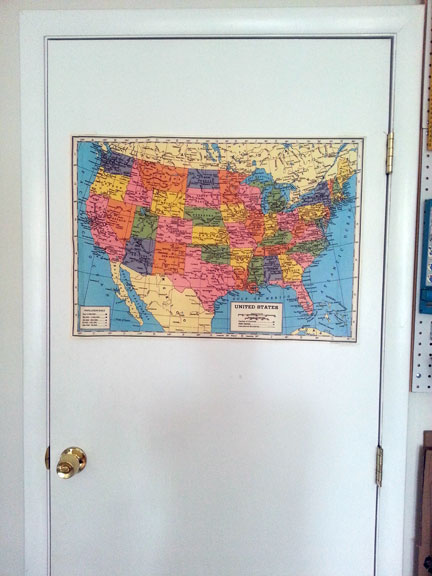
I'm guessing this map is from the 1970s. It's fun to think about all the places I've yet to visit in this huge, amazing country.

I’m guessing this map is from the 1970s. It’s fun to think about all the places I’ve yet to visit in this huge, amazing country.

As far as I'm concerned, books, artist's tape, and colorful pens are non-negotiable.

Pegboard’s irresistible promise of organization.

As far as I'm concerned, books, artist's tape, and colorful pens are non-negotiable.

As far as I’m concerned, books, artist’s tape, and colorful pens are non-negotiable.

Though I would rather have a studio outside the home, I have to admit—the convenience of a home studio is a big plus. Working from home, I’ll never have to eat a Trader Joe’s MRI or bodega junk food. I’ll never have to commute just to get the dimensions of a work of art or pick up a ruler. Other artists’ dusts, fumes, music and garbage are non-issues. Late at night, I don’t have to get creeped out in an empty building or desolate neighborhood. I get to use a full kitchen and clean bathroom! I never suffer the consequences of leaving materials or references at “home,” and bringing a fan or air conditioner, or scarf or jacket, takes all of 30 seconds.

According to the W.A.G.E. survey, 45.8% of artist-respondents reported that they don’t rent studios outside of their own residences, either. So I’m far from alone in managing my resources this way. My fears were based on assumptions of what a serious artist should be doing. But as Creative Capital mentors have said,

Artists! Don’t should all over yourself.

I’d love a bigger, more flexible studio one day, but for now, my little home studio is not too bad—and now that I think about it, it’s pretty great. I’ll try to take my own advice and Be Here Now.

WF made me this awesome trophy.

W made me this awesome trophy. Be here now!

Standard
Meta-Practice

notes on meta-practice from Bryan Cranston

Actor Bryan Cranston, who worked for years doing guest appearances and commercials, felt “stuck in junior varsity,” but persisted in his self-promotion efforts nonetheless:

The whole idea is to put yourself in a position to be recognized for your work so opportunities increase. False humility or even laziness could prevent that.

(Tad Friend, “The One Who Knocks,” New Yorker, September 16, 2013)

Author Tad Friend ascribes that even

…luck is the residue of design and devotion.

Standard
Meta-Practice

To exhibit or not to exhibit? Try a Decision Table

Along the lines of This is the Level of Nerdiness You Should Aspire To, actor and director Bryan Cranston shared a system of determining what projects to take on. Presumably it also helps him arrive at decisions faster:

he’d constructed a grid in blue ballpoint: the Cranston Project Assessment Scale. On the left were rankings from Very Good to Poor, and across the top, in decreasing order of importance, were Story, Script, Role, Director, and Cast. A very good story was worth ten points, a very good cast only two. Story and script count the most, he said, because “an actor can only raise the level of bad writing by a grade. C writing, and I don’t care if you’re Meryl Streep—you can only raise it to a B.” After factoring in bonus points (high salary = +1; significant time away from family = –3), he’d pass on a project that scored less than 16 points, consider one from 16 to 20, accept one from 21 to 25, and accept with alacrity one from 26 to 32.

(Tad Friend, “The One Who Knocks,” New Yorker, September 16, 2013)

What might such a ranking system look like for a visual artist? Artists often want to say “yes” to every opportunity that comes their way, so when they should say “no,” they deliberate about it for a while. Perhaps something like this could help artists?

Proposal for an exhibition opportunity ranking system. As each artist values each category differently, you'll have to fill in the values. Getting the math to square across different opportunities was tricky; I'm sure scientists and mathematicians who are more knowledgeable than I in designing experiments could advise on how much to weigh each cell.

Proposal for an exhibition opportunity ranking system. Since artists’ priorities are different, you’ll have to fill in the points. It also helps if you have some math/science sense to properly weigh each cell.

For me, how much I’m personally invested in a project matters. The curation should be minimally, appropriate, and ideally, compelling. Funding is always a consideration, though how significant it is depends on the project costs and the precariousness of my financial situation. The venue‘s physical spaces and upkeep, exhibition design, and organizational capacity are important to me too. Audience appropriateness, relevance, and foot traffic are factors too.

Standard
Community, Meta-Practice

Shaping the art criticism that we would like to participate in

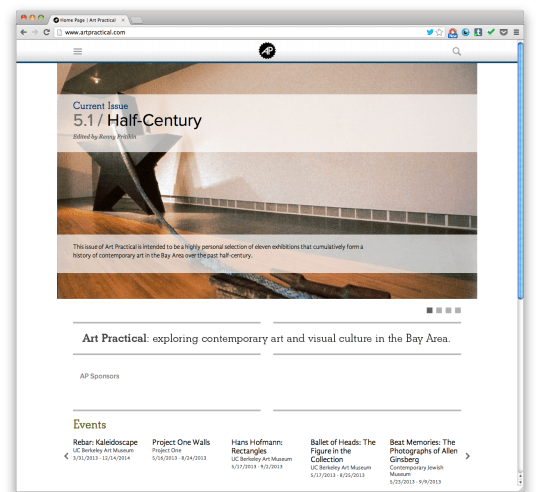
Art Practical's first issue on its redesigned site.

Art Practical’s first issue on its redesigned site.

Have a look at the re-design of Art Practical, an online art criticism platform with reviews and features focusing on San Francisco Bay Area art.

Five years ago, there was a dearth of art criticism in the Bay Area. The chances of having a review written about your work seemed maddeningly infinitesimal. I think all that has changed because of Art Practical, with its diverse base of contributors and regular bi-weekly publishing schedule. It’s better edited than most metro dailies and stays focused on substance..

Art Practical can’t single-handedly cover all the shows in the Bay Area, but does more than any other publication or platform. It also centralizes an archive of Bay Area art activity, and cultivates a new generation of critics.

Art Practical is a perfect example of what happens when dedicated people actualize an aspect of the art world they want to participate in.

If Bay Area artists still feel like there isn’t enough art criticism there, I’d challenge them to submit a Shotgun Review. Complaining about the lack of criticism won’t result in better or more criticism, as legions of Bay Area artists and art students have shown. Taking a position and crafting a review requires risk and responsibility, just like building a new platform to enhance a local art ecology.   

The latest issue features a history of Bay Area art in eleven shows.

Standard
Artists

Iran do Espírito Santo’s Poetics

Iran do Espírito Santo, Water Glass 2, 2008, crystal, edition 23/25, 14 x 8.5 x 8.5 cm. // Source: Ingleby Gallery, inglebygallery.com. If you're ever not sure what to get me for my birthday, well, this would be nice.

Iran do Espírito Santo, Water Glass 2, 2008, crystal, edition 23/25, 14 x 8.5 x 8.5 cm. // Source: Ingleby Gallery, inglebygallery.com. If you’re ever not sure what to get me for my birthday, look no further.

Tonight’s artist talk by Iran do Espírito Santo, a Brazilian sculptor and installation artist, energized me. It was part of the Public Art Fund’s excellent series of talks at the New School’s Vera List Center.

Santo constructed a slide lecture that began with a sequence of formally related artworks—a room with circular cutouts, followed by a plaster block with Swiss cheese holes dug out with coins from different currencies, followed by an installation of plaster hemispheres on gallery walls. From there, Santo showed site-specific wall paintings that referred back to the existing architecture, such as floor-to-ceiling brick pattern painted inside SFMOMA in 1997 referring to the brick façade outside. He showed “folding” glass plate installations, wall paintings of gradations of grey, and solid sculptures based on specific forms, such as tin cans, pint glasses, and lamps. 

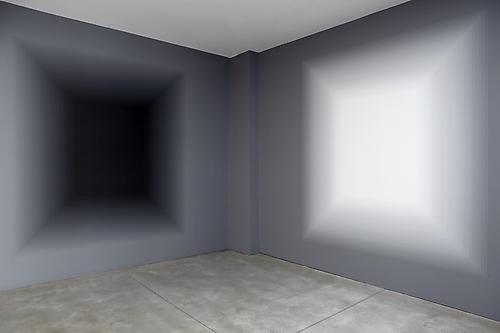
IRAN do ESPÍRITO SANTO SWITCH, 2012 latex paint on wall dimensions variable unique // Source: Sean Kelly Gallery, skny.com.

IRAN do ESPÍRITO SANTO
SWITCH, 2012
latex paint on wall
dimensions variable
unique // Source: Sean Kelly Gallery, skny.com.

Santo delivered his talk in a matter-of-fact way: In this project I did this, this site was that. He didn’t get into what he was thinking or trying to do. At first, I wanted to hear more—to ask what Jon and Anna from Eastport asked me, because they wanted to ask all artists:

Why do artists make art?

I wanted to know why Santo made what he made.

As the images continued, however, the question seemed less pressing. Though Santo worked in many media, they all seemed to make sense as a body of work. There was a coherence of sensibility and thought to them, even if I couldn’t spell it out how or why.

I still tried to find a logic or connecting thread to them, and here’s what I formulated: Santo’s work is rarely representational but often mimetic (having a referent), while some of his work, such as the gradient paintings, aren’t mimetic. They are about perceptual experiences. What these divergent works shared is open-endedness, a need to be interpreted or looked at, which seemed to suggest generosity or consideration of the viewer.

Santo spoke beautifully about his concern for the viewer. He explained that he (I’m paraphrasing)

envisions his work operating cinematically, because as viewers, we are moving cameras.

I love this idea, because I think a lot about how the aesthetic experience unfolds over time, and how looking is a process that at times is simultaneous and at times sequential.

He also said something like

how the viewer accesses the work is part of the works’ poetics.

That’s a fantastic and fascinating choice of words. I am excited to continue to consider the idea of poetics in terms of art, mulling over theories of how things take an effect on viewers, in Santo’s art, and my own.

A few more insights I learned tonight are below. If you already like Santo’s work, you can skip this paragraph. The following info will not better equip you in your encounter with the work, as you already have what you need. Read on, however, if you’ve yet to be won over.

While I don’t want to conflate the artist with the art for oeuvres like this, more facts about Santo help contextualize his work. First, he has a background in photography, which he discussed during the Q&A when someone asked about the tension between the Platonic ideal and the found. (This is an uncommon case where the Platonic ideal is actually relevant, as so many of Santo’s work are in such a state of material perfection that they seem otherworldly.) Santo explained that perhaps his photo background relates to his interest in reducing images, simplifying forms, and seeing light. Another audience member’s question prompted Santo to discuss his interest in architecture, which formed the support and informed the content of his wall paintings. But for his objects, too, I can see a rigorous, almost severe formalism that seems related to architecture, or what we mean when we describe something as “architectural.”

Playground, Santo’s project for the Public Art Fund, is on view through February 16, 2014 in Central Park.

A few of Santo’s works will also be on view in a group show at Sean Kelly gallery that opens Friday.

Standard