Check out my list of Resources for Becoming an Activist.
Author Archives: cwongyap
We Got Each Other’s Backs: Downloadable Solidarity Poster
[Updated 11/19/2016: A bilingual Spanish poster has been added.]
Here’s a call for solidarity among all the people targeted by Trump. Download this poster in English or Spanish, print and share it under a Creative Commons License (Attribution-NonCommercial 4.0 International).

Christine Wong Yap, We Got Each Other’s Backs, 2016, letterpress print, 12×18 inches.

Christine Wong Yap, Nos Cubrimos Las Espaldas/We Got Each Other’s Backs, 2016, letterpress print, 12×18 inches.*
Today, passing Trump Tower amidst other shellshocked New Yorkers, I thought about all the people Donald Trump has alienated on his path towards the US Presidency. I thought about women, African Americans, Latinx, immigrants, Muslims, LQBTQs, and the disabled. I was reminded that other artists have responded in crises, and then I was motivated by how disparate groups can unite in spite of this targeting. The despair was real, but our skills, and our capacities for solidarity and resistance, are too.
I printed this poster today. It’s letterpress-printed, with pressure plate and wood type. B organized a meeting at an art non-profit*, and I intended to distribute posters there. But as I was finishing up printing, a group of Latinx came in to the printshop. It was an ESL class from La Guardia on a field trip. They did not like Trump and were delighted I gave them posters. It was clear they were really proud to express their resistance.
—
*Thanks Young Zo for the translation help! I could design this poster in different languages; translation is my biggest obstacle. If you can help with translating this idiom into other languages of those groups particularly targeted by Trump, let me know!
—
Addendum (December 5,2016)
“We Got Each Other’s Backs” is a principle. The poster serves to remind ourselves and each other. But we must also back up those words with actions. It is not enough to perform allyship. Trump and his Islamophobic, homophobic, anti-immigrant, anti-reproductive rights cabinet will wield real power, enact real laws, and hurt real people’s lives. We have to actively resist and take risks, especially when it is inconvenient, uncomfortable, and risky.
I am disheartened to read that NYC subway riders did not intervene when three drunk men recently harassed an 18-year-old Egyptian American woman wearing a headscarf. (Though the Times reported that bystanders on the platform tried to stop the attackers from escaping.) But I’d expected that subway riders would speak up. Silence is complicity. Passively allowing rights to be eroded is anticipatory obedience to white supremacy.
Yet how can I say that I would have intervened? It is indulgent to imagine scaring off attackers with righteous indignation. But the reality is that I wasn’t there, I didn’t feel the intimidation or fear, and I don’t know how to defuse a situation. I’d like to think that being present—as in #illwalkwithyou—would help. But what a gamble (and pretension) to risk your and someone else’s safety on the assumption that your untutored participation (or privilege) will stop a bigot.
So I’m going to a community workshop to learn tactics to intervene productively. Join me.

If you can’t make it to Western Queens, invite trainers to conduct a workshop at your school, workplace, or community. Or, read “How to Help if Someone Is Being Harassed,” by Anna North (New York Times, November 23, 2016), including the links in the last paragraph.
Not My President
Friends abroad and fellow citizens, with Donald Trump winning the race for President of the United States, I want to let a few things be known:
I voted for Hillary. She was the most qualified candidate, with her a long career as a lawyer and public servant, and deep knowledge of international affairs. I had a few reservations about her hawkishness towards Russia, but there was no question what was the right thing to do in the voting booth yesterday. I voted to the best of my ability as a citizen, and I voted my conscience.
Donald Trump does not represent me. His hate-filled, divisive, misogynist, xenophobic rhetoric is offensive as words, and terrifying if translated into action. I don’t believe in further militarizing the US-Mexican border. I don’t believe in breaking up families with undocumented students and workers. Unlike many in the US, I don’t believe that our country is fundamentally Christian, or that fearing Muslims and Islam is rational. The thought of barring Muslims recalls Japanese American internment—one of the dark periods of American history. Further, I believe that Trump is a megalomaniac. He’s ill-prepared and ill-suited, and driven by his own overinflated self-image. When he lies about what he’s said on the public record, it seems, frankly, delusional. I do not believe he knows what’s best, or that he possesses the humility necessary to learn. His attitude towards women is regressive; we are more than objects or a demographic segment, we’re 51% of the world. Trump has led a cloistered, elite life, and they way he talks about Black and brown communities reveals ignorance and limited real world life experiences. He’s known for stiffing workers and avoiding taxes; he values profits over people—objectionable in business and wrong for lawmaking. His campaign has been short on substance and long on fear-mongering. Rural white people who have voted for Trump to preserve carbon-fuel jobs, to balm a fragile sense of whiteness, who are nostalgic for peak white privilege, it’s a pity you feel so disenfranchised. But there is a lot more at stake than draining non-renewable resources and reassuring white identity.
What inspires me. Yesterday, after I voted, my heart swelled with patriotism. I was looking forward to the first female president, and to stop hearing Trump’s incendiary rhetoric. Friends posted about living in the future that suffragettes made. H made a great point that’s easy to forget: the majority of people living in America couldn’t vote before 1920, and even then people of color couldn’t vote until 1965. It felt great to exercise this hard-won right among neighbors. I thought about my mom, and how she still displays a newspaper clipping from the early 1980s. It’s from our small town newspaper, announcing that she and a few others had become naturalized. My mom’s education was curtailed by economic necessity and the Vietnam War; she’s proud of studying hard, passing her naturalization test, and becoming a citizen.
Disappointment. The more I’ve traveled within the US, the more I’ve deepened my appreciation of its cultural diversity. I love that places like Santa Fe; Wichita; Minneapolis; Portland, OR; and Eastport, ME are so distinct. Our diversity and commitment to equality and pluralism are what makes America’s promise great. It’s intensely disheartening that so many fellow citizens are willing to take such a massive risk on a candidate with no experience as a politician, out of fear that a female candidate may carry on the legacy of our first Black president.
If you voted for a third-party candidate in a state like Florida, Michigan, North Carolina or New Hampshire… While in principle everyone should be free to vote their conscience, the way our electoral system is set up, some votes do matter more than others, and I’d argue that the responsibility to vote strategically surpasses the modest amount of self-expression of a protest vote. If you want to change the system, do it with advocacy and legislation.
The presidency should be decided by popular vote. The electoral system was created to benefit slave-holding Southern states. It’s archaic, un-Democratic, and confusing to the common citizen. Urge your representatives to support the National Popular Vote bill.
Interdependence and politics
Over the past year as I’ve been working on Ways and Means, I’ve been thinking about interdependence, stewardship, and agency. I’ve been mulling how becoming accountable to a shared space and ethos is an intentional act, and how it’s similar to citizenship and being accountable as a political being. On Election Day, an article exploring the relationship between neighborliness and politics seemed especially salient to me, both as an artist and a voter.
Joshua Rothman’s “Enemy Next Door” (New Yorker, November 7, 2016; appears online as “Red Neighbor, Blue Neighbor”) is worth reading in its entirety; here’s what struck me.
Like many, I’ve struggled to stay engaged and optimistic about democracy and fellow citizens’ judgment. Rothman perfectly describes the sense of delimitation I’ve been seeking in response, as well as past feelings about being an activist simultaneously with being an artist.
Politics matters enormously; it’s right to care, to feel alarmed, and to argue. … And yet politics can become a poisonous influence in our lives. … It fills us with unwanted passionate intensity. Perhaps, somewhere in the territory of the self, a border marks the place where our lives as citizens end and our sovereignty as individuals begins.
What qualities contribute to interdependence and collaboration? Acceptance and open-mindedness.
Throughout American history, [author of Good Neighbors Nancy] Rosenblum finds, … good neighbors are “decent folk.” Decency, here, is a circumspect sort of virtue. Being decent doesn’t necessarily mean being good. It means accepting the flaws in others and returning, despite disruptions and disappointments, to the predictable rhythms of reciprocity.
I’m interested in self-initiated acts of agency and mutualism, because the empowerment and optimism that follows are compelling. It feels nice to move forward to an ideal, rather than merely pushing back against an existing system.
When politics turns against us—when we can’t trust Congress, the courts, or the police—we still look to neighborliness as a source of “democratic hope untethered to public political institutions.”
I’d venture that many social practice projects have similar rationales—that an aesthetic interpersonal gesture might temporarily reconfigure social and political relations.
…these moments of neighborly kindness aren’t, strictly speaking, political. In fact, they are anti-political. They come about because neighbors insist on relating to one another as individuals, rather than as members of parties or groups….
If temporarily reconfiguring political relations through a social practice project is anti-political, so be it. But Rosenblum warns against equating neighborliness with citizenship, through theories of holism versus pluralism:
…the implication was that, by tapping into a reservoir of neighborly good will, we might arrest the slide into polarized dysfunction. This is a comforting idea. As individual voters, we can do very little to reform our broken political system, or to change the apocalyptic tenor of today’s political campaigns. But, as neighbors and friends, we can redeem politics through ordinary human decency.
Rosenblum is skeptical of this theory. She describes it as a species of “social and political holism.” Instead, she argues, American life is characterized by “pluralism.” … We are, simultaneously, citizens, workers, neighbors, parents, lovers, [and artists, activists] and souls; in each of these spheres, we observe and uphold different rules and values. … Our values aren’t conveniently unified. They’re discontinuous.
If we can accept this contradictory nature of our selves, it seems, then we can accept our fellow citizens.
…It’s tempting to commit a kind of moral synecdoche—to take a part (e.g., voting for Trump) for a whole (being a bad person). [“The reverse is true, too, of course. Our “good” political beliefs don’t make us good people all the time,” Rothman added in a later passage.] To the extent that we avoid this, it’s by adopting a pluralistic view of the people around us. … In its strongest form, pluralism is a theory of selfhood. American democracy, Rosenblum thinks, is founded on this theory. We have in common the understanding that we contain multitudes. Reconciling ourselves to the contradictions of pluralism is what makes it possible for us to unite as a people.
Finally, the best way to make political change is to make political change.
After the election, the return of neighborliness will be reassuring. It shouldn’t be. The political stream is still tumbling along out there, as turbulent as ever.
Ways and Means: Points of Reference
A few past notes and new points of reference related to my Ways and Means project, on view through October 15 at Kala Art Institute.
—
Ways and Means came out of my Inter/dependence ‘zine, a report focusing on self-organizers. I loved the way Adam Gopnik wrote about Jane Jacobs’s interest in self-organizing [emphasis added]:
[In The Death and Life of Great American Cities, Jane Jacobs] told the story of a little girl seemingly being harassed by an older man, and of how all of Hudson Street emerged from stores and stoops to protect her…. She made the still startling point that, on richer blocks, a whole class of eyes had to be hired to play the role that, on Hudson Street, locals played for nothing: “A network of doormen and superintendents, of delivery boys and nursemaids, a form of hired neighborhood, keeps residential Park Avenue supplied with eyes.” A hired neighborhood! It’s obvious once it’s said, but no one before had said it, because no one before had seen it.
The book is really a study in the miracle of self-organization, as with D’Arcy Thompson’s studies of biological growth. Without plans, beautiful shapes and systems emerge from necessity. Where before her people had seen accident or exploitation or ugliness, she saw an ecology of appetites.
—Adam Gopnik, “Jane Jacobs’s Street Smarts,” New Yorker, September 26, 2016
This sense of acting out of necessity, or appetite—the agency and empowerment of creating a desired condition to exist within—is a huge inspiration to me.
—
Most of the activity kits in Ways and Means have two components: printed ephemera, housed in a canvas tool pocket or pouch (which can be attached to an apron, belt, or garment). The pouch is important to me, as I see a strong connection between physical agency, and social or political agency. Freedom is first and foremost about mobility. And feeling free—say, as artists—means that we don’t have to shape our lives around systems whose values we don’t believe in. In many ways, the project is about recognizing the tools, skills, and resources (read: each other) that we already carry, made physical by the tool pouches.
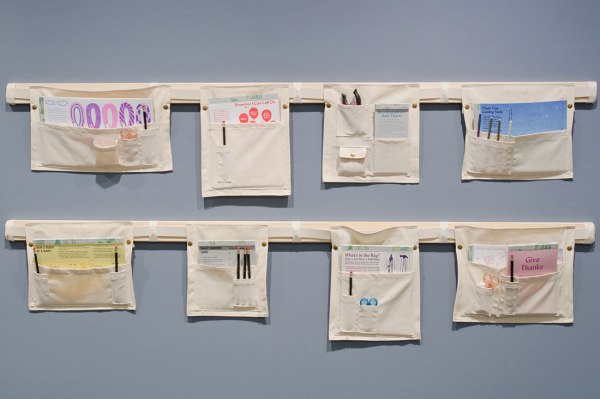
Activities housed in canvas pouches, displayed on a wall. Participants can attach them to garments using the snaps. Supported by a Fellowship from Kala Art Institute and an Artist-in-Residence Workspace Grant from the Center for Book Arts. Photo: Jiajun Wang
With that in mind, Chelsea G. Summers’ “The Politics of Pockets” (Racked, 9/19/2016) is an intriguing history of pockets from a feminist perspective. It starts with the fact that in Medieval times, men and women carried pouches attached to their waists. (The following several hundred years of gender-policing-via-pockets seem like an aberration to me.) The essay also touches upon the intersection of pockets and bicycling—again, mobility implying freedom.
—
One of the responses to Ways and Means has to do with the number of components involved. As there was a lot of letterpress printing, the process was particularly preparation-intensive. Here’s how I kept track of things:

Workflow spreadsheet for managing each activity kits across multiple stages.
I am not saying this level of nerdiness is always warranted, and I think many people would chafe at organizing creative production this way. But letterpress printing takes a special kind of detail-oriented person—hence the aphorism, “check your ‘p’s and ‘q’s.” This chart was useful for getting all the pieces—plates, type, paper, board, fabric—in place before I started printing. And getting different activities to converge at similar stages was helpful, e.g., buying paper in one trip, or binding all at once. Seeing that things were in-progress helped me stay focused; there is always something to do. And when you’re working in more than one space—such as a studio and printshop on opposite ends of a complex, or a home studio and a printshop in another borough—it’s nice to remember to pack the right materials for the day’s tasks.
A minor innovation that took a while for me to arrive at is this (it’s also a peek at a forthcoming activity):
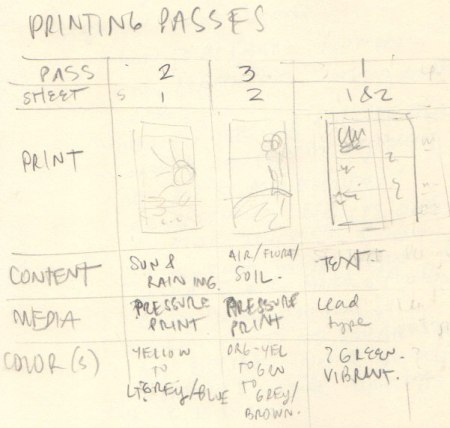
A chart of printing passes.
Some activities entail multiple printing passes using different inks and media, and it could get confusing. I found that charting it this way helps me to visualize the steps, and prepare the plates and type accordingly. I may have even saved myself a fourth pass on this one. Pass 1 is done, 2 and 3 remain. To be continued…
A Simple Bookbinding How-to
[Reposting from Instagram] Here’s a bookbinding how-to I made while binding a collaborative activity with Leah Rosenberg for Ways and Means (on view now through October 15 at Kala). The project was printed at Kala Art Institute in Berkeley, CA, and bound at the Center for Book Arts in NYC.
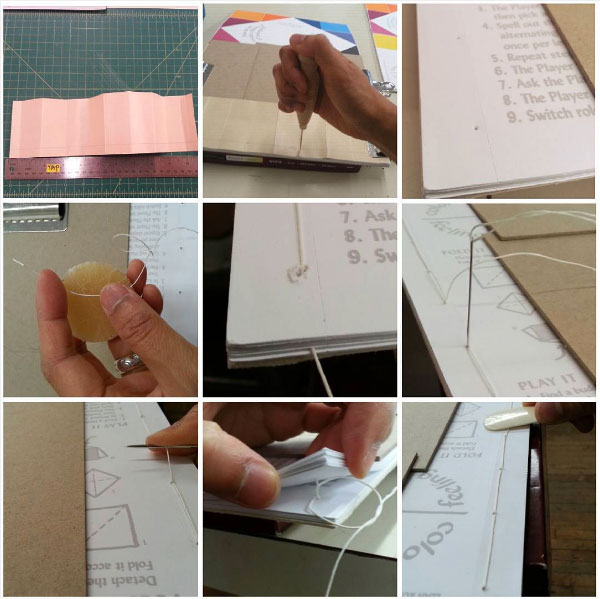
Bookbinding steps, part 1 of 2. Make a 10-hole guide. Transfer with a pin tool (to your block squared out and bulldog clipped between boards). Drill holes with a Dremel. Beat down the swell (burnish burrs with a bone folder). Wax 18-30 gauge linen thread. Straight stitch forwards then back. Snug it up. Tie a square knot in the middle of your text block. Beat down again. Techniques picked up from Nancy Loeber and Uriel Cidor at the Center for Book Arts.
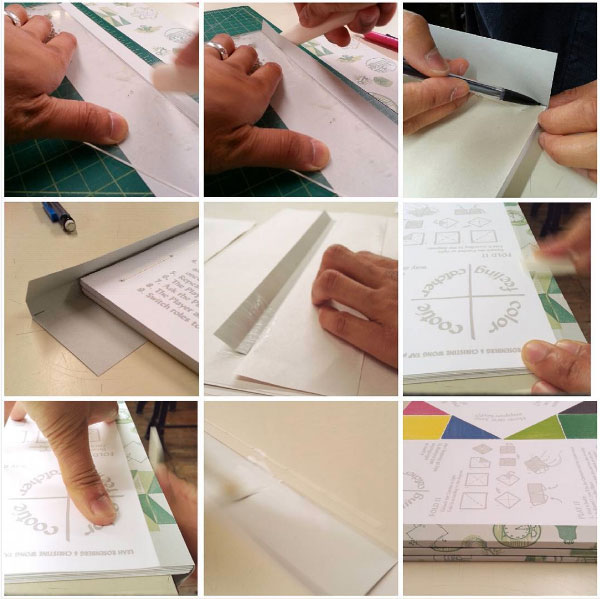
Bookbinding steps, part 2 of 2: Glueing the spine wrap. Cut paper and score to depth to cover stitches. Fold up using triangle and bone folder. Mark spine width, score and fold. Dry fit. Brush on PVA from folds outward using a newsprint mask. Place on block and burnish top and spine. Stand up book on spine and repeat on back.
Twelve Months in Art Competitions
Stats on my art competition applications from July 2015 to June 2016.
Though my goal was to apply to 18 competitions, I applied to only 6 in order to fulfill opportunities received in this period.
I applied to: 2 residencies, 0 fellowships, 1 exhibition/museum submissions, 1 studio program, 1 grant/award, 0 public art commissions, and 1 professional development programs.
++++++
I received: 1 residency.
++++++
One application was solicited following a recommendation from a fellow artist. Following another application, I received an inquiry for a studio visit with a curator.
++++++
Of the 6 entries, my overall success rate was 1 out of 6, or 16.6%.
I paid $15 for a single application fee. Five out of six applications were free.
0$0000
Kala Fellowship: Residency Notes, Part 2
A few notes on my residency in June and July, with personal reflections. A continuation of “Kala Fellowship: Residency Notes, Part 1.”

Christine Wong Yap, including collaborations with Sarrita Hunn, Leah Rosenberg, and Elizabeth Travelslight, Ways and Means, in Kala’s Fellows exhibition, Appro-propagation, on through October 15. Photo: JiaJun Wang. Works developed at Kala Art Institute’s Fellowship program, as well as in the Center for Book Arts’ Workspace Grant program.
I returned to Kala from early June to late July for a second residency stint. Over those six weeks, I developed new work—including collaborations with Leah Rosenberg, Elizabeth Travelslight, and Sarrita Hunn (Institute for Autonomous Practices)—and installed it in the Kala Fellows’ exhibition (currently on view through October 15). [Update: I’ve posted photos on my website.]

Screenprints in the drying rack for a game developed in collaboration with Sarrita Hunn (Institute for Autonomous Practice). The top layers are cards, including some inspired by questions in my recent zine on interdependence. The bottom layers are canvas game “boards.”

Press lock-up on the delightfully light Vandercook SP-15. For Friendship Field Trip, a collaboration with Elizabeth Travelslight. It comes in four pieces, each describing an activity to deepen a friendship. The back of all four assembles into a map/poster.
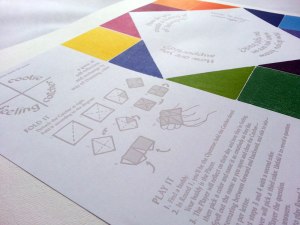
Detail of Color | Cootie | Feeling | Catcher, an activity developed in collaboration with Leah Rosenberg. 13-color woodcut and polymer plate letterpress print.
This experience was extraordinarily positive, like my January/February stint. Here are a few updates:
Busier printshop. There were more AIRs and Fellows in town for the summer season. The chill, atelier-like vibe often gave way to a bustling hive of printing. The screen printing equipment was especially popular.

Fellows and staff took a break for lunch.
New Fellows Ronny Quevedo (Bronx, NY) and James Voller (New Zealand/Melbourne), Honorary Fellows Katie Baldwin and Chris Thorson, and AIRs Aaron Hughes and Mikey Kelly arrived or continued their visits, and I enjoyed getting to know them and work alongside them.
Staff changes and special mentions. New Studio Manager, Ben Engle, is upbeat and enthusiastic about printmaking and helping people. Artist Program Manager Carrie Hott is leaving to pursue other things (check out her show at Mills College Art Museum through August 28).
Kala is a special place, run by extraordinarily dedicated people. For example, I needed to borrow a table from Southern Exposure (thanks SoEx and Val!), and Art Sales Manager Andrea Voinot picked it up on her day off. I feel indebted to Kala and the people whose labor, energy and generosity make it work.
Deadlines. My prior stint involved experimenting to learn techniques. But for this visit, I had to focus on finishing work for the show. The numerous steps involved in my project—preparing the art, printing, binding, sewing, installation—quickly became an unyielding reality I had to cope with.
I think I could have scheduled my production a bit more strategically, especially when it came to collaborations. I felt like I was running out of time. As an art handler, I felt that my work should have been done ahead of the installation period. But as an artist, I realized that this is all new work—quite a bit of it, with an involved installation, and it’s not the same thing as installing existing works.
Thankfully, I received assistance with perforation, lighting, and photography from interns Katrina and Sean, and sewing assistance from my mom, Sophia Wong.

Mom proudly sports the apron she just finished sewing in the artist’s project space at Kala.
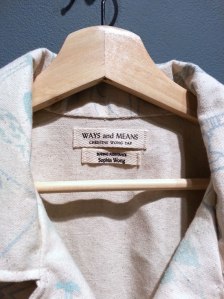
Detail of a lab coat sewn by Mom.
Work/life balance. As with other residencies, I got really invested in productivity. I was often at the printshop by 7am—partly to beat the bridge traffic, and partly to get things done (aided by starting out on East Coast time). I made the most of my time at Kala, but I can’t say the same about the Bay Area…

Early mornings in the printshop.
I could have been more present for family and friends, been a more patient and kind collaborator, seen more art (especially the new SFMOMA, Ed Ruscha show at the DeYoung, Torreya Cummings’ installation at the Oakland Museum, Postscripts to Revolution at Southern Exposure, and Bizarre Bazaar at Root Division) and spared myself some of the 12-(up to 15.5-)hour days. It’s paradoxical to sacrifice relationships to make art about interdependence. But I’m not sure what I could have changed, if I had the chance to do it again. There’s only so many hours in the day, and it was already a privilege (as well as financial and marital stretches) to be away so long.
Interdependent, communal spaces. At Kala, I thought about Elizabeth Travelslight‘s description of being a co-op member in CO-LABORATION:
It becomes quite habitual—you get in the habit of seeing people fully and being seen fully.
That was how I felt at Kala. The collective ethos there can be enlivened with little effort, mainly greeting people, communicating openly, and generally having faith in others. I had to adopt these attitudes and behaviors (it felt almost Midwestern…). I felt welcomed and very much like a thread in the social fabric. Colleagues were encouraging, helpful, and friendly. Even with my middling technique, I was accepted… It was validating.
—
[Addendum/Tangent:
With the help of LR, I realized that these are the same feelings I felt at gyms Pacific Ring Sports and Fight and Fitness this summer, and are the same motivations for training amongst others. I hadn’t realized the connection until LR visited PRS and pointed out how members can similarly cultivate a spirit of mutual respect and encouragement. That validation grew my sense of value within these communities, which can become like chosen families. To be encouraged to keep training, and to come back anytime by people who’d easily submitted me, or who I’d accidentally headbutted, melts my heart. It’s about sportsmanship, but moreover, shared experiences of hard work and growth. These gyms and Kala provided opportunities to be humbled, to develop new skills and new friends, to be accepted, and to be grateful. I felt my sense of value and integrity being grounded by being seen and seeing others, and gained lived experiences of ordering aspects of life interdependently.]

The head coaches at Pacific Ring and Fight and Fitness were all from Fairtex, whose SF gym has since dissolved. I started out there too, about 15 years ago. After a hiatus following my move to NYC, I’m revitalizing my appreciation for the development and relationships gained through this type of training. The Bay Area has an embarrassment of riches when it comes to quality muay thai and BJJ training; I recommend residents avail themselves to it.
 R+D
R+D 