Art & Development

Here’s to women and risk-taking

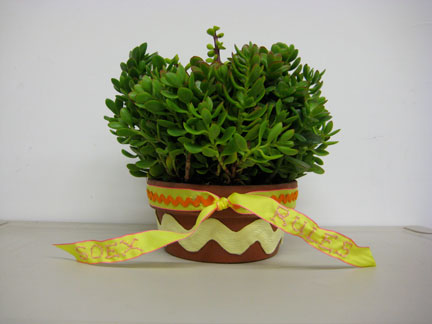
Housewarming. The ribbons are embroidered with SoEx Rules.

Housewarming. The ribbons are embroidered with SoEx Rules.

CHEERS to the female-staffed SoEx, for successfully pulling off the grand opening of a beautiful permanent home.

and

CHEERS to Stephanie Syjuco, for successfully bridging her interest in black markets with a commercial art fair, to critical acclaim. It’s a dicey proposition to put other artists and galleries’ livelihood (and by extension, one’s own popularity and career if there’s a bad fallout) at stake but Stephanie forged (ahem!) ahead with a great idea, and it’s proven to be a timely commentary on the art market and the economic climate. Read about Copystand, her project at the Frieze Art Fair on NYTimes.com and Guardian.co.uk.

These feats are admirable. It’s pretty extraordinary to be so committed to a vision and a practice. You could say that being an artist is like being a small business owner — the fact is, most people don’t have the stomach for the financial ups and downs, much less the creative ones.

There’s nothing wrong with being ambitious.

Calvin Tompkin’s recent profile of contemporary artist Urs Fishcher in the New Yorker left me with two major takeaways. Curiously, they had nothing to do with art practice — Fischer seems too mercurial to extract much substance in that area. Rather, I was quite impressed with Urs Fischer as an organization.

Tompkins described a visit to Fischer’s studio, where the staff ate lunch — loaves of french bread and cheese — communally in the studio kitchen. I loved this. If I ever have staff, I’d like it to be the kind of work environment where a convivial meal is part of the day. (I’d add tea, fruit and chutney to the pantry.)

Second, Fischer employed close friends whose honesty and judgment he could rely on. Only very successful international artists can command fees that allow for full-time staff, yet I find the idea of paying people who I love and trust, and treating them well as colleagues, to be really beautiful and inspiring.

It’s wildly ambitious for me to imagine myself in Fischer’s shoes. Yet these mental notes form a welcome alternative to the model of the lone artist toiling away in isolation and struggle.

Standard
Research

style points

Random items from the bitstream floating my boat right now:

olafur eliasson skateboard for mekanism
Olafur Eliasson’s deck design for Mekanism Skateboards. So pretty and unusual. A feat of boardmaking technique.
(Image source: Mekanism Skateboards)

design nurd bow-tie necklace
These bow-tie necklaces on DesignNurd.

augusten burroghs, nytimes
Augusten Burrogh’s typographic ornament tattoos.
(From NYTimes.com, photo by Piotr Redlinski for The New York Times)

Standard
Art & Development

o! the joy of teaching

I had a great day of sharing knowledge. I presented my work in Sydney Cohen‘s 2-D class at CCA, and taught my Sketchbook Drawing class at the ASUC at UC Berkeley.

The 2-D class is for first-year undergrads in all departments. Though my work is fairly conceptual and 3-D, the students seemed responsive to my non-art materials such as the night lights in Dark into Light. They also asked great questions, like Do you come up with a concept first to execute? (While I often start with an idea, the project takes form as I’m working), and this gem: You mentioned your frustration with the limit of available materials — would you rather have any imaginable media to work with? (Yes, but no, the material’s manufacture and limitations often inform the work). Another student asked How do you choose what books to read? (The Road is perhaps bleakest of novels, and Dreams of my Father is most optimistic of memoirs. Psychology books are is easy to find, because psychologists always reference other researchers.)

My talk is littered with quotes and references, but the unglamorous reality is that I don’t actually retain much of what I read. I’m too much of a spazzy multi-tasker to absorb and recall information. I have to synthesize it. And the only way I’ve found to synthesize and retain information — my personal method of aperception — is to write extensive notes by longhand in my sketchbook. In fact, I looked up Holly Schorno‘s name in sketchbook #15 today, so I could present her work in my Sketchbook Drawing class.

I proposed Sketchbook Drawing, a six-week class, to the ASUC at UC Berkeley. They run art classes open to Cal students and the general public.

My goal was to make the class fun, safe for experimentation, and keep the students — who had a variety of previous art experiences — engaged. I skimmed fundamentals like figure drawing, gesture drawing, cartoon skeletons, contour drawing and color theory. My interest lies more in creative self-expression and mixed media fluidity than realism or mastery. In my own experience, drawing everyday is the only surefire way to improve one’s observational skills, and a sketchbook practice is a great place to start.

I had taken a few years off of teaching, and I had reservations about returning to it. But students that are responsible, self-motivated, and eager to learn has made teaching a dream. It’s been fun to present the work of artists and illustrators filtered through my tastes (Eric Drooker, Henri Matisse, Jess, Weston Teruya, Charley Harper, Maurice Sendak, Raymond Pettibon, Michelle Blade, John Audobon, Dan Eldon). Of course it’s really great that many of my students responded appreciatively to the class and are enthused about the next 6-week section, Intermediate Sketchbook Drawing, starting Wednesday, November 4.

I value transparency, so I was happy to talk about professional practices with the students at CCA. When I was younger, I thought of the “art world” as monolithic, and I regarded it with suspicion. It was nice to explain my new position that the art world is in fact comprised of a network of people, most of whom are bright, hardworking and benign. I encouraged them to consider their role in the network, and how their behavior shapes others’ opinions of art and artists. I put it rather bluntly, but I think I got my message across.

Standard
Art & Development

Fine Messes

I had a great time celebrating SoEx’s Grand Opening and the opening of Bellwether this weekend. Great people, great space and a great reason to celebrate. Both nights ended with dancing in the street. I can’t think of a better way to celebrate a new home.

I was too busy taking in all the happy faces to bother with photos, but here are two… I’m quite fond of many of the works in the show, and especially of Jonn Herschend‘s work. I know a lot of people came to the opening but didn’t have a chance to see the video, and I strongly recommend going back for it. I’d offer some sort of bribe — cookies perhaps? — but the video in itself is reward enough. Yeah, I know, big words. So?

Jonn Herschend's Another Fine Mess, Part 1

Jonn Herschend's Another Fine Mess, Part 1

detail of Jonn Herschend's Another Fine Mess, Part 1

detail of Jonn Herschend's Another Fine Mess, Part 1

And a studio moment:

Dad's old saw.

Firing up dad's old circular saw for the first time.

Fired up a new hand-me-down saw. This one also dates from the pre-dustbag years.

Standard
Art & Development

a moment for gratitude

I am feeling humbled and profoundly grateful to be one of the lucky artists to participate in the SoEx network.

SoEx’s Grand Opening Member’s Preview tonight saw the street closed off, strung up in festive lights, and peopled with smiling faces. It was a celebration of a shared hunger for art and ideas, with the tacit common ground that alternative art space is vital.

It seems like nothing short of a coup for a scrappy arts non-profit to secure a permanent home in San Francisco in this economy, and inaugurate it with new artist commissions and public projects.

It took a lot of people to make everything possible tonight. I’ve only glimpsed a small extent of the vision, courage, leadership, labor and generosity needed for this contemporary art barn-raising. Thank you.

Please stop by tomorrow between 4-10pm at 20th and Alabama Streets for continued revelry, of our fair city, and of our good fortune that it is home to a brilliant, generous, like-minded network.

Standard
Art & Development

mirrorsblack

mirrorsblack (2009, wood, mirrors, spraypaint, lights, casters, 36x66x36 inches / 1×1.6×1 m) is a new sculpture I’ve made for Bellwether, the inaugural exhibition at Southern Exposure’s new headquarters.

In line with my previous work exploring optimism and pessimism using metaphors like light and dark and how art objects mediate relationships between artists and viewers, mirrorsblack literalizes the attempt to create phenomenological installations wherein viewers experience “mimetic engulfment” and the “dissolution of the self” (Claire Bishop, Installation Art: A Critical History, Routledge, 2005).

Literalizing concepts has been a way for me to point out my skepticism about the expectation that art should be transcendent or ineffable. By putting the viewer (or at least, his or her partial reflections) into the work, I’m also exploring whose expectations and meanings are projected onto the art object.

My engagement with this work was further stimulated by a recent article in the Boston Globe (Drake Bennet, “Thinking Literally,” Sept. 29, 2009) on psychologists’ research on how metaphors are not just a way humans communicate, but are in fact keys to the way we think. An implication of this experiment-based research seems to be that — as phenomenological artists have intuited for some time — while philosophers have valued abstract thought, and and conventionally-minded art patrons might prefer visual stimuli, bodily experience is no less a realm of cognition and the conveyance of meaning.

mirrorsblack suggests my ambiguity about the future, and the sense that one can never get a complete picture from any singular perspective.

Bellwether opens this Friday and Saturday with grand opening parties, including a block party with artist-led events. The exhibition continues through December 12, 2009. For more information, visit soex.org.

Standard
Art & Development

Hello Manchester

Yarright mates,

Should you find yourself at home on 20 October, fancying a bit of contemporary art, perhaps you might like to direct the telly to Channel M at 15:00 for Zeitgeist, in which I try to convince the general public that coloring with pound shop glitter pens is in fact legitimate contemporary art. The projects that resulted from my residency at Chinese Arts CentrePounds of Happiness, Unlimited Promise, the Cheap and Cheerful drawings and Sorted — may appear in the programme as well.

Cheers,
Christine

PS. The student-producers from a university in Salford were quite taken with my Californian accent, and clearly, the fascination was mutual.

Standard
Art & Development, Sights

so much easier to love…

I came across some snippets of snipes on NYMag.com, wherein two of NYC macho-garde chefs rain rants across the land. It’s hilarious, and it made me wish that there was an equivalently funny bullshit-calling in the art world.

But, there isn’t that much that I hate in art. Hate is a strong word. Maybe I’m just not grouchy enough. Plus, there are loads of things right now that I love, or at least, expect to really, really like:

Maurice Sendak at the Contemporary Jewish Museum
In my college years, I spent hours studying the illustrator’s line and hand lettering. In The Night Kitchen remains one of my all-time favorite illustrated books. We may take for granted the grief and pathos in children’s fables thanks to Pixar, but I think Sendak, along with Roald Dahl and Shel Silverstein, bridged a tradition of making children’s stories that are more psychologically powerful and ambiguous than the sanitized moralism of fairy tales and Disney.

Charley Harper at Altman Siegal Gallery
Sooner or later, every designer (myself included) borrows from modernist geometry and late 20th century decoration, but the illustrator Charley Harper was the real deal. I’m looking forward to checking out this show of illustrations from Harper’s estate in person, and spying on his paintings on canvas. It naturally follows that for hard-edged, patterned, geometric abstraction would evolve in Adobe Illustrator, but it’s destined to result in hollow imitations without illustrators’ keen eyes.

—-
Black Mirrors

Some of my fellow CCA post-grads share an interest in black mirrors. For example, I learned of the Claude glass from Elizabeth Mooney last year. Recently, Bessma Khalaf created a black mirror for a video. The object and video appear in You’re Not There, Khalaf’s current solo show at Steven Wolf Gallery. The exhibition is sometimes funny and often disturbing. Bessma’s style might be described as no holds barred; You’re Not There trades in creepy, powerful experiences that are hard to shake, the visceral discomfort reminds me of Bruce Nauman’s work.

My project for SoEx’s Bellwether, incidentally, is called mirrorsblack. I’ve been literalizing the idea of putting viewers into my work for some time, but this new sculpture also attempts to literalize the dissolution of self as well. So it’s a pleasure to read about the latest massive installation in the Tate Modern‘s Turbine Hall: what it amounts to be is a black hole of visual perception: Miroslaw Balka’s giant, pitch black chamber. So often I think people go into museums expecting only visual pleasure, I love the idea of turning this expectation on its head, and putting nothingness — or, perhaps more accurately, non-visual experience or the vision of darkness — at the fore.

I would be remiss if I didn’t mention Exercises in Seeing, a show curated by Matthew Post at Queen’s Nails Annex coming up in November. It’s a one-night exhibition in which the gallery will be completely dark. The question of where the art is will be literalized, and again, experience will be emphasized over visuality. I’ll post more details as I hear of them.

Standard