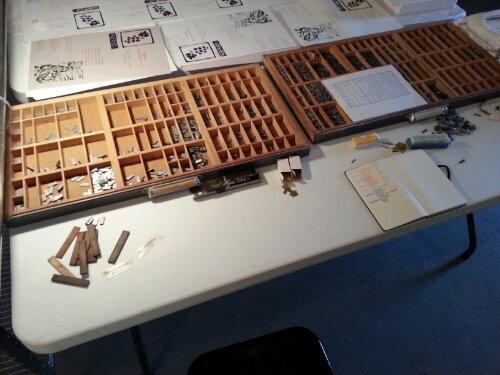
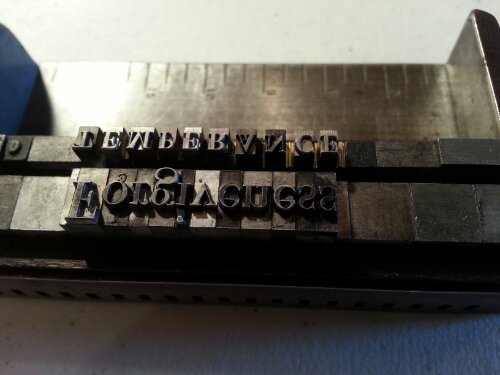
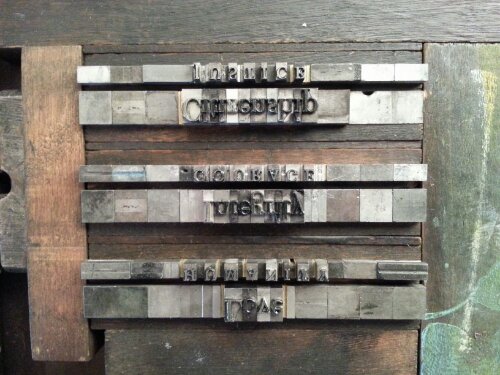
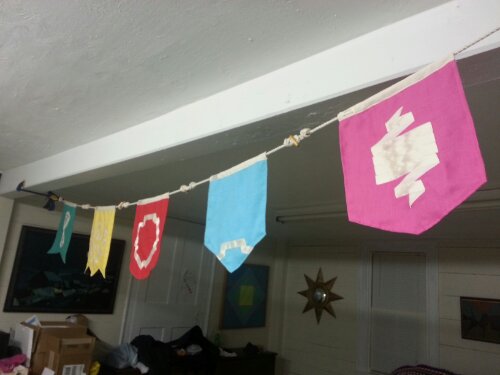
A story in photos on the making of letterpress labels for a set of semaphore flags representing the VIA Character Strengths and Virtues.
Tag Archives: printmaking
Excitation in the printshop
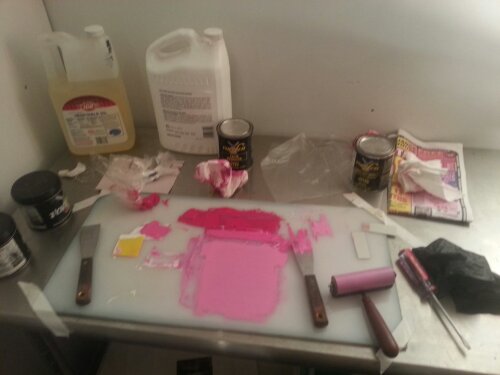
Gearing up for printing, with this to keep in mind:
“The majors signs of [solvent] toxicity are respiratory tract irritation and neurological effects (specifically, excitation followed by depression).”
–From Paul Maravelas’ Letterpress Printing (2005)
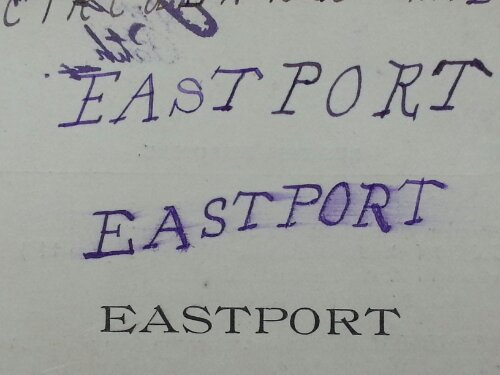
Greetings from Eastport
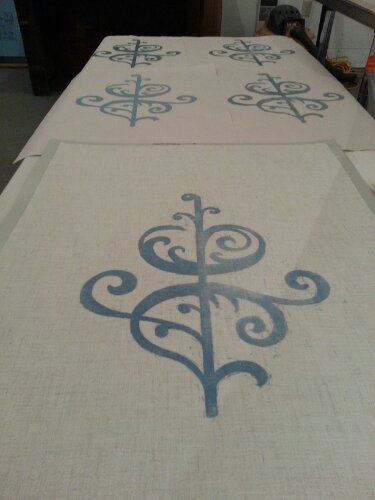
Months ago, I applied to an open call with a proposal to make banners inspired by maritime history and semaphore flags.
Today, I am posting this from Eastport, Maine, one week into the Studio Works residency at the Tides Institute and Museum of Art to which I am so grateful for the opportunity.
Eastport is the easternmost city in the U.S., but it is more like a small town (so small, in fact, that my very definition of “small town” seems to be expanding while the conceptual parameters are diminishing). Coming from New York, it feels a bit anachronistic to me. Many of the buildings are beautifully preserved from the 1800s, when Eastport flourished. My lodgings are similarly historic, so it seems fitting that my digital and online capacities are reduced while I’m here. For that reason, my posts this trip will be infrequent and concise, if I can help myself.
A few reflections, great and small, in no particular order:
• Printmaking is a little like riding a bike. Though I printed most actively in my undergrad years, once I got back in a print shop it seemed quite familiar. I enjoyed many “I remember this” moments: feeling my arm fatigue mixing cold inks straight from the can, listening to the sound of the brayer to learn about the tackiness of the ink, and all the peripheral tips and tricks in setup and cleanup to save time, like making little tabs of scrap materials to use for skimming inks or modifiers.
• Printmaking is nothing like riding a bike. It’s a long slow process of proofing, refining, modifying, adjusting pressure, adding packing, and so on. The ideal is perfect craftsmanship demonstrated through identical reproduction. I was never into that. And I don’t want to get hung up on it now. I’m trying to let this be more experimental, not having to produce an edition, unless it’s an edition varie. To let my hand, indeed, my ability, however lacking, show. I’m interested in decoration and domestic production–e.g. how individuals, not corporations, made flags for hundreds of years–so I think it makes sense that the banners aren’t perfectly mass editioned like Victorian collectibles.
The most rewarding place from which to learn has been, for me, the mistakes. At the same time, perhaps there are no mistakes–there’s just more than one right way to do things. –Marcia Tucker, A Short Life of Trouble
Printmaking in the Catskills
I’ve been in upstate NY for just over a week, and it’s been dreamy. In California, a NY artist once explained how many artists live in the Hudson River Valley, and how you can buy a house and convert a barn to a studio. I was skeptical that it would be worth being out of the city. But now, after noticing the sound of automobiles only between long stretches of rustling tree leaves and birdsong, I completely understand.
Today, I took a relaxing drive down county routes to Rosendale, NY. The address wouldn’t even register in my GPS. Navigating the old fashioned way, I took one wrong turn and was immediately happy that I did. The road circled the banks of a beautiful lake, with only a few white clapboard houses nestled among the wooded trees on the opposite bank. The light glistened off of the water; everything was either mossy green or platinum light. I felt so grateful to be there at that moment. It was as if the longing and nostalgia of a Thomas Kinkade painting were coupled with immediacy of accompanying sensations: clean mountain air, woodsy smells, a slight humidity hinting at the impending rain shower.

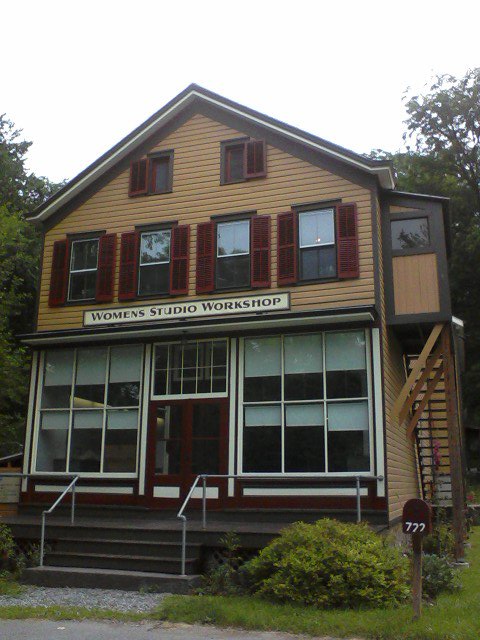
Women's Studio Workshop in Rosendale, NY.
I finally made it to Women’s Studio Workshop, a printmaking, bookmaking, and ceramics studio in Rosendale, NY. I had heard of WSW through their residency program, and thought that it would be a perfect place to pull a series of collagraphic monotypes that I had been scheming on.
Upon my arrival, I was invited to join a lunch of salad and crispy no-red-sauce veggie pizza (which touched this Californian transplant’s heart; in some ways, I may be a New Yorker, but not when it comes to pizza). There really is nothing like a home-cooked meal to make people feel welcomed.
While I have only screenprinted since my MFA degree, pulling the monotypes came back to me: setting up the press and the blankets, modifying the inks, finding the right balance of wet paper and releasing ink. I thought I would be rusty and have to humbly ask for technical help (much like the time a drummer who’d been playing on electric pads for so long he couldn’t set up a drum kit), but somewhere in me that printmaking experience remains. Though I used much of graduate experience to explore other media, I am happy to report that I can still call on my printmaking abilities. I even figured out the less-toxic clean-up oils (which were not used at my alma mater)—thankfully, since I’ve lost any tolerance for mineral spirits that I had built up in my inky woodcarving years.
Through April 16: IMPRESSIONS: From the CCA(C) Print Shop
Thanks to AR for pointing this out to me: An old woodcut print of mine, originally exhibited in my BFA senior show in 1998 at the California College of the Arts, is in a current exhibition in Oakland, CA.
Curated by CCA(C) printmaking instructors Tim Sharman and Jack Y. Ford, I’d wager that the exhibition includes lots of oldies-but-goodies, with etchings, lithographs (from actual limestones!), woodcuts and letterpress prints on view.
I haven’t made prints in a while, but I’ve hung two etchings in my kitchen here in NY. They were acquired in one of the department’s end-of-semester print exchanges.
March 4 – April 16
IMPRESSIONS: From the CCA(C) Print Shop
Studio Quercus
385 26th Street, b/Broadway & Telegraph, downtown Oakland, CA
THE FAMOUS, NOT-SO-FAMOUS AND THE TOTALLY UNKNOWN
Curated by Tim Sharman and Jack FordAn exhibition of prints spanning 60 years of printmaking from the print shop at the California College of the Arts—formerly known as the California College of Arts and Crafts. Examples of lithography, intaglio, relief and screen printing will be on display. Over the years, the CCA(C) print shop has seen many students and teachers using the presses to create images to remember. This survey is a celebration of that long history of creativity.
Curated by CCA(C) alumni and instructor Tim Sharman and CCA(C) alumni and professor Jack Ford, this exhibition honors the traditional craft of printmaking.
Cultivating inefficiencies
As S. Barich pointed out to me, Jerry Saltz recently wrote:
“Like most people in the art world, I’m basically making this up as I go. The art world is about trying to invent new definitions of skill.” (Jerry Saltz, “Work of Art Season Premiere: Judge Jerry Saltz Recaps,” NYMag.com, June 10, 2010)
One of my skills, if I could call it that, is procurement. Even after all these years, I’m surprised at how much time and energy I spend sourcing materials.
Since I respond to the materials that I work with, I often can’t start a project until I have them in hand. Yet identifying and getting the right materials can take weeks. Beyond brushes, paint, paper, frames and the usual, Dick Blick and Aaron Bros aren’t much help. Besides, I’m too self-conscious a consumer; I know their target audiences are Sunday painters and scrapbook keepers. One must get creative.
As an artist, I’m constantly negotiating how to materialize my ideas. The frustrating thing is reaching limits persistently and pervasively — a recipe for pessimism, according to Martin E. P. Seligman in Learned Optimism.
For example, recently I envisioned producing a multiple: a circular, printed on newsprint in full color, of about 100 copies, at the size of a standard advertising insert, roughly 11×12 inches folded or 22×12 flat. This, it turns out, is not feasible. I’ve become a customer service nightmare, making ridiculous requests.
Digital printers don’t want to run newsprint (which is lightweight, only 16-18#s) in their machines; the lowest weight they’ll accept for double-sided full color jobs is 60-70#. Further, they’ll resist anything but standard sizes: 11×17, 13×19, 12.25×18.25. These sizes are efficiencies that work across multiple industries — paper mills, presses, reprographics — but not me, not now. What I need to use, like what I need to produce, are inefficiencies in the system.
Circulars are typically printed on offset web presses, the massive kind that fill warehouses. These presses take too long to set up to produce my piddly quantity. I could do it if I had to make like 5,000 copies, or had about $5k to spend.
Newspaper Club in the UK produces bespoke short-run newspapers. Too bad they don’t ship internationally. An article on Time reveals that Newspaper Club prints on large newspapers’ presses during their inactive times. I contacted some small, local papers to see if they’d bang out an odd job for me, and they courteously but firmly denied my request.
When I produced Sorted, a gilt badge, I contacted many vendors, who would only take on jobs with minimums of 200-250 pcs, way out of my budget. I finally found a vendor that specializes in badges for schools (such as “hall monitor”) that would make smaller quantities of custom badges at reasonable prices. So I took the same tack and looked up school newspaper printers. (I remember buying indie newspapers at Epicenter about home schooling; which couldn’t have had a large circulation.) But times sure have changed. It turns out the young whippersnappers today produce online school newspapers. Of course!
So maybe I have to do this myself. I could make a relief, intaglio or screen print. But that would mean four color separations and a week to produce the edition. The result would be Fine Art. Bummer. I’m just not interested in making a crispy-clean print to mat and frame for this project. I want to make a circular — a big, glossy, tacky, cheap, off-gassing circular. Viewers would handle it with bare hands. Gasp!
Now I’m thinking about freedom and familiarity, and how once again, even the most mundane materials are irrevocably tied with a feeling of constriction. That what I can imagine must be shoved through the machinations of capitalism and global manufacture, and it risks being extruded in unrecognizable form.
To make objects is to direct form-making. I don’t think twice about 8.5×11 inch Letter-sized sheets most days, but today, it seems oppressively inescapable.
The process of de-materialization is ongoing. I’m thinking more about making less. Returning to examples like Chu Yun and Jeremy Deller.
To be optimistic is to take a selective perspective. I’m refusing to let these vendors’ limitations become my own. This project will materialize with the right materials, or not at all. Time to get creative.