Research

Highlights from the Positive Psychology conference

Last weekend I attended the International Positive Psychology Association’s Second World Congress on Positive Psychology in Philadelphia, PA, with the support of a Travel and Study Grant from the Jerome Foundation. It was an invigorating experience. I gained new concepts, an inspired list of books to read, and a clearer understanding of this growing field.

Positive psychology is a new realm; I’ve encountered skepticism of it based on its name only. But the conference (which I’ll call ‘IPPA,’ pronounced “IH-pah”) featured rigorous empirical researchers and practitioners across clinical psychology, education, business, and the humanities. With 1,200 whip-smart attendees from 62 countries, I felt as though I was part of an emergent domain that will revolutionize psychology as well as culture. I’ve been reading books about positive psychology since 2009; IPPA made me excited to learn more and help advance the field as it intersects with the arts and humanities.

What is positive psychology? Perhaps this is best explained via the words of its founding psychologists, Martin Seligman and Mihaly Csikszentmihalyi (2000), as quoted by Robert Vallerand:

“Psychology should document how people’s lives can be most worth living.”

To paraphrase James Pawelski, IPPA President as well as the Director of Education and Senior Scholar at the Masters of Applied Positive Psychology program at UPenn, one of the leading centers of research and scholarship:

Positive psychology is not merely a psychology for sunny days. It is also a psychology for rainy days…. [As a young person witnessing the aftermath of the recent terrorist acts in Norway said,] ‘If one man can create so much hate and death, how much good can we create together?’

I think it was also Pawelski, in discussing the positive turn in humanities, who expressed that

We see positive psychology as balancing (negative) psychology

which for the 20th century has been fixated on trauma, illness, and pathology. As in physical medicine, it is high time to expand beyond treatment towards wellbeing. As Chris Peterson put it:

“Health is more than the absence of illness”

and so too, psychological wellbeing is more than the absence of pathology. The positive psychology view according to Martin Seligman is that

People are not driven by the past, but can be drawn to the future.

Again, Pawelski:

Rather than seeing the positive as simplistic, positive psychology makes the positive more complex.

What I looked forward to. Many of my drawings in the Positive Signs series, as well as some concepts in my essays on Art Practical, were inspired by Martin Seligman’s Learned Optimism and Mihaly Csikszentmihalyi’s Creativity. During my residency at Woodstock Byrdcliffe Guild immediately preceding IPPA, I read Csikszentmihalyi’s Flow: The Psychology of Optimal Experience. So I was very excited to hear Seligman and Csikszentmihalyi speak.

Seligman (left) and Csikszentmihalyi (right) are named IPPA Fellows.

Seligman (left) and Csikszentmihalyi (right) are named IPPA Fellows.

I was also excited to meet potential partners, especially those whose work intersects with the arts. I suspect that principles of positive psychology can be useful for contemporary artists by informing:

processes, by becoming aware of flow activities;

artwork, via increased understanding of relationships created in the art viewing experience and new theories of phenomenology; and

attitudes, especially in regards to experiencing career setbacks and successes.

Highlights. I was very excited about:

Clearer definitions. University of Illinois researcher Ed Diener identified

preconditions of happiness as optimism, positive experiences, and lack of negative affect.

Gallup Scientist in Residence Shane Lopez pinpoints hope.

“Hope is goal-directed thinking (goals thinking) in which people perceive that they can produce routes to desired goals (pathways thinking) and the requisite motivation to use those routes (agency thinking).

Hope — The ideas and energy we have for the future.

High hope people believe that the future will be better than the present and that they have the power to make it so.”

Matt Gallagher, a clinical psychology researcher at the University of Kansas, distinguishes between hope and optimism:

Hope (Snyder) — Agency and pathways towards goals

Optimism (Scheier & Carver) — Globalized positive/negative expectancies

Emphasis on personal agency [is the] crucial difference
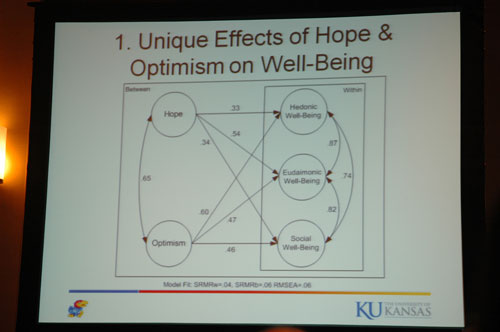
Matthew Gallagher's research on the unique effects of hope and optimism on wellbeing.

Matthew Gallagher's research on the unique effects of hope and optimism on wellbeing.

He also explained the difference thusly:

When you mash optimism and self-efficacy together, you get hope.

Erica Chadwick, PhD candidate from the Victoria University of Wellington, shared this definition of savoring from Fred B. Byrant and Joseph Veroff (2007):

If a savoring process is elicited when a positive emotion is experienced, then savoring could well be the mediating mechanism through which a person’s cognitive repertoire is expanded when a positive emotion is experienced. Furthermore, when people savor, they often broaden the range of feelings they can have and contexts in which these feelings can occur.

Happiness is not frivolous. Hope can’t wait.

Lopez’s Gallup studies revealed that

Hope, engagement, and wellbeing do not correlate to income.

Clearly this is not an argument against equity, but a call to foster hope without delay. That’s because, as Lopez pointed out,

“When we link ourselves to the future, we behave better today.”

Abraham Maslow’s hierarchy of needs (1943) is a fundamental psychology concept visually represented as a pyramid. The idea is that basic needs must be met first, and in order of importance, with self-actualization as the pinnacle—and endmost—need.

Maslow's hierarchy of needs

Maslow's hierarchy of needs (Source: Wikipedia)

At IPPA, Diener argued that

Abraham Maslow’s hierarchy of needs can be addressed at all levels, not necessarily in the order Maslow suggested.

Ed Diener's revision of Maslow's hierarchy of needs, with the needs congruent and concurrent.

Ed Diener's revision of Maslow's hierarchy of needs, with basic needs side-by-side with psychological needs.

Edward Deci, who studies self-determination theory, focused on

three basic human needs: the need to express competence, autonomy, and relatedness, which can be intrinsic, extrinsic, or emotionally motivated. Extrinsic motivations can actually undermine intrinsic motivations for engaging activities.

Edward Deci's Self-Determination Theory describes three basic psychological needs. Competence is the sense of effectance and confidence in ones's context. Autonomy is to behave in accord with abiding vaules and interests, and engage actions that would be relatively self-endorsed. Relatedness is feeling cared for, connected to, and having a sense of belonging with others.

Edward Deci's Self-Determination Theory describes three basic psychological needs. Competence is the sense of effectance and confidence in ones's context. Autonomy is to behave in accord with abiding vaules and interests, and engage actions that would be relatively self-endorsed. Relatedness is feeling cared for, connected to, and having a sense of belonging with others.

I especially appreciated Deci’s point that

Autonomy does not mean complete independence; you can be autonomously dependent

because that points to how artists can be autonomous and forge their own paths with the support and encouragement of their peers.

This sentiment was echoed by Karen Skerrett, who studies qualities of resilience in couple relationships:

Resilience is not self-sufficiency.

Deci added that

To foster greater internalization, create social contexts that allow people to feel competent, autonomous, and related. But it must fit with who people are

Which seems like a worthwhile consideration for artists developing participatory and relational projects.

Diener also identified,

“The number one predictor of enjoyment: ‘I learned new things, and I got to use my new skills today.’

In advance of a positive criticality. Since even my wholly optimistic work can inspire projections of skepticism, I was especially keen to hear Pawelski share Csikszentmihalyi’s opinion that

Positive psychology is a metaphysical orientation towards the positive. In other words, the positive is just as real as the negative.

Dan Moores illustrated this with a humorous talk called Ecstatic Poetry and the Limits of Suspicion. In it, he conveyed

we have a hermeneutics [study of interpretation] of suspicion (Marx, Nietzsche, and Freud), while lacking a hermeneutics of affirmation.  

Such a hermeneutics disserves

“The ecstatic poetic tradition [which] connects many cultures and reaches across vast stretches of time. It represents a positive affirmation of the values of happiness, human connections, festivities, and relatedness to transcendent sources of meaning. The tradition contains countless poems depicting peak states of being and positive, life-affirming emotions, such as serenity, awe, wonder, rapture, joy, gratitude, and love. Such poetry is written in praise of the goodness of life, the abundance of nature, and the intimate interrelation of the whole cosmos.”

Unsurprisingly, Moores shared a Romantic poem. This spurred a sense that contemporary art trends that revisit Romanticism and Transcendentalism (the “New Sincerity”) may find inspiration in this intersection of positive psychology and humanities, if the scientific approach isn’t too much at odds with the intuitive nature of such artmaking.

Elevation and awe. Jonathan Haidt, who studies moral political psychology, presented research

on emotion and elevation, correlating ‘up’ with altruism and admiration
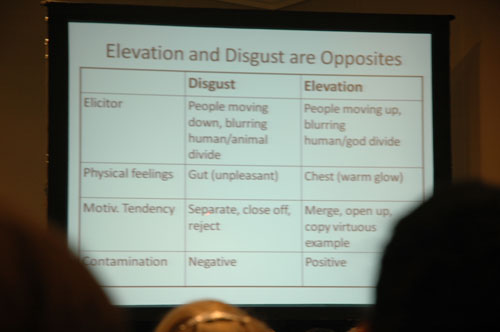
Jonathan Haidt's chart showing how Elevation and Disgust are Opposites. People moving up blurs the human/animal divide, stirs unpleasant physical feelings in the gut, and motivates people to separate, close off, and reject, so is negative. People moving up blurs the human/god divide, providing a warm glow in the chest, and motivates toward merging, opening up, and copying virtuous example, and so is positive.

Jonathan Haidt's chart showing how Elevation and Disgust are Opposites. People moving up blurs the human/animal divide, stirs unpleasant physical feelings in the gut, and motivates people to separate, close off, and reject, so is negative. People moving up blurs the human/god divide, providing a warm glow in the chest, and motivates toward merging, opening up, and copying virtuous example, and so is positive.

It’s similar to the up-down cognitive metaphors in Lakoff/Johnson’s linguistics, which I diagrammed in Positive Sign #24.

Christine Wong Yap, Positive Sign #24 (Conceptual Metaphors), 2011; glitter and neon pen on gridded vellum; 8.5 × 11 in./21.5 × 28 cm

Christine Wong Yap, Positive Sign #24 (Conceptual Metaphors), 2011; glitter and neon pen on gridded vellum; 8.5 × 11 in./21.5 × 28 cm. Source: blog.sfmoma.org.

Veronika Huta, who studies awe, inspiration, and transcendence at the University of Ottowa, independently confirmed that

Elevation is correlated with, and is an indicator of, virtuous, pro-social behavior.

Connecting neo-Romantic art and studies of awe was UPenn graduate student Ann Marie Roepke’s diagram relating horror and awe, similar to the 19th century view of the sublime.
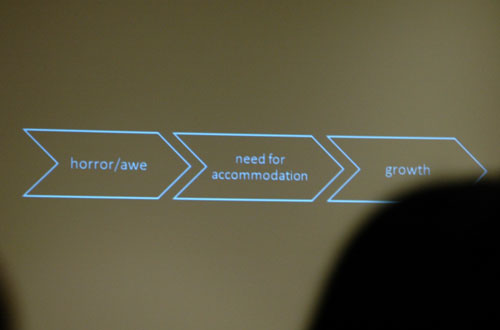
horrow/awe to need for accommodation to growth.

Slide by Anne Marie Roepke showing horrow/awe to need for accommodation to growth.

Passion. Robert Vallerand, from the University of Montreal, studies obsessive and harmonious passion.
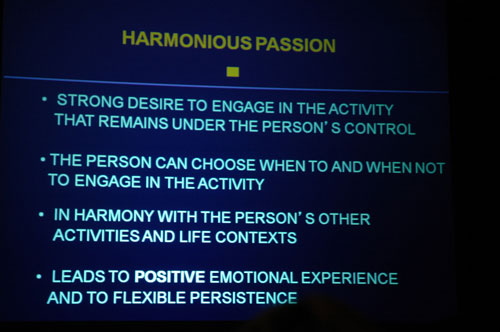
Harmonious passion manifests as a strong desire to engage in the activity that remains under the person's control. The person can choose when to and when not to engage in the activity. It is in harmony with the person's other activities and life contexts, and it leads to positive emotional experience and to flexible persistence.
Robert Vallerand describes harmonious passion as a strong desire to engage in the activity that remains under the person's control. The person can choose when to and when not to engage in the activity. It is in harmony with the person's other activities and life contexts, and it leads to positive emotional experience and to flexible persistence.

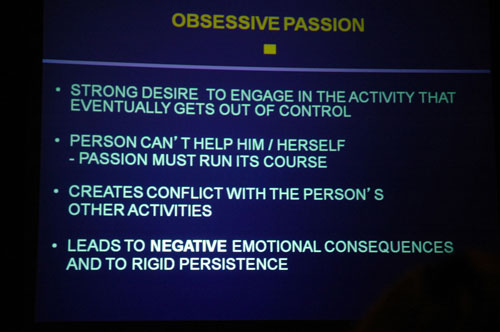
Robert Vallerand describes obsessive passion as a strong desire to engage in the activity that eventually gets out of control. The person can't help him or herself; the passion must run its course. It creates conflict with the person's other activities, and leads to negative emotional consequences and to rigid persistence.

Vallerand describes obsessive passion as a strong desire to engage in the activity that eventually gets out of control. The person can't help him or herself; the passion must run its course. It creates conflict with the person's other activities, and leads to negative emotional consequences and to rigid persistence.

There’s a clear analogy to the arts here, where artists may develop a detrimental obsessive passion driven by extrinsic motivators, rather than a harmonious passion fueled by intrinsic motivation that leads towards increased subjective wellbeing.
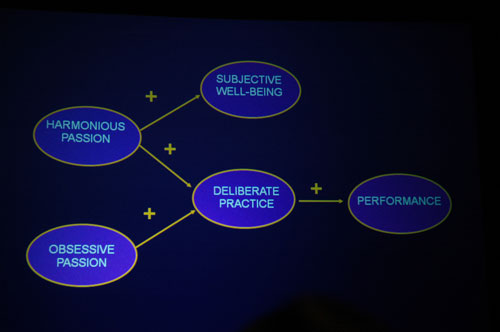
Robert Vallerand shows that obsessive passion and harmonious passion can both lead to performance, but only harmonious passion will include enhanced subjective wellbeing.

Vallerand found that obsessive passion and harmonious passion can both lead to deliberate practice and performance, but only harmonious passion will include enhanced subjective wellbeing.

Since I think emerging artists can put pressure themselves to see extrinsic rewards to their progress, Vallerand’s final message seems especially relevant.

Vallerand's take home messages: Try to cultivate harmonious passion for one activity. Take the activity seriously without taking yourself seriously. Include other fun activities in your life. Understand the functionality of obsessive passion. Learn from setbacks, improve and grow within the activity.

Vallerand's take home messages: Try to cultivate harmonious passion for one activity. Take the activity seriously without taking yourself seriously. Include other fun activities in your life. Understand the functionality of obsessive passion. Learn from setbacks, improve and grow within the activity.

Information graphics. What follows is a sampling of visuals which appealed to me.
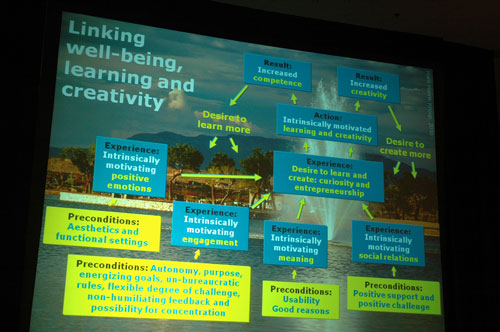
Hans Henrik Knoop's flow chart linking wellbeing, learning, and creativity, delightfully overlaid on a fountain.

Hans Henrik Knoop's flow chart linking wellbeing, learning, and creativity, delightfully overlaid on a fountain.

Neural synchrony imaged by Stephens, Silbert and Hasson, displayed in a talk by Barbara Friedrickson.

Neural synchrony imaged by Stephens, Silbert and Hasson, displayed in a talk by Barbara Friedrickson.

Sara L. Trescott presented a poster entitled Pain and Happiness: A Shifting Mathematical and Psychological Paradigm.

Sara L. Trescott presented a poster entitled Pain and Happiness: A Shifting Mathematical and Psychological Paradigm.

The most frequently presented graphic seemed to be a flow chart whose correlations are represented in nominal tenths or hundredths, rather than the visual hierarchies I would have preferred. It might well be a data-minded scientific idiom. Perhaps visual representation would be misconstrued as non-empirical shorthand.
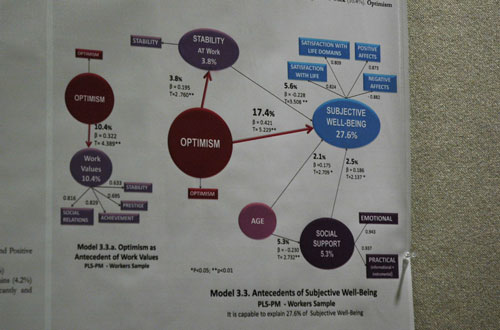
I believe this is Lucia Helena Walendy De Freitas' poster on The Influence of Optimism on Subjective Wellbeing: A Study Based on College Students and Workers Samples.

I believe this is Lucia Helena Walendy De Freitas' poster on The Influence of Optimism on Subjective Wellbeing: A Study Based on College Students and Workers Samples.

Bee Teng Lim's Powerpoint flow chart showing the impact of amplifying savoring.

Bee Teng Lim's Powerpoint flow chart showing the impact of amplifying savoring.

These graphics, indeed, the positive psychology endeavor as a whole—recall a passage from Alain de Botton’s The Pleasures and Sorrows of Work, in which the author responds to an engineer’s algebraic formula:

“I was struck by how impoverished ordinary language can be by contrast, requiring its user to arrange inordinate numbers of words in tottering and unstable piles in order to communicate meanings more infinitely more basic than anything related to an electrical network. I found myself wishing that the rest of mankind would follow the engineers’ example and agree on a series of symbols which could point incontrovertibly to certain elusive, vaporous and often painful psychological states—a code which might help us feel less tongue-tied and less lonely, and enable us to resolve arguments with swift and silent exchanges of equations.”

Two projects deserve special recognition for employing terrific graphic design. Both were large-scale public initiatives promoting wellbeing, thus the success of the endeavors was dependent on accessible design and copywriting.

Nic Marks discussed a project with new economics foundation promoting wellbeing in London.
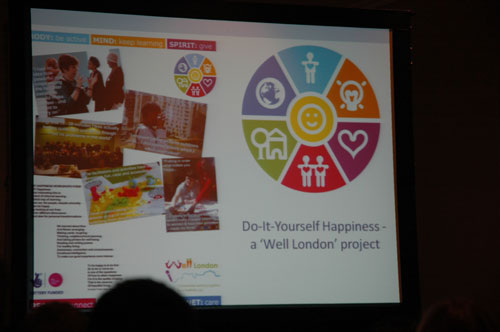
Nic Marks presented Do-It-Yourself Happiness, a Well London project.

Nic Marks presented Do-It-Yourself Happiness, a Well London project.

Plus, Marks conducted a drawing exercise in which workshop attendees drew each other without looking at their papers, which enacted the five steps the public initiative promoted. I loved the exercise, as participants’ responses were immediate, hilarious, and relational.

Participant's blind portrait of another participant.

Participant's blind portrait of another participant.

Chris Peterson and Nansook Park, both from the University of Michigan, shared their ___ Makes Life Worth Living campaign, a university-wide year theme. Students wore t-shirts with the blanks filled in.

___ Makes Life Worth Living.

Conference photos. And inspired by Richard Baker’s quiet and stirring photographs in Alain de Botton’s The Pleasures and Sorrows of Work, I clicked a few images documenting the visual vocabulary of the conference.
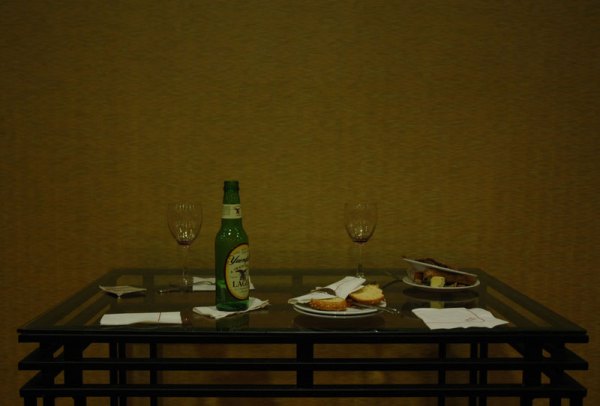
Post Reception Still Life

Applied Positive Psychology symposium.

Poster Session 1

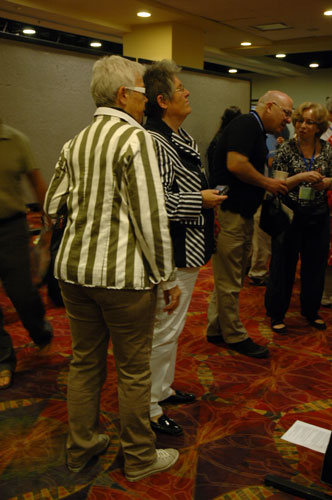
Stripes

Poster Session.

Gina Haines' poster on positive psychology and phenomenology featured a foil mirror.
Gina Haines' poster on positive psychology and phenomenology featured a foil mirror.

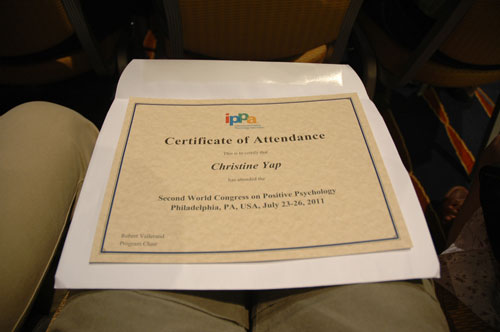
Certificate of Attendence

Standard
Community, News, Travelogue

Goodbye Byrdcliffe, Hello Positive Psychology!

I had a lovely time at the Woodstock Byrdcliffe residency. It was really an idyllic place to live and make art. A typical day for me:

Wake up to birdsong.
Run (including my first 10-mile).
Read and write in my sun-drenched studio—Mihaly Csiksentmihalyi’s thought-provoking Flow: The Psychology of Optimal Experience (1990) and Alain de Botton’s beautiful The Pleasures and Sorrows of Work (1998).
Work on drawings, collages, mixed media, or photo projects.
Eat and socialize in the large communal kitchen with the other AIRs, including some amazing, health-minded cooks. They inspire me to eat more whole grains and less meat, and cook more. You’d be inspired too, if you’d had Dan’s homemade pita bread, Tryn’s key lime pie, and Bob’s chilled carrot-coconut milk soup.

Sights around Byrdcliffe: a brilliant meadow, backlit leaves, turkey vulture, black bear.

Sights around Byrdcliffe: a brilliant meadow, backlit leaves, turkey vulture, black bear.

Chipmunks everywhere.

Chipmunks everywhere.

Julie, Mary, Robert, Tryn, and Dan hanging out in the kitchen after Mexican food night.

Julie, Mary, Robert, Tryn, and Dan hanging out in the kitchen after Mexican food night.

Outdoor sculpture show at White Pines. Really loved the architecture.

Outdoor sculpture show at White Pines. Really loved the architecture.

View from White Pines.

View from White Pines.

In addition I took a Machine Woodworking class with Paul Henderson, down at the Byrdcliffe Barn. Cutting dovetails, mortises, and tenons with Paul, we’d chat about tools and music (he’s a trumpeter in a funk band!). It was tons of fun, and it reminds me how nice it is to have access to a really nice woodshop….

Paul and Jessica in the woodshop. That day's lesson: using routers and jigs to machine dovetails.

Paul and Jessica in the woodshop. That day's lesson: using routers and jigs to machine dovetails.

The residency was very productive and re-energizing. I am so grateful I got to be part of the Byrdcliffe story, enjoy the amazing land, and meet the other AIRs and the hardworking Byrdcliffe staff. Thanks Byrdcliffe!

Today
Artist in Residence Open Studios
Byrdcliffe Art Colony, Woodstock, NY
3:30–7pm

Woodstock Byrdcliffe Guild Artist in Residence Open Studios, July 23rd. full text: http://www.woodstockguild.org/artist-in-residence

My 360º studio photo-collage was featured on Woodstock Byrdcliffe’s email announcement! The super smart and interesting Julie Perini will be screening her experimental film and video work in my studio. Photos of my projects are in the Villeta, however, I won’t be there because I’ll be at…

July 23–26
The International Positive Psychology Association’s Second World Congress of Positive Psychology

Philadelphia, PA

Among the speakers are Martin Seligman and Mihaly Csikszentmihalyi, whose books inform my work, including, most directly, the Positive Signs series (a selection is now on view at Steven Wolf Fine Arts, San Francisco, CA). I’m really looking forward to hearing these authors speak, delving deeper into positive psychology, and thinking through how it relates to artmaking and art viewing experiences.

I am able to attend this gathering with the support of a Travel and Study Grant from the Jerome Foundation. I am so grateful to them for the support. Thank you Jerome Foundation!

Standard
Research

Happiness Infographics

Via ET and FlowingData.com:

'life is simple' by Moritz Resl

Moritz Resl, Life is simple, digital art print, 16x16 inches / 42x42 cm, Open edition.

Source: MoritzResl.net

I like these infographics, even if they are a bit simplistic, they’re upbeat.

Are you happy?

By H34DUP and David Meiklejohn. Source: blog.h34dup.com

A quibble: humans adapt to positive emotions quite readily, as Phillip Zimbardo and John Boyd wrote in The Time Paradox. So the advice “Keep doing what you’re doing” would probably maintain happiness, but only for so long. Humans also need novelty, variation, and new challenges.

Cheap and Cheerful #5

Christine Wong Yap, Cheap and Cheerful #5, 2009, neon and glitter pen, 11.625 x 7.75 inches / 29.5 x 45 cm. Produced in the Breathe Residency at Chinese Arts Centre.

Plus, for you-know-whats and giggles (unless you’re an information graphics designer for which chartjunk is a curse upon the earth of Biblical proportions):

The usually illustrious Christoph Nieman’s illustration for Portfolio.com:

Illustration by Christoph Niemann

Illustration by Christoph Niemann for article about personal wealth and happiness on Portfolio.com

Standard
Community, Research

Points of reference

For artists and/or fans of Borges and Calvino:
Cynthia Ozick reading “In the Reign of Harad IV,” a wonderful short story by Steven Millhauser, about making, visibility, and recognition. On the New Yorker‘s fiction podcast.

For fellow cognitive science and psychology dabblers:
“Social Animal: How the new sciences of human nature can help make sense of a life,” by David Brooks (yup, that David Brooks, the NYT columnist), a summation of loads of psychological and cognitive science research, including thoughts about flow and happiness.

For those who need an optimism booster shot:
Born to Be Good: The Science of a Meaningful Life, by Dasher Keltner (New York: W.W. Norton & Co., 2009).
The UC Berkeley psychology professor’s theories on how to live a balanced life of “completing the good in others.” Interesting discussion of the intellectual lineage from Darwin to Ekman (a facial expression researcher profiled by Malcolm Gladwell in the New Yorker). The author’s long hair + references to Eastern philosophy = high hippie dippy quotient, but Keltner is an informed and lively writer. Those seeking cynical, burdensome academic texts ought look elsewhere.

For those seeking art that touches on psychoanalysis:
Jonathan Solo: Shadow
Catherine Clark Gallery
January 8 – February 19, 2011
see also: Carl Jung, Shadow

For those obsessed with happiness and/or mapping:
Mappiness, an iPhone app that asks users to rate their level of happiness at random moments throughout the day. Developed by London School of Economics PhD candidates, it’s a fully realized, popular version of what I had hoped to do with Hedonimeter.net, a project I started in grad school and hadn’t yet returned to. My enthusiasm for visual and symbolic systems has not evolved into the motivation to learn more about statistics and programming… yet.

For art-seekers in San Francisco:
Works by friends and supporters:
Three solo exhibitions: Jaime Cortez, Kenneth Lo, and Ginger Wolfe-Suarez
Southern Exposure, 3030 20th St., San Francisco, CA
January 7, 2011 – February 19, 2011

For art-seekers in LA:
Collective Show
January 21-23 and January 27-30, 2011
995, 997 North Hill Street, Los Angeles, CA

For art-seekers in Liverpool:
Nam June Paik
Tate Liverpool
17 December 2010 – 13 March 2011

For typography nerds:
The flyer for the symposium at the Nam June Paik Art Center. Nothing wrong with type-based solutions, no.

For design-seekers in San Francisco:
A show curated by the super-talented, super-humble Jon Sueda
The Way Beyond Art: Wide White Space
January 20–February 5
CCA Wattis Institute for Contemporary Art

Standard
Research

Schjeldahl on Rist

In “Feeling Good” (New Yorker, September 27, 2010; abstract here ), Peter Schjeldahl reviews Pipolotti Rist’s show at Luhring Augustine in NYC, and in the process, extols the singular artist and her commitment to pleasure.

I savored the subject and the conveyance. I admire Rist’s work for it fearless optimism and exuberance. She manages to make massive installations that are friendly and participatory. Schjeldahl’s words brim with enthusiasm, and he also contextualizes Rist’s work with a preternaturally long view.

A few of my favorite passages are:

The first two lines:

The Swiss video- and installation-maker Pipilotti Rist is an evangelist for happiness like no other first-rate artist that I can think of, except, perhaps, Alexander Calder. Like Calder, she is immune to solemnity, and her work appeals to more or less everybody.

This gem:

Color is more than the keynote of Rist’s art—it’s practially the theology.

Her pop cultural affinities don’t unite high and low so much as make them seem like interchangeable engines of pleasure. Rist resolves no critical problems of contemporary art. She just makes you forget there are any.

(I wondered about this same dialectic—this addiction to criticality as radical opposition—in my show Irrational Exuberance, and it was discussed in the closing dialogue, As Is: Pop and Complicity.)

…not that thought is allowed much traction. There’s a steady state of wonderment at having a body right here, right now…. Imagine, as Rist makes easy in the show’s main room, being a sheep in a lush meadow entirely surrounded, as far as you can see, by what you like to eat. Life surely vitiates such sublime contentment most of the time, but numbness to it seems an optional tragedy.

Just as positive psychologists want you to know: Optimism is a choice.

Schjeldahl takes a strong position in the course of explaining Rist’s significance:

Pleasure is a serious matter in and for art, which must justify itself continually in a global culture of mass entertainments. Glumness is an understandable but self-defeating reaction of people determined to somehow make a difference. Rist is remarkable for having insisted on bliss in an era, which peaked in the nineteen-nineties, when a parade of artists ambitiously expanded art’s physical scale and social address only to burden it, self-importantly, with theoretical arcana and political sanctimony.

As a critical writer, I aspire to this level of expertise and confidence.

Proof that writing about art need not be burdened by art-speak, pretension, or obfuscation:

Responsible as well as responsive to contemporary art’s enlarged public sphere, she maintains standards of craft and sincerity—outward discipline, inward necessity—that speak for themselves, without critical gloss or winking irony.

Standard
Research

Positive Psychology and Positive Thinking

In developing my exhibition, “Irrational Exuberance (Asst. Colors),” last spring, I studied positive psychology. During the closing dialogue, “As Is: Pop and Complicity” (read the transcript), I realized that the term positive psychology is easily confused with popular psychology—understandably, since the distinction is not entirely clear, when my readings of positive psychology take form in trade paperbacks—and positive thinking. Certainly, positive psychology is optimistic; through research-based cognitive behavior modification, it aims to increase happiness, and to engage in that kind of self-awareness and change is to embrace to possibility that one can positively change one’s attitudes. However, to mistake positive psychology for mere positive thinking is a mistake.

In “Power Lines: What’s behind Rhonda Byrne’s spiritual empire?” (New Yorker, September 13, 2010), Kelefa Sanneh reviews two recent books on positive thinking. He takes a critical look at Rhonda Byrne, the positive thinking guru and author of “The Secret” (2007) and “The Power” (2010), starting off with Byrne’s appearance on Oprah. Maybe I’m an elitist, sheltered in a ‘Bay Area Bubble’ unconcerned with such mass culture, but the phenomenon of “The Secret” remained a secret to me until now. Is this what people think I mean when I say positive psychology?

Sanneh contrasts Byrne’s quasi-but-un-religious, ultra-simplistic mysticism with Barbara Ehrenreich’s “Bright-Sided: How Positive Thinking is Undermining America” (2009; also released with the more specific, less ‘sticky’ subtitle, “How the Relentless Promotion of Positive Thinking is Undermining America”). When the leftist activist fired this shot, it alarmed me, but as Sanneh points out,

For Ehrenreich, the alternative to the pursuit of happiness is the pursuit of justice—except you don’t have to choose…. She promises that we can find a deeper, richer form of happiness by ‘shaking off self-absorption and taking action in the world.’

This, of course, brings to mind the three components, according to Paul Martin, author of “Sex, Drugs and Chocolate” (2008) of happiness: pleasure, the absence of displeasure, and satisfaction—becoming an agent, enacting one’s will in the world. Striving and accomplishing goals through acting in the world—not mere positive thinking—leads to deeper happiness? Yes, I’d agree with that. I am now more inclined to believe that Ehrenreich—whose undercover reports on working class struggle instantiated institutional privilege in America in “Nickel and Dimed” (2001) I enjoyed—is explicit in her aim at unthinking positive thinking, rather than all psychology concerned with happiness.

So while the terminology may overlap, along with the general optimistic outlook and “woo woo” self-improvement vibe, positive psychology and positive thinking are very different. For the latter, read Byrne and watch Oprah. For the former, read psychologists and researchers like Martin Seligman and Mihaly Csikszentmihalvi.

Standard
Research

hug it out!

Making exhibitions requires a lot of teamwork, so I’ve been practicing sharing epic high-fives. Just the other day, K, R and I shared a spinning jump triple. That momentary gesture turned a feeling of mild accomplishment into floaty elation.

In “Evidence That Little Touches Do Mean So Much,” (NYTimes.com, February 22, 2010) Benedict Carey examines the psychology and neuroscience of meaningful touches.

Momentary touches, [researchers] say — whether an exuberant high five, a warm hand on the shoulder, or a creepy touch to the arm — can communicate an even wider range of emotion than gestures or expressions, and sometimes do so more quickly and accurately than words….

“We used to think that touch only served to intensify communicated emotions,” Dr. [Matthew] Hertenstein [a psychologist at DePauw University in Indiana] said. Now it turns out to be “a much more differentiated signaling system than we had imagined.

As an artist working with installation and phenomenology, I’m really interested in embodied experiences. As Lakoff & Johnson explain in “Metaphors We Live By,” metaphors are not merely linguistic devices, but cognitive tools; we think using metaphors grounded in our physical experience.

High-fives express shared excitement or accomplishment (“Nice one!”). It conveys that this experience is good, and yay for sharing it with me. It is harmless hedonism, of taking pleasure in the present. It’s dorky, hip, sweet, and maybe a little ironic, but maybe also infused with feel-good, unabashed enthusiasm (like Ugo Rodinone’s “Hell Yes!”). I hope I never feel too old to share a high-five.

As usual, I’d like to participate in an art world characterized by community and reciprocity. Supportive touches express mutuality; maybe more curators, artists, critics and collectors should be hugging it out.

…In the brain, prefrontal areas, which help regulate emotion, can relax, freeing them for another of their primary purposes: problem solving. In effect, the body interprets a supportive touch as “I’ll share the load.”

“We think that humans build relationships precisely for this reason, to distribute problem solving across brains,” said James A. Coan, a a psychologist at the University of Virginia. “We are wired to literally share the processing load, and this is the signal we’re getting when we receive support through touch.”

Carey also quotes Dacher Keltner, a professor of psychology at the University of California, Berkeley, and the author of “Born to Be Good: The Science of a Meaningful Life.” Incidentally, Keltner’s mentor was San Francisco psychologist Paul Ekman, who was profiled by Malcolm Gladwell in an eye-opening article about emotions and facial expressions (“The Naked Face,” New Yorker, 2002). If you’ve heard of the wide, genuine, impossible-to-fake Duchenne smile, then you’ve been touched by Ekman’s influence.

Standard
Research

perfectionism, happiness, time perspectives

Cultivate: setting goals, taking risks, being organized, self-actualizing
De-emphasize: worrying about regrets and how you are perceived
Takeaway: Build self-regard and internal measures of achievement

[Psychologist Robert W. Hill of Appalachian State University] argues that perfectionistic traits can be either adaptive or maladaptive. It depends upon whether they are forward- or backward-looking, emotionally positive or negative, and motivated from an inner urge or an outside push.

In a paper just published in the journal Personality and Individual Differences, Hill and two colleagues describe an experiment that illustrates the importance of distinguishing between types of perfectionism. They surveyed 216 psychology students to assess their perfectionistic tendencies, as well as their psychological well-being and satisfaction with life.

Adaptive perfectionism was determined by combining the students’ self-reported scores in four areas: striving for excellence, organizational skills, tendency to plan ahead and holding others to high standards. Maladaptive perfectionism was measured by the sum of four other scores: concern over mistakes, need for approval, tendency to ruminate over past performances and perceived parental pressure.

“We found that adaptive perfectionism was associated with indicators of positive psychological outcomes,” Hill reports. “The more an individual was prone to striving for excellence, planning ahead, being organized, they typically had a high level of psychological well-being, life satisfaction and positive mood. The inverse was true for maladaptive perfectionism.”

Hill found a “wide distribution” of these traits in the test subjects, suggesting that most people have some combination of adaptive and maladaptive perfectionism….

“Adaptive perfectionism is an internal standard for achievement,” he notes. “Maladaptive perfectionism is an external concern – wondering what other people are going to think. It’s kind of a thinking habit: ‘I made a mistake there.’ ‘Someone will notice I didn’t do that right.’ We know from a number of studies that cognitive behavioral therapy can change or reduce those kinds of thoughts.”

—Tom Jacobs, “The Two Faces of Perfectionism,” Miller-McCune, January 28, 2010

Standard