Community, Sights

See: Bessma Khalaf @ Steven Wolf Fine Arts

This looks like it’s going to be an amazing show. Go Bessma & Steven!

April 20 – May 19, 2012
Bessma Khalaf: Re-Enchanter
Opening Reception: Friday, April 20, 6-8pm
Steven Wolf Fine Arts

2747 19th Street, A, San Francisco, CA 94110
Gallery Hours: Wed–Fri 10:30-5:30, Saturday 11-5

In Re-enchanter, Bessma Khalaf’s new exhibition at Steven Wolf Fine Arts, the Iraqi born artist draws upon the Chaldean tradition of witchcraft, sorcery and truth telling to play the role of artist as re-enchanter of a dead, modernist world. Chaldeans are a small Christian sect of Iraqis. Historically, they were perceived by neighboring empires as experts in sorcery, astrology and the magical arts, and were consulted to deal with the unknown. But with the rise of religious fundamentalism they are now hunted like witches in their region.

With little more than an oversized hoodie and some everyday objects, Khalaf uses vaudevillian magic to transform herself from Gandalf the wizard, to a lady in a burka, to a Jedi Knight, and then back to an Oakland home girl. Her broomstick is a Segway and her backdrop is night, and the promise land of California. While this new body of work is visually darker than Khalaf’s previous films and photographs, it continues to rely on humor and ironic juxtapositions to illuminate the dark, tragic geography that divides the old world and the new.

Standard
Artists

Preparator Magic

Working as a preparator, I’m halfway through a two-week install involving lots of building. It’s exciting and exhausting, requiring focus and grace. You work with materials, tools, people, institutions, vendors… elevator systems, security systems. You aim to please, perhaps even aspire to perfection, yet you have to manage expectations, including your own. Preparators are only midwives to artists’ visions, but pride—not to be discounted—is at stake. Behind the impression of timelessness that artworks and exhibitions strive for is a lot of risk/hopethatworks/noonewillknow. Dive in, fight fatigue, feel crumbly yet alive, playing a role in a complex that fuses creative ambition with material reality.

In my research about Jim Hodges this weekend, I came across examples of the paradoxes/great cosmic jokes that preparator work involves.

Jim Hodges, Untitled, 2011  Mirror ball, mechanics and water; dimensions variable. Source: GladstoneGallery.com.

Jim Hodges, Untitled, 2011 Mirror ball, mechanics and water; dimensions variable. Source: GladstoneGallery.com.

Jim Hodges oversees the deinstallation of Untitled at Gladstone Gallery. Source: WalkerArt.org.

Jim Hodges oversees the deinstallation of Untitled at Gladstone Gallery. Source: WalkerArt.org.

Different locations, same artist, same gallery.

First image: Jackhammered hole.

Second image: Concrete floor protected in gaffer-taped Masonite. Note pieces cut-to-size for break-away brace. Nifty.

In art and art exhibitions, the visible is often just the tip of the iceberg, while many more systems, materials, labor, and even experiences, are kept invisible.

Standard
Research

Jim Hodges

Jim Hodges (b. 1957) is an American contemporary artist based in New York, NY. I loved his work at Barbara Gladstone (both locations) a few months ago, as well as at SFMOMA and Marc Foxx Galleryin LA in the past. His materials (including mirrors and lightbulbs), and themes (happiness) overlap with those in my work. I am finally getting around to doing more research about him.

The more I learn, the more it seems that I’ve been following in Hodge’s footsteps.

What I admire most about Hodges’ work is this: simple gestures generating expansive imports. In other words, 1 + 1 = 3. When two recognizable things or ideas combine for an unexpected outcome, it’s startling.

Hodge’s work can be luminous or colorful, and suggestive of pleasure or happiness, but it is also characterized by themes of death and fragility. The feeling of loss made sense when I learned that Hodges was a contemporary and friend of Felix Gonzales-Torres. I was also reminded of how Tom Friedman experiments with common materials too.

Below are some photos found online, and some scanned in from an exhibition catalog. I think the dates of the works are quite telling about the artist’s development.

Past Installations

I suspect that Hodge’s fake flower projects started with simple material investigations: taking apart ready-made flowers, arranging and re-arranging them, which culminates in monumentally-scaled curtains that drape on the floor.

Jim Hodges, Untitled (Threshold), 1993–4, silk, plastic, thread, steel wire, 92x58 inches. The Ann and Mel Schaffer Family Collection. Source: Hodges, Jim, Ian Berry, Ron Platt, and Allan Schwartzman. 2003. Jim Hodges. Saratoga Springs, N.Y.: Frances Young Tang Teaching Museum and Art Gallery at Skidmore College.

Jim Hodges, Untitled (Threshold), 1993–4, silk, plastic, thread, steel wire, 92x58 inches. The Ann and Mel Schaffer Family Collection. Source: Hodges, Jim, Ian Berry, Ron Platt, and Allan Schwartzman. 2003. Jim Hodges. Saratoga Springs, N.Y.: Frances Young Tang Teaching Museum and Art Gallery at Skidmore College.

Jim Hodges, Changing things (detail), 1997, Silk, plastic, wire and pins (342 parts), 193 x 376 cm, Dallas Museum of Art, Mary Margaret Munson Wilcox Fund and gift of Catherine and Will Rose, Howard Rachofsky, Christopher Drew and Alexandra May, and Martin Posner and Robyn Menter-Posner, © martabuso / Fondazione Bevilacqua La Masa, From the exhibition Love, eccetera, Fondazione Bevilacqua La Masa, 5 February-5 April 2010, Piazza San Marco Gallery, Venezia. Source: ArtTattler.com.

Jim Hodges, Changing things (detail), 1997, Silk, plastic, wire and pins (342 parts), 193 x 376 cm, Dallas Museum of Art, Mary Margaret Munson Wilcox Fund and gift of Catherine and Will Rose, Howard Rachofsky, Christopher Drew and Alexandra May, and Martin Posner and Robyn Menter-Posner, © martabuso / Fondazione Bevilacqua La Masa, From the exhibition Love, eccetera, Fondazione Bevilacqua La Masa, 5 February-5 April 2010, Piazza San Marco Gallery, Venezia. Source: ArtTattler.com.

A massive curtain composed completely of fake flowers. It’s super colorful and translucent in person. It’s also very difficult to resist touching. Sometimes I think contemporary art is afraid of sentiment, but this work wholly embraces joy. Very pop.

Jim Hodges, No Betweens, 1996; sculpture; silk, cotton, polyester, and thread, 360 in. x 324 in. (914.4 cm x 822.96 cm); Collection SFMOMA, Purchase through a gift of Kimberly S. Light; © Jim Hodges  Source: San Francisco Museum of Modern Art

Jim Hodges, No Betweens, 1996; sculpture; silk, cotton, polyester, and thread, 360 in. x 324 in. (914.4 cm x 822.96 cm); Collection SFMOMA, Purchase through a gift of Kimberly S. Light; © Jim Hodges Source: San Francisco Museum of Modern Art

Jim Hodges, Where are we now? (detail), 1999, silk, cotton, polyester, and thread, 24x18 feet, installation view at Miami Art Museum, Carlos and Rosa de la Cruz Collection. Source: Hodges, Jim, Ian Berry, Ron Platt, and Allan Schwartzman. 2003. Jim Hodges. Saratoga Springs, N.Y.: Frances Young Tang Teaching Museum and Art Gallery at Skidmore College.

Jim Hodges, Where are we now? (detail), 1999, silk, cotton, polyester, and thread, 24x18 feet, installation view at Miami Art Museum, Carlos and Rosa de la Cruz Collection. Source: Hodges, Jim, Ian Berry, Ron Platt, and Allan Schwartzman. 2003. Jim Hodges. Saratoga Springs, N.Y.: Frances Young Tang Teaching Museum and Art Gallery at Skidmore College.

Here’s a curious black version.

Jim Hodges, The end from where you are, 1998, Silk, cotton, polyester, and thread, 16 x 16'. Source: ArtTattler.com.

Jim Hodges, The end from where you are, 1998, Silk, cotton, polyester, and thread, 16 x 16'. Source: ArtTattler.com.

Jim Hodges, Into Life, 2001  Silk, cotton, polyester and thread; dimensions variable. Source: GladstoneGallery.com.

Jim Hodges, Into Life, 2001 Silk, cotton, polyester and thread; dimensions variable. Source: GladstoneGallery.com.


I’ve been sewing and thinking about flags a lot, so here’s one more instance of serendipity.

Jim Hodges, Here's Where We Will Stay  printed nylon, painted chiffon and silk head scarves with thread, embroidery and sequins 230 x 225 in. (584.2 x 571.5 cm.) 1995. Source: Christies.com.

Jim Hodges, Here's Where We Will Stay printed nylon, painted chiffon and silk head scarves with thread, embroidery and sequins 230 x 225 in. (584.2 x 571.5 cm.) 1995. Source: Christies.com.

Immersive gold leaf.

Jim Hodges and still this 2005-2008 23.5K and 24K gold with Beva on gessoed linen in 10 parts 200" x 185" x 89". Source: JamesWagner.com.

Jim Hodges and still this 2005-2008 23.5K and 24K gold with Beva on gessoed linen in 10 parts 200" x 185" x 89". Source: JamesWagner.com.

2.5-D
(Works that are not quite 2-D or 3-D)

Jim Hodges, Folding (into a Greater World), 1998 Mirror on canvas in two parts 72 x 96 inches Collection of Eileen and Peter Norton, Santa Monica. Source: ArtLies.org.

Jim Hodges, Folding (into a Greater World), 1998 Mirror on canvas in two parts 72 x 96 inches Collection of Eileen and Peter Norton, Santa Monica. Source: ArtLies.org.

Jim Hodges, Movements (stage II), 2006  Mirror on canvas; 84 x 96 inches. Source: GladstoneGallery.com.

Jim Hodges, Movements (stage II), 2006 Mirror on canvas; 84 x 96 inches. Source: GladstoneGallery.com.

Having spent so much time obsessed with light bulbs for previous projects, it’s strange that I’m only just now coming across this work.

Jim Hodges, Coming Through, 1999 Light bulbs, ceramic sockets, wood and metal panels 31 x 63 x 5 inches Collection of Rebecca and Alexander Stewart, Seattle. Source: ArtLies.org.

Jim Hodges, Coming Through, 1999 Light bulbs, ceramic sockets, wood and metal panels 31 x 63 x 5 inches Collection of Rebecca and Alexander Stewart, Seattle. Source: ArtLies.org.

Jim Hodges, With the Wind, 1997, scarves, thread, 90x99x5 inches. Collection of Penny Cooper and Rena Rosenwasser. Source: Hodges, Jim, Ian Berry, Ron Platt, and Allan Schwartzman. 2003. Jim Hodges. Saratoga Springs, N.Y.: Frances Young Tang Teaching Museum and Art Gallery at Skidmore College.

Jim Hodges, With the Wind, 1997, scarves, thread, 90x99x5 inches. Collection of Penny Cooper and Rena Rosenwasser. Source: Hodges, Jim, Ian Berry, Ron Platt, and Allan Schwartzman. 2003. Jim Hodges. Saratoga Springs, N.Y.: Frances Young Tang Teaching Museum and Art Gallery at Skidmore College.

I love how simple yet effective this is. It’s presented in an unfussy way, yet is beautiful and works beautifully.

Jim Hodges, Arranged, 1996, Folded book with metal paper clips, 33 x 16.5 x 26 cm, photo: Heidi L. Steiger. Source: ArtTattler.com.

Jim Hodges, Arranged, 1996, Folded book with metal paper clips, 33 x 16.5 x 26 cm, photo: Heidi L. Steiger. Source: ArtTattler.com.

Jim Hodges, Untitled, 2001, Prismacolor on wall, dims. var. Installation views, CRG Gallery, NY. Source: Hodges, Jim, Ian Berry, Ron Platt, and Allan Schwartzman. 2003. Jim Hodges. Saratoga Springs, N.Y.: Frances Young Tang Teaching Museum and Art Gallery at Skidmore College.

Jim Hodges, Untitled, 2001, Prismacolor on wall, dims. var. Installation views, CRG Gallery, NY. Source: Hodges, Jim, Ian Berry, Ron Platt, and Allan Schwartzman. 2003. Jim Hodges. Saratoga Springs, N.Y.: Frances Young Tang Teaching Museum and Art Gallery at Skidmore College.

Works on Paper

Jim Hodges, Overlaps under there, 1999, tissue paper with cut paper, 30 x 22.5 inches. Private Collection, NY. Source: Hodges, Jim, Ian Berry, Ron Platt, and Allan Schwartzman. 2003. Jim Hodges. Saratoga Springs, N.Y.: Frances Young Tang Teaching Museum and Art Gallery at Skidmore College.

Jim Hodges, Overlaps under there, 1999, tissue paper with cut paper, 30 x 22.5 inches. Private Collection, NY. Source: Hodges, Jim, Ian Berry, Ron Platt, and Allan Schwartzman. 2003. Jim Hodges. Saratoga Springs, N.Y.: Frances Young Tang Teaching Museum and Art Gallery at Skidmore College.

Happy III Jim Hodges (American, born 1957)  2001. Colored pencil on two pieces of paper, Installation: 60 x 44 1/2" (152.4 x 113 cm). The Judith Rothschild Foundation Contemporary Drawings Collection Gift. © 2012 Jim Hodges. Source: MoMA.org.

Happy III Jim Hodges (American, born 1957) 2001. Colored pencil on two pieces of paper, Installation: 60 x 44 1/2" (152.4 x 113 cm). The Judith Rothschild Foundation Contemporary Drawings Collection Gift. © 2012 Jim Hodges. Source: MoMA.org.

Jim Hodges  COMPLEX CHORD - GREEN CENTERED GOLD 2011 collage 15 1/8 x 11 1/2 x 2 1/2 inches. Source: 2by2catalogue.org.

Jim Hodges COMPLEX CHORD - GREEN CENTERED GOLD 2011 collage 15 1/8 x 11 1/2 x 2 1/2 inches. Source: 2by2catalogue.org.

Jim Hodges. Source: art-documents.tumblr.com

Jim Hodges. Source: art-documents.tumblr.com

Found this today. Oddly, I’ve also been playing with photo transparencies of kitch imagery in the studio lately.

Jim Hodges, I've pictured us..., 2008, Folded archival pigment print on transparent Mylar, 36 7/8 x 27 x 2 3/4 inches. Source: ArtNet.com.

Jim Hodges, I've pictured us..., 2008, Folded archival pigment print on transparent Mylar, 36 7/8 x 27 x 2 3/4 inches. Source: ArtNet.com.

Text Work

Lift ticket for Aspen Art Museum’s partnership project. If this is not positive psychology, I don’t know what is.

Jim Hodges, Give More Than You Take, 2008. Image courtesy of the artist and CRG Gallery, New York. Source: aspenartmuseum.org.

Jim Hodges, Give More Than You Take, 2008. Image courtesy of the artist and CRG Gallery, New York. Source: aspenartmuseum.org.

For this billboard, according to the Hirshhorn:

Hodges invited international delegates to the United Nations to translate in their own language and handwriting the phrase “don’t be afraid.”

Originally used “to remind the artist to have courage in making his own work,” the phrase also takes on various political connotations.

Jim Hodges, Don’t Be Afraid billboard at the Hirschhorn, 2005-2006. Source: hirshhorn.si.edu.

Jim Hodges, Don’t Be Afraid billboard at the Hirshhorn, 2005-2006. Source: hirshhorn.si.edu.

Jim Hodges, Don't Be Afraid, 2004  Injet on vinyl; dimensions variable. Source: GladstoneGallery.com

Jim Hodges, Don't Be Afraid, 2004 Injet on vinyl; dimensions variable. Source: GladstoneGallery.com

Recent Exhibitions

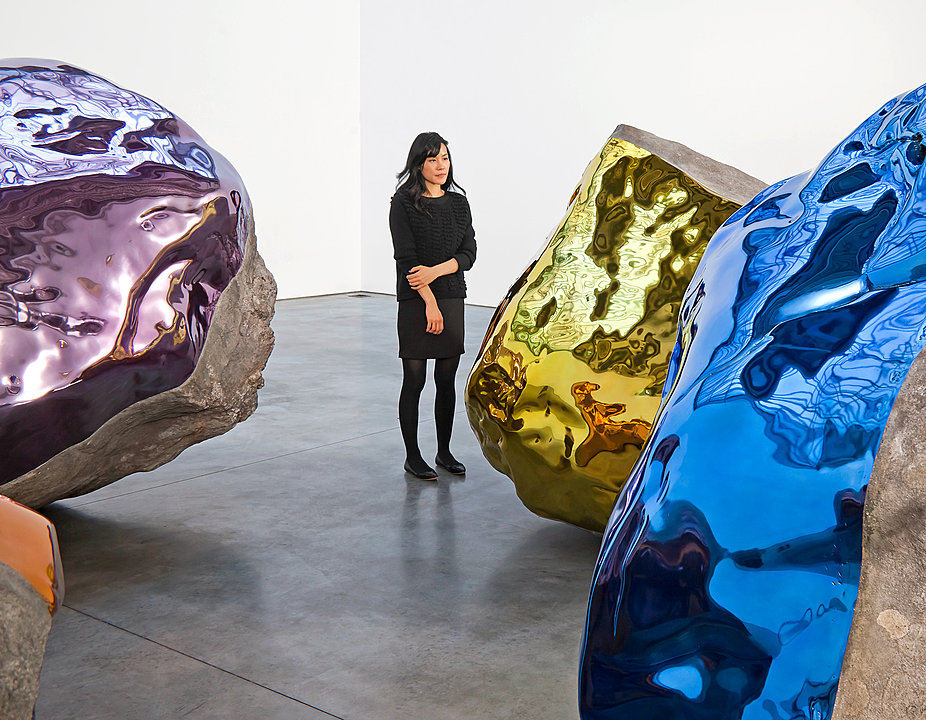
Selections from the knock-out exhibitions at Barbara Gladstone this past winter. Rejoice, Minnesotans: these are going to be in the Walker’s 2014 survey exhibition, Jim Hodges: sometimes beauty.

Jim Hodges Untitled (2011) installed at Barbara Gladstone Gallery, New York Photo: Gladstone Gallery. Source: WalkerArt.org.

Jim Hodges, Untitled (2011) installed at Barbara Gladstone Gallery, New York Photo: Gladstone Gallery. Source: WalkerArt.org.

Get the backstory on the monoliths at Walker Art Magazine.

Jim Hodges oversees the deinstallation of Untitled at Gladstone Gallery. Source: WalkerArt.org.

Jim Hodges oversees the deinstallation of Untitled at Gladstone Gallery. Source: WalkerArt.org.

Installation using light, mirrors, motors, blackened water, the entire gallery space, and then some. It’s really riveting. Have a look at the video of a performance at jimhodges.com.

Jim Hodges, Untitled, 2011  Mirror ball, mechanics and water; dimensions variable. Source: BarbaraGladstone.com.

Jim Hodges, Untitled, 2011 Mirror ball, mechanics and water; dimensions variable. Source: GladstoneGallery.com.

Jim Hodges, Untitled, 2011  Mirror ball, mechanics and water; dimensions variable. Source: BarbaraGladstone.com.

Jim Hodges, Untitled, 2011 Mirror ball, mechanics and water; dimensions variable. Source: GladstoneGallery.com.

Untitled, 2011  Wood, canvas, tempera and mechanics; Inside: 120 x 180 x 180 inches (304.8 x 457.2 x 457.2 cm) / Outside: 163 x 185 1/4 x 189 1/4 inches (414 x 470.5 x 480.7 cm). Source: BarbaraGladstone.com.

Jim Hodges, Untitled, 2011 Wood, canvas, tempera and mechanics; Inside: 120 x 180 x 180 inches (304.8 x 457.2 x 457.2 cm) / Outside: 163 x 185 1/4 x 189 1/4 inches (414 x 470.5 x 480.7 cm). Source: GladstoneGallery.com.

It’s interesting to think about how an artist develops—starting with modest projects made alone, in a studio, using materials at hand, and then orchestrating multi-venue, logistics-laden, monumental fabrication projects. This is a particularly contemporary way for an artist’s work to mature, as the latter is only possible with market success and the support of blue-chip institutions.

Perhaps if emerging artists bushwhack their way through creative territories, established artists have to remain true to course despite siren songs of numerous pathways (sorry for mixing maritime and terrestrial metaphors). Even in his recent massive metallized boulders, I think Hodges’ work retains its elemental, experimental and experiential aspects.

This seems to be true for viewers and for artists, including Hodges. Quoted by Heidi Zuckerman Jacobson of the Aspen Art Museum (HuffPo), Hodges said:

There are no guarantees [in art]. [Art] challenges and rewards. We get what we choose from it.

Surveying an artist’s life’s work is a great way to gain perspective. When I did a lot of research on contemporary artists in graduate school, I realized that of the artists whose work I love, the work they’re making their fifties is outstanding. Hodges is in his mid-fifties. (So is Cindy Sherman.) The message is to keep pushing, be patient, and never stop evolving.

I think it’s fantastic that the Walker is going to host a survey of Hodges’ work next year. Combined with the Walker’s amazing design team, I’m sure the catalog is going to be fantastic. Maybe a Phaidon monograph will be in order soon?

Standard
Sights

This Saturday in San Francisco

Positive Signs, 2011, glitter pen, fluorescent pen, foil print, gridded vellum, 8.5 × 11 in / 21.5 × 28 cm.

Positive Signs, 2011, glitter pen, fluorescent pen, foil print, gridded vellum, 8.5 × 11 in / 21.5 × 28 cm.

Artists’ Talk
In Other Words
Sat, March 24, 2pm
Intersection for the Arts
925 Mission Street (at Fifth), San Francisco CA 94103
Exhibition extended through 3/31
Gallery hours: Tue–Sat, 12–6pm

In Other Words is a group exhibition that looks at language and its capacity to clarify and confuse, convene and separate, inspire and discourage. By exploring a range of areas concering the influence and evolution of language in our lives—the impact of technology, the obscurity of industry-specific terminology, the psychological internalization of language, and the recontextualization of language—the artists in this exhibition demonstrate through a diversity of media the many ways in which we strive to communicate to each other.

Katie Gilmartin, Julia Goodman, Emanuela Harris-Sintamarian, Susan O’Malley, Meryl Pataky, Alex Potts, Cassie Thorton, Annie Vought, Christine Wong Yap

Read reviews on SFGate, Zero1 blog, and the East Bay Monthly.
View opening photos on ArtBusiness.com.

hope for good, allow for even better, 2012, ribbon, thread, pins, 51.5 × 47 in / 1.3 × 1.2 m

hope for good, allow for even better, 2012, ribbon, thread, pins, 51.5 × 47 in / 1.3 × 1.2 m


Opening reception: Sat, March 24, 3–5
Winter Art Walk 2012: Sat, March 24, 12–5
Voices of Home
Jenkins Johnson Gallery
464 Sutter Street (between Powell & Stockton), San Francisco, CA
Gallery hours: Tue–Fri 10–6; Sat 10–5
Exhibition: March 24–April 28, 2012

Each of these artists visually articulates works inspired by their diverse and rich cultural and ethnic backgrounds.

Artists: Noel Anderson, Kajahl Benes, Elaine Bradford, Elizabeth Colomba, Jamal Cyrus, Nathaniel Donnett, Zak Ové, Leslie Smith III, Devin Troy Strother, Felandus Thames, and Christine Wong Yap.


Standard
News

The Artist Welcoming Committee: New York City Branch

Call for Artists who have recently moved to New York City

The Artist Welcoming Committee: New York City Branch seeks guests of honor for the second Welcome to New York! celebration, to be held at Art in General the third week in April. This is not a grant or an exhibition opportunity, rather it is a chance for a small batch of artists new to New York City’s arts community to be formally welcomed by a room full of local gallerists, curators, arts writers, administrators, and artists. Of course, this will all be done with the help of some bubbly and glitter confetti!

DEADLINE: April 10th, 2012

Learn more.

Standard
Research

[International Art] English Spoken Here

In “Tip of the Tongue” (Frieze, Spring 2012), writer and translator Vincenzo Latronico asks, “Since English has become the lingua franca, what has happened to art – and to language?”

It’s an interesting question, which was brought to my attention a few years ago during a studio visit. A Lithuanian curator asked why I make my text-based work in English. As a native speaker born in the US, my initial reaction was that it was somewhat essentializing, though now I think he wanted to question any assumptions about English’s neutrality. Latronico delves deeper into the implications of art world English:

On the predominance of English in the art world and its effects:

[When artists switched from writing in their native language to English] The most obvious transformation was formal – short sentences, modest vocabulary, basic syntax…. English has a distinct intellectual style: language-specific criteria for a convincing argument, a well-grounded idea, a strong proposal or a good quotation.

Contrast English with Italian intellectual style, whose description recalls visions of my graduate school readers, scribbled marginalia asking, “What’s the point?”:

Italian intellectual style … has been determined, until very recently, by … 19th-century German philosophy … and French post-Structuralism…. This mixture makes the prose meandering, strenuously long, convolutedly composed of subordinates nested within other subordinates in a smoky mise-en-abîme. To anyone used to English writing, it’s most likely to sound as if no argument had been made at all.

And consider a study by

…artist David Levine and the sociologist Alix Rule…. ‘International Art English’ is exemplified by a large set of English-language, art-related press releases and newsletters. They analyzed the corpus and found a tendency towards overly long sentences, a proliferation of superfluous abstract nouns, the excessively frequent derivation of nouns ending in ‘-ization’ and even a slightly peculiar metaphysics: writers granting agency to inanimate objects – exhibitions, projects, research – when this agency should be ascribed to the people who created them. For Levine and Rule, the cause of these traits lies in a foreign influence: the imitation of French philosophy and theory as read in English translation.

Which the author interprets thusly

The foreign influence makes the language more accessible for a different, wider, more diverse audience than one composed of native speakers only. International Art English … uses fewer words and less varied syntax than ‘high’ standard English; at the same time, the words used are not necessarily the easiest, nor are the syntactic constructions the simplest. Adapted to the needs of non-native speakers, the language becomes at once complex and easy: a combination of convoluted, abstract refinement and down-to-earth directness….

This is a satisfyingly optimistic conclusion, and I hope it’s true.

Standard
Research

optimism and setbacks, tony tasset sculptures

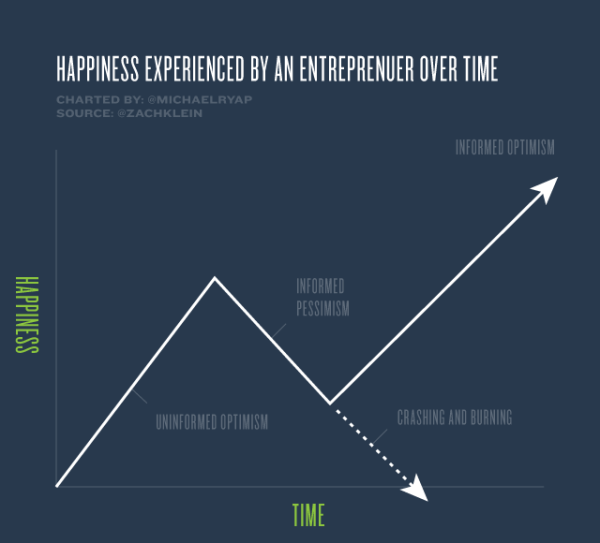
Happiness experienced by an entrepreneur over time. Michael Yap. Source: twitter.com/#!/michaelryap

Happiness experienced by an entrepreneur over time. Michael Yap. Source: twitter.com/#!/michaelryap

As Martin Seligman points out, the difference between optimists and pessimists is not that optimists do not suffer from setbacks, but that they optimists weather setbacks better.


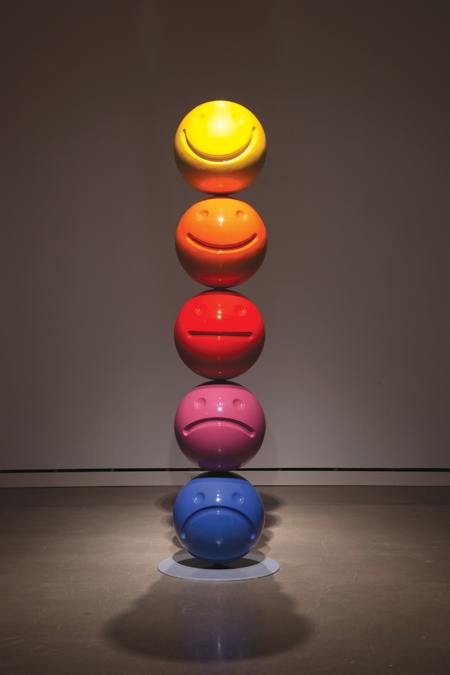
Tony Tasset, Mood Sculpture, 2011, Fiberglass and paint, 90" x 18" diameter, Photos: courtesy Kavi Gupta Gallery, Chicago // Source: ArtLtdMag.com

Tony Tasset, Mood Sculpture, 2011, Fiberglass and paint, 90" x 18" diameter, Photos: courtesy Kavi Gupta Gallery, Chicago // Source: ArtLtdMag.com


Tony Tasset, Why Can't We All Just Get Along?, 2009, lambda print, 47" x 47". Source: KaviGupta.com

Tony Tasset, Why Can't We All Just Get Along?, 2009, lambda print, 47" x 47". Source: KaviGupta.com

Standard
Art Competition Odds

Art Competition Odds: Virginia A. Groot Foundation Grant

The Virginia A. Groot Foundation received 274 applications for 3 grants in 2012.

///////////////////////////////////////////////////////////////////////////
///////////////////////////////////////////////////////////////////////////
///////////////////////////////////////////////////////////////////////////
/////////////////////////////////////////////////

or about 1:91, or 1%

See all Art Competition Odds.

Standard