Citizenship, Community, Sights

get excited: open studios, mfa shows, more

Besides Frieze, NADA, and Pulse art fairs in NYC this week, there’s a slew of auxilliary events, open studios, and MFA shows to check out. In support of friends and community, here’s my list:

Go Stephanie!

May 4–6
Stephanie Syjuco: RAIDERS (Redux)
Catharine Clark Gallery’s New York Pop-Up Gallery
313 W 14th Street, 2F, NYC

May 4–6
LMCC’s Open Studio Weekend
125 Maiden Lane, 14th Floor, NYC

Go Michael!

Saturday, May 12
IN/VISION
2012 MFA Interaction Design Festival at the School of Visual Arts
Thesis Presentations: 11am – 4pm @ SVA Theatre
Thesis Exhibition: 5–7pm @ SVA Interaction Design Department
Go Nyeema!
May 12–13
NARS Foundation Open Studios
88 35th Street, 3rd Floor, Brooklyn
May 18–19
Kambui Olujimi: A Life in Pictures
Apex Art, 291 Church Street, NYC
Saturday, May 19
Question Bridge: Black Males Blueprint Roundtable
Brooklyn Museum 
Finally, if that’s not enough, learn about Emergency USA‘s amazing projects building medical infrastructure in areas of conflict:
Thursday, May 3, 7pm, E-USA office @ 21 Exchange Place. Presentation. RSVP to nyc@emergencyusa.org.
Sunday, May 6, 5–8pm, Randolph Beer, Nolita. 15% benefit happy hour.
Standard
Art & Development

Labor and Time

As posited by Art Monthly (#356: May 2012):

In a western world dominated by immaterial labour, and where scientists and philosophers have thrown into doubt our understanding of physical objects, how have artists – from John McCracken and John Hilliard to Wood & Harrison and Andrew Dodds – questioned and defended the nature of things?

‘Sculpture, of all the arts, must surely be responsible for mapping the various journeys of thinghood. “What is a Thing?” – the question Heidegger asked in the 1920s – turns out to be a question that we have to keep asking.’

As I help M prepare his exhibition, the challenges of working with materials become instantiated everyday. In contrast to clicking “undo” and swiping screens, sourcing, handling, manipulating and displaying materials—not to mention lending them the illusion of perfection and timelessness so often desired of art objects—is complicated, expensive, and risky. Entropy constantly threatens. Nothing gets done without physical energy and attention; things take time and skill. Labor has become, as Art Monthly put it, immaterial—and I wonder how this shifts how art objects are perceived and understood. So many of my recent art viewing experiences have conjured thoughts about production values, for better or worse. The drawback, for me, is over-emphasizing how something is made over what it accomplishes in content or concept. For those who are disconnected from materials and labor, perhaps the work triggers thoughts unencumbered by human and environmental costs, at best looking with “deadpan” eyes (as Rosalind Krass described of Minimalism) at form and form alone, and at worst, with the Like/Dislike, Instagram-worthy consumer browsing. In that mindset, to register visually, to click and upload, is the power to put a thing in a shopping cart, pay for it, bring it home, and store it in a vast garage, all in one instant.

Standard
Citizenship

Via e-flux: Sotheby’s: offer your art handlers a fair contract

Don’t be jerks, Sotheby’s. Do the right thing.

Art handlers lift things that are heavier than you want to lift, handle things that you’re too nervous to handle yourself, and pack and unpack things that you’re not skilled to handle. If you want workers to handle art and antiques with care, treat your workers with dignity.

Sign the petition at change.org.

For the past eight months, Sotheby’s has locked its 43 unionized art handlers out of work. Rather than negotiating a fair contract with its employees, the company has issued a set of demands: the gutting of the art handlers’ union, the elimination of health insurance and other benefits, and the replacement of full-time skilled workers with temporary unskilled laborers.

Sotheby’s has decided that the handling of priceless artworks is an easy job; that low-paid temporary workers with little training or incentive can manage the constant stream of artifacts into and out of the world’s largest auction house. The 43 locked-out workers who have made art handling their career know this is not true.

There have been no negotiations. Read on.

Standard
Artists

Life Models: Isabel and Rubén Toledo

For some, a charmed existence is a farmhouse in a rolling pastoral with kids. For others, it may be an airy, industrial live-work loft on Broadway in Manhattan for a creative husband-and-wife (or better put, wife-and-husband) team. The latter is Isabel and Rubén Toledo’s life. They have four floors; one is Rubén’s painting studio, and the other three are for Isabel’s fashion design studio and production. More importantly, they collaborate and they’re passionately in love, gently finishing each others’ sentences on a recent episode of Studio 360.* This is the kind of love story that makes my heart ache.

I’ve had quite a few conversations with other female artists about how to balance life and work, especially when that work is a creative passion without any guarantee of remuneration. I’ve even found myself co-miserating that romantic love and artistic passion might be incompatible. But two people grow and change, and while you can’t always pedal at the same speed in the same direction, we have to be grateful for the times we catch up and cruise alongside our mates. The Toledos’ story is an immigrant success story, an American fashion legend, a tale of love. If you’re not familiar with it, peep this 2008 profile in the New Yorker:

She does the cooking in a tiny alcove, and he brews the Cuban coffee. They have Sunday brunch together, lingering over it for hours, and at night, if they don’t feel like going out, Ruben said, “we put some cha-cha or rumba music on and boogie around by ourselves. We’re both great dancers.”

Adorable.

*I know, two posts in a row inspired by public radio. Take heart—heavy podcast usage, for me, indicates intensive studio production.  I also loved this quote from Rubén Toledo on Studio 360:

We’re not buyers and sellers, we’re makers.

Standard
Community

get excited: in the bay

So much to get excited about in the Bay, meaning the San Francisco Bay Area, and more specifically, the actual bay.

We Players: How We Leave and Return: Intersections of Art and History
April 28–July 1, 2012
Angel Island State Park

Opening Reception @ the Visitor’s Center: April 28th, 2012 1:30 – 3pm

Exhibiting Artists:
James Bradley
Torreya Cummings
Lauren Dietrich Chavez
Julia Goodman
Matthew Gordon
Justin Hurty
Brandon Walls Olsen
Imin Yeh

How We Leave and Return is a site-specific exhibition of visual art on Angel Island State Park.

Seven Bay Area artists were invited to explore Angel Island’s history, architecture, and landscape, and create contemporary artworks inspired by the island’s historic narratives and recurring themes.

How We Leave and Return asks the audience to consider the cyclical nature of human history, marking that it often repeats itself, and presents ideas as to how a society copes with its legacy of ideologies, ontological positions, and cultural practices.

Lots of CCA alum (woot!) in this show, curious to see hear how TC’s boat voyage goes…. I don’t like getting caught up in issues of race and representation, but I’m glad that a Chinese American artist, especially one who deals with issues of identity in her work, is in the show. Angel Island is so important in California history as it intersections with Chinese Americans.

FOR-SITE Foundation: International Orange
Fort Point National Historic Site
(beneath the Golden Gate Bridge)
May 25–October 28, 2012

Celebrating the 75th anniversary of the Golden Gate Bridge, International Orange — named in honor of the unique paint color of the span — offers fresh perspectives on an enduring landmark. This exhibition at Fort Point presents new work by contemporary artists responding to the bridge as icon, historic structure, and conceptual inspiration.

The contributing artists — Anandamayi Arnold, Mark Dion and Dana Sherwood, Bill Fontana, Andy Freeberg, Doug Hall, Courtney Lain, David Liittschwager, Abelardo Morell, Cornelia Parker, Kate Pocrass, Jeannene Przyblyski, Allison Smith, Stephanie Syjuco, Camille Utterback, and Pae White — approach the bridge with diverse and distinctively individual aesthetics, materials, and points of view.

Really excited that this show, featuring so many stellar Bay Area and national artists (my personal faves linked above), will be on for a few months, increasing the chances of me catching it.

Standard
Meta-Practice

Via Hyperallergic: William Powhida’s Artist Payments at NYC Nonprofits, By the Numbers

Awesome sequence of very disturbing information graphics about artists’ payments at nonprofits. I love working with nonprofits and know that many just scrape by, but still, some of these numbers, and the failure to remunerate artists for their labor, is just shocking.

From Artist Payments at NYC Nonprofits, By the Numbers by William Powhida on Hyperallergic, April 23, 2012.

From Artist Payments at NYC Nonprofits, By the Numbers by William Powhida on Hyperallergic, April 23, 2012.

Standard
Impressions

Chelsea jaunt

Made lemons out of lemonade today: Sidelined from running, I took up biking, and I rode down to Chelsea and up to Columbia for some art shows. Perfect weather for it.

Standouts:

Three of the four shows I loved have to do with mirrors. So sue me.
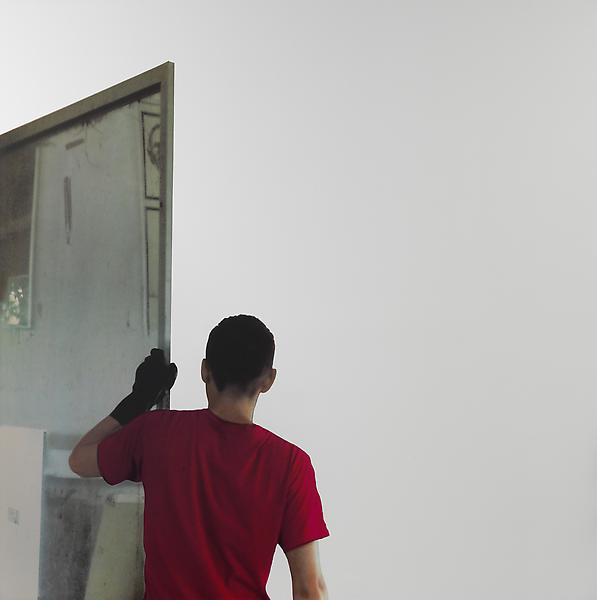
Michelangelo Pistoletto, Lavoro - Atelier, 2008-2011, Silkscreen on polished super mirror stainless steel 59 X 59 inches (150 X 150 cm). // Source: luhringaugustine.com

Michelangelo Pistoletto, Lavoro - Atelier, 2008-2011, Silkscreen on polished super mirror stainless steel 59 X 59 inches (150 X 150 cm). // Source: luhringaugustine.com

Michelangelo Pistoletto at Luhring Augustine
Lavoro
Thru April 28

The Arte Povera mirror-maker depicts construction workers, bringing the past of each building these are shown in into the present. I liked these a lot. Baffled why the statement said that the images are “adhered” when the image captions, and the works themselves, suggest screenprinting as the medium. These are not my favorite Pistolettos; I liked some of the older ones at the Walker and Brooklyn Museum better, but it’s still great to see so many of them in one place. A treat.

Greg Smith at Susan Inglett Gallery
ners Banners Banners Ban
Thru May 26

GO SEE IT. ESPECIALLY THE VIDEO.

If you can’t make it, read on…. (Spoiler alert.)

I made a point of going into galleries that aren’t on my usual route, and this one paid off. There are drawings and mixed media assemblages with a harness, all very cruddy and rough. The best thing, though, is a video that documents a performance in which the artist produced and installed the works under and on the Brooklyn-Queens Expressway. There’s a belt of canvas that goes completely around the car, and shots of the artist operating a sewing machine while driving (not recommended!). He used copious amounts of sweetly colorful dots, and also made some fabric-and-cotton-batting pennant flags. It’s a bizarre experiment with lots of physical and legal risk for crafty, yet un-crafted, artworks. Super thought-provoking for thinking about what is at stake in a work or practice, and what is success or failure.

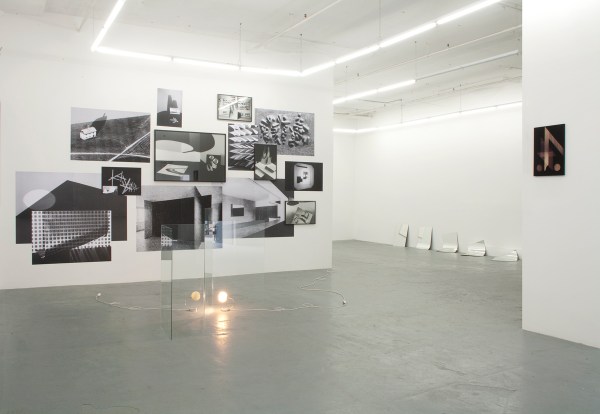
Grey Peak of the Wave, Installation view, 2012 Alicja Kwade, Alexandra Leykauf and Florian & Michael Quistrebert. Source: HarrisLieberman.com.

Grey Peak of the Wave, Installation view, 2012 Alicja Kwade, Alexandra Leykauf and Florian & Michael Quistrebert. Source: HarrisLieberman.com.

Grey Peak of the Wave at Harris Leiberman
Group show of European artistst
Through April 28

I love this kind of work. Subtle, open-ended, perceptual, quiet. My favorites were:

Alicja Kwade’s taped glass sheets with two lamps, one on, one off (above, on ground). In the glass’ reflection, the unlit lamp appears convincingly illuminated.

Alicja Kwade’s bent mirrors, as if drooping down off the wall like a sheet of paper (also seen above, in the rear space). Surreal. Materially simple, disguising what I’m sure was laborious or expensive fabrication. Manipulating common materials in uncommon ways never gets old to me.

Alexandra Leykauf’s wall vinyls and framed photos (also above, back wall). Who doesn’t love a b/w photo of geometric abstraction made with real objects? And then complicating commodification with both framed works and site-specific, one-use vinyl? So simple, so good.

IRAN do ESPÍRITO SANTO, Installation view of SWITCH at Sean Kelly Gallery, New York March 21 - April 28, 2012 Photo: Jason Wyche, New York. Source: skny.com.

IRAN do ESPÍRITO SANTO, Installation view of SWITCH at Sean Kelly Gallery, New York March 21 - April 28, 2012 Photo: Jason Wyche, New York. Source: skny.com.

Iran do Espírito Santo at Sean Kelly
Switch
Thru April 28

I loved this Brazilian artists’ subtle, perceptual, materially sophisticated works ever since I saw a few at Altman Siegal in San Francisco. This show is a brave selection of 3 major works: a large wall painting, a series of marble replicas of glass bulb covers, and this series of “mirrors.” In fact, these are all made with two sheets of plate glass sandwiching a reflective tint. They look like mirrors until you spend a little more time with them, and realize that they are slightly transparent. They don’t, as the press release states, look like they’re folding, the way Kwade’s bent mirrors do at Harris Lieberman. But they do achieve something else, which as to do with how the leaning piece and the floor piece allow slightly different amounts of light and reflectivity. It’s sort of like the difference between a 100% printed CMYK black, and a “rick black,” which is a mixture using more colors, and hence, more saturation. The mirror on the floor looks as if you could fall into it.

Standard