Techniques, Travelogue

Printmaking minutia

image

Proofs in the printshop windows. I'm too shy and easily distracted to print with focus on the etching press nested in the storefront.

[If you print readily and often, these notes may seem trivial or obvious. Since i don’t, these tips were useful  time savers and I hope to share them with others as well as my future self. Enjoy.]

image

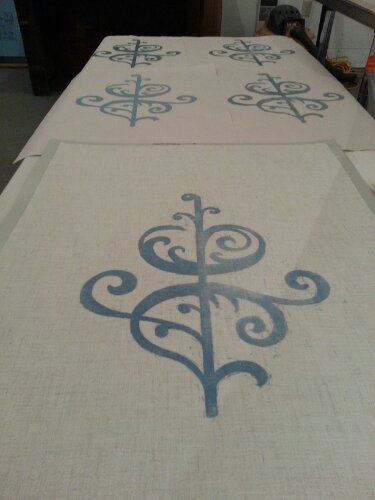
New woodcut prints on linen and cotton, to be sewn into banners.

I’ve been cranking away in the print shop for the past 2.5 weeks in this Studio Works residency at the Tides Institute and Museum of Art. It’s been great reaching far back into my memory and bringing my old woodcut and letterpress knowledge into the present.

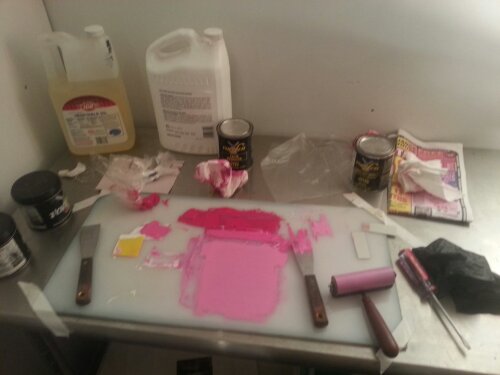
Luckily, traditional printmaking techniques are antiquated, so they are pretty much the same as when I last printed (only less toxic, due to solvent alternatives and less showy bravado on my part). Still, there is always room for invention.

image

On-block registration.

For example, its fun to embellish upon established registration methods to suit your needs. I’ve taken a basic centerline and overlaid axes, with each direction labeled N, S, E, or W.

image

Annotated print-in-progress. It doesn't look like much but you'd be surprised how many prints I made before I realized how much a few notes would help.

I’ve annotated each print with the direction and offset distance of each pass (i.e., S 0.25″). Then if I want to do a series of passes on a 45 degree angle, my notes will remind me how far I’ve gone, and what the next pass should be (i.e., SW 1″, SW 0.5″, 0, NE 0.5″, etc.).  

image

Woodcut prints on fabric adhered to plastic backing sheets for printing and registration.

I’m really pleased with the materials I got for mounting fabric during printing. I’ve only printed on fabric once or twice before this, and I knew I needed to keep the fabric rigid for registration across multiple passes. At the old CCA printshop, which included stone lithography equipment, there were plastic tympans to use instead of blankets between your plate or block and the press drum. Eastport is small enough that I knew I had to order my materials in advance, so I got HDPE sheets–they’re flexible,  durable, easy to cut with scissors, and, most importantly, chemical resistant. I also knew from screen printing that I’d need spray adhesive. Low tack repositionable spray adhesive behaves just like it sounds, and so far has left no residue. Together, these two things have made printing on fabric a breeze. I spray a light mist of adhesive on the plastic sheet, lay down my cut fabric, smooth it out like vinyl, and it stays perfectly in position through multiple passes through the press.

Instead of laying my printing substrate down on the block and then turning the press handle, I’ve found another method to print cleaner: register only the front end of the tympan, then push the bed forward so the drum grabs, then release that hand to crank. Keep the back end high throughout, so the fabric only makes contact to the block when both are under the drum.
image

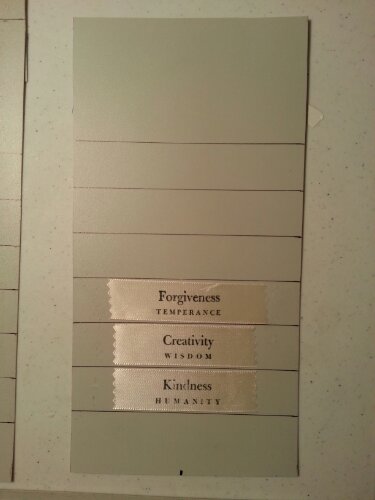
Labels for character strengths semaphore flags. Lead type printed on ribbon.

The same materials, though smaller in scale and manifold, has been working out really well for printing lead type on ribbon to make labels on a proofing press.
Standard
Travelogue

Eastport Aesthetics

Many residents of this area are creative, but visual arts are only one party of the larger aesthetic experience of being here.

The island, its climate, and the outdoors seems to attract as spring showers persist into summer.

image

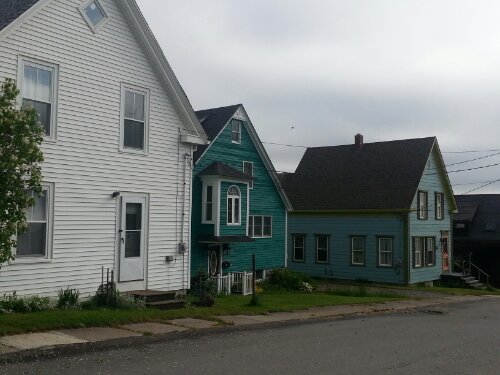
Eastport's heyday was in the 1800s, and most of the architecture are historic buildings. I love the pleasing and inventive palette of the house on the far right.

image

Amazing scents!

image

These brilliant orange flowers with crepe paper petals are blooming all over the island right now.

image

The harbor is coming to life. Summer starts a little later in such nirtern climes.

image

Looking out towards Deer Island from Eastport's Moose Island.

image

Rainbow joy.

Standard
Travelogue

Greetings from Eastport

image

Across the bay, Canada.


image

View of downtown Eastport from the pier.

Months ago, I applied to an open call with a proposal to make banners inspired by maritime history and semaphore flags.  

Today, I am posting this from Eastport, Maine, one week into the Studio Works residency at the Tides Institute and Museum of Art to which I am so grateful for the opportunity.  

Eastport is the easternmost city in the U.S., but it is more like a small town (so small, in fact, that my very definition of “small town” seems to be expanding while the conceptual parameters are diminishing). Coming from New York, it feels a bit anachronistic to me. Many of the buildings are beautifully preserved from the 1800s, when Eastport flourished. My lodgings are similarly historic,  so it seems fitting that my digital and online capacities are reduced while I’m here. For that reason, my posts this trip will be infrequent and concise, if I can help myself.  

image

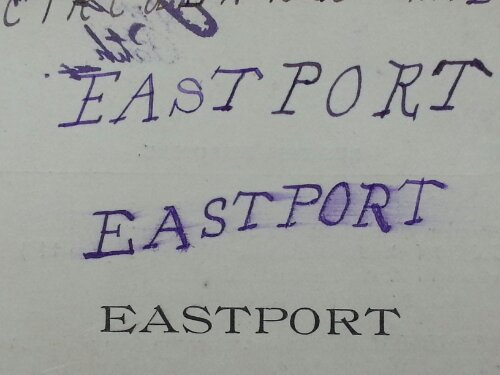
Page from an 1800s Eastport directory in the collection at the Tides Institute.

A few reflections, great and small, in no particular order:  

image

New woodblock print of a flourish (typographic ornament) on linen.

• Printmaking is a little like riding a bike. Though I printed most actively in my undergrad years, once I got back in a print shop it seemed quite familiar. I enjoyed many “I remember this” moments: feeling my arm fatigue mixing cold inks straight from the can, listening to the sound of the brayer to learn about the tackiness of the ink, and all the peripheral tips and tricks in setup and cleanup to save time, like making little tabs of scrap materials to use for skimming inks or modifiers.    

image

A very handy reference chat for the organization of letterpress type. Without it, I'd be helpless.

• Printmaking is nothing like riding a bike. It’s a long slow process of proofing, refining, modifying, adjusting pressure, adding packing, and so on. The ideal is perfect craftsmanship demonstrated through identical reproduction. I was never into that. And I don’t want to get hung up on it now. I’m trying to let this be more experimental, not having to produce an edition, unless it’s an edition varie. To let my hand, indeed, my ability, however lacking, show. I’m interested in decoration and domestic production–e.g. how individuals, not corporations, made flags for hundreds of years–so I think it makes sense that the banners aren’t perfectly mass editioned like Victorian collectibles.  

The most rewarding place from which to learn has been, for me, the mistakes. At the same time, perhaps there are no mistakes–there’s just more than one right way to do things. –Marcia Tucker, A Short Life of Trouble

Standard
Meta-Practice

Site-responsive proposal factors

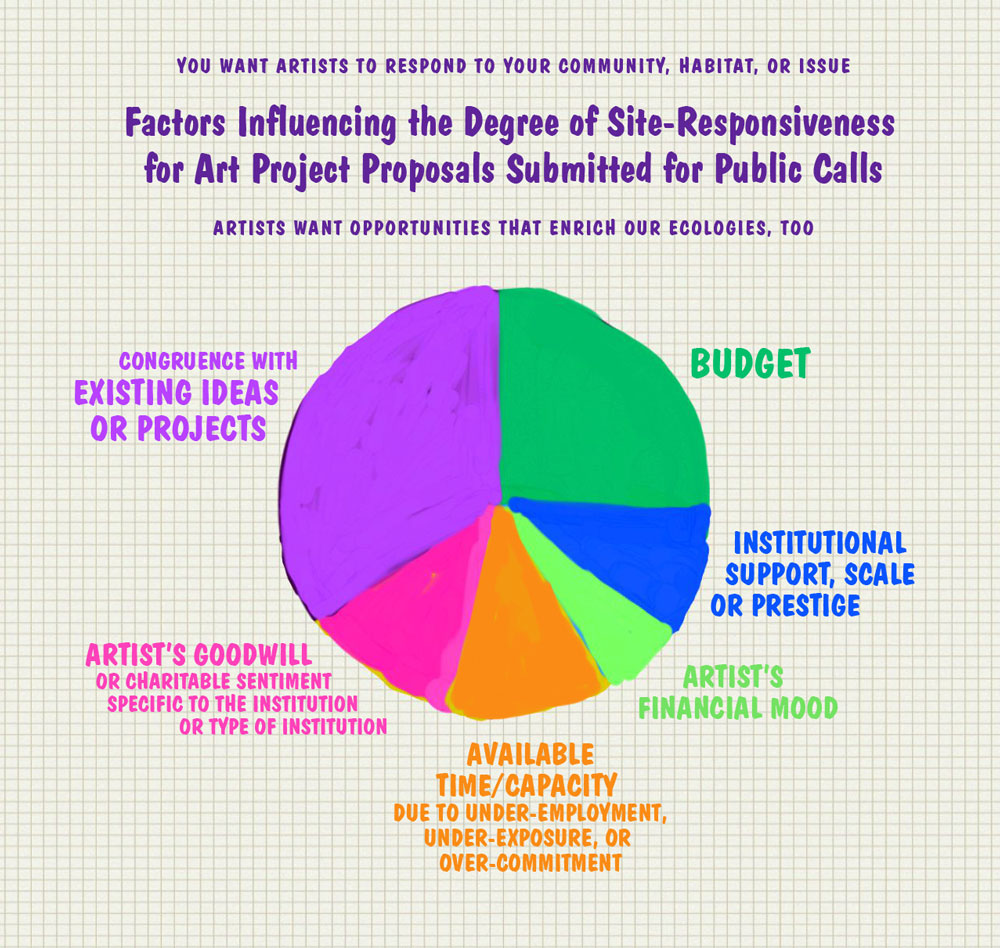
Not all calls for site-specific projects are created equally.

Competitions reward ambition, but ambitious projects aren’t always adequately supported. I am guilty of having breathed a sigh of relief upon hearing that I didn’t receive an award for an overly ambitious or under-funded opportunity. Sometimes things change. Ideas become less attractive, or other commitments become more engaging.

Site-specific calls are especially labor-intensive, so perhaps savvy artists embrace degrees of site-responsiveness. These are some factors that influence to what degree I push speculative projects. Enjoy.

Site-responsive proposal factors

Site-responsive proposal factors

Standard
Research

Recommended: Marcia Tucker’s A Short Life of Trouble

A Short Life of Trouble, by Marcia Tucker (2008)

A Short Life of Trouble, by Marcia Tucker (2008)

In addition to apologies for forgetting who he/she is, I owe huge thanks to whoever recommended Marcia Tucker’s memoir, A Short Life of Trouble (2008) to me. I’m over halfway through and already regretting the diminishing number of pages left to enjoy.

The redoubtable curator’s early life was full of adventure and anguish. There are parties in downtown NYC, a cross-country motorcycle ride, overseas romance, upstate escapes, and day jobs assisting mad artists. Later, she funnels her passion into a curatorial career as the first female curator ever hired at the Whitney Museum of American Art.

Her activism as a feminist and the courage and aplomb with which she challenges sexism in the art world is inspiring and encouraging. It’s also a great reminder of the brevity of contemporary art history—that the institutions that seem dominant today have really been shaped by key individuals that are still active now, and these individuals aren’t the ubiquitous blue-chip male brands you typically think of.

Tucker writes in a cut-to-the-chase style fitting for her unstoppable determination and remarkable work ethic.


I highly recommend A Short Life of Trouble to artists and curators alike, especially those interested in how to live and work in fifth gear, regardless of gender. Young art and curatorial students may find the story of how Tucker realized that she was a curator, not an artist, especially useful.


Standard
Research

looking at art, on whose terms

It seems coincidental yet fitting that after filtering through the Frieze Fair for things I could use (materials, techniques, displays) and coming away with an unimpressive whole, that I should stumble upon this bit of wisdom:

When I first started going to [artist’s] studios, I was looking for work that met my own terms, even if I couldn’t quite define them. But after a while, I realized that I was approaching the whole enterprise from the wrong end. I needed to find out what the work’s terms were, and then see if I could stretch my understanding to meet them.

(from the prologue of Marcia Tucker’s A Short Life of Trouble, 2008)

Indeed, objects I make are often seen as the results of my efforts. But moreover, the ultimate results I seek to create are the internal and external experiences that unravel, visually and conceptually, over time.

[Thanks, CLF, for the recommendation.]

Standard
Impressions

Frieze Art Fair: 2013 prowl-through

N and I were able to attend the Frieze Art Fair thanks to O (whose pass spared us each $42 entrance fees). I convinced her and M that the cross-Triboro Bridge walk would be lovely. It was, but I neglected to consider that once we got to the fair we’d be on our feet another 2.5 hours. Weary-legged and short on cash on an island where a bottle of water costs $4, I had little time or attention to really engage the artworks.

(When I used to go on long runs, I’d carry hydration and fuel—AKA water and snacks—with me. I should have the same mentality when visiting fairs can take as long as an endurance race.)

Mostly, as in past fairs, I looked at methods of display, uses of materials, and forms related to upcoming projects—which now are banners and textiles.

Andrea Bowers, in both booths housing her work, shared this useful statement that sheds light on Frieze’s use of non-union labor. (One thought about the lack of mass response to OWS Arts & Labor’s call might be attributed to this: NYC’s unions are very active in picketing non-union business. In fact, it’s common enough that one might see the inflatable picketing rat a few times a week. New Yorkers just keep walking.)

Bowers’ drawings on cardboard of Victorian icons of liberation were quite lovely, and much looser than her photo-realist graphite drawings, interestingly.

Open letter from Andrea Bowers regarding Frieze's use of non-union labor.

Open letter from Andrea Bowers regarding Frieze’s use of non-union labor.

Photolithographic etching on copper-clad plastic by Sam Lewitt at Miguel Abreau Gallery (NYC). Having just worked on a vinyl sculpture, I thought this way of displaying floppy plastic was really smart.

Photolithographic etching on copper-clad plastic by Sam Lewitt at Miguel Abreau Gallery (NYC). Having just worked on a vinyl sculpture, I thought this way of displaying floppy plastic was really smart.

Handmade crochet by Servet Kocygit at Rampa (Istanbul). This is just pretty and in-your-face. Though I'm not sure what it means, I thought it was useful for thinking about how to frame textile text works. The crochet looks like it was treated with a glue, such as a matte medium, and pinned in place to a (removed) substrate, so it lays flat. The substrate it's now on is a woven fabric.

Handmade crochet by Servet Koçyiğit at Rampa (Istanbul). This is just pretty and in-your-face. Though I’m not sure what it means, I thought it was useful for thinking about how to frame textile text works. The crochet looks like it was treated with a glue, such as a matte medium, and pinned in place to a (removed) substrate, so it lays flat. The substrate it’s now on is a woven fabric.

Cameron Platter's monumental wood text at Whatiftheworld/Gallery (Cape Town). Another puzzle in terms of content, and yes, the scale suits the obviousness of fairs. But it is pretty smart to appeal to people's love (or fetish?) of wood type, and use condensed gothic typography.

Cameron Platter‘s monumental wood text at Whatiftheworld/Gallery (Cape Town). Another puzzle in terms of content, and yes, the scale suits the obviousness of fairs. But it is pretty smart to appeal to people’s love (or fetish?) of wood type, and use condensed gothic typography.

Amir Mogharabi at Ibid Projects (London). Things. On shelves. This is like a little poem, with mother-of-pearl.

Amir Mogharabi at Ibid Projects (London). Things. On shelves. This is like a little poem, with mother-of-pearl.

Maybe the collection of works where I could have spent a lot more time and gotten a much richer experience: Catherine Sullivan and Valerie Snowbeck's installation of texts on laminated fabrics and sculptural works at Galerie Catherine Bastide (Belgium). The materials and typography were so unusual, and I suspect the works told a well-conceived narrative. I regret the momentum that propelled me to march onward, instead of lingering and looking more closely.

Maybe the collection of works where I could have spent a lot more time and gotten a much richer experience: Catherine Sullivan and Valerie Snowbeck’s installation of texts on laminated fabrics and sculptural works at Galerie Catherine Bastide (Belgium). The materials and typography were so unusual, and I suspect the works told a well-conceived narrative. I regret the momentum that propelled me to march onward, instead of lingering and looking more closely.

Lily Van Der Stokker's installation at Kaufman Repetto (Milan). This is just kooky and happy. The chest in plaid is so humorous. In working with fabric I've been wondering how to distinguish my work from craft—more specifically, something crafty, cute and consumable from Etsy. Van Der Stokker seems to tackle this distinction head-on with these works. What makes a painting on canvas art, a textile design, and a painting on a cabinet any less a painting?

Lily van der Stokker‘s installation at Kaufman Repetto (Milan). Kooky. Happy. The chest in plaid is so humorous. In working with fabric I’ve been wondering how to distinguish my work from craft—more specifically, something crafty, cute and consumable from Etsy. Van Der Stokker seems to tackle this distinction head-on with these works. What makes a painting on canvas art, a textile design, and a painting on a cabinet any less a painting?

Mmm, banners. Matthew Brannon's banners at David Kordansky Gallery (NYC). With their stylish design, Brannon's screenprints on paper were always charming; it's interesting to see larger works in textiles that are also a bit more open-ended.

Mmm, banners. Matthew Brannon‘s banners at David Kordansky Gallery (NYC). With their stylish design, Brannon’s screenprints on paper were always charming; it’s interesting to see larger works in textiles that are also a bit more open-ended.

I like Peter Liversidge's conceptual practice. His work appears in a lot of fairs, but every project is unique to the fair, which makes the encounter a little more special for audiences. Liversidge typed the letter at left describing the work to be produced, adjacent. That this type of conceptual practice still exists is great. The fact that it appears commercially viable is interesting; it's one of those questions that perhaps better remains unasked. At Sean Kelly (NYC).

I like Peter Liversidge‘s conceptual practice. His work appears in a lot of fairs, but every project is unique to the fair, which makes the encounter a little more special for audiences. Liversidge typed the letter at left describing the work to be produced, adjacent. That this type of conceptual practice still exists is great. The fact that it appears commercially viable is interesting; it’s one of those questions that perhaps better remains unasked. At Sean Kelly (NYC).

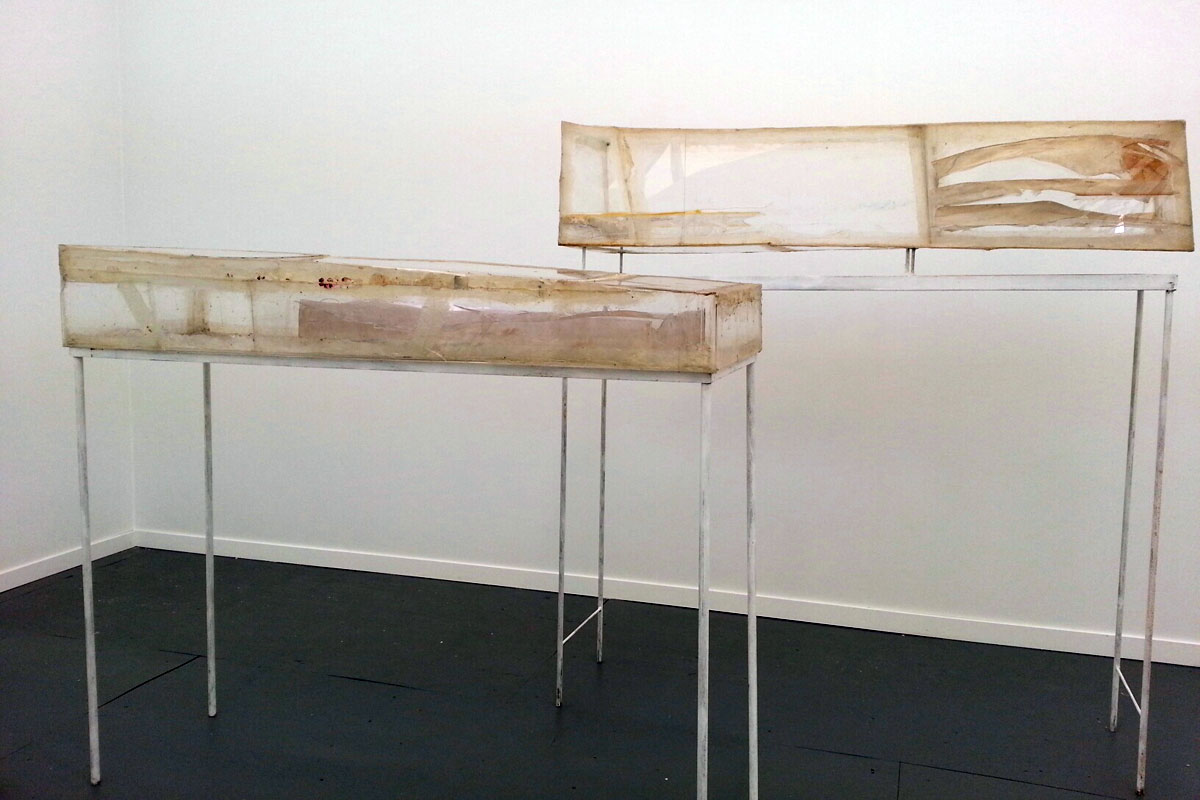
Rudolf Polanszky's vitrines of decrepitude at Ancient & Modern (London). These, on purely emotional levels, worked for me.

Rudolf Polanszky’s vitrines of decrepitude at Ancient & Modern (London). These worked for me, formally and emotionally.

Standard