Artists

Iran do Espírito Santo’s Poetics

Iran do Espírito Santo, Water Glass 2, 2008, crystal, edition 23/25, 14 x 8.5 x 8.5 cm. // Source: Ingleby Gallery, inglebygallery.com. If you're ever not sure what to get me for my birthday, well, this would be nice.

Iran do Espírito Santo, Water Glass 2, 2008, crystal, edition 23/25, 14 x 8.5 x 8.5 cm. // Source: Ingleby Gallery, inglebygallery.com. If you’re ever not sure what to get me for my birthday, look no further.

Tonight’s artist talk by Iran do Espírito Santo, a Brazilian sculptor and installation artist, energized me. It was part of the Public Art Fund’s excellent series of talks at the New School’s Vera List Center.

Santo constructed a slide lecture that began with a sequence of formally related artworks—a room with circular cutouts, followed by a plaster block with Swiss cheese holes dug out with coins from different currencies, followed by an installation of plaster hemispheres on gallery walls. From there, Santo showed site-specific wall paintings that referred back to the existing architecture, such as floor-to-ceiling brick pattern painted inside SFMOMA in 1997 referring to the brick façade outside. He showed “folding” glass plate installations, wall paintings of gradations of grey, and solid sculptures based on specific forms, such as tin cans, pint glasses, and lamps. 

IRAN do ESPÍRITO SANTO SWITCH, 2012 latex paint on wall dimensions variable unique // Source: Sean Kelly Gallery, skny.com.

IRAN do ESPÍRITO SANTO
SWITCH, 2012
latex paint on wall
dimensions variable
unique // Source: Sean Kelly Gallery, skny.com.

Santo delivered his talk in a matter-of-fact way: In this project I did this, this site was that. He didn’t get into what he was thinking or trying to do. At first, I wanted to hear more—to ask what Jon and Anna from Eastport asked me, because they wanted to ask all artists:

Why do artists make art?

I wanted to know why Santo made what he made.

As the images continued, however, the question seemed less pressing. Though Santo worked in many media, they all seemed to make sense as a body of work. There was a coherence of sensibility and thought to them, even if I couldn’t spell it out how or why.

I still tried to find a logic or connecting thread to them, and here’s what I formulated: Santo’s work is rarely representational but often mimetic (having a referent), while some of his work, such as the gradient paintings, aren’t mimetic. They are about perceptual experiences. What these divergent works shared is open-endedness, a need to be interpreted or looked at, which seemed to suggest generosity or consideration of the viewer.

Santo spoke beautifully about his concern for the viewer. He explained that he (I’m paraphrasing)

envisions his work operating cinematically, because as viewers, we are moving cameras.

I love this idea, because I think a lot about how the aesthetic experience unfolds over time, and how looking is a process that at times is simultaneous and at times sequential.

He also said something like

how the viewer accesses the work is part of the works’ poetics.

That’s a fantastic and fascinating choice of words. I am excited to continue to consider the idea of poetics in terms of art, mulling over theories of how things take an effect on viewers, in Santo’s art, and my own.

A few more insights I learned tonight are below. If you already like Santo’s work, you can skip this paragraph. The following info will not better equip you in your encounter with the work, as you already have what you need. Read on, however, if you’ve yet to be won over.

While I don’t want to conflate the artist with the art for oeuvres like this, more facts about Santo help contextualize his work. First, he has a background in photography, which he discussed during the Q&A when someone asked about the tension between the Platonic ideal and the found. (This is an uncommon case where the Platonic ideal is actually relevant, as so many of Santo’s work are in such a state of material perfection that they seem otherworldly.) Santo explained that perhaps his photo background relates to his interest in reducing images, simplifying forms, and seeing light. Another audience member’s question prompted Santo to discuss his interest in architecture, which formed the support and informed the content of his wall paintings. But for his objects, too, I can see a rigorous, almost severe formalism that seems related to architecture, or what we mean when we describe something as “architectural.”

Playground, Santo’s project for the Public Art Fund, is on view through February 16, 2014 in Central Park.

A few of Santo’s works will also be on view in a group show at Sean Kelly gallery that opens Friday.

Standard
Impressions, Research

Points of Reference: Haim Steinbach, The Meaning of Things, and Irrational Exuberance Anew

Christine Wong Yap, Irrational Exuberance (Asst. Colors), installation view at Sight School, Oakland, CA. 2010.

Christine Wong Yap, Irrational Exuberance (Asst. Colors), installation view at Sight School, Oakland, CA. 2010.

It’s been three years since I created Irrational Exuberance (Asst. Colors), a body of work inspired by discount store culture, pleasure and decoration. Recently, I’ve encountered salient art and writings related to those ideas. These references are not too late—in fact, they are perfectly on time, as I’m currently revisiting Irrational Exuberance to envision a new body of work and self-initiated project.

The references are like three planets with shared orbits:

A Two-Hour Drive. A Three-Year Journey.

Featured guests (L-R): artist, writer and theorist Ginger Wolfe-Suarez, curator and critic Glen Helfand, and writer and curator Patricia Maloney.

Featured guests at As Is, the dialogue at Irrational Exuberance at Sigh School (L-R): artist, writer and theorist Ginger Wolfe-Suarez, curator and critic Glen Helfand, and writer and curator Patricia Maloney.

In the dialogue that accompanied Irrational Exuberance in 2010, artist and theorist Ginger Wolfe-Suarez cited Steinbach’s work (download her interview with Steinbach from his site):

I’m interested in looking at Christine’s work, and work like Christine’s, that transcends consumption as a closed system of signs and symbols. That conversation can be transformative. … I was really interested in how [Haim Steinbach and Allan McCollum’ talked about their objects. …. There are political ramifications for words like consumption—like nihilation—so I think the ability to tackle, and transcend, those conversations is really exciting for me.

I had looked at reproductions of Steinbach’s most iconic works: found objects displayed on shelves. I was inspired by how modest they were, but also found the objects un-transformed, recognizable identities difficult to overcome. Like the drawing instruction, “Draw what you see, not what you know,” when I as faced with Steinbach’s artworks, it was hard to see what was in front of me when it kept on insisting to be what I knew it to be. I couldn’t find the space for visual or conceptual discovery at the time.
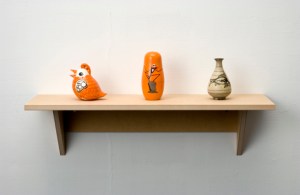
Haim Steinbach, Untitled (bird, nesting dolls, vase), 2006  MDF shelf; ceramic bird; wooden nesting dolls; Korean ceramic vase 11-3/4 x 33 x 10-1/2 in. (30 x 84 x 27 cm). // Source: HaimSteinbach.net.

Haim Steinbach, Untitled (bird, nesting dolls, vase), 2006 MDF shelf; ceramic bird; wooden nesting dolls; Korean ceramic vase 11-3/4 x 33 x 10-1/2 in. (30 x 84 x 27 cm). // Source: HaimSteinbach.net.

I was still curious to learn more, so I visited once again the world is flat. Bard is a two-hour drive from NYC, but it was worth the trek. I gained a profound appreciation for Steinbach’s work by seeing it in person, in abundance, and with exceptionally keen curatorial direction by Tom Eccles and Johanna Burton united with spot-on exhibition design for maximum effect. I didn’t love all the work, or completely understand it, but I fully respected it. I had to wrestle with what Steinbach was doing, what the viewers are meant to do or experience, and what I felt, which was at times pleasure, bafflement, and also despair—the world is flat, leaving my preconceptions about value in limbo. While Steinbach’s work is still potently mysterious to me, I found the accompanying catalog to set interesting parameters about what, exactly, Steinbach’s ideas and works are.

Brute Material Facts

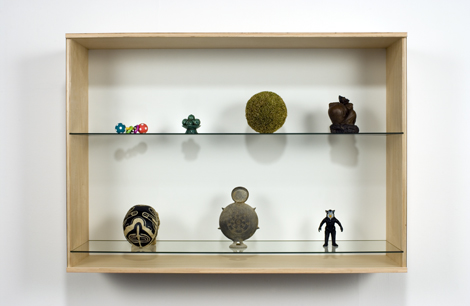
Haim Steinbach, Untitled (skull, vessel, figurine, toy, fruit bowl, sphere, peasant), 2006  Birch plywood, plastic laminate and glass box; synthetic polymer skull; Korean ceramic vessel; plastic figurine; plastic baby toy; Chinese fruit bowl; straw ball; Chinese ceramic statuette 37-3/4 x 53-3/4 x 14-3/4 in. (95.8 x 136.6 x 37.5 cm) // Source: HaimSteinbach.net.

Haim Steinbach, Untitled (skull, vessel, figurine, toy, fruit bowl, sphere, peasant), 2006 Birch plywood, plastic laminate and glass box; synthetic polymer skull; Korean ceramic vessel; plastic figurine; plastic baby toy; Chinese fruit bowl; straw ball; Chinese ceramic statuette 37-3/4 x 53-3/4 x 14-3/4 in. (95.8 x 136.6 x 37.5 cm) // Source: HaimSteinbach.net.

The aesthetic experience of contemporary art is often like an act of unraveling a riddle. Familiarity with the tropes usually leads towards plausible hypotheses: commenting on this, re-contextualizing that, hybridizing this plus that—you get the idea. Steinbach’s work is more abstruse. It offers no Tootsie Roll center like the center of a Tootsie Pop. In her essay, “Some Collectables,” from the exhibition catalogue for once again the world is flat., curator Johanna Burton points out:

These are not … representations of things, but rather presentations of them.

Steinbach’s objects are not metaphors or symbols to be deciphered. They are all surfaces and cultural associations. They are the point. Whereas, discussions of the readymade, appropriation, and mass production, Burton states,

are only tangential to the brute material fact of what’s actually there.

That “brute material fact” is exactly what I couldn’t overcome initially. And this may also be another point of Steinbach’s—for me, as a viewer, to look at what’s there and to forget habits of looking. As Burton says, the very title

asks us to reconsider what we think we know, and to survey the terrain around us, as if we were seeing it for the first time again.

In other words, Steinbach is asking viewers to move beyond recognition to perception. In The Meaning of Things, Csikszentmihalyi and Rochberg-Halton explain John Dewey’s ideas of perception versus recognition. Recognition is

when we experience a thing and interpret it only as something we already know

Hence, there is no new organization of feeling, attention or intentions within the viewer. Just as I could only see the objects’ identities when I first encountered Steinbach’s work, I could not garner a meaningful aesthetic experience from them. On the other hand, perception is

when we experience a thing and realize its own inherent character … [the] object imposes certain qualities on the viewer that create new insights.

Certainly art objects are intended to create aesthetic experiences that “create new insights” on the viewer; Steinbach challenges viewers to perceive quotidian objects anew.

The Quotidian

In Irrational Exuberance, I sought to question class and value distinctions inherent in decorative objects. Many of the works in Irrational Exuberance are multiples, reinforcing discount stores’ feelings of immediacy and abundance. The subtext is that idea serialized objects can also be personally meaningful. Burton explains that this holds true for Steinbach too:

Steinbach’s interest … in collecting as a mode of production would seem to court the individualistic, affective drive toward objects, while also acknowledging the serial nature of every such ‘special’ object.

For the Things authors, everyday objects bring together the self and the world:

household objects become sights of a wider network of meanings that embrace the whole world.

echoing the very title of the Steinbach show: once again the world is flat. This leveling works two ways: bringing art objects ‘down’ to the same level as quotidian objects and elevating everyday things ‘up’ to the rarified realm of artworks.

In “Not a Readymade” (reprinted in the exhibition catalog and also downloadable from Steinbach’s site) Anthony Huberman interviews Steinbach, who reveals that his work

embraces the idea that art is always with us, a function of the everyday.

Vinyl Ficus #3 & 4, 2010, vinyl, mylar, thread, lacing, wire, ~18 x 12 x 12 inches / 45 x 30 x30 cm each

Christine Wong Yap, Vinyl Ficus #3 & 4, 2010, vinyl, mylar, thread, lacing, wire, ~18 x 12 x 12 inches / 45 x 30 x30 cm each

The Things authors even wrote about the role of objects in visual art thusly:

Creative artists are those who can find a convincing visual solution to a problem that was never previously formulated. In the solution, and even in the formulation of creative problems, objects stimulate and help develop the artist’s thought.

In 1980, they could not known to what extent Steinbach would use objects expressly to advance thought.

Sentiment

Cute ___ Calendar, 2010, collage of found calendars, 12 x 12 x 0.5 inches / 30 x 30 x 1.2 cm

Christine Wong Yap, Cute ___ Calendar, 2010, collage of found calendars, 12 x 12 x 0.5 inches / 30 x 30 x 1.2 cm

In 2010, I wrote that Irrational Exuberance was an immersion in sentiment:

… an exercise in pleasure, modest expectations and accessibility.

With its unabashed enthusiasm, … Irrational Exuberance (Asst. Colors) marks a shift … I became enamored with the aesthetic, symbolic and conceptual potential of discount store culture, the decorative impulse, and the search for happiness.

…sentiment and immediacy are embraced. The exhibition’s title highlights the paradox of thinking rationally about emotional and internal experiences.

My previous work had been “cool”—often black-and-white, reserved, and materially minimal. I found kinship in a quote attributed to G. K. Chesterton:

The meanest habit of humankind is to be skeptical of sentiment.

In the public dialogue, sentimentality appeared divisive; perhaps in the age of irony, audiences automatically assume that elation and enthusiasm cannot be sincere. It’s a comfort to me that Steinbach does not shy from sentiment either. In Giorgio Verzotti’s “Object, Sign, Community: On the Art of Haim Steinbach” (reprinted in the exhibition catalog and also downloadable from Steinbach’s site), he states:

What Steinbach highlights …. is the object as a focus of emotion.

The Reciprocal Relationship Between Objects and Selfhood
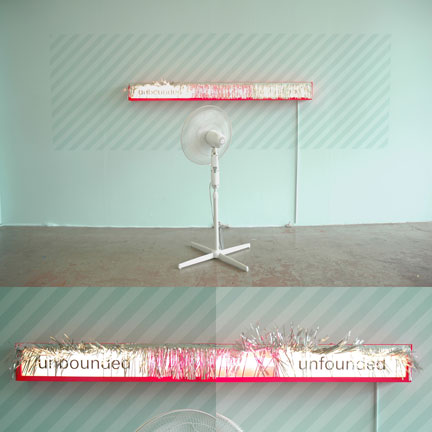
Christine Wong Yap, Unbounded/Unfounded, 2010, fan, metallic fringe and light box: pegboard, wood, acrylic, vinyl, lights, paint, 73 x 60 x 48 inches / 1.8 x 1.5 x 1.2 m.

Christine Wong Yap, Unbounded/Unfounded, 2010, fan, metallic fringe and light box: pegboard, wood, acrylic, vinyl, lights, paint, 73 x 60 x 48 inches / 1.8 x 1.5 x 1.2 m.

I’m interested in how objects accrue meaning or sentiment. Are objects merely containers for human associations? Or do they “act” as well? This transaction may be more reciprocal than I think, as objects can also shape humans.

Verzotti describes the link between objects shape the self:

An object, inasmuch as it forms part of our daily lives … to satisfy certain needs, becomes, Steinbach says, vital to the construction of our identity.

This is essentially what the authors of Things set out to study:

how the most complex pattern of emotion and thought can become embedded in and symbolized by concrete things, that is how things themselves are part of the interpretive sign process that constitutes meaning.

They elaborate:

Things actively change the content of what we think is our self and thus perform a creative as well as reflexive function….

Objects affect what a person can do, either by expanding or restricting the scope of that person’s actions and thoughts…. Objects have a determining effect on the development of the self.

According to Burton, Steinbach’s work conjures very similar ideas:

Objects are less about their owners, … and more about the circulations they make…. Objects reflect much of their owners’ beliefs, systems of faith, and measures of value… [and] also produce [them].

The overlap in the ideas between the Things authors, Burton, and Irrational Exuberance are abundant. One of Burton’s paragraphs in particular is especially sociological and psychological:

Our drive to acquire and organize things is, in part, how we understand ourselves. Less a comment on capitalism than an investigation of the production of self, Steinbach’s work acknowledges the fragility of subjecthood—that our funny, fragile egos are bound up in the unexpectedly rich terrain of the knickknacks and bric-a-brac, to say nothing of priceless mementos, we collect and covet.

This is a sequence of ideas that are relevant even line by line. First, she writes,

Our drive to acquire and organize things is, in part, how we understand ourselves. …[Steinbach’s work is] an investigation of the production of self…

This echoes the Things authors:

the potential significance of things is realized in a process of actively cultivating a world of meanings, which both reflect and help create the ultimate goals of one’s existence.

Next, Burton specifies that Steinbach’s work is

Less a comment on capitalism

This, too, came up at the dialogue at Irrational Exuberance (Asst. Colors). Some viewers assumed a negative, oppositional critique on my part where there was none. I embraced the bright colors and cheap materiality as sincere expressions of enthusiasm and pleasure, so this perspective was confounding. Where was it coming from? I had theorized that works of art can operate like barometers for optimism and pessimism, and this seemed further evidence that viewer’s projections are just as integral to the reading of the work as the work itself.

Last, Burton writes

our funny, fragile egos are bound up in the unexpectedly rich terrain of the knickknacks and bric-a-brac

This could very well be a statement for Irrational Exuberance.

The Social Life of Objects

Christine Wong Yap, Irrational Exuberance (Asst. Colors) buttons #1–3, 2010, badges, 1–1.75 inches / 2.5 x 4.5 cm dia. each.

Christine Wong Yap, Irrational Exuberance (Asst. Colors) buttons #1–3, 2010, badges, 1–1.75 inches / 2.5 x 4.5 cm dia. each.

In the study of positive psychology, improving one’s subjective wellbeing seems to always begin with the self and expand towards the social. There seems to be a parallel here: beginning with the habits of mind such as recognition and perception, acknowledging the everyday, and considering the organization of the self, and moving on to relationships.

In Steinbach’s interview with Huberman, he states

my practice is directly committed to the social.

How is it that inanimate objects can be social? Steinbach suggests how can they not:

There’s always more than one object at hand. Being here means you and here.

Verzotti’s points out the relational aspect of things between people:

Each object is both an object and a sign associated with a specific social dynamic, a token of exchange with we weave our interpersonal relations…

I’d thought about art objects as props that mediate relationships. Now it appears that objects might function similarly.

Christine Wong Yap, a diagram of how artists and viewers inform works of art and thereby mediate relationships between artists and viewers.

Christine Wong Yap, a diagram of how artists and viewers inform works of art and thereby mediate relationships between artists and viewers.

Csikszentmihalyi and Rochberg-Halton elaborate on the many levels of this social potential:

Objects … serve to express dynamic processes within people, among people, and between people and the total environment. These processes might lead to a more and more specific differentiation or increasing integration…

by which they mean, the individuation of the self or alignment with others. They add:

Differentiation is the result of control, whereas integration is based on participation.

This calls to mind my idea that art experiences are opportunities for enacting trust or skepticism. Perhaps another way to think of art experiences is as opportunities for expressing differentiation/control or integration/participation.

Integration and Differentiation

When I read the once again the world is flat. exhibition catalog, so many points seemed to overlap with my own interests in Irrational Exuberance that I became nervous—which I self-diagnosed as the anxiety of influence.

An obvious similarity between once again the world is flat. and Irrational Exuberance is the use of common objects displayed on shelves. Though I used found objects in non-shelf displays, I collaged, sewed, and constructed most of the objects in Irrational Exuberance. My work conveys “craft” more than “brute materiality.” Further, Steinbach invests much of his constructive energy in the shelves, not the objects on display; in my work, the attention is reversed.

I like to think that I’m forging a different path on shared terrain. Or to use a different metaphor (same idea, different things), since orbits have different trajectories, coincidental moments of proximity are the result of traveling great distances.

Standard
Research

Inverse Flag Designs

I love an inverse flag design.

I think it goes back to an old Muay Thai t-shirt design from around 2001. I always felt like I should be better at Muay Thai before sporting the shirt outside of the gym, so I never got it, but I always remembered its wonderfully peculiar use of color….

Designer unknown, Fairtex Muay Thai t-shirt design, circa 2001 (the Clementina Street days).

Designer unknown, Fairtex Muay Thai t-shirt design, circa 2001 (the Clementina Street days).

Black tees are the obvious choice for this audience; yet even with only two colors, the traditional white stripes could have been preserved. Instead, the usually-blue canton (flag-speak for upper quadrant) is white, with the black text knocked out (designer-speak for not-printed).

Flag orthodoxy would decree this manipulation of the US flag a desecration. But to me I sort of see it as an immigrant small business’ version of a folk artist’s flag:

R.A. Miller, Miller Family American Flag, enamel paint on tin // Source: GainesvilleTimes.com.

R.A. Miller, Miller Family American Flag, enamel paint on tin // Source: GainesvilleTimes.com.

So when I stumbled upon this image, I got very excited:

Afterimage US flag from the Exploratorium. // Source: Exploratorium.edu.

Afterimage US flag from the Exploratorium. // Source: Exploratorium.edu.

Of course, it’s from that world-class hands-on science museum in San Francisco, the Exploratorium. It’s from one of their classic science exhibits on perception—this one is about afterimages. Stare at the image for 15 seconds, then look away to see the US flag in red, white and blue.

Standard
Meta-Practice

Be Here Now: Artists’ Majority Power

Lately among my colleagues, sharing information and support has been especially active and enjoyable. We usually send links to art opportunities,* and I’ve also been contributing ideas to CF’s curriculum. In a virtual book club, we share intellectual discourse as well as a sense of camaraderie.

I was reminded to be grateful for this generosity after hearing from a disenchanted colleague recently. He was frustrated and fatigued, but worst of all, he seemed to feel hopeless about his position in relation to the art world.

So many artists feel like there aren’t enough resources to go around; that we are all competing for a limited number of opportunities/commissions/gallery rosters/fashionably “in” careers as art stars, and only the already privileged, networked, and fashionable win. It’s true that the art world is structured so that it can’t accommodate all of the artists who would like to make art for a living. As an artist, the odds are that you win some, and lose most. Rejection is unavoidable, and it can result in

an increase in sadness, despair and hostility, and a decrease in self-esteem, belonging, sense of control and meaning in life

according to Todd Kashdan, George Mason University professor of psychology (“Understanding Rejection’s Psychological Sting,” Huffington Post, September 16, 2011). To counteract the effects of rejection, Kashdan suggests cultivating

those powerful human capacities for awareness, openness and compassion

As artists, we have to help each other. We’re in the best positions to understand what our peers are going through, and to hear of opportunities that might be perfect for a colleague. After participating in a public art program in Poland last year, a friend and I shared this year’s call, and colleague’s work was selected. A deserving artist and an interesting program connected.

Christine Wong Yap, Positive Sign #40, 2011, glitter gel pen on gridded vellum, 11x8.5".

Christine Wong Yap, Positive Sign #40, 2011, glitter gel pen on gridded vellum, 11×8.5″.

People assume that optimism is simple minded, but it’s actually pessimism that’s all too easy. If you look for reasons to be cynical about the art world, it will provide in abundance. But if you cultivate optimism and enact your principles amongst your peers, I think it will be more rewarding ultimately. Cooperation, not competition, is the best approach for a life in the arts.

Disenfranchised artists might consider RY’s advice:

Pressure leads to perseverance; perseverance to character; character leads to courage; courage to hope.

Since my birthday, I’ve been grappling with a personal achievement gap of sorts—what I’ve done or am about to do, versus some ideas that drifted down from aloft like stray pigeon feathers about where my art career and personal life should be now.

Just like everybody else, artists can easily mistake career achievement for happiness. A lawyer might think, “I’ll be happy when I finally become a partner,” and artists might think, “I’ll be happy when I my career takes off.” The challenges of working day jobs to support art practice are in ample evidence in our daily lives, so we assume that selling enough art to live on will unlock a more authentic state of creative freedom.

But as AV pointed out (in a book club meeting!), art stars aren’t necessarily more free or happier. They may feel like sovereigns of mini-empires, compelled to pump out increasingly higher priced products in order to sustain multiplying sectors on organizational charts, while terrified by the thought of ceding relevance and influence to other artists.

Two ways of looking at the art world. Left: A conventional model where the majority of artists are struggling and strive to become a member of the tiny percentage of art stars. Right: A different perspective, extolling the  benefits of not being darlings of auctions, media, collectors, etc., and appreciating the kinship of peers who are hardworking, inventive,  tenacious, and generous; free to re-invent our practices and shape the communities in which we would like to participate.

Two ways of looking at the art world. Left: A conventional model where the majority of artists are struggling and strive to become a member of the tiny percentage of art stars. Right: A different perspective, extolling the benefits of not being darlings of auctions, media, collectors, etc., and appreciating the kinship of peers who are hardworking, inventive, tenacious, and generous; free to re-invent our practices and shape the communities in which we would like to participate.

I’ve written before that the “art world” is too often equated with a tiny sliver of artists, auction houses, collectors, galleries and critics, who, in my view, are actually on the margins of most artists’ (and people’s) experiences.

Similarly, I’d like to re-frame a pyramid of working artists. I’ve always thought of the vast majority of artists as underlings, trying to claw their way into inclusion into that elite world of international art stars. But just as one chooses whether a half-glass of water is half empty or half full, we can choose to imbue the majority of artists with the majority of relevance (the beauty of majorities!). My peers are vibrant, meaningful, and no less creative and worthy of attention. To complain about this disparity is to reify the minority’s hierarchy. To acknowledge our majority power is to assert our freedom over our attentions. 

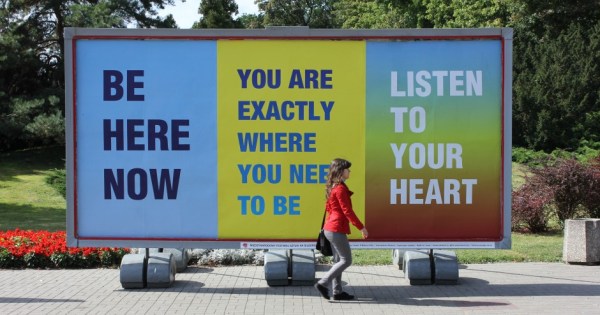
Susan O'Malley, Inspirational Posters: Be Here Now, You Are Exactly Where You Need to Be and Listen to Your Heart billboard, Rapackiego Square, Art Moves Festival, Toruń, Poland

Susan O’Malley, Be Here Now, You Are Exactly Where You Need to Be and Listen to Your Heart billboard, Rapackiego Square, Art Moves Festival, Toruń, Poland // Source: SusanOMalley.org.

*RateMyResidency.com is an artist-initiated website that offers users the chance to review residencies. I love this idea, and have been hoping for something like this appear for some time. This site is still pretty new, so not many residencies have been reviewed, and I think the interface could use some tuning up, but in the meantime, it’s a great resource for upcoming deadlines.

Standard
Citizenship, Meta-Practice

A Declaration of Principles (for artists, cultural workers and supporters thereof)

By Justin Langlois:

By posting this page, we submit that we are an artist, cultural worker, or a supporter thereof and declare the following: we are no longer interested in participating in consultancies, asset maps, or activities that offer us “promotional opportunities” in absence of clear financial or strategic gain. We will not support the exploitation of artists or other cultural workers or their works for the sole purpose of further municipal or economic planning, fundraising, or marketing. We refuse to acknowledge the existence of the politically-invented term, creative economy, which lumps together practicing artists with video cassette duplication services. We can no longer participate in activities that knowingly disadvantage artists with less experience and we vow to make accessible opportunities that we have to these same artists. We hereby decide to stop playing prescribed games and to start making it up for ourselves. Henceforth, we will support one another by adhering to this declaration.

By posting this page, we submit that we are an artist, cultural worker, or a supporter thereof and declare the following: we are no longer interested in participating in consultancies, asset maps, or activities that offer us “promotional opportunities” in absence of clear financial or strategic gain. We will not support the exploitation of artists or other cultural workers or their works for the sole purpose of further municipal or economic planning, fundraising, or marketing. We refuse to acknowledge the existence of the politically-invented term, creative economy, which lumps together practicing artists with video cassette duplication services. We can no longer participate in activities that knowingly disadvantage artists with less experience and we vow to make accessible opportunities that we have to these same artists. We hereby decide to stop playing prescribed games and to start making it up for ourselves. Henceforth, we will support one another by adhering to this declaration.

Standard
Meta-Practice

New research on equality in the arts

Yesterday, the Strategic National Arts Alliance Projeect (SNAAP), a consortium of educational institutions, released its latest report, “An Uneven Canvas: Inequalities in Artistic Training and Careers” (PDF). Long-standing issues of racial and gender parity are elucidated in this survey compiling data from over 65,000 arts graduates. I noted some interesting points:

Female alumni are less likely than male alumni to ever work as artists and to do so currently.

(page 15)

(As JW put it, female artists continuing to work as artists is sometimes a matter of a war of attrition.)

Across all racial/ethnic groups, Black graduates and Hispanic graduates are the least likely to ever work as artists—with 76% of both groups ever working in this capacity.

(page 15)

Black and Hispanic alumni are much more likely to cite both lack of access to networks and debt (including student loan debt) as barriers to artistic careers, compared to White respondents.

(page 16)

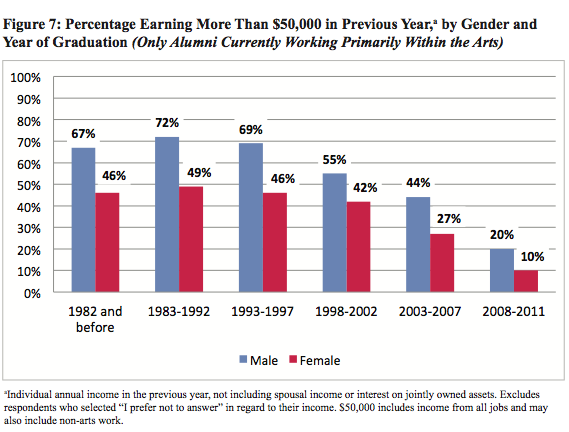
SNAAP reveals sharp disparities in earnings by gender. Among alumni currently spending the majority of their work time in an arts-related job, men out-earn women. For example, among undergraduate-level respondents who currently work primarily within the arts, 56% of men earned more than $50,000 in the past year—compared to 36% of women.

(page 17)

The Question of Who Qualifies as “Artists” in the SNAAP Study

SNAAP uses the labels “art” and “artist” to refer to a broad spectrum of practicioners, including performers and creative writers. They also include workers in fields that often hire salaried employees, such as in architecture, design, film, illustration and animation—which I would consider creative industries (see also Ben Davis’ recently published 9.5 Theses on Art and Class, 2013).

I strongly believe that the inclusion of workers in creative industries skew the data—a criticism I’ve voiced about past reports. “An Uneven Canvas” seems to make a more conscious effort to acknowledge this:

Differences in the artistic fields … partially account for some disparities between groups.

(page 19)

Gender Disparity

SNAAP does a great job investigating general trends of gender-based income disparity:

the income gap between male and female arts alumni persists regardless of how long ago they graduated from their institutions

(page 21)
SNAAP's "An Uneven Canvas," Figure 7: Percentage Earning More than $50,000 in the Previous Year by Gender and Year of Graduation (Only Alumni Currently Working Primarily in the Arts). Those who graduated in the 80s and 90s (who are likely older), clearly make more than recent grads with less post-graduate work experience. However, the key point of this bar chart is that income disparity by gender in the arts is an ongoing trend over the past 30 years. The pay difference is highest among those who earn more; for recent grads, the 10% more of men who earned $50k is also 100% more of women who earned $50k.

It’s easy to misinterpret this bar chart as showing the reduction of income, and gender-based pay disparity, over time. What it actually shows is gender-based pay disparity in 2011 according to graduation year ranges. Those who graduated in the 80s and 90s (who are likely older and further along towards maximizing their earning potential) see the highest gender-based pay disparity. For the most recent grads, the there is relatively less pay disparity in percentage points, but, in this cohort, you could also say that the number of men who earned $50k is 100% more than women. 

One salient feature of this graph is that male artistic workers out-earn females within every cohort group. …income differences are not simply the result of men’s and women’s different work commitments, but rather reflect persistent patterns of discrimination. Furthermore, these data provide compelling evidence that gender inequalities continue to exist for the newest graduates and are not simply a relic of an older time.

(page 24)

The Data We Get vs. the Data I Want to See:
Free the Fine Artist Subset

SNAAP’s wide definition of “artist” may be useful for including the majors offered at its member institutions, but its analysis can only be applied to fine artists with remote and questionable extrapolations.

The fine arts is worthwhile of analysis as its own data subset. The fine arts are exceptional. In other words, the economics of fine arts operates does not follow any logic found in other fields (see Hans Abbing’s Why Are Artists Poor? The Exceptional Economy of the Arts, 2004).

Most pressingly, the fine arts are well-known for its huge disparities. The vast majority of artists work non-art day jobs to support their art practices, while only a tiny fraction of artists garner dramatically higher income levels from their art sales. Thanks to the media’s obsession with auction sales, gender-based income disparity is well-documented for the highest earners, but this data ignores most working artists.

SNAAP’s subset of data relating specifically to contemporary fine artists is robust, according to the interactive SNAAP Shot 2012, with about 21,000 respondents who majored in Studio/Fine Arts. This is no small data set. SNAAP should make this data set freely available, like many contemporary federal- and city-level governments, or the UK Guardian, for statisticians and information graphic designers to interpret and share.

I would love to see this data set analyzed to address questions such as:

  • What can be learned about the lives and working conditions of contemporary fine artists?
  • What percentage of fine artists’ primary means of income is from their art?
  • For fine artists whose primary means of income is not based on their art, how much of their income is?
  • How much gender-based income disparity do fine artists experience?
  • How does this change over the graduation-year-separated cohorts?
  • What are the breakdowns of racial inequality in the fine arts—how many artists of different races persist into the field of fine arts, over what period of time, and to what degree are they able to transition their art-making into a viable profession?
  • In addition to comparing people of color and women to the responses of White men, I’d like to see intersectionality integrated into this report—what can we learn about the experiences of women of color?


Standard
Impressions

NYC Art Itinerary: Wave Hill

Relaxing after a hike in the woods and in the galleries at Wave Hill, Bronx, NY.

Relaxing after a hike in the woods and in the galleries at Wave Hill, Bronx, NY.

Today I visited Wave Hill, a public, NYC-owned garden and art center in the Bronx. It’s one more place checked off on my ongoing NYC Art Itinerary.

As soon as one enters, there’s a spectacular view of the cliffs of the Palisades across the Hudson River. The grounds are not insurmountably huge, but the landscaping is impeccable, and the trails, walks and greenhouses offer lots to explore. 

M and I got there early, and I highly recommend doing the same. We virtually had the place to ourselves for the first hour. It was a lovely change of pace to explore the gardens at our own unhurried pace. We encountered empty gazebos where we enjoyed the serenity to ourselves. Technically we weren’t even outside of the five boroughs, but it felt a universe away from the crowds.

We visited the Glyndor Gallery, which had an exhibition of works by artists in the Bronx Museum of Arts’ Artists in the Marketplace program. The work was all over the place, including abstract installations, brushy paintings, some technically capable and cool photography, sculpture, videos and video installations, and a metal assemblage wall work. The most captivating for me was Elisabeth Smolarz’ $100 project, a 13-channel video installation documenting her visits to every G8 +5 country and seeing how many people she could hire for $100 for one hour, and what they would do.

We also visited the Sunroom Gallery, which is reserved for emerging NYC artists’ solo projects. It’s a challenging space, with two walls of windows, and the remaining two walls made of brick and punctuated with many doors. There are also four skylights. My impression was that the original intended use of the space—to view the outdoors—still dominated the space; the meadow, woods, river, sunlight, and breeze beyond the windows seem to call for the viewer’s attention and pulls one towards a reflective mood.

Standard
Impressions

Claes Oldenburg @ MoMA

Claes Oldenburg: The Street and The Store 
Claes Oldenburg: Mouse Museum/Ray Gun Wing
April 14–August 5, 2013
Museum of Modern Art, NYC

It’s likable. Dive in.

Claes Oldenburg. Pastry Case, I 1961—62 Burlap and muslin soaked in plaster, painted with enamel, metal bowls, and ceramic plates in glass-and-metal case. 20 3/4 x 30 1/8 x 14 3/4" (52.7 x 76.5 x 37.3 cm). The Sidney and Harriet Janis Collection. © 1961—62 Claes Oldenburg. Photo: The Museum of Modern Art, Imaging and Visual Resources Department, Kate Keller. // Source: moma.org.

Claes Oldenburg. Pastry Case, I, 1961—62. Burlap and muslin soaked in plaster, painted with enamel, metal bowls, and ceramic plates in glass-and-metal case. 20 3/4 x 30 1/8 x 14 3/4″ (52.7 x 76.5 x 37.3 cm). The Sidney and Harriet Janis Collection. © 1961—62 Claes Oldenburg. Photo: The Museum of Modern Art, Imaging and Visual Resources Department, Kate Keller. // Source: moma.org.

I’ve found that there are two common ways of responding to Pop art inspired by familiar objects. The first is skeptical: viewers resent low culture intruding in high museums, and/or presume an underlying oppositional agenda when none is proffered. The second response is more open and instinctual; viewers delight in identifying with common objects and enjoy the humor in the familiar made strange.

For me, Claes Oldenburg’s works in The Store are imminently likable. The objects are ultra quotidian: hats, men’s dress shirts with ties, canvas lace-ups, ice cream sundaes. They are rendered in drippy, cragged plaster covered in vibrant gloss enamels. The forms are rough and exaggerated; the effect is both grotesque and comical.

Some of the genius in these sculptures comes from Oldenburg’s selection of common yet iconographic sources. Traces of the early 1960s appear, but do not pervade. For example, the 7-Up logo and other trademarks are obsolete. And I surmise that the preponderance of sundaes may correlate to a midcentury ice cream parlor vogue. But most others objects—such as burgers, shoes, and pants—have not changed much in the past five decades, and they remain current and relatable. Indeed, the shiny enamel is beautifully preserved (or probably, simply durable), and still conveys commerce’s exuberant newness.

Oldenburg’s project expanded the boundaries of art, helping to merge high art and low commerce. The exhibition also makes other equivalences clear too. This is exemplified by a vitrine containing a model plane, a salad, and a man’s hat. It suggests that food and possessions are alike as objects of consumption. They call us with our desire for them and reaffirm us as reflections of our identities.

From a historical perspective, the show allowed ample opportunities to think about zeitgeists and simultaneous developments. Oldenburg’s display cases full of pies (or tartines, created for a show in Paris) recall the luscious frosting-like paintings of Wayne Thiebaud. An oversized wall calendar made of stuffed, sewn fabric numbers brought to mind Jasper Johns’ number paintings. Neither comparisons diminish said works.

Claes Oldenburg. Floor Burger 1962 Canvas filled with foam rubber and cardboard boxes, painted with acrylic paint. 52" x 7' x 7' (132.1 x 213.4 x 213.4 cm). Collection Art Gallery of Ontario, Toronto. Purchase, 1967. © 1962 Claes Oldenburg. Photo: Sean Weaver. // Source: moma.org.

Claes Oldenburg. Floor Burger, 1962. Canvas filled with foam rubber and cardboard boxes, painted with acrylic paint. 52″ x 7′ x 7′ (132.1 x 213.4 x 213.4 cm). Collection Art Gallery of Ontario, Toronto. Purchase, 1967. © 1962 Claes Oldenburg. Photo: Sean Weaver. // Source: moma.org.

Oldenburg’s monumental soft sculptures provide a nice climax for the show. Floor Cone, Floor Burger, and Floor Cakewere designed for a spacious gallery that was meant for the display of luxury cars. This use of scale brilliantly addresses the massive spaces that have become so common today, while remaining totally appropriate to the works (in contrast to many contemporary works’ use of monumental scale to convey power and wealth). These individual portions of dishes at preposterously large scale, in sewn and stuffed painted canvas, exude comfort and welcome. They suggest an invitation to play, if not literally, than imaginatively. Taking a nap on one might be an entirely reasonable way to relate to it. I appreciated that these floor-specific works were actually exhibited on the floor, not on white plinths that keep viewers at bay. The Street, in an adjoining gallery, is installed this way, with ample space, which formalizes the seemingly-abstract cardboard shapes and seems remote from the original inspiration—colorful 1961 Lower East Side. The works fall flat in a disappointing compromise between a lively street-level feel and the MoMA’s staggeringly-trafficked museum needs.

Also on view are Mouse Museum and Ray Gun Wing, two exhibition halls housing found, readymade and created objects, developed for Documenta in the 1970s. The wall text explains that Oldenburg demonstrates an equivalence between creating and collecting. The installation seemed to reward prolonged viewing. The more you look at dissimilar objects, such as the children’s toys, sex toys, gloves, and food sculptures in Mouse Museum, the more similarities you’ll see. The longer you look at similar objects, such as the gun-shaped things in Ray Gun Wing, the more acute the differences become. A brief look was like an insight into Oldenburg’s thought process. But the nature of the long queues for these structures at MoMA made it seem indecent to linger for long.

Oldenburg’s plaster-and-enamel sculptures of everyday commodities has been an important reference point for me for several years. They signal a way to think about merging art and life, embracing the everyday non-art materials and subjects around us, and the viability of artist-initiated exhibitions (Oldenburg exhibited The Store as an immersive installation in his studio). MoMA’s and Museum Moderner Kunst Stiftung Ludwig Wien’s decision to exhibit precisely these seminal works is a testament to the mandate of these collecting, preserving and presenting institutions, for which I am grateful.

Standard