Art & Development, Meta-Practice

Points of Reference: Finding the right partners means not working with the wrong ones

1.
Being an artist and applying to competitions means dealing with rejection.
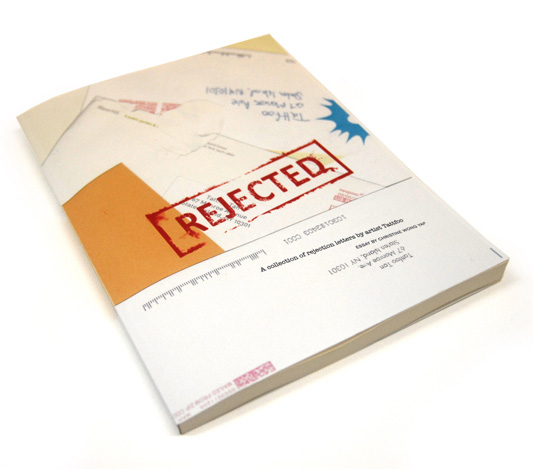
Rejected, a compilation of rejection letters, by Tattfoo Tan. // Source: Tattfoo.com.

Rejected, a compilation of rejection letters, by Tattfoo Tan. // Source: Tattfoo.com.

See also: Tattfoo Tan’s iheartrejectionletters.com.

2.
But dealing often with rejection doesn’t mean accepting everything that comes your way. Artists aren’t powerless. We have agency. When an “opportunity” presents itself, an appropriate reaction is to evaluate benefits and costs.

From “Standard Questions for Artists” from Standard Deviation by Helena Keefe (via ArtPractical.com):

Given an opportunity…
Do I believe in what this institution does/stands for? Is it the ideal venue for this project/my work? Does my work feel alive in this context?…
Does this opportunity help me meet or get to know people I may want to work with in the future? Will it enable conversation with people I want to be in conversation with? Is this opportunity helping me reach the audience I want to reach?…
Is there enough freedom in this opportunity? Would saying no to this opportunity be saying yes to something else I care more about? Is this the best artworld for my work? Is it the most effective use of my time/money/energy?

[I’d even ponder, “Is this what I want to do with my life?”]

…Am I being instrumentalized? Am I okay with that?
Am I happier making my living separate from making my art?

3.
Artists, too, can be selective, and reject things that aren’t good fits for us. Indeed, taking a pass on an opportunity can be a generative, productive action.

From Non-Participation: Call for Submissions by Lauren van Haaften-Schick:

The project, Non-Participation, will be a collection of letters by artists, curators, and other cultural producers, written to decline their participation in events, or with organizations and institutions which they either find suspect or whose actions run counter to their stated missions. These statements are in effect protests against common hypocrisies among cultural organizations, and pose a positive alternative to an equally ubiquitous pressure to perform. At the heart of the project is the notion that what we say “no” to is perhaps more important than what we agree to.

Historic instances and examples include: Adrian Piper’s letter announcing her withdrawal from the show Reconsidering the Object of Art: 1965-1975 at LA MoCA, stating her opposition to Phillip Morris’ funding of the museum and requesting that her criticizing statement be publicly shown; A letter from Jo Baer to a Whitney Museum curator canceling an upcoming exhibition on the grounds that her work was not being taken seriously because she is a woman artist; Marcel Broodthaers open letter to Joseph Beuys questioning the relationship between artists and exhibiting institutions; and, just recently, critic Dave Hickey‘s public announcement of his “quitting” the art world.

This tactic is oppositional to always saying yes; to the (non-)strategy of waiting for more powerful or influential dealers/curators/critics to “save” artists from obscurity and precarity; and to making art only for external validation. You will risk upsetting people and possibly being seen as “difficult.” But to do otherwise is to run the risk of adopting values—self-interest, opportunism, careerism—not your own, which are harmful to your practice and your fellow artists.

See also: Art Practical’s current issue, Value/Labor.

Addendum, added 4/10/2014:

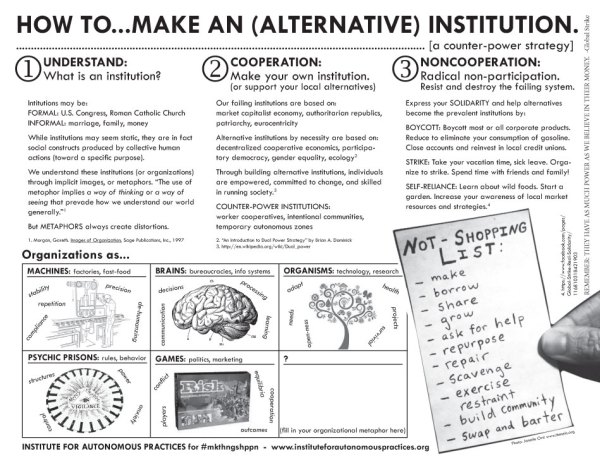
Sarrita Hunn, “How to…Make an (Alternative) Institution” // Source: makethings-happen.christinewongyap.com.

Sarrita Hunn, “How to…Make an (Alternative) Institution” // Source: makethings-happen.christinewongyap.com.

See also: Sarrita Hunn’s “How to… Make an (Alternative) Institution,” a freely downloadable PDF ‘activity sheet’/visual essay for Make Things (Happen). In the third of three steps, Hunn describes “Noncooperation/Radical Non-Participation.” Also online at Temporary Art Review.
Standard
Anna Gray + Ryan Wilson Paulsen. 100 Posterworks, 2009-2013; printed poster; 11 x 17 in. Courtesy of the Artists.  // Source: ArtPractical.com

Anna Gray + Ryan Wilson Paulsen. 100 Posterworks, 2009-2013; printed poster; 11 x 17 in. Courtesy of the Artists. // Source: ArtPractical.com

Works

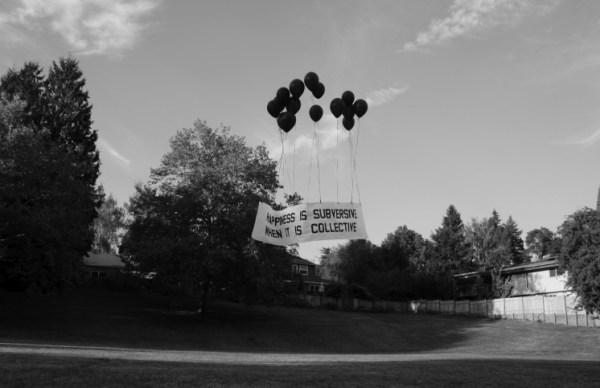
Happiness is Subversive When It is Collective

Image
Bob and Roberta Smith, Art Does Real and Permanent Good 2011, enamel on found material, 8.5 x 12 x 1 inches

Bob and Roberta Smith, Art Does Real and Permanent Good, 2011, enamel on found material, 8.5 x 12 x 1 inches // Source: Pierogi2000.com.

Works

Bob and Roberta Smith, Art Does Real and Permanent Good, 2011

Image
Art & Development

Dream a little group show for you

The Bronx AIM program has started and I am enjoying the first assignment immensely. We were asked to present the artists who would be in our dream group show–to convey the ideal context for showing one’s own works. I started thinking of all the artists I love, all the projects that share sympatico with my practice, and the potential of new site-specific commissions. I imagined very established artists in dialogue with less recognized but completely worthy friends. I envisioned an exhibition copy of a high value seminal work of a blue chip artist made as a public sculpture. Then I situated it all at a local non-art  site brimming with potential. This exercise made me think of many people, actions, and possibilities that make art seem like an expansive, generous realm. It provided me with welcome hope and enthusiasm. Try it!

Standard
Meta-Practice

“…the history of market success and the history of interesting ideas in art diverge more often than they connect. I grew up seeing an art world where that success immediately made your ideas suspect. You grew up seeing one where market failure meant a failure of idea as well. Each situation was fleeting and in the larger sense meaningless.”

Nayland Blake on defining your own success

Quote
Make Things (Happen)

Make Things (Happen) Now Open!

Impressions from the Social In Practice opening, plus news from contributing artists who are Making Things Happen.

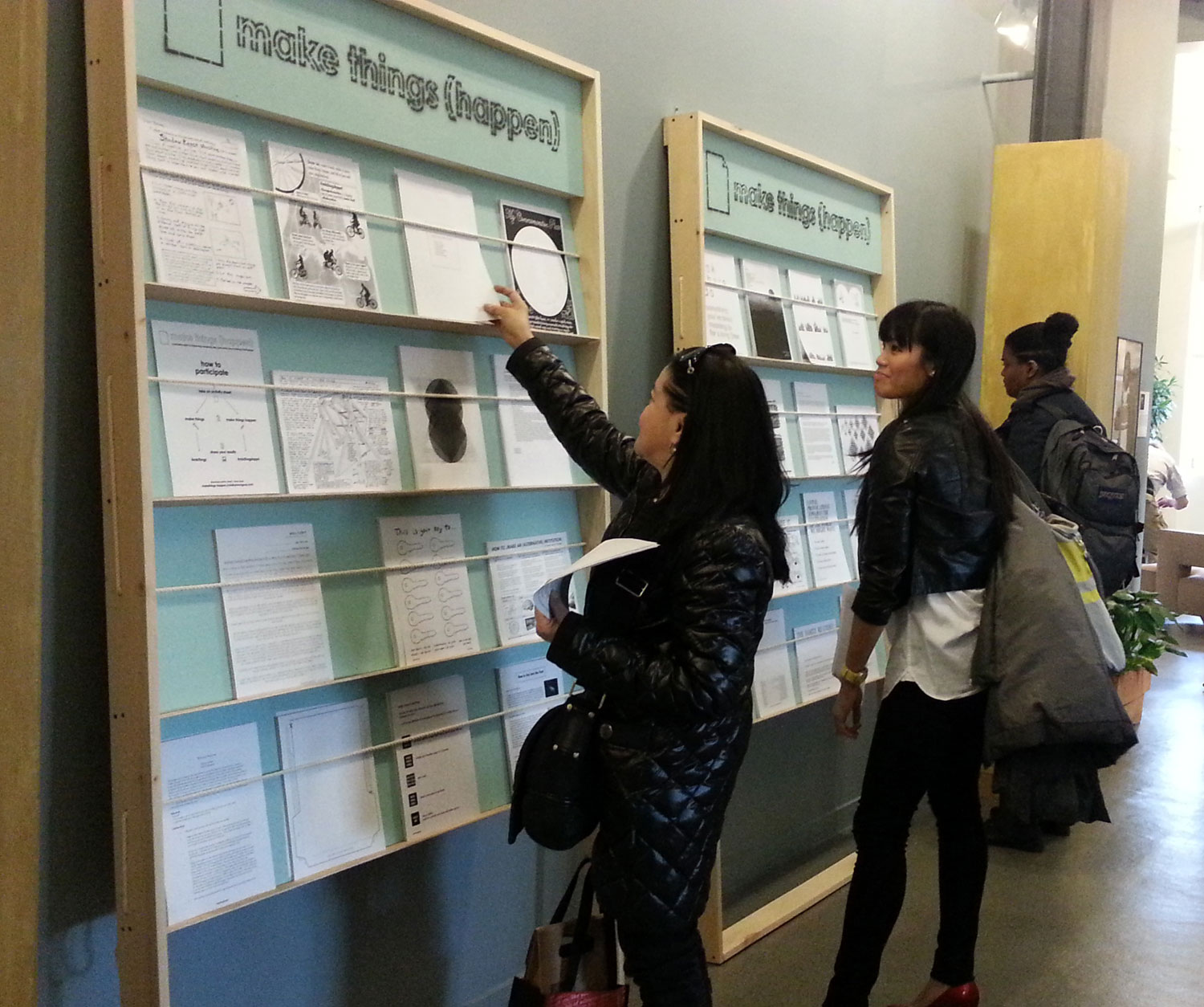
Activity sheets freely available in Make Things (Happen) at Social in Practice at the Nathan Cummings Foundation, NYC.

Activity sheets freely available in Make Things (Happen) at Social in Practice at the Nathan Cummings Foundation, NYC.

Thanks to everyone who made it to the Nathan Cummings Foundation for the opening of Social in Practice on Thursday.

The breadth of the artists in the show is impressive. Curated by Deb Willis and Hank Willis Thomas, the exhibition includes diverse, socially-engaged photographers. There’s a lot of work, and it’s beautifully installed in NCF’s spacious offices. I’m going to return—there’s much to take in!

I’m so happy with the positive responses to Make Things (Happen). Many viewers took activity sheets home—can’t wait to see their results at #mkthngs and #mkthngshppn.

Social in Practice is on view at the Nathan Cummings Foundation at 475 Tenth Avenue, between W. 36th & 37th Streets (in the same building that used to house Exit Art), 14th floor. Viewable by appointment Mondays through Fridays now until October; email exhibits@nathancummings.org.

Make Things (Happen) allows me to share the work of compelling artists and their practices. I’ll post occasional digests of their current goings-on, to help contextualize their activity sheets for your participation.

Still from Julie Perini’s video “The White Lady Diaries” (2013) (Source: Hyperallergic.com via JuliePerini.org).

Still from Julie Perini’s video “The White Lady Diaries” (2013)// Source: Hyperallergic.com via JuliePerini.org.

In addition to experimental video work, Portland, OR-based Julie Perini examines whiteness. Safe and Sound?, a documentary on the race and police brutality developed by Perini and others, and her White Lady Diaries short videos were recently featured in “Seeing Past Portland’s Whiteness” by Alicia Eler on Hyperallergic (March 24, 2014).

I have met white people who feel like it would be politically incorrect for them to speak about race whatsoever. But that’s not true—as Julie exemplefies with her activity sheet, Instructions for White People Fighting White Supremacy in the United States #1.

Maurice Carlin, Performance Publishing: Regent Trading Estate. Photo Gwen Jones. Source: MauriceCarlin.com.

Maurice Carlin, Performance Publishing: Regent Trading Estate. // Photo Gwen Jones. Source: MauriceCarlin.com.

It’s the last weekend to see Salford, UK-based Maurice Carlin’s epic site-specific printmaking project, Performance Publishing: Regent Trading Estate. The estate is situated behind Islington Mill, the massive mill-turned-artist-studios/alternative-art-school/music venue/alternative-art-experiment Carlin co-runs. Viewing hours are Sunday and Monday 12-6pm; or see the lovely photos on MauriceCarlin.com.

Fittingly for a founder of an alternative art school, Carlin’s activity sheet, Primary Sources, describes experimental procedures for developing artworks. Give it a try!

Standard
Citizenship

#2 SAVE
 THE 
SHRINKING 
PUBLIC 
DOMAIN. 
Public 
parks, 
schools, community 
centers–
everything 
public 
that 
is 
needed 
for 
affordable neighborhoods
–
are 
shrinking 
and getting 
privatized. 
At 
the neighborhood 
level, 
we 
need 
to 
protect 
and 
expand 
the commons. 
Keep 
the 
libraries 
open. 
Stop 
concessions 
from 
taking 
over 
the parks. Save 
neighborhood 
schools 
and 
keep 
them 
integrated 
and public. 
Don’t 
let 
services for 
the 
less 
fortunate
–
like 
soup kitchens 
and 
homeless 
shelters
–
be 
driven 
out 
by high 
rents.

By Tom Agnotti
(Via SB)

(One of) Five Things You Can Do to About Gentrification (in New York City)

Quote
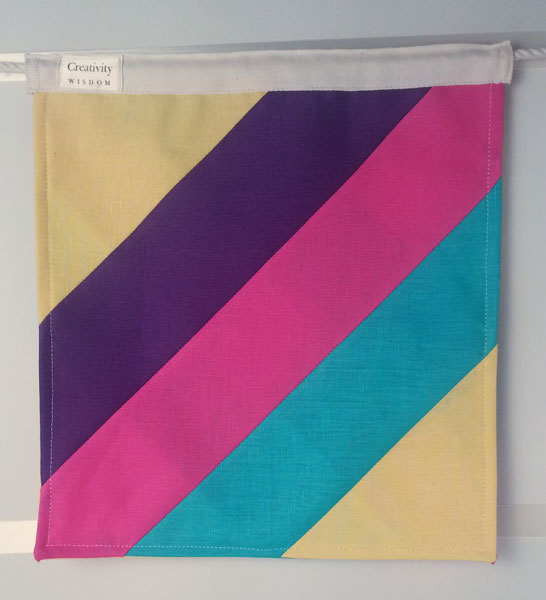
Christine Wong Yap, project in progress, humor flag for a series of semaphores representing 24 character strengths and virtues identified by Martin Seligman and Chris Peterson. 2014. Linen, twill tape, letterpress-printed ribbon, rope, wooden toggle. 12.5" x 12".

Christine Wong Yap, project in progress: flag representing Creativity, in the category of Wisdom (yellow), featuring stripes of purple (transcendence), pink (courage), and blue (temperance). From a series of semaphores representing 24 character strengths and virtues identified by psychologists Chris Peterson and Martin Seligman. 2014. Linen, twill tape, letterpress-printed ribbon, rope, wooden toggle. 12.5″ x 12″. Edition of three.

Projects

VIA Semaphore Flag: Creativity

Image