[Robert Irwin] came to think of paintings as showing two faces, one as interpretable image and another as physical presence, and he saw the former as bleeding the intensity of the latter. To the extent that a canvas could be subsumed as a painting of something, it was no longer being confronted as an energy field in its own right. And what Irwin was increasingly after was this pure physicality.
…[Irwin noted:] “When you stop giving [the late line paintings] a literate or articulate read (the kind of read you give a Renaissance painting) and instead look at them perceptually, you find that your eye ends up suspended in mid-air, mid-space, or mid-stride: both time and space blend into a continuum. You lose your bearings for a moment. … The thing is you cease reading and you cease articulating and you fall into a state where nothing else is going on but the tactile, experimental process.
“…When I look at the world now, my posture is not one of focus but rather of attention.”
—Lawrence Weschler, Robert Irwin / MATRIX 15 catalog essay, University Art Museum (now BAM/PFA), October 1, 1978 – December 31, 1978
The Pictures Full of Happiness
A recent billboard exhibition on happiness in Poland.

The Pictures Full of Happiness mobile billboards with art by (left to right): Christine Wong Yap, Galeria Rusz, and Susan O’Malley. Photo courtesy of Galeria Rusz.
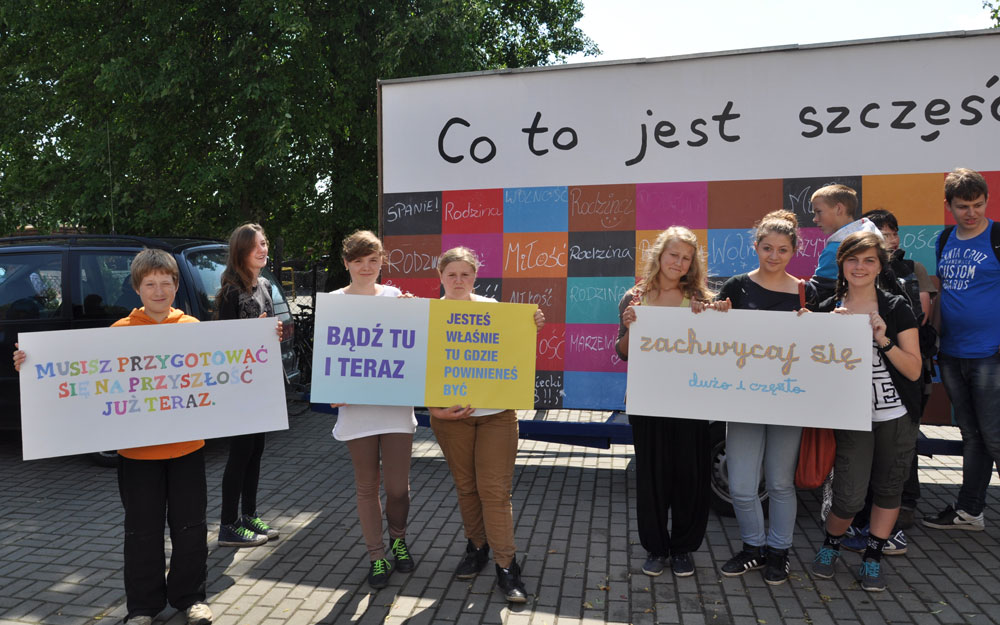
Students hold posters by (left to right): Leah Rosenberg, Susan O’Malley, and Christine Wong Yap, in front of an interactive billboard by Galeria Rusz. Photo courtesy of Galeria Rusz.
From June 2–8, Galeria Rusz’s travelling exhibition, The Pictures Full of Happiness, traveled across Poland’s Kujawsko-Pomorskie region asking the Polish public to reflect on an emotion. In small villages and cities, artworks by Galeria Rusz, Susan O’Malley, Leah Rosenberg, and myself, appeared as mobile billboards and posters. Organized student activities solicited responses via interactive billboards and artworks.
Big thanks to Galeria Rusz’ Joanna, Rafał, and Agnieszka for sharing my artwork with the public!
“You could say that what is on display is failure, what has not been achieved,” [says] Liversidge.
Liversidge is that rare thing for an artist, a poet who proposes to “investigate coincidence” and “a composer” of other people’s actions. It is up to the recipient to determine to what extent they can embrace the project.
—Karen Wright, “In The Studio: Peter Liversidge, artist,” The Independent, August 2, 2013
Peter Liversidge on failure and the role of viewers
Points of Reference, June 8, 2014
Insights, artworks, and other recent ignition sparks.
—

AIMers watching Brian Zegeer’s 3D animation/video installation at his Chashama studio at Brooklyn Army Terminal. See clips of Brian’s Book of Khalid project.
Last weekend, I shared my work with fellow Bronx AIM program participants. Among smart, interested friends, I spoke honestly about where I’m at in my studio practice, leading up to current work-in-progress and the questions that surround them.
I got great feedback. It was fantastic. A mutually supportive community can make an incredible difference. So I highly recommend:
Organizing studio visits with likeminded artists.
Though I procrastinate on organizing visits to my studio, the AIM program was a perfect foil for my hang-ups, with the added benefit of learning about great artists’ work too. So, artists: Just do it! Get a group together, set up a schedule—maybe every two weeks or once a month, and create conditions for great conversations to take place! It’s important! If it seems that it’s not a great time, be forgiving—there’s hardly ever a perfect time, so better now than never.
After my visit, I started thinking about:
Not taking myself too seriously.
The tone of my presentation was blunt and vulnerable, but also (sometimes unintentionally) funny. My colleagues really “got” me and where I’m coming from. I’d love it if my audience also had this perspective. I wonder how to incorporate this further into the reading of my work? For starters, it’d help me keep approaching:
Art-making as a way to test ideas.
In grad school, I allowed works to be resolved to varying degrees. Maybe I’ve drifted towards the dominant market-oriented inclination to make things that are more polished, impressive, “accomplished,” and intelligible to selection review committees, gallerists, etc.
So Ernesto Pujol’s writing resonated with me on many fronts:
I… practice with the belief that there is enough art, feeling no pressure to create more art, so what excites me is to create something ambiguous, something liminal, so that it has the effect of art, regardless of its final label.
—Ernesto Pujol, in Mary Jane Jacobs and Jacqueline Baas, eds., Learning Mind: Experience Into Art [Berkeley: UC Press] 2009
Time to re-set.
If I am to re-orient my approach, it’ll make the way I relate to viewers more open-ended. I’ll be able to:
Speak openly about unintended receptions of artworks.
How viewers interact, interpret, and experience the work—in a full range of successes and failures—could be embraced.
We must risk and endure misunderstanding, even by those who supposedly support us, which is the most painful of all misinterpretation, because we still create and promote all this mainly through art world channels.
—Ernesto Pujol, in Learning Mind
Which implies:
Embracing middle grounds
[Artists] should regard ourselves as writers of novels for smaller but more substantial audiences, even as we would like to make them accessible and meaningful to all.
—Ernesto Pujol, in Learning Mind
—
JHK Activity—Collection & Research on J H Kocman
My influential grad school advisers Ted Purves and the late Steven Lieber helped me stop worrying about making grand statements, and appreciate modest gestures such as ephemera. Just as I was thinking about becoming more process- and less results-oriented, I learned about Ted’s latest project—a blog documenting the works of Czech conceptualist J H Kochman. This work, in particular, exemplifies what I gained from Ted and Steven, and my “un-aspirational” aspirations:

J. H. Kocman, Bipolar Analysis of a Square, offset print, A4, signed/numbered. // Source: jhkactivity.wordpress.com.
—
Pae White: In Between the Inside Out

Pae White: In Between the Inside Out, Installation view, Mills College Art Museum, 2009 // Photo: Paul Kuroda // Source: ArtandEducation.net
Five years later,* still thinking about White’s 3-D rendering video projected inside enclosures made of two-way mirrors. First seen at New Langton Arts (RIP) and Mills College Art Museum.
*Read my enthusiastic 2009 response—sorry about the link-rotted images. (FYI, I’ve improved my image linking now.)
—
To re-orient to the studio, I’ve enjoyed diving into books by artists. They counterbalance criticism and theory, and can be an antidote to market orientations.
The Human Argument by Agnes Denes
Excited to grow my appreciation of Agnes Denes’ work with a book of her writings:

The Human Argument, The Writings of Agnes Denes
See ArtBook for the description (though it’s out of stock there; I found a used copy on ABEBooks).
Don’t know why I never got around to this one, either. The oversight that shall be redressed shortly.
Allan Kaprow (Jeff Kelley, ed.), Essays on the Blurring of Art and Life
—
A reminder about the centrality of studio practice:
A life of making isn’t a series of shows, or projects, or productions, or things; it is an everyday practice.
…It isn’t necessarily the objects of art in their many forms that we are here to support, it is the possibility of art, the question of art, the place it makes in the culture for those acts which ‘just are’ and, in their being just for the sake of themselves, can open worlds in which we might listen differently.
—Ann Hamilton, in Learning Mind
Hamilton also shared this lovely quote from Ralph Waldo Emerson:
Let me remind the reader that I am only an experimenter. Do not set the least value on what I do, or the least discredit on what I do not, as if I pretended to settle anything as true or false. I unsettle all things. No facts are to me sacred, none are profane; I simply experiment, an endless seeker with no past.”
art competition odds: Lower Manhattan Cultural Council’s 2014-2015 Workspace Residency
The Lower Manhattan Cultural Council’s 2014-2015 Workspace Residency program received over 1,100 applications for 10–15 visual art residencies.
//////////////////////////////////////////////////
//////////////////////////////////////////////////
//////////////////////////////////////////////////
//////////////////////////////////////////////////
//////////////////////////////////////////////////
//////////////////////////////////////////////////
//////////////////////////////////////////////////
//////////////////////////////////////////////////
//////////////////////////////////////////////////
//////////////////////////////////////////////////
//////////////////////////////////////////////////
//////////////////////////////////////////////////
//////////////////////////////////////////////////
//////////////////////////////////////////////////
//////////////////////////////////////////////////
//////////////////////////////////////////////////
//////////////////////////////////////////////////
//////////////////////////////////////////////////
//////////////////////////////////////////////////
//////////////////////////////////////////////////
//////////////////////////////////////////////////
//////////////////////////////////////////////////+
Participants comprise about 1:73–110, or 0.9–1.3% of applicants.
Sources: Number of visual arts applications stated in rejection letter. Approximate number of visual artists accepted stated in LMCC’s WorkSpace information session, January 15, 2014. Final list of artists will be available in late summer 2014.
See all Art Competition Odds.
Workers Are People, Too

Art labor and working conditions have been on my mind lately–perhaps it’s because I installed at the recent art fairs, where art handlers get access without influence.* For example, installers at Frieze receive exhibitors’ class “C” passes—which are good only for entry before or after public hours.
A recent op-ed on NYT (Tony Schwartz and Christine Porath, “Why You Hate Work”, May 30, 2014) states what many managers, HR people and executives seem impervious to (but anyone with a shitty job already knows):
Employees are vastly more satisfied and productive, it turns out, when four of their core needs are met: physical, through opportunities to regularly renew and recharge at work; emotional, by feeling valued and appreciated for their contributions; mental, when they have the opportunity to focus in an absorbed way on their most important tasks and define when and where they get their work done; and spiritual, by doing more of what they do best and enjoy most, and by feeling connected to a higher purpose at work.
…Put simply, the way people feel at work profoundly influences how they perform.
This seems so obvious to me, yet some excel in failing to consider that workers are people. (In a particularly dense example, I’ve had to explain why “feeling valued and appreciated for [one’s] contributions” means not treating workers as interchangeable and
replaceable by firing them willy-nilly.)
…Partly, the challenge for employers is trust. …many employers remain fearful that their employees won’t accomplish their work without constant oversight — a belief that ironically feeds the distrust of their employees, and diminishes their engagement.
The worst example of this is requiring some workers (but not white collar staff) to use a fingerprint scanning time clocks. (Workers were allowed to choose which finger to scan in with. Guess which one it was?)
Of course, many supervisors get it, and are generous and humane. Their employees are happier and more productive for it, and likely so are they.
—
* “[Preparator] work gives the perspective of an insider without the credibility of one,” Torreya Cummings, as quoted by moi in “Portrait of an Artist: Wily and Engaged,” Art Practical, May 4, 2011.
Put Pen to Paper

Sketchbook/notebook notes on a book by Csikszentmihalyi & Rochberg
Writing notes longhand helps people better understand and retain information! I’ve been doing this for many years for this reason. It’s slow but efficient, plus (I hope) it minimizes the decline of my handwriting.
“When we write, a unique neural circuit is automatically activated,” said Stanislas Dehaene, a psychologist at the Collège de France in Paris. “There is a core recognition of the gesture in the written word, a sort of recognition by mental simulation in your brain.
“And it seems that this circuit is contributing in unique ways we didn’t realize,” he continued. “Learning is made easier.”
—Maria Konnikova, “What’s Lost as Handwriting Fades,” NY Times, June 2, 2014
Typing doesn’t have the same effects, while cursive and printing might have different implications. Artists and performers interested in embodied cognition take note.
See: SURVEILLAPOCALYPSE @ FiveMyles, Crown Heights, BK

SURVEILLAPOCALYPSE
June 7—June 22, 2014
Opening reception Saturday, June 7, 5–8pm
FiveMyles, 558 Saint Johns Place, Brooklyn
Installation, wall works, performance by Brooklyn-based collective Artcodex, Canada-based Native American collective 007, and guest artists Oasa Duverney, Laura Napier, Joshua Peters, David Gregory Wallace, Bryan Zimmerman.
Sounds like a great show, and excited to support the ever-thoughtful Laura Napier, and of course Make Things (Happen) artists Maria Hupfield and David Gregory Wallace, who will be showing a kinetic shadow puppet installation (learn how to make your own with his activity sheet).
 R+D
R+D 