Art & Development, Travelogue, Values

3 visits + a P.O.V.: Manchester Museum, Whitworth, Urbis, US-UK

Manchester Museum
The natural history museum is a metonym for Manchester: a bricolage of old and new. There are bright, airy, open galleries brushing up against dim halls lined with cabinets that look like they’re from Darwin’s time. It’s all fitted neatly into a neo-gothic building at the University of Manchester.

During today’s visit, I found the mineralogy department the most fascinating. It’s small — a single room, almost, though a tiny gift shop shares the space. But the specimens are small, so there’s actually lots to see. I must have spent at least an hour looking at rocks today.

The north of Britian is geologically diverse, and the museum featured many spectacular specimens from nearby mines. The range of colors and shapes where dazzling, to the point, where I wondered, as an artist, how could I ever possibly complete with the beauty in Nature?
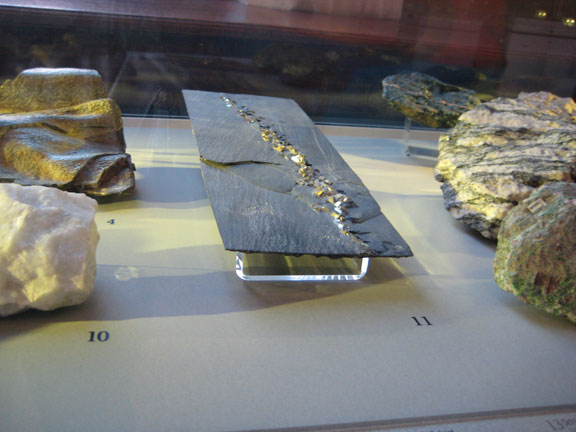
Slaty cleavage of pyrite cubes

Slaty cleavage of pyrite cubes

I almost missed one dark cabinet, thinking it was out of order. Then I found a button and pushed. UV lights blinked on, and rocks of all shapes glowed in purples and phantasmagoric grains of green. Awesome. I love the idea of minerals formed by heat, pressure and seismic shifts gaining the property of phosphorescence, even when they are deep in the earth, shielded from light. I find it poetic that in the mining of coal or ore for industry, enigmas were also uncovered.

Whitworth Gallery

Subversive Spaces is a large-scale exhibition pairing early 20th century Surrealism with contemporary sculptures, installations and videos by international artists. I’ve had two brief encounters with the show and find that it’s just not my cup of tea. Maybe I’m just not that into Surrealism. Part of this has to do with the fact that Surrealism is often used to introduce viewers to Modern Art, so, for me, it’s taken on a whiff of the palatable, familiar, introductory. Besides, after HBO and David Lynch, the Freudian ideas in early Surrealist paintings and sculptures aren’t very shocking anymore.

That said, I was impressed with Markus Schinwald’s video (watch it on YouTube) featuring two actors — including an immensely capable dancer/movement artist. I think this work epitomizes the show: it’s subversive, surreal and innovative.

The show includes works by major contemporary artists. Among these are two sculptures by Mona Hatoum (a prison-like baby crib in galvanized steel, and an oversized egg slicer), two sculptures by Robert Gober (the foot coming out of a wall, and a perspectival playpen), an installation by Sarah Lucas (a figurative display composed of lights and furniture), and a video by Francis Alÿs (creating music by walking and hitting a fence with a stick).

Gregor Schneider‘s Weisee Folter, a new, site-specific commission that takes up a major gallery, is highly hyped but viewable one visitor at a time. Advance bookings are not taken, and wait times were 90 minutes on an early Tuesday afternoon. So I skipped it, though I suspect that it would register as particularly German—intellectual and dark—like the work of Anselm Kiefer and Martin Kippenberger.

Urbis
Urbis is an ingenious building that’s completely out of character with old Manchester, but it can be forgiven because it adds large, high-quality exhibitions of art and design to the city centre.

Aidan O’Rourke’s Manchester Mega-Photo—basically a giant photographic cityscape—is cool. Even though the commercial district smacks of boosterism, the Mega-Photo is still enjoyable. And anyway, the higher your familiarity with Manchester, the more meaningful the photo becomes.

Reality Hack: Hidden Manchester by Andrew Brooks is a series of fantastic, large light boxes and prints of Manchester’s hidden spaces. These digitally-composed photos are densely-detailed, well-composed, dramatically lit, and completely vertiginous. Nice use of light boxes and prints on silvered paper, which make the photos appear illuminated from within like light boxes, but with the added advantage of non-reflective surfaces.

The photos are visually stunning, though I’ll register two minor qualms, both stemming from questions of taste and commercialism. First, the wall labels: while the didatic texts are well-written and useful, I found the graphic design drew too much attention to itself. They were hard to read (small type, white ink on black ground, rather low on the wall) and cheesy (the exhibition’s identity scheme, a bar code—why?—appeared on all wall labels). Most offensive were the punning titles, like “Abel Tower” (a photo of a bell tower) and “Culvert Report” (a photo of a culvert). Cringe-inducing. So much skill and sophistication in the work, undermined by these useless add-ons. Urbis’ curatorial vision seems like it could use more contemporary art rigor.

While two of the exhibits seem explicitly about Manchester, others are very American.

Black Panther: Emory Douglas and the Art of Revolution
I live in Oakland, and I’ve met Emory Douglas (nice guy). The traveling exhibition is largely educational, employing lots of original source materials, oversized vinyl and wallpaper. Much of the original art is lost, but it was meant for reproduction anyway. It’s curious to be in a multicultural center of England learning about the Black Panther’s radicalism in the U.S. Something about it seems totemic, historicizing, in a way that disconnects the BPP from today’s struggles.

Coming up, Urbis will have a show called State of the Art: New York. Urbis showcases different creative cities in an annual program, but New York!? What is this, 1980? What’s with this obsession with America?

Printed canvas art in Oldham, Greater Manchester, UK

Printed canvas art in Oldham, Greater Manchester, UK

It turns out that some Brits would love for the UK to join the European Union, while others hope that the UK would be more like America. This easy to see in Manchester’s commercial city centre, where nearly all young men are dressed in deliriously colorful post-Kanye gear, while the most popular look for young women includes tights, Uggs, blonde highlights and orange tans. It’s SoCal simulacra under slate Mancunian skies.

Clearly, Manchester is has reinvented itself since the post-Industrial decline and nineties’ IRA bombing into a vibrant city. But its model need not be so sanitized and American, with high-rise condos and Urban Outfitters. Rather than aspire to be Santa Monica today, I’d rather see a new, distinctly English or European vision for tomorrow. Distinctly contemporary English things like The Cooperative: a co-op that actually provides services like quality groceries and banking. Preserving the pubs alongside the hip lounges. And walking the green walk: have a recycling program, for starters. Green the city and its canals. Create other safe, viable public spaces besides the mall.
Standard
Art & Development, Travelogue

tempers, temperments, temperatures

My interest in optimism and pessimism is developing into an investigation of temperaments in Manchester and the UK.

Stuart Maconie’s travelogue, “Pies and Prejudice: In Search of the North,” (Ebury Press, 2008 ) has been a wonderful, laugh-out-loud guide. I really enjoy Maconie’s writing, even if I have to look up several words–slang, local, or otherwise–per page. Maconie is a BBC personality, and his narratives ooze with charm:

And most famous of all, to be born within the sound of the Bow Bells is the mark of a true Cockney…. The first Cockney I heard was from a newspaper vendor who seemed to be berating a customer for not having the right change. That would have been it, but for two surly youths, their pinched faces volcanic with pimples, dressed in the cheap, nasty uniform of the urban urchin: fake Nikes, hoodies, flammable polyester trackie bottoms that would go up in a single woosh, outsized jeans. They both smoked in that affected way that people who are trying really hard to be hard do; fag between crooked index and middle finger, eyes narrowed, sucking desperately as if trying to actually remove by suction the B&H logo.

Maconie rightfully points out the hypocrisy of the disdain for (Northern) chavs while Cockney low-lifes are routinely glorified in Hollywood films, and most offensively cheery. He doesn’t spare judgement of Northern youth, however:

Two youths in the ubiquitous hoodie style of the early twenty-first century are trying to be menacing by a bus stop but failing because of the utter ridiculousness of their appearance. I know it’s a sure sign of middle age when you start chortling at how young people dress but, really, a hood worn over a flat cap. The effect is less lethal urban gangster than senile old bloke unaware that he’s put two hats on.

I was also quite amused to see this pop up in today’s Guardian in reaction to the recent snow chaos:

Meanwhile, yet another few thousand calls to the BBC mount up, so it seems timely to ask: how much does complaining cost the UK economy? All those people, presumably taking time out from work to get angry about countless perceived injustices.

Marina Hyde. “Let it snow on our nation of the permanently outraged.” Guardian. 7 February 2009.

Maybe it’s the lowbrow tone of the news here, but it does seem like Britons are quite vocal with their discontent. Everyone is talking about the snowstorm, which has caused chaos in London. You’d think it’s War of the Worlds down there.

Manchester hasn’t been hit too bad. As a Californian, I find the weather chilly; my hands crack and ache, and I invariably err towards lugging around a parka, scarf and gloves. On the other hand, I’ve been to Boston in the winter, and in comparison, Manchester really isn’t that cold. In the past 9 days, the weather’s been rather consistent: chilly air hovering around 40°F, little wind, a little snow between a few sunny days. The skies are rather gloomy, but there hasn’t been a drop of rain. Mancunians are so quick to point out how much rain Manchester gets, I’m starting to suspect this has more to do with a self-perception than actuality. The expectations are so low that I’ve been pleasantly surprised by the weather a few times.

While I wouldn’t recommend it, lots of girls are out and about wearing short skirts and tights, or tees and a thin hoodie. I even saw a chap wearing basketball shorts in the snow, gawd bless ‘im.

Standard
Art & Development, Travelogue

Liverpool

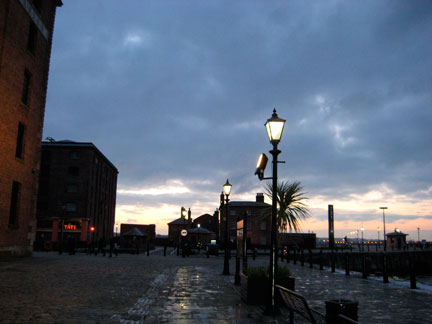
Albert Docks, Liverpool

Albert Docks, Liverpool

An all-day art trip to Liverpool today, guided by the indefatigable Breathe Residency co-ordinator, David Hancock. I’ve got a ridiculously high tolerance for gallery-going, but even I was starting to wane compared to David’s vim. Yesterday’s snow had melted and frozen again, leaving patches of slippy ice on the footpath (slippery ice on the sidewalk), but the rain stayed away, so we covered a lot of ground.

In America, it’s easy to be unaware that Liverpool was the 2008 European Capital of Culture, and now I can see how the city deserved the recognition. It’s a compact city compared to Manchester, and I found it quite scenic. Both cities are historic, but Manchester’s not especially picturesque, and while its recent development has lent a sense of energy, it’s sort of a tony, American, consumerist vibe. In contrast, my sense was that Liverpool culture was a little underground, more woven in with historic architecture, and that there’s quality arts and culture site here.

FACT (Foundation for Art and Creative Technology)
An institute for contemporary art dedicated to new/digital media.
I was intrigued by the website, and the actual place lived up to my expectations. It’s a cool building on a quiet little street lined with a few pubs and architecture/design studios. The galleries are nice, and the installations are meticulous. There were three shows on — one primarily found-sound installation, one essentially an art music video featuring beautiful video of industrial sites, and one kinetic/live data feed type of thing. All were high quality, impressive installations. I’m looking forward to going back to see more great shows, and maybe knocking back a cocktail before visiting their cinema.

Random observation: These UK ICAs sure know how to incorporate both cafes and cool lounge/bars into their buildings nicely. Maybe because the national museums are free, but it seems more common to find galleries to be cool, well-utilized hang-out spaces over here.

Open Eye Gallery
A non-profit gallery focusing on photography. A nice gallery of modest scale, featuring a great show by David Goldblatt. The exhibition pairs photographs shot in South Africa, contrasting framed, grainy, apartheid-era B/Ws with large, unframed, contemporary color prints. The premise could easily be problematic, but the quality of the work, and the way the show is organized, made a delicate, artful statement.

Walker Art Gallery, Liverpool

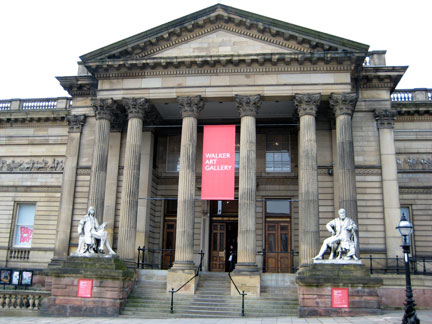
Walker Art Gallery, Liverpool. My American sensibilities find these century-and-a-half-old neo-classical buildings fantastically impressive; I wonder if they become run-of-the-mill for Britons?

Walker Art Gallery
Yet another free, civic-run general art gallery. The collection is fine, inclusive of decorative arts and old paintings.

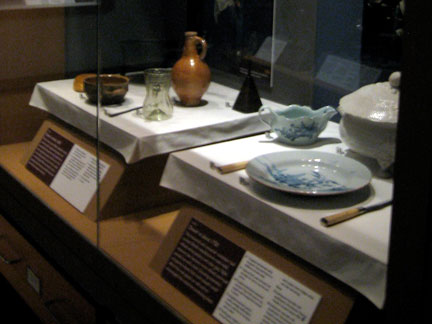
A typical table setting before (left) and after (right) the start of the Industrial Revolution. Walker Art Gallery.

A typical table setting before (left) and after (right) the start of the Industrial Revolution. Walker Art Gallery.

I’m finding the Industrial Revolution-era glass and ceramics to be really interesting, since it speaks to Chinoserie and the rise of the middle class. You really get a sense of how quickly the Industrial Revolution changed things. Plus, so many famous factories were here — Wedgewood, producers of delftware, pressed glass, etc. I’m better appreciating the over-the-top sensibilities of commemorative bowls, teapots, mugs and trays.

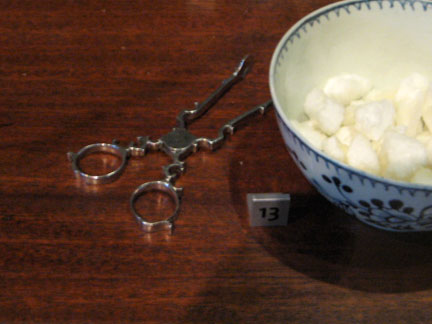
A beautiful pair of tongs for sugar lumps.

A beautiful pair of tongs for sugar lumps.

One contemporary project took my breath away: Jyll Bradley‘s The Botanic Garden, a series of photographic lightboxes shot around the cities’ botanical sites, including labs, libraries, and greenhouses. I love the stunningly dissonant photograph of two night guards. In the background, foliage and the domed conservatory walls loom grandly, but the guards’ station, littered with oversized containers of Nescafe and milk, couldn’t be more mundane. The photos were amazing: densely detailed, rich colors, and printed or mounted on some sort of matte substrate whose tooth reminded me of quality paper.

The Bluecoat
This fantastic ICA wasn’t on my radar before, but it sure is now. It’s a really beautiful, contemporary venue set in an old brick school with a recently-expanded galleries, along with in-house studios for artists and creatives. Brilliant.

Next Up: Liverpool Art Now is a regional survey that comes to some predictable conclusions, like jokey work by young artists, naughty messages on nice hankies, moody paintings, and poppy wall-drawing, but there are some nice turns as well. Here’s what sparked my imagination:
Stephen Forge‘s routed melamine pieces tickle the divide between formal and mimetic.
David Jacques’ fictional, documentary-style video and embroidered and painted banners.
James Loftus’ Tesseract Panopticon Camera, a six-sided pinhole camera that made six-part, cross-like prints.
Imogen Stidworthy’s Topography of a Voice, intaglio prints of 3D audio renderings.
Alison Jones’ Portrait of the Artist by Proxy is an intriguing audio track of non-artists having a hard time describing a face. The more speakers stumbled over their words, the more it seemed to validate artists’ visual skills.

Liverpool Art Now" catalogue

Spread from the Next Up: Liverpool Art Now\

Tate Liverpool
Two exhibits. First, works by William Blake — a really nice treat. And, a DLA Piper series showcasing selections of 20th century figurative and abstract art from the collections. It sounded boooorrrrring, like a bunch of surrealist paintings, cubist paintings and AbEx at any old museum of modern art, but it wasn’t too bad. There were even a few surprises from Op Art and Arte Povera.

Julio Le Parc's Continuous Mobile, Continuous Painting

Julio Le Parc's Continuous Mobile, Continuous Painting

This Julio Le Parc was somehow resonant — it’s an obvious result from the era when artists did anything and everything to get off the wall, but I still like it.

Peter Halley’s The Place struck me in a way Christopher Wool‘s work first impressed me — as a painting that follows in a tradition, but slightly off, tongue-in-cheek. At first glance it looks like your basic grid abstraction, with some wonky, sort of tacky textures, but the neon colors suggest pop culture, and the form itself is a bit like a computer chip. This undermines the purism of abstraction, which doesn’t do much for me in theory, but is pretty entertaining in practice.

There were many strong contributions from contemporary women artists too:
Sarah LucasBeyond the Pleasure Principle junk installation on sex and death included raw light bulbs and a coffin of corrugated cardboard.
Mona Hatoum‘s Home is an installation where metal kitchen gadgets buzzed with a live current (or so the illusion suggested).
Melanie Smith’s Six Steps to Abstraction was a collection of Bridget-Riley-esque paintings stacked abjectedly against the wall, with hanging piles of colored string, and videos shot in Mexico, including one where a bossy customer tries to get a street vendor to re-upholster a cushion in modern art way. The concept seems like something you’d see in any art school grad show, but Smith pulled off a cool, museum-worthy iteration.

Liverpool John Moores University
Finally, I attended a lecture by Garry Charnock, who spearheaded a campaign to make Ashton Hayes, his hometown, the first carbon neutral village in England. Though the campaign is grassroots and has only been going for a few years, they’ve made remarkable process, reducing their energy consumption, attracting a lot of press and empowering the local community. Charnock’s got a background in engineering and journalism, so he tells a convincing story, but his success as a community organizer is the most inspiring.
Visit the project website or watch the video on YouTube.

Standard
Art & Development, Travelogue

Dinu Li at the Manchester Art Gallery

Yesterday, I attended the lecture by Mancunian photographer and video artist Dinu Li, whose photographic series, Press the * and Say Hello, are on view in the Manchester Art Gallery. I also saw these works commissioned by Autograph ABP in the inaugural show at INIVA during my visit to London one and a half years ago, and I thought it was a great body of work. The photos are documentary-style portraits of immigrants talking on the phone in call centers, and it captures a wide diversity of the people from around the world who find themselves in the UK.

My jetlag hit me hard yesterday, but Dinu’s talk was very compelling nonetheless. I was surprised to hear him speak at length about a primary inspiration of his: a painting by Vermeer. It really contextualized his interests nicely—the duality of light and dark and ambivalence between internal reality vs. external world. You can see these principles played out in his works, which started out with a documentary look (he was a commercial photographer in advertising before becoming an artist) and has recently become more cinematic and poetic.

The Manchester Art Gallery (really a mid-sized museum, with many permanent works from the collections) is always free — and I think it really makes a difference that visitors can come and go as they please. In the states, monthly free days at museums are madhouses.

Other unsolicited opinions:

YAY:
HearManchester.com, a great audio portrait in 10 episodes. Nicely produced, hosted by John Robb, a soothingly-voiced local punk rock impresario. Beautiful web design to boot!.

The Chinese Art Centre kitchen has an electric grill. I’ve always wanted one but could never justify it. Cheese toasties, here I come!

Detail of an amusement attraction at the Chinese New Year Festival in Manchester.

Detail of an amusement attraction at the Chinese New Year Festival in Manchester.

BOO:
The City of Manchester has no curbside recycling program. What!? For all of Manchester’s innovation in industry, science (the first atom was split in Manchester!) and music… no recycling?

Standard
Art & Development, Travelogue

breathe begins

9flashes
ready-made fluorescent-ink printed paper, die-cut in flashes

I’ve just started the Breathe Residency at Chinese Art Centre in Manchester, UK, and it’s quite an honor.

I arrived in the UK yesterday morning, and the residency program manager, David Hancock, has generously lent his past two days to get me situated in the studio and introduce me to Manchester’s resources and galleries. I visited Manchester briefly in 2007, but it is like day and night compared to having a local point the way.

Chinese Art Centre’s staff have been very welcoming, forthcoming and professional. The signage is up, the spaces are clean, and a manual with pretty much everything I need to know is in hand. They’ve allowed me lots of space: a 20 x 15′ gallery with high ceilings and an attached utility room/tool closet, a private bathroom and marginally shared kitchen, a sleeping loft, and access to the CAC’s library, which is stocked with books and catalogs. The staff has been really sweet, and very considerate of my privacy. Though I’m technically inhabiting a live/work studio in an art center, it feels more like having an apartment adjacent to the art center. This, along with David’s generous assistance, has truly underscored the privilege of being an artist in residence here.

I’m excited about what’s nearby:
–two art supply shops
–restaurants
–very cool bars (don’t think pubs, think lounges)
–the gigantic Arndale mall, which is replete with anything I could possibly need, from the dollar store (“Poundland”) to fast-food pasties (Gregg) to fresh shark (!) steak at a seafood market.
–just on the other side of the mall is Tesco, the supermarket, which will be a key to living inexpensively in England. The lower end of the price range is bafflingly cheap: £1.18 ($1.66), loaf of flax/soy bread. £0.86 ($1.21), quart of milk. £3 ($4.22), 4-pack of 330ml ciders. I’m curious about why the cost of food is so high in the U.S., even with all of our subsidies.
–a wonderful little shop named Clark Brothers, which stocks old signs and fake decorations. There’s a display of flower garlands that looks like a Wofford/Mail Order Brides dream set. But the other side of the room is lined with shelves full of fluorescent two-tone store signs. The signs are printed, but the text is just idiosyncratic enough to signal hand-lettering. It’s like a wall of ready-made Ruschas or something. I can’t get enough of it.

While I’m looking forward to diminishing my sense of disorientation, I’m also savoring the prickliness of the linguistic textures I’m hearing. It’s peculiar to be speaking the same language as everyone here, but not at all in the same way. When people speak, I have to listen hard, and I have to ask people to repeat themselves much more often than I’d like. Even when I do make out the words, I also find myself hung up on slang — pondering the etymologies of skally and chav, or just mulling over the wondrous glottal stop in grotty. Then there’s the getting used to the nearly ubiquitous “All right?”, a greeting that sounds to me like a question, but is typically answered with another “All right?” And I’m getting accustomed to the slightly emphatic, sing-song “‘Bye!,” which is neutral here, but reminiscent of a sarcastic American Valley Girl’s “‘Bye!”

The next three months are like a blank slate, but I’m confident that there is lots of time to develop and experiment. I got here; now I think the art process will take care of itself. And there are a few constellations that are already forming for the near future:
–a trip to Liverpool. I missed it on my last visit, but it’s close to Manchester and bursting with culture, like the Tate Liverpool and Anton Gormley’s installation at Crosby Beach.
–tomorrow’s lecture by Dinu Li at the Manchester Art Gallery
–a lecture by Antony Hall at Cornerhouse. Hall contributed a provocative installation featuring a soundproof booth for communicating electronically with a live fish in Interspecies, Cornerhouse’s current exhibition.
–artists’ salon-type events, which David mentioned he’d organize soon.
–Manuel Saiz’s “Private Party. Keep Out” exhibition at Castlefield Gallery.
–the opening of “Subversive Spaces: Surrealism And Contemporary Art” at The Whitworth Art Gallery, The University of Manchester. It’s a great space and it looks like it’s going to be a great show. I’m so excited.

Standard
Research, Travelogue

NYC Art

Some NYC highlights:

The kindness of friends and fellow travelers

The easy loquaciousness of a city of professional talkers

Brilliant people and their sincere enthusiasm to share industry insights

Surprising phosphorescent rubber sculptures by Jeanne Silverthorne at McKee Gallery.

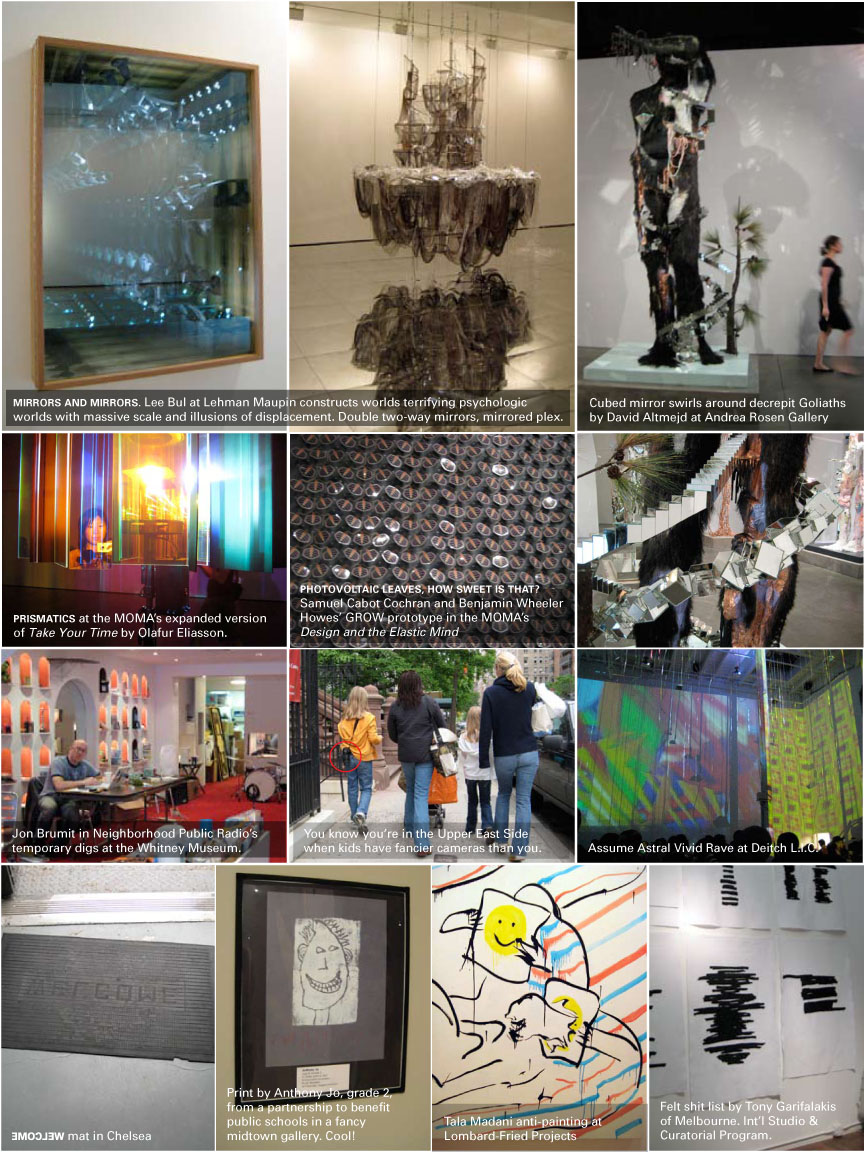
The psychologically pregnant, tough and beautiful sculptures by Lee Bul at Lehmann Maupin Gallery

The strange giant figurative sculptures in unexpected media by David Altmejd at Andrea Rosen Gallery

More (yes, more!) Olafur Eliasson art at MOMA and PS1. Yes, the big rotating mirrored ceiling is impressive, but so are the kaleidoscope windows and color spectrum screenprint series.

Neighborhood Public Radio‘s quirky storefront broadcast studio and friendly faces at the Whitney Biennial

The videos at the Whitney Biennial:
Javier Tellez’ blind people and an elephant,
Omer Fast’s exploration of memory with a soldier’s narrative,
Mika Rottenberg’s chick/chicken coop installation/video, whose video/installation at the Tate Modern last fall was extremely enjoyable as well,
Spike Lee’s When the Levees Broke.
Also,
Ellen Harvey‘s Museum of Failure, which expresses her skepticism of art’s capacity in light and mirrors,
Heather Rowe’s Screen for the Rooms Behind,
photographs and shipped glass Fed Ex boxes by Walead Beshty

Vlatka Horvat’s temporary text-in-nature performances photographed and on display at Neuhoff Gallery

A delightful taste of sad-sack SF humor at Apex Art‘s Lots of Things Like This, a group show curated by Dave Eggers with Tucker Nichols and

Cao Guo-Qiang at the Guggenheim. Great use of the space. I loved the discreet installations in the wings, such as the shipwreck of china plates and cups, and the river constructed of yak skin with live snakes.

New York Magazine‘s fantastic graphic design

The International Studio and Curatorial Program‘s great new building in East Williamsburg, and esp. Satoshi Hashimoto for his futile video in which he buries himself in dirt.

Yoko Ono at Galerie Lelong
(A tangent: My mother loved the Beatles. She was introduced to their music by her Adult Education English instructor. She loved John Lennon’s voice, but she was also impressed that regardless of his wealth and fame, he married a Japanese woman. It was proof that anything is possible in America. Little did my mother know about Oko’s influence in Conceptual Art and Fluxus.)

Substraction, the surprising and humorous show of giant Ab Ex paintings at Deitch Projects.

Marco Breur & Arnold Helbling mail art with chromogenic paper at Von Lintel Gallery

Vintage Robert Colescott videos and mockumentary at Kravets Wheby

Some low-lights:

Overpriced food and coffee that tasted like coffee-flavored beverage.

Loads of corporate and secondary market galleries selling historic paintings by white men from the 20th century, as recent as the 1970s.

Standard
Art & Development, Travelogue

Art Highlights: Los Angeles

Santa Monica • Chinatown • Culver City • Fairfax

Click on the images to see a larger file.
gallery_la_art_p1_sm.jpg

gallery_la_art_p2_sm.jpg

Two days, 50+ galleries, 4 museums. Here’s what stood out:

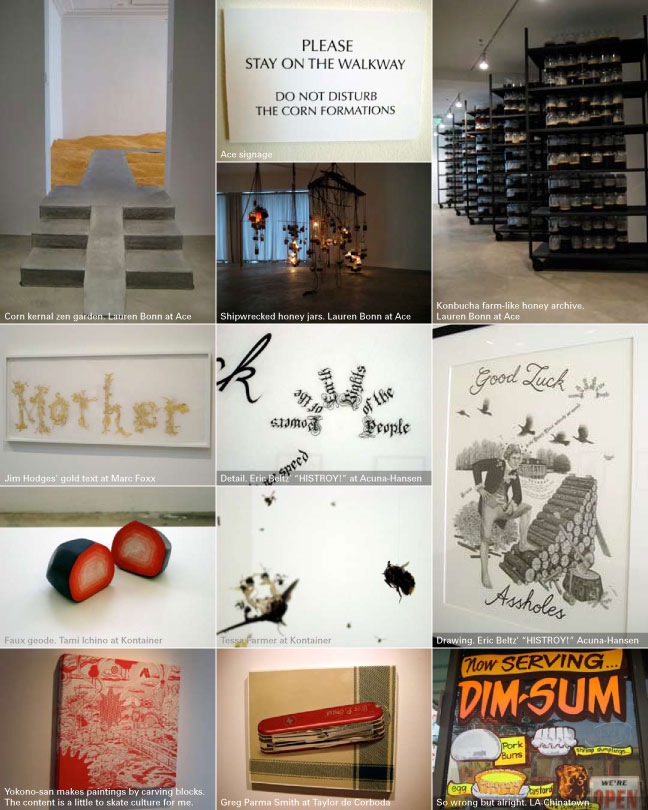
Won Ju Lim at Patrick Painter
Maximum effect with minimum trickery: digital projectors, colored plexi vitrines, poured paint sculptures, and some fake plants with gooseneck clamp lamps. The effect is truly astounding, and somehow very pertinent after the Southland fires. Lim may be my new favorite artist.

Lauren Bonn at Ace
Bonn’s Not a Cornfield cornfield was massive in scope and social programming, and she fills Ace with massive and terrifying psychic spaces which are somehow related to the cornfield and her study of bees. The scale is stupefying. I don’t know how Bonn orchestrates it, or Ace sustains it. But it’s amazing.
A side note: Bonn is also exhibiting the residue of a conceptual drawing piece involving an object recording the marks of a cross-Pacific passage. Sounds very similar to my Regalos project, doesn’t it?

Glenn Ligon at Regen Projects
A perfect example of why object-based conceptual practice is great: there’s so little mass in Ligon’s show, but there’s so much to think about. Thirty-six near-identical gold and black text paintings and one black-out neon text sculpture. Joke paintings invoke Richard Prince, but the racial content begs more conflicted social terrain. The neon text sculpture, of course, resonates with other (White) Conceptualists’ work, but again, Ligon’s content diverges into a realm of his own determination. My next stop was to look up Ligon’s article, “Black Light: David Hammons and The Poetics of Emptiness” (Artforum, Sept. 2004), a really beautiful artist’s writing/critical essay/statement about making art, resistance, the artist’s refusal, the “emptying out the self as a critical strategy,” and light as a material.

Kim Rugg at Mark Moore
Twenty-six re-assembled newspaper covers comprise Rugg’s “Don’t Mention the War,” in which she’s sliced and diced single letters and alphabetized them. I think she’s set a record; she’s broken an OCD-Art barrier. I’m impressed with the artist’s commitment to this massive project in an non-archival, unstable material. Furthermore, the craftsmanship is amazing, with hardly any relief in the collage.
Also at Mark Moore was Kenichi Yokono. I’m including this because I would have liked to explore this medium about ten years ago, when I was really into carving woodcuts, but not only interested in making prints. Yokono carves wood as if for printing, then displays the blocks as paintings, screens or skateboard decks. The content is punk-skate-pop culture, and the cut-out forms seem a little all over the place to me, veering towards hand-carved souvenir shop variety.

Group show at Marc Foxx
Lots of text-based work floated my boat here, including Jim Hodges‘ gold-leaf “Mother” on vellum. Francis Stark exhibited more good-bad-ugly work, which was awkward but intriguing nonetheless with its Alhambra delivery truck sized hanging sequins. While some artists cultivate the artistic persona of a naif through the use of odd materials, you get the sense that she isn’t faking her intuitive process.

Wild Women group show at Kontainer
This quietly installed group show was very smart. Tessa Farmer has assigned herself the dreadful task of creating minature (think: convert to microns) skeletons and attaching them to insects, and then hanging the dead bugs from monofilament. It’s a mind-blowing artistic practice. Tami Ichino‘s ceramic faux geodes are beautiful objects that manifested her paintings’ spacey psychedelia into three dimensions.

Eric Beltz’ “HISTROY!” at Acuna-Hansen
I resisted these drawings. They’re too slick: the gothic calligraphy and cursive script is too cool, the dead presidents theme seems so trendy, the literary references are very pop-goth. But these drawings have to be seen in the flesh, and I have to admit, Beltz’ self-described “high definition drawing” provides a truly enjoyable, memorable experience. Bonus: the title is wickedly funny, yet fitting.

A Great Delicacy group show at Taylor de Cordoba
Clearly I don’t connect often with paintings these days, but Greg Parma Smith‘s painting of a Swiss Army knife with a fabric pattern that escapes the still-life’s margins surprised me. It didn’t seem to take itself so seriously, which is hard to find among photo realist works. Rebecca Veit‘s and Kathryn Hillier‘s tense food-porn photos were convincingly reminiscent of Sunset Magazine, and Danica Phelp‘s charts were pleasingly ‘drawing-ly,’ if one could make up a graphite corollary to ‘painterly.’ McKendree Key‘s color photocopy stop-motion animation had a nice storm-at-sea rhythm while man-made garbage tumbled by as if on a watery freeway.

I had the pleasure of crossing paths with some Halloween- and Thanksgiving-themed sponge painting on the tinted windows of a dim sum shop in Chinatown. You haven’t lived until you’ve seen sio mai rendered in florescent sponge paint.

No photos, just strong impressions:

Slater Bradley‘s CGI rain cloud and singin’ in the rain dandy at Blum and Poe.

William Pope.L‘s show at the Santa Monica Museum of Art, “Art After White People.” Think about it.

Jamie Isenstein‘s deliciously restrained and curious “Welcome to the Egress” at Hammer Projects.

Francis Alÿs‘ “When Faith Moves Mountains,” also at the Hammer (whose exhibition title, “Politics of Rehearsal” could also be “Poetics of Reversals”).

Standard
Research, Travelogue

Art I Saw and Really Liked in England

Sao Paolo-based Carla Zaccagnini at Blow de la Barra, London
A restrained show of a selection of curious objects — which were slightly reminiscent of Surrealism and Fluxism, in very good ways — united by heady concepts. From the press release: “‘Wish’… is mainly based on works that deal with desire and its necessary insatisfaction.”

Travel Guide by Matei Bejenaru, which was part of The Irresistable Force at the Tate Modern, London
A fold-out map with detailed instructions for a successful border-crossing into Great Britain or Ireland from Romania. It documents the physical and legal dangers. This content was an eye-opener for me — I have only a vague understanding of immigration in the European Union, as membership frees up the movement of people, to dramatic effects. I also liked the restrained form of display, limited to one floor graphic and take-away brochures.

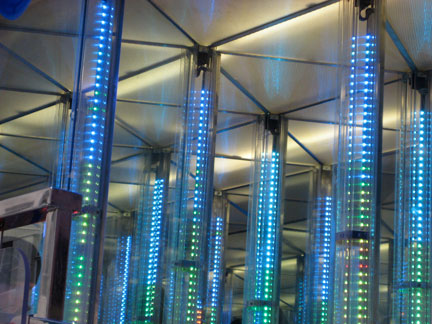
I enjoyed Outside the Box at Cornerhouse very much. Almost every work in the show was a thought-provoking contribution. Gallery 2 (there are three) was my favorite, because it included Jim Campbells’s low-res screens of LED lights, Daniel Canogar’s fantastic fiber-optic projector and projections and Christopher Thomas Allen’s Dialogue, a theatrical replica of two adjoining office desks, whose computer monitors appeared to engage in a debate, flashing Google-image-searched pictures based on the words in an audio track.

Standard