Art & Development, Community, Travelogue

new manc art highlights

Islington Mill Studios; hallway.

Islington Mill Studios; hallway.

The Dilemma of Archive
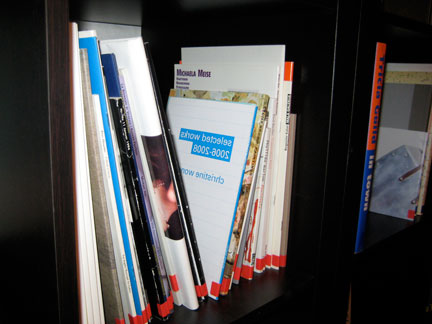
New library
Islington Mill

Islington Mill is a really cool artist-initiated studio compound with a gallery, performance venue, experimental school, and now, a new library focusing on art books. I find the whole idea of the place very grassroots, appealing and innovative.

detail of installation by Maurice Carlin

detail of installation by Maurice Carlin


detail of installation by Maurice Carlin

detail of installation by Maurice Carlin

Last night, I attended the opening of The Dilemma of Archive, a show featuring the work of Maurice Carlin and G. Leddington. The exhibition space is a disused studio — about the size of a bedroom, maybe 15×12 feet. But the modest space held a really tight grouping of four works, which were peculiar and quiet and rewarded sustained attention.

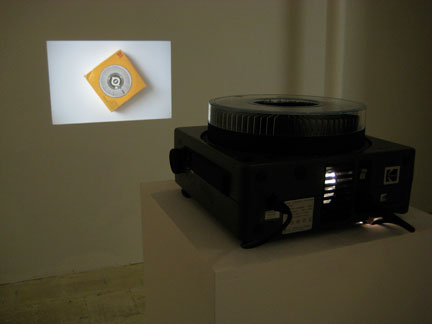
Slide show/installation by G. Leddington at Islington Mill

Slide show/installation by G. Leddington at Islington Mill

I really liked G. Leddington’s slide show of a turning carosel box, which reminded me of the work of Anne Collier and Tacita Dean. But Leddington’s accompanying works — photo prints of obscure articles, book plates and photos relating to Henri Michaux, art collector/smuggler swung the content away from the project of photography and back towards the archive.

My contribution to the new library.

My contribution to the new library.

The curatorial statement is quite smart, pointing out the paradoxes inherent in any archive — exhibitions, art collections or libraries. I really liked the high conceptual quality and grassroots venue partnered with the new library initiative. I keep telling people that Manchester is a cool city, and if they can look past the binge drinking and American-style malls, they’d see the local points of vibrance like Islington Mills.

Gregor Schneider‘s Kinderzimmer
Subversive Spaces
Whitworth Art Museum

I couldn’t be bothered to see this pitch-black, one-viewer-at-a-time installation — the wait times were always long, but today, by happenstance, I was able to get in after a brief 10-minute wait.

I won’t spoil what’s inside for those who yet to see it, but I will say this:

I found it extremely effective. It was emotional — the darkness was so complete it was terrifying, and upon exiting, my sense of relief gave way to a curious ecstasy. It was provocative and I experienced a sense of convergence between:

  • Dan Graham’s interest in the just-past
  • In Claire Bishop’s Installation Art: A Critical History (Tate 2005) darkness and the dissolution of self…
  • …and how Kinderzimmer manages to include pure phenomenology, mimesis and representation
  • how Schneider exploited the flaws in human hardware
  • how the installation achieved high aspirations in spite of the humble materials
  • grief and existential subjectivity
Standard
Art & Development, Community, Travelogue

thameside art highlights

Shadows and lights on the Queen's Walk, Thameside, London. Sorry, none of the exhibitions allowed photography. What you see is what you get.

Shadows and lights on the Queen's Walk, Thameside, London. Sorry, none of the exhibitions allowed photography. What you see is what you get.

Some highlights from my recent trip to visit museums in London. It seems like there’s never enough time in London, but I hope to make it back for galleries and more fun.

Annette Messenger
Mark Wallinger Curates The Russian Linesman
Hayward Gallery

Messenger is amazing. The exhibition makes evident how she was influential in the development of installation art. The work highly symbolic and theatrical — “a dreamscene tableaux,” as Claire Bishop might describe it — so it’s not exactly my favorite type of installation art, but I was profoundly moved nonetheless. In particular, I really liked “Articulated/Disarticulated,” (see a photo on Urban Landfill blog) a recent, room-sized installation where stuffed human and animal forms were mechanically tortured. It really captured the essence of her dichotomies — both comical and horrifying, humorous and tragic, magical and corporeal. “Casino” is a giant installation — the most phenomenological of the works on view, I think — and it’s stunning.

Wallinger curated a show that probed perception and thresholds. Artifacts are mixed in with contemporary and historical works. It’s a really perceptive show. Fred Sandback’s space delimitations looked fantastic. I knew that the rectangular outline was comprised purely of black string, not glass or some other solid surface, but I tried to bring myself to interrupt the immaterial plane and I couldn’t. Good stuff.

Wallinger’s also got some of his own work, mixed in with a series of 3-D viewfinders of historical photos. They set a high expectation for excellence for the show, and it doesn’t disappoint.

Roni Horn
Rodchenko & Popova
Tate Modern

Horn’s work is highly idiosyncratic. I’m still mulling it over — especially the strange groupings of photographs, including the signature weather/model image — but two things immediately stuck. First, of course, I enjoyed “The Opposite of White” dyad — giant, solid cast glass sculptures in transparent glass and opaque black. Two irreconcilable, but true facts: white reflects light, hence its opposite is transparency; or is its opposite that which absorbs light (black)? Second, you have to see Horn’s hermetic, strange drawings. Reproduction doesn’t do them justice. They’re extreme — a pattern is loose and gestural, pencil marks diagrammatic, and cuts and inlays mechanically precise. They’re astounding, quiet feats, really.

Rodchenko & Popova is a major survey of the dynamic output of two pre-Stalinist artists. Paintings, graphic works (pleasingly tight in pen, weirdly wonky in color crayon, of all things), letterpress publications, films, textile design, furniture, posters, 3-D constructions, photographs and did I mention motion graphics?—means that there is loads to look at and appreciate. I really ‘get’ the Constructions in Constructivism now, and formally appreciate the simple compositions of repeated lines and circles. Most of all, I came away with the sense of avant garde fearlessness, as the couple was unafraid to make clean breaks from previous art styles, even their own. They formulated many new platforms and embraced integration and service to the public.

Altermodern
Tate Britain

Nicolas Bourriaud curated this triennial of mostly British artists. Bourriaud has coined “Altermodern” to describe an in-progress theory about the globalized, interconnected epoch to follow Postmodernism. He casts the artist as “homo viator, a traveller whose passage through signs and formats reflect a contemporary experience of mobility.” When I turned my gaze from the Tate Britain’s impressive pediment towards the Thames (where it’s easy to recognize the seat of imperial power), I wondered how fully a British art institution could embrace a new, multi-polar, Zakarian world. My skepticism was corroborated, when, in Global Modernities, the coinciding symposium, Walter Mignolo labelled the theory “a Eurocentric critique of Eurocentrism.”

I think altermodern an interesting term, and it may be useful for categorizing some existing themes in art — transitional sites (e.g., Walead Beshty’s FedEx boxes, “transit-specific works” as Galleon Trade colleague Eric Estuar Reyes would put it, see video at the Whitney 2008 Biennial site) and liminal states (Spartacus Chetwynd’s beanbag installation with psychedelic performative video, or Gustav Metzger’s crystal light show — I shit you not). The triennial is sort of, well, triennial-y: giant, well-executed spectacular installations, some big names, and limited thematic connections. Here’s what stood out:

Franz Ackermann posits what seems to be a critique of immigration and national identity. (Pics on ArtNet.)

Darren Almond delivers surprising, stunning photographs as usual.

Peter Coffin‘s staged projection- and installation-based museum exhibition, where photos and videos are projected on works from museum collections, e.g., bees on a painting by Joseph Albers. A virulent strain of MJT uncanny.

Navin Rawanchaikul‘s hand-painted Indian-style movie billboard is a riot; the accompanying documentary video of interviews of Indians who’ve relocated to Thailand seems pedestrian and conventional by comparison.

Bob and Roberta Smith create a “junk space” (as identified by Irit Rogoff, the consequences of global modernity) littered with disused stuff and the characteristically ironically upbeat-but-sad-sack enamel signs. One, “I wish I could have voted for Barack Obama,” (pic on ArtNet) is paired with a colorful plastic tricycle, highlighting the wishful thoughts of Britons. Smith pointed out that the exhibition is meant to be interrogative, but I think it’s pretty cool to have an explicitly didactic space within it via his signs. Extra points to Mr. Smith for avoiding the common UK mispronunciation of Barack (“BER-rick,” as opposed to “Buh-RAWK).

Simon Starling illustrates his brilliant reduction of forms with a series of desks commissioned by emailing low-resolution photographs to furniture makers. There’s more to it, of course, having to do with Francis Bacon and others, but the gesture is pure poetry.

Tate-to-Tate ferry
Brilliant, easy, scenic, affordable. You know, art institutions usually have short hours, so minimized travel during open hours is appreciated. Also, “Tate-to-Tate” is a nice sounding phrase, like a mirror, and also reminds me of the 1980s TV show, “Hart to Hart.”

Reconnecting with Mediha

This quote.
As an existentialist, I tend to agonize about my art/legacy/life becoming fodder for “the dustbin of history,” so it was surprising to hear the ever-optimistic M.D. say: “The great thing about history is that things disappear” in regards to the dominating influence of Conceptualism and Minimalism in contemporary art today.

Standard
Art & Development, Travelogue

Hip Hip Hooray for Barrow: Fly Eric

I had become pessimistic. Maybe it’s the economy, the dreary Mancunian skies, or the feeling that I was spinning my wheels as an artist. But reading books by Fareed Zakaria and Barack Obama made me want to be an optimist again.

Changing outlooks takes effort. Good luck also helps.

When I heard about an art symposium in a seaside town two hours away by rail, I hardly considered making the trek. I’d been in Manchester for almost a month, and had already settled into a routine. Perhaps, set adrift from familiar places, people and responsibilities, I’d latched onto the studio for security. I told myself, It’s too far. What if the symposium was a waste of time? What if I missed the last return train? (When I think of “seaside town” and “art” I think of Morro Bay, glass dolphins and watercolor landscapes.)

I realized I had traded in my sense of adventure for a little security. So I gave the symposium a shot. And things couldn’t have turned out better.

Morecambe Bay, I think. The photo doesn't do it justice. I looks dreary, but it's actually a spectacular landscape. It may be grey, but it's a hundred shades of grey.

Morecambe Bay (I think).

Today’s symposium, called “Changing Perceptions of What Artists Can Do,” was great. It featured four dynamic artists/architects — they were all great speakers, with interesting practices. In particular, Verity-Jane Keefe, an artist working with muf architecture, seemed to be at the cutting edge of how art practices can shape urban design dialogues. David Cotterrell was also a great speaker. He further proved my theory that university professors are the best art lecturers, because they construct and effectively convey the narrative of their own development. I was really moved when he talked freely about “making art I could no longer afford to make” and maintaining a commitment to his art-making, even if there isn’t a readily identifiable core practice. It re-affirmed my own struggles; the inquiry required to make conceptually-oriented art is constant, and the rewards elusive.

Speakers at "Changing Perceptions of What Artists Can Do," a symposium sponsored by Fly Eric

Speakers at Changing Perceptions of What Artists Can Do, a symposium sponsored by Fly Eric

The symposium was sponsored by Fly Eric, a collaborative of three artist-run spaces in the Northwest: Art Gene (Barrow-in-Furness), Storey Gallery (Lancaster) and Castlefield Gallery (Manchester). It was hosted by Art Gene, a dynamic contemporary art gallery and residency program in a little seaside town known as “the longest cul-de-sac in the world.” I had first heard of Art Gene through Intersection for the Arts‘ Kevin Chen, who put me in touch with Conrad Atkinson and Margaret Harrison, Art Gene champions. Barrow is lucky that Maddi Nicholson and Stuart Bastik, Art Gene’s dynamos/artists/co-founders, have chosen this windswept slice of Northern coast as their home base.

I had forgotten the paradox that the more rural a place is, the easier it is to meet like-minded people. This proved true today many times — I got re-acquainted with an artist I had met in 2007 in Penrith, a bijou cake of a Cumbrian village. I met two working artists/art commissioners, who invited me to their art group in Preston, and numerous other savvy artists, thinkers and art commissioners from across the Northwest. Nearly half the attendees met at the pub for pints and chips or shepherd’s pie. Quaint, innit? I felt profoundly lucky to be there.

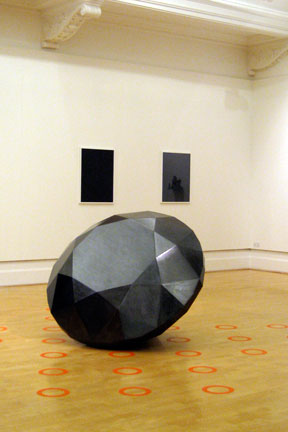
I had only a few minutes before my Trans-Pennine train whisked me away, but I caught a few minutes of the reception for Welcome to Paradise, Art Gene’s new exhibition. Stuart Bastik’s graphite diamond totally floated my boat. It’s an awesome project, one that I wish I could have done, but Bastik executed it perfectly.

Art by Stuart Bastik in "Welcome to Paradise" exhibition at Art Gene. "The Weight of History is Crushing Me in my Bed" (foreground), with "Constellation" I and II (background).

Art by Stuart Bastik in the Welcome to Paradise exhibition at Art Gene. The Weight of History is Crushing Me in my Bed (foreground), with Constellation I and II (background).

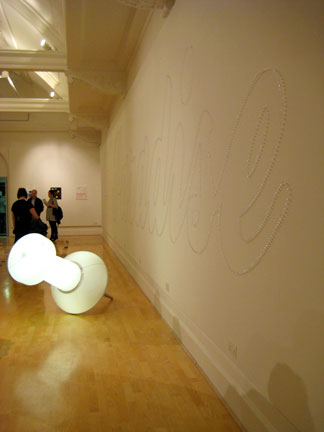
I also really loved the Ultimate Holding Company‘s illuminated push-pin, locating a “there” there.

"The Giant Map Pin" (left) and "Paradise" (pushpins on wall) by The Ultimate Holding Company (with Art Gene)

The Giant Map Pin (left) and Paradise (pushpins on wall) by The Ultimate Holding Company (with Art Gene)

I look forward to returning to this place that expanding my notions of what’s possible — for art in a remote area, for community where you least expect it, for my sense of adventure, for my outlook.

Standard
Art & Development, Travelogue

not helping

An addendum to the previous post on Fareed Zakaria’s The Post-American World:

If, as Zakaria writes, America can continue “to thrive because it has kept itself open to the world—to goods and services, ideas and inventions, and above all, to people and cultures,” it follows that America should steer away from these current trends in the UK:

The curtailment of civil liberties.

Immigration policies that reduce the number of artists allowed to enter the country.

Like Zakaria, I believe that immigration policies that stop people from working are terribly misguided. Furthermore, artists are agents of culture; to de-value cultural exchange in an increasingly interdependent world reeks of regressive isolationism.

I’m looking forward to visiting London soon; the quality and vitality of the arts there are unparalleled. But if London becomes stagnant and inward-looking, there are many more centers in the art world that would happily render conventional art capitals like London obsolete.

Standard
Art & Development, Travelogue

Antony Hall lecture at Cornerhouse

Antony Hall demonstrates the m-Log in front of a projection of a deliriously rhizomatic interface

Antony Hall demonstrates the m-Log (a sensor-driven noise-making interface, housed in a real log) in front of a projection of a deliriously rhizomatic interface

Antony Hall wants to have it both ways. He is disappointed if his science-based projects (which span interspecies communications and fluid mechanics, like creating vortexes in coffee cups) aren’t regarded as serious experiments. On the other hand, seems to be in disbelief that he performs as a experimental sound artist at art events. But when the public wants to acquire his handmade musical instruments, he prefers instead to lead D.I.Y. workshops, acknowledging the (social) aesthetics at work.

The science experiments are smart and interesting. I haven’t had a chance to try the chamber for interfacing with a fish currently in the Interspecies exhibition at Cornerhouse, but the idea and interface are lovely.

The music projects’ low-meets-hi-tech is endearingly ironic. What started out as an elaborate joke (Hall and a friend, whose name I can’t recall, thought it would be funny to make music from a homemade analog interface housed in a log, called iLog, rather than a laptop) has turned into the Owl Project. It’s a grouping of preposterous inventions: the iLog, the m-Log (sort of like the Owl version of an iPod, but with only sensors and no harddrive, I think), and the Sound Lathe (It’s a lathe! It’s an instrument! And it’s pedal-powered!).

Standard
Research, Travelogue

Fareed Zakaria’s The Post-American World

Global economic collapse.
The quagmire in Iraq.
Anti-American sentiment.
China, the sleeping dragon, asserting itself.

There are so many geopolitical reasons to be anxious, afraid and pessimistic. Like many Americans, I’ve been feeling a foreboding sense of decline. In The Post-American World, Fareed Zakaria* argues that America will not be the same kind of lone superpower it has been, but we have many reasons to be optimistic. Indeed, he posits that if the US faces the coming challenges with cooperation and adaptability, we can help shape a secure, prosperous post-American world.

The post-American world is “not about the decline of America but rather about the rise of everyone else,” Zakaria writes. Globalization and rising economic powers means that past paradigms (“integrate with the Western order, or reject it”) no longer apply. As he puts it, “The world is moving from anger to indifference, from Anti-Americanism to post-Americanism.” China and India are becoming major players. They will work to secure their interests and expand their influence. It’s not that the American share of the pie will get smaller, but the pie itself will get bigger.

After all of the boosterism, accusations, and cynical “othering” around the 2008 Beijing Olympics, I found Zakaria’s perspectives on China quite refreshing. China’s rapid growth has caused some Americans to fear China as an evil, inscrutable state. But Zakaria argues that the Chinese government is not intentionally malicious — its major priority has been non-confrontational economic growth, which has lifted millions out of poverty in the past 30 years. Furthermore, Chinese manufacturing flourishes, but it’s not a threat to America yet, as Americans are good at innovation and adding value. We benefit from the high profit areas of development and retail/marketing.

Innovation, of course, is key to growth, and growth is more critical for future success than wealth. For example, when Europe was reeling from the Black Plague, China could have led the world in discovery and innovation. Instead, it closed itself off, and disregarded new technologies.

Another country that paid a dear price for failing to innovate is Great Britain. It was known as the world’s workshop in the 19th century, but failed to compete against U.S. innovation in the 20th century.

But America is different; our economy demonstrates unique advantages. Even though “The Post-American World” was published before the mortgage crisis led to bank collapses, I suspect that the author would still maintain his optimistic views. Despite all our problems, the U.S. economy — however weakened — is still the largest in the world (comprising a quarter of the world’s G.D.P.).

There’s our “demographic vibrance.” As Zakaria points out, “Europe presents the most significant short-term challenge to the U.S. in the economic realm,” but Europe’s population is declining, and unlike the US, it is reluctant to allow and assimilate immigrants. Zakaria asserts, “America’s edge in innovation is overwhelmingly a product of immigration” and “this is what sets this country apart from the experience of Britain and all other historical examples of great powers.”

Then there’s our technology and innovation. Zakaria dispels the myth that our students are outperformed by foreign counterparts. The averaged statistics mislead (or rather, they reveal the inequality in our schools). Still, many of the top universities are located in the U.S., which attract top talents from around the world. We should retain them, too, instead of implement regressive immigration policies.

Unlike Great Britain, whose biggest challenge in maintaining its superpower was economic, Zakaria argues that America’s biggest challenge is political. He says that the post-American world will be multi-polar world. America can help this world be prosperous and stable by taking an active role, guided by principles of cooperation, consultation and compromise. The U.S. can’t make exceptions for itself when it comes to rules like nuclear weapons. The U.S. can’t solve all the world’s problems, but some larger problems, like climate change, require an organizer, and only if the U.S. maintains great relationships with all countries, can it be a successful facilitator. The U.S. must stop cowering in fear from terrorists (and overreacting to them), asserting its military might when diplomacy would do, re-gain its confidence, become open and inviting again, and re-gain legitimacy.

I think Zakaria is saying: It’s not only possible, but necessary, to approach the future with optimism.

Will America be optimistic, and take these steps towards mutual respect and collaboration? I hope so. Next on my optimism/pessimism reading list: Barack Obama’s Dreams of My Father.

*A note about ideology: I think Zakaria makes many valid points grounded in research, reason and pragmatism. This should be adequate grounds for discussing his ideas; I hope ideology doesn’t get in the way of discourse. Some progressives may not find Zakaria sufficiently leftist, but I think that’s a poor reason for discrediting his work. I value his rigor in making clear, persuasive arguments. For example, when John McCain threw a Hail Mary and nominated Sarah Palin (and successfully galvanized the right), it seemed like lefties couldn’t recover from the sheer audacity. They hysterically bashed Palin amongst themselves, instead of responding productively and bringing the conversation back to real issues. So when Fareed Zakaria published an editorial articulating why Palin is bad for America, I took note.]

Book Review by Josef Joffe, NYTimes

FareedZakaria.com

Excerpt, Newsweek

Standard
Travelogue, Values

greening manchester

Tibb Street car park "bring" site

Manchester is planning to start a kerbside recycling program for the Northern Quarter in the fall of this year. Even Santa Rosa, CA started a recycling program in the eighties — and Santa Rosa was still a hick town back then; the air hung thick with the stench of manure in planting season.

The irony is that Manchester has historically been known as a city where coal smoke blackened the sky. Public and private partnerships have spiffed up the city, even spawning a “Green Quarter” housing district.

But in terms of public services, the Manchester City Council seems behind the times, barely keeping pace with industry and the national government.

Please make the facilities exist so the public may recycle.

Please make the facilities exist so the public may recycle.

Currently, Manchester only runs “bring” sites for recycling, where residents can voluntarily drop off household glass, paper and cans. Neither plastics nor cardboard are accepted. Waste receptacles found on city streets are for rubbish only.

Furthermore, there’s no household hazardous waste program in Manchester either. What do you do with a bag full of compact fluorescent lights, each containing small amounts of mercury? I hope the city council doesn’t wait several more years to make their waste management safer for public health, as the national government plans to phase out the production of incandescent bulbs this year.

What do I care, anyway? Well, to make art, artists have to bring, consume, reshape, and dispose of things. Materials matter.

Standard
Art & Development, Travelogue

Screening of Manuel Saiz’ work

Attended a screening the work of Manuel Saiz, an event co-hosted by Instituto Cervantes and Castlefield Gallery. Saiz’ solo show at Castlefield consisted of videos exploring cinematic tropes and a diagrammatic poster questioning the nature of art.

Kwong of Castlefield Gallery and color bars in ornately arched hall at Instituto Cervantes.

Kwong of Castlefield Gallery and color bars in ornately arched hall at Instituto Cervantes.

The video screening helped me to better appreciate Saiz’ ongoing themes (more cinematic tropes, mimesis, and the uncanny) and strategies (mirroring, displacement).

Parallel Universes Meet at Infinity is an especially enjoyable two-channel installation. On one channel, an animal shifts its view, in the second channel, a human mimics every movement. It’s a feat of acting, as well as a coded investigation into mimicry and representation, and what art itself is or achieves.

The last video made me laugh, cry, and beg for it to end.

It’s the documentation for an installation called Public Displays of Affection (click on Public Displays of Affection on this page), in which the artist motorized a track for video camera to shoot 360-degree videos with soaring instrumentals. It’s a parody, of course, on the cheesy romantic, triumphant long kiss, but I couldn’t help but tear up as couples kissed and families hugged each other. The artist is not so sentimental. Maybe it’s because Valentine’s Day is around the corner, but the video made me want to tell the world forget the rest, just love your beloved.

Standard