Impressions, Sights

See: Ebony Patterson, Gina Osterloh, Houseplants

Two shows I like, and one I’d like to see.

Through April 3, 2016
Ebony G. Patterson: DEAD TREEZ
Museum of Arts and Design, NYC

Ebony G. Patterson, Swag Swag Krew-From the Out and Bad Series // Source:  madmuseum.org

Ebony G. Patterson, Swag Swag Krew-From the Out and Bad Series // Source: madmuseum.org

A visually dense show of custom Jacquard tapestries embellished with glitter and toys, and an installation inspired by Jamaican dancehall dandies, shown in floral print-wallpapered galleries. There’s also a terrarium-like installation of the museum’s jewelry collection. [Full disclosure: I freelance here and helped install the show. And you know what? I really enjoyed meeting and working with Patterson—she was engaged, down-to-earth, and hardworking. Big points for learning the crew’s names and feeding us patties from Jamaica.] I’m excited about this show for MAD; I hope future programming reflects similar youthfulness, urgency, and color.

[This winter’s a promising time to visit. There are some amazing pots and insanely intricate minatures in the Japanese contemporary ceramics show. Takuro Kuwata’s pots are knock-outs.]

Through December 19, 2015
Gina Osterloh
Higher Pictures, NYC

Gina Osterloh, Press and Outline (still), 2014, b/w 16mm positive film, TRT 5:30 loop // Source: higherpictures.com

Gina Osterloh, Press and Outline (still), 2014, b/w 16mm positive film, TRT 5:30 loop // Source: higherpictures.com

[The solo show of a super talented and skilled friend from LA. She’s good; you don’t have to take my word for it.] Quiet, meticulously-crafted photos of paper-crafted sets exploring the body. A triptych of photos of hand-painted lines forming warped grids conjures an industrial bathroom floor or the subway; the queasiness of the distortion in the leftmost image seems to offer relief of the more rationally ordered grid in the right image. There’s a mesmerizing film of the artist tracing her own shadow on the wall—she’s framed at a distance, and the gestures are controlled, yet the experience is oddly intimate.

[Also, while you’re in the foyer at 980 Madision, take a minute to enjoy the large Ed Ruscha painting of three masted ships, courtesy of Gagosian.]

Through November 21, 2015
Imperceptibly and Slowly Opening
Sector 2337, Chicago

Sri Chowdhury, "Affected Painting," site specific installation, 2015. Wood, linen, oil paint, concrete, plants, light gels, shadows, ceramics, dimensions variable. Photo by Clare Britt. // Source: cocopicard.com.

Sri Chowdhury, “Affected Painting,” site specific installation, 2015. Wood, linen, oil paint, concrete, plants, light gels, shadows, ceramics, dimensions variable. Photo by Clare Britt. // Source: cocopicard.com.

If I were in Chicago I’d check out this show about how plants “trouble human structures.” It looks like a brainy show with a diverse array of approaches to this subject matter. While there, I’d also get to know Sector 2337, an artist-run gallery, bookstore, and press, as well as a modest studio residency program.


Standard
Works

Memory of an Artwork: Thomas Demand’s Rain/Regen

A stop-motion that reappears along a river of time.

Thomas Demand, Rain/Regen, (still), 2008. // Source: dhc-art.org.

Thomas Demand, Rain/Regen, (still), 2008. // Source: dhc-art.org.

Certain art-viewing experiences stay with you over time. When they’re pleasant, they can remind you of how meaningful the act of looking can be. Recalling a work of art—like reliving any memory—strengthens its salience. It could be that a series of vital art experiences will one day form a tally of the particular arcs of my life.

I’m in a reflective mood, having just finished William Finnegan’s memoir, Barbarian Days: A Surfing Life. It’s about a life shaped by a passion, and later, a passion shaped by life, including loss and aging. Along with reading a remembrance of Oliver Sacks, and a book by the late positive psychologist Chris Peterson, my thoughts keep returning to what makes a life worth living.*

One work that I’ve continued to think about is Thomas Demand’s** Rain/Regen (2008). I saw it in 2010 in The Dissolve, the moving-image focused iteration of SITE Santa Fe’s biennial. It was my first visit to SITE and Santa Fe, on my first cross-country drive. We were moving from California to New York. Marking this life change with a road trip was wise. Those two weeks stand out in high relief.

I remember stepping out of Santa Fe’s picturesque, sun-baked adobe environs into the cinematic black box of the ICA. Floating screens and scrims primed me for psychologically-loaded spaces. Teresa Hak Kyung Cha’s notion that video paralleled the cinema of the mind seemed present.

Essentially, Demand makes stop-motion animations using paper constructions that are ever-increasing feats of production value. Rain/Regen is just what it sounds like—it’s an animated image of raindrops falling in a thin, frame-filling puddle. The fact that it’s constructed by hand, frame by frame, is astonishing. In this case, the paper might be bits of thin, clear plastic torn and stretched by hand. But like rain, all you see are streaks and a momentary splash upon impact. It’s gone in a split second. It happens fast, before your eye can catch up to it. It’s startlingly reminiscent of the overall peripheral sensation of rain. The perceptiveness of perception itself seems yet even more impressive. I know crediting this work with technical wow-factor sounds hollow. But the simplicity of the shot, indeed, the everydayness of the concept, paired with the ambition of animating it, forms a curious nexus.

I was moved by many works in that show, but Rain has stuck with me. Even the physics of a seemingly trivial drop of water exceeds the abilities of the human eye. We grasp only its motion, implosion, and disappearance.

*It’s been oddly reassuring that mentions of friends, colleagues, and acquaintances keep popping up in books I’m reading: Ted Purves in Tom Finklepearl’s What We Made, Marshall Trammel in Greg Sholette’s Dark Matter, and a familiar image by Hank Willis Thomas in Jeff Chang’s Who We Be. It’s probably attributable to two truths: the inevitability that a cohort would become the archivists and subjects of our eras, and, though I didn’t know it at the time, I was in the right places at the right times.

**It’s safe to assume that mega-artists like Thomas Demand rely heavily on studio staff for producing artworks, so a more fitting attribution would actually be “Thomas Demand Studio.” Of course sole authorship flows more freely through the systems of capitalism and law, but it’s nice to imagine a day that we drop these pretenses.

Standard
Impressions

Writing Waves Indeed

The many reasons why Jay Caspian Kang’s “Writing Waves”—part memoir, part book review of William Finnegan’s “Barbarian Days”—in the New York Times Magazine resonated with me.

Kang starts out by researching writing about surfing and pondering its difficulty, locating at the crux one of my favorite topics:

“I concluded that writing about surfing was impossible because surfing elicited happiness, and it is impossible to write about happiness.”

I think positive psychologists would argue that the sciences and humanities can intersect productively with happiness. It’s not impossible, it’s just very hard to do without cliché. Kang says Finnegan

“was the first person I had come across who could write about surfing without schmaltz or weighty metaphors.”

Here’s Kang quoting Finnegan’s description of Ocean Beach:

“San Francisco’s ‘giant gray,’ ‘ominous’ waves”

I can picture those waves, and OB’s riptide warning signs, posted at every entrance. It’s there that I watched M surf, in the same years that Kang surfed there daily.

Kang, inspired by Finnegan, even considers intrinsic versus extrinsic motivation. To find flow, psychologist Mihaly Csikszentmihalyi explains, one should participate in activities that are worthwhile in themselves.

On clean, January days, surfing, even badly, was enough to give me a purpose in life. But on choppy, stupid days in September, as I paddled futilely straight into the first line of white water at Ocean Beach, I would think about Peewee’s vision of silent, simple doing over Doc’s vision of daily, ritualistic heroism. I did not really believe surfing was nothing more than surfing, but I hoped I might one day get good enough at it to drop all its sentimental trappings.

He seems to be yearning for an un-self-consciousness state of engagement, where one’s skills are matched well to the challenges: flow.

He also covets Finnegan’s freedom to solely pursue surfing, not unlike my jealousy of Matisse’s lifetime of art-making:

A surfer feels an even mix of nostalgia and envy reading that passage. The boundlessness of Finnegan’s wave chasing now feels at once out of reach and dated, in the manner of Kerouac’s Sal Paradise and Dean Moriarty.

I’m intrigued by the humility, insight, and craftsmanship from both Kang and Finnegan. I adored Finnegan’s “Off Diamond Head” in the New Yorker a few weeks ago, and now am especially eager to read “Barbarian Days.”

Standard
Impressions, Travelogue

Impressions of Amsterdam

Exhibitions by Matisse, Goedel, and Kentridge.

A few months after I put up a map of the world with the loose intention of inspiring more travel, M surprised me with a short, spontaneous trip to Amsterdam for two of our favorite things—riding bicycles and seeing art and design. Here are my highlights.

The Oasis of Matisse, installation view. Photo: Gert Jan van Rooij. ©Succession H. Matisse, c/o Pictoright Amsterdam 2014

The Oasis of Matisse, installation view. Photo: Gert Jan van Rooij. ©Succession H. Matisse, c/o Pictoright Amsterdam 2014 // Source: stedelijk.nl

The Oasis of Matisse at the Stedelijk Museum

As a young art student I was deeply inspired by Matisse’s paper cutout collage. I loved how they were joyful and expressive, and full of movement and freedom. I missed them when they were at the MoMA, but it is just as well as the Stedelijk wasn’t very crowded last Friday afternoon.

There are two segments of the show. Downstairs, smaller galleries identify Matisse’s stages of development, often correlated to periods of travel, and show works alongside others by Matisse’s contemporaries. It was like a who’s who of early 20th century art, with Fauvists, German Expressionists, Supremetists, and more. I thought a lot about luck and privilege—the happenstances and conditions that contributed to Matisse’s development—being born in a certain country and period, of a particular race and gender, with the means to travel and devote oneself entirely to studying and making art, within a milieu of likewise-enabled artists, interested patrons, and a tolerant government. I thought about how these probably shaped Matisse’s psyche, and his confidence and ambition—the aspects of his art that are most striking. The exhibition leads up to Matisse’s late-in-life cutouts. It seemed that every stage was a step towards this fullest expression of the master artist. I couldn’t help but feel a pang of jealousy, of all the time he was able to devote to his own artistic development.

Upstairs, a large gallery displays Matisse’s cutouts, often using his signature fig leaf motif. I loved the color palette: rich, vibrant ultramarine, an even more vibrant magenta, black, red, yellow. These high-key colors underscore the graphic sensibility, yet the papers are hand-painted and improvised—you can see where the cutouts were cut and moved around again. Some of the collages are massive. You could spend a long time in this gallery, noticing how one’s eye moves around the musical compositions.

The Oasis of Matisse, installation view. Photo: Gert Jan van Rooij. ©Succession H. Matisse, c/o Pictoright Amsterdam 2014

The Oasis of Matisse, installation view. Photo: Gert Jan van Rooij. ©Succession H. Matisse, c/o Pictoright Amsterdam 2014 // Source: stedelijk.nl

While I was familiar with many of Matisse’s works, including his design for a stained glass window (above, left), I was surprised to see a number of ceremonial capes. These were lovely translations of Matisse’s free, expressive cutouts in satin appliqués. The palettes, designs, and relation to the body were satisfyingly unified wholes.

Finally, another large gallery is devoted to Jazz, Matisse’s book of cutouts and handwritten pages. While I admired how the cutouts were slightly textured as prints (and appreciated the validation that handwritten pages could make an interesting exhibition), I was interested to read that Matisse was disappointed in the result—he found the prints lifeless, and the experience helped him realize that the cutouts could work as artworks in their own rights. Even “master” artists have to take risks and fail (even if such works are not perceived by others as failures). It underscored the sense that one could use a whole lifetime to fully realize one’s potential as an artist.

Observatorie VII, 2013 © Noémie Goudal // Source: http://www.foam.org/museum/programme/noemie-goudal

Observatorie VII, 2013 © Noémie Goudal // Source: foam.org

Noémie Goudal: The Geometrical Determination of the Sunrise at FOAM

This show—with a series of large photographs, a photo-installation, stereoscopic images, and two short videos—was a stunning introduction for me to this young French artist’s work. She’s concerned with architecture that is related to the sun, and fabricates what look like xerographic constructions that she shoots as immaculate black and white analog photographs. They’re quiet and wonderfully strange.

There’s also an anamorphic installation of pieces of plate glass with cutout photographic imagery of an interior space. There are stereoscopic images of natural landscapes, like snowy peaks shrouded in clouds.

The exhibition is really rounded out by two short videos. Both are single, continuous shots from afar of a large architectural structure, wherein identically costumed humans commence and end a repetitive task. In the first, workers in white bunny suits descend ladders inside a massive, dark factory space, coming from a skylight and dropping beneath the floor. In the second, divers climb up and dive from a diving tower in a river foregrounding a distant mountain. There’s only about a half-dozen of them, and they cycle on for minutes, becoming more tired, and finally stopping. The videos function like moving image photographs of an architectural space, or like little scenes about an unidentified place. There is a sense of myth, detached from any specific time and place.

The Goudal show is excellently paired with Katy Grannan’s The Nine and The Ninety-Nine, portraits and scenes from a video-in-progress of the down-and-out in and around Modesto, CA.

William Kentridge, If We Ever Get to Heaven, installation view at Eye Film Institute

William Kentridge, More Sweetly Play the Dance, installation view at Eye Film Institute

William Kentridge: If We Ever Get to Heaven at the Eye Film Institute

There are three works in this knockout show: a 2008 single-channel stop-motion animation, a 2011 video installation with multiple channels, More Sweetly Play the Dance, a new commission especially for the Eye that is a 45-meter-long, multi-channel, synced panorama. The first two contextualize how Kentridge arrived at the third.

The video is a blend of Kentridge’s characteristic charcoal animation forming the background (I liked the restrained use of his signature style), a few puppets, and many live actors carrying props made by Kentridge. (The props are on view in an adjacent gallery, and are totally scrappy. A few are installed with the back towards viewers, to show their fabrication of corrugated cardboard, ink, hot glue, and bits of wood for reinforcement and handles.)
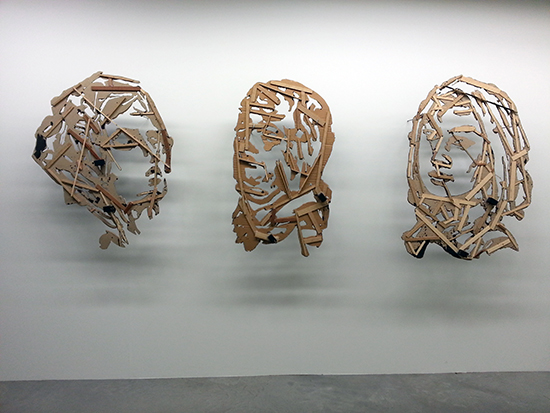
kentridge-prop-backs

William Kentridge, If We Ever Get to Heaven, installation view at Eye Film Institute

kentridge-prop-gallery

William Kentridge, If We Ever Get to Heaven, installation view at Eye Film Institute

The actors form a parade, which starts out with a brass band in ornate dress and dancers. The tone is joyful. I appreciated the combination of expressive looseness and high-production value. The staging of the filming must have been a massive undertaking, yet the props are simple, roughshod cardboard elements. The score, audio recording, and audio playback are very well done, yet the projections do not match up edge-to-edge, echoing the collage-like feeling of Kentridge’s animations.

As the film continues, however, the parade morphs into a darker, mournful procession. The sick push IVs, goaded along by others wearing head to toe plastic protection gear. There are gravediggers carrying shovels. One might think of Kentridge’s work in the context of the fallout of apartheid—something of the past, of a specific nation (though there’s a different resonance in the Netherlands, as South Africa was colonized by the Dutch)—but there are larger narratives, having to do with Ebola throughout Africa, that implicate all of us. More Sweetly Play the Dance is a powerful example of Kentridge’s ability to blend the specific, the poetic, and the topical.

In the exhibition essay, Kentridge is quoted as saying:

Every act of enlightenment, all the missions to save souls, all the best impulses, are so dogged by the weight of what follows them; their shadow, the violence that has accompanied enlightenment.

While I’m not totally comfortable with the futility and pessimism in the statement, it made me think about the Truth and Reconciliation process in South Africa, in contrast with the persistent institutional racism and denial of privilege going on in the US now.

A few asides:

We also went to De Appel Arts Centre, the Stedelijk Museum Bureau Amsterdam (project space) and the Huis Marseille Museum of Photography. Cool spaces, but I personally didn’t connect with the current exhibitions.

Privilege the viewing experience. While I had aspirations to visit the Van Gogh Museum, I just couldn’t bring myself to deal with the long lines and crowds. I’m not interested in elbowing my way into a clear sightline around a famous, expensive painting as other tourists snap photos. It’s too stressful and unpleasant. It’s not a good way to experience a work of art, and I am glad that I know myself well enough not to visit out of a sense of duty only.

I did have the odd feeling of recognizing works from art history books at the Matisse show. The reproduction does detract from the aura of the original, but more so does hype.

Safety first, and all that follows. I really like riding a bicycle but I rarely do. There are too many reasons not to—fear of being hit by a car, truck, or bus; concerns about personal safety after nightfall; poor bike lanes; not enough bike parking; bike theft; and aggressively car-centric attitudes in general. When you eliminate or minimize such reasons, it’s liberating. I enjoyed the integration and espousal of bike culture in Amsterdam during my short stay, and wonder how living in such a bike-friendly place impacts your lifestyle and psyche over the long term. We saw thousands of bicyclists everyday, including parents toting one or more children, and very few private cars on the road. Bike lanes were protected and clearly marked. When lanes are shared, drivers were almost always patient and respectful. A tram stopped to let us cross the street. That feeling of safety is maybe one of the most foreign and novel things I experienced—such a contrast from the outright aggression that cyclists face and have to psychologically armor themselves against when riding in NYC.

This pretty much sums it up. Life's too short to hate your commute.

This pretty much sums it up. Life’s too short to hate your commute.

Standard
Meta-Practice, Research

Returning to the Crossroads: Life as an Artist

Wise words from the sage San Francisco Bay Area based artist Jaime Cortez, via the Congratulations Pine Tree podcast:

“As you go through your artistic life, the basic questions are always the same. How are you feeling about your work? Do you feel like it’s getting recognized and supported? How is your financial picture? How is your courage? And it’s always those variables, but they’re in different measures. You keep coming to the crossroads and the crossroads is always the same one, but every time you come to it, you’re gonna formulate a slightly different answer. Sometimes your courage is very high, but your finances are crappy. Sometimes you’re actually doing OK financially, but other pieces of your creative life are not so great. I think to me being an artist is about re-negotiating the same variables again and again to deal with your changing life, and you have to keep adjusting and re-adjusting and re-calibrating your decisions.”

Jaime Cortez, Congratulations Pine Tree podcast, Episode 19: “Naked Penises and Pine Cones (with Jaime Cortez,” December 28, 2014
Standard
Impressions, Make Things (Happen), The Eve Of..., Travelogue

c3:initiative Residency Day 12 Update

Some things I’ve done, thought about, and seen in the first 12 days of a 17-day residency in Portland, OR.

On Saturday, I installed two pieces from The Eve Of… in the window project space at PDX Contemporary, with a little help from JZ, DH, Caitlin, and James. It’s viewable 24/7 at the corner of NW Flanders and NW 9th.

It’s a satellite of the larger exhibition at Portland ‘Pataphysical Society (‘Pata), which opens Thursday (First Thursdays) from 6-9pm, at NW Everett and NW 6th.

The exhibition at ‘Pata will include new works—four large pieces of handmade cotton rag paper, which I made with the tutelage of Jenn Woodward at the Pulp and Deckle paper making studio thanks to support from c3:initiative. The paper is created for display in the ‘Pata windows, which will also be viewable 24/7.

Make Things (Happen) PSU Assembly brochure page. Illustrations of activities by Kari Marboe & Erik Scollon, Piero Passacantando, and Tattfoo Tan.

Make Things (Happen) PSU Assembly brochure page. Illustrations of activities by Kari Marboe & Erik Scollon, Piero Passacantando, and Tattfoo Tan.

Last Wednesday, I had a chat about Make Things (Happen) in PSU Assembly. It was sponsored by c3:initiative and located at Portland ‘Pataphysical Society. I invited Make Things (Happen) participating artists Lexa Walsh and Julie Perini to present their activity sheets and have a dialogue. Lexa asked me how I felt about shared authorship—I am interested in exploring it, and talked about the creative freedom I tried to offer artists, since I wasn’t able to offer remuneration. This spurred an audience member to ask Lexa and Julie what motivated them to participate. Lexa mentioned that this was a easy extension of an existing project, and Julie explained it’s hard to think of who would fund projects to fight white supremacy.

We also talked about if I’ve met resistance to my work about happiness, and I mentioned how much inspiration I take from Susan O’Malley‘s commitment to make art that is whole-heartedly positive. (At Harvester, I talked about how people can easily underestimate the amount of courage that making art about happiness can require.) Another person asked about where else I’d like to see this project, which reminded me of the last message I got from Susan:

I really think it would be amazing to see this project at the airport or library or DMV or city hall or some kind of public space…..

She was so smart about curation and public space. I should heed her words. These are just one more example of so many bits of wisdom she shared.

Thanks to everyone who attended, and who made it happen: Julie, Lexa, Shir, Erin, Josephine, David, Harrell, and many more.

I made paper before, once, in Nance O’Banion’s Bookmaking class as an undergrad. My memory of it pretty hazy, except for an image of the sheet collapsing as I unsuccessfully tried to “kiss” the wet paper pulp off the mold and onto the drying screen.

A few thoughts about paper making:

It’s technical, but much of it, like in printmaking, is by feel. You screw it up to know where it goes wrong, and then by experience feel when it’s right. For example, you figure out how much retention aid is enough, which you can feel in the softness of the water.

It’s physical. I made four 43×56″ sheets, each comprised of twelve sheets from a ~15×15″ mold. The water’s surface tension provides a good amount of resistance when you pull the mold. You sometimes have to lift and pour big buckets (30-40 pounds). A backache after the first day was all the reminder I needed to use my core and legs on subsequent days.

Oddly, I think having done vinyl signage helps. Though the materials couldn’t be more opposite in many ways—natural vs. plastic, historical or niche vs. ubiquitously modern—the processes share releasing a fragile sheet from one surface to another. It’s about timing and pressure.

It’s pretty magical. There’s no binder. The fibers just stick together. Because it’s very physical and intuitive, it’s a great process for finding flow. Jenn is a great teacher—very knowledgeable, patient, and no-stress. Pulp & Deckle‘s classes and private workshops are affordable. Recommended!

Time management. You might think that artists who are also art handlers will take less time to prepare for and install an exhibition. This is not necessarily true.

1. We can nerd out on details. I built a plinth for a work that usually sits on the ground, and a box for A/V that could just sit a shelf. I’m also sewing light blocks for ‘Pata’s clerestory windows and sheer window coverings to layer behind the paper.

2. It takes time. I underestimated how long it would take me to build boxes and pack my work to ship out here. Yet I work on crews where we do that for several days or weeks at a time. The scale of my work is smaller; but still, in this case, it included two large boxes the sizes of doors.

3. Because you never know when you’ll need to problem-solve. What can go wrong when you’re traveling, using local sources, unfamiliar tools, and new spaces? The patience and generosity of friends and strangers go a long way.


Bathing in the afterglow of the Postcards from America opening at Newspace Center for Photography; it was pretty cool to see dudely big-deals like Alec Soth and Jim Goldberg mixing it up with local subjects (a retiree, a girl named Cherish, a physical therapist who served vets, an advocate for Iraqi refugees) and PSU Social Practice students. The event was part of PSU Assembly. Susan Meiselas‘ project to raise the visibility of VOZ, a worker-led organization to empower immigrant workers is a smart, worthy way to use photography in social practice; limited edition screenprint posters are available to raise funds for printing. It’s super cute and signed by the Portland Postcards from America photogs. I was tempted. I previously thought Magnum was just a hotshot agency, but in a recent talk at Portland Art Museum, they explained that it’s a co-op run by photographers for photographers, and had to find new ways to support the work they want to do.

Yale Union/YU Contemporary‘s new exhibition by Willem Oorebeek. We were only there for a few minutes between engagements, and my largest impressions are of the space (a huge renovated industrial space not unlike Mass MOCA or DIA:Beacon, with beautiful light) and the architect-made exhibition design (2×4 framing on 12″ centers, very selectively sheathed). There were reproductions from magazines, and sheets of glass over rubber flooring with round nubs intended to read as pixels, though I thought of LEDs. There were black-on-black prints (black lithographic prints over a variety of mediums) that had optical or durational effects—you had to stand right in front of them to see them, which was engaging in how it forced an intimate relationship with the image within a massive space.

Woodwork. Borrowed tools from a suspension-tree-house maker named Devan. A 12″ compound miter saw, Skil saw, and compressor and nailer (yes!). Nice blades, smooth sailing. I forgot to pick up clamps, though, so I nailed a 1×2 as a guide wherever I needed it. It hit 92ºF and the patio umbrella was a savior.


Standard
Meta-Practice, Research

many artists who are commissioned by producers are already successful gallery based artists, being brought into the public realm with a support team in place.
The speakers acknowledge the need to change institutional structure in order to allow new forms of public art to emerge, and the need for artists, producers and curators to gain skills to make public art work in reality. Another change that might be interesting to explore is how public art could shift hierarchies, and allow artists at different stages of their career to develop projects they have already initiated.

Katy Bienart, “Lighting the touchpaper: Public art as situation or spectacle,” Public Art (Now) blog, April 27, 2015

Katy Bienart on Public Art (Now)

Quote
​Susan O’Malley, Advice From My 80 Year-Old Self, 2015 // Source: Kala Art Institute.

​Susan O’Malley, Advice From My 80 Year-Old Self, 2015 // Source: Kala Art Institute.

Print Public
May 7 – June 27, 2015

Opening Reception: Thurs, May 7, 6-9pm
Open House: Sat, May 16, 12-5pm
Kala Art Institute, 2990 San Pablo Ave, Berkeley, CA
Plus various events at Kala and the neighborhood

Taro Hattori
Taraneh Hemami
Susan O’Malley
Sue Mark
Swell
Imin Yeh

This is the exhibition and final phase of Print Public, a two-year place-making project along the San Pablo Avenue Corridor in Kala’s West Berkeley neighborhood.

Sights

See: Print Public @ Kala Art Institute, Berkeley, CA

Image