Research

Inverse Flag Designs

I love an inverse flag design.

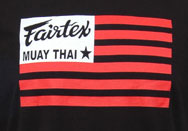
I think it goes back to an old Muay Thai t-shirt design from around 2001. I always felt like I should be better at Muay Thai before sporting the shirt outside of the gym, so I never got it, but I always remembered its wonderfully peculiar use of color….

Designer unknown, Fairtex Muay Thai t-shirt design, circa 2001 (the Clementina Street days).

Designer unknown, Fairtex Muay Thai t-shirt design, circa 2001 (the Clementina Street days).

Black tees are the obvious choice for this audience; yet even with only two colors, the traditional white stripes could have been preserved. Instead, the usually-blue canton (flag-speak for upper quadrant) is white, with the black text knocked out (designer-speak for not-printed).

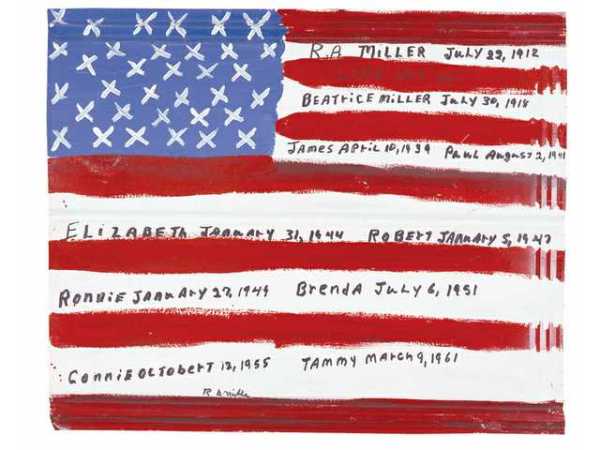
Flag orthodoxy would decree this manipulation of the US flag a desecration. But to me I sort of see it as an immigrant small business’ version of a folk artist’s flag:

R.A. Miller, Miller Family American Flag, enamel paint on tin // Source: GainesvilleTimes.com.

R.A. Miller, Miller Family American Flag, enamel paint on tin // Source: GainesvilleTimes.com.

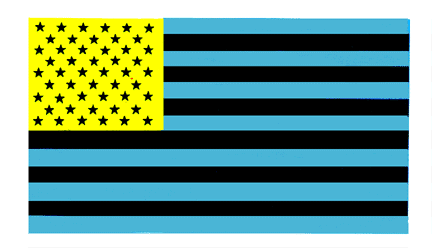
So when I stumbled upon this image, I got very excited:

Afterimage US flag from the Exploratorium. // Source: Exploratorium.edu.

Afterimage US flag from the Exploratorium. // Source: Exploratorium.edu.

Of course, it’s from that world-class hands-on science museum in San Francisco, the Exploratorium. It’s from one of their classic science exhibits on perception—this one is about afterimages. Stare at the image for 15 seconds, then look away to see the US flag in red, white and blue.

Standard
Impressions

NYC Art Itinerary: Wave Hill

Relaxing after a hike in the woods and in the galleries at Wave Hill, Bronx, NY.

Relaxing after a hike in the woods and in the galleries at Wave Hill, Bronx, NY.

Today I visited Wave Hill, a public, NYC-owned garden and art center in the Bronx. It’s one more place checked off on my ongoing NYC Art Itinerary.

As soon as one enters, there’s a spectacular view of the cliffs of the Palisades across the Hudson River. The grounds are not insurmountably huge, but the landscaping is impeccable, and the trails, walks and greenhouses offer lots to explore. 

M and I got there early, and I highly recommend doing the same. We virtually had the place to ourselves for the first hour. It was a lovely change of pace to explore the gardens at our own unhurried pace. We encountered empty gazebos where we enjoyed the serenity to ourselves. Technically we weren’t even outside of the five boroughs, but it felt a universe away from the crowds.

We visited the Glyndor Gallery, which had an exhibition of works by artists in the Bronx Museum of Arts’ Artists in the Marketplace program. The work was all over the place, including abstract installations, brushy paintings, some technically capable and cool photography, sculpture, videos and video installations, and a metal assemblage wall work. The most captivating for me was Elisabeth Smolarz’ $100 project, a 13-channel video installation documenting her visits to every G8 +5 country and seeing how many people she could hire for $100 for one hour, and what they would do.

We also visited the Sunroom Gallery, which is reserved for emerging NYC artists’ solo projects. It’s a challenging space, with two walls of windows, and the remaining two walls made of brick and punctuated with many doors. There are also four skylights. My impression was that the original intended use of the space—to view the outdoors—still dominated the space; the meadow, woods, river, sunlight, and breeze beyond the windows seem to call for the viewer’s attention and pulls one towards a reflective mood.

Standard
Impressions

Claes Oldenburg @ MoMA

Claes Oldenburg: The Street and The Store 
Claes Oldenburg: Mouse Museum/Ray Gun Wing
April 14–August 5, 2013
Museum of Modern Art, NYC

It’s likable. Dive in.

Claes Oldenburg. Pastry Case, I 1961—62 Burlap and muslin soaked in plaster, painted with enamel, metal bowls, and ceramic plates in glass-and-metal case. 20 3/4 x 30 1/8 x 14 3/4" (52.7 x 76.5 x 37.3 cm). The Sidney and Harriet Janis Collection. © 1961—62 Claes Oldenburg. Photo: The Museum of Modern Art, Imaging and Visual Resources Department, Kate Keller. // Source: moma.org.

Claes Oldenburg. Pastry Case, I, 1961—62. Burlap and muslin soaked in plaster, painted with enamel, metal bowls, and ceramic plates in glass-and-metal case. 20 3/4 x 30 1/8 x 14 3/4″ (52.7 x 76.5 x 37.3 cm). The Sidney and Harriet Janis Collection. © 1961—62 Claes Oldenburg. Photo: The Museum of Modern Art, Imaging and Visual Resources Department, Kate Keller. // Source: moma.org.

I’ve found that there are two common ways of responding to Pop art inspired by familiar objects. The first is skeptical: viewers resent low culture intruding in high museums, and/or presume an underlying oppositional agenda when none is proffered. The second response is more open and instinctual; viewers delight in identifying with common objects and enjoy the humor in the familiar made strange.

For me, Claes Oldenburg’s works in The Store are imminently likable. The objects are ultra quotidian: hats, men’s dress shirts with ties, canvas lace-ups, ice cream sundaes. They are rendered in drippy, cragged plaster covered in vibrant gloss enamels. The forms are rough and exaggerated; the effect is both grotesque and comical.

Some of the genius in these sculptures comes from Oldenburg’s selection of common yet iconographic sources. Traces of the early 1960s appear, but do not pervade. For example, the 7-Up logo and other trademarks are obsolete. And I surmise that the preponderance of sundaes may correlate to a midcentury ice cream parlor vogue. But most others objects—such as burgers, shoes, and pants—have not changed much in the past five decades, and they remain current and relatable. Indeed, the shiny enamel is beautifully preserved (or probably, simply durable), and still conveys commerce’s exuberant newness.

Oldenburg’s project expanded the boundaries of art, helping to merge high art and low commerce. The exhibition also makes other equivalences clear too. This is exemplified by a vitrine containing a model plane, a salad, and a man’s hat. It suggests that food and possessions are alike as objects of consumption. They call us with our desire for them and reaffirm us as reflections of our identities.

From a historical perspective, the show allowed ample opportunities to think about zeitgeists and simultaneous developments. Oldenburg’s display cases full of pies (or tartines, created for a show in Paris) recall the luscious frosting-like paintings of Wayne Thiebaud. An oversized wall calendar made of stuffed, sewn fabric numbers brought to mind Jasper Johns’ number paintings. Neither comparisons diminish said works.

Claes Oldenburg. Floor Burger 1962 Canvas filled with foam rubber and cardboard boxes, painted with acrylic paint. 52" x 7' x 7' (132.1 x 213.4 x 213.4 cm). Collection Art Gallery of Ontario, Toronto. Purchase, 1967. © 1962 Claes Oldenburg. Photo: Sean Weaver. // Source: moma.org.

Claes Oldenburg. Floor Burger, 1962. Canvas filled with foam rubber and cardboard boxes, painted with acrylic paint. 52″ x 7′ x 7′ (132.1 x 213.4 x 213.4 cm). Collection Art Gallery of Ontario, Toronto. Purchase, 1967. © 1962 Claes Oldenburg. Photo: Sean Weaver. // Source: moma.org.

Oldenburg’s monumental soft sculptures provide a nice climax for the show. Floor Cone, Floor Burger, and Floor Cakewere designed for a spacious gallery that was meant for the display of luxury cars. This use of scale brilliantly addresses the massive spaces that have become so common today, while remaining totally appropriate to the works (in contrast to many contemporary works’ use of monumental scale to convey power and wealth). These individual portions of dishes at preposterously large scale, in sewn and stuffed painted canvas, exude comfort and welcome. They suggest an invitation to play, if not literally, than imaginatively. Taking a nap on one might be an entirely reasonable way to relate to it. I appreciated that these floor-specific works were actually exhibited on the floor, not on white plinths that keep viewers at bay. The Street, in an adjoining gallery, is installed this way, with ample space, which formalizes the seemingly-abstract cardboard shapes and seems remote from the original inspiration—colorful 1961 Lower East Side. The works fall flat in a disappointing compromise between a lively street-level feel and the MoMA’s staggeringly-trafficked museum needs.

Also on view are Mouse Museum and Ray Gun Wing, two exhibition halls housing found, readymade and created objects, developed for Documenta in the 1970s. The wall text explains that Oldenburg demonstrates an equivalence between creating and collecting. The installation seemed to reward prolonged viewing. The more you look at dissimilar objects, such as the children’s toys, sex toys, gloves, and food sculptures in Mouse Museum, the more similarities you’ll see. The longer you look at similar objects, such as the gun-shaped things in Ray Gun Wing, the more acute the differences become. A brief look was like an insight into Oldenburg’s thought process. But the nature of the long queues for these structures at MoMA made it seem indecent to linger for long.

Oldenburg’s plaster-and-enamel sculptures of everyday commodities has been an important reference point for me for several years. They signal a way to think about merging art and life, embracing the everyday non-art materials and subjects around us, and the viability of artist-initiated exhibitions (Oldenburg exhibited The Store as an immersive installation in his studio). MoMA’s and Museum Moderner Kunst Stiftung Ludwig Wien’s decision to exhibit precisely these seminal works is a testament to the mandate of these collecting, preserving and presenting institutions, for which I am grateful.
Standard
Research

notes on things: politically incorrect maps

This week’s Ethicist column (“Map or Menace?” by Chuck Klosterman, New York Times, July 5, 2013) offers an interesting opportunity to consider the neutrality of objects, via a vintage map of Germany in 1937 for possible display in a living room.

I would argue that the artifact itself should be neutral, yet its display is freighted with associations that are not. How much meaning is imparted by the artifact, and how much by its display?

Consider the paradox:

There’s no ethical responsibility to avoid offending people who manufacture personal meanings.

I appreciate that Klosterman acknowledges that meanings are superimposed by viewers upon objects here, echoing artist Haim Steinbach’s The Object Lesson course centered on show-and-tells of the same objects every week (The Artist’s Institute describes how students learned that “analysis hinged on their own projections and desires”).

Yet:

If you deliberately present an image that is prone to misinterpretation, you have to accept the consequences.

…perhaps presenting an opportunity to map an overlap between the home’s “symbolic ecology” (as described by psychologist Mihaly Csikszentmihalyi) and group social relations. The symbolic ecology reminds residents of who they are, what they’ve accomplished, and what they aspire to do, yet it also conveys these identities to visitors. What we own and display tells others about who we are, even from within the safety of our own domestic museums of the self.

Standard
Research

Recommended: Marcia Tucker’s A Short Life of Trouble

A Short Life of Trouble, by Marcia Tucker (2008)

A Short Life of Trouble, by Marcia Tucker (2008)

In addition to apologies for forgetting who he/she is, I owe huge thanks to whoever recommended Marcia Tucker’s memoir, A Short Life of Trouble (2008) to me. I’m over halfway through and already regretting the diminishing number of pages left to enjoy.

The redoubtable curator’s early life was full of adventure and anguish. There are parties in downtown NYC, a cross-country motorcycle ride, overseas romance, upstate escapes, and day jobs assisting mad artists. Later, she funnels her passion into a curatorial career as the first female curator ever hired at the Whitney Museum of American Art.

Her activism as a feminist and the courage and aplomb with which she challenges sexism in the art world is inspiring and encouraging. It’s also a great reminder of the brevity of contemporary art history—that the institutions that seem dominant today have really been shaped by key individuals that are still active now, and these individuals aren’t the ubiquitous blue-chip male brands you typically think of.

Tucker writes in a cut-to-the-chase style fitting for her unstoppable determination and remarkable work ethic.


I highly recommend A Short Life of Trouble to artists and curators alike, especially those interested in how to live and work in fifth gear, regardless of gender. Young art and curatorial students may find the story of how Tucker realized that she was a curator, not an artist, especially useful.


Standard
Research

looking at art, on whose terms

It seems coincidental yet fitting that after filtering through the Frieze Fair for things I could use (materials, techniques, displays) and coming away with an unimpressive whole, that I should stumble upon this bit of wisdom:

When I first started going to [artist’s] studios, I was looking for work that met my own terms, even if I couldn’t quite define them. But after a while, I realized that I was approaching the whole enterprise from the wrong end. I needed to find out what the work’s terms were, and then see if I could stretch my understanding to meet them.

(from the prologue of Marcia Tucker’s A Short Life of Trouble, 2008)

Indeed, objects I make are often seen as the results of my efforts. But moreover, the ultimate results I seek to create are the internal and external experiences that unravel, visually and conceptually, over time.

[Thanks, CLF, for the recommendation.]

Standard
Impressions

Frieze Art Fair: 2013 prowl-through

N and I were able to attend the Frieze Art Fair thanks to O (whose pass spared us each $42 entrance fees). I convinced her and M that the cross-Triboro Bridge walk would be lovely. It was, but I neglected to consider that once we got to the fair we’d be on our feet another 2.5 hours. Weary-legged and short on cash on an island where a bottle of water costs $4, I had little time or attention to really engage the artworks.

(When I used to go on long runs, I’d carry hydration and fuel—AKA water and snacks—with me. I should have the same mentality when visiting fairs can take as long as an endurance race.)

Mostly, as in past fairs, I looked at methods of display, uses of materials, and forms related to upcoming projects—which now are banners and textiles.

Andrea Bowers, in both booths housing her work, shared this useful statement that sheds light on Frieze’s use of non-union labor. (One thought about the lack of mass response to OWS Arts & Labor’s call might be attributed to this: NYC’s unions are very active in picketing non-union business. In fact, it’s common enough that one might see the inflatable picketing rat a few times a week. New Yorkers just keep walking.)

Bowers’ drawings on cardboard of Victorian icons of liberation were quite lovely, and much looser than her photo-realist graphite drawings, interestingly.

Open letter from Andrea Bowers regarding Frieze's use of non-union labor.

Open letter from Andrea Bowers regarding Frieze’s use of non-union labor.

Photolithographic etching on copper-clad plastic by Sam Lewitt at Miguel Abreau Gallery (NYC). Having just worked on a vinyl sculpture, I thought this way of displaying floppy plastic was really smart.

Photolithographic etching on copper-clad plastic by Sam Lewitt at Miguel Abreau Gallery (NYC). Having just worked on a vinyl sculpture, I thought this way of displaying floppy plastic was really smart.

Handmade crochet by Servet Kocygit at Rampa (Istanbul). This is just pretty and in-your-face. Though I'm not sure what it means, I thought it was useful for thinking about how to frame textile text works. The crochet looks like it was treated with a glue, such as a matte medium, and pinned in place to a (removed) substrate, so it lays flat. The substrate it's now on is a woven fabric.

Handmade crochet by Servet Koçyiğit at Rampa (Istanbul). This is just pretty and in-your-face. Though I’m not sure what it means, I thought it was useful for thinking about how to frame textile text works. The crochet looks like it was treated with a glue, such as a matte medium, and pinned in place to a (removed) substrate, so it lays flat. The substrate it’s now on is a woven fabric.

Cameron Platter's monumental wood text at Whatiftheworld/Gallery (Cape Town). Another puzzle in terms of content, and yes, the scale suits the obviousness of fairs. But it is pretty smart to appeal to people's love (or fetish?) of wood type, and use condensed gothic typography.

Cameron Platter‘s monumental wood text at Whatiftheworld/Gallery (Cape Town). Another puzzle in terms of content, and yes, the scale suits the obviousness of fairs. But it is pretty smart to appeal to people’s love (or fetish?) of wood type, and use condensed gothic typography.

Amir Mogharabi at Ibid Projects (London). Things. On shelves. This is like a little poem, with mother-of-pearl.

Amir Mogharabi at Ibid Projects (London). Things. On shelves. This is like a little poem, with mother-of-pearl.

Maybe the collection of works where I could have spent a lot more time and gotten a much richer experience: Catherine Sullivan and Valerie Snowbeck's installation of texts on laminated fabrics and sculptural works at Galerie Catherine Bastide (Belgium). The materials and typography were so unusual, and I suspect the works told a well-conceived narrative. I regret the momentum that propelled me to march onward, instead of lingering and looking more closely.

Maybe the collection of works where I could have spent a lot more time and gotten a much richer experience: Catherine Sullivan and Valerie Snowbeck’s installation of texts on laminated fabrics and sculptural works at Galerie Catherine Bastide (Belgium). The materials and typography were so unusual, and I suspect the works told a well-conceived narrative. I regret the momentum that propelled me to march onward, instead of lingering and looking more closely.

Lily Van Der Stokker's installation at Kaufman Repetto (Milan). This is just kooky and happy. The chest in plaid is so humorous. In working with fabric I've been wondering how to distinguish my work from craft—more specifically, something crafty, cute and consumable from Etsy. Van Der Stokker seems to tackle this distinction head-on with these works. What makes a painting on canvas art, a textile design, and a painting on a cabinet any less a painting?

Lily van der Stokker‘s installation at Kaufman Repetto (Milan). Kooky. Happy. The chest in plaid is so humorous. In working with fabric I’ve been wondering how to distinguish my work from craft—more specifically, something crafty, cute and consumable from Etsy. Van Der Stokker seems to tackle this distinction head-on with these works. What makes a painting on canvas art, a textile design, and a painting on a cabinet any less a painting?

Mmm, banners. Matthew Brannon's banners at David Kordansky Gallery (NYC). With their stylish design, Brannon's screenprints on paper were always charming; it's interesting to see larger works in textiles that are also a bit more open-ended.

Mmm, banners. Matthew Brannon‘s banners at David Kordansky Gallery (NYC). With their stylish design, Brannon’s screenprints on paper were always charming; it’s interesting to see larger works in textiles that are also a bit more open-ended.

I like Peter Liversidge's conceptual practice. His work appears in a lot of fairs, but every project is unique to the fair, which makes the encounter a little more special for audiences. Liversidge typed the letter at left describing the work to be produced, adjacent. That this type of conceptual practice still exists is great. The fact that it appears commercially viable is interesting; it's one of those questions that perhaps better remains unasked. At Sean Kelly (NYC).

I like Peter Liversidge‘s conceptual practice. His work appears in a lot of fairs, but every project is unique to the fair, which makes the encounter a little more special for audiences. Liversidge typed the letter at left describing the work to be produced, adjacent. That this type of conceptual practice still exists is great. The fact that it appears commercially viable is interesting; it’s one of those questions that perhaps better remains unasked. At Sean Kelly (NYC).

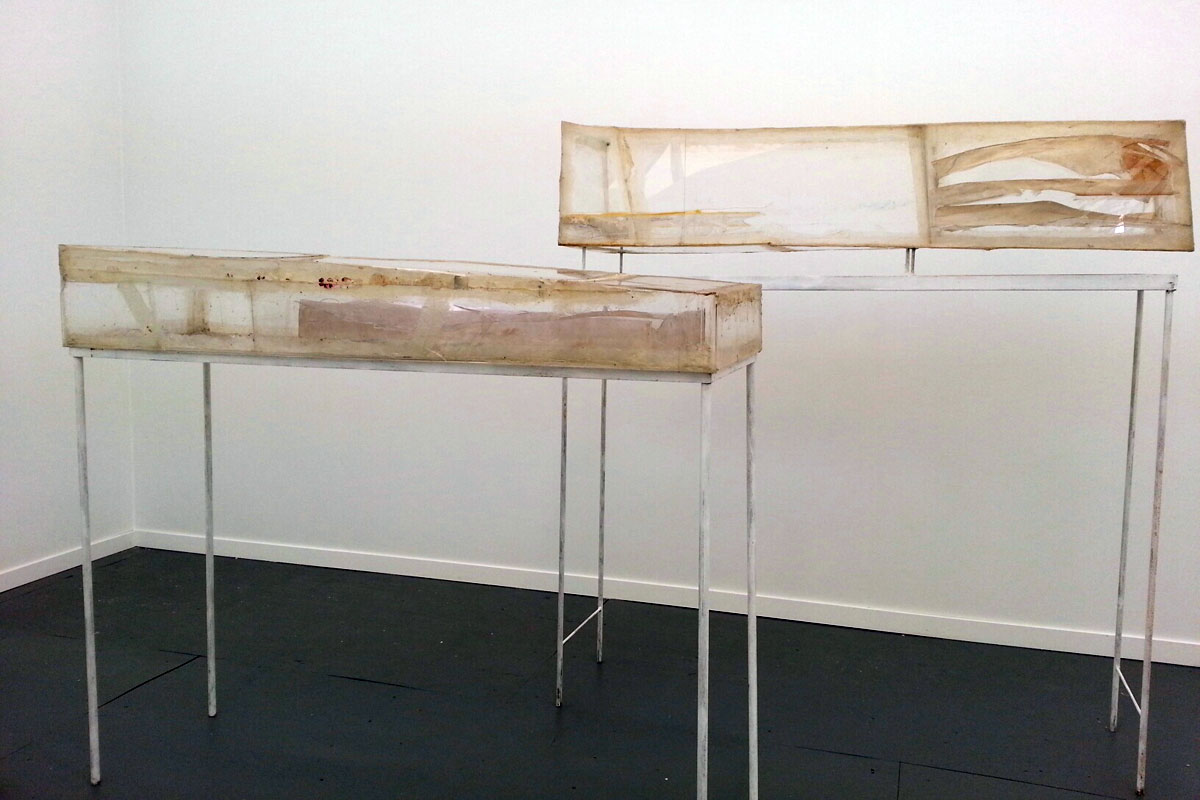
Rudolf Polanszky's vitrines of decrepitude at Ancient & Modern (London). These, on purely emotional levels, worked for me.

Rudolf Polanszky’s vitrines of decrepitude at Ancient & Modern (London). These worked for me, formally and emotionally.

Standard
Sights

notes on things: from The Intelligence of Things, Parsons 2013 MFA curatorial statement

For a growing number of contemporary artists and thinkers, the ontology of objects has prompted new investigations and modes of making. Perhaps in reaction to the dominance of screens and images in our daily life, artistic practice has embraced the object-as-thing: estranged, powerful and physical…. …objects become ciphers for memory, desire and fantasy. Far from simple gestures, thethings in these works articulate their place as icons and bodily analogs, and as protagonists in interiors, architectural spaces and the scope of history.

The exhibition privileges the role of the displayed objects over any overarching curatorial concept. As a title The Intelligence of Things both emphasizes this approach and illuminates these artworks’ powerful effect and affect. That is to say that following Kant’s purposeful purposelessness, these artworks upend our notions of a thing’s effect or intent, and each one has a particular character, demeanor, and accent—whether fierce or foppish. …The exhibition and the works therein, rather, critically explore how things and human subjects together produce meaning in the world.

(Source: Art & Education)

Standard