Activist Imagination, Community

random and rad

From e-Flux:

kempinas tube
Zilvinas Kempinas.
Tube, 2008
Installation view, Atelier Calder, France

Žilvinas Kempinas will represent Lithuania at the 53rd Venice Biennale of International Art

fourfold program
by elizabeth travelslight

chinese new year in daly city: dim sum + polvoron

“I think for some reason we are unwilling to honor people who are politically active. We want to honor people who just have had enough and sort of spontaneously won’t take it any more. But somehow if they get categorized as active citizens, … then somehow it becomes self-serving, part of a movement which we’re less comfortable with.”

Tim Tyson, scholar, in a great segment on Rosa Parks

“Tabula Rosa”

On the Media, NPR, January 23, 2009

The strange history of lorem ipsum (5:15)
Alex Gallafent, The World, PRI, January 26, 2009

Standard
Art & Development, Community

love it/ hate it

Love it:

“The Big Three,” the current exhibition at Rosenthal Gallery, features the work of 18 artists, though the title could be written for me, since three of my classmates from CCA (MFA 07) are in it: David Gurman, Renee Gertler and Erik Scollon.

Scollon continues his series of life-sized fist-shaped cast ceramic sculptures. The new sculptures are all pushing the boundaries of domestic kitsch, featuring the sort of rose patterns you’d find on linens at Ross. While some of his past blue-and-white fist sculptures were ironic and cool, these would especially great atop crocheted doilies.

The always-meticulous Gurman shows a dyad of photographs sourced from government agencies. I wasn’t able to get through his verbose statement at the packed opening, but I appreciate his conceptual rigor as an artist working with found photos, a process that can lend itself towards emotional, intuitive interpretations.

Gertler contributes goodie-bag assortment of odd forms in aluminum foil, painted paper mâche, “DO NOT EAT” silicate pebbles, balsa wood and other unidentifiable scraps. It’s a kind of joyous formalism — humorous, humble and a bit nerdy. As an artist struggling with how my work fits in the world and the market, I really appreciate Gertler’s commitment to making impertinently impermanent art.

Love it, too:

Good coincidences. I realized yesterday that I should look into getting a bank of LEDs for an upcoming project. Guess what came in the mail today? The new Jameco catalog! Sweet!

Hate it:

What I’d add to The Onion‘s “Things We’re Barely Tolerating This Week”:

Michael’s, the craft store. Despite its new logo and cutesy interior design, its biggest problems persist: crap customer service (No wonder the cashiers give customers attitude! I heard two surly teenage slackers give the manager lip today.) and heavy-handed mark-ups (A 10 oz jar of Armour Etch, a wonderful and frighteningly caustic cream used for etching glass: $27.99. At Long’s in Oakland, you can get a jar with 2 more oz for $4 less! As Woff says, “Long Live Longs.”)

Standard
Art & Development, Community

LA Art Trip 2008

Four days.
Five museums.
Thirty-five galleries.
I saw innovative, fresh exhibitions in museums, and only a few ambitious shows in galleries. Many galleries were closed for the holidays, though a few have folded since my last visit a year ago (too bad, I really liked Anna Helwing’s gallery).

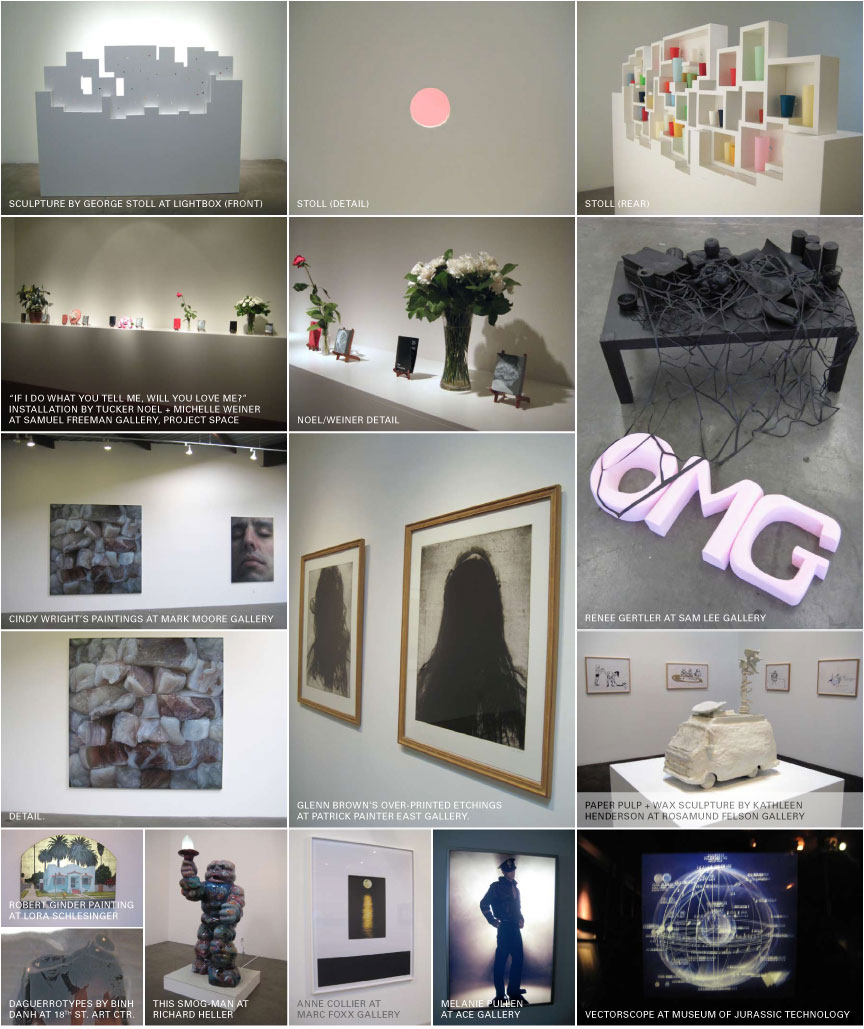
Click on the image below for a larger view. It’s a big file, give it a sec.
la_art_trip_photos

High points:

1.
California Biennial
Orange County Museum of Art

A fantastic show that counterbalances a surprisingly pointed emphasis on war and borders with utopic, phenomenological experiments. Curator Lauri Firstenberg pulled off a multi-site show featuring many excellent artists of color and women. I saw the museum show, the site of work by only about 30 of 50+ artists. I really enjoyed the work of Erica Vogt, whose small-scale projector-based installations were intimate reflections on media as framing devices. Mike Arcega‘s installation of two-by-fours looked great, and worked well sited near the port of Long Beach, as did Jebediah Ceasar’s 4x4x8’ polyurethane block. Anna Sew Hoy‘s site-specific sculptures for a dance performance were Isamu Noguchi-esque and a little cuddly. Justin Beal presented an intriguing installation of objects, furniture and wall-based works at the intersection of industrial production and war profiteering. Daniel Joseph Martinez‘ installation with an animatronic human figure was cold and discomfiting, effectively conjuring (for me) our complicity in acts of torture. Jordan Kantor and Mark Hagan both present satisfyingly odd, brainy paintings. (If commercial galleries only exhibited drawings and paintings as thought-provoking as Hagan’s and Kantor’s, gallery goers would be spared so much mediocre art!) Edgar Arceneaux‘s installation of shiny things, broken mirrors and haphazard projectors looked like a set for a Pink Floyd video, while his video reminded me of Politics of Rehearsal, Francis Alÿs’ show at the Hammer Museum. Arceneaux’s search for meaning seems highly provisional, reflecting the times’ uncertainty. In the same vein, I found Amanda Ross-Ho‘s excised studio walls — assemblages of found objects upon found marks — a little too totemic for my tastes, but I could appreciate the inward-looking search for authenticity, especially as institutions are crashing down all around us.

2.
Other People: Portraits from Grunwald and Hammer Collections
Oranges and Sardines
Gouge: The Modern Woodcut 1870 to Now
Armand Hammer Museum

I like the Hammer a lot. My current investigations don’t overlap with any of these shows’ themes — woodcuts, new abstract painting, and portraits — so it’s a testament to the institution that I found all of these shows elucidating, richly textured and curatorially interesting.
Other People mixed contemporary and historical portraits. It was a treat to see 400-year-old engravings by Dürer next to narrative photographs by Wolfgang Tillmans and Catherine Opie. I also really liked Mike Mandell‘s baseball trading cards featuring photographers. The photos are dorky and fun, and a little bit cringe-worthy like Mike Smith’s photos.
In Oranges and Sardines, six contemporary abstract painters selected art to hang alongside one of their own works. I’m not crazy about Wade Guyton’s inkjet prints on canvas, but his selections — which included a light by Dan Flavin, a stage for a go-go dancer by Felix Gonzalez-Torres, and a photograph of a hammer, sickle and slice of pizza by Andy Warhol — were sensational and funny, and they inspired a new look at his work. Oranges and Sardines is a great chance to see painters’ points of references firsthand.
I’m familiar with woodcuts, but I still enjoyed many surprises in Gouge. Indian prints from the late 1800s were endearingly stylized; they seemed to be evidence of early modernism’s appropriation of non-Western visual languages. I was amazed by a detail of Thomas Kilpper’s ambitious project, “The Ring,” a woodcut made from a 4,000 square foot parquet floor. I also found Christine Baumgartner’s engraving-style woodcuts based on video surveillance satisfying in its visual and conceptual integration. And Edvard Munch’ timeless variations on the Kiss (see image) were moving as always.

3.
Anne Collier
Marc Foxx Gallery

Really nice photos about photography / framing framed things like albums, prints, works of art. It’s a tight grouping of images that compels the viewer to construct a narrative from these disparate, but beautifully made and installed, images.

4.
Violent Times
Melanie Pullen
Ace Gallery

Ninety-five massive prints and lightboxes feature models dressed as soldiers in action. The show is a sexy indictment of the valorization of youth, masculinity and war.

5.
Ambitious programming, like Rain Field by Jake Lee-High at Fringe Exhibitions, and Nail to Nail by Darren Almond at David Patton Projects
Honestly, I’m most impressed by the scale and ambition of these works. Lee-High presents a 117-channel audio and weather installation in nearly complete darkness. Almond presents a beautifully-shot, comment-free documentary-style video of a worker mining sulphur in Indonesia. The work is interesting and good, but considering that most galleries of this size are content with simply putting pictures on the walls, I especially admire the galleries for committing to this risk-taking art.

Low points:

The Grapevine was closed due to a severe storm, forcing us to take a lengthy detour to Highway 101. The drive takes twice as long as it should have.

A disgustingly artificial tea. I asked for an unsweetened chai and receive a drink loaded with “No Sugar Added®” sweetener. The English language is being supplanted by branded corporate-speak.

Standard
Community, Values

DIY, DDIY

I was pleasantly surprised by how much I liked the installation-in-progress by resident artist Daniel Nevers at Southern Exposure. His project involves accumulating and configuring ready-made materials purchased from Home Depot.

Before I saw the work, I suspected that I’d miss a sense of intervention or critique, as Nevers’ Home Depot transactions do not disrupt manufacturing or retail business-as-usual. But then again, artists still get their paper and plaster from somewhere — Home Depot may be a more notorious multi-national big box, but it doesn’t mean that Dick Blick or other chains are any better.

Nevers is interested in “DIY as the new self-help.” I didn’t see the introspective, psychological layers to the work in my quick walk-through; perhaps I was too dazzled by so much new and shiny merchandise, which is reminiscent of the work of Jessica Stockholder.

Nevers’ installation inhabits nearly every cubic foot of the storefront gallery. Liminal spaces are framed by 2x4s and sealed behind plastic sheeting. Mounds of orange extension cords on the floor are visually attractive — sensuous, even. A screen seamed with blue-green cable ties makes a 3-D fringe, and plunger heads outfitted with tiny light bulbs form beacons on the windows. Expanding foam overflows its container, lending an oozing, vegetative quality. Visitors have to find their own narrow paths through this crammed-to-the-gills installation, and every corner reveals more unexpected colors and patterns. The effect is like walking inside an overgrown window display. Through Nevers’ comically exaggerated accumulations and arrangements, the recognizable household items — push-brooms, sawhorses — outshine their mundane identities.

Recent Headlands Center for the Arts resident David Moises also uses consumer-grade appliances and tools as foundational materials in his work. Moises, though, intervenes in the objects’ functions to create viewer-interactive kinetic works, such as gasoline-powered hobby horses. He spoke about his interest in examining a tool’s potential, like liberating a bumper car from its electric floor.

Lisa Anne Auerbach‘s manifesto, “DDIY: Don’t Do It Yourself” (Journal of Aesthetics and Protest, #6), directly critiques DIY as co-opted by corporations and lifestyle magazines. In keeping with the manifesto style, the premise is indicting, the tone hyperbolic. Auerbach proposes “Don’t Do It Yourself,” which sounds a lot like the original spirit of DIY, with the revisions of hiring professionals when appropriate and trading services whenever possible. DDIY “is un-commiditized, barter-based, community-crazed and liberating.”

I have shared Auerbach’s disgust at the ridiculous extent of DIY ubiquity (e.g., God’s Eyes, the pre-school age appropriate art activity, on the cover of Readymade Magazine), and the marketing of rudimentary creative trends like scrapbooking.

As an artist and freelance graphic designer, I also agree that expertise should be valued accordingly. But though bartering can be fruitful, I think it’s an alternative to monetary compensation that should be carefully negotiated and never presumed. (Until the day landlords and HMOs accept payments in home-baked bread or knit hats, independent contractors should be spared the indignity of defending the value of their services.)

At the same time, I see nothing wrong with DIY. My parents rototilled their own land, sewed their childrens’ clothes and repaired their own home. But they didn’t call it DIY; it wasn’t a fashion or political statement, or a way of demonstrating indie community values. Their way of life has been largely abandoned because of marketing and consumer culture, true, but also due to affluence and de-skilling. Auerbach hopes to reclaim creativity and skill-building, but she disdains DIY-marketed products. But rejecting consumer culture — including DIY-marketed products — is as easy as it’s always been: shop less and do it yourself more often.

Standard
Community

Erlich, Chen

Hair Salon is a mirrored installation by Leandro Erlich at the Singapore Biennial — but it uses no mirrors. Brilliant! The work’s investigation of the “mutability of perception” strikes a chord with me (see my work in Activist Imagination). It’s funny how much this piece reminds me of Mario Ybarra Jr.’s New Chinatown Barbershop installation, yet with totally different aims.

See pics and read more in a write-up by Fumio Nanjo for Universes in Universe.

Also, an unsung hero gets some recognition… Edward Guthmann wrote up a nice profile of one of the most respected, intelligent, hardworking artists and exhibition-producers I have the good fortune of knowing and working with. Check it out at “Kevin Chen’s job: to make sure show goes on,” S.F. Chronicle (October 2, 2008)

Standard
Community

brilliant!

tomorrow is for those who can hear it coming, Julio Cesar Morales‘ current exhibition at New Langton Arts, is brilliant, literally and figuratively. I’m very inspired by how buttoned-up Julio keeps his big video / photo / neon installations. The content is really fantastic — the intersections of Mexican/settler cultures in early California, spelled out in a sequence of images that alternate between tantalizing and visceral. The costumes and decor are spot-on; the cinematography in the video’s is beautiful, quality HD. Very impressive! Congrats to the artist and the non-profit New Langton on such a beautiful exhibition.

And congrats to the latest artist-recipients of the Macarthur “Genius” Grant, including current Headlands AIR, Walter Kitundu, one of the most unconventional artists in the Bay Area, and one of the humblest people around.

Both of these artists are persistent (Walter sold his jeep — which was once his father’s — to fund his Icelandic residency a few years back) and generous (Morales runs an artist-run space and shows often at non-profits; Walter also shows at non-profits like the Luggage Store, performs music, and works at the Exploratorium). So it’s great to see these artists get their dues. And it’s nice to have two more reasons not to worry about being under-the-radar in the Bay Area or showing in non-profits.

Standard
Community

art on Mrkt St

Jenifer Wofford, artist, teacher, friend and Galleon Trade mastermind, is gracing Market Street with Flor de Manila y San Francisco, a new graphic novel, with help from the SF Arts Commission. The preview photos look great! So nice to see public art relevant to the area. Can’t wait to see them in person. Here’s a sample!

Standard
Community

review: APAture

This year’s APAture exhibition at Kearny Street Workshop is different, and you can tell right away.

APAture is Kearny Street Workshop’s juried annual multidisciplinary arts festival. I’ve been involved in past APAtures and KSW, so this will be part review, part proud stock-taking of how far KSW has come.

It’s tighter and more focused, with fewer artists, more work of a higher caliber, and more professional exhibition strategies. The result is less misses and more hits. Cheers to everyone for making it all happen: for putting in the work, but also being brave enough to break from tradition and raise the stakes.

Past shows have leaned heavily towards emerging art, and, for lack of a better term, “Asian America 101” art. In this show, some work dealt with identity issues, but the overall show was much more contemporary in tone. Short artists’ statements on the wall labels helped to convey the artists’ intentions and broad range of investigations.

Here’s what caught my attention:

dinesh_perrera

Prints by Dinesh Perrera

Dinesh Perrera’s screenprinted revisions of Art Nouveau-style Ceylon Tea posters are beautiful and demonstrate stylized drawing skills, but I’m not convinced that they fulfill their stated mission “to recontextualize Sri Lanka’s tea industry from being a British luxury import to a product that is integral to Sri Lanka’s cultural identity.” The artist swapped out Mucha’s fair-skinned feminine beauty for a Sri Lankan feminine beauty. In place of romanticized botanical motifs, tame elephants and critters serve The Lady tea in dainty teacups and saucers. The idealized Western images and their corresponding values — leisure, afforded by wealth — have too much of a presence, and the posters still function like ads, inspiring class aspirations, but with modified cultural symbols.

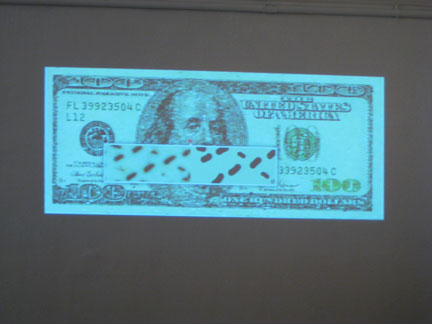
Projected interface for Takashi Kawashima's Ten Thousand Pennies project

Projected interface for Takashi Kawashima's Ten Thousand Pennies project

I was really amused by Takashi Kawashima‘s Ten Thousand Cents, a participatory project in which he contracted, at the cost of one penny each, drawings of tiny fragments of a $100 bill. He reassembled the drawings to form a counterfeit image, and developed a really cool, simple interface that allows viewers to click on a pixel and see the original fragment side-by-side with a video of the drawings-in-progress. Kawashima’s project is complicated and yet cleverly circular (the labor costs were $100, and the participatory process is mirrored by interactive viewing), with a straightforward display.

Viewer in Amy M. Ho's Beyond II

Viewer in Amy M. Ho's Beyond II

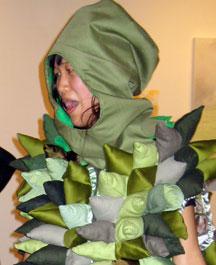
Amy Ho presents a ceiling-mounted mirrored box full of cut paper that resembles leaves of grass. Viewers ascend a ladder to insert their head and see an infinite room. It’s difficult not to associate this experience with Misako Inaoka’s room-sized installation currently on view in Bay Area Now at YBCA. Inaoka’s dropped moss ceiling was interrupted with small dome-like portals to take in animated sculptures, sounds and even a view of grass. It’s an unfortunate but inevitable comparison. I was also puzzled about the placement of the box, a few feet away from an actual skylight in KSW’s ceiling. This was made up for, though, in oodles of surprise and delight when the artist appeared in a handmade durian costume.

Is that a durian costume? You bet!

Is that a durian costume? You bet!

Detail of a work on paper by Weston Teruya

Detail of a work on paper by Weston Teruya

Weston Teruya is the Featured Artist in the show, and he contributed two collages/works on paper. Teruya’s work is always fantastically well-made. His imagery are piles of junk — chairs, rubbish, coolers, ladders — in what seems to be the middle of a hurricane. Flying objects may seem fanciful, but given the tumult in the world these days, the images strike a chord with the nervous sensation of impending collapse.
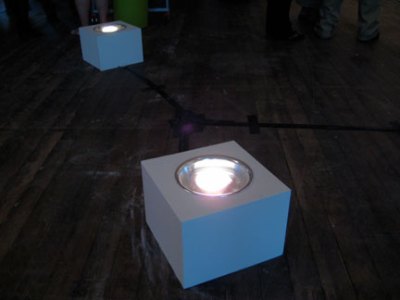
Custom lighting appliances for Mark Baugh-Sasaki's sculpture

Light-boxes for Mark Baugh-Sasaki's sculpture

Mark Baugh-Sasaki makes sculptures that literalize the awkward tension between nature and industry. His hanging sculpture of two naked tree boughs mechanically splinted together is more subtle and poetic than previous works, but I’m an admitted light bulb nerd, so sue me if I was fascinated by his custom designed lighting fixtures: clamp lights embedded in low pedestals. The geometry of it all (square-circle-circle) and unexpected surfaces were just nicely weird and matter-of-fact; no illusions or pretenses. The bulbs were slightly menacing when you realized how much current passes just under the glass at foot level…

Another artist contributed a narrative photographic triptych, but she sort of approached-me-but-not before I could snap my note-taking photo of the wall label. I have seen women-in-costumes-in-the-forest photos before, but there was something ironic about these staged images that I wanted to hear more about. So I asked her. In a very brief, cagey conversation, I learned that the photos were “about race and gender.” She recasts herself as the shining prince in the fairy tale, but I was less than charmed by her reticence in person and in the exhibition materials to contextualize her work or motivations.

Barbara R. Horiuchi’s aluminum panel is basically an abstract painting, but even I found its visual drama breathtaking, and found it even more curious after learning about the strange materials behind it.

Standard