Art & Development, Community, Travelogue

Late Summer, Cross-Country Points of Reference

I’ve just crossed the country from San Francisco to New York by car. That’s three thousand, eight hundred miles in 14 days: camping, sightseeing, a few gallery visits and more than a few BBQ meals. The experience increased my appreciation for friendliness, waving at strangers, America, the grandeur of the West, the rich musical history of Tennessee, the quaint main streets of the lush Eastern seaboard—and most of all, the astounding diversity. I love that so many people can epitomize being American, while freely espousing indigenous, foreign, and home-spun cultures without a sense of paradox. From West to East, a few of my strongest visual impressions:

Dockside with Friends
Lake Merritt, Oakland, CA

A gathering of friends on a beautiful July evening at sunset. Celebrating friendships and the blessed life I’ve enjoyed since moving to Oakland in 1994.

landscape with road, arizona
The West
I’m California-born and raised, but I haven’t really seen the “West until now. It’s stunning. My fears that the world is crisscrossed with interstates and civilized with Walmarts are not completely warranted. The drive from Las Vegas, N.V. to Santa Fe, N.M. showed me that much of the West is still wild; the dramatic red bluffs are nothing short of breathtaking. I snapped some pics, but they fall terribly short; you have to be there to experience sense of scale and grandeur.

Santa Fe paper mache
Santa Fe, New Mexico, America
M and I played tourist in Santa Fe, seeing sites in the historic downtown (and crashing a church festival for some G.O.A.T. carne asada tacos). Santa Fe is gorgeous, scenic, historic, and bursting with culture. Tons of visual art, Native American art (so many images from art history classes come to life: black-on-black pots by Maria Martinez, squash blossom turquoise-and-silver-necklaces), Spanish colonial architecture, and fun stuff like Native American papercuts, paper machê crafts, and—yes, ya’ll—Southwestern regional woodcut artists (and why not?). Our brief visit was far too short; I was struck with the feeling that I could easily spend more time there. So I’m putting it out there, Universe: Have Me Back To Santa Fe.

The Dissolve: SITE Santa Fe’s 2010 biennial
Santa Fe, NM

A strong show of videos made and manipulated by 30 contemporary international artists, including biennial-circuit usual suspects (Kara Walker, Paul Chan, William Kentridge) and more. Thomas Demand’s video of raindrops hitting a glossy concrete floor is another impressive feat of stop-motion paper animation, very sweet in its mundanity. Robin Rhode’s short video in black and white, largely about inversions, race and light, is another favorite of mine. I just didn’t have time to see the whole show (which would have taken days), but many of my impressions were influenced by the forceful exhibition design, for better and worse. The first room successfully featured scrims dividing roughly equal-sized screening rooms.* But the exhibition design of later rooms overpowered the ther works. The light and audio seepage in the cyclorama-like oval were missteps, as was the integration of solo viewing booths into a bench in theater with one dominant screen. The experience was unpleasantly akin to screen-in-screen browsing; I could focus on neither screen in front of me. I think this kind of overwhelming media experience is fine for solo shows, but in a group show, it shafts the artists who’ve drawn short straws. It’s a strong curatorial statement to feature 30 videos, and it would be a challenge to any institution, but you have to wonder what the architects were thinking. SITE Santa Fe had some flaws but it was energetic, now, and smart.

Who Shot Rock & Roll?: A Photographic History, 1955 to the Present
Brooks Museum, Memphis, TN
Organized by the Brooklyn Museum with guest curator Gail Buckland

Who Shot Rock & Roll is a large, highly enjoyable exhibition of photographs of rock and pop musicians from the last half-century. The celebrity, glamor, pop culture, and sensationalism appeals. Those who dig deeper will find insightful captions about the technique, ingenuity and chance that went into the making of the famous photographs. Having spent my fair share of adolescence studying trippy album covers, I also appreciated the didactic texts and displays about the surreal, pre-Photoshop images by artist-designer Storm Thorgersen and Jean-Paul Goude (of superhuman Grace Jones, natch).

Hatch Show Print

Photo: Michael Yap

Hatch Show Print
Broadway, Nashville, TN

In our improvised gander at Nashville, we stumbled into a beautiful, huge, working letterpress shop and storefront. Downtown Nashville is anchored by a shiny new country music museum, the usual Hard Rock Cafe and BB King blues club, so I wasn’t expecting to see such historic, indie culture. But there it was on touristy Broadway, with its fittingly nostalgic relief prints, cheeky and upbeat typography, and endearingly worn sign type. While we were browsing the wares, I overheard the proprietor mentioning CCA and the SF Center for the Book!

Roanoke, VA
That the two most interesting contemporary art exhibits on my eastern migration (the SITE Santa Fe biennial and Rock & Roll) were curated by New York curators/institutions was not a good sign for the idea of a de-centralized contemporary art world. So it was a pleasant surprise to come across SF Bay Area artists Binh Danh and Primitivo Suarez in, of all places, Roanoke, VA. Danh (whose solo show opens at Mills College Art Museum August 21) mentioned that he was doing a residency, but I forgot until I saw his artist’s talk advertised in the local paper. Suarez has a large installation on view at the Taubman Museum of Art, a swooping steel-and-glass trifle that contrasts sharply with the colonial railroad town.
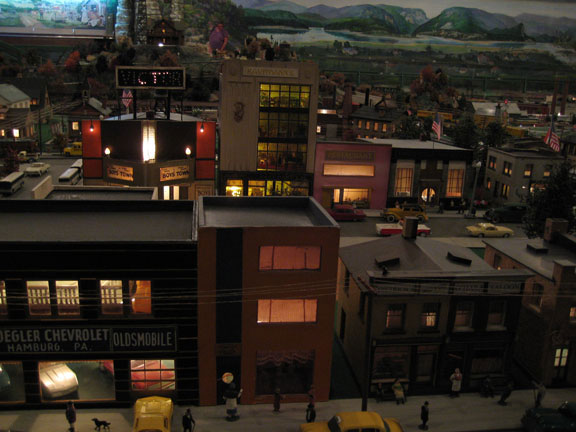
roadside America
roadside America
Roadside America
Shartlesville, PA

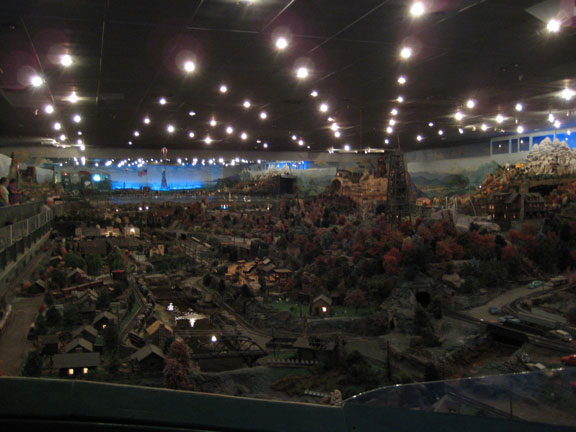
Perhaps M was right—this is a tourist trap. Or maybe I’m right—a miniature village hand-crafted by two brothers at mid-century, which sprawls over several thousand square feet, loaded with electric trains, lights, fountains and a waterfall is art. Or at least it is artistic production worth a visit, because it says something about tinkerers, hobbyists, miniature culture, maker culture, and the urge to create and reflect the world you see. In either case it is odd and wonderfully preserved, though you get the sense that it is anachronistic enough that its future is in jeopardy, and you feel lucky to have seen it.

Brushy Lake State Park, Oklahoma

National Forests and State Parks
Despite serious weather (lots of thunderstorms, and threats of flash floods, hail, tornadoes and severe heat), our car-camping trip was safe, fun, and scenic. Here’s a brief round-up of our stays made possible by the U. S. of A.’s government-run, social programs:
·Coconino National Forest, A.Z.: Friendly park hosts, beautiful pine grove at elevation that brought the oven-like southwestern heat to nice cool temps. Absolutely pristine and sparsely populated in a way that you’d never see in California.
·Ute Lake State Park, N.M.: Your basic horseshoe campground in a great plain. Curious and friendly park hosts and RV campers. Apparently we visited during monsoon season; hot, humid, windy.
·Foss Lake State Park, western O.K., and Brushy Lake State Park, eastern O.K. Oklahoman reservoirs tricked out for RV camping and water sports, a study in contrasts. The former filled with empties-throwing, nappies-leaving, jet-skiing yahoos and not a ranger in sight; the latter, alcohol prohibited, but quiet, scenic, clean and staffed by a generous host.
·Edgar Evins State Park, T.N.: A unique campground situated on a steep hillside. Sites were wood-plank and I-beam pads jutting out from the road. The reservoir was clean and calm, great for swimming. Fireflies abounded.
·Hungry Mother State Park, V.A.: Hands down the best park: natural lake with diving boards, lots of swimming, lots to explore, cute discovery center. The only downside was that the sites were too close together, but the neighbors in our RV subdivision were nice enough.
·Fort Frederick, M.D. Self-pay, no water, no bathrooms, lots of rules, and a train passing nearby. The fort itself had a neat history (at one time owned by a formed slave) but the campsites weren’t nothing special.

A pleasant greeting
Queens, NY

My new neighbors shouting from the patios of their tidy brick townhouses:
“Welcome to Astoria!”

[*In a previous version I got my German filmmakers with the initials L.R. mixed up, committing a cardinal sin of be-smirching an innocent leftist with Nazi support. It was a mistake. Apologies.]

Standard
Art & Development, Community

Artist-curated shows and alumni notes

Summer is supposed to be the low season for art, but this is San Francisco and we don’t summer in the Hamptons; the fog rolls in just the same. A few galleries have mixed up their programming with artist-curated shows.

“They Knew What They Wanted”
Katy Grannan, Shannon Ebner, Jordan Kantor and Robert Bechtle curates selections from Altman-Siegal, Fraenkel, Berggruen and Ratio 3. Go see this show for insights into four interesting artist-curators, pictures and objects you wouldn’t normally get to see, and some really great works, including a communal ballpoint pen drawing initiated by Arte Povera artist Alighero e Boetti at Ratio 3.

A similar work by Alighero e Boetti, Mettere al mondo il mondo 1972 -73 penna biro blu su carta intelata 2 elementi, cm 159 X 164 cad. Source: Archivo Alighero Boetti.

If you aren’t familiar with Boetti’s work, have a look at the virtual tour at Archivo Alighero Boetti.

Over at Patricia Sweetow Gallery, abstract painter Kim Anno curates a group show called “Everyday Mystics.” I wish I could have made out the images in Ricardo Rivera‘s projections on and alongside reflective objects like helmets and metal cups. The idea was neat. I overheard the owner mentioning something about the work being about communicating with outer space, so I figured it’s just as well I couldn’t tell what was going on, since I’m not the intended audience. The MP3 player embedded in the center of a spinning turntable is crafty and chuckle-worthy.

Ali Naschke-Messing‘s thread installations shined with glitter and glowed with fluorescence. Two large floor-to-ceiling works that exploited incidental marks and holes in the existing architecture. A series of wall-based works, which incorporated some sort of putty or plaster, were striking in their simplicity and efficacy. The works are formal investigations of site and form and volume; they’re also catalysts for subtle perceptual experiences. From a distance (and in photographs), the works are almost imperceptible; I almost didn’t see one until it was right in front of me. In person—and particularly with PSG’s abundant afternoon light—the density of thread creates vibrancy. They are more materially substantial than Fred Sandback‘s string intallations, but not by much.

Suné Woods contributes some moving black and white photographs whose imagery is memorably unstable.

Woods is a recent MFAs from CCA (class of 2010). Naschke-Messing was my classmate (class of 2007); I’m proud to have studied alongside so many bright, hardworking, curious, supportive and respectful artists. They change directions, start new projects, stay connected, and keep showing. This summer, shows around town by my classmates include:

Lindsey White: Equivalent Exposures install at Baer Ridgway Exhibitions, Source: http://www.baerridgway.com/

Through July 17
Lindsey White: “Equivalent Exposures”
Quietly humorous and deceptively simple photographs, videos and sculpture
Baer Ridgeway, SOMA, SF

Through July 25
Robin Johnston : “meditations on space and time” (two-person show with Chelsea Pegram, Mills MFA candidate)
Data-driven weavings and drawings
Swarm Gallery, Oakland

Just closed July 10
Amanda Curreri: “Occupy The Empty”
Installation, text, video, participation
Ping Pong Gallery, Dogpatch, SF

Opens July 16
Erik Scollon: “The Urge”
Queer porcelain fetish-based installation
Ping Pong Gallery, Dogpatch, SF

And internationally, new media artist David Gurman is a 2010 TEDGlobal Fellow, participating in the technology and ideas conference in Oxford, UK.

Standard
Community

Sonic Pardee

Double whammy: I showed up for the last tour of the Pardee Home Museum during the run of the Here and Now projects, in which Floor Vahn created three sound installations at that historic home in Oakland.

I’ve heard Floor’s soundtracks twice before, and they’ve struck me as moody and evocative invitations to linger and be quiet. There’s something about them that beg to be experienced physically. The compositions involved strings and other acoustic instruments, and are usually played at a substantial volume—the way real acoustic instruments permeate spaces. Her sound pieces partially recorded at, and played back in, three rooms at Pardee Home Museum, upheld and enhanced my expectations. I don’t know much about sound as an art medium, but Floor’s Sonic Pardee pieces were clear and articulate, well-researched, and a bit humorous and sad.

The Pardee Home Museum tour was also a delight.

(I usually have mixed feelings about old estate houses. California’s history involves significant anti-Chinese legislation and sentiment. It may seem like old news to most people, but for me, standing in homes of the 1880s élite reifies the privileged protected by those policies.)

Pardee is a historic home museum that’s more quirky than your average home museum. The Board decided to keep the home as it was in the 1980s. It’s a curiosity. Alongside Belle Epoch artifacts and collectibles, including hundreds of candlesticks and beautiful old symphonias, you’ll see amazing, mismatched chairs and a 1960s television set. There’s a case overflowing with scrimsaws, a beautiful dining room with loads of cut and blown glass sets. Old writing desks feature accoutrements like boxes of labels with gorgeous typography. My favorites were the light fixtures, especially a glass-photograph-paneled-lightbox-chandelier by Carleton Watkins featuring images of Yosemite. There was also an amazing billiards room.

It all seemed a bit mad, and quite enjoyable. Don’t miss the cupola, where 360 degree views can be seen.

Pardee Home Museum offers tours year-round. You can also book high tea in their lovely dining room. On July 4th, they’re hosting a “Stereopticon Ice Cream Social.” Sounds fun.
pardeehome.org.

Standard
Community

Junk Pirate Rocks

Yesterday, during a dialog at Sight School, Julia Hamilton mentioned the pleasure she found in familiar objects.

I experienced this delight, over and over, when I visited Junk Pirate, Pete Glover‘s solo show at The Compound Gallery. Glover works at a junk store (when he’s not co-directing Rowan Morrison Gallery with Narangkar Glover).

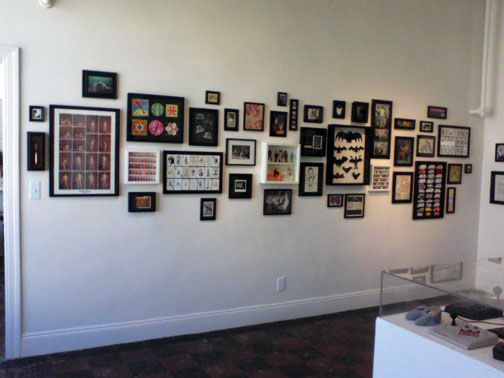
Over the years, he’s amassed an impressive collection of objects. He’s lovingly composed these objects into shadow boxes, picture frames and vitrines. The show is a collection of collections, filtered through an unabashed love of popular culture and humor. It’s like the garage sale of a fabulous window display artist.

Junk Pirate exhibition view, detail

The objects are nostalgic, curious, and insouciant. Some are truly visually arresting, particularly a composition of fluorescent orange water guns in a black shadow box. Art history buffs might enjoy a chuckle as they recall Claes Oldenburg’s Ray Gun Mfg. Co. in relation to this work.

Pete Glover's assemblage of orange water guns

A few works suggest glimmers of the transgressive or anti-social, such as a found photograph of a man with one eye, or a class photograph in which every kid’s portrait has an “x” drawn over it. But despite his participation in street/skate culture, Glover rarely indulges in cred-proving, candid “how effed is that” photos. His eye for the peculiar is more amusement-arcade than in-your-face.

In yesterday’s dialog, featured guest Glen Helfand suggested the idea of “added value.” That is, an artist might start with something cheap and through the investment of labor, creativity and display, the object gains value, both monetarily, visually, and perhaps psychologically. In contrast with the whimsy of oddities in Wunderkammers, Pete displays a fanboy’s attention to Complete Sets. This unabashed embrace of sentiment and nostalgic 80s amusements reveals itself in his devotion to tokens, cards, video game controllers and jokily branded popcorn bags. Kitsch, promotional collateral and residue of material life collide.

The show is largely about appropriation, popular memory, composition and display. Scented stickers, for example, are framed without glass to encourage interaction. The most successful works include vitrines of board game characters and “nipples” sorted by color. The results are graphic, striking, miniature and absorbing. These offer more to read, infer and return to.

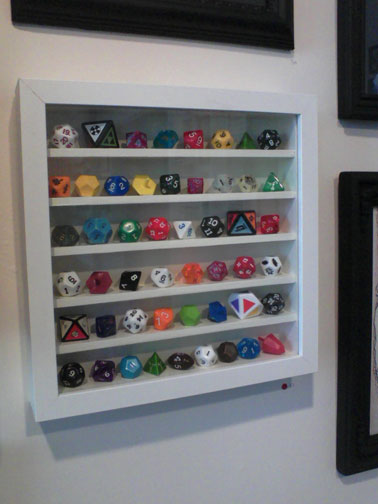
What I love about Junk Pirate is that not all the cases are art. They are all clearly re-configurations of recognizable things. A few objects transcend their humble origins to become a dynamic hybrid of art/collections/decoration/keepsakes. In a brilliant stroke, Glover extended the gaming theme to the pricing of the works, so that a roll of a die determines the price to be paid. This reinforces the objects/collections non-art identities, and refers back to the chance in Glover’s procurement process of discovering and identifying treasures in mounds of detritus.

Junk Pirate is the Compound Gallery’s first show at its beautiful new location on 65th Street. The gallery is housed in a grand foyer complemented by lots of windows and two side bays: one holds a tiny gallery for drawings; the other houses Professor Squirrel Shop, an adorably appointed indie mart with properly twee décor and accessories for sale. Fittingly, Junk Pirate is sited perfectly between a commercial (albeit indie) venture, and an exhibit of fine art.

Standard
Art & Development, Community

parallels

Some connections between projects in Oakland, California, USA and Birmingham and Manchester, England, U.K….

Simon and Tom Bloors' exhibition at Eastside Projects, Birmingham UK, 2009

Simon and Tom Bloors' exhibition at Eastside Projects, Birmingham UK, 2009

Eastside Projects is an artist-run space, a public gallery for the City of Birmingham and the World. It is organised by a founding collective comprising Simon & Tom Bloor, Céline Condorelli, Ruth Claxton, James Langdon and Gavin Wade, who first conceived and now runs the space.

Eastside Projects is a new model for a gallery, one where space and programme are intertwined: a complex evolving programme of works and events starting from radical historical positions. We aim to commission and present experimental contemporary art practices and exhibitions. The artist is invited to set the existing conditions for the gallery. Work may remain. Work may be responded to. The gallery is a collection. The gallery is an artwork. The artist-run space is a public good.

We aim to support the cultural growth of the City.

James Sterling Pitt, installation view, Sight School

Sight School is an artist-run exhibition space directed by Michelle Blade. The space began from a desire to create dialogue around new modes of living and being in the world in order to reveal connections between art and life.

As Michelle and I have worked together on Irrational Exuberance (Asst. Colors), I’ve gotten a better sense of her vision for Sight School. She’s committed to her local neighborhood—she makes a point to get to know her neighbors, put up flyers at local businesses, and support the growth of the Golden Gate Arts District (an emergent auxiliary to downtown Oakland’s wildly popular Art Murmur). She is highly invested in community—her decisions that structure the gallery and space are often driven by generosity and openness. She’s got a keen sense of contemporary practice in art. I get the feeling that the gallery is something like a commons for art experimentation; that her aim is to provide a site for artists to do experimental projects that would be considered untenable elsewhere. She seems interested in this as an experiment, thinking of every next move as an opportunity to innovate. This is not merely another gallery; she’s stepping out of the white cube by hosting one-night events, mutual learning projects and discourses. So when I re-visited Eastside Projects’ mission statement, particularly

The artist is invited to set the existing conditions for the gallery.
The gallery is an artwork.
The artist-run space is a public good.

it occurred to me that ESP and Sight School might be kindred spirits, with their energetic, unruly collectivity.

The director of ESP is an interesting curator and artist’s book instigator named Gavin Wade. In an interview on NYFA.org, Wade says that American artists differ from their UK counterparts because we’re less

willing to interact and collaborate and allow their work even to sit on top of someone else’s. There’s a certain individuality here; New York is so much about standing alone.

That interest in interaction, collaboration and experimentation that challenges artworks’ autonomy will be at work in Unlimited Potentials, an exhibition organized by Manchester-based curator and performance artist Mike Chavez-Dawson at Cornerhouse.

The show is comprised of several ambitious components, including loads of collaborators (including Wade), a project instigated by Liam Gillick, dozens of contributors (myself included) and a talk with Kwong Lee, the brilliant director of Castlefield Gallery, an important MCR artist-run space (their recent exhibitions include shows by David Osbaldeston and Leo Fitzmaurice and Kim Rugg).

Last year, when I exhibited my installation, Unlimited Promise, at an open studio at the end of the Breathe Residency at Chinese Art Center in Manchester, Mike Chavez-Dawson told me about Unrealised Potentials. I’m excited to play a small part in his forthcoming exhibition, especially when you consider the themes of resisting finished-ness in artwork in We have as much time as it takes at the Wattis:

We have as much time as it takes questions and highlights expectations of achievement, productivity, and established systems of management that make up the programs and academic mission of the Wattis Institute and CCA. … The works embody circular processes, resist completion, welcome change, and refute demands for definable results and resolution. They challenge the conventional form of the art object and the traditional parameters of exhibitions.

I’m excited that this conceptual investigation and expansion of exhibition-form-making is occurring in so many spaces around the world right now. In conjunction with more traditional viewing experiences, viewers of art are being offered more ways to think about art, participate in exhibitions, and complete the speculative thought processes artists begin.

Standard
Community

Three cheers for great Studio-mates!

Check out these forthcoming shows! My studiomates rock!

CURRERI.Occupy 7

Ping Pong Gallery is pleased to welcome Amanda Curreri back to the gallery for her second solo exhibition, OCCUPY THE EMPTY. There will be an opening reception for the artist this FRIDAY, June 11, 6-9PM.

Following the inspired careers of such artists as Felix Gonzalez Torres, Lygia Clark, and Helio Oiticica, whose work centered on the commingling of public and private spheres, and the sustained commitment to narrative, social engagement and cultural commentary, Curreri offers an exhibition that depends on the consideration, sensitivity, and participation of its audience.

OCCUPY THE EMPTY is born from an experience the artist had last summer in the Massachusetts courthouse where Italian-American anarchists, Sacco and Vanzetti, were sentenced to death in the early 20th century. The court case Curreri participated in was for her deceased father, also an Italian-American. The experience of those two weeks spent in the historical courtroom with her father’s loved ones, with lawyers, a judge, and jury shared qualities with the dramatic arts and the stage: theatrical and performative, positioning Curreri as one of the characters. Inspired by the work of radical democracy theorists Ernesto Laclau and Chantal Mouffe, Curreri considers the assumption that democracy is inherently available, empty to be inhabited, performed and occupied. This exhibition takes the courtroom, the American hallmark of democracy, and translates it to the space of the gallery. Explicitly empty by design, the gallery becomes a tangible stage for testing ideas of personal histories, democracy and the social body.

WithinOCCUPY THE EMPTYare paintings and sculptural arrangements, schematic works on paper, documentation, and an interpersonal durational piece that will come to create the portrait of the people involved in the themes of the exhibition. Working in response to ideas of community, family, history, equivalence, Curreri’s work suggests that individuals, perhaps fixed in certain roles, can become illuminated, freed, re-invented, and moved to a place where they can participate, act, and speak freely. By shifting the expected experience (spectatorship?) within the gallery, and making intimate/active the relationships within, the artist traverses the divide between public and private. In so doing, Curreri encourages the formation of a broader social movement, one where the audience of active creators becomes part of the story, sharing and ultimately helping engineer a collective transformation. The invitational gesture for viewers to play a part in the formal creation and conceptual democracy of the work is one that might come to highlight the healing qualities of art and its ability to serve as catharsis for viewers.

In the words of Helio Oiticica: “The crucial point of these ideas […] is that the artist’s task is not to deal in modifications in the aesthetic field, as if this were a second nature, an object in itself, but to seek to erect, through participation, the foundations of a cultural totality, engendering deep transformations in man’s consciousness which, from being a passive spectator of events, would begin to act upon them using the means at hand: revolt, protest, constructive work, to achieve this transformation… (General Scheme of the New Objectivity).

Curreri holds an MFA from the California College of the Arts, a BFA from The School of the Museum of Fine Arts, Boston, and a BA from Tufts University in Sociology and Peace & Justice Studies. The artist was the recipient of a Joan Mitchell Foundation fellowship in 2009 and her work has been reviewed in the San Francisco Chronicle, ArtForum.com, FlashArt Online, The SF Weekly, and The Portland Phoenix, among others. She is the co-editor and co-founder of an (ir)regular artist publication, Color&Color, which aims to tactically connect artists with new audiences and expanded dialogue through the serial print medium of small books.

For additional information, please contact the gallery at 415.550.7483 or email info

PING PONG GALLERY
1240 22nd Street
San Francisco CA 94107
415.550.7483

GALLERY HOURS:
Tuesday 6-9PM, Thursday 6-9PM, Friday 11-5, Saturday 11-5; Appointments welcome

Splitside 9″ x 11″ watercolor on paper 2010

Opening June 15th
Linda Geary- Thirteen Watercolors
Reception: Tuesday June 15th from 6-8
Rose Burlingham Living Room Gallery
15 Park Row, #16E, New York, New York 10038
By appointment through the summer: 646 229 0998

Like a poem buried in the silence of things…Linda Geary’s abstract watercolors are full of unexpected configurations. Spontaneous drips and blurred bands of elegant color recall ambiguous plant and landscape forms but mostly refer back to themselves. There is a tension between her reductive, expressive line and blocks of organic melting color. We are somehow at a remove from the emotional qualities of color. Two-dimensional space is indicated without symbolism. At first look they appear to be describing the process of their own making but gradually her particular place emerges.
No matter what the scale they feel monumental. Color extends past the page’s edge with a vastness that recalls Chinese landscape painting. She transposes compositions with ease to a very large size for the medium (up to 40 x 60”). Some sing in elegiac tones interwoven with underwater darkness. Others are about pure and brilliant light. The simple titles reveal her preoccupations: Fuse page, Split side, Saw tooth, Untraceable, Fall out, Zero to indigo.
Aqueous light as well as a physical sense of water mixed with pigment reinforces the materiality. She allows the paint to do what it will, to pool and run and blend without losing control. Geary’s expansive openness grants us the latitude to acknowledge the ambiguity inherent in vision itself and it’s promise of free play of the mind.

Recent exhibitions and publications include, 2010 Solo exhibition, Rena Bransten Gallery, SF, 2010 Interview with Bruno Fazzolari and John Zurier, in Artpractical.com. 2009 Group Exhibitions at Pulliam Gallery, Portland, Rose Burlingham, NY, 2009 Night Tide, curated by Colter Jacobsen, SF, Pulliam Deffenbaugh Gallery in Portland, Oregon; Barry Sakata Garo Gallery in Sacramento; and HP Garcia Gallery in New York. Her solo exhibition at Rena Bransten Gallery, San Francisco, was reviewed in ArtForum (February 2007), residency at Art Omi International New York in 2007. 2006, solo exhibition of works on paper in Otranto, Italy, organized through the Bau Institute in New York and Otranto, curated by Lilly Wei, with a catalog essay by Kenneth Baker.

Standard
Community

More alt…

No Soul for Sale: A Festival of Independents closed yesterday at Tate Modern, but you can still learn more about projects spaces on Project Space Survival Strategies, a research project by the artist Elysa Lozano for Autonomous Organization, produced in collaboration with Invisible Venue.

There’s also Artist Run Gallery Spaces of the Bay Area, a Google Map created by Narangkar Glover (co-director, Rowan Morrison Gallery).

Standard
Community

Art art art

Closer to home, there are lots of art shows worth checking out… On my list:

This film screening in conjunction with We have as much time as it takes sounds interesting. If you haven’t had a chance to see the show (to which I contributed Unlimited Promise), the gallery’s open late…
Tuesday, May 18, 7–10 pm
Wattis presents Another Time
A one-night-only screening of James Benning’s 2005 film One Way Boogie Woogie / 27 Years Later in Timken Lecture Hall. The film portrays an industrial, blue-collar town, in the filmmaker’s hometown of Milwaukee. The first 60 shots of the film–depicting factories, lonely railroad tracks, and desolate construction sites–were captured in 1977. Twenty-seven years later Benning returned to restage the film shot-by-shot, revealing the transformation of the landscape over time. One Way Boogie Woogie / 27 Years Later is exemplary of Benning’s distinctive cinematographic language, including extended shots that prolong anticipation.
CCA Wattis, 1111 Eighth Street @ Irwin, San Francisco

Leah’s delightful and intriguingly odd stripey, colorful paintings…
May 13–June 30, 2010
Time Will Tell
Solo Show by Leah Rosenberg
18 Reasons, 593 Guerrero St., San Francisco, CA 94110

Immersive light and video artists’ projects.
May 14-July 3, 2010
Jars Filmed Inside (Elaine Buckholtz Solo Show)
Perception Projection Delay (Hunter Longe Installation)
Triple Base, 3041 24th Street, San Francisco, CA
Gallery Hours: Thu-Sun 12-5pm

The inaugural show at Intersection’s new downtown space! A little bird told me it’d be good!
May 19 – July 3, 2010
Let’s Talk of a System
A group exhibition featuring work by April Banks, Sergio De La Torre & Vicky Funari, Suzanne Husky, Laura Parker, Favianna Rodriguez, James Reed and Banker White.
Intersection 5M, 901 Mission Street @ 5th, San Francisco, CA 94103
Hours: Tuesday through Saturday 12 to 6pm / First Thursdays: 12 to 8 pm
Opening reception: Wednesday May 19, 2010, 6-8pm

Standard