Art & Development, Travelogue

not helping

An addendum to the previous post on Fareed Zakaria’s The Post-American World:

If, as Zakaria writes, America can continue “to thrive because it has kept itself open to the world—to goods and services, ideas and inventions, and above all, to people and cultures,” it follows that America should steer away from these current trends in the UK:

The curtailment of civil liberties.

Immigration policies that reduce the number of artists allowed to enter the country.

Like Zakaria, I believe that immigration policies that stop people from working are terribly misguided. Furthermore, artists are agents of culture; to de-value cultural exchange in an increasingly interdependent world reeks of regressive isolationism.

I’m looking forward to visiting London soon; the quality and vitality of the arts there are unparalleled. But if London becomes stagnant and inward-looking, there are many more centers in the art world that would happily render conventional art capitals like London obsolete.

Standard
Art & Development, Travelogue

Antony Hall lecture at Cornerhouse

Antony Hall demonstrates the m-Log in front of a projection of a deliriously rhizomatic interface

Antony Hall demonstrates the m-Log (a sensor-driven noise-making interface, housed in a real log) in front of a projection of a deliriously rhizomatic interface

Antony Hall wants to have it both ways. He is disappointed if his science-based projects (which span interspecies communications and fluid mechanics, like creating vortexes in coffee cups) aren’t regarded as serious experiments. On the other hand, seems to be in disbelief that he performs as a experimental sound artist at art events. But when the public wants to acquire his handmade musical instruments, he prefers instead to lead D.I.Y. workshops, acknowledging the (social) aesthetics at work.

The science experiments are smart and interesting. I haven’t had a chance to try the chamber for interfacing with a fish currently in the Interspecies exhibition at Cornerhouse, but the idea and interface are lovely.

The music projects’ low-meets-hi-tech is endearingly ironic. What started out as an elaborate joke (Hall and a friend, whose name I can’t recall, thought it would be funny to make music from a homemade analog interface housed in a log, called iLog, rather than a laptop) has turned into the Owl Project. It’s a grouping of preposterous inventions: the iLog, the m-Log (sort of like the Owl version of an iPod, but with only sensors and no harddrive, I think), and the Sound Lathe (It’s a lathe! It’s an instrument! And it’s pedal-powered!).

Standard
Art & Development, Values

Points of Reference

eclipse installation by Pavel Buchler
Pavel Büchler’ Eclipse at Max Wigram Gallery (London)
I love this simple but thoughtful installation.

Maureen Dowd recently remarked in the New York Times that Barack Obama’s election somehow signified that Americans are post-race. What a tremendously privileged point-of-view to take. Artist Kerry James Marshall doesn’t think we’re post-race, and neither do I. Cheers to SFMOMA for commissioning Marshall, and the two for pulling no punches.

I really appreciated Philip Tinari’s “OPENINGS: CHU YUN” in this month’s Artforum as well. It takes a lot of confidence — more than I’m naturally disposed of — to make works that are authentically minimal at the risk of seeming slight. As Tinari puts it, there’s

something subversive… about making works that were barely works.

Visit Chu Yun’s website. I really love the Constellation installation.

Paul Morrison’s exhibition at the Manchester Art Gallery is pretty good. I enjoyed the giant 75′ wide b/w hard-edged mural, which combines source images from 19th-century-style engraving and 20th-century cartoons (I think I saw some Smurfs’ flowers?). I don’t think the shifts in scale is as dark or menacing as the curatorial statement suggests, however. And while I appreciate the white-on-white high-relief picture of dandelions, which is reminiscent of Van Gogh’s sunflowers, I also found the white-gold-and-black-acrylic-on-canvas paintings to slip too easily into collectible luxury items. As I learn more about gold and how, like diamonds, its mining and refinement is inseparable from issues of colonialism, inequality and environmentalism, I can’t see how Morrison justifies his use of gold leaf. Terry Gross’ interview with Brook Larmer on “The Real Price of Gold” is elucidating (Fresh Air, January 8, 2009).

Tomorrow, there’ll be a march on Washington against the use of coal. Writing from Manchester — a city spawned by the Industrial Revolution, whose skies were literally blackened by coal smoke, but has since embraced everything green — coal seems like such a 19th-century phenomenon, and it’s hard to imagine that it’s still a necessity today. Stranger still is how the myth of “clean coal” can persist in America today, despite a relatively educated populous.

Podcast of Joseph Kosuth’s Meet the Artist lecture at the Hirshhorn Museum. I’ve found this podcast series extremely inconsistent, with some poor audio quality of in-gallery recordings. But Kosuth excells in providing a smart, well-prepared lecture about his work and Conceptual Art. Cheers for artists talking with precision about art!

The work of two Mancunian conceptually-oriented object-makers:
Nick Crowe
Ian Rawlinson
and their work as a collaborative team

Standard
Art & Development

The Quick and the Dead: the legacy of Conceptualism

This show looks so awesome, I’m holding my head in my hands so my brain doesn’t explode. The Walker kicks ass.

The Quick and the Dead
April 24 – September 27, 2009
The Walker Art Center
Minneapolis, MN

Surveying art that tries to reach beyond itself and the limits of our knowledge and experience, The Quick and the Dead seeks, in part, to ask what is alive and dead within the legacy of conceptual art. Though the term “conceptual” has been applied to myriad kinds of art, it originally covered works and practices from the 1960s and ‘70s that emphasized the idea behind or around a work of art, foregrounding language, action, and context rather than visual form. But this basic definition fails to convey the ambitions of many artists who have been variously described as conceptual. Although some of their work involves unremarkable materials or even borders on the invisible, these artists explore new ways of thinking about time and space, often aspiring to realms and effects that fall outside of our perceptual limitations.

The exhibition brings together some 90 works by an international group of more than 50 artists in a range of media, juxtaposing a core group from the 1960s and ‘70s with more recent examples that might only loosely qualify as conceptual. With its breadth, The Quick and the Dead seeks to reinvigorate conceptual art’s enchantment and heroic sublimity, reaffirming its ability to engage some of the deeper mysteries and questions of our lives. The presentation expands beyond the Walker’s main galleries to its public spaces, parking ramp, the Minneapolis Sculpture Garden, and the nearby Basilica of Saint Mary.

Artists in the exhibition: Francis Alÿs, Robert Barry, Joseph Beuys, George Brecht, James Lee Byars, John Cage, Maurizio Cattelan, Paul Chan, Lygia Clark, Tony Conrad, Tacita Dean, Jason Dodge, Trisha Donnelly, Marcel Duchamp, Harold Edgerton, Ceal Floyer [my new favorite artist!], Felix Gonzalez-Torres, Roger Hiorns, Douglas Huebler, Pierre Huyghe, The Institute For Figuring, Stephen Kaltenbach, On Kawara, Christine Kozlov, David Lamelas, Louise Lawler, Paul Etienne Lincoln, Mark Manders, Kris Martin, Steve McQueen, Helen Mirra, Catherine Murphy, Bruce Nauman, Rivane Neuenschwander, Claes Oldenburg, Roman Ondák, Giuseppe Penone, Susan Philipsz, Anthony Phillips, Adrian Piper, Steven Pippin, Paul Ramírez Jonas, Charles Ray, Tobias Rehberger, Hannah Rickards, Arthur Russell, Michael Sailstorfer, Roman Signer, Simon Starling, John Stezaker, Mladen Stilinović, Sturtevant, and Shomei Tomatsu.

A catalogue accompanies the exhibition.

Curator: Peter Eleey

Standard
Art & Development, Community

Points of reference: 15 Feb 2009, 1306 GMT

This video of artist Ryan Gander talking about his exhibition, “Heralded as the New Black” at IKON Gallery, Birmingham’s top-notch ICA.

Drawings by Donald Urquhart, an Edinburgh-based 2-D artist. His older works (online at Maureen Paley Gallery, London’s Bethnel Green) remind me of Candyass’ jokey text works (see them at Alexander Gray Associates, NYC) and Tony Garifalakis‘ heavy metal-influenced work. Drawings like “An Alphabet of Bad Luck, Doom and Horror” (2004) are charming, if a bit juvenile and 1990s. So it’s interesting to see Urquhart’s successive turn. Newer works look like Vija Celmins’ photorealist drawings conceptually paired with monochromes (see a photo and review on The List) Interesting!

Maria Fusco’s “Report: Contemporary Art Writing and it’s environs” on Map Magazine, based in Scotland.

Why didn’t [the] Brooks [Memorial Art Gallery] — and other museums that practiced racial segregation de jure — create two collections: one for whites and one for blacks? After all, segregation laws had doubled other public facilities: water fountains, schools, hospitals. This answer is more obvious. If there had been two collections — or two museums — the ‘white’ one could no longer make a claim to be universal. Art for ‘whites only’ would be particular, representing only white taste. Letting ‘negroes’ into the public museum one day a week was an unavoidable way to guarantee the universality of what was, in effect, purely white culture. It was not enough to marginalize African Americans; they were required as silent witnesses to their own exclusion by a supremacist culture masquerading as a universal one.

Jenifer Allen’s “Colour Theory: The history of racial segregation in American art galleries and contemporary identity politics.” Frieze Magazine. Issue 120. January-February 2009.

Allen does a great job of articulating the privilege of white racelessness. In art, white (often male) figures are sometimes used to convey universal emotions, truths or experiences. You see this a lot in combinatoric mass culture kitsch (as Johanna Drucker puts it). I’ve been guilty of this before. Which maybe explains why I no longer relate to art that employs stylized raceless (read white) figures to get at vague, larger truths or somehow hint at the subconscious.

Standard
Art & Development, Travelogue

Screening of Manuel Saiz’ work

Attended a screening the work of Manuel Saiz, an event co-hosted by Instituto Cervantes and Castlefield Gallery. Saiz’ solo show at Castlefield consisted of videos exploring cinematic tropes and a diagrammatic poster questioning the nature of art.

Kwong of Castlefield Gallery and color bars in ornately arched hall at Instituto Cervantes.

Kwong of Castlefield Gallery and color bars in ornately arched hall at Instituto Cervantes.

The video screening helped me to better appreciate Saiz’ ongoing themes (more cinematic tropes, mimesis, and the uncanny) and strategies (mirroring, displacement).

Parallel Universes Meet at Infinity is an especially enjoyable two-channel installation. On one channel, an animal shifts its view, in the second channel, a human mimics every movement. It’s a feat of acting, as well as a coded investigation into mimicry and representation, and what art itself is or achieves.

The last video made me laugh, cry, and beg for it to end.

It’s the documentation for an installation called Public Displays of Affection (click on Public Displays of Affection on this page), in which the artist motorized a track for video camera to shoot 360-degree videos with soaring instrumentals. It’s a parody, of course, on the cheesy romantic, triumphant long kiss, but I couldn’t help but tear up as couples kissed and families hugged each other. The artist is not so sentimental. Maybe it’s because Valentine’s Day is around the corner, but the video made me want to tell the world forget the rest, just love your beloved.

Standard
Art & Development, Travelogue, Values

3 visits + a P.O.V.: Manchester Museum, Whitworth, Urbis, US-UK

Manchester Museum
The natural history museum is a metonym for Manchester: a bricolage of old and new. There are bright, airy, open galleries brushing up against dim halls lined with cabinets that look like they’re from Darwin’s time. It’s all fitted neatly into a neo-gothic building at the University of Manchester.

During today’s visit, I found the mineralogy department the most fascinating. It’s small — a single room, almost, though a tiny gift shop shares the space. But the specimens are small, so there’s actually lots to see. I must have spent at least an hour looking at rocks today.

The north of Britian is geologically diverse, and the museum featured many spectacular specimens from nearby mines. The range of colors and shapes where dazzling, to the point, where I wondered, as an artist, how could I ever possibly complete with the beauty in Nature?
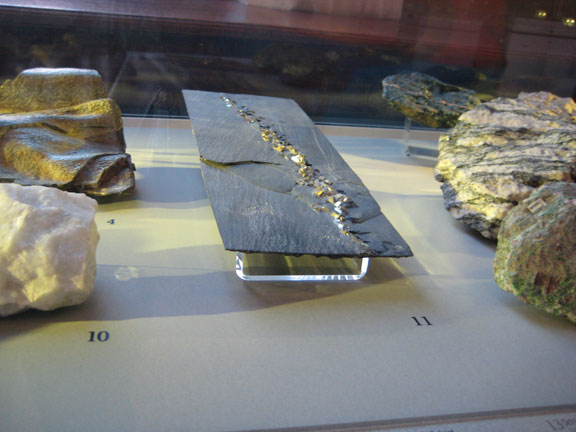
Slaty cleavage of pyrite cubes

Slaty cleavage of pyrite cubes

I almost missed one dark cabinet, thinking it was out of order. Then I found a button and pushed. UV lights blinked on, and rocks of all shapes glowed in purples and phantasmagoric grains of green. Awesome. I love the idea of minerals formed by heat, pressure and seismic shifts gaining the property of phosphorescence, even when they are deep in the earth, shielded from light. I find it poetic that in the mining of coal or ore for industry, enigmas were also uncovered.

Whitworth Gallery

Subversive Spaces is a large-scale exhibition pairing early 20th century Surrealism with contemporary sculptures, installations and videos by international artists. I’ve had two brief encounters with the show and find that it’s just not my cup of tea. Maybe I’m just not that into Surrealism. Part of this has to do with the fact that Surrealism is often used to introduce viewers to Modern Art, so, for me, it’s taken on a whiff of the palatable, familiar, introductory. Besides, after HBO and David Lynch, the Freudian ideas in early Surrealist paintings and sculptures aren’t very shocking anymore.

That said, I was impressed with Markus Schinwald’s video (watch it on YouTube) featuring two actors — including an immensely capable dancer/movement artist. I think this work epitomizes the show: it’s subversive, surreal and innovative.

The show includes works by major contemporary artists. Among these are two sculptures by Mona Hatoum (a prison-like baby crib in galvanized steel, and an oversized egg slicer), two sculptures by Robert Gober (the foot coming out of a wall, and a perspectival playpen), an installation by Sarah Lucas (a figurative display composed of lights and furniture), and a video by Francis Alÿs (creating music by walking and hitting a fence with a stick).

Gregor Schneider‘s Weisee Folter, a new, site-specific commission that takes up a major gallery, is highly hyped but viewable one visitor at a time. Advance bookings are not taken, and wait times were 90 minutes on an early Tuesday afternoon. So I skipped it, though I suspect that it would register as particularly German—intellectual and dark—like the work of Anselm Kiefer and Martin Kippenberger.

Urbis
Urbis is an ingenious building that’s completely out of character with old Manchester, but it can be forgiven because it adds large, high-quality exhibitions of art and design to the city centre.

Aidan O’Rourke’s Manchester Mega-Photo—basically a giant photographic cityscape—is cool. Even though the commercial district smacks of boosterism, the Mega-Photo is still enjoyable. And anyway, the higher your familiarity with Manchester, the more meaningful the photo becomes.

Reality Hack: Hidden Manchester by Andrew Brooks is a series of fantastic, large light boxes and prints of Manchester’s hidden spaces. These digitally-composed photos are densely-detailed, well-composed, dramatically lit, and completely vertiginous. Nice use of light boxes and prints on silvered paper, which make the photos appear illuminated from within like light boxes, but with the added advantage of non-reflective surfaces.

The photos are visually stunning, though I’ll register two minor qualms, both stemming from questions of taste and commercialism. First, the wall labels: while the didatic texts are well-written and useful, I found the graphic design drew too much attention to itself. They were hard to read (small type, white ink on black ground, rather low on the wall) and cheesy (the exhibition’s identity scheme, a bar code—why?—appeared on all wall labels). Most offensive were the punning titles, like “Abel Tower” (a photo of a bell tower) and “Culvert Report” (a photo of a culvert). Cringe-inducing. So much skill and sophistication in the work, undermined by these useless add-ons. Urbis’ curatorial vision seems like it could use more contemporary art rigor.

While two of the exhibits seem explicitly about Manchester, others are very American.

Black Panther: Emory Douglas and the Art of Revolution
I live in Oakland, and I’ve met Emory Douglas (nice guy). The traveling exhibition is largely educational, employing lots of original source materials, oversized vinyl and wallpaper. Much of the original art is lost, but it was meant for reproduction anyway. It’s curious to be in a multicultural center of England learning about the Black Panther’s radicalism in the U.S. Something about it seems totemic, historicizing, in a way that disconnects the BPP from today’s struggles.

Coming up, Urbis will have a show called State of the Art: New York. Urbis showcases different creative cities in an annual program, but New York!? What is this, 1980? What’s with this obsession with America?

Printed canvas art in Oldham, Greater Manchester, UK

Printed canvas art in Oldham, Greater Manchester, UK

It turns out that some Brits would love for the UK to join the European Union, while others hope that the UK would be more like America. This easy to see in Manchester’s commercial city centre, where nearly all young men are dressed in deliriously colorful post-Kanye gear, while the most popular look for young women includes tights, Uggs, blonde highlights and orange tans. It’s SoCal simulacra under slate Mancunian skies.

Clearly, Manchester is has reinvented itself since the post-Industrial decline and nineties’ IRA bombing into a vibrant city. But its model need not be so sanitized and American, with high-rise condos and Urban Outfitters. Rather than aspire to be Santa Monica today, I’d rather see a new, distinctly English or European vision for tomorrow. Distinctly contemporary English things like The Cooperative: a co-op that actually provides services like quality groceries and banking. Preserving the pubs alongside the hip lounges. And walking the green walk: have a recycling program, for starters. Green the city and its canals. Create other safe, viable public spaces besides the mall.

Standard
Art & Development, Travelogue

tempers, temperments, temperatures

My interest in optimism and pessimism is developing into an investigation of temperaments in Manchester and the UK.

Stuart Maconie’s travelogue, “Pies and Prejudice: In Search of the North,” (Ebury Press, 2008 ) has been a wonderful, laugh-out-loud guide. I really enjoy Maconie’s writing, even if I have to look up several words–slang, local, or otherwise–per page. Maconie is a BBC personality, and his narratives ooze with charm:

And most famous of all, to be born within the sound of the Bow Bells is the mark of a true Cockney…. The first Cockney I heard was from a newspaper vendor who seemed to be berating a customer for not having the right change. That would have been it, but for two surly youths, their pinched faces volcanic with pimples, dressed in the cheap, nasty uniform of the urban urchin: fake Nikes, hoodies, flammable polyester trackie bottoms that would go up in a single woosh, outsized jeans. They both smoked in that affected way that people who are trying really hard to be hard do; fag between crooked index and middle finger, eyes narrowed, sucking desperately as if trying to actually remove by suction the B&H logo.

Maconie rightfully points out the hypocrisy of the disdain for (Northern) chavs while Cockney low-lifes are routinely glorified in Hollywood films, and most offensively cheery. He doesn’t spare judgement of Northern youth, however:

Two youths in the ubiquitous hoodie style of the early twenty-first century are trying to be menacing by a bus stop but failing because of the utter ridiculousness of their appearance. I know it’s a sure sign of middle age when you start chortling at how young people dress but, really, a hood worn over a flat cap. The effect is less lethal urban gangster than senile old bloke unaware that he’s put two hats on.

I was also quite amused to see this pop up in today’s Guardian in reaction to the recent snow chaos:

Meanwhile, yet another few thousand calls to the BBC mount up, so it seems timely to ask: how much does complaining cost the UK economy? All those people, presumably taking time out from work to get angry about countless perceived injustices.

Marina Hyde. “Let it snow on our nation of the permanently outraged.” Guardian. 7 February 2009.

Maybe it’s the lowbrow tone of the news here, but it does seem like Britons are quite vocal with their discontent. Everyone is talking about the snowstorm, which has caused chaos in London. You’d think it’s War of the Worlds down there.

Manchester hasn’t been hit too bad. As a Californian, I find the weather chilly; my hands crack and ache, and I invariably err towards lugging around a parka, scarf and gloves. On the other hand, I’ve been to Boston in the winter, and in comparison, Manchester really isn’t that cold. In the past 9 days, the weather’s been rather consistent: chilly air hovering around 40°F, little wind, a little snow between a few sunny days. The skies are rather gloomy, but there hasn’t been a drop of rain. Mancunians are so quick to point out how much rain Manchester gets, I’m starting to suspect this has more to do with a self-perception than actuality. The expectations are so low that I’ve been pleasantly surprised by the weather a few times.

While I wouldn’t recommend it, lots of girls are out and about wearing short skirts and tights, or tees and a thin hoodie. I even saw a chap wearing basketball shorts in the snow, gawd bless ‘im.

Standard