Art & Development, Research

heart NY

Like: H&FJ, type designers extraordinaire

Jonathan Hoefler and Tobias Frere-Jones are lecturing at Cooper Union next Tuesday night. If only I lived in New York…

H&FJ are among the country’s best and most influential living type designers. Years ago, I parlayed my art skills into illustration and graphic design; in the past year or two, I’ve focused my attention on typography — thanks to books by Robert Bringhurst and Ellen Lupton. I think you can see the effect on both my design and art work.

I admire H&FJ for the consistency of the excellence of their output, which is always considered and gimmick-free. Their type families are remarkably thorough and usable; they manage to both timeless and modern. I know my praises sound like platitudes, but you can see their skill with the ubiquity of the typeface Gotham. More recently, Archer has been catching my eye with more regularity. It’s cute, fresh and a little cheeky.

LIKE: Conceptualism and Identity Art, neither compromised

I DON’T WANT TO BRAND something called “Black Conceptual Art.” It’s less a question about who produced the work than of the object’s material history. If you can get to that history, and if that can take you to a very specific place, culturally and racially, then that’s where you locate the blackness. It becomes a secondary discovery rather than a necessary attribute of the work itself.

“30 Seconds Off an Inch” does not look at the conceptualisms that followed Minimalism. Instead, it investigates the kind of art that asks the viewer to think about something beyond the sheer materiality of the object, beyond formalism and formal practice. The works ask you to wonder where the trash originated, for instance, and about the history of a specific cloth and clothing, or whether the work is appropriated. There is a history and a lineage to all the works in the show that lend themselves to conceptual thought beyond the objects.

The viewer should have a sense of recognition when walking through the exhibition. There is not a lot of tape around the objects—I want visitors to be able to put their noses up to the works. The objects in the show are not to be seen as metaphors, but very literally, and you don’t need an advanced degree in art history to read them.

—Naomi Beckwith, “500 Words,” Artforum, 11/25/2009

Beckwith is the assistant curator at the Studio Museum in Harlem, where she organized “the exhibition ’30 Seconds Off an Inch,’ which explores the intersection of identity politics and dominant tendencies of the 1960s, from conceptual practices to Arte Povera.”

Wowee. I like this. It’s plain language on how to look at conceptual art, and how material can have content relating to identity. It challenges the ideas that conceptual art is too élite to be easily appreciated or too hermetic to have meaningful content, and that art relates to identity has to be populist/symbolist/representational. Well done.

LIKE: studio

This morning, in my dream, I found myself in a bare room: white walls, unpainted wood floors. I was sitting at cheap melamine dinette table. To my left was a the kind of kitchen you’d find in economy apartments — cream colored, with a small fridge and low fluorescent tubes. A cutout in the wall from which a cook might engage guests while attending the electric stovetop. But ahead of me was an expansive room, maybe 75 feet long. One side was all old industrial windows. The space was empty, unlit and dusty. It was my studio, and the sense of potential surged in me. It was so much space that I could work on a project, walk away from it, start a new project, and so on, for a long time before running out of space. I wouldn’t have to re-organize whenever I changed projects. To the side of the kitchen, I found a walk-in closet: my painting and flat work storage. The place was a bit drafty and quiet, but I was overjoyed. I was in New York. My job was to make art. The studio was mine.
Standard
Art & Development

water towers, sunset strip and donuts

Prepping for tonight’s Sketchbook Mixed Media Class at ASUC Berkeley, I pulled together sample taxonomies:

The Bescher’s water towers
(though I would have loved to get a picture of SFMOMA’s print of superimposed water towers)

Ed Ruscha’s Every Building on Sunset Strip

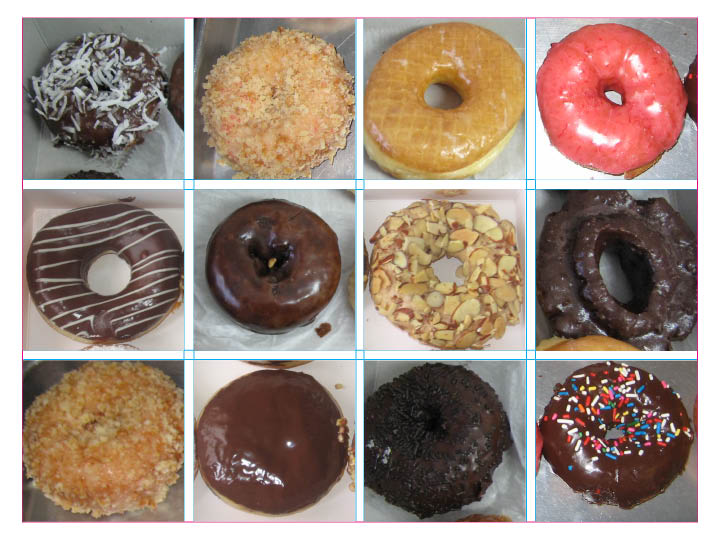
And made a mock of a sample grid, with lifted pics of donuts.

Donuts on a grid! Hi-larious.

This grid allowed me to talk about margins, columns and gutters, as well as introduce real-life uses of algebra :

How does one determine column widths?
Say our page is 12 inches, our margins 0.5 inches, that leaves us an 11-inch wide art area.
column widths = A
gutter widths = B
4a x 3b = 11 inches
Assigning B a width of 0.25 inches, A = 5.125 or 5–1/8 inches

Most 7th graders don’t take trips from Zurich to Paris. Then again, most don’t make grids to draw taxonomies, either, but for a nerdy art kid like me this would have been great!

[ADDENDUM: A week later, Linda Yablonsky blogged about a grid of donuts by ___ as part of the Miami art fairs festivities (“Art Basel Miami Beach: The Pre-Game Show,” New York Times Magazine, Dec. 2, 2009). Something’s in the air, and I think it smells like donuts.]

Standard
Art & Development

Nathaniel Rackowe’s Black Shed (Expanded)

This project by Nathaniel Rackowe looks amazing. It’ll be at Bischoff/Weiss Gallery‘s booth at Art Basel Miami, so I’ll just have to live with experiencing only the beautiful isometric rendering and my power of visualization. I had a chance to see a previous installation by Rackowe at B/W, just half a block from INIVA in London, and it was fantastic. This new work will be covered in bitumen, which, as it turns out, might be asphalt. I imagine the heat, light, and smell will be moving.

Standard
Art & Development, Research

Optimism the public art project, metaphors, gratitude, the identity of art

Reed Seifer, “a graphic artist and designer,” partnered up with Creative Time to put optimism—at least, the printed word—into the public’s pockets. See a photo and write-up: Michael M. Grynbaum’s article, “The Days May Be Grim, but Here’s a Good Word to Put in Your Pocket” (NYTimes, Nov. 19, 2009).

I’m all for optimism and public art in mundane settings. To be a bit critical, though, I think the ambiguity of a single word—any single word—seems very apparent in this project, maybe too much for my liking. That’s because the work appears in reproduction in an advertising space, and uses the tools of advertising (copywriting, concision, graphic design, mass production). It seems to be simultaneously a bit of marketing for optimism as well as marketing for itself as a single author’s project. If it is a work of conceptual art, I think it’s about as sticky as a chance procedure, as temporal as an incidental “piece.” While I’m interested in conceptual art, and I make idea-driven art, I’m pretty attached to how an art object embodies its idea.

While at times I’m acutely aware of the distance I feel from material reality / meatspace, I’m also accepting that our embodied selves inform how we understand the world. George Lakoff and Mark Johnson’s Metaphors We Live By (University of Chicago Press, 1978) is proving to be a useful text for me. It outlines the orientational and ontological means of cognition that are rooted in our physical and phenomenological experiences.

I have been thinking about gratitude and generosity a lot lately. Some of this has to do with art practice; some of it concerns life.

I’ve maintained a gratitude journal—to record that which I am grateful for—for half a year now. I first learned of the practice during my residency in Manchester this Spring, when I researched positive psychology. I started it as much to satisfy my therapeutic curiosity (to see if gratitude journals would work and make me a happier person) and as part of my commitment, as an artist, to exploring optimism.

One thing I have learned, so far, is that gratitude begets generosity. I’m reminded that I’m a lucky person; that makes me feel happy, and I’m motivated to share that lightness of spirit. These small gestures—among friends, loved ones, co-workers—are nothing; merely the stuff of everyday life; utterly forgettable and yet, for the brief times they last, thoroughly pleasurable. These are truly modest pleasures.

These gestures aren’t art. Yes, they originated in, and feed, my art practice. There’s certainly art theory and practice about generosity. And I’m still interested in Lewis Hyde‘s notions of the gift as a tool for forming or reifying social bonds. So it had occurred to me that I could make art out of these gestures—shoot some photos, name them as pieces—but that needlessly complicates them. Without a name the gesture is not a Work. But as a not-Work the gesture remains as a gesture—temporal, simple, modest. I’m appreciative of these qualities. I had come to appreciate works that are nervily barely works; in this case I like gestures that are so slight they aren’t even works. So it seems like I’m—for the moment—interested in the practice of art practice, or maybe as Barthes might put it, the Text over the Work. Indeed, Barthes’ joissance—pleasure without separation, or the pleasurable loss of awareness of self—seems to correlate with Zimbardo’s keen interest on the loss of self in instances of “finding the flow” of activities (a modest pleasure itself).

One surefire way you could have made my eyes roll in art school is to pose the question, “Is this art?” This is a worthy discussion for young artists, but it’s can also be a tedious riddle, with no definitive answers and an overabundance of circular logic. Curiously, I’ve found myself uttering this same question in my work as a preparator. There are times you unpack a crate of art, and where the Art Object begins and ends is not always apparent. It’s funny to handle stray materials with white gloves, focus and care, until their identities are determined, and it becomes “safe” to handle them with bare hands, reintegrated as parts of the mundane material reality of everyday life.

Standard
Art & Development

another joy of teaching

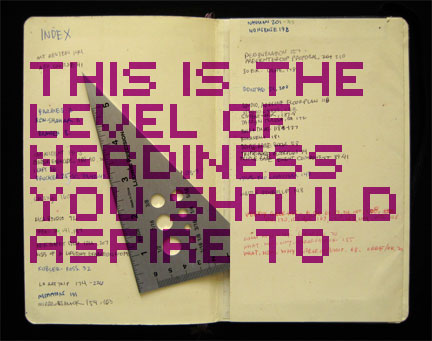
M and I were talking about sharing knowledge; he teaches design and I teach drawing/mixed media at the ASUC Art Studio. We both love to encourage our students to be extreme in their embrace of tools and techniques. He articulated one of my new favorite pedagogical mottoes:

This is the level of nerdiness you should aspire to

The pocket in the back of my Moleskin sketchbook has finally found its true calling: home to an ultra-precise metal triangle.

Standard
Art & Development

optimism and pessimism

I am opposed to false dichotomies (who isn’t), and there are times when I think artists’ embrace of ambiguity is a bit wishy-washy (obsessions man v. nature, nature v. technology, interstitial spaces, etc), but I do think optimism and pessimism is a rich terrain, and much more than a mere duality.

The test of a first-rate intelligence is the ability to hold two opposing ideas in mind at the same time and still retain the ability to function. One should, for example, be able to see that things are hopeless yet be determined to make them otherwise.
— F. Scott Fitzgerald

Standard
Art & Development, Research, Travelogue

notes from the southland

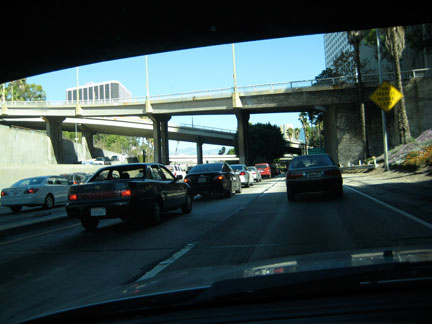
la_traffic

LA. Traffic.

Just got back from Los Angeles, where I de-installed my work at Tarryn Teresa Gallery. A few notes from my mental scrapbook:

mailinvoice

Packing up mailinvoicegetcarsmogged, 2006, plastic and ink on paper, 48 x 66 x 12 inches

Packing tools? I’ll never doubt you again, needle-nose pliers and extension cords! I should expect map pin heads to come clean off by now. I should know better than to rely on the palm sander’s cord. Thankfully, I erred on the side of caution, and it paid off.

NPR and classic rock. Apparently there’s no public radio along the I-5 in Fresno and Merced Counties, or they’re all run by evangelicals. Sans audio books, my substitute of choice was a Bakersfield-based classic rock station. If you could forgive the gratuitous misogyny, you’d discover a playlist spanning Zep, GNR, Def Leppard, Van Halen, Metallica, and Journey. Those bands once inspired repulsion in me, but I think we can all agree now that hair bands made some pretty great pop music. Last week, I heard Thin Lizzy’s “The Boys Are Back in Town” on an early morning grocery run, and it instilled a good mood that lasted hours. So I’m reclaiming this music from the heshers/burnouts/metalheads/bullies who gave it a bad name in high school, and you’re welcome to join me. For those about to rock…

Charles Burchfield, Glory of Spring, 1950, Watercolor on paper. Collection Parrish Art Museum, Southampton, New York. Gift of Mr. and Mrs. Alfred Corning Clark, 1959.6.6. Photo by Gary Mamay. Image source: Hammer Museum


Charles Burchfield at the Hammer Museum. I couldn’t see what Robert Gober, the contemporary hyper-realist sculptor, would see in a mid-century painter of landscapes. The Hammer exhibition, however, is fantastic. It makes clear that Burchfield was vastly under-recognized and portentious. His interest in abstraction, background in Asian-influenced Art Nouveau wallpaper design, experience with social realist pictorialism, and probable mental illness (see Dave Harvey’s great write-up in the LA Weekly) led to an innovative body of paintings that manages to embody countless references (to traditional Chinese scroll painting, Japanese woodcuts, OCD doodling, Cubism, and modern-day fantasy art) while forging a distinct visual language — psychedelic, immersive. I also admire his sheer conviction — after a successful stint as a Regionalist painter, Burchfield wrote in his journal,

“It seems to me, more than ever, imperative that I somehow get these fantasies into finished concrete form even tho there is not sale for them. How we will live, I do not know.”

Burchfield’s final paintings are really tremendous pictures. Some of them are breathtaking. The show is accompanied by extensive notes which provide welcome keys to the artist’s process, thoughts, doubts and motivations.

Nic Hess’ Hammer Project. Pretty great too. Masking tape drawings, a ton of vinyl decals. The placement of imagery in the space was cheeky and unexpected.

Robert Crumb’s Book of Genesis at the Hammer. I always feel the same way after viewing Crumb’s drawings: slightly dirty and tawdry, like I’d stayed at a cheap motel and watched Entertainment Weekly. More of my base self and less of my ideal self. It’s brilliant for Crumb to do a literal interpretation of the first book of the Bible in all its wretched, meaty drama. Of course Crumb can draw like no other, and there’s something vaguely appropriate, like Chick Tracts, to visualize this content in a sensational manner. The curators took pains to point out Crumb’s attempts at historical accuracy in regards to robes and architecture, but his comically zaftig female figures seem excepted from revision.

The historical exhibit at the Japanese American National Museum. I went for the Giant Robot Biennale, but two items from the historical exhibit were like punches to the stomach. First: a small girl’s cape. An internee mother modified a disused Navy peacoat for her daughter. It makes tangible the completely deranged skewing of context (where giving old military coats to forcibly-relocated families is like compassion; where modifying said coat is an act of love and resilience). Second, a massive diorama reified the scope of the internment camp at Manzanar. It was conceived and created by Robert Hasuike, a Mattel Toys model maker. It was effective and, by extrapolation, nightmarish.

Exhibition in Pasadena featuring some high-profile artists from the past 20 years of the institution’s programming. Ambitious show, disappointing reality. Only a few works emerged unscathed from the poor presentation and compromised spaces. I think the less said about this exhibition, the better. So I’ll pose, then, a series of questions:

1. When you’re an artist, and have identified artists you admire who embody rigor, quality, thoughtfulness and professionalism, and you see their work suffer due to poor presentation, how does that make you feel? Do you have similar experiences in your own history so that you can relate to these established artist’s possible regrets? And does this make you hopeful (that you’re not alone) or sad (that even established artists can’t avoid partnerships with presenters who don’t deliver)?

2. Is it the artist’s burden to accept the limitations of a non-commercial presenter? Or is it the artist’s responsibility to push them to expand their capacity and raise the level of exhibition installation and management towards professionalism?

3. When you’re a viewer and your expectations of an exhibition are raised by professionally-produced promotional collateral, who is at fault when the actual show’s installation reads on a lower level of quality, like student-grade?


On Whinging. This post is a bit more critical than usual, but I do grapple with these questions and criticisms wholly. I’m invested—I drove all over LA on a beautiful holiday afternoon and selected a a few shows to focus my attention on. I don’t set out to be critical of these shows—I try to keep an open mind and hope to be surprised for the positive.

Happy Halloween!

halloween

Standard
Art & Development

Here’s to women and risk-taking

Housewarming. The ribbons are embroidered with SoEx Rules.

Housewarming. The ribbons are embroidered with SoEx Rules.

CHEERS to the female-staffed SoEx, for successfully pulling off the grand opening of a beautiful permanent home.

and

CHEERS to Stephanie Syjuco, for successfully bridging her interest in black markets with a commercial art fair, to critical acclaim. It’s a dicey proposition to put other artists and galleries’ livelihood (and by extension, one’s own popularity and career if there’s a bad fallout) at stake but Stephanie forged (ahem!) ahead with a great idea, and it’s proven to be a timely commentary on the art market and the economic climate. Read about Copystand, her project at the Frieze Art Fair on NYTimes.com and Guardian.co.uk.

These feats are admirable. It’s pretty extraordinary to be so committed to a vision and a practice. You could say that being an artist is like being a small business owner — the fact is, most people don’t have the stomach for the financial ups and downs, much less the creative ones.

There’s nothing wrong with being ambitious.

Calvin Tompkin’s recent profile of contemporary artist Urs Fishcher in the New Yorker left me with two major takeaways. Curiously, they had nothing to do with art practice — Fischer seems too mercurial to extract much substance in that area. Rather, I was quite impressed with Urs Fischer as an organization.

Tompkins described a visit to Fischer’s studio, where the staff ate lunch — loaves of french bread and cheese — communally in the studio kitchen. I loved this. If I ever have staff, I’d like it to be the kind of work environment where a convivial meal is part of the day. (I’d add tea, fruit and chutney to the pantry.)

Second, Fischer employed close friends whose honesty and judgment he could rely on. Only very successful international artists can command fees that allow for full-time staff, yet I find the idea of paying people who I love and trust, and treating them well as colleagues, to be really beautiful and inspiring.

It’s wildly ambitious for me to imagine myself in Fischer’s shoes. Yet these mental notes form a welcome alternative to the model of the lone artist toiling away in isolation and struggle.

Standard