Art & Development

Friends who rule

I’ll bend my posting-about-art-mostly rule to express gratitude (which is not entirely unrelated to my art practice, since positive psychologists advise the maintenance of gratitude journals.)

Like in a past stint in New York, I’m again surprised to find myself among many transplanted and visiting Californians. If it seems odd to be among Californians in New York—maybe it’s cheesy and inauthentic, like hanging out at an ex-pat internet café in Bali—I am unapologetic about enjoying it. Sure, I have been meeting new people and cultivating a community here, but I am also very thankful for the old friends and acquaintances that I’ve been able to rely upon—who I know, and with whom I am known. In a new environment with emergent reflections, it’s comforting to share a rapport and background with friends.

Kinship is invaluable to me. I’m so thankful to have or have had:

Fellow Bay Area artists to relate to about navigating New York.

• Grad school classmates who are mutually supportive, and who I can rely upon for no-B.S. responses to art projects. As grad school fades further in the past, relationships with esteemed peers become more precious. I would trade no amount of money or power for the certainty of some of my cohorts’ opinions. To know and trust someone enough to ask them “Does this suck?” about my latest work in progress, and to be confident in the rigor of their critique and their knowledge of my history are truly priceless.

Longtime friends—and new friends—of deep integrity, who live life with enthusiasm, curiosity, adventure, courage, vision, insight, and conviction; who are unapologetic intellectuals; who talk and listen with warmth and generosity. I’ve been inspired by their dynamism—to learn more about cognitive science, to enact my principles more often, and to buttress my values. As ET put it, “Being nice matters.” New York is filled with ambitious people; I hope that I won’t get inured to the sight of boorish self-promotion and transparent displays of power-hunger.

• A steady stream of visitors. When I left the Bay Area, I knew I would miss everyone. But having friends, family, and art community members come to NY has eased the transition.

Colleagues. It’s neat to know that so many people—especially CCA alum—are operating in so many parts of the NY art world. The implication is that I’ll find a place soon enough; and with their help and generosity, I feel like I’ve already started down a path.

Of course, I would be adrift without those in California who continue to reach out, and put in the extra effort to maintain long distance friendships.

(With apologies to MW for lifting the post title.)

Standard
Art & Development

Freebies

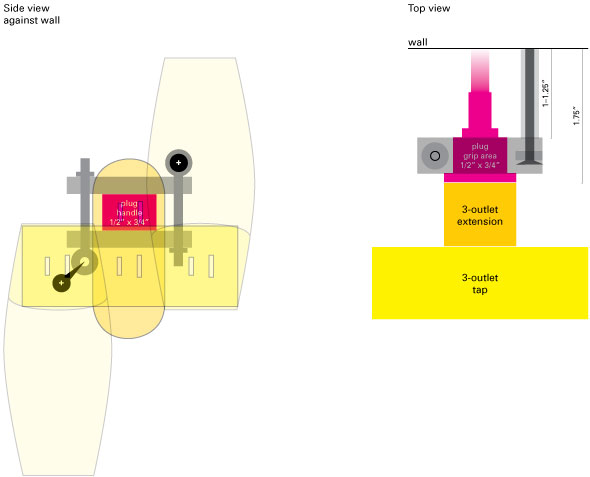
Found these old schematics recently. I made them while developing Dark into Light, an installation of 100 night lights. These schematics made me laugh, and I thought you might like them too.

Dark into Light light box construction schematic

Dark into Light light box construction schematic, 2008

Dark into Light installation hardware schematic

Dark into Light installation hardware schematic, 2008

There is a lot of invisible labor that goes into making art and exhibitions. You come up with projects, solve problems, and learn about materials—and that’s before you even make the work, finish it, pack it, transport it, and figure out how to install it. These sketches are not art; they’re byproducts, but after not seeing them for a while, I found them surprisingly fun and funny to look at and think about, if partly for the absurdity of all the work it takes to make even minimal, quiet installations.

Standard
Art & Development

videos now on vimeo

I just posted videos documenting past installations on Vimeo. Now, the Vimeo videos replace the Quicktime .mov files previously used on my website. When I built my site a few years ago, fast load times and clean design were paramount. I wanted an exhaustive but clean site, with minimal coding. Now that Vimeo’s around, and it provides crisp quality and attractive controls, it warranted an upgrade.

Now if only WordPress would support Vimeo…

In the meantime, here are links to the videos:

Documentation of Unbounded/Unfounded, 2010, light and text installation

Documentation of Binary Pair, 2008/2009, light and text installation

Documentation of Unlimited Promise, 2009/2010, light and text installation

Documentation of Dark into Light, 2008, light installation and lightbox

Documentation of Dark into Light, 2008, artist’s book

Standard
Art & Development

City Reader is here!

I contributed artwork to an artist’s publication curated and designed by Julie Clothier, a really interesting artist and designer. Featuring writing and art projects, City Reader is “a publication for the pedestrian intending to expand the frame we live within.”

The first issue of City Reader will be distributed for free on Friday, October 15th on public streets in San Francisco.

You can also view it in the Art Publishing Now, the summit happening this weekend, October 9-10 at Southern Exposure. The Art Publishing Now library will also be on view October 9 to December 2010 at Southern Exposure.

For more info about City Reader, visit Reading Conventions.

Standard
Art & Development

Musings on artifice, optimism, and synthetic happiness

Cute ___ Calendar, 2010, collage of found calendars, 12 x 12 x 0.5 inches / 30 x 30 x 1.2 cm

Cute ___ Calendar, 2010, collage of found calendars, 12 x 12 x 0.5 inches / 30 x 30 x 1.2 cm


In my most recent work about happiness, such as Irrational Exuberance (Asst. Colors), I thought about being unafraid of artifice. Since optimism, in my view, is a choice, deliberately choosing to find and take the optimistic perspective in any given situation is a bit artificial. Rather than making optimism seem less genuine, it made me think that optimism is more accessible. I may not have been born an optimist, but that doesn’t mean I can’t become one.

In a similar vein, the objects I constructed were blatantly about pleasure. People seem to have a hard time with that; their skepticism colored the work with futility. But I do really see these objects, for all their cheap materials and modest ambitions—maybe something as innocuous as to brighten one’s day—to also express my sincere interest in optimism and the benefit of small pleasures, no matter how naked their (modest) ambitions.

We synthesize happiness, but we think happiness is something to be found.

We believe that synthetic happiness is not the same as what we might call “natural” happiness. What are these terms? Natural happiness is what we get when we get what we wanted. Synthetic happiness is what we make when we don’t get what we wanted. In our society, we have a strong belief that synthetic happiness is of an inferior kind. Why do we have that belief? Well, it’s very simple. What kind of economic engine would keep churning, if we believed that not getting what we want would make us just as happy as getting it?…

I want to suggest to you that synthetic happiness is just as real and enduring as the kind of happiness that you stumble upon when you get exactly what you were aiming for… (Dan Gilbert, “Why are we happy?” delivered at a TED conference, 2004)

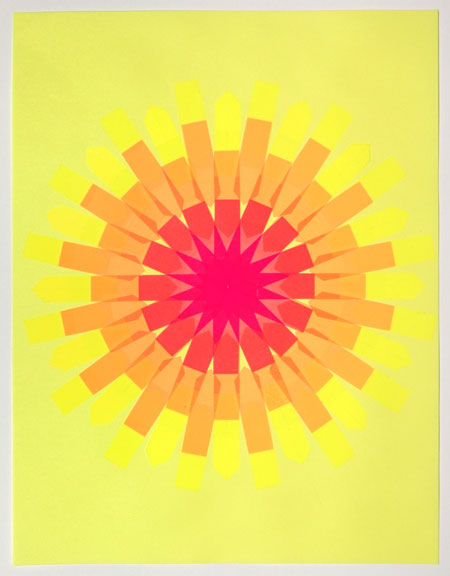
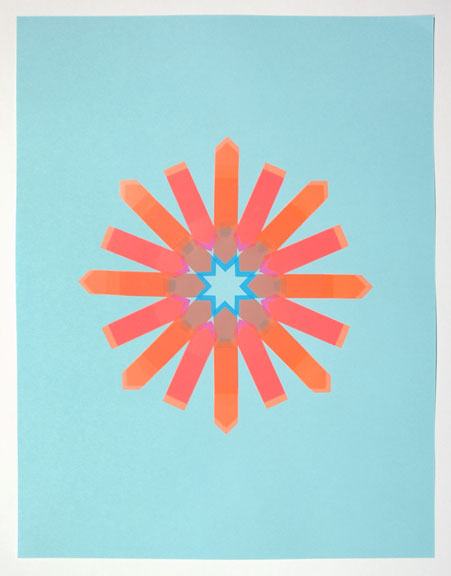
I recently just finished a new series of works on paper using more discount store goods. This time, I made 18 works using only stick-on flags arranged on “neon” paper. (As dollar-store goods are wont to do, the packaging’s promise fulfilled expectations from its own alternate universe—in other conditions, the blue and green papers would be considered pastel. I’m not complaining: “Neon” paper isn’t really neon anyway; inert gasses wouldn’t make good collage substrates.)

Working with the materials, I discovered their small potentials: while the number of available colors was very limited, the flags’ translucence and adhesive—which enhances saturation—creates the illusion of a wider color spectrum. The flags’ matte surfaces also draw attention to the paper’s reflectivity. It’s amazing how even cheap, everyday materials can convey exuberance and pleasure.

Flag Snowflake No. 2, 2010, stick-on flags on neon paper, 8.5 x 11 inches / 21.5 x 30 cm

Flag Snowflake #2, 2010, stick-on flags on neon paper, 8.5 x 11 inches / 21.5 x 30 cm

Flag Snowflake No. 12, 2010, stick-on flags on neon paper, 8.5 x 11 inches / 21.5 x 30 cm

Flag Snowflake #2, #12, & #17, 2010, stick-on flags on neon paper, 8.5 x 11 inches / 21.5 x 30 cm

Flag Snowflake No. 17, 2010, stick-on flags on neon paper, 8.5 x 11 inches / 21.5 x 30 cm

Flag Snowflake #2, #12, & #17, 2010, stick-on flags on neon paper, 8.5 x 11 inches / 21.5 x 30 cm

To support Kearny Street Workshop, I’m donating the above three selections from the Flag Snowflake series to One Size Fits All, an online sale. Bid on works by 48 artists who created 8.5×11 works on paper—all for the stunningly affordable price of $100 each. Artists include Jenifer K Wofford, Mike Arcega, Stephanie Syjuco, Weston Teruya, and many, many more.

Kearny Street Workshop is the nation’s oldest Asian Pacific American multidisciplinary arts organization. They have supported me in the past by exhibiting my work in their emerging arts festival, inviting me to present my work, and in 2008, supporting the development of all new work for a three-person exhibition. They have been continuing their work with the dynamic leadership of Ellen Oh—recent projects include partnerships with the de Young Museum. I’m very honored to support KSW, and hope you do too if you can.

Especially for artists: Some thoughts about setting goals and heeding cautions—

Yes, some things are better than others. We should have preferences that lead us into one future over another. But when those preferences drive us too hard and too fast, because we have overrated the differences between these two futures, we are at risk. When our ambition is bounded, it leads us to work joyfully. When our ambition is unbounded, it leads us to lie, to cheat, to steal, to hurt others, to sacrifice things of real value. When our fears are bounded, we’re prudent, we’re cautious, we’re thoughtful. When our fears are unbounded and overblown, we’re reckless, and we’re cowardly. The lesson I want to leave you with, with these data, is that our longings and our fears are both overblown to some degree, because we have within us the capacity to manufacture the very commodity we are constantly chasing when we choose experience. (Dan Gilbert, “Why are we happy?” delivered at a TED conference, 2004)

Standard
Art & Development

Art Publishing Now & Critical Sources II

I am so proud to be involved with Art Practical. With its mission to cultivate and art critical writing and writers, Art Practical the result of the hard work and generosity of lots of bright, interesting people. I think the San Francisco Bay Area is lucky to have them, and that you should know about their programs and projects.

Art Publishing Now
October 9-10, 2010
Southern Exposure, San Francisco, CA

This coming weekend, October 9 and 10, Art Practical will participate in Art Publishing Now, a Summit, Afterparty and Library organized by Southern Exposure and a slew of publishing dynamos. The list of participants in the Fair looks killer. I love ‘zine fairs and I love art criticism (especially presented by writers and editors). Just go!

Critical Sources II
October 16, 2010, 12 – 4 p.m.
The Lab, San Francisco, CA
$25

Art Practical and The Lab are hosting Critical Sources II, the second in a series of workshops on art criticism. Among the workshop instructors is Kevin Killian, whose charming presence I spent many hours in while at CCA. His class on writing reviews was one of my favorites. (I once drove to Fresno for a field trip—a seven-hour round trip—but cut it short to get back for Kevin’s class.)

I’m sure all the instructors are great. At that price, it’s like they’re paying you to be there. [J.L.!]

It gets better: The class includes workshop-ing your reviews, and the two exhibitions you can choose to write about include Huckleberry Finn at the CCA Wattis Institute. I previously exhibited artwork and worked at the Wattis; I’m very fond of the literary series. I’ve heard very sharp critics say that this is the best of the series so far. Judging by last years’ no-holds-barred Moby-Dick, it must be impressive.

So, not only are they paying you to improve your art writing, they’re giving you an excuse to make it out to Dogpatch and see an amazing exhibition.

Standard
Art & Development

Points of Reference

Assorted sources of gratification, amusement, and inspiration.

Sol Lewitt at Dia:Beacon

Sol LeWitt, Wall Drawing #1085: Drawing Series-Composite, Part I-IV, #1-24, A+B, (detail), 1968/2003. Photo: Bill Jacobson.

Sol LeWitt, Wall Drawing #1085: Drawing Series-Composite, Part I-IV, #1-24, A+B, (detail), 1968/2003. Photo: Bill Jacobson. Image Sources: Dia:Beacon

Sol LeWitt, Wall Drawing #1085: Drawing Series-Composite, Part I-IV, #1-24, A+B, https://cwongyap.wordpress.com/wp-admin/post-new.php(detail), 1968/2003. Photo: Bill Jacobson.

Sol LeWitt, Wall Drawing #1085: Drawing Series-Composite, Part I-IV, #1-24, A+B, (detail), 1968/2003. Photo: Bill Jacobson. Image Source: Dia:Beacon

Learn why this combo rocked my world in the previous post, “Good New for Art Lovers.”

Designer and happiness evangelicist Stephen Sagmeister’s TED talk videos

Graphic designer Sagmeister wants to promote happiness. He’s compiled some advice on living in an exuberantly designed book called “Things I Have Learned in My Life So Far.” In his TED talks, he presents his ideas in a very elemental, approachable style. At the risk of making a huge generalization, I found his demeanor self-possessed in a European way—dry wit and nonchalance just short of indifference. (It makes American enthusiasm—wide eyes, big smiles—seem like ostentatious over-sharing.) Presenting simple, innocent gestures with such unconcerned confidence can sometimes come off with a whiff of entitlement, but for all his success—which is evidently abundant—he is modest and gracious, always using the pronoun “we” to share the authorship of his work (but never naming names).

Anytime designers can break free from the conventional corporate path is great; Sagmeister’s direction—happiness—is an interesting choice.

Some of Sagmeister’s projects look like art. He makes installations, photographs and other creative gestures, often on his sabbaticals. Some of the appropriations of contemporary art techniques seem a bit apparent. At one point during his slide show, I winced, because a text made of shadows so recalled the work of Fred Eerdeckens. I haven’t got a problem with designers, or other artists, trying creative approaches that have been done before. It’s just that designers’ images aren’t held to the same critical standards that the works of contemporary artists—the creative risks are not the same. With Sagmeister’s office located in Chelsea, it’s safe to assume that he sees lots of art; a nice gesture, if he does borrow from what he sees, would be to collect art, rewarding those whose inspiration has enhanced your life (if not also your firm’s bottom line).

[On a related note, M is currently studying design that moves beyond visual style. I’m eager to see what he discovers. As designers generate content, and become authors and researchers, with what criteria should their work be judged?]

Designer Ed Fella charms and confuses young ‘uns with talk of photostats and Letraset at the Walker

Ed Fella is an interesting counterpart to hip Sagmeister. Fella, known for his handmade design work and typographic doodles, has a cult-like following among art and design students. His work is delightfully old-school. He’s also completely transparent about his appropriation of styles, and of the insignificance of the content of his work beyond the design community.

In his lecture at the Walker Art Center in Minneapolis, he’s got a kindly conversational style, both grandfatherly and professorial. With his quirky hoarding of images of vernacular signage, his pursuit of offbeat methods, his unapologetic borrowing of historical styles, and his insistence on making room for young designers, Fella is generous and forthright.

[Can I just say how great it is to be able to access museum lectures online? It’s a proper extension of museum’s purposes.]

Chris Duncan
Eye Against I
Baer Ridgeway Exhibitions, San Francisco

Chris Duncan, Eye Against I, installation view

Chris Duncan, Eye Against I, installation view. Source: Baer Ridgeway Exhibitions, San Francisco, CA.

Chris Duncant, Obstructed Image 14, 2010  Found paper and tape  14 x 20 inches

Chris Duncan, Obstructed Image #14, 2010, Found paper and tape, 14 x 20 inches. Source: Baer Ridgeway Exhibitions, San Francisco, CA.

This show manages to be sparse but massive. In encompassing and altering the gallery’s architecture, it brims with Duncan’s ambition. It places the viewer literally within his vision. The smaller works look brilliantly simple and expertly executed. I think the tape-out pieces are sublime.

Wish I could be in San Francisco to experience it firsthand.

Standard
Art & Development

Good news for art lovers

I had a revelatory experience looking at squiggles on a wall today.

For the first time, I gained a deep appreciation for Sol Lewitt‘s work. Though I’ve seen a few of his works in person and many in reproduction, the innovation, technique and phenomenological experience did not become reified to me until my visit to Dia:Beacon today.

There are eight rooms dedicated to Lewitt’s early wallworks at the Dia:Beacon in upstate New York. While all the works followed instructions, and often consisted of no more than pencil line on white walls, they resulted in myriad visual experiences. They were immense, immaculately executed, and beautifully situated in one of the best buildings for viewing art that I’ve seen in the US.

The drawings brought to mind ideas about order, grid, variation, geometry, the human hand and authorship. I thought about the attention to detail that the executors brought to their tasks, the roots of our associations between abstractions and whimsy or gravitas, the simplicity of the materials, and the ingeniousness of Lewitt’s efficacy.

The works grounded me at Dia:Beacon. I was flooded with gratitude. I felt lucky to be able to see the works in person in such a lovely setting. I was also grateful to the Dia Foundation for allowing so much space to individual artists. I never saw anything like this in California. This dedication was complimented with a commitment to direct, uninterrupted viewing experiences. Didactic texts were minimal; perfect, indirect sunlight filtered in from the building’s northern windows; guards were sparse, demure, and inconspicuous; and there was plenty of space and peace.

It might seem strange to admit, but standing in a room with only pencil lines and squiggles on a grid, a dopey smile spread across my face. This the quality and scale of the viewing experience and the stellar collection re-energized my excitement about being in New York. At the risk of hyperbole, Dia:Beacon elevated my expectations of what is possible in art.

Also on view are breathtaking “negative sculptures” by Michael Heizer, and many fine examples of Fred Sandback’s yarn installations and Bernd and Hilla Becher’s photographs. I also loved the cool basement full of uningratiating works by Bruce Nauman (including his recent studio-mouse-surveillance videos, complete with shop stools), Louise Lawler’s humorous bird calls-based outdoor sound piece, and a room full of On Kawara’s date paintings. Robert Irwin’s landscape design formed a soothing contemporary art idyll. I didn’t want to leave.

Photographs were not allowed, and in any case, my snaps would not do any justice to Lewitt or Dia. You’ll just have to see it with your own eyes.

Dia:Beacon
Beacon, NY

Standard