Art Competition Odds

art competition odds: Smack Mellon’s 2015 Artist Studio Program

Smack Mellon’s 2015 Artist Studio Program received 675 applications for 6 available studios.

/////////////////////////////////////////////////
/////////////////////////////////////////////////
/////////////////////////////////////////////////
/////////////////////////////////////////////////
/////////////////////////////////////////////////
/////////////////////////////////////////////////
/////////////////////////////////////////////////
/////////////////////////////////////////////////
/////////////////////////////////////////////////
/////////////////////////////////////////////////
/////////////////////////////////////////////////
/////////////////////////////////////////////////
/////////////////////////

or about 1:112.5, or 0.88%.

That’s roughly 0.3% better odds than in 2014.

See all Art Competition Odds.

Standard
Art Competition Odds

art competition odds: Art OMI’s 2015 residency program

Art OMI’s 2015 residency program received 990 applications for 30 accepted residents.

//////////////////////////////////////////////////
//////////////////////////////////////////////////
//////////////////////////////////////////////////
//////////////////////////////////////////////////
//////////////////////////////////////////////////
//////////////////////////////////////////////////
//////////////////////////////////////////////////
//////////////////////////////////////////////////
//////////////////////////////////////////////////
//////////////////////////////////////////////////
//////////////////////////////////////////////////
//////////////////////////////////////////////////
//////////////////////////////////////////////////
//////////////////////////////////////////////////
//////////////////////////////////////////////////
//////////////////////////////////////////////////
//////////////////////////////////////////////////
//////////////////////////////////////////////////
//////////////////////////////////////////////////
////////////////////////////////////////

Participants comprise about 1:33, or 3.0% of applicants.

This is a higher rate of applications and worse odds from past years.

See all Art Competition Odds.

Standard
Make Things (Happen), News

Make Things (Happen) Coming to Oakland, CA!

Make Things (Happen)
Interface Gallery
Oakland, CA

Over the past few months, I’ve been expanding Make Things (Happen) for its exhibition at Interface Gallery in Oakland! Now with 45 artist-created activity sheets, the project will include interactive work stations, offsite locations (pick up a postcard in the gallery for details), and public programming led by artists!

February 6–March 1
Interface Gallery

486 49th Street (in Temescal Alley, off Telegraph), Oakland, CA

Friday, February 6
6–9pm: Opening reception (Oakland First Fridays)
7pm: Probe the twin histories of astronomy and astrology with Lauren Marie Taylor. Make a star chart, create new constellations, then officially name and dedicate your very own star.

Saturday, February 7 
1pm: Meal Ticket with Lexa Walsh brings together different individuals for a home-cooked meal and recipe exchange to facilitate conversation and community. The recipes are complied into a community cookbook, creating a unique group identity, while the meals propose a temporary utopia to encourage a hospitable democracy. RSVP at interfaceartgallery@gmail.comat capacity.

Gallery Hours: Wed–Sun, 11–4
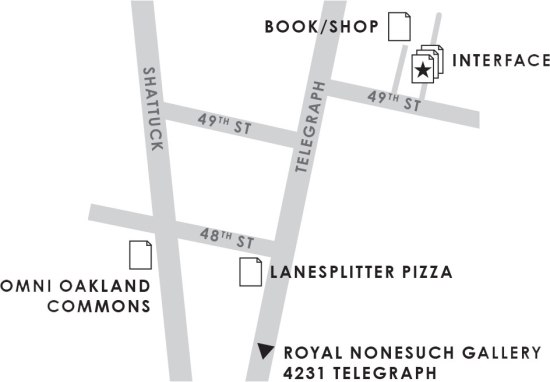
 

map of offsite locations

Go out and find four sheets at our neighbors:
Book/Shop, 482D 49th St, Tue–Fri 12–6, Sat 10–6
Lanesplitter Pizza, 4799 Telegraph @ 48th St, daily 11am-12am
La Commune Bookstore at Omni Oakland Commons, Shattuck @ 48th St, Tue–Sun 12–6
Royal Nonesuch Gallery, 4231 Telegraph @ 43rd St, Sat–Sun 1–4

Artists: Lauren F. Adams, Oliver Braid, Maurice Carlin, Kevin B. Chen, Torreya Cummings, Helen de Main, double zero, Bean Gilsdorf, Galeria Rusz, Sarrita Hunn, Maria Hupfield, Ariana Jacob, Hannah Jickling & Helen Reed, Nick Lally, Justin Langlois, Justin Limoges, Jessica Longmore, Mail Order Brides/M.O.B., Kari Marboe & Erik Scollon, Betty Marín, Mark Anthony Martinez, Meta Local Collaborative, Melissa Miller, Roy Meuwissen, Laura Napier, Susan O’Malley, Dionis Ortiz, Kristina Paabus, Piero Passacantando, Julie Perini, Ryan Pierce, Pavel Romaniko, Risa Puno, Genevieve Quick, Mary Rothlisberger, Pallavi Sen, Elisabeth Smolarz, Tattfoo Tan, Lauren Marie Taylor, sharita towne, Emilio Vavarella, David Gregory Wallace, Lexa Walsh, Alex Wilde & Emily Chappell, Brian Zegeer, Lu Zhang

The results ran the gamut from celebratory, such as making commemorative plates of one’s own life, to darkly hilarious, such as the reproduction and delivery of an ominous note written by Stanley Kubrick to Tom Cruise. … While some of the artists’ instructables can be executed solo, Yap is a great fan of the Venn diagram: Overlapping with others is the real payoff.

—Silke Tudor “DIY Gallery,” SF Weekly (February 4, 2015).


#mkthngshppn

Standard
Research

Ellen Sebastian Chang’s and Maya Gurantz’ live video feed public art project, A Hole in Space (Oakland Redux), was inspired by Kit Galloway’s and Sherry Rabinowitz’ 1980 Hole in Space. But instead of inviting the public on opposite coasts to interact as in the original version, Chang and Gurantz sited the project for residents of North and East Oakland. See Sarah Burke’s “Artists Create Two-Way Video Portal for Oaklanders to Meet Their Neighbors” in the East Bay Express (January 28, 2015).

Link

Lots of strong works on view in (Im)Material, a smart exhibition exploring the visible and the invisible. Curated by Kevin B. Chen, it is on view at the Headlands Center for the Arts in Fort Barry, Marin through February 22. I loved seeing new developments by Bay Area artists alongside many artists new to me.

Soyoung Shin, Byron Au Yong, Susie J. Lee.,  Piano Concerto – Houston. Source: soyoungshin.com.

Silent, captivating video portraits of musicians mimicking a performance. Perhaps the closest I’ll experience to synesthesia. Soyoung Shin, Byron Au Yong, Susie J. Lee., Piano Concerto – Houston. Source: soyoungshin.com.

Randy Colosky, Ghost in the Machine, 2012, steel frame with 1" aluminum tubes, courtesy the artist and Chandra Cerrito Contemporary.

Love this super simple form with interesting optical effects. It isn’t any more elaborate than it needs to be, yet offers much room for perceptual discovery. Randy Colosky, Ghost in the Machine, 2012, steel frame with 1″ aluminum tubes, courtesy the artist and Chandra Cerrito Contemporary.

Detail. Randy Colosky, Ghost in the Machine, 2012, steel frame with 1" aluminum tubes, courtesy the artist and Chandra Cerrito Contemporary.

Detail. Randy Colosky, Ghost in the Machine, 2012, steel frame with 1″ aluminum tubes, courtesy the artist and Chandra Cerrito Contemporary.

Jennifer Brandon, Cast VIII, 2014, archival pigment print. Source: jenniferbrandon.com

Again, simple idea, nice execution. Strangely formal drapery images that appear solid, but are in fact pieces of plastic sheet that hang in the air for a millisecond. Jennifer Brandon, Cast VIII, 2014, archival pigment print. Source: jenniferbrandon.com

A densely layered papercut photo print using an image recovered from the 2011 earthquake and tsunami in Japan. Amazing craftsmanship around a very powerful history. Mayumi Hamanaka, from the Invisible Lands series. Source: mayumihamanaka.com

A densely layered papercut photo print using an image recovered from the 2011 earthquake and tsunami in Japan. Amazing craftsmanship around a very powerful history. Mayumi Hamanaka, from the Invisible Lands series. Source: mayumihamanaka.com

Anyone who has lost a loved one will recognize these collections of possessions as memorials to people. The futility of capturing one's loss and grief is only underscored by the objects that remain present. Kija Lucas, Objects to Remember You By: Collections from Sundown, 2014, archival pigment print. Source: kijalucas.com.

Anyone who has lost a loved one will recognize these collections of possessions as memorials to people. The futility of capturing one’s loss and grief is only underscored by the objects that remain present. Kija Lucas, Objects to Remember You By: Collections from Sundown, 2014, archival pigment print. Source: kijalucas.com.

Sights

Sights: (Im)Material @ Headlands Center for the Arts

Image
Impressions

Impressions: Jos de Gruyter & Harald Thys @ the Wattis

_____ness, overexamined.


Longtime New Yorkers, including Martha Rosler, like to point out how suburbanized New York City has become. However, I could argue that, as real New Yorkers, they do not truly know suburbia. I thought about this as I stepped off the SFO-originating BART and into the slow, foggy town of my teenage years, where, over the coming days, I would complain about how the Home Depot’s layout is backwards from its usual lumber-on-the-right floor plan, and, for even the most middling of needs, visit Target  at a mall whose property line would encompass two subway stops on the N/Q. No stranger in a strange land, I’m a prodigal daughter in an ur-burb. I mull “basic culture”—the concept, terminology, and usage, and all the classism and cultural elitism it entails—while consuming it too.

With this in mind, Tram 3 struck me as extremely _____, in multiple ways. Here, rather than a symbol of purity, it’s a non-color, a normative default, nothingness. It pervades the works with the angst of pointlessness.

For Tram 3, the Wattis is a large, airy, sky-lit cube immaculately painted in matte, cool _____. Nary a patch glinted. Several oversized, oversimplified human-like cutouts populate the space. They’re simply constructed from steel plates, but are painted so matte and so _____ that they could well be Sintra (a rigid foam board). Casually taped on them are quick sketches of portraits on _____ paper, drawn as if the artist was short on graphite and time. On the walls are similar drawings of trams and tram riders. They’re framed but unglazed. The whole space is luminous with soft, reflected light. Even the track incandescent lighting approximates ambient fluorescents.

In a cavernous neighboring space, the artist’s video, Die Aap van Bloemfontein [The Ape from Bloemfontein] (2015) plays. Or, rather, the media advances. It’s a spectacle of inaction, a series of painfully long shots of tableaux in which actors imitate motionlessness. The actors are all _____. They are shot under hot lights, in unflattering, tight close-ups. Moles glisten. Crooked teeth are bared. A narrator’s voiceover describes transformations of objects into subjects and back. Rather than magical, it’s passively futile. Nothing happens, acutely. It’s not liberating Zen; it’s oppressive sameness. It’s monolithic culture, Northern European social order, and suburban predictability. It’s ennui born of (first-world) boredom. Sartre flat-packed in IKEA.

The exhibition signage is black text in Times Roman, a signature that Wattis director Anthony Huberman imported with him from the Artist’s Institute in NYC. Simple, black-and-___, and open is a quietly loud differentiation from predecessor Jens Hoffman, who with graphic designer Jon Sueda gave each exhibition assertive identities via color, typography, and architectural interventions. Under Huberman’s lead, the Wattis’ collateral has become restrained and cerebral. The website features no images, as if to say that art is not objects and visuals, but a series of open-ended ideas and exercises best experienced temporally and ephemerally. Thankfully, the exhibition brochure is written with concision and wit. While it ascribes absurdism to de Gruyter’s and Thys’ work, I didn’t see this lightness. If there is humor, it’s only black.


Through April 18
Jos de Gruyter & Harald Thys: Tram 3

Wattis Institute
San Francisco, CA


Standard
Citizenship

Thoughts on galleries in San Francisco Chinatown

Capital Gallery and Et Al make two galleries now in San Francisco Chinatown. It is premature to call a trend, and probably fear-mongering to mention gentrification. But while I like these two galleries in Chinatown, I wouldn’t necessarily want to see many more.

Reasons to be excited:

  • New galleries in SF! Especially after all the recent closures….
  • These are good galleries. They’re curatorially interesting: Artists currently at Capital: Virginia Overton, Will Rogan, Cynthia Daignault (nice to see local and non-local artists in dialogue; though if this were in Chelsea I wouldn’t be impressed). Et Al seems to specialize in an area in which I’ve long felt the Bay Area underperforms: giving well-deserved solo shows to local artists (however the current show by Anthony Discenza may be an exception, as he’s got representation and visibility; I’ve posted impressions).
  • They espouse and maintain professional-level display. There are plenty of scrappy, funky, or difficult spaces here already.

Reasons to proceed with caution:

  • SF Chinatown is already dense and hemmed in by the Financial District and touristy North Beach. The very existence of Chinatown, as an idea and a place, has been contested with xenophobia and racism, throughout its history and particularly following the 1906 earthquake. (LA Chinatown’s galleries are different; they seem to occupy a sleepier area away from vital markets used by residents, whereas there isn’t really under-utilized space in SF.) I hope it would be safe to assume that any proud Bay Area residents need not be reminded of Manilatown, the I-Hotel, and the dangers of gentrification.
  • I didn’t grow up in Chinatown. Yet its continuing importance in my personal and family life might help illustrate its overall importance to Chinese Americans in the Bay Area. My grandparents lived there—the neighborhood is an ideal community for Chinese-speaking seniors, especially when you consider aging people’s isolation in car-oriented suburbs. Like countless many before her, when my mom first came to the US, she stayed in a boarding house in Chinatown; it’s a point of entry, a navigable community in which to find a home and learn about a new country. Later, after my parents married and relocated north to work, we would visit Chinatown every Sunday to visit family and stock up on groceries, driving an hour each way. When we moved closer, I gained Chinese language skills by attending Saturday school on Jackson Street. As a young adult trying to form my identity, I’d roam Chinatown in seek of meaningful connections. Eventually I gained an internship at the Chinese Cultural Center (on Kearny just north of the galleries), which organized a trip—the only program of its kind to do so in the US—to visit my ancestral village in the Pearl River Delta region in China. That experience was a life-changing event. I garnered a new understanding of myself, my parents, and my grandparents, as well as an un-describable feeling that comes with knowing that one of my family lines can be traced back 34 generations. Despite moving to suburbia, my parents enjoyed many years attending events at a family association, one of their primary means for social connection, on Stockton. (In fact, most of the people at my wedding—held in a banquet hall on Grant, one block west of the galleries—were members of my parent’s family association.) My mom continues to attend association events and patronize Chinatown’s Buddhist temples, traditional pharmacies, and bookstores.

Non-Chinese San Franciscans might think of Chinatown as only Grant Street—as essentially a constructed tourist trap, with some cheesy dive bars thrown in. But it’s much more culturally rich and important than that. Even if Chinese Americans reside throughout the Bay Area now, SF Chinatown is still the beating heart of this community.

This is not a criticism of the galleries or the people that run them. Et Al is run by a trio; of which Jackie Im and Aaron Harbour are vocal supporters of contemporary art and critical discourse in the Bay Area. Capital is run by two Bay Area artists, Jonathan Runcio (I liked his work at Romer Young’s booth at NADA last year) and Bob Linder, who co-directed Queen’s Nails. I am sure that finding affordable space and running a gallery in SF is extremely challenging now, and those efforts are to be commended. If anyone can situate a gallery sensitively within a neighborhood, I hope they—and anyone following in their footsteps—can.

Standard