Works

Memory of an Artwork: Thomas Demand’s Rain/Regen

A stop-motion that reappears along a river of time.

Thomas Demand, Rain/Regen, (still), 2008. // Source: dhc-art.org.

Thomas Demand, Rain/Regen, (still), 2008. // Source: dhc-art.org.

Certain art-viewing experiences stay with you over time. When they’re pleasant, they can remind you of how meaningful the act of looking can be. Recalling a work of art—like reliving any memory—strengthens its salience. It could be that a series of vital art experiences will one day form a tally of the particular arcs of my life.

I’m in a reflective mood, having just finished William Finnegan’s memoir, Barbarian Days: A Surfing Life. It’s about a life shaped by a passion, and later, a passion shaped by life, including loss and aging. Along with reading a remembrance of Oliver Sacks, and a book by the late positive psychologist Chris Peterson, my thoughts keep returning to what makes a life worth living.*

One work that I’ve continued to think about is Thomas Demand’s** Rain/Regen (2008). I saw it in 2010 in The Dissolve, the moving-image focused iteration of SITE Santa Fe’s biennial. It was my first visit to SITE and Santa Fe, on my first cross-country drive. We were moving from California to New York. Marking this life change with a road trip was wise. Those two weeks stand out in high relief.

I remember stepping out of Santa Fe’s picturesque, sun-baked adobe environs into the cinematic black box of the ICA. Floating screens and scrims primed me for psychologically-loaded spaces. Teresa Hak Kyung Cha’s notion that video paralleled the cinema of the mind seemed present.

Essentially, Demand makes stop-motion animations using paper constructions that are ever-increasing feats of production value. Rain/Regen is just what it sounds like—it’s an animated image of raindrops falling in a thin, frame-filling puddle. The fact that it’s constructed by hand, frame by frame, is astonishing. In this case, the paper might be bits of thin, clear plastic torn and stretched by hand. But like rain, all you see are streaks and a momentary splash upon impact. It’s gone in a split second. It happens fast, before your eye can catch up to it. It’s startlingly reminiscent of the overall peripheral sensation of rain. The perceptiveness of perception itself seems yet even more impressive. I know crediting this work with technical wow-factor sounds hollow. But the simplicity of the shot, indeed, the everydayness of the concept, paired with the ambition of animating it, forms a curious nexus.

I was moved by many works in that show, but Rain has stuck with me. Even the physics of a seemingly trivial drop of water exceeds the abilities of the human eye. We grasp only its motion, implosion, and disappearance.

*It’s been oddly reassuring that mentions of friends, colleagues, and acquaintances keep popping up in books I’m reading: Ted Purves in Tom Finklepearl’s What We Made, Marshall Trammel in Greg Sholette’s Dark Matter, and a familiar image by Hank Willis Thomas in Jeff Chang’s Who We Be. It’s probably attributable to two truths: the inevitability that a cohort would become the archivists and subjects of our eras, and, though I didn’t know it at the time, I was in the right places at the right times.

**It’s safe to assume that mega-artists like Thomas Demand rely heavily on studio staff for producing artworks, so a more fitting attribution would actually be “Thomas Demand Studio.” Of course sole authorship flows more freely through the systems of capitalism and law, but it’s nice to imagine a day that we drop these pretenses.

Standard
Values

“Someone who is highly self-aware knows where he is headed and why; so, for example, he will be able to be firm in turning down a job offer that is tempting financially but does not fit with his principles or long-term goals. A person who lacks self-awareness is apt to make decisions that bring on inner turmoil by treading on buried values.”

Daniel Goleman, “What Makes a Leader,” Harvard Business Review, January 2004.

Daniel Goleman on values coherence

Quote
Art Competition Odds

Art Competition Odds: 2016 Dieu Donné Workspace Program residency

The 2016 Dieu Donné Workspace Program residency received nearly 400 applications for 4 residencies.

//////////////////////////////////////////////////
//////////////////////////////////////////////////
//////////////////////////////////////////////////
//////////////////////////////////////////////////
//////////////////////////////////////////////////
//////////////////////////////////////////////////
//////////////////////////////////////////////////
//////////////////////////////////////////////////~

Residents comprise about 1:100, or 1% of applicants.

See all Art Competition Odds.

Standard
Thought Experiments in Agency

Wages Among Art Worker Coalition Members

On the value of an hour.

In Julia Bryan-Wilson’s Art Workers: Radical Practice in the Vietnam War Era, three hourly wages are described: $2–3, 4, and $25.

$2–3/hour

Lucy Lippard got her master’s at NYU so she could raise her hourly rate for doing research from $2 to $3. She graduated in 1962. In 2015 dollars, that’s $15.65 and $23.48, respectively.*

$4/hour

Slightly better paid were a few art handlers. Sol Lewitt paid four assistants $4 per hour for four days to fabricate his wall drawing in Kynaston McShine’s Information show at the Museum of Modern Art. Four 1970 dollars adjusts to $24.91 in 2015.* It’s decent; it’s close to a common freelance art handler rate in New York now.

$25/hour

This is Robert Morris’ wage in The Peripatetic Artists Guild, an performative art project in which he placed ads offering his services in a range of political, artistic, and construction projects. (He also stipulated that “all travel, materials, construction and other costs to be paid by the owner-sponsor” and that any subsequent sales require a 50% return of funds.) Twenty-five dollars in 1970 amounts to $155.71 in 2015 dollars.*

This is an art project, so it’s economically irrational, to the extent that Bryan-Wilson acknowledges that “in retrospect it appears to offer a remarkably good deal.” I assume that she’s comparing that hourly wage to the cost of purchasing Morris’ artworks now.

Still, I think there’s something fishy about this project as an exercise in wage labor. With such a high rate, all expenses paid, and resale rights that most artists today still don’t enjoy, the ‘guild’ is operating more like a hard-negotiating consultant. When you can make in one hour what others make in eight, you’re afforded more choice and autonomy. It’s not a precarious or proletarian position, so Morris’ identification with “workers” and “wage labor” is questionable.

As Patricia Maloney asserts in a recent op-ed on Art Practical:

“We cannot perceive artistic compensation as an end goal abstracted from the strata of support that precipitate that payment. We need to reinforce the infrastructure that enacts that labor.”

Building upon that, I’d ask what are the infrastructures that afford and determine compensation? How are these infrastructures shaped? Art handlers at large museums usually receive a decent wage and working conditions, mirroring the affiliation of museum workers with a union—one of the lasting accomplishments of Art Worker Coalition agitation.

How are these infrastructures biased?** Do they fall into the trap of equating administrative labor with women’s work, rendering it less visible and less likely to be well-remunerated? When I interviewed Elizabeth Travelslight this spring, she noted,

“I think administration—often because it’s gendered female—it’s not considered noteworthy.”

Yet administration keeps collectives, coalitions, and movements together. Indeed, one of the factors in the dissolution of the Art Workers Coalition was the defection of women—including its administrators—to feminist groups where they felt they could be heard.

*Inflation adjusted via dollartimes.com.

**The Andrew W. Mellon Foundation’s new study of diversity on museum staffs provides quantitive evidence to what many museum workers already know: women are well represented in curatorial, conservation, and education, and people of color are often employed in low-growth departments in maintenance and security.

Standard
Thought Experiments in Agency

Artists, Self-Care, Psychology and Politics

In thinking about psychological resourcefulness, and how artists might view ourselves, this struck a chord:

“I think of self-care as a political position, which one must take when one is vulnerable to a system that doesn’t recognize and care for you.”

—Shannon Stratton, as quoted by Zachary Cahill, “Exquisite Self-Reliance: Zachary Cahill talks with Shannon Stratton,” The Exhibitionist, August 10, 2015

It was great timing to come across this quote, as I’ve been thinking about artists’ power this past week-and-a-half in LMCC’s Process Space studio program.

Julia Bryan-Wilson: Art Workers: Radical Practice in the Vietnam War Era

Julia Bryan-Wilson: Art Workers: Radical Practice in the Vietnam War Era // Source: UC Press

I read Julia Bryan-Wilson’s “Art Workers: Radical Practice in the Vietnam War Era” (2011), a look at the ‘art worker’ identity vis á vis the Art Workers Coalition and four key figures: Carl Andre, Robert Morris, Lucy Lippard, and Hans Haacke. The book has deepened my understanding of AWC and each of these individuals’ practices, especially how their politics influenced their artistic development and vice versa (rhetoric and a soapbox for Andre, risk and a cynical turn for Morris, public evolution of perspectives for Lippard, and a lost Guggenheim solo show and reinforced beliefs for Haacke).

Hans Haacke, On Social Grease (quote David Rockefeller; one of six panels) 1975. Photograph: Walter Russell. © Hans Haacke/VG Bild-Kunst // Source: tate.org.uk

Hans Haacke, On Social Grease (quote David Rockefeller; one of six panels) 1975. Photograph: Walter Russell. © Hans Haacke/VG Bild-Kunst // Source: tate.org.uk

I especially appreciate the extensive historical context, from the Vietnam War (and burgeoning anti-corporate ethos), the strategy of non-participation in the context of mass strikes and slowdowns, the New Left and the writings of Marcuse, and the rise of second wave Feminism (which ultimately bore the alternative culture the museum-targeting AWC aspired to create). I enjoyed Bryan-Wilson’s embrace of practice-as-rehearsal; ‘success’ and ‘failure’ are criteria too blunt for these shifting developments. She’s a fastidious thinker, using clear language to nimbly explore contradictory aspirations and actions.

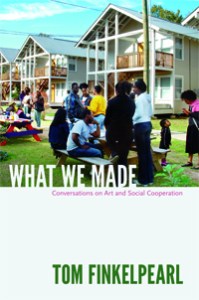
Tom Finkelpearl, What We Made: Conversations on Art and Social Cooperation // Source: Duke University Press.

Tom Finkelpearl, What We Made: Conversations on Art and Social Cooperation // Source: Duke University Press.

I’ve also recently re-read the introduction and conclusion of Tom Finklepearl’s What We Made: Conversations on Art and Social Cooperation (2013). The introduction is a thorough history of social and relational art, the social history that influenced it, and the books and exhibitions that mark its evolution. It’s a fantastically researched chapter, and if it were up to me, I’d make it required reading.

Finklepearl, formerly of the Queens Museum, profiles a refreshingly diverse set of artists. The conclusion draws upon American philosophical pragmatism, and social relationships and actions as productive fields of practice. It’s an energizing read, which left me thinking about how individuals contribute to groups, and how, in turn, individuals achieve more agency, individuation, and autonomy. A lot of writing about cooperation is based on evolutionary theories, which strikes me as a bit too transactional and calculated. For Finklepearl, the benefits of mutualism extend beyond corporeal or material gain to intrinsic reward and personal growth among participants. The optimism is contagious.

Standard
Values

Life’s Too Short for Poor Habits of Mind

Recommended: an essay on freeing oneself from energy-sapping forces. It’s inspired by turning 60, but the call to preserve one’s attention for the truly worthwhile and to care for one’s emotional well-being applies at any age.

“Young(er) women, take this to heart: Why waste time and energy on insecurity? … I’m happy to have a body that is healthy, that gets me where I want to go…

What matters most is the work. Does it give you pleasure, or hope? Does it sustain your soul? …I’m too old for the dark forces, for hopelessness and despair…

Toxic people? Sour, spoiled people? I’m simply walking away… Take a pass on bad manners, on thoughtlessness, on unreliability, on carelessness and on all the other ways people distinguish themselves as unappealing specimens. Take a pass on your own unappealing behavior, too: the pining, yearning, longing and otherwise frittering away of valuable brainwaves…

My new mantra is liberating… I spare myself a great deal of suffering… goodbye to all that has done nothing but hold us back.”

Dominique Browning, “I’m Too Old for This” (NY Times, August 8, 2015)
Standard
Art Worlds

To Making Good Vibes

A double-whammy of expanding communities of artists. 

Some of my best moments in life are when I’m surrounded by smart, generous, enthusiastic artists. I’m thankful that I was able to be in that situation twice in the past two days. I am grateful for everything that went into making those moments happen.

Yesterday, I attended the orientation for Lower Manhattan Cultural Council’s Process Space, a five-month studio residency on Governor’s Island. I was excited about the opportunity but also anxious about meeting 19 strangers! There’s a lot that could go wrong.*

But it went really well—everyone was friendly and excited as we took the ferry across the sunny NY Harbor. When we sat down to get to know each other, it became clear that the participants have an interesting range of advanced inquiries. I was glad to see other POCs and a majority of female participants.

And I was happy that following the official orientation, J organized a happy hour. How I appreciate these social spaces has matured over the years. It’s not only for fun, but to learn more about individuals’ opinions, pasts, and senses of humor; it deepens connection, trust, and empathy. The sooner these spaces happen within any kind of artists’ programs, the better. I’m really excited to continue getting to know my cohorts, working alongside them in Process Space, and building a community of likeminded artists.

Today, I met up with 16 artists from the Artists in the Marketplace program for our informal, for-us, by-us walk-through of the Bronx Calling exhibition at the Bronx Museum. I initiated it because there’s so many strong, smart, and mutually-invested artists in my 2014 cohort, I knew it would be worthwhile to meet members of this year’s group.

I love it when artists talk about their practices and interests in an intelligent, unpretentious, and honest way. It’s great to be able to take in their words and ask them questions in the same space as their original artwork. I’m thankful to the smart, diverse, articulate artists who shared their enthusiasm and attention today.

Making these spaces happen takes initiative, labor, and, risk—you can’t guarantee that people will attend or enjoy themselves. But I would encourage artists: Do it! Why miss an opportunity? Make time and space to have fruitful conversations with other artists about art! If you’re worried about the time commitment, remember that events pass—and so does the labor of organizing them.

The payoff is worth it. Though the happy hour and walk-through were initiated by individuals, they manifested like potlucks—everyone coming to the table with something, like good will, openness, and receptiveness.**

*Recommended satire about social anxiety, see: “Everything I Am Afraid Might Happen If I Ask New Acquaintances to Get Coffee” by Hallie Cantor.

**Of course, these spaces are the cherries on the cake that is the support of LMCC and the Bronx Museum, for whom I’m tremendously grateful.

Standard
Thought Experiments in Agency

Eleanor Heartney on Precarity and Creativity

[Full disclosure: This is from the catalog for a show I’m in (along with 71 other artists).]

“…the arts and humanities help ensure that you are more than just vir economicus (man of economics). In fact, the study of humanities, like the decision to pursue an art career, may work against a neat fit into corporate culture. People with a broader knowledge of history, literature, philosophy, and art may not be so willing to accept the current state of things as inevitable. …given how poorly the status quo is serving the vast majority of people to today, maybe critical thinking is exactly what is needed now.

Can artists transcend their role as cogs in the capitalist system? …the challenge is to find a way to live between the demands of two very different marketplaces [the art market and the marketplace of ideas]…

…each era evolves its own reaction to an oppressive structure…

If artists are to be more than small manufacturers for the luxury trade, we have to acknowledge a need for new thinking, new institutions, new methods of distribution, and new publications interested in the discussion of ideas as opposed to the dissemination of market news. The current situation is not inevitable or even rational…. artists must use their creative imaginations… to rethink how they interact with each other and with the larger world. They may need to assume multiple roles, reach out to different kinds of audiences, and reimagine what it means to be an artist… Out of adversity comes possibility.”

—Eleanor Heartney, “The State of the Arts: Precarity and Creativity,” from the catalog, Bronx Calling: The Third AIM Biennial, Bronx Museum, 2015.
Standard