Art & Development, Travelogue

Sanitary Tortilla Factory Residency Wrap-Up: What, Where, When, Why, How, and My Experience

I was the first artist-in-residence at the Sanitary Tortilla Factory in Albuquerque, NM. Here are the residency basics and reflections on my personal experience. 

WHAT

Studio on Residency Day 24: Hand-lettering signs.

Studio on Residency Day 24: Hand-lettering signs.

Sanitary Tortilla Factory houses over a dozen artists’ studios, a sign shop, a wood and metal shop, a gallery, and, now, a five-week artist-in-residency program. I came across the call for proposals on NYFA. It solicited proposals around social practice and/or sculpture. There were two residents selected: Alex Branch and I. (Coincidentally, we both happened to be female NY-based artists who also daylight as art handlers.) I was the first AIR. Alex’s residency is scheduled to start in mid-August. The residency entailed:

  • The use of the 500 s/f gallery as my private studio.
  • Access to the shop.
  • On-site living quarters.
  • A $2k stipend ($1,500 materials and $500 for travel).
  • An exhibition in the gallery following the residency.

The gallery/studio: My project was not studio-oriented, so it sometimes felt like an embarrassment of riches to have a 1,100-square-foot gallery to work in. I was grateful, though, to address the gallery early on, when I had more slack time as I was waiting for submissions to come in. I drew oversized maps and hand-lettered questions for a response wall. The public could interact with them at an artist’s talk in the beginning of the residency, as well as throughout the exhibition following the residency. This was helpful since a major component of my project was located at various sites around town.

Studio 360: The STF gallery/ my AIR studio on Day Four of my residency.

Studio 360: The STF gallery/ my AIR studio on Day 4 of my residency.

It was very helpful to have a large space for two workshops with a local youth arts organization.

A participant's contribution on the response wall.

A participant’s contribution on the response wall.

STF was very kind in not asking me to open my studio to be public outside of scheduled events. I really appreciated the flexibility to work when and where I saw fit: in the gallery, in the apartment, or at other locales.


The shop. The wood shop has a table saw, and a chop saw with 16’ fence with measuring tape and adjustable stop. There’s also a band saw, a drill press, a belt/disc sander, an air compressor with brad and construction-grade nailers, a table router, and a joiner. There’s also a forklift. There’s welding equipment but my knowledge of metalworking is so limited I shouldn’t attempt to describe it. I borrowed sheri’s Makita impact drivers and drill on an as-needed basis. I brought my own small hand tools and PPE. Getting the dust collection system up and running is sheri’s next project.
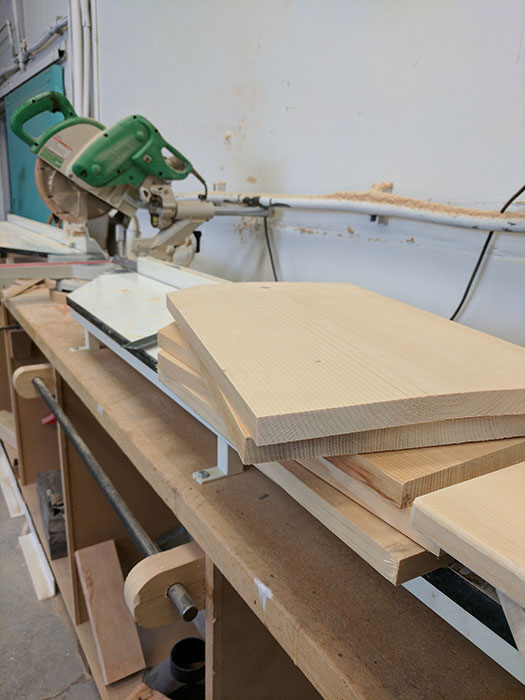
Hitachi chopsaw with a real long fence.

Hitachi sliding compound miter saw with a real long fence.

sheri trusted my self-assessment of my skills, and we didn’t do a shop orientation. Sometimes orientations are welcome, and sometimes scheduling them can become a hurdle to getting your work done.


The apartment is a beautifully appointed studio, with a full kitchen, WIFI, a washer and dryer, and a dishwasher. (I donated an exercise mat for yoga and stretching.) The apartment is located on the side of the STF building with a private entrance off an alley. They installed a cute sculpture/cactus garden in front.

Apartment 360, on Day 1 of the residency. They added a flat-screen TV after this photo was taken.

Apartment 360, on Day 1 of the residency. They added a flat-screen TV after this photo was taken.

Just across the alley is a beautiful patio shared by Sidetrack Brewing and Zendo Coffee, both quality purveyors. Their spaces became a mini-extension of the residency—they’re great places to read on cool mornings, and meet up with local artists in the evenings.

Just two blocks away is grocery store with a pretty good selection for its size. I was happy to find almond milk, organic carrots and kombucha there. They had really cheap (conventionally grown) cherries and cantaloupes during my visit.

Alternatively, you can get pricy but farm-fresh produce (including great salad greens grown in ABQ), eggs, and fancy bread at the Downtown Grower’s Market on Saturdays and the Railyards Market on Sundays. Both are within walking or biking distance.

Friend of STF Rebecca lent a red girl’s bike (I brought and donated a helmet and bike lock). Coming from NYC, I found Albuquerque to be bike-friendly. Nobody honked at me or drove too close. The North Diversion Channel Trail is a neat bike path (where I spotted a roadrunner) that runs between a channel and the I-40.

sheri provided transportation as needed in her capacious cargo van, to the lumber yard, to/from the airport, etc. She also spent a day driving around and installing signs with me. It was possible to install these signs alone, but I was very grateful to have a buddy.


The exhibition. My project had three components: story collection, the offsite signs, and the zine—and the timeline and budget just covered them. I didn’t plan an elaborate a solo show for the exhibition. The exhibition showcases the zine, and has a looped slide show about the process, with photos of workshops, signs, and the sign locations. There are also interactive elements, where the public can post thoughts about what belonging means, and collectively map their roots and their places of belonging in Albuquerque. I’m grateful that sheri was supportive of keeping the effort for the exhibition minimal.

Members of the public connecting their roots and places of belonging in Albuquerque on hand-drawn maps.

Members of the public connecting their roots and places of belonging in Albuquerque on hand-drawn maps.


Participants pinned and labeled their places of belonging. The painted numbers indicate locations of commemorative signs.

Participants pinned and labeled their places of belonging. The painted numbers indicate locations with commemorative signs.

Albuquerque’s art scene is highly geared towards First Fridays. There are lots of galleries open, and audiences in droves. Launching the exhibition on the First Friday in July was a great send-off. I left town the next day.


WHERE

Sunset from Barelas.

Sunset from Barelas.

STF is located in Downtown Albuquerque. To the north just a few blocks is Central Ave./Route 66, and the main strip for night life and Kimo’s quirky Art-Deco-meets-Southwest movie theater. I was lucky enough to arrive just as a film festival started; I really enjoyed an evening of local shorts.

To the South are the Railyards and Barelas, a historic, largely Latino community that is also home to Working Classroom, and a few scrappy artist-run spaces.

If future residents haven’t spent much time in Albuquerque, I recommend renting a car and visiting Meow Wolf and other cultural offerings in Santa Fe and going for hikes in wilderness areas. I really enjoyed visiting Taos Pueblo and Casa San Ysidro in Corrales. It was a great way to learn about New Mexico history, and experience how places help tell the stories that happened there.

Taos Pueblo.

Taos Pueblo.

WHEN

My residency was from June 1 to July 8. It was hot. The daytime highs were usually in the 90s, and sometimes in the 100s. I was very glad I brought a sun hat. The advantage of summer is the great farmer’s markets. But some resources—like the clay studios at UNM and Barelas Community Center—were closed for the summer.


WHO

STF is staffed by the director sheri crider. In addition to running the STF studios, gallery, and residency program, sheri is also a practicing artist and contractor. If it sounds impossible to juggle all three, you haven’t met sheri. She’s an absolute dynamo. She’s indefatigable. I immediately liked her. She’s down to earth and has lived a lot. She is pretty chill, and you don’t get the sense that she likes rules or will enforce boundaries awkwardly. I got the impression that she doesn’t have time for bullshit, but she never made me feel that she didn’t have time for me. Someone assisting sheri is also helping with STF’s social media, and I’d accidentally mistaken them for STF staff. I was initially concerned about lack of staff capacity, as I’ve experienced the impact that good and bad studio managers and/or residency coordinators can have on residency experiences. I think it helped to adapt accordingly, by trying to be more self-sufficient and creative about who I asked for help.

sheri crider and Valerie Roybal made a bee hotel that is installed in an ABQ open space.

sheri crider and Valerie Roybal‘s project-in-progress in the shop: a bee hotel that is now installed in an ABQ open space.

Barb Bell, sheri’s partner, helps out, especially with events. Michael Apolo Gomez is helping me out with photography.

The lines between STF and sheri crider are blurry. I lightly hitched rides on expendables in the studio, shop, and the de-facto STF office—sheri’s studio. Sometimes I asked, sometimes I intuited. I hope that what I gave in return—intangibly via the project, and tangibly with expendables I reintroduced into the shop ecology—is a fair trade.

There was only one resident artist at a time. I was very grateful for the friendliness and welcome of STF studio artists, especially Travis Black, Beau Carey, and Karsten Creightney. Travis and his assistant/studio mate Ani Bea were ever friendly and caring. Beau was nice enough to share his work with Working Classroom interns when they came by for a workshop, and let me tag along when he went to the art supply store. Karsten brought a truckload full of scrap lumber for forthcoming AIR Alex Branch. Tami Abts and Josh Stuyvesant of A Good Sign were instrumental in receiving shipments and getting them picked up, loaning me a grommet press, and also sharing what they do with Working Classroom interns. When you are new to a town and a shared space, being around people who are happy to help is immensely reassuring.

As Lucy R. Lippard was a juror (along with Bill Gilbert, who had to leave for Japan), sheri was kind enough to invite her over for lunch. I’d been reading “The Lure of the Local” and it was tremendously helpful in thinking through the complications and paradoxes of doing work about being an outsider and making work about the local.


WHY

I’d heard sheri say one of the goals of the residency is so artists from elsewhere learn about the art happening in Albuquerque. While New Mexico history is incredibly deep and complicated, I definitely gained an appreciation for the art community, as well as various people, culture, and places here. The list of reasons that this place is special is astoundingly long. There is space, physically and creatively, for artists to take risks here.

I heard others express an interest in increasing the production and visibility of social practices and community-engaged art in Albuquerque. ABQ seems to have many drawing-and-painting-oriented artists and community muralists. I think Ellen Babcock’s Friends of Orphan Signs is lovely in it site-specificity and community engagement.

For me, I applied because its offerings matched my goals and interests. I was intrigued because there are few residency opportunities focusing on social practice, and I’d wanted to return to New Mexico since my first time visiting seven years ago. Having my proposal reviewed by Lucy R. Lippard was a bonus. Moreover, it provided an opportunity to realize a new project that merged my interests in participatory projects, research, and community engagement. I really wanted to do something as an artist that formed an alternative to divisive, hate-mongering rhetoric.

My projects often have an emotional touchstone. For this project, the touchstone was the feeling of welcome and pride I find in a newspaper clipping that my mom has kept for over 30 years. It’s an article announcing the naturalization ceremony that welcomed 50 “new Americans,” including my parents. I am not an immigrant, but I identify with immigrants, and I really love how this project encompasses how different people find places where they feel belonging. For example, Zahra Marwan, a Kuwaiti-New Mexican UNM alumni and illustrator, said that when she first heard the cante, or singing, in flamenco class, it reminded her of the call to prayer in the Middle East. Barbara Bell wrote about being of service to her elderly Hispanic New Mexican and Mexican neighbors. (You can read excerpts from all the stories in the Belonging zine).


HOW

This residency cycle was supported by the Fulcrum Fund in partnership with the Andy Warhol Foundation for the Visual Arts and The FUNd at Albuquerque Community Foundation. Without funding, I couldn’t have done the residency or project. I wouldn’t even have applied to it. (Some folks in ABQ danced around the question of if I have a day job. I do—in fact, more than one: art handler/crew lead, freelance designer, and artist’s assistant.) As you might have guessed, the residency is also subsidized with sheri’s labor, resources, and generosity.


MY EXPERIENCE

I had a rough start—I flew in from NYC with a woozy-making head cold. The 5,000-foot elevation, sun, and dryness took a toll, too. I was a mess. Thankfully, Travis, Ani, and sheri checked in on me, and cued me in to the prevalence of local allergens, and I switched from cold meds to allergy meds.

As I’ve written before, residencies offer new resources while removing you from many of your own. That includes the emotional support of people who love you. Setbacks can test your resilience and how you bounce back from self-doubt, isolation, and uncertainty. It really makes you appreciate people who offer genuine care, encouragement, help, and enthusiasm.

This was my first residency project in which social practice and community engagement were key components. Soliciting participation for this project was challenging, and at times, frustrating. There were many factors: I have few connections to Albuquerque, and the residents of a place nicknamed “The Land of Mañana” can be noncommittal or slow to respond. Quite a few contacts were away on vacation, and some services were closed for the summer. A service organization scheduled a workshop but did not show up. I’d emailed refugee groupsw and attended their events, but didn’t receive any stories from them. I posted an open call to which people responded with enthusiasm online and at the artists’ talk, but few followed through with submissions. Sometimes I was frustrated with the small returns in light of so much outreach effort. Other times, I rolled with the city’s leisurely pace. Perhaps one social practice skill is mono-tasking being patient.

The lifeblood of the project became partnerships with Working Classroom, an arts and education program for young artists from historically ignored communities; and Saranam, a two-year housing and education program for homeless families in Albuquerque. My connections to these organizations were quite happenstance. I mentioned going to ABQ to Ronny Quevedo, an artist who I rarely run into in NY. He connected me with Working Classroom. I was connected with Saranam via Erin Fussell.

I also suspect that the topic of belonging is both sensitive and uncommon—identifying your place of belonging may take time and be uncomfortable. You have to risk exposure and vulnerability.

As a result, I kept the story submission open until three weeks in to the residency.

This left two weeks for production—painting 13 signs, installing most of them, having a hand in 6 of the 7 activity sheets, building and painting 5 boxes, and writing, editing, and designing the 24-page ’zine. There were many late nights. I was pretty exhausted by the end.

In past residencies, I learned about the need to simplify, let go of unnecessary details, and not make myself crazy. I took that to heart, using it like a mantra. It was helpful. For example, I made mini signs for the oversize map in the gallery, and then I started making miniature activity boxes… How cute would it be to make an actual mini box with a hinged lid with mini activities inside? I wondered. But with priority components still in progress, I knew enough not to fall down that rabbit hole.

Though this project was similar to past projects involving a survey and zine, it also involved a higher degree of social practice and public art. I’m satisfied with how the project came out, yet I still look forward to more critical distance and feedback from participants and audiences. On one hand, I aspire to be free of the need for external validation. On the other, validation is gratifying, and moreover, this is a community-engaged project, in a new place. How it goes over is important. I was really moved when one audience member said, “using art to give people a voice, to start a dialogue, to ask questions and most importantly to listen” is “most relevant today.” I suppose this comes back to patience as a social practice skill: how the zine will be read, if and how the signs live on, and if participants and places are affected—these all will play out over time. The residency has ended, but project’s new phase as a publication and public artwork is just beginning.

Overall I had a wonderful residency experience. I’m especially grateful for sheri and her easygoing manner, her openness to my project and suggestions, and her help and encouragement.

Find the zine and activities at BelongingABQ.com. Photos will be posted soon.

Standard
Art Competition Odds

Art Competition Odds: NYFA’s 2017 Artist Fellowship

The New York Foundation for the Arts’ 2017 Fellowship program received 2,477 applications for 92 grants.

//////////////////////////////////////////////////
//////////////////////////////////////////
////////
//////////////////////////////////////////////////
//////////////////////////////////////////////////
//////////////////////////////////////////////////
//////////////////////////////////////////////////
//////////////////////////////////////////////////
//////////////////////////////////////////////////
//////////////////////////////////////////////////
//////////////////////////////////////////////////
//////////////////////////////////////////////////
//////////////////////////////////////////////////
//////////////////////////////////////////////////
//////////////////////////////////////////////////
//////////////////////////////////////////////////
//////////////////////////////////////////////////
//////////////////////////////////////////////////
//////////////////////////////////////////////////
//////////////////////////////////////////////////
//////////////////////////////////////////////////
//////////////////////////////////////////////////
//////////////////////////////////////////////////
//////////////////////////////////////////////////
//////////////////////////////////////////////////
//////////////////////////////////////////////////
//////////////////////////////////////////////////
//////////////////////////////////////////////////
//////////////////////////////////////////////////
//////////////////////////////////////////////////
//////////////////////////////////////////////////
//////////////////////////////////////////////////
//////////////////////////////////////////////////
//////////////////////////////////////////////////
//////////////////////////////////////////////////
//////////////////////////////////////////////////
//////////////////////////////////////////////////
//////////////////////////////////////////////////
//////////////////////////////////////////////////
//////////////////////////////////////////////////
//////////////////////////////////////////////////
//////////////////////////////////////////////////
//////////////////////////////////////////////////
//////////////////////////////////////////////////
//////////////////////////////////////////////////
//////////////////////////////////////////////////
//////////////////////////////////////////////////
//////////////////////////////////////////////////
//////////////////////////////////////////////////
//////////////////////////////////////////////////
///////////////////////////

Selected artists comprise about 1:27, or 3.6% of applicants.

See all Art Competition Odds.

See the 2014 NYFA Artist Fellowship competition odds.

Standard
Art Competition Odds

Art Competition Odds: Women’s Studio Workshop Studio Residency Grant

The Women’s Studio Workshop Studio Residency Grant received about 130 applications for 4 awards.

//////////////////////////////////////////////////
//////////////////////////////////////////////////
//////////////////////////////~

Selected artists comprise 1:~32, or roughly 3% of applicants.

See WSW’s 2015 odds for this program.

See all Art Competition Odds.

Standard
Art & Development

Center for Book Arts Residency Wrap-up

Notes on a year(-and-a-half)-long residency.

IMG_20170310_160655

Printing linoleum cuts on the Vandercook letterpress.

WHAT:

I was awarded the Center for Book Arts’ 2016 Workspace Artist-in-Residence Grant. The program offers a materials stipend, 24-hour access to the Center for Book Arts’ letterpress print shop and bindery studios, a group exhibition, and the chance to take nearly unlimited classes in printing, book arts, and related workshops on paper marbling, making bone folders, etc. (Read my Residency Notes, Part 1, penned practically a year ago for more about the classes I took.) The Center also has an exhibition program and weekly events, so there are always book arts to view and new perspectives to be exposed to.

1471577718856

The steps in binding a pad of Color | Cootie | Feeling | Catcher, a collaboration with Leah Rosenberg. Make a guide to evenly space the holes. Use a pin tool to punch holes (put a weight on the text block to hold it steady). Wax your thread. Start your thread so the tail goes out the side of the block (to hide the knot later). Sew down the length of the book, and back. Tighten each stitch. Tie a knot in the middle of the pad (to hide the knot, see?). Use a bone folder “beat the swell,” which is to smash down any additional thickness gained from binding.

IMG_20160818_235845

Steps in adding an endpaper-wrap: Use a triangle and bone folder to score a line in the endpaper. Fold along the score. Mark the depth of the pad on your end paper. Score and fold at the mark. Use pieces of newsprint as a mask to apply PVA only to one half of the end paper. Glue down to your text block and beat down with a bone folder. Smooth the edge with a bone folder too. Flip the book over and apply glue to the last segment of endpaper and smooth with a bone folder. Tada!

WHEN:

The residency is from January to December, theoretically. In reality, it’s looser than that. As a live-out studio program for local artists, they don’t have to enforce strict end dates. In fact, they offer AIRs the chance to continue working in the studios until their exhibitions, which are typically scheduled in April of the following year, affording three ‘bonus’ months of studio access. (I returned my keys for incoming AIRs and thus was keyless those last three months. It worked out most—but not all—of the time.) Additionally, AIRs are required to complete letterpress and binding classes before using the studio, and may be screened additionally before printing unsupervised, so matching schedules is advantageous.

My residency started in January 2016. I had already made a three-month, out-of-state commitment last year, so I tried to make the most of the rest of the year. I expected to be more active in the fall, but my seasonal job sapped my time and energy, and I got sick often. Moving forward, I have a more realistic sense of what I can achieve in the fall.

The Center underwent through renovations in December and January, through the spring. The space is modest, storage is limited, and programming can interfere with studio access. As mentioned in my prior post, flexibility and forbearance are helpful.

I was able to dedicate more time in the lead-up to the exhibition, so the bonus months were critical to my growth.

1469824400631

In Bookbinding II, I learned how to pare leather to make hardcover books with a decorative cord on the spine.

WHO:

There are usually 5 AIRs every year. Every year’s cohort of artists is different. Some years’ AIRs are very tight, and other years’ are less present and supportive. If you’re thinking of applying, here are some tips (I was on the selection panel for the 2017 program): You don’t have to be experienced in book arts or printing. You should have a well-developed, thoughtful body of work. You should be prepared to make the most of the opportunity. And you should contribute to the Center with your presence and practice.

There are also three Scholars—who have more bookbinding experience and propose specific book projects—who start their residencies in the fall. In addition, there is a community of renters—often artists and bookbinders who produce their own work or work for clients there. The Center also regularly books Stewards to provide technical advice during certain nights of the week (ask regularly, and double-check).

I was very grateful to be able to turn to the Scholars, renters and Stewards for help. They answered questions and provided technical advice and feedback. I couldn’t have made my final project without their help! I also learned from them by osmosis, observing different styles of working, and expanded scopes of what I thought possible in book arts.

The Center for Book Arts is a small non-profit. The staff work hard, pull long hours, and do unglamorous tasks to keep the place running. Renters, teachers, and supporters supplement by pitching in or bearing with inconveniences. I’ve been thinking about how print shops are communal spaces that foster interdependence. I have had opportunities to reflect on the ups and downs, and the boundaries that make for healthy relationships.

WHERE:

One of my favorite aspects of this residency is the great location at 27th and Broadway, in NoMAD (just north of Madison Square). It took refreshingly little effort and time to get there after work. It’s very easy and convenient to get there by subway. I also got a Citibike membership, which was worthwhile. There are ample options for healthy food and groceries nearby. (That may sound trivial, but it amounts to more studio time and focus.)

1479532114512

Printing a “pressure plate” of cut paper, and wood type.

WHY:

I also really appreciate the way that the residency and access to the Center enhances my skills and capacities. One of my most memorable moments was responding to an evolving situation quickly by printing a poster, and being able to distribute it while still printing to appreciative people. I’ve adapted to having access to printing; my foray into Riso printing while the Center was being renovated was an expensive reminder of printing otherwise.

Of course, I wouldn’t have been able to create my final project without this residency. I greatly increased my book arts skills. Though I’d done relief printing in undergrad, I hadn’t ever gotten very comfortable with letterpresses. By the end of the residency, I’d gotten more fluent at solving problems, and working with, not against, the nature of lead type.

My final project is Working Together: a mix-and-match book of nice and not-so-nice modes of collaboration. It’s inspired partly by investigating collaboration as a subject and a practice over the past two years, and partly by politicians’ disregard for others over the past several months. While mix-and-match books—as well as teaching cooperation—might be associated with childhood, I have come to think that collaboration is not a skill once mastered, but a lifelong series of choices.

I’m very grateful to the Center for Book Arts for this opportunity, and by extension to the NEA, NYS Council on the Arts, NYC Department of Cultural Affairs, and NY City Council for supporting the Center for Book Arts.

I feel like I’ve worked my way into the rhythms or the fabric of the Center. It’s nice to feel a sense of kinship with the other shop users, and to feel that I have a place I can go to, belong, and do my work. The Center welcomes AIRs to stay on with affordable studio rental rates, an option I’ll likely explore in the future.

Working Together is on view, in the Workspace Artists-in-Residence exhibition, through June 30.

Standard
Research

To Bring Into Being an Optimistic Future

Recent points of reference about psychology, anxiety, and the need to be intentional about optimism and humor. Plus artworks made when I was first learned about positive psychology at the beginning of the Obama presidency.


Christine Wong Yap. Stars and Stripes from the Pounds of Happiness installation, 2009, mixed media.

Christine Wong Yap. Stars and Stripes from the Pounds of Happiness installation, 2009, mixed media.

We live in a world where there is a constant feed from social media, the news, etc., of things that can scare us, and we become so anxious because human beings are designed to be sensitized to dangerous stuff. You get a bad review as a writer, you remember it for 10 years. You get 100 good reviews, you forget them all. You say hello to 100 people in a city, and it doesn’t mean anything to you. One racist comment passes by, it sticks with you a decade. We keep the negative stuff because it’s the negative stuff that’s going to—potentially—kill us. That fin in the water—maybe it is a shark. That yellow thing behind a tree—maybe it is a lion. You need to be scared. But contemporary culture in Pakistan, just like in America, is continuously hitting us with scary stuff, and so we are utterly anxious.

I think that it’s very important to resist that anxiety, to think of ways of resisting the constant inflow of negative feelings—not to become depoliticized as a result, but to actually work actively to bring into being an optimistic future. For me, writing books and being someone who is politically active is part of that. I don’t want to be anxious in my day-to-day life; I want to try to imagine a future I’d like to live in and then write books and do things that, in my own small way, make it more likely that that future will come to exist.

—Author Mohsin Hamid (“Pakistani Author Mohsin Hamid And His Roving ‘Discontent’,’ Fresh Air, March 9, 2017)


Christine Wong Yap, Cheap and Cheerful #3, 2009, gel pen on paper, A4.

Christine Wong Yap, Cheap and Cheerful #3, 2009, gel pen on paper, A4.

…one of the offshoots of the rise of Trump has been to rob many liberals of their sense of humor. To pay close attention to the news is to trap oneself in a daily cycle of outrage, self-righteousness, a pained recognition of the inelegance of that self-righteousness, and, finally, a feeling of futility. Part of what made the Women’s March so powerful was its scenes of comedy, not simply the signs that mocked the President but those that recognized the joyousness in the very of act of protest.

…Constant vigilant outrage is not only exhausting, and eventually deflating, but it’s ill suited to liberal culture, which is suffused with a healthy dose of self-awareness, self-mockery, and even self-loathing. There’s a reason conservatives control talk radio, with all its grim certitude, and liberals run comedy, which is characterized by, among others things, ambivalence.

—Ian Crouch, “This Is The Future That Liberals Want” Is The Joke That Liberals Need, NewYorker.com, March 3, 2017


Christine Wong Yap, Unlimited Promise, 2009/2010, installation.

Christine Wong Yap, Unlimited Promise, 2009/2010, installation.


Standard
News

Resistance and Solidarity

I am happy to share two new prints—both are inspired by our dawning age of ungovernability. 

Both are on view in Social Energies, curated by Alice Wu, through March 10 at Legion, San Francisco.

Horoscopophilia
risograph print, 11×17 inches with 12 tearaway cards, signed and numbered edition of 70

Christine Wong Yap, Horoscopophilia, 2017.

Christine Wong Yap, Horoscopophilia, 2017.

Horoscopophilia is a broadside with 12 tearaway cards. It’s inspired by the Chinese zodiac and “the positive exercise of rights, capacities, and possibilities for action.”

For each card, I interpreted the strengths of a zodiac animal (for example, people born in the year of the snake are smart, dangerous) as an aspect of activism (“When it’s time, STRIKE!”). For one-player use, ask yourself the reflection question (“What is my source of power? How do I use it?”). For multi-player scenarios, pose the conversation question (“What could we accomplish if we joined forces?”)

Printed by Colpa Press, an artist-run press in San Francisco. Drawn and perforated in Queens, NY.

$10 each, available at Legion.

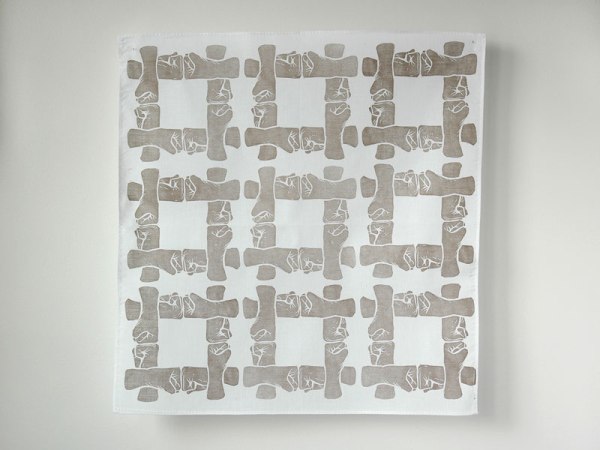
Fist Bump Bandanna
letterpress-printed linoleum on 100% cotton, 17×17 inches, edition of 20

Christine Wong Yap, Fist Bump Bandanna, 2016.

Christine Wong Yap, Fist Bump Bandanna, 2016.

Fist Bump Bandanna is inspired by the ideal of solidarity among all politically marginalized groups, and the ferocity of our people power and revolutionary love.

Curator Alice Wu and I are donating 50% of each $20 Fist Bump Bandanna sale to the Chinatown Progressive Association. They’re a non-profit organization based in San Francisco’s Chinatown since 1972. CPA “educates, organizes and empowers the low income and working class immigrant Chinese community in San Francisco to build collective power with other oppressed communities to demand better living and working conditions and justice for all people.” They are also a member organization of SF Rising, an alliance of multi-racial social justice organizations. I’m happy to support organizations like CPA, which have been empowering local communities from within for years.

Printed at the Center for Book Arts, NYC, with the support of a 2016 Workspace Artist-in-Residence Grant.


Limited edition. Only $20 each, available at Legion.

Standard
"Seven Nations Cake, with arak liqueur from Iraq, hawash spice blend for Somalia, mastic from Yemen, qamar al-deen (apricot leather) from Syria, Shamshiri tea from Iran, dates for Libya, and sorghum for Sudan. With honey for sweetness and rose petals for a warm welcome home." // Source: Instagram @protestcake
Citizenship

Points of Reference: Resistance Day 16: Cakes, Spells, Dance, and Multi-Centeredness

It’s hard to keep up—much less synthesize—current events, so here is a collection of ideas that have been resonating with me… None more than this:

“No one action will be adequate. All actions will be necessary.”

—Jon Stewart as quoted by Dave Itzkoff, “Jon Stewart Savages Trump: ‘Purposeful, Vindictive Chaos,’” New York Times, February 1, 2017. (Please read in full, in fairness to comedic craft.)


Note to self: If I question the value of individual acts of resistance, remember that more is more.

Case in point: The #nobannowall opposition—protestors’ and lawyers’ rapid response at airports, the ACLU’s legal cases, the Brooklyn judge’s emergency order, the win achieved by Washington State’s Attorney General, and the strike self-organized by 1,000 NYC Yemeni bodega owners. (Side note: If self-employed, precarious bodega owners can demonstrate such a unified show of force, when will artists? Why were strikers in the #J20 art strike dispersed among art-world institutions?)

Protest Cakes’ Seven Nations Cake, distributed in last night’s #nobannowall protest at San Francisco City Hall.

"Seven Nations Cake, with arak liqueur from Iraq, hawash spice blend for Somalia, mastic from Yemen, qamar al-deen (apricot leather) from Syria, Shamshiri tea from Iran, dates for Libya, and sorghum for Sudan. With honey for sweetness and rose petals for a warm welcome home." // Source: Instagram @protestcake

“Seven Nations Cake, with arak liqueur from Iraq, hawash spice blend for Somalia, mastic from Yemen, qamar al-deen (apricot leather) from Syria, Shamshiri tea from Iran, dates for Libya, and sorghum for Sudan. With honey for sweetness and rose petals for a warm welcome home.” // Source: Instagram @protestcake.

Illustrator and comic book artist Yumi Sakugawa‘s recent drawing/meditation:

"Intersectional, intergenerational, intergalactic, international, interconnection. Even if it takes years, decades, centuries-- any unit of time beyond my lifetime and my theoretical grandchildren's lifetime-- I believe in action, I believe in compassion, I believe in a plane of existence where peace is the default and not the exception. Do what you can to show up. Every gesture matters." Source: Instagram: @YumiSakagawa.

“Intersectional, intergenerational, intergalactic, international, interconnection. Even if it takes years, decades, centuries– any unit of time beyond my lifetime and my theoretical grandchildren’s lifetime– I believe in action, I believe in compassion, I believe in a plane of existence where peace is the default and not the exception. Do what you can to show up. Every gesture matters.” Source: Instagram: @YumiSakagawa.

Victoria Graham’s projects about casting spells:

Jenifer k Wofford’s NO SCRUBS intervention: joy in the face of repression, cultural workers making revolution irresistible, with women of color to the front.

"NO SCRUBS was a boisterous, fun dance brigade that injected playfulness into the SF and Oakland Women's Marches. Their focused energy was fueled by fun, feisty tunes by women of color and quirky protest signs." Organized by Jenifer k Wofford. // Source: Instagram @100DaysAction

“NO SCRUBS was a boisterous, fun dance brigade that injected playfulness into the SF and Oakland Women’s Marches. Their focused energy was fueled by fun, feisty tunes by women of color and quirky protest signs.” Organized by Jenifer k Wofford. // Source: Instagram @100DaysAction

Krista Tippett: “A cynic would say, ‘…they’re just drops in the ocean.’”

Larry Ward, dharma teacher and Baptist minister:

“That is true. I am a drop in the ocean, but I’m also the ocean. I’m a drop in America, but I’m also America.”

—From “Being Peace in a World of Trauma,” On Being, July 14, 2016.


Reflections on immigration, racial identity, and place

My mom's Chinese New Year's preparations this year included tamarind, which she used to eat fresh from a neighborhood tree in Vietnam.

My mom’s Chinese New Year’s preparations. Citrus and lettuce represent wishes for prosperity. Tamarind is not a traditional offering, but my mom likes it because there was a tamarind tree near her home in Vietnam. In Chinese, pink is considered light red, the color of luck.

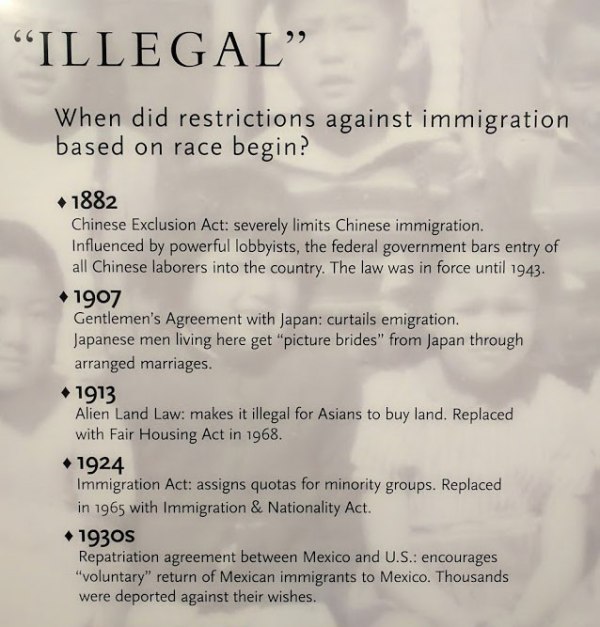
Wall text from "Land of Opportunity" at the San Mateo History Museum, Redwood City, CA.

Wall text from “Land of Opportunity” at the San Mateo History Museum, Redwood City, CA.

I flew back to the Bay Area to visit family. The next day, Lunar New Year, the Muslim ban, and the gravity of DJT’s reckless nationalism began.

I watched videos of protests at SFO and JFK as my mom happily arranged Chinese New Year’s offerings for peace and prosperity. It was surreal to think that my parents—who came to the US to escape war and fear of persecution in Vietnam and mainland China—might not be welcomed today.

I didn’t do anything to earn citizenship. I was granted citizenship because I was born here—a simple quirk at the complex nexus of my parent’s tremendous sacrifices and generations of people who fought for equality. When I think about how hard immigrants have to work to become naturalized, it makes me want to be deserving of citizenship. Engaging as an active citizen seems a small price.

At the San Mateo History Museum, I saw register books for “enemy aliens”—Japanese, German and Italian Americans. I thought about how such xenophobic, unconstitutional acts seemed like relics of the past not too long ago, but could be seen as part of a racist continuum now (and indeed have been cited as legal precedents).

My past internalized racism also came to light. A a youth I disdained the peninsula and the South Bay; I thought they were boring and lacked culture and worldliness. But I looked at things differently as I drove around San Mateo and visited a pan-Southeast Asian Buddhist temple in San Jose. While the region may be short on high or alternative cultures, its unfussy integration of Asian and Pacific Islander cultures into suburbia with mid-century vernacular architecture and design, is specific and kind of wonderful.

It renews my gratitude to call  both the San Francisco Bay Area and Queens home. What I love most about the two are their richness of cultural diversity and the simpatico afforded by progressivism and tolerance. I don’t feel split or unrooted. I feel “multi-centered.” Is that such an odd proposition? My mom is shaped by three countries—the one of her heritage, the one where she was raised, and the one she emigrated to.

I just started reading Lucy Lippard’s The Lure of the Local: Senses of Place in a Multicentered Society (1997). The idea of belonging to a place, and at the same time, to an interconnected world, seems especially meaningful.


Notes for forward movement

Some tidbits of creative inspiration:

  • The lion dance is said to have originated when villagers were tormented by a monster, so in defense they sewed a costume and choreographed a dance. Their united power scared the monster away.
  • 2017 is the Year of the Rooster. The rooster is in charge of time and starting a new day.

Positive psychology researcher Shane Lopez’s Hope Map exercise is a set of instructions to identify goals, pathways, obstacles, and methods (in other words, ways and means) of overcoming obstacles. [Updated link.]

[I’ve been holding on to this one because it’s like a make things (happen) activity waiting to happen, if presented as visually-oriented handout for download. But it seems worth sharing now; the time is ripe for planning and self-determined goals.]

L-R: (1) My assumed schema. (2) Kevin's described schema. (3) A proposed revision.

L-R: (1) My assumed schema. (2) Kevin’s described schema. (3) A proposed revision.

I liked how Kevin Chen recently described five areas of life (figure 2): a romantic relationship, friendships, family, practice, and job(s). In this schema, “productivity” accounts for only two-fifths of life, and relationships account for a majority.

I realized that I’d held a three-part schema (figure 1): work, practice, and personal life. This short-changed other people and explained why I always felt like I was failing someone.

I suppose I might add two more “houses” to a revised schema (figure 3): “me-time” and citizenship/civic engagement. This might be a temporary mode for the next few years, that incorporates both activism and self-care. In this case, people still occupy the majority.

Standard