Community, Values

Finishing the Game: a movie, but not just a movie

Finishing the Game (2007, dir. Justin Lin, dist. IFC Films) is an indie mock-umentary of the re-casting of Bruce Lee’s unfinished film after his death in the 1970s. The auditions bring out Asians of all stripes — suave professionals, dreamers and actors of integrity — throwing kicks and emitting feline howls. It’s a light-hearted movie with lots of big hair, but in the subtexts are plentiful jabs at the movie industry’s racism and money-grubbing values.

Go see it!

I really liked the film. It’s funny and irreverent, and inherently Asian without being limited to Asian-ness, yet it touches on serious issues of race and representation. Plus there’s a token white guy! Come on! That’s hilarious! I hear the subtext, and it sounds like: You know where you can stick those quirky sidekick / comedic relief roles?!!

Finishing the Game just opened in the Bay Area. Haven’t heard of it? That’s because they don’t have a marketing budget.

But the upswing is that since the cast is involved in grassroots promotions, I caught a really eye-opening Q&A with some of the actors and producers. The discussion (which provided a classic example of who feels entitled to speak) kept coming back to the clash between representation and the movie industry, or art and business. I knew that Justin Lin’s first big feature film, Better Luck Tomorrow, was a “credit card film.” Talk about self-subsidizing (think six figures!) Its success was a miracle story. But actor Roger Fan (who stars in both films) explained that the popularity of BLT provided Hollywood studios with the hard evidence to take on movies with APA leads, and the result was that MTV became BLT’s distributor, and Harold and Kumar was green-lighted.

But here’s the sad news. Actor Sung Kang shared a maxim: people make indie films because they have to. The irony is that Lin originally wanted a Hollywood studio behind BLT at the start — and he had his chance — he was offered $2m to make BLT as long as the cast was not APA. So three cheers to Lin and BLT producers Julie Asato and Curtis Choy (yeah, the Curtis Choy who made The Fall of the I-Hotel. Uh huh!) for sticking to their guns. You can cite their integrity for the recent improvements in APA representation in American cinema. Cheers!

But Kang also pointed out that he’s just an actor: all he can do is be the best actor he can. What talks to studio execs is dollars, so, as cheesy as it sounds, support your independantly-produced APA film! Your ticket really means something.

http://www.youoffendmeyouoffendmyfamily.com/

Standard
Community, Values

Exceptional Art Economics

Art doesn’t play by conventional economic rules, argues Dutch economist and artist Hans Abbing in “Why Are Artists Poor?: The Exceptional Economy of the Arts.”

Art isn’t valued like typical commodities.
Art workers aren’t treated like other workers. Being an artist is similar, though, to being a small business owner — except that most small business owners have business plans, and know when to cut their losses.
Artists usually self-subsidize their practices, yet what most often makes artists stand out is their commitment to developing new work over the years. Like a Jenifer Wofford recently blogged, being an artist sometimes feels like a game of attrition — whoever sticks around long enough, whoever can still develop while forfeiting a salary and stability, wins.

But art is valued exceptionally, which inspires rare generosity. For example…

FRED went out on a limb to support my work for this year’s festival. They hadn’t heard of me and didn’t know anyone who could vouch for me (the “vouch” is important, not for cronyism, well, only, but because the terms “art” and “artist” are so unsanction-able; i.e., “artist” can refer to hobbyists and professionals alike), but they believed in my project. For the opportunity to realize my soft sculpture for FRED, I’m thankful.

When we made contact in England, Rico, my host in London, was a friend of the aforementioned Wofford. Without hesitation, Rico opened his home for a fellow artist. These days I would count him as a friend, and I’m grateful for his openness and hospitality.

I am also grateful to photographers who contribute art documentation to artists. Tony West shot brilliant photographs of my work for the FRED Festival. His excellent photos are vast improvements in my art documentation. I am so thankful to Tony West for sharing his photographs with me. Please check out Tony’s site. I am especially amazed with his landscapes. He’s a truly agile photographer, and you wouldn’t believe how quickly he works.

Standard
Activist Imagination, Research

Art ideas

1.
Write “Come up with a good idea for an art piece and write it down. Mail it to myself, as I could use the postmark date to show that I had the idea first” on a piece of paper. Mail it to myself.

2.
Invite Kearny Street Workshop’s audience to edit the Wikipedia page on Kearny Street Workshop.

3.
Address the ideas of celebrationism and nostalgia, political rigor vs moral outrage, in APA activist art.

Standard
Research, Travelogue

Art I Saw and Really Liked in England

Sao Paolo-based Carla Zaccagnini at Blow de la Barra, London
A restrained show of a selection of curious objects — which were slightly reminiscent of Surrealism and Fluxism, in very good ways — united by heady concepts. From the press release: “‘Wish’… is mainly based on works that deal with desire and its necessary insatisfaction.”

Travel Guide by Matei Bejenaru, which was part of The Irresistable Force at the Tate Modern, London
A fold-out map with detailed instructions for a successful border-crossing into Great Britain or Ireland from Romania. It documents the physical and legal dangers. This content was an eye-opener for me — I have only a vague understanding of immigration in the European Union, as membership frees up the movement of people, to dramatic effects. I also liked the restrained form of display, limited to one floor graphic and take-away brochures.

I enjoyed Outside the Box at Cornerhouse very much. Almost every work in the show was a thought-provoking contribution. Gallery 2 (there are three) was my favorite, because it included Jim Campbells’s low-res screens of LED lights, Daniel Canogar’s fantastic fiber-optic projector and projections and Christopher Thomas Allen’s Dialogue, a theatrical replica of two adjoining office desks, whose computer monitors appeared to engage in a debate, flashing Google-image-searched pictures based on the words in an audio track.

Standard
Community, Research

Tastes in art: what I learned from two videos

My generous host in London, curator and artist Rico Reyes, posed a thought-provoking question. We were visiting galleries, and I had something like an allergic reaction to psychedelic self-portrait videos at a gallery in London’s chi-chi West End (think: garish tie-dye animation superimposed on a bodysuit, with an Enya-like house music soundtrack, and hideous picture quality). I couldn’t hang, so I waited for Rico outside.

He asked: Do you look at art that is similiar to yours, or dissimilar?

Clearly my estimation of art is influenced by my tastes, and of course any artist would be happy to discover art that resonates with one’s own. So I admitted I usually look longest at art that is similar to mine. For example, I tend to spend less time with photographs and videos.

But I don’t feel that this is too limiting, because Jordan Kantor, a professor of mine in grad school, pointed out that art can look or think like one’s own. So while I headed out to the V&A just to see Simon Perriton’s installation just because its medium is papercuts, I’ll also happily perform actions with built-in futility in Jon Brumit‘s Vendetta Clinic, which was on view in Yerba Buena Center for the Arts earlier this year.

Which is not to mean that I don’t appreciate art that’s dissimilar to my own. I was recently surprised and impressed with a short video by Michelle Blade. Her work is on display in “I’m OK, You’re OK” (a group show I’m also in) at Playspace, the graduate gallery at CCA. (While our work can be tied together curatorially, I find her work different than mine because it seems uniformly optimistic.)

Michelle’s video consisted of a single shot of a gathering at Golden Gate Park. In the video, dozens of people, organized as a color spectrum of brightly hued shirts, hold hands and run in a winding spiral until they form a tightly knit column. And then they disperse. If you view the work as an abstraction, the colors advance in an orderly, quick pace, slow to a graceful endpoint, and then re-animate in disorderly joy. Colors overlap, the action reveals itself, and the activity disperses. It’s utopic — like the previously mentioned video — but Michelle’s is simple, short, endearing, unpretentious and pleasingly self-contained. While the video employs simple parameters, the social sculpture depicted in it is a fertile catalyst for ideas about art, painting, abstraction and social actions.

Though I tend to look for work that is similar to my own, I’m most interested in the elegant conveyance of complex ideas.

Standard
Art & Development, Community

Headlands Open House

Join me at the Headlands’ Open House.

It’s a privilege for me to be an Affiliate Artist at the Headlands, a vibrant community of national and international artists, writers, composers, musicians and dancers in residence.

I value being a member of a community where colleagues live, work, and breathe their creative practices.

The Headlands Open House happens three times a year, and it’s a great opportunity to visit studios and meet artists. I find open studios to be nice, informal settings for conversations about art. The current bunch is a varied and interesting, and includes tech-savvy object-makers like Chris Bell and David Gurman (who will present a large installation of photographs in Building 961) and conceptually-driven photo and video artist Hank Willis Thomas. I’m also really looking forward to seeing the finessed video work of UK-transplant Richard T. Walker (Affiliate Building, 960).

It’s a long haul out to the Marin Headlands, but the setting is gorgeous: fresh air, ocean salt. Just the other night I saw more stars that I have in all my years living in Oakland.

My studio is in the basement of the Affiliate Building (960, around the bend and up the hill, behind the Nike missle. Seriously.). Coats imperative, scarves recommended. See you there.

Standard
Art & Development, Research, Travelogue

Travelogue Entry No. 2: Manchester, London

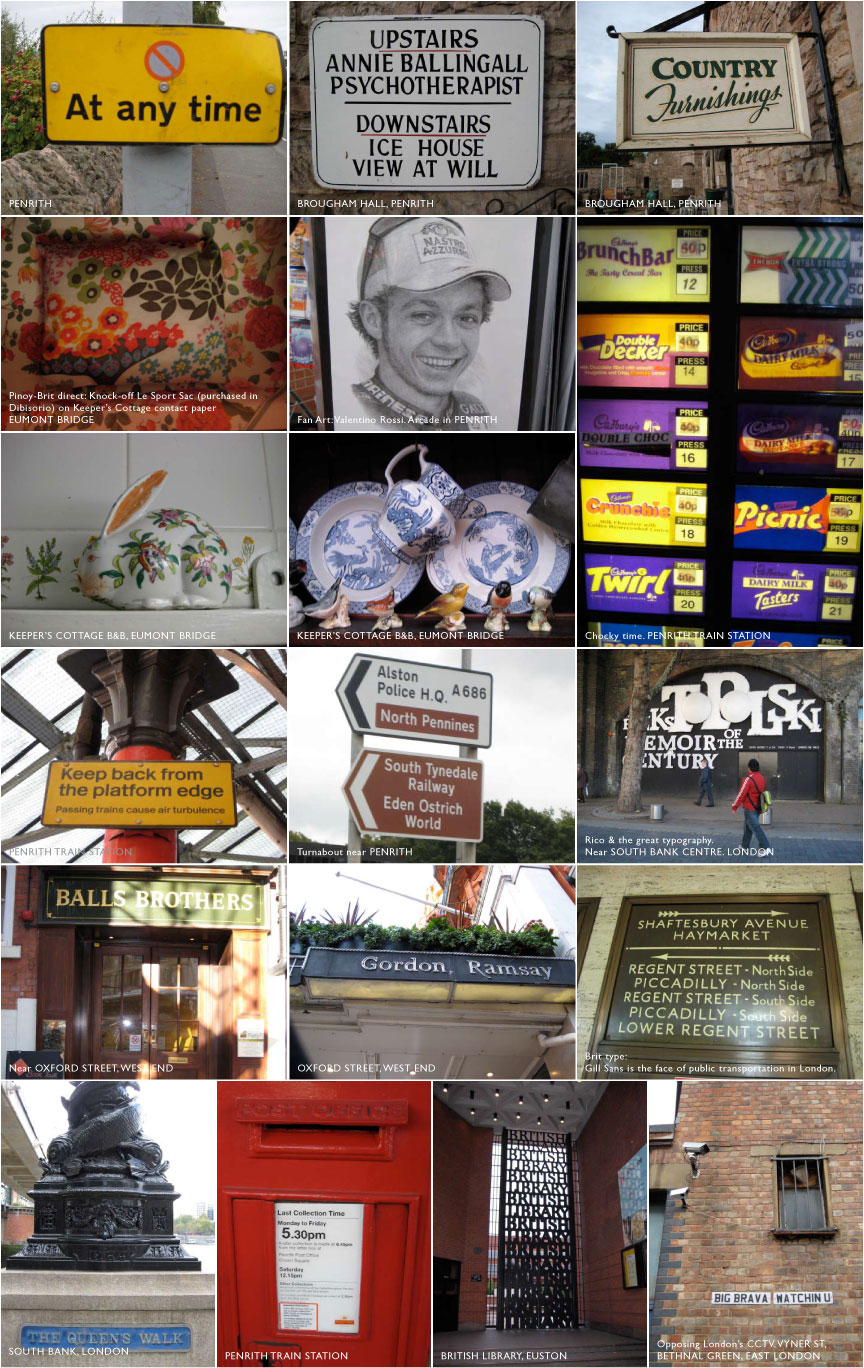
My last day of four in London. Too premature to sum up any concrete ideas. Immediate impressions follow:

-Manchester’s great. I was really impressed with the city’s investment in culture. Saw “Outside of the Box,” a knock-out show of media art at Cornerhouse, an contemporary art gallery and film hub, as well as a cool retrospective of work by SF-based Lynn Hershman Leeson at the Whitworth Gallery at the University of Manchester. I was so impressed with the city’s vibrance that I found the constant refrain that Manchester was trying to shake off its industrial reputation to seem outdated, but a Londoner’s slight scoff at Manchester proved me that other minds have yet to be opened.

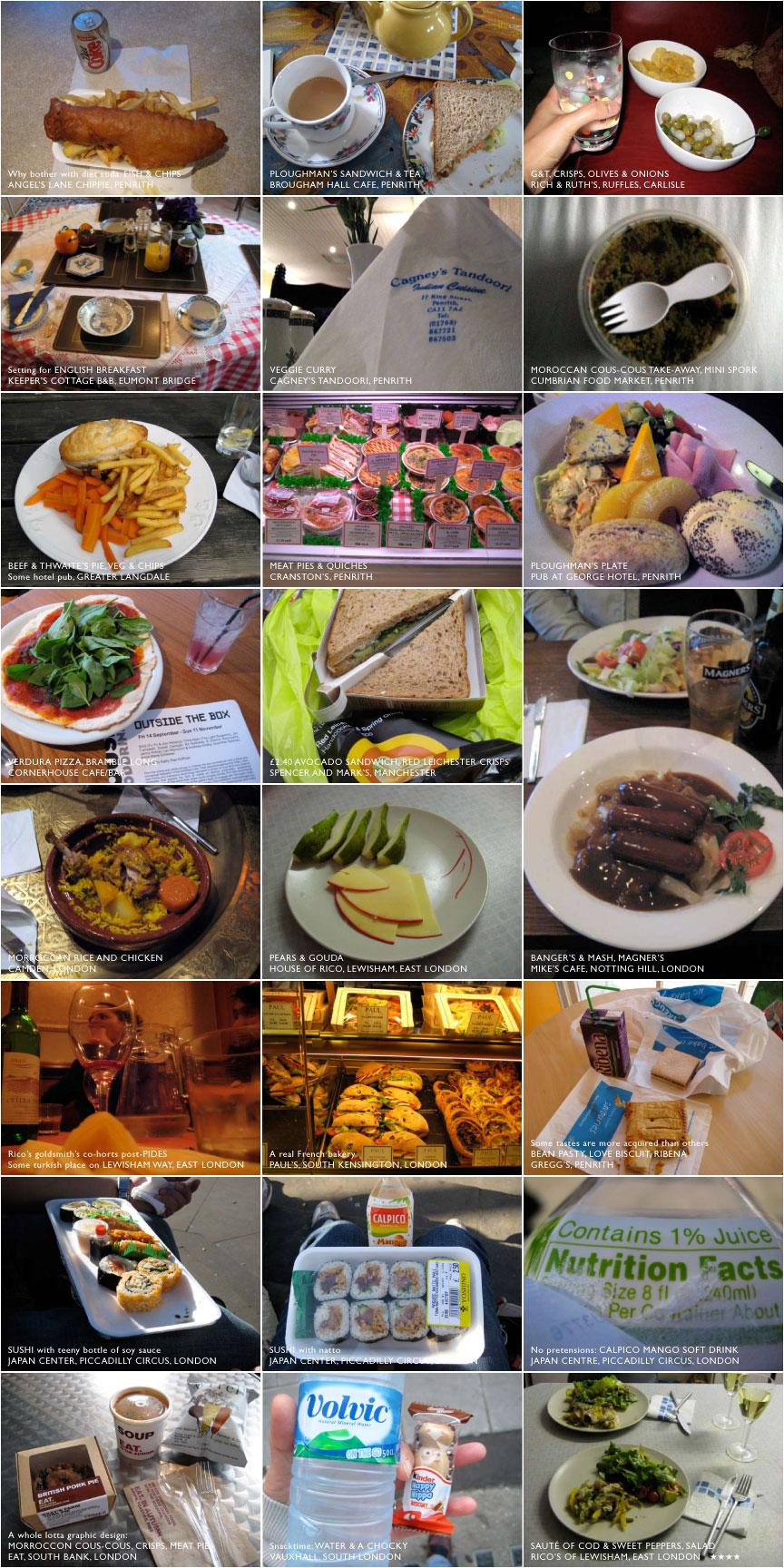
-London has looked like this in my visit:

–Lewisham Road feels remarkably similar, at least on appearances to parts of Brooklyn: lots of immigrants from all over the world, internet cafes/call centers, low storefronts with lightboxes, fried chicken, mattress retailers. Of course on the other side of Lewisham Road is Goldsmith’s, where I’ve stumbled upon a small community of Filipino and Fil-Am expats. How funny it is to sit in a Morrocan cafe in punk-rock Camden-town and listen to Taglish.

–Quiet opulence everywhere. The city is not especially pretty, but the remarkable architecture always gives me an awareness of a sensibility of being in the seat of an Imperial power, however faded it may be in the shadow of the U.S. superpower. Even as I snap my tourist photos of Parliament and Big Ben, I’m thinking: what were the conditions that made all of this possible? The finest building materials: gold, marble. The huge consumption of tea from China, chocolate from Latin America, sugar from the West Indies? I like the idea that somehow I can subvert something by being here and sitting in Royal parks, walking through the free museums… but of course what’s more important is what I can bring home as a citizen, not just a consumer, of the United States.

I was startled and amazed and angered when, lost in the Victoria & Albert Museum in London’s swank South Kensington, I stumbled upon a view of two great halls. In one hall sat two monumental columns, which soared to the atrium several stories above. They were the two halves of Trajan’s Column, built in Rome in AD 131. On the other side sat a conservatory for antiquities, with a replica of Michalangelo’s David sitting among dozens of partially crated busts, statues and reliquaries. The view of these priceless antiquities was awe-inspiring. And I mean awe in the sense of terrific, and terrible. I am only surmising the conditions that made it possible for the Column to be cut in half and moved to South Kensington from Rome. And there are so many layers of meaning to explore: the collapse of the Roman empire, the past greatness of the British Empire, the vulnerability in the consolidation of wealth and power of that magnitude.

View of amusement park
My DIY Burtynsky. Visited the Mall of America — mega-church of consumerism and diversions — on an unplanned overnight layover in Minneapolis (Tip: Flying to London? Fly direct and avoid Northwest Air).

Victoria and Albert Museum
The wealth of nations at the Victoria and Albert Museum.

–In addition to some art and history museums, I’ve been visiting as many contemporary art spaces as possible, seeing everything from Doris Salcedo’s unsettling exhibition at White Cube on Hoxton Square to Ed Ruscha’s stunning watercolors at Gagosian on Oxford street — about £1m in small photorealist watercolors were watched over by two suited and booted guards who found my photo-taking suspicious — to group shows at Alma Enterprises, which has all the atmosphere of a decaying public high school, in up-and-coming  Bethnel Green. The standout space, however, is inIVA, the Institute for International Visual Arts, spearheaded by an international consortium of artists, thinkers and business leaders of color. It’s brand new, on a smelly alley in Hoxton, with a largish gallery, project space, and library that collects catalogs by artists of color only. I love it. It’s a beautiful building in a great location with top-notch art and huge potential to be a formidible force in London, and hopefully, the world. I find it hope-inspiring.

Rico Reyes (artist, curator, theorist and my generous host in London) and I had the good fortune of participating in Leticia Valverdes’ project, “Is London the Place for Me?” As I’ve been travelling and shooting photos of landscapes of sheeps and stone walls, neo-Gothic cathedrals and plates of bangers and mash, I’d been wondering how much I’m looking for experiences that fit my expectations of England, instead of seeing England as it is. But with Valverdes’ props and a digital studio, we were able to play with the cliches. We placed ourselves — Chinese American and Filipino American artists — into a tea room designed to display wealth and refinement. It’s a simple, ironic gesture, and I enjoyed it very much.

Standard