Art & Development

Headlands Open House / Home for Artists

One of my favorite things about being part of the Headlands community is the post-Open-House walkabouts. Since I’m reluctant to leave my studio during the Open House, it’s nice to go around to the other artist’s studios and see everything I missed. We visited about two dozen studios tonight. I love visiting studios and hearing artists talk about their work.

Here are a few photos. Click on the image for a larger file.
headlands center for the arts post open house walkable photo collage

And if you were caught in Fleet Week traffic and missed Open House, here’s a 360 shot of my studio. Click on the image for a larger file.
lorem ipsum series, miniature charcoal ingots, the best person i can be lighted sign

I haven’t got installations up in my studio, because I’ve got an installation and sculpture out at Bay Area Now‘s Galleon Trade exhibition at YBCA, and am also preparing for the Headlands’ Mystery Ball on Oct. 25. The Lorem Ipsum series (2 panels plus 2 hand-drawn wall texts) will appear in Kearny Street Workshop’s Shifted Focus exhibition, which opens Oct. 25 as well.

Standard
Research

more on the end of the american century

“One thing seems probable to me,” Peer Steinbrück, the German finance minister, said recently. “The U.S. will lose its status as the superpower of the global financial system.” At another time, that remark might have sounded like mere nationalist bluster. Right now, it doesn’t seem so ridiculous to ask whether 2008 will come to be seen as the first year of a distinctly non-American century.

…and yet…

The political language of both presidential campaigns makes clear that many voters, for all the current pessimism, still believe in the idea of American pre-eminence.

David Leonhardt, “A Power That May Not Stay So Super,” NYTimes.com, October 11, 2008

Standard
Art & Development

Dreamy utopian radicalism in art

I find the backwards-looking tendency in contemporary art to be a bit nostalgic, so I was really glad to hear a respected art critic rail against the trend of valorizing the sixties…

[Martha] Rosler’s show is simply mediocre. What is points to, however, is far worse and more widespread. Too many younger artists, critics, and curators are fetishizing the sixties, transforming the period into a deformed cult, a fantasy religion, a hip brand, and a crippling disease. A generation is caught in a Freudian death spiral and seems unable to escape the ridiculous idea that in order for art to be political it has to hark back to the talismanic hippie era—that it must create a revolution. It is sophistry to think that everything relates to Europe and America in 1968. The very paradigm of revolution, of right versus wrong, good versus bad, is a relic with no bearing on the present. Yet artists, exhibitions, and curators valorize the sixties [in a generational cycle of critical writing]…. It’s a trap set by a previous generation in order to preserve its legacy a little longer, or at least until its members relinquish their positions in academe, museums, and media. Many things happened in the sixties, but the period is no more significant, better, or more “political” than today. It’s time to turn the page.

Jerry Saltz, “Welcome to the Sixties, Yet Again,” New York Magazine, October 13, 2008.

Last year I wrote about the sixties trend, but never published it. Here are excerpts…

If art by emerging artists is any indication — recurring images include utopias, rainbows, communes, self-help books and God’s eyes — we’re entering a new New Age.

god's eye
God’s eye

Authenticity is IN. Irony is OUT. And many contemporary artists and curators are looking back at the 1960s and 1970s’ youthful idealism and radical social change.

For example, sixties- and seventies-style collectives were celebrated in Whitney Biennials past, museums all over are taking a look at Feminism, and Sixties poster art shows too. Maybe it’s nagging White guilt, or a feel-good riposte to 1990s Identity Art, or Presidential Regret (Blame my administration—not me! We ARE the world!) towards a more humble, human-scale, wishful we-can-change-the-world movement.

I like the idea of an injection of radicalism. I like cooperation and collectivity over competition and materialism. I like authenticity, not irony and distancing oneself from the world. But artists in their 20s and 30s weren’t there, and much of this recent contemporary art idealizes radicalism. Symbols of hippie communes abound, while images of war, the tumultuous end of colonialism, and the beginning of the Cold War are largely ignored. It seems like the 1960s and 1970s is standing in for an age of innocence. And I think that’s a problem. Why? The widespread politicization of hippies (read: white people) in the 1960s stemmed from two things: the groundwork laid by the Civil Rights Movement of the 1950s (read: people of color–who took real risks: Where to send the kids to school? Go to work or stare down the fire hoses today? and made real, permanent change in groundbreaking Federal-level legislation–and white allies), as well as a real cost to the middle class (read: the draft).

The 1960s and 1970s wasn’t an age of innocence. It was a time of radical social and cultural change, yes, but it wasn’t the idealized, nostalgic era that many artists seem so enamored of.

Standard
Sights

Missed connections

The good news is: we’re halfway through Mercury Retrograde.
The bad news is: we’re halfway through Mercury Retrograde.

Feeling frustrated? Misunderstood? Like you’re speaking a different language than everybody else? A friend has posted a fine astrological and personal account of Mercury Retrograde. It totally describes my experience with Mercury Retrograde where all communication goes down the drain. Everything seems haywire, bent out of shape. Plus, it’s got an animated GIF, to boot.

In my text based work, I thought a lot about the general inadequacy of language, and the gap between word and meaning. And after the recent campaign debates, I find myself unable to resist seeking out colleagues who can vet my perceptions—Nooo, he didn’t say that! She totally dodged the question! Did you see that? Tell me I’m not alone here. We aren’t speaking different languages, are we?

Regardless, hopefully, those of you who can make it to the Headlands Open House will do so. Of course since it’s Mercury Retrograde, double check your calendar, bring directions, and don’t forget to say hi to me in my studio in the basement of 960.

Fall Open House
Sunday, October 12, noon–5 pm
Headlands Center for the Arts
944 Simmonds Road, Sausalito, CA (directions)

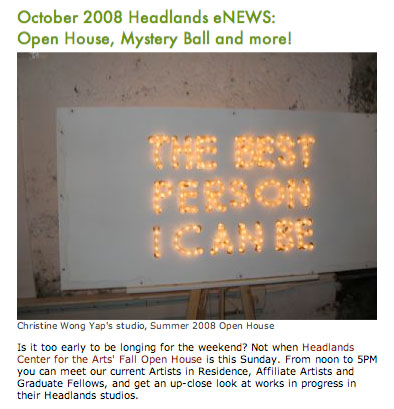
A relic in my studio from The Best Person I Can Be in the recent Headlands' eNews. Will you look at that!

A relic in my studio from The Best Person I Can Be in the recent Headlands' eNews. Will you look at that!

Standard
Citizenship

Some media mullings

Things I’ve been thinking about. I’ll keep this brief:

The Bad at Sports contemporary art podcast is great for frank, in-depth art interviews, even if the hosts often over-indulge in candor and chit-chat.

[Update, 2/24/2012: This podcast’s consistency and audio production, and the prestige of interview subjects, has risen in the past four years. Unfortunately, the original hosts remain dedicated to the podcast’s origins in bar conversations. The quality of dialogue remains informal and joke-y, verging on anti-intellectual and overly self-reflective. When the subjects allow the hosts to lead, it can seem like a college radio DJ interviewing an indie band, both trying hard to look like they are not trying at all. The only full episodes I’ve been able to finish lately has been with subjects who refused to be embarrassed about speaking seriously about their work.]

The Fresh Air episode on extraordinary rendition, with interviews with N.Y. Times writer Jane Mayer and a Canadian citizen sent to Syria for torture and detainment without just cause by the US government (aired Sept. 23, 2008). We really should pay attention and be more outraged. Another case of hubristic American Exceptionalism again…

The damn-the-world, God-chose-us rage of that America has sharpened as U.S. exceptionalism has become harder to square with the 21st-century world’s interconnectedness. How exceptional can you be when every major problem you face, from terrorism to nuclear proliferation to gas prices, requires joint action?

Very exceptional, insists Palin, and so does John McCain by choosing her. (He has said: “I do believe in American exceptionalism. We are the only nation I know that really is deeply concerned about adhering to the principle that all of us are created equal.”)

Roger Cohen, “Palin’s American Exception,” NYTimes.com, September 25, 2008

Tom Morello (RATM) speaking out in the current issue of SPIN Magazine: in between snarky quotables about the wacky intersection of music and politics, Morello tells it like it is: Bush should be tried for war crimes (including, in my opinion, extraordinary renditions and Geneva Convention violations at Guantanamo and Abu Gharib, not to mention the unconstitutional expansion of the Vice Presidential office into the Legislative Branch). Furthermore, Morello reminds us that while a certain Presidential candidate may be hope-inspiring, in the truest democracy all citizens participate in making social change. Word!

Philip Zimbardo’s TED talk on the principles outlined in his book, The Lucifer Effect. After focusing on evil in his infamous Stanford experiment, Zimbardo wants to emphasize the possibility of good by bucking conformity, taking action, and following one’s own heroic imagination.

That almost-instantaneous meme, “Wall Street/Main Street,” and the dangerously explosive draw of anti-intellectual, common-sense wisdom and Joe-Six-Pack vernacular.

Finally, a quick bailout drawing, after Candyass.

toxic assets

toxic assets

Standard
Community

Erlich, Chen

Hair Salon is a mirrored installation by Leandro Erlich at the Singapore Biennial — but it uses no mirrors. Brilliant! The work’s investigation of the “mutability of perception” strikes a chord with me (see my work in Activist Imagination). It’s funny how much this piece reminds me of Mario Ybarra Jr.’s New Chinatown Barbershop installation, yet with totally different aims.

See pics and read more in a write-up by Fumio Nanjo for Universes in Universe.

Also, an unsung hero gets some recognition… Edward Guthmann wrote up a nice profile of one of the most respected, intelligent, hardworking artists and exhibition-producers I have the good fortune of knowing and working with. Check it out at “Kevin Chen’s job: to make sure show goes on,” S.F. Chronicle (October 2, 2008)

Standard
Research

bummers and more

All of my work is about optimism and pessimism. In late 2007, I decided to be an optimist. I am thinking about being a pessimist again. Here’s why:


Bummer: With all the spectacular financial ruin on Wall Street, I was thinking that maybe I should pull my money out of my bank. Too late!

Bummer: I know everyone’s got it tough, I’m afraid these lean times will get even leaner. Like Emil Hirsch’s character in Into the Wild, says, Where are the the F’n animals?

It’s not all pity party yet. There are still a few things that float my boat– examples of smart people doing interesting things:

Red Lines
Death Vows
Foreclosures
Risk Structures

September 9 – December 21, 2008
Architectures of finance from the Great Depression to the Subprime Meltdown
An exhibition by Damon Rich and the Center for Urban Pedagogy (CUP)
Commissioned by the MIT Center for Advanced Visual Studies (CAVS)
Hosted by the MIT Museum
MIT Museum Compton Gallery, Cambridge, MA
How timely! What a great idea to develop an exhibition model for examining these rather convoluted economic structures.

Won Ju Lim: 24 SECONDS OF SILENCE
September 27 – November 26, 2008
Curated by UCCA Curator David Spalding
I really loved Won Ju Lim’s work at Patrick Painter, and I’m sure she’s up to something amazing at the huge, recently opened Ullens Center.

Apex Art’s Franchise opportunity.
Strange curatorial potential.

Josiah McElheny’s “The End of the Dark Ages” sculptural infographics of the Big Bang at Andrea Rosen Gallery

And finally, a smart person has written a (presumably) interesting book about a really, really big bummer:

David S. Mason’s blog for his new book, The End of the American Century, is already really topical, though the book isn’t due out until Oct. 1. The timing really couldn’t be worse, if you’ve already got the bad news blues, or better, if you’re a fan of Lehmannfraude.

Standard
Community

brilliant!

tomorrow is for those who can hear it coming, Julio Cesar Morales‘ current exhibition at New Langton Arts, is brilliant, literally and figuratively. I’m very inspired by how buttoned-up Julio keeps his big video / photo / neon installations. The content is really fantastic — the intersections of Mexican/settler cultures in early California, spelled out in a sequence of images that alternate between tantalizing and visceral. The costumes and decor are spot-on; the cinematography in the video’s is beautiful, quality HD. Very impressive! Congrats to the artist and the non-profit New Langton on such a beautiful exhibition.

And congrats to the latest artist-recipients of the Macarthur “Genius” Grant, including current Headlands AIR, Walter Kitundu, one of the most unconventional artists in the Bay Area, and one of the humblest people around.

Both of these artists are persistent (Walter sold his jeep — which was once his father’s — to fund his Icelandic residency a few years back) and generous (Morales runs an artist-run space and shows often at non-profits; Walter also shows at non-profits like the Luggage Store, performs music, and works at the Exploratorium). So it’s great to see these artists get their dues. And it’s nice to have two more reasons not to worry about being under-the-radar in the Bay Area or showing in non-profits.

Standard