Art & Development, Community

art art art weekend part two

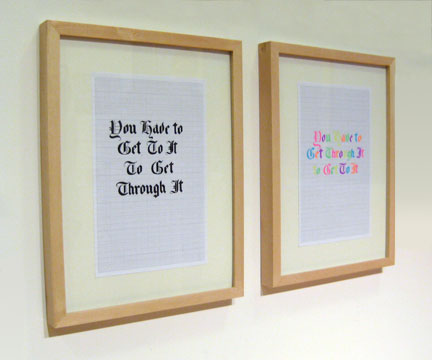
Christine Wong Yap, You Have to Get Through it to Get To It / You Have to Get To it to Get Through it, 2009, ink on paper 7.625 x 11.5 inches each. Produced in the Breathe Residency at Chinese Arts Centre.

Christine Wong Yap, You Have to Get Through it to Get To It / You Have to Get To it to Get Through it, 2009, ink on paper 7.625 x 11.5 inches each. Produced in the Breathe Residency at Chinese Arts Centre.

This installment of my art weekend update starts off with a few happy observations concerning last Saturday’s Southern Exposure’s Pop Noir auction at Electric Works:

First, it seemed like a successful fundraiser. The bidding was active and collectors seemed to enjoy getting worthy works and good deals while supporting SoEx. It was really great to see people buying art. Non-profits are struggling more than usual, so it’s great to see arts supporters persist.

Second, SoEx puts on a great auction. They got really great donations of local food and booze; the auction was run really smoothly, and the installation seemed to fit an incredible amount of work on rather limited wall space really well.

Third, my donation (pictured above) went at above the retail price; not bad when the minimum bid starts low. It’s nice to see your work appreciated so measurably. I’m not opposed to partnering with the right gallery, but lately, I’ve enjoyed the freedom to just make whatever I feel like, and get on with collaborations with artists and friends.

In the end, my attitude is the same as Leonard Cohen’s, who was recently quoted in “Careless Whisper” by Jennifer Allen in Frieze Magazine (April 2009):

I didn’t want to work for pay, but I wanted to be paid for my work.

In that spirit, I’ve made some works available.

Christine Wong Yap, Dime Store Advice, 2009, China marker on foil-laminated cardstock, 11.75 x 16.5 inches. Produced in the Breathe Residency at Chinese Arts Centre.

Christine Wong Yap, Dime Store Advice, 2009, China marker on foil-laminated cardstock, 11.75 x 16.5 inches. Produced in the Breathe Residency at Chinese Arts Centre.

Christine Wong Yap, Untitled (Lens Flare, Small Mirror), 2007, Etched mirror, colored pencil, frame, 13 x 16 x 2 inches

Christine Wong Yap, Untitled (Lens Flare, Small Mirror), 2007, Etched mirror, colored pencil, frame, 13 x 16 x 2 inches

Christine Wong Yap, Cheap and Cheerful #3, 2009, neon and glitter pen, 11.625 x 7.75 inches. Produced in the Breathe Residency at Chinese Arts Centre.

Christine Wong Yap, Cheap and Cheerful #3, 2009, neon and glitter pen, 11.625 x 7.75 inches. Produced in the Breathe Residency at Chinese Arts Centre.

Christine Wong Yap, Cheap and Cheerful #10, 2009, neon and glitter pen, 11.625 x 7.75 inches. Produced in the Breathe Residency at Chinese Arts Centre.

Christine Wong Yap, Cheap and Cheerful #10, 2009, neon and glitter pen, 11.625 x 7.75 inches. Produced in the Breathe Residency at Chinese Arts Centre.

If you’re interested in providing a good home for any of these works, please email me at cwy (at) christinewongyap.com, and I’ll send over a link where you can get prices (ranging from under $100 to a few hundred and up) and more info about these and other available works. Cheers.

If original art is out of your price range, consider multiples and books, available at my Store.
Standard
Community

art art art weekend part one

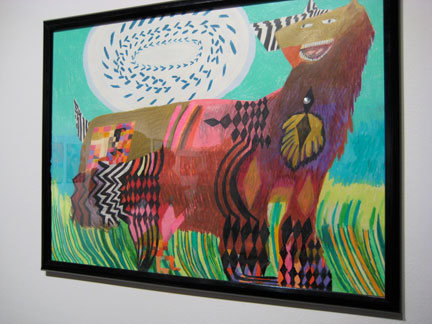
Installation by Sam Lopes, Joy Fritz and Friends at Blankspace Gallery.

Installation by Sam Lopes, Joy Fritz and Friends at Blankspace Gallery.

Nipped in Sam Lopes’ opening at Blankspace Gallery in Oakland, CA. To be more specific, the exhibition, “Just because there are questions doesn’t mean there are answers,” is a show of “new collaborative work by Sam Lopes, Joy Fritz and Friends.” The works were what JC (not that JC) might have called craptastic, where craftsmanship seems deliberately hobbled, so that naive drawing styles in odd materials (crayons and oil pastels) take precedence. The show is really colorful and sweet, and compellingly nostalgic for the 1970s. It turns out the depiction of of handicrafts from the shag carpet era might be inspired by nostalgia for a gay heyday.

lopes

Drawing by Sam Lopes, Joy Fritz and/or Friends

There were some passages that reminded me, in a good way, of Ben Shahn’s work, where the line seems so unfettered you can’t tell when it’s good or bad, but you just know that it’s exuberant.

In contemporary art, “decorative” is usually used derisively, but I’m starting to re-think this prejudice. Certainly, I’m more interested in work that has interesting and rigorous conceptual intents, but I’m also beginning to suspect that decoration and conceptual rigor are not as oppositional as presumed. In a way, decoration is not entirely free of function—people seem to have an innate decorating impulse, tied maybe to creativity and expression as well as aspirations and the need to see themselves reflected in the world. At a basic level, it seems to fill a desire to find a voice or secure a space in the material world.

lopes

Drawing by Sam Lopes, Joy Fritz and/or Friends

There’s a lot of decoration in “Just because.” It’s in the selection of subjects that lend themselves to high-spirited colors and patterns, like bedspreads with fringes, wallpaper, bolero jackets and hand-knit rugs. And while I’m sure this decorative impulse was driven partly by pleasure and the unadulterated love of drawing, I also suspect that the choices were not entirely formal, and the use of pattern and decoration suggests something about art being, fundamentally, a craft, and craft being more akin to hobby-like forms of self-expression, rather than a selling point of marketable art objects.

It’s East Bay Open Studios this weekend, where everyone and their purse-making sister, graf-merging cousin, and urban-artifact-re-arranging uncle open their studios to the public. I think that membership-based art organizations are critical to building and sustaining a vibrant local art community, of course, but the experience of seeing so many different kinds and qualities of art can have low returns when taken all together. It’s like going to an international buffet, and you end up getting hummus on your sushi and chow mein in your bread pudding.

I stopped by a few different studios in Oakland today. I found it strange that only half of the studios in a certain complex were open. I realize that registration for Open Studios requires a hefty membership fee, but still, it seems like a missed opportunity to not be in your studio if the public is going to be wandering through your building anyway.

terry furry

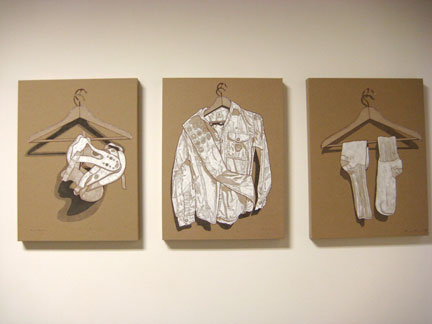
Works on mounted Kraft paper by Terry Furry at Swarm Studios.

Terry Furry’s a genuine, nice guy, so it’s hard for me to be objective about his work, but I really enjoyed his latest batch of paintings on mounted Kraft paper. I know that some of their appeal stems from a certain graphic design or illustration-y cleanness. Still, these still-lifes of a boy’s or man’s personal effects are more ambiguous than his previous figurative paintings, and hence, more open-ended and compelling. The empty spaces seem less like formal devices, and a little more affective.

Standard
Research

Bainbridge, optimism and everyday materials

Whilst in the UK, I developed a taste for the Mancunian accent (“wot?” “ay!?” “is the shoPP open on tchoose-day, or does it close UR-leh”) and Frieze Magazine. The quality of design and content are high, and the content-to-ad-ratio is pleasant to navigate. Two articles in the May issue were particularly relevant for me.

“Future Conditional,” the editor’s note by Jonathan Griffin, makes a case for optimism— while images of dystopia and apocalypse are popular in contemporary art, we could use more images of

convincing alternatives…. A shared image of what is to come is not only healthy but also a form of prophesy; the fulfillment of the only future we can imagine, whether utopian or apocalyptic, is, on some level, deeply satisfying… [but] If a new future is to be developed, is it reasonable to ask art to contribute to its construction?

This seems to mirror Angela Davis’ argument that art must not only act in opposition, but imagine alternative futures.

In “Tales of Everyday Madness,” Griffin also profiles the British sculptor Eric Bainbridge, with this choice descriptions that seem relevant to my interest in the use of the readymade. Bainbridge “works with certain materials, forms and cultural references because he finds them ridiculous, repellant or pathetic,” and maybe these are attributes he sees in himself.

eric bainbridge
Eric Bainbridge at Middleborough Institute of Modern Art
Image Source: Frieze Magazine website, Archives Section, Issue 119, Nov/Dec 2008, Eric Bainbridge review.

In fact, cheap materials “elicit a kind of sympathy, an identification with the viewer that this is what we are.” I was bemused to hear that when Bainbridge showed his work in New York in the 1980s, he felt “utterly deflated at how English it looked, in its moderate scale, self-effacing humor, and domestic frames of reference.” But I would argue that this deflation constitutes not a detriment to the quality of his work, but an affirmation that his work was going against the grain of the spectacular, garish, market-friendly art of the time.

Bainbridge went on to assert that “the sublime could exist in the most unlikely of places…. Even the most exotic, fancy objects conceal the mundane and familiar, and conversely, that the things closest to home can occasionally reveal themselves to be strange, foreign and unknowable.”

This is not the most profound revelation in art—as it’s a fundamental principle behind Surrealism, as well as the contemporary folk-art-influenced naivete—but I love how Bainbridge articulates it. Rather than elevating the mundane, or valorize authenticity with aestheticized faux naif gestures, Bainbridge seems to complicate the act of declaring an object a work of art, and seems to be winking at viewers in the creation of what might be considered campy knickknackery.

Standard
Citizenship, Community, Research

Things are grim, but I can’t stop thinking about happiness.

Where my mind’s been at:

Positive psychology — a relatively new field of evidence-based self-help for being happier. Think of it like the shift in medicine from treating illness to increasing wellness. As Tal Ben-Shahar, PhD, writes in Happier, pretty much everything we want in life ultimately leads back to happiness.

The idea is to increase happiness in daily life, rather than dealing with unhappiness only during moments of crisis.

[See also Dr. Martin Seligman, Prof. Philip Zimbardo and Dr. Walter Mischel (whose research was the subject of a great article by Jonah Lehrer recently in the New Yorker Magazine).]

Practicing gratitude is one of the oft-cited methods of increasing happiness.

I’m tremendously grateful for friends helping friends. I know, I know, everyone’s hurting now financially. But a lot of artists are freelancers, and while freelancing is typically like riding a roller coaster, it seems like a lot of my peers are feeling lost in a free fall. These are bright, hardworking people doing everything from graphic design, to interactive art direction, to preparator/installation to cooking.

The financial safety nets are being strained, but it seems like social bonds are staying strong… Artists helping artists. Freelancers helping freelancers. I’m so grateful to be in an art community, in which, even in lean times, can exhibit generosity instead of competition.

If you can support the arts in these times, for goodness’ sake, here’s how (and where and when!):

travis meinholf art
Formerly San Francisco-based, now Berlin-based artist Travis Meinolf is in the unenviable position of raising funds for a matching grant (good luck!) for his kind of hilarious but also strangely innovative practice of action-weaving. Like his healthy ‘stache, Travis’ participatory weaving seems impossibly sincere (his last project resulted in 12 volunteer-made blankets being donated to a women’s shelter). He’s a good guy and a hard worker and I wish him the best of luck in sowing his weaving projects ’round the world… Contact Jennifer McCabe, director of the Museum of Craft and Folk Art at jmccabe@mocfa.org to make a contribution towards Meinolf’s exhibition. (Image source: actionweaver.com)

(In case you missed it, I mentioned Scott Oliver’s totally fund-able project about my beloved Lake Merritt in a previous post.)

This Saturday night is Pop Noir, an auction to benefit Southern Exposure, an alternative art space that’s consistently invested in local artists, community engagement, and excellence in contemporary art. This female-led organization has always pushed the envelope, and I’m very proud to donate a pair of text-based drawings to support their work. Over a hundred and fifty other local artists have donated work too. Countless volunteers are contributing time. But it’s all for naught without buyers. So come on down—with auction prices starting at a fraction of the retail price, the price is right. Look for some really nice pieces by Weston Teruya, The Thing Quarterly by Allora and Callzadia, Michael Hall, Laurie Reid, Jeff Canham, Jamie Vasta, Edgar Arcenaux, Dustin Fosnot, and yours truly (pictured as follows).
weston teruya artThe Thing Quarterlymichael hall artlaurie reid artjeff canham artjamie vasta artedgar arcenaux artdustin fosnot artchristine wong yap art
(Image sources: Southern Exposure’s Pop Noir Auction Artists

Pop Noir will be held at the gorgeous galleries at Electric Works at 8th and Mission Streets in San Francisco. Tix, more info, pics of the auction lots, and absentee bidding details here. Hope to see you there.

Stephani Martinez, Daily Cakes - Extra Fancy, 2009, Variable, Doilies, Plaster, Gold Leaf
(Image: Stephani Martinez, Daily Cakes – Extra Fancy, 2009, Variable, Doilies, Plaster, Gold Leaf. Image source: Intersection for the Arts’ 2009 Benefit Art Auction.)
Of course the other amazing alternative art space in San Francisco is Intersection for the Arts, who is well-respected for the rigor of their programming, and renown for making miracles on a shoestring. Like many non-profits, the downturn is hitting their typically lean infrastructure hard. Intersection’s auction comes up next weekend, on the following Saturday, June 13.

Daniel Tierny, Double Jump, 2009, Tape on lambda print, 23 x 33 in., Courtesy of the Artist and Steven Wolf Fine Arts, San Francisco.
(Image: Daniel Tierny, Double Jump, 2009, Tape on lambda print, 23 x 33 in., Courtesy of the Artist and Steven Wolf Fine Arts, San Francisco. Image source: Headlands 2009 Benefit Auction, Artists, Daniel Tierney.)
Wednesday, June 10, the Headlands Center for the Arts holds their auction at the Herbst International Exhibition Hall in the Presidio. I’ve been an Affiliate Artist at the Headlands for a year and a half. The Headlands is an amazing locus for an international and local art community. When I think about relocating, few places compare with the quality of the Bay Area arts scene, partly because of the Headlands’ role in drawing international artists in residence to the area.

So there you go. Support an artist directly, or support the organizations who support the artists. And take home some artwork!

Standard
Community

Good art

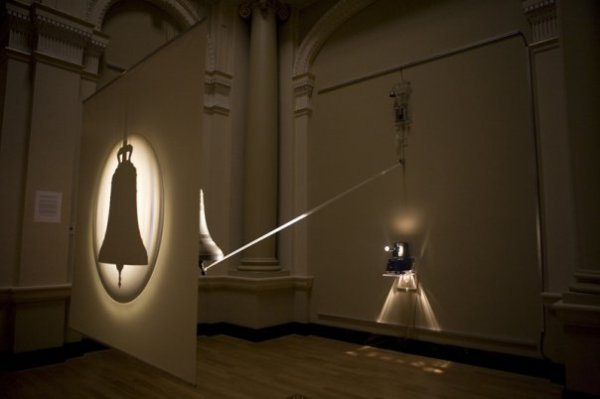
David Gurman, "The Nicolas Shadow," 2009

David Gurman, The Nicolas Shadow, 2009

David Gurman’s The Nicolas Shadow installation at St. Ignatius Church in San Francisco is pretty great. Though I’m quite secular, I really enjoyed my visit to the church, which is on the corner of the USF campus. The exhibition in Manresa Gallery, Icons and the Iconic, is an interesting mix of traditional icons, modern icons in the traditional style, and a few modern and contemporary works. Gurman’s installation is stunningly beautiful in a meditative way, and yet its content (a large bell tolls every hour counting the number of civilian casualities in Iraq) is explicitly political.

I also attended Claire Fontaine‘s artists’ talk at the Wattis Institute tonight. The Paris-based collective has been showing interesting conceptual work with radical interests at the Wattis and the Tate Modern for a few years, and it was really cool to see the artists speak with such intellect, humor and humility. Their work at the Wattis consists of texts spelled out in fluorescent tube light fixtures, in what they coined “K-Font” (sp?).

Standard
Community

Points of Reference: posters, typefaces, Lake Merritt

The artists behind Shotgun Review are doing some really interesting individual and collaborative projects.

I’m SUPER digging the two projects on Joseph del Pesco‘s site right now.

pile of artist's funding posters
State of the Arts, The Present Group & Horwinski Press, December 2008.
Image source: http://delpesco.com/

Beautiful posters influenced by wood type and mixed-fountain printing, demanding better working conditions for artists. What’s not to like?

Black Market Type & Print Shop
Joseph del Pesco, Black Market Type & Print Shop, Articule, Montréal, June 2008
Image source: http://delpesco.com/index.php/P1/

Artist’s typefaces—I love it! It’s a great coincidence, because after working on hand-lettering during the Breathe Residency, and reading Ellen Lupton’s Thinking with Type recently, I decided I’d like to design a typeface. It’ll probably be a display face, exuberant and expressive at the risk of legibility. But I figure it’ll be an art project, not a design project; I know enough to leave the development of extensive type families to the pros.

There are so many crappy fonts in the world already, why bring another one into existence? Well, the fact is, even typographic design can be a little subjective; Blackletter was considered very legible in the early 20th century among Germans and inscrutable in other parts of the world. And history, as well as Lupton’s book, is filled with other examples of typefaces that were reviled in their time. For example, Baskerville, a typeface that many modern eyes would consider just another serif roman font, rather boring and not particularly distinctive, was reviled for

Blinding the Readers in the Nation; for the strokes of your letters being too thin and narrow, hurt the Eye.

–as quoted in Ellen Lupton’s Thinking with Type

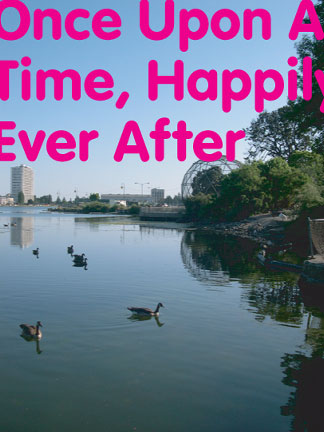
Scott Oliver's Once Upon A Time, Happily Ever After, audio tour of Lake Merritt, Oakland, CA

Scott Oliver's Once Upon A Time, Happily Ever After, audio tour of Lake Merritt, Oakland, CA

I’ve always liked Scott Oliver‘s material investigations/post-conceptual modifications of everyday objects, and his next project—an audio tour of Oakland’s Lake Merritt—totally floats my boat for two reasons.

A. I love Lake Merritt, it’s one of the few things that keep my regard for living in Oakland really high.

It’s a nice open space in the middle of the tree-starved flatlands, and while it’s not the most natural of places, it plays an important role larger ecosystems. Lake Merritt is not a “man-made lake,” but an estuary, which is why it’s a unique habitat for migratory birds.

It’s also a nice public space used by a cool cross-section of residents: runners, walkers, people who put on jogging suits to get coffee at Peet’s, guys hanging out in their cars all day, serious athletes running the stairs, office workers and families from all walks of life.

B. Oliver’s working with some really bright collaborators, and bringing onboard a lot of local arts organizations. Any local histories can be tricky, but Oliver’s got the right approach.

Oliver’s got a matching grant, so he needs to raise matching funds in the form of donations from individuals. Matching grants are challenges in any situation, but I don’t envy his position in this economy.

Once Upon A Time, Happily Ever After: An Audio Walking Tour of Lake Merritt will offer an immersive audio experience to listeners—using a mixture of ambient field recordings, interviews, music and narration to weave an idiosyncratic but approachable narrative that will guide listeners through the various natural and artificial elements that surround Lake Merritt. With an emphasis on local history, cultural diversity, urban ecology, and the power of imagination, Once Upon A Time, Happily Ever After will explore the invisible that surrounds the visible—the stories and forces that shape the lake and our perceptions of it. Once Upon A Time, Happily Ever After will be free to the public and widely accessible to Lake Merritt visitors through both on-site and remote locations.

To support the audio tour of Lake Merritt, email Scott Oliver at: knot (at) sbcglobal . net.

Standard
Art & Development

The Quest for the Perfect Sketchbook Continues

Having once engaged in the activity of drawing fervently, and now doing conceptually-oriented work in different media, I tend to disappoint past colleagues who are fond of my old drawings, and surprise new acquaintances when my skills are revealed.

Sometimes These are nice drawings! also means Oh! You can draw!

I’m sure most people would wonder why I’ve de-emphasized my expressive “hand” in favor of simpler, diagrammatic drawings. Maybe persistent stereotypes — like the myth that individuals either “can” or “can’t” draw, or that conceptual artists are too lazy or un-skilled to make objects — influence their views.

But the reasons are: I’m not out to “wow” anyone with my drawing skills, most of the time. My drawings are usually proposals for objects, information graphics or investigations of time and labor. So, using an expressive hand (revealing an authorial ego) could undermine the work. I try to execute my ideas in a straightforward way, with conceptual rigor and economy—to make simple acts go far.

While I’ve stepped away from intensive journal-keeping in recent years, I’ve come back to it during the Breathe Residency in Manchester. In those three months, I filled up almost 400 5×8″ pages. And those pages couldn’t look more different than my past sketchbooks.

Here’s a page from about 10 years ago.

Christine Wong Yap, untitled page from Sketchbook #7, 1998, acrylic, pen, collage and photo on textbook.

Christine Wong Yap, untitled page from Sketchbook #7, 1998, acrylic, pen, collage and photo on textbook.

I was inspired by illustrator/teacher Barron Storey and friends like John Copeland to capture my daily life and draw my immediate environments. I was blurring the line between finished works and works in sketchbooks.

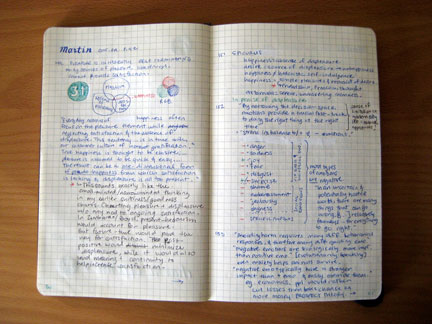
Now, though, I’m consumed with research spanning pop psychology, installation and conceptual art, and any source that offers insights on optimism and pessimism. Here’s a page from my current sketchbook:

Christine Wong Yap, untitled page from book 24, ink on paper

Christine Wong Yap, untitled page from book 24, ink on paper

OK, I’ve embraced my inner nerd. Many of the pages are reading notes, lecture notes or diagrams of concepts. But I sketch ideas for projects too.

Christine Wong Yap, untitled page from book 24, ink on paper

Christine Wong Yap, untitled page from book 24, ink on paper

These aren’t works or drawings, really, but these books form the research backbone of my work. As Stephanie Syjuco recently advised UC Berkeley’s MFA graduates, it’s good to

Honor your intangible labor in the studio, even when you or others don’t see apparent results.

And that’s what the residency afforded — time and space to embark on intangible labor — experiments, research, reading. I’m confident that absolutely none of the work that resulted in the residency would have happened without all the research I conducted. So these notebooks may not be “works,” but that doesn’t diminish the importance of this work.

I’ve had every sort of possible sketchbook available on the market, and some handmade ones too. For research and diagrams, I’ve been happy with Moleskin’s gridded books. Yes, Moleskins are sort of hoity-toity, like I should be wearing a velvet blazer and Mary Jane Clarks, but they’re sooo worth it, even if the grid is in metric. Recently, I found a Moleskin knock-off (complete with creamy pages and soft grey grid) in a composition book form. This one’s nice because you have more space for your hand to rest.

5x8" hardbound Moleskin (left) and composition book-sized soft cover journal (right)

5x8 hardbound Moleskin (left) and composition book-sized soft cover journal (right)

Still, this one has a hideous plastic cover, molded to mimic pebbled leather — a tactile feature I’ll try to overlook.

cwongyap_sketchbook_24-4

Alas, the quest continues.

Standard
Community

Wunderflator, Junk Spaces, Hunger, Drucker

Life in California is pretty great.

Yesterday I drove down to Stanford University for Wünderflater, the MFA show by Reed Anderson, Michael Arcega, Kazumi Shiho, Cobi van Tonder and Jina Valentine. Palo Alto always strikes me as a surreal idyll, but the cool breeze, setting sun and beautiful arty people had me savoring my good luck of living in California. I might have lingered a bit too long, though, as my time inside the exhibition was too brief. Still, the inflatable structure containing a room displaying studio detritus made a lot of connections, which I haven’t yet all sorted out…. The inflatable reminded me of Ant Farm’s early inflatables, which were meant to radicalize architecture, though I was told that the inflatable in Wünderflater is meant to evoke a dream scene, which it does in a metaphoric, rather than theatrical, way. The detritus reminded me of Goldsmiths’ Professor Irit Rogoff’s comment at Global Modernities at Tate Britain that much of the Nicolas Bourriard-curated Triennial was about the re-presentation of junk spaces. For example, Bob and Roberta Smith’s installation combines hand-painted signs literally with junk that would turn up on Bob Smith’s street corner, and Franz Ackermans’ de-constructed installation about immigration and borders was strewn with flags on the ground. I thought that for the MFA grads to refuse to show spectacular, finished, marketable work — their “brands” in the art worlds — is pretty courageous and really interesting in the context of thinking about the hangover of overproduction in a globalized manufacturing system.* And strangely recursive and shockingly straightforward at the same time — exhibiting the objects (that exist directly in the world) that are banal and yet inspiring for the creative process of making more objects to exist in the world… It may not be the most earth-shattering show ever, but it evinces a really interesting sequence of ideas and actions…

[*Likewise with Weston Teruya‘s work at Patricia Sweetow Gallery — sure, the works on paper are these human-less narratives of ecological disaster, yet the pictures are populated with the signifiers of consumption/overconsumption… of maybe sea garbage washed ashore, adrift without nationality and mortally banal in their ubiquity.]

During the after-party (which was kindly serviced by a taco truck and tamale ladies: brilliant!), I got a peek at the amazing, huge studios. It looks like each MFA grad gets their own studio building. I was agog. It made me want to go to Stanford for another MFA. After the brief flash of jealously passed, I added the vision of a luxuriously large, comfortable studio in a wooded grove to my new found hunger. Since I’ve been back from the Breathe Residency, I’ve been living more intently and intensely, filled with this urgency to go for it, to get what I want — to be an artist all the time, not just for as long as I can afford it, or dependent upon deadlines / external validation. To just live it. To be hungry, to be unstoppable, like Pacquiao.

If you’ve read the blog before you probably know I’ve got a healthy obsession with artist and theorist Johanna Drucker. In addition to my good fortune of living in beautiful Calfornia, I’m also happy to share the good fortune of hearing Drucker deliver a keynote address for an event affiliated with an exhibition I’m in. It’s coming up on Wednesday, and I would wager a pretty penny that you won’t be sorry if you take the time to come out to Santa Clara for it.

Tactical Digital Aesthetics
Wednesday, May 20, 2009, 6:00-8:00 p.m., free
An evening of art and conversation exploring new media, remediation, and cultural politics. Keynote by Johanna Drucker; roundtable by Ray Beldner, Stephanie Syjuco, Anthony Discenza, and Johanna Drucker; and moderated by Katie Vann and Kathy Aoki. Co-sponsored by the de Saisset Museum; the Public Engagement Program of the Center for Science, Technology, and Society; and a SCU Technology Innovation grant.

Standard