Art & Development, Travelogue

Hip Hip Hooray for Barrow: Fly Eric

I had become pessimistic. Maybe it’s the economy, the dreary Mancunian skies, or the feeling that I was spinning my wheels as an artist. But reading books by Fareed Zakaria and Barack Obama made me want to be an optimist again.

Changing outlooks takes effort. Good luck also helps.

When I heard about an art symposium in a seaside town two hours away by rail, I hardly considered making the trek. I’d been in Manchester for almost a month, and had already settled into a routine. Perhaps, set adrift from familiar places, people and responsibilities, I’d latched onto the studio for security. I told myself, It’s too far. What if the symposium was a waste of time? What if I missed the last return train? (When I think of “seaside town” and “art” I think of Morro Bay, glass dolphins and watercolor landscapes.)

I realized I had traded in my sense of adventure for a little security. So I gave the symposium a shot. And things couldn’t have turned out better.

Morecambe Bay, I think. The photo doesn't do it justice. I looks dreary, but it's actually a spectacular landscape. It may be grey, but it's a hundred shades of grey.

Morecambe Bay (I think).

Today’s symposium, called “Changing Perceptions of What Artists Can Do,” was great. It featured four dynamic artists/architects — they were all great speakers, with interesting practices. In particular, Verity-Jane Keefe, an artist working with muf architecture, seemed to be at the cutting edge of how art practices can shape urban design dialogues. David Cotterrell was also a great speaker. He further proved my theory that university professors are the best art lecturers, because they construct and effectively convey the narrative of their own development. I was really moved when he talked freely about “making art I could no longer afford to make” and maintaining a commitment to his art-making, even if there isn’t a readily identifiable core practice. It re-affirmed my own struggles; the inquiry required to make conceptually-oriented art is constant, and the rewards elusive.

Speakers at "Changing Perceptions of What Artists Can Do," a symposium sponsored by Fly Eric

Speakers at Changing Perceptions of What Artists Can Do, a symposium sponsored by Fly Eric

The symposium was sponsored by Fly Eric, a collaborative of three artist-run spaces in the Northwest: Art Gene (Barrow-in-Furness), Storey Gallery (Lancaster) and Castlefield Gallery (Manchester). It was hosted by Art Gene, a dynamic contemporary art gallery and residency program in a little seaside town known as “the longest cul-de-sac in the world.” I had first heard of Art Gene through Intersection for the Arts‘ Kevin Chen, who put me in touch with Conrad Atkinson and Margaret Harrison, Art Gene champions. Barrow is lucky that Maddi Nicholson and Stuart Bastik, Art Gene’s dynamos/artists/co-founders, have chosen this windswept slice of Northern coast as their home base.

I had forgotten the paradox that the more rural a place is, the easier it is to meet like-minded people. This proved true today many times — I got re-acquainted with an artist I had met in 2007 in Penrith, a bijou cake of a Cumbrian village. I met two working artists/art commissioners, who invited me to their art group in Preston, and numerous other savvy artists, thinkers and art commissioners from across the Northwest. Nearly half the attendees met at the pub for pints and chips or shepherd’s pie. Quaint, innit? I felt profoundly lucky to be there.

I had only a few minutes before my Trans-Pennine train whisked me away, but I caught a few minutes of the reception for Welcome to Paradise, Art Gene’s new exhibition. Stuart Bastik’s graphite diamond totally floated my boat. It’s an awesome project, one that I wish I could have done, but Bastik executed it perfectly.
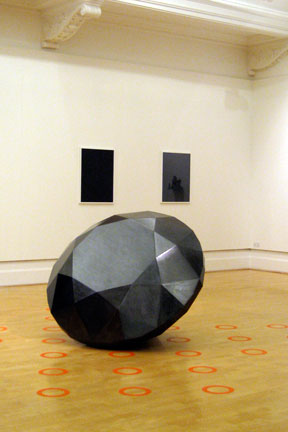
Art by Stuart Bastik in "Welcome to Paradise" exhibition at Art Gene. "The Weight of History is Crushing Me in my Bed" (foreground), with "Constellation" I and II (background).

Art by Stuart Bastik in the Welcome to Paradise exhibition at Art Gene. The Weight of History is Crushing Me in my Bed (foreground), with Constellation I and II (background).

I also really loved the Ultimate Holding Company‘s illuminated push-pin, locating a “there” there.
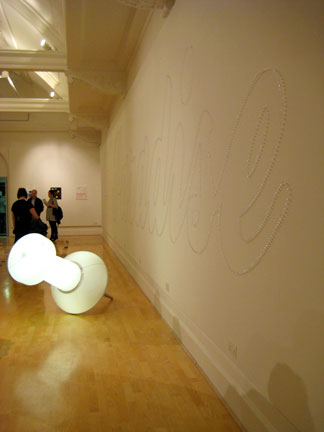
"The Giant Map Pin" (left) and "Paradise" (pushpins on wall) by The Ultimate Holding Company (with Art Gene)

The Giant Map Pin (left) and Paradise (pushpins on wall) by The Ultimate Holding Company (with Art Gene)

I look forward to returning to this place that expanding my notions of what’s possible — for art in a remote area, for community where you least expect it, for my sense of adventure, for my outlook.

Standard
Art & Development, Travelogue

not helping

An addendum to the previous post on Fareed Zakaria’s The Post-American World:

If, as Zakaria writes, America can continue “to thrive because it has kept itself open to the world—to goods and services, ideas and inventions, and above all, to people and cultures,” it follows that America should steer away from these current trends in the UK:

The curtailment of civil liberties.

Immigration policies that reduce the number of artists allowed to enter the country.

Like Zakaria, I believe that immigration policies that stop people from working are terribly misguided. Furthermore, artists are agents of culture; to de-value cultural exchange in an increasingly interdependent world reeks of regressive isolationism.

I’m looking forward to visiting London soon; the quality and vitality of the arts there are unparalleled. But if London becomes stagnant and inward-looking, there are many more centers in the art world that would happily render conventional art capitals like London obsolete.

Standard
Art & Development, Travelogue

Antony Hall lecture at Cornerhouse

Antony Hall demonstrates the m-Log in front of a projection of a deliriously rhizomatic interface

Antony Hall demonstrates the m-Log (a sensor-driven noise-making interface, housed in a real log) in front of a projection of a deliriously rhizomatic interface

Antony Hall wants to have it both ways. He is disappointed if his science-based projects (which span interspecies communications and fluid mechanics, like creating vortexes in coffee cups) aren’t regarded as serious experiments. On the other hand, seems to be in disbelief that he performs as a experimental sound artist at art events. But when the public wants to acquire his handmade musical instruments, he prefers instead to lead D.I.Y. workshops, acknowledging the (social) aesthetics at work.

The science experiments are smart and interesting. I haven’t had a chance to try the chamber for interfacing with a fish currently in the Interspecies exhibition at Cornerhouse, but the idea and interface are lovely.

The music projects’ low-meets-hi-tech is endearingly ironic. What started out as an elaborate joke (Hall and a friend, whose name I can’t recall, thought it would be funny to make music from a homemade analog interface housed in a log, called iLog, rather than a laptop) has turned into the Owl Project. It’s a grouping of preposterous inventions: the iLog, the m-Log (sort of like the Owl version of an iPod, but with only sensors and no harddrive, I think), and the Sound Lathe (It’s a lathe! It’s an instrument! And it’s pedal-powered!).

Standard
Research, Travelogue

Fareed Zakaria’s The Post-American World

Global economic collapse.
The quagmire in Iraq.
Anti-American sentiment.
China, the sleeping dragon, asserting itself.

There are so many geopolitical reasons to be anxious, afraid and pessimistic. Like many Americans, I’ve been feeling a foreboding sense of decline. In The Post-American World, Fareed Zakaria* argues that America will not be the same kind of lone superpower it has been, but we have many reasons to be optimistic. Indeed, he posits that if the US faces the coming challenges with cooperation and adaptability, we can help shape a secure, prosperous post-American world.

The post-American world is “not about the decline of America but rather about the rise of everyone else,” Zakaria writes. Globalization and rising economic powers means that past paradigms (“integrate with the Western order, or reject it”) no longer apply. As he puts it, “The world is moving from anger to indifference, from Anti-Americanism to post-Americanism.” China and India are becoming major players. They will work to secure their interests and expand their influence. It’s not that the American share of the pie will get smaller, but the pie itself will get bigger.

After all of the boosterism, accusations, and cynical “othering” around the 2008 Beijing Olympics, I found Zakaria’s perspectives on China quite refreshing. China’s rapid growth has caused some Americans to fear China as an evil, inscrutable state. But Zakaria argues that the Chinese government is not intentionally malicious — its major priority has been non-confrontational economic growth, which has lifted millions out of poverty in the past 30 years. Furthermore, Chinese manufacturing flourishes, but it’s not a threat to America yet, as Americans are good at innovation and adding value. We benefit from the high profit areas of development and retail/marketing.

Innovation, of course, is key to growth, and growth is more critical for future success than wealth. For example, when Europe was reeling from the Black Plague, China could have led the world in discovery and innovation. Instead, it closed itself off, and disregarded new technologies.

Another country that paid a dear price for failing to innovate is Great Britain. It was known as the world’s workshop in the 19th century, but failed to compete against U.S. innovation in the 20th century.

But America is different; our economy demonstrates unique advantages. Even though “The Post-American World” was published before the mortgage crisis led to bank collapses, I suspect that the author would still maintain his optimistic views. Despite all our problems, the U.S. economy — however weakened — is still the largest in the world (comprising a quarter of the world’s G.D.P.).

There’s our “demographic vibrance.” As Zakaria points out, “Europe presents the most significant short-term challenge to the U.S. in the economic realm,” but Europe’s population is declining, and unlike the US, it is reluctant to allow and assimilate immigrants. Zakaria asserts, “America’s edge in innovation is overwhelmingly a product of immigration” and “this is what sets this country apart from the experience of Britain and all other historical examples of great powers.”

Then there’s our technology and innovation. Zakaria dispels the myth that our students are outperformed by foreign counterparts. The averaged statistics mislead (or rather, they reveal the inequality in our schools). Still, many of the top universities are located in the U.S., which attract top talents from around the world. We should retain them, too, instead of implement regressive immigration policies.

Unlike Great Britain, whose biggest challenge in maintaining its superpower was economic, Zakaria argues that America’s biggest challenge is political. He says that the post-American world will be multi-polar world. America can help this world be prosperous and stable by taking an active role, guided by principles of cooperation, consultation and compromise. The U.S. can’t make exceptions for itself when it comes to rules like nuclear weapons. The U.S. can’t solve all the world’s problems, but some larger problems, like climate change, require an organizer, and only if the U.S. maintains great relationships with all countries, can it be a successful facilitator. The U.S. must stop cowering in fear from terrorists (and overreacting to them), asserting its military might when diplomacy would do, re-gain its confidence, become open and inviting again, and re-gain legitimacy.

I think Zakaria is saying: It’s not only possible, but necessary, to approach the future with optimism.

Will America be optimistic, and take these steps towards mutual respect and collaboration? I hope so. Next on my optimism/pessimism reading list: Barack Obama’s Dreams of My Father.

*A note about ideology: I think Zakaria makes many valid points grounded in research, reason and pragmatism. This should be adequate grounds for discussing his ideas; I hope ideology doesn’t get in the way of discourse. Some progressives may not find Zakaria sufficiently leftist, but I think that’s a poor reason for discrediting his work. I value his rigor in making clear, persuasive arguments. For example, when John McCain threw a Hail Mary and nominated Sarah Palin (and successfully galvanized the right), it seemed like lefties couldn’t recover from the sheer audacity. They hysterically bashed Palin amongst themselves, instead of responding productively and bringing the conversation back to real issues. So when Fareed Zakaria published an editorial articulating why Palin is bad for America, I took note.]

Book Review by Josef Joffe, NYTimes

FareedZakaria.com

Excerpt, Newsweek

Standard
Art & Development, Values

Points of Reference

eclipse installation by Pavel Buchler
Pavel Büchler’ Eclipse at Max Wigram Gallery (London)
I love this simple but thoughtful installation.

Maureen Dowd recently remarked in the New York Times that Barack Obama’s election somehow signified that Americans are post-race. What a tremendously privileged point-of-view to take. Artist Kerry James Marshall doesn’t think we’re post-race, and neither do I. Cheers to SFMOMA for commissioning Marshall, and the two for pulling no punches.

I really appreciated Philip Tinari’s “OPENINGS: CHU YUN” in this month’s Artforum as well. It takes a lot of confidence — more than I’m naturally disposed of — to make works that are authentically minimal at the risk of seeming slight. As Tinari puts it, there’s

something subversive… about making works that were barely works.

Visit Chu Yun’s website. I really love the Constellation installation.

Paul Morrison’s exhibition at the Manchester Art Gallery is pretty good. I enjoyed the giant 75′ wide b/w hard-edged mural, which combines source images from 19th-century-style engraving and 20th-century cartoons (I think I saw some Smurfs’ flowers?). I don’t think the shifts in scale is as dark or menacing as the curatorial statement suggests, however. And while I appreciate the white-on-white high-relief picture of dandelions, which is reminiscent of Van Gogh’s sunflowers, I also found the white-gold-and-black-acrylic-on-canvas paintings to slip too easily into collectible luxury items. As I learn more about gold and how, like diamonds, its mining and refinement is inseparable from issues of colonialism, inequality and environmentalism, I can’t see how Morrison justifies his use of gold leaf. Terry Gross’ interview with Brook Larmer on “The Real Price of Gold” is elucidating (Fresh Air, January 8, 2009).

Tomorrow, there’ll be a march on Washington against the use of coal. Writing from Manchester — a city spawned by the Industrial Revolution, whose skies were literally blackened by coal smoke, but has since embraced everything green — coal seems like such a 19th-century phenomenon, and it’s hard to imagine that it’s still a necessity today. Stranger still is how the myth of “clean coal” can persist in America today, despite a relatively educated populous.

Podcast of Joseph Kosuth’s Meet the Artist lecture at the Hirshhorn Museum. I’ve found this podcast series extremely inconsistent, with some poor audio quality of in-gallery recordings. But Kosuth excells in providing a smart, well-prepared lecture about his work and Conceptual Art. Cheers for artists talking with precision about art!

The work of two Mancunian conceptually-oriented object-makers:
Nick Crowe
Ian Rawlinson
and their work as a collaborative team

Standard
Art & Development, Community

Points of reference: 15 Feb 2009, 1306 GMT

This video of artist Ryan Gander talking about his exhibition, “Heralded as the New Black” at IKON Gallery, Birmingham’s top-notch ICA.

Drawings by Donald Urquhart, an Edinburgh-based 2-D artist. His older works (online at Maureen Paley Gallery, London’s Bethnel Green) remind me of Candyass’ jokey text works (see them at Alexander Gray Associates, NYC) and Tony Garifalakis‘ heavy metal-influenced work. Drawings like “An Alphabet of Bad Luck, Doom and Horror” (2004) are charming, if a bit juvenile and 1990s. So it’s interesting to see Urquhart’s successive turn. Newer works look like Vija Celmins’ photorealist drawings conceptually paired with monochromes (see a photo and review on The List) Interesting!

Maria Fusco’s “Report: Contemporary Art Writing and it’s environs” on Map Magazine, based in Scotland.

Why didn’t [the] Brooks [Memorial Art Gallery] — and other museums that practiced racial segregation de jure — create two collections: one for whites and one for blacks? After all, segregation laws had doubled other public facilities: water fountains, schools, hospitals. This answer is more obvious. If there had been two collections — or two museums — the ‘white’ one could no longer make a claim to be universal. Art for ‘whites only’ would be particular, representing only white taste. Letting ‘negroes’ into the public museum one day a week was an unavoidable way to guarantee the universality of what was, in effect, purely white culture. It was not enough to marginalize African Americans; they were required as silent witnesses to their own exclusion by a supremacist culture masquerading as a universal one.

Jenifer Allen’s “Colour Theory: The history of racial segregation in American art galleries and contemporary identity politics.” Frieze Magazine. Issue 120. January-February 2009.

Allen does a great job of articulating the privilege of white racelessness. In art, white (often male) figures are sometimes used to convey universal emotions, truths or experiences. You see this a lot in combinatoric mass culture kitsch (as Johanna Drucker puts it). I’ve been guilty of this before. Which maybe explains why I no longer relate to art that employs stylized raceless (read white) figures to get at vague, larger truths or somehow hint at the subconscious.

Standard
Travelogue, Values

greening manchester

Tibb Street car park "bring" site

Manchester is planning to start a kerbside recycling program for the Northern Quarter in the fall of this year. Even Santa Rosa, CA started a recycling program in the eighties — and Santa Rosa was still a hick town back then; the air hung thick with the stench of manure in planting season.

The irony is that Manchester has historically been known as a city where coal smoke blackened the sky. Public and private partnerships have spiffed up the city, even spawning a “Green Quarter” housing district.

But in terms of public services, the Manchester City Council seems behind the times, barely keeping pace with industry and the national government.

Please make the facilities exist so the public may recycle.

Please make the facilities exist so the public may recycle.

Currently, Manchester only runs “bring” sites for recycling, where residents can voluntarily drop off household glass, paper and cans. Neither plastics nor cardboard are accepted. Waste receptacles found on city streets are for rubbish only.

Furthermore, there’s no household hazardous waste program in Manchester either. What do you do with a bag full of compact fluorescent lights, each containing small amounts of mercury? I hope the city council doesn’t wait several more years to make their waste management safer for public health, as the national government plans to phase out the production of incandescent bulbs this year.

What do I care, anyway? Well, to make art, artists have to bring, consume, reshape, and dispose of things. Materials matter.

Standard
Art & Development, Travelogue

Screening of Manuel Saiz’ work

Attended a screening the work of Manuel Saiz, an event co-hosted by Instituto Cervantes and Castlefield Gallery. Saiz’ solo show at Castlefield consisted of videos exploring cinematic tropes and a diagrammatic poster questioning the nature of art.

Kwong of Castlefield Gallery and color bars in ornately arched hall at Instituto Cervantes.

Kwong of Castlefield Gallery and color bars in ornately arched hall at Instituto Cervantes.

The video screening helped me to better appreciate Saiz’ ongoing themes (more cinematic tropes, mimesis, and the uncanny) and strategies (mirroring, displacement).

Parallel Universes Meet at Infinity is an especially enjoyable two-channel installation. On one channel, an animal shifts its view, in the second channel, a human mimics every movement. It’s a feat of acting, as well as a coded investigation into mimicry and representation, and what art itself is or achieves.

The last video made me laugh, cry, and beg for it to end.

It’s the documentation for an installation called Public Displays of Affection (click on Public Displays of Affection on this page), in which the artist motorized a track for video camera to shoot 360-degree videos with soaring instrumentals. It’s a parody, of course, on the cheesy romantic, triumphant long kiss, but I couldn’t help but tear up as couples kissed and families hugged each other. The artist is not so sentimental. Maybe it’s because Valentine’s Day is around the corner, but the video made me want to tell the world forget the rest, just love your beloved.

Standard