Community

Sonic Pardee

Double whammy: I showed up for the last tour of the Pardee Home Museum during the run of the Here and Now projects, in which Floor Vahn created three sound installations at that historic home in Oakland.

I’ve heard Floor’s soundtracks twice before, and they’ve struck me as moody and evocative invitations to linger and be quiet. There’s something about them that beg to be experienced physically. The compositions involved strings and other acoustic instruments, and are usually played at a substantial volume—the way real acoustic instruments permeate spaces. Her sound pieces partially recorded at, and played back in, three rooms at Pardee Home Museum, upheld and enhanced my expectations. I don’t know much about sound as an art medium, but Floor’s Sonic Pardee pieces were clear and articulate, well-researched, and a bit humorous and sad.

The Pardee Home Museum tour was also a delight.

(I usually have mixed feelings about old estate houses. California’s history involves significant anti-Chinese legislation and sentiment. It may seem like old news to most people, but for me, standing in homes of the 1880s élite reifies the privileged protected by those policies.)

Pardee is a historic home museum that’s more quirky than your average home museum. The Board decided to keep the home as it was in the 1980s. It’s a curiosity. Alongside Belle Epoch artifacts and collectibles, including hundreds of candlesticks and beautiful old symphonias, you’ll see amazing, mismatched chairs and a 1960s television set. There’s a case overflowing with scrimsaws, a beautiful dining room with loads of cut and blown glass sets. Old writing desks feature accoutrements like boxes of labels with gorgeous typography. My favorites were the light fixtures, especially a glass-photograph-paneled-lightbox-chandelier by Carleton Watkins featuring images of Yosemite. There was also an amazing billiards room.

It all seemed a bit mad, and quite enjoyable. Don’t miss the cupola, where 360 degree views can be seen.

Pardee Home Museum offers tours year-round. You can also book high tea in their lovely dining room. On July 4th, they’re hosting a “Stereopticon Ice Cream Social.” Sounds fun.
pardeehome.org.

Standard
Art & Development

As Is transcript, Great Balloon Giveaway photos posted!

as is audience and panel

In case you were wondering:

What’s the role of pleasure in art?
How do you gauge sincerity?
Can Pop art transcend radical negative consumerist critique?

You might like to have a gander at the transcript of As Is: Pop & Complicity, the closing dialogue of my solo show, Irrational Exuberance (Asst. Colors) at Sight School, featuring Glen Helfand, Patricia Maloney, and Ginger Wolfe-Suarez.

Some highlights:

The show is like an experiment; it’s a sincere embrace of different things that are supposed to make you happy. She’s taken a lot of objects that supposedly exude a lot of optimism to see what sort of effect they may have. I don’t think the sentiment in the objects is sincere, but the sentiment in her embrace of that possibility is. (Victoria Gannon)

The term that comes to mind in regards to Christine’s work is ‘added value.’ For example, learning what the Banner photographs are made of makes them more exciting to me. They’re cheesy gift bags that have been transformed. Even though they’re working in the language that the materials are intended to be about—the notion of the gift—they become something ghostly. There’s an added layer of what the artist can bring to the materials. (Glen Helfand)

Also, I’ve just posted some beautiful photographs of The Great Balloon Giveaway shot by Paul Kuroda. Here are some sneak peeks:

The site-specific public project and social sculpture took place at the Camron-Stanford House on Lake Merritt in Oakland a few weekends ago. It was part of a series of projects sited in historic Oakland architecture called Here and Now. A closing reception for Here and Now is scheduled for tomorrow, Saturday, June 26, 8-10pm at Mills Hall, which is also the last chance to see Elaine Buckholtz’ light installation! Prior to that, catch Floor Vahn’s audio installation at Pardee Home Museum.

Full details available at Mills Art Museum or Invisible Venue.

Standard
Meta-Practice, Research

Cultivating inefficiencies

As S. Barich pointed out to me, Jerry Saltz recently wrote:

“Like most people in the art world, I’m basically making this up as I go. The art world is about trying to invent new definitions of skill.” (Jerry Saltz, “Work of Art Season Premiere: Judge Jerry Saltz Recaps,” NYMag.com, June 10, 2010)

One of my skills, if I could call it that, is procurement. Even after all these years, I’m surprised at how much time and energy I spend sourcing materials.

Since I respond to the materials that I work with, I often can’t start a project until I have them in hand. Yet identifying and getting the right materials can take weeks. Beyond brushes, paint, paper, frames and the usual, Dick Blick and Aaron Bros aren’t much help. Besides, I’m too self-conscious a consumer; I know their target audiences are Sunday painters and scrapbook keepers. One must get creative.

As an artist, I’m constantly negotiating how to materialize my ideas. The frustrating thing is reaching limits persistently and pervasively — a recipe for pessimism, according to Martin E. P. Seligman in Learned Optimism.

For example, recently I envisioned producing a multiple: a circular, printed on newsprint in full color, of about 100 copies, at the size of a standard advertising insert, roughly 11×12 inches folded or 22×12 flat. This, it turns out, is not feasible. I’ve become a customer service nightmare, making ridiculous requests.

Digital printers don’t want to run newsprint (which is lightweight, only 16-18#s) in their machines; the lowest weight they’ll accept for double-sided full color jobs is 60-70#. Further, they’ll resist anything but standard sizes: 11×17, 13×19, 12.25×18.25. These sizes are efficiencies that work across multiple industries — paper mills, presses, reprographics — but not me, not now. What I need to use, like what I need to produce, are inefficiencies in the system.

Circulars are typically printed on offset web presses, the massive kind that fill warehouses. These presses take too long to set up to produce my piddly quantity. I could do it if I had to make like 5,000 copies, or had about $5k to spend.

Newspaper Club in the UK produces bespoke short-run newspapers. Too bad they don’t ship internationally. An article on Time reveals that Newspaper Club prints on large newspapers’ presses during their inactive times. I contacted some small, local papers to see if they’d bang out an odd job for me, and they courteously but firmly denied my request.

When I produced Sorted, a gilt badge, I contacted many vendors, who would only take on jobs with minimums of 200-250 pcs, way out of my budget. I finally found a vendor that specializes in badges for schools (such as “hall monitor”) that would make smaller quantities of custom badges at reasonable prices. So I took the same tack and looked up school newspaper printers. (I remember buying indie newspapers at Epicenter about home schooling; which couldn’t have had a large circulation.) But times sure have changed. It turns out the young whippersnappers today produce online school newspapers. Of course!

So maybe I have to do this myself. I could make a relief, intaglio or screen print. But that would mean four color separations and a week to produce the edition. The result would be Fine Art. Bummer. I’m just not interested in making a crispy-clean print to mat and frame for this project. I want to make a circular — a big, glossy, tacky, cheap, off-gassing circular. Viewers would handle it with bare hands. Gasp!

Now I’m thinking about freedom and familiarity, and how once again, even the most mundane materials are irrevocably tied with a feeling of constriction. That what I can imagine must be shoved through the machinations of capitalism and global manufacture, and it risks being extruded in unrecognizable form.

To make objects is to direct form-making. I don’t think twice about 8.5×11 inch Letter-sized sheets most days, but today, it seems oppressively inescapable.

The process of de-materialization is ongoing. I’m thinking more about making less. Returning to examples like Chu Yun and Jeremy Deller.

To be optimistic is to take a selective perspective. I’m refusing to let these vendors’ limitations become my own. This project will materialize with the right materials, or not at all. Time to get creative.

Standard
Research

Biology, Trust and Skepticism

Both trust and distrust, it now seems, are influenced by hormones that can induce people to ratchet their feeling of trust up or down.
The trust side of the equation is mediated by a brain hormone known as oxytocin. A soft touch or caress will send a pulse of oxytocin into a person’s bloodstream….
There needs to be an antidote to oxytocin that makes a person keep those warm, fuzzy feelings suppressed in the appropriate circumstances….
Researchers at Utrecht University in Holland now report that they have identified this antidote: it is testosterone….
“Testosterone decreases interpersonal trust and in an apparently adaptive manner,” the researchers conclude. (Nicolas Wade, “She Doesn’t Trust You? Blame the Testosterone,” NYTimes.com, June 7, 2010)

Standard
Research

Art takes you to some funny websites

This is the printing service I need for an upcoming project:

Newspaper Club: Helping people to make their own newspapers

Unfortunately, it’s based in the UK and they don’t ship internationally!

I am currently researching short-run printing on newsprint. I can’t afford offset printing quantities, and the local digital printers that I’ve worked are reluctant to try odd paper stocks. It’s one of my pet peeves when I have a vision and service bureaus try to steer me away from it. Materials matter; as much as I’m reminded of the option, I find simulating the newsprint “look” with a halftone depressingly dreadful.

Also, I’m disappointed that many digital printers don’t offer the same attention to quality as offset printers. (I’ve examined print samples with the owner of a digital press who said, in all seriousness, that “You can’t tell the difference” between offset and digital printing, though his halftones had banding and the ink a waxy finish. Outrageous.) It’s like how youngsters actually prefer the sound of MP3s over richer audio formats, and how oldsters like me find HD a little jarring.

Standard
Community

Junk Pirate Rocks

Yesterday, during a dialog at Sight School, Julia Hamilton mentioned the pleasure she found in familiar objects.

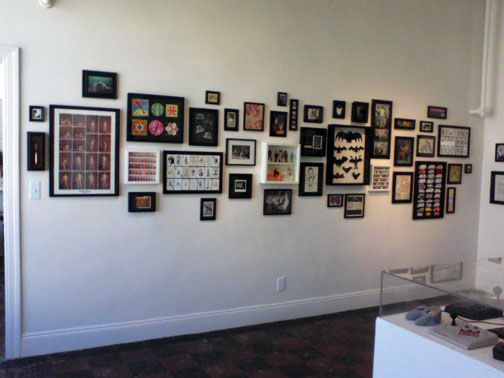
I experienced this delight, over and over, when I visited Junk Pirate, Pete Glover‘s solo show at The Compound Gallery. Glover works at a junk store (when he’s not co-directing Rowan Morrison Gallery with Narangkar Glover).

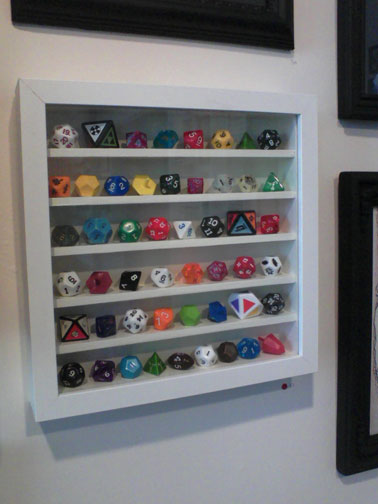
Over the years, he’s amassed an impressive collection of objects. He’s lovingly composed these objects into shadow boxes, picture frames and vitrines. The show is a collection of collections, filtered through an unabashed love of popular culture and humor. It’s like the garage sale of a fabulous window display artist.

Junk Pirate exhibition view, detail

The objects are nostalgic, curious, and insouciant. Some are truly visually arresting, particularly a composition of fluorescent orange water guns in a black shadow box. Art history buffs might enjoy a chuckle as they recall Claes Oldenburg’s Ray Gun Mfg. Co. in relation to this work.

Pete Glover's assemblage of orange water guns

A few works suggest glimmers of the transgressive or anti-social, such as a found photograph of a man with one eye, or a class photograph in which every kid’s portrait has an “x” drawn over it. But despite his participation in street/skate culture, Glover rarely indulges in cred-proving, candid “how effed is that” photos. His eye for the peculiar is more amusement-arcade than in-your-face.

In yesterday’s dialog, featured guest Glen Helfand suggested the idea of “added value.” That is, an artist might start with something cheap and through the investment of labor, creativity and display, the object gains value, both monetarily, visually, and perhaps psychologically. In contrast with the whimsy of oddities in Wunderkammers, Pete displays a fanboy’s attention to Complete Sets. This unabashed embrace of sentiment and nostalgic 80s amusements reveals itself in his devotion to tokens, cards, video game controllers and jokily branded popcorn bags. Kitsch, promotional collateral and residue of material life collide.

The show is largely about appropriation, popular memory, composition and display. Scented stickers, for example, are framed without glass to encourage interaction. The most successful works include vitrines of board game characters and “nipples” sorted by color. The results are graphic, striking, miniature and absorbing. These offer more to read, infer and return to.

What I love about Junk Pirate is that not all the cases are art. They are all clearly re-configurations of recognizable things. A few objects transcend their humble origins to become a dynamic hybrid of art/collections/decoration/keepsakes. In a brilliant stroke, Glover extended the gaming theme to the pricing of the works, so that a roll of a die determines the price to be paid. This reinforces the objects/collections non-art identities, and refers back to the chance in Glover’s procurement process of discovering and identifying treasures in mounds of detritus.

Junk Pirate is the Compound Gallery’s first show at its beautiful new location on 65th Street. The gallery is housed in a grand foyer complemented by lots of windows and two side bays: one holds a tiny gallery for drawings; the other houses Professor Squirrel Shop, an adorably appointed indie mart with properly twee décor and accessories for sale. Fittingly, Junk Pirate is sited perfectly between a commercial (albeit indie) venture, and an exhibit of fine art.

Standard